
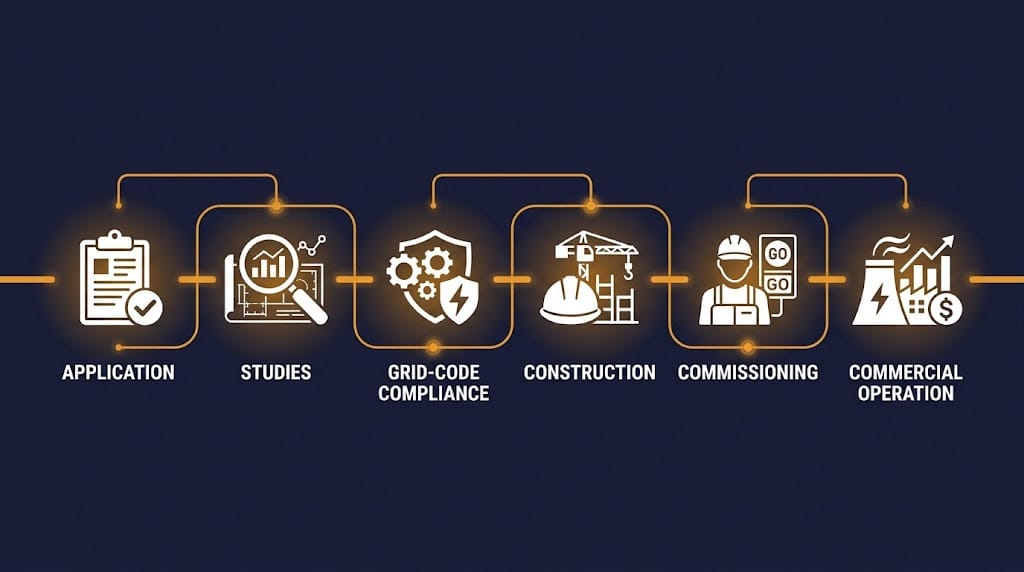
BESS Interconnection Process: From Application to Commercial Operation
The BESS interconnection process is the set of steps a battery storage project completes to connect to the grid and start commercial operation.
It covers the application, technical studies, grid-code compliance, construction, commissioning, and final approval.
Because of that, getting this process right shapes project cost, schedule, and revenue.
Quick Answer: The BESS interconnection process includes the application, technical studies, grid-code compliance, construction, commissioning tests, and final approval needed to connect a battery storage system to the grid. Distribution-connected projects often have a more standardized, potentially faster pathway than transmission-connected plants, particularly when no major feeder or transformer upgrades are needed. Requirements depend on project size, connection voltage, location, and the system operator involved.
Why Interconnection Matters for BESS Projects
The BESS interconnection process is often the most uncertain part of a BESS project.
So it carries three main risks: schedule, cost, and revenue.
- First, schedule risk: queue times and study delays can push back the commercial operation date.
- Second, cost risk: network upgrades and extended studies can raise CAPEX and OPEX.
- Third, revenue risk: delays can limit market participation and contract performance.
In the United States, interconnection queues have grown sharply. In fact, Berkeley Lab reports that projects completed in recent years have typically spent substantially longer in the interconnection process than projects completed in the early 2000s, reflecting larger queues, more complex studies, and network-upgrade constraints.
Even so, actual timing varies widely by region, project type, queue rules, and required upgrades.
For example, these delays feed directly into project economics. See our BESS CAPEX calculation, OPEX model, and LCOS guide for how interconnection cost and delay risk shows up in the numbers.
Compliance also affects revenue. See our BESS revenue streams and value-stacking guide for how grid-code compliance opens up market access.
Distribution vs Transmission Interconnection for BESS
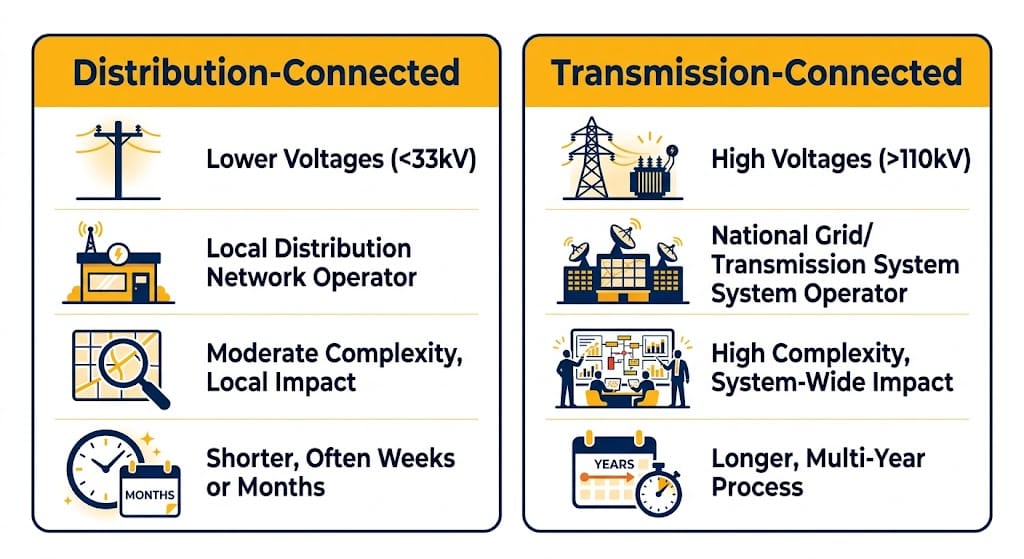
The first choice point in the BESS interconnection process is the connection voltage: distribution or transmission.
Distribution-Connected BESS
This path fits most C&I and smaller utility projects.
- Connects directly to medium- or low-voltage distribution networks.
- Managed by the local distribution utility or DSO/DNO as the interconnection authority.
- Features a standardized, streamlined pathway with screening for smaller systems.
- Grid-code requirements also cover ride-through, frequency response, reactive-power support, protection, and power quality.
Because rules vary by country, see our BESS grid codes and compliance guide for the specifics.
Transmission-Connected BESS
This path fits large utility-scale plants.
- Connects to high-voltage transmission networks.
- Also, the TSO, ISO/RTO, or transmission owner is the interconnection authority.
- The process also involves multiple study phases, detailed modeling, and often significant network upgrades.
- Grid-code requirements are stricter too, covering fault-ride-through, frequency response, fault-current, and modeling obligations.
As a result, transmission projects often face longer queues and closer coordination between the TSO, owner, and any off-takers.
The BESS Interconnection Process: Step by Step
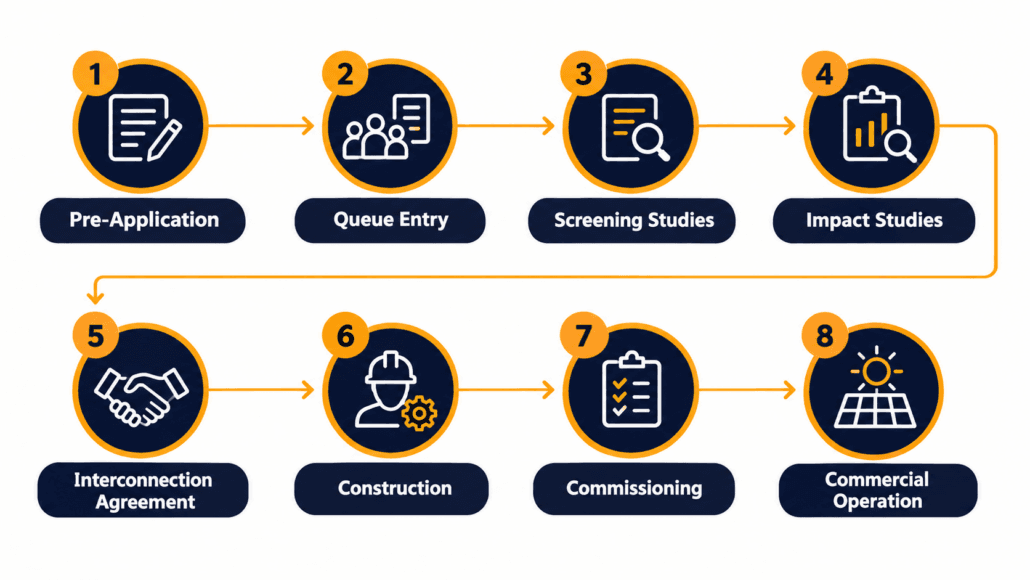
Most projects move through the same broad BESS interconnection process, even though the details vary by market.
Step 1: Pre-Application and Feasibility
Before filing, developers confirm the point of interconnection and connection voltage.
- First, confirm the applicable system operator, distributor, and interconnection rules.
- Next, prepare a preliminary single-line diagram, equipment list, and control architecture.
- Then, run feasibility studies to screen for thermal overloads, voltage issues, or protection conflicts.
Because of that, early engagement with the utility or TSO clarifies queue status and likely upgrade needs.
Point of interconnection (POI) vs. point of common coupling (PCC): the POI is where the project connects to the utility or transmission network. The PCC is the electrical point shared with other network users. Depending on project layout, the POI and PCC may be at the exact same location or separated by short network distances.
Step 2: Interconnection Request and Queue Entry
The formal BESS interconnection process usually starts with a written application.
- For example, project details include capacity, technology, expected in-service date, and point of interconnection.
- It also includes technical data: inverter models, ride-through behavior, protection settings, and control modes.
- Finally, it includes an application fee and a queue position.
The project then waits in a queue for studies to begin, and queue position can affect cost allocation.
Step 3: Screening and Scoping Studies
Distribution projects usually start with a screening study.
- First, it checks basic compliance with the distribution code.
- It also flags overloads, voltage violations, or protection conflicts.
- As a result, it can lead to fast-track approval for small, compliant systems.
Transmission projects instead run a scoping study or cluster screen.
- First, it defines which studies are required: impact, facilities, or system impact.
- Then, it sets the models and data the developer must supply.
- Finally, it flags preliminary upgrade candidates and cost responsibility.
Step 4: Impact and System Studies
This is the core technical phase of the BESS interconnection process, especially for transmission-connected BESS.
- Short-circuit and fault-level studies verify protection coordination and fault-current contributions.
- Also, voltage and thermal studies check steady-state and dynamic voltage profiles and equipment loading.
- In turn, protection coordination studies align BESS protection with utility or TSO schemes and ride-through rules.
- Stability and dynamic-performance studies also assess frequency response and interaction with other resources.
- Meanwhile, harmonic and power-quality studies confirm limits on harmonics, flicker, and DC injection.
- System-strength, control-interaction, or electromagnetic-transient studies, where required, check whether inverter controls stay stable in weak-grid conditions and interact properly with nearby inverter-based resources.
For a closer look at how each of these studies actually works — load flow, short-circuit, protection coordination, harmonics, and RMS/EMT modelling — see our BESS grid connection studies guide.
As a result, the output is a system impact report listing required upgrades, protection changes, and any operating constraints.
Step 5: Interconnection Agreement and Project Milestones
Once the required studies are complete, the developer and the relevant utility, transmission provider, system operator, or network operator negotiate and execute an interconnection agreement or equivalent connection agreement.
- First, it sets technical requirements: ride-through curves, frequency response, reactive-power capability, and protection settings.
- It also covers network upgrades: who designs, builds, and pays for each one.
- Then it sets milestones: financial security, construction start, substantial completion, and commercial operation date.
- Finally, it defines testing and compliance requirements: model validation, commissioning tests, and ongoing reporting.
In turn, signing the agreement usually triggers financial security postings and a firmer construction schedule.
Step 6: Construction and Equipment Installation
During this stage of the BESS interconnection process, the owner and EPC install the physical plant.
- This includes battery containers, PCS, transformers, switchgear, and protection systems.
- It also covers the control architecture: plant controller, SCADA, communications, and telemetry.
- Throughout, the team coordinates with the utility or TSO on any network upgrades or substation work.
As a result, good documentation and early coordination reduce delays at commissioning.
Step 7: Commissioning and Compliance Testing
Before moving to commercial operation in the BESS interconnection process, the plant must prove compliance with the interconnection agreement.
- For example, ride-through and frequency-response verification covers LVRT/HVRT, frequency ride-through, and control behavior, demonstrated through the method the operator requires — site measurements, controller records, model validation, staged tests, or another approved procedure.
- It also runs frequency-response tests: droop, deadband, and response time.
- Then come reactive-power and voltage-control tests: fixed Q/V, droop, and power-factor capability.
- Protection tests follow too: over/under voltage and frequency, overcurrent, earth fault, and anti-islanding.
- So do power-quality tests: harmonics, flicker, unbalance, and DC injection.
- Finally, model validation compares simulated and measured responses.
Together, successful commissioning tests, completed documentation, and required inspections fulfill the technical criteria. Once network-upgrade and telemetry obligations are confirmed, the system operator can grant final permission to operate or authorize commercial operation.
Step 8: Commercial Operation and Ongoing Compliance
Once the BESS interconnection process is complete, the project officially enters commercial operation.
- First, it maintains compliance with grid-code settings and protection.
- It also provides telemetry, performance data, and availability reports to the system or market operator.
- In addition, it participates in required markets or programs: capacity, ancillary services, or flexibility.
- Finally, it manages changes: equipment or control updates may trigger re-approval or new studies.
Otherwise, non-compliance can bring penalties, export limits, or mandatory corrective action.
How Grid Codes Shape the BESS Interconnection Process
Grid codes are not a side checkbox. Instead, they drive most of the BESS interconnection process.
- First, study inputs: ride-through curves, frequency-response parameters, and reactive-power capability feed the impact and stability studies. See our BESS grid codes and compliance guide.
- Also, equipment selection: inverter and PCS capability must match the applicable code. See our BESS PCS functions and features guide and Understanding BESS specifications guide.
- In turn, testing scope: commissioning tests verify ride-through, frequency response, reactive power, protection, and power quality directly. See our LVRT and HVRT guide and Fast Frequency Response (FFR) guide.
- Finally, market participation: many capacity and ancillary-service products require proof of specific grid-code performance. See our BESS revenue streams and value-stacking guide.
Together, a well-coordinated strategy lines up grid-code compliance, equipment selection, and market plans from day one.
Typical Timelines and Cost Drivers in the BESS Interconnection Process
However, timelines and costs vary widely by market, project size, and network conditions.
Distribution-Connected BESS Timeline
Smaller systems often connect within months, assuming no major upgrades.
- For example, cost drivers include application and study fees, minor protection or transformer upgrades, and local voltage support.
- Risk factors also include feeder constraints, high DER penetration, and conservative utility practices.
Transmission-Connected BESS Interconnection Process Timeline
Large plants often take years from application to commercial operation, especially in congested queues.
- Cost drivers include network upgrades, extended studies, financial security, and prolonged commissioning.
- Risk factors also include queue position, cluster effects, and evolving grid-code or market requirements.
For how these factors affect project economics, see our BESS CAPEX calculation and OPEX model.
Practical Tips to De-Risk the BESS Interconnection Process
A consistent approach to the BESS interconnection process helps teams developing multiple projects.
- First, engage early: talk to the utility or TSO before filing to learn queue status and likely constraints.
- Second, design for compliance: pick inverters and PCS with proven ride-through, frequency-response, and protection capability.
- Third, invest in good models: accurate plant models cut study iterations and commissioning surprises.
- Fourth, plan for testing: budget time and cost for ride-through, frequency, reactive-power, protection, and power-quality tests.
- Finally, document changes: track any equipment or control change during construction and re-approve where required.
Together, our BESS grid codes and compliance guide and Understanding BESS specifications guide can help translate these requirements into concrete equipment and control specifications.
Frequently Asked Questions
These common questions cover the BESS interconnection process in more detail.
What Is the BESS Interconnection Process?
In short, the BESS interconnection process is the set of steps a battery storage project completes to connect to the grid and start commercial operation.
It includes the application, technical studies, grid-code compliance, construction, commissioning tests, and final approval.
Also, distribution-connected projects often have a more standardized, potentially faster pathway than transmission-connected plants, particularly when no major feeder or transformer upgrades are needed.
How Long Does the BESS Interconnection Process Take?
Timing depends on project size, connection voltage, location, queue rules, study complexity, and required network upgrades.
For example, smaller distribution-connected BESS projects may complete interconnection in months when the local network has capacity and no major upgrades are needed.
Transmission-connected projects can take years because of queue backlogs, cluster studies, network upgrades, financial-security milestones, detailed modeling, and commissioning requirements.
What Studies Are Required for BESS Interconnection?
Common studies include short-circuit and fault-level, voltage and thermal, protection coordination, stability and dynamic-performance, and harmonic and power-quality studies.
In general, transmission projects typically need more extensive studies and detailed modeling than distribution projects.
Do C&I Projects Follow the Same BESS Interconnection Process as Utility-Scale?
The basic steps are similar, but the detail differs.
For example, C&I and distribution-connected projects usually follow a standardized process with screening and simplified studies.
By contrast, utility-scale and transmission-connected BESS face more complex studies, stricter grid codes, and longer timelines.
What Happens if a BESS Fails Interconnection Tests?
If a BESS fails commissioning or grid-code tests, the network operator may delay permission to operate, require hardware, firmware, protection, or control changes, or restrict export capacity.
The developer may also need to repeat studies or validation tests if the final installed equipment differs from the approved models.
So, permission to operate is normally granted only after corrective actions, documentation, and required verification are complete.
Further Reading
These related guides cover topics referenced throughout this BESS interconnection process overview.
- BESS Grid Codes and Compliance: Global Requirements by Country
- LVRT and HVRT: Voltage Ride-Through for BESS and Solar
- Fault Ride-Through Features in PCS Hardware & Control
- Fast Frequency Response (FFR)
- BESS PCS Functions and Features
- Understanding BESS Specifications
- BESS CAPEX Calculation
- BESS OPEX and Operating Cost Model
- Cost of Storing Energy: BESS LCOS Calculator Guide
- BESS Revenue Streams and Value Stacking
- ESS Codes and Standards for USA Utility-Scale BESS
- U.S. Department of Energy – Interconnection Innovation e-Xchange (i2X)




Trackbacks & Pingbacks
[…] Learn the full BESS interconnection process (BESS Interconnection Process: From Application to Commercial Operation) […]
[…] For the general, country-agnostic version of this workflow, see our BESS interconnection process guide. […]
[…] short-circuit, protection, harmonic, RMS dynamic, and potentially EMT studies. Our guide to the BESS interconnection process covers where this study stage sits inside the wider application-to-commissioning […]
[…] For the cost side of compliance, see our BESS CAPEX calculation and BESS OPEX model guides. Our BESS revenue streams and value-stacking guide covers how compliant performance turns into income. For the project workflow that turns these technical requirements into an approved grid connection—from application and studies through commissioning and commercial operation—see our BESS interconnection process guide. […]
Leave a Reply
Want to join the discussion?Feel free to contribute!