
Cell Matching Before Pack Assembly: Why It Matters Before the BMS Ever Balances a Cell
| ⚡ Quick Answer: What Is Cell Matching? Cell matching is the process of sorting battery cells by voltage, capacity, and internal resistance before they go into a pack, so cells with similar characteristics end up grouped together. It happens on the factory floor, before assembly. This is not the same thing as BMS balancing, which corrects drift after the pack is already built and in use. Skipping cell matching does not make a pack unsafe by itself, since the BMS still protects it. However, it does mean the BMS has to work much harder from day one. As a result, the pack’s real-world capacity and cycle life will likely fall short of what the cell datasheet promises. |
1. Why Cell Matching Happens Before the BMS Gets Involved
Cell matching is a manufacturing step that happens before a single cell ever reaches a pack. Even cells from the same production batch are not identical. Small differences in electrode coating thickness, electrolyte fill, and formation cycling leave every cell slightly different. Capacity, voltage, and internal resistance all vary a little, even when the datasheet lists one number for all of them. In a single cell, this variation does not matter. Once dozens or hundreds of cells connect into a pack, though, it matters a great deal.
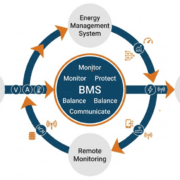
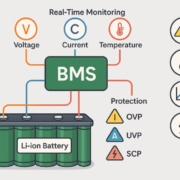
The BMS will eventually correct some of this drift through balancing, as covered in our complete battery management system guide. Cell matching, however, happens earlier. It is a manufacturing step, not a BMS function, and it exists to reduce how much correction the BMS has to do later.
2. Three Criteria Used to Sort Cells: Voltage, Capacity, and Resistance
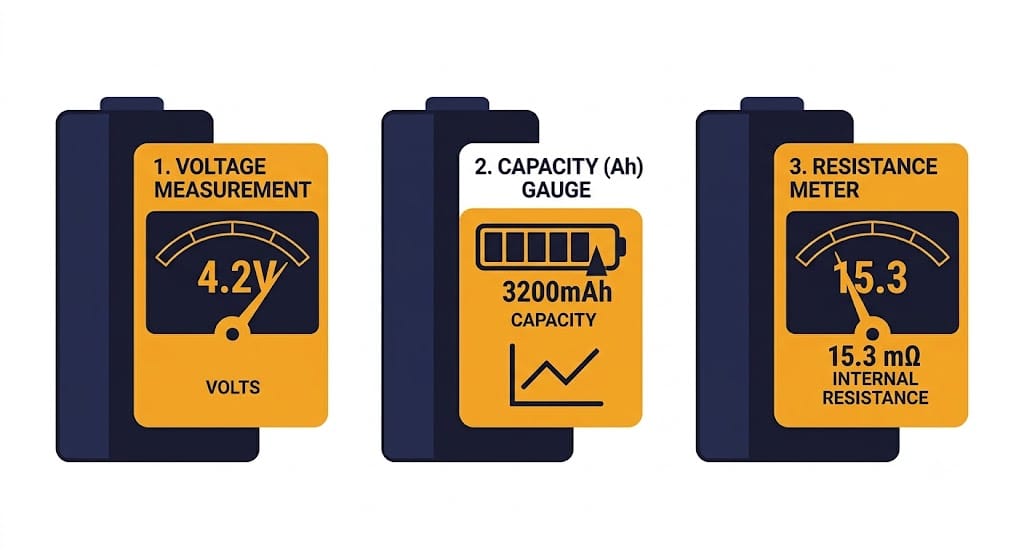
Cell matching typically screens for three characteristics. Each one affects the pack differently. As a result, a thorough process checks all three rather than relying on just one.
- Voltage (or SOC) matching — technicians group cells by their resting voltage after a defined charge or discharge point. This is the simplest check to run. It also catches the most obvious mismatches quickly.
- Capacity matching — technicians charge and discharge test each cell to measure actual usable Ah, then group cells with similar capacity together. This matters most for series strings, since the lowest-capacity cell sets the ceiling for the whole string.
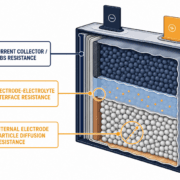
- Internal resistance matching — technicians measure resistance using one of two methods, DCIR or ACIR, then group similar-resistance cells into the same parallel group. This matters most for parallel groups, since a lower-resistance cell otherwise takes more than its fair share of current.
High-volume manufacturers often combine all three, and internal resistance testing itself splits into two distinct methods worth understanding.
DCIR vs ACIR: Two Ways to Measure Internal Resistance
DCIR (DC internal resistance) testing applies a current pulse to the cell and measures the resulting voltage drop. Technicians then calculate resistance directly from Ohm’s law. This method closely reflects how the cell behaves under a real load, since it uses an actual current step rather than a small signal. The tradeoff is speed: each pulse needs time to apply and settle, which slows down high-volume sorting.
ACIR (AC internal resistance) testing instead applies a small alternating current signal, commonly at 1 kHz, and reads the resulting impedance directly. This method runs much faster than DCIR, which is why many production sorting lines use it as a first-pass screen. However, ACIR mostly captures the cell’s high-frequency ohmic resistance. It does not fully capture the slower electrochemical charge-transfer resistance that DCIR testing reveals.
In practice, many manufacturers use ACIR for fast first-pass screening across an entire incoming batch, then apply DCIR pulse testing to verify cells before they go into the same series string or parallel group. A supplier who only mentions one of these two methods is likely doing the faster, less thorough version alone.
3. Series Strings vs Parallel Groups: Different Priorities
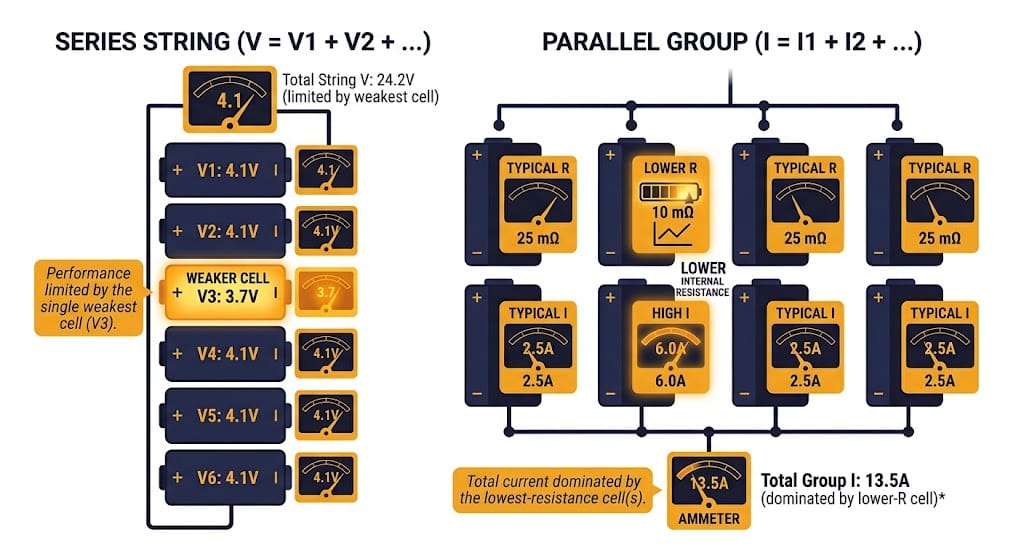
Series and parallel connections fail differently when cells are mismatched. For this reason, they need different matching priorities.
In a series string, cells share the same current, but their voltages differ based on individual state. The weakest cell — the one with the lowest capacity — reaches its low-voltage cutoff first during discharge. Likewise, it hits its high-voltage cutoff first during charge. As a result, that one weak cell limits the usable capacity of the entire string. This happens even though the other cells still have energy left. This is why capacity matching matters most for series strings.
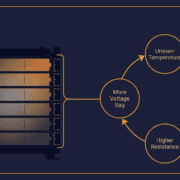
In a parallel group, cells share the same voltage, but current splits between them based on internal resistance. A cell with lower resistance pulls more current than its neighbors. In turn, it works harder and ages faster. Over time, that uneven current sharing can widen the resistance gap further, creating a feedback loop. Left unchecked, this loop drives localized accelerated aging in the same cells, cycle after cycle. That localized wear is what leads to premature pack failure, well before the rest of the pack reaches end of life. For a buyer, that translates directly into a shorter calendar life and a worse return than the datasheet cycle life implied. This is why resistance matching matters most for parallel groups.
| ☀️ Resistance matching matters most for parallel groups. 💡 The Thermal Feedback Loop: Internal resistance mismatch and localized heating reinforce one another. For a deeper look at how temperature imbalances accelerate this degradation, read our guide on Cell Temperature Gradients in BESS |
4. What Happens If You Skip Cell Matching
Skipping cell matching does not make a pack dangerous on its own. A properly designed BMS still enforces voltage and temperature limits, regardless of how well matched the cells are. What changes, instead, is how hard the BMS has to work, and how much capacity the pack actually delivers.
If cells arrive at noticeably different SOC and go into a pack without matching, the BMS must run a large initial balancing pass. This happens the first time the pack charges. Passive balancing currents are typically small — often just tens to a few hundred milliamps — compared to the pack’s full Ah rating. Correcting a large initial mismatch this way can take many hours. In some cases, it takes several charge cycles before the pack reaches a properly balanced state.
Beyond the slow start, an unmatched pack often never fully closes the gap. If capacity variation between cells is large enough, ongoing balancing keeps the weakest cell from falling further behind. Still, balancing cannot manufacture capacity that a weak cell simply does not have. The pack’s usable capacity, therefore, ends up set by its weakest link, cycle after cycle.
5. Top-Balance vs Bottom-Balance: Which Comes First
When manufacturers match cells by connecting them in parallel before final assembly, the SOC point at which this happens changes the outcome.
Bottom-balance matching connects cells in parallel at a low SOC, often close to how they arrive from the manufacturer. This approach is simple and fast. However, it only aligns the cells at the bottom of the charge curve. The pack will likely still need a top-of-charge balancing pass once assembled and charged for the first time.
Top-balance matching, instead, charges the parallel-connected cells to a high SOC before final assembly, typically near the top of the charge curve. This produces a better-aligned pack from the first charge. That is because the region where mismatch matters most for safety and full capacity gets addressed early. The tradeoff is time: bringing a large batch of cells to a matched high-SOC state takes more equipment and more hours before assembly can begin.
6. Cell Matching at Scale: How Manufacturers Grade Cells for Utility BESS
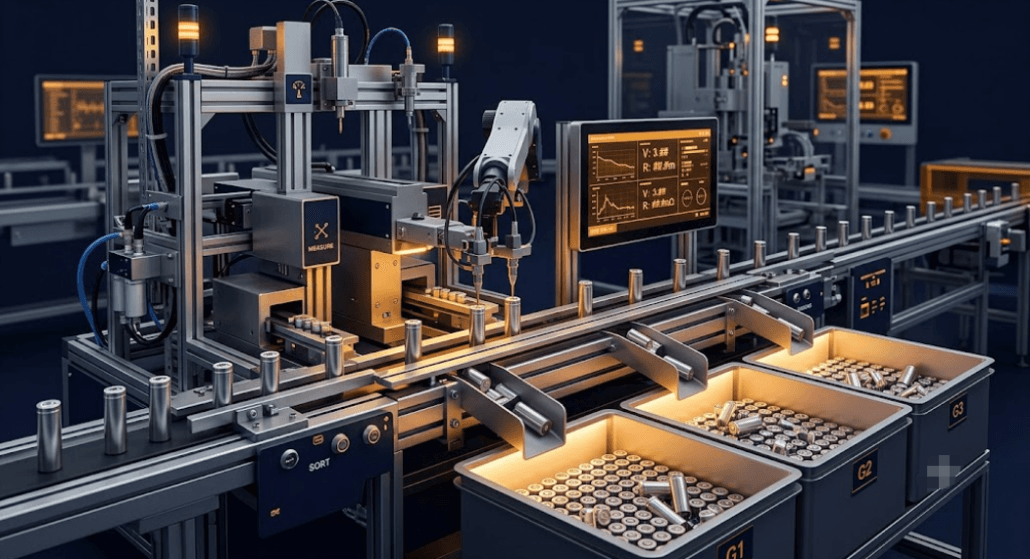
At utility scale, matching thousands of cells by hand is not practical. Instead, high-volume manufacturers run automated sorting lines. These measure voltage, capacity, and resistance for every incoming cell. Grading software then groups cells into matched sets before they ever reach the assembly line.
For a BESS buyer, this raises a practical question worth asking directly: does the supplier grade and match cells before assembly, or does the pack rely entirely on the BMS to fix mismatch after the fact? Independent testing resources such as Battery University document just how differently DCIR and ACIR readings can diverge on the same cell, which is exactly why asking a supplier which method they use, and at which stage, is worth doing directly.
A supplier who can show incoming cell test data is doing meaningfully more quality control than one who simply points to their BMS’s balancing feature. Look, in particular, for a specific matching tolerance — for example, a defined percentage spread in capacity, or a defined milliohm band in resistance.
7. Questions to Ask Your Cell or Pack Supplier
- Do you test and match cells by voltage, capacity, and internal resistance before assembly, or only one of these?
- For internal resistance, do you use DCIR, ACIR, or both — and at which stage does each method apply?
- What matching tolerance do you use? For example, what percentage spread in capacity, or what milliohm band in resistance?
- Do you keep incoming cell test data on file? Can you provide it for the specific batch used in our order?
For series strings, how do you decide which cells go together — capacity, resistance, or both? Our BMS algorithms guide covers how the BMS itself later measures DCIR for SOH estimation, which is a useful comparison point when you ask this question.
- Is matching done at a low SOC, a high SOC, or both, before final assembly?
Conclusion: Matching Sets the Ceiling the BMS Can’t Raise
A BMS is very good at correcting small, ongoing drift between cells. It is not designed, however, to compensate for a pack that started out badly mismatched. Cell matching before pack assembly sets the baseline the BMS then has to maintain for the life of the system. A well-matched pack lets the BMS do its normal job: fine-tuning small differences over time. A poorly matched pack, by contrast, forces the BMS into a losing battle against a gap it cannot close, cycle after cycle.
When evaluating a cell or pack supplier, ask specifically how they match cells before assembly, including whether they use DCIR, ACIR, or both. Do not just ask how the BMS balances them afterward. For supplier evaluation more broadly, see our BESS supplier BMS evaluation guide. The cell matching answer says a lot about how much real capacity and cycle life you can expect to see in practice.
| ☀️ Need Help Evaluating a Cell Matching Process? Sunlith Energy reviews incoming cell test data, matching tolerances, and pack assembly quality control for BESS projects from 50 kWh upward. Contact us before you finalize a cell or pack supplier. |
Frequently Asked Questions About Cell Matching
Is cell matching the same as BMS balancing?
No. Cell matching happens before assembly. It is a manufacturing step that sorts cells by voltage, capacity, and internal resistance, so similar cells end up grouped together. BMS balancing, on the other hand, happens after assembly, correcting the small drift that develops during normal use. Matching reduces how much balancing the BMS has to do; it does not replace it.
What is the difference between DCIR and ACIR matching?
DCIR testing applies a current pulse and calculates resistance from the voltage drop using Ohm’s law, closely reflecting real load behavior. ACIR testing applies a small AC signal, commonly at 1 kHz, and reads impedance directly, which runs much faster but mostly captures high-frequency ohmic resistance rather than the full picture. Many manufacturers use ACIR for fast first-pass screening, then confirm with DCIR before final grouping.
What is the difference between capacity-based and resistance-based sorting?
Capacity-based sorting groups cells with similar usable Ah, and matters most for series strings, since the lowest-capacity cell sets the ceiling for the whole string. Resistance-based sorting, by contrast, groups cells with similar internal resistance, and matters most for parallel groups, since a lower-resistance cell will otherwise pull more than its fair share of current.
Does skipping this step make a battery pack unsafe?
Not directly. A properly designed BMS still enforces voltage and temperature limits, no matter how well the cells were matched. That said, skipping this step does mean the BMS must run a larger initial balancing pass. In turn, the pack’s real-world capacity may fall short of the datasheet value, since the weakest cell limits the whole pack.
Should I ask my BESS supplier for this test data?
Yes. Ask whether the supplier tests and matches cells by voltage, capacity, and internal resistance before assembly, and which resistance method they use. A supplier who can provide incoming cell test data for your specific batch is demonstrating a real quality control process, not just relying on the BMS to compensate after the fact.
Is top-balance or bottom-balance better?
Top-balance, which aligns cells at a high SOC before assembly, generally produces a better-aligned pack from the first charge. That is because it addresses the top-of-charge region where mismatch matters most. Bottom-balance is faster, but the pack will likely still need a top-of-charge balancing pass once assembled.





Trackbacks & Pingbacks
[…] cell matching solves the starting-point problem. Our cell matching before pack assembly guide covers that stage in depth. It groups cells by voltage, capacity, and resistance before assembly. […]
[…] a full breakdown of this step, read our complete cell matching before pack assembly guide. It covers how internal resistance affects series versus parallel groups. In short, this is the […]
[…] [!NOTE] For the manufacturing step that happens before balancing even starts, see our cell matching guide. […]
Leave a Reply
Want to join the discussion?Feel free to contribute!