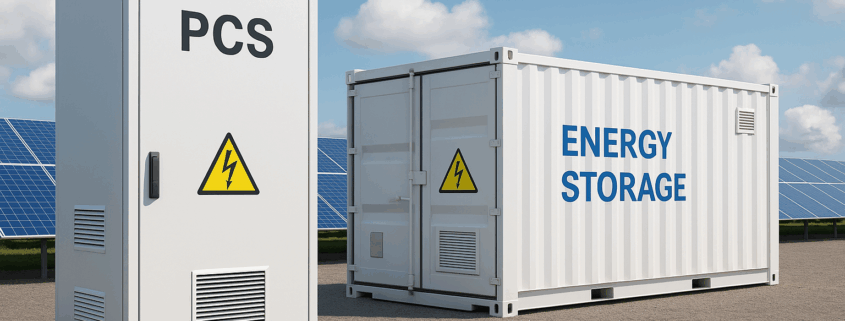
Ever wondered what Energy Storage PCS actually does? In this post, we’ll break down how it works and where it’s used in real-world energy storage systems.
What is PCS in Energy Storage?
PCS stands for Power Conversion System. It is an essential device in energy storage systems that converts electricity between alternating current (AC) and direct current (DC). It allows batteries to store energy from the grid or renewable sources and then release it back as usable AC power when needed.
In short, PCS is the bridge between your batteries and the electrical grid—managing energy flow, ensuring safety, and improving overall efficiency.
What is Energy Storage PCS and Why It Matters?
Energy storage PCS (Power Conversion System) is the heart of any Battery Energy Storage System (BESS). It is responsible for managing the conversion between AC and DC power, enabling batteries to store energy and deliver it back to the grid when needed. Without a PCS, your energy storage solution is like a car without an engine.
The PCS helps to regulate the flow of electricity, balance energy loads, and ensure maximum efficiency and safety of your battery system. Whether for solar, wind, or hybrid power systems,energy storage PCS plays a vital role in stabilizing renewable energy.
How Energy Storage PCS Works
The PCS acts as a two-way converter. When the energy is generated by solar panels or wind turbines (AC power), the PCS converts it into DC to charge the batteries. When the energy is needed (like during peak hours), it converts the stored DC power back into AC to feed into the grid or power your home or facility.
In simpler terms:
AC to DC conversion for charging the battery.
DC to AC conversion for discharging to the grid or loads.
It also works with smart controllers and EMS (Energy Management Systems) to provide grid-support functions, frequency regulation, peak shaving, and energy arbitrage.
Voltage & Frequency Control: Ensures clean, stable, and reliable electricity output.
Safety & Protection: Prevents overcurrent, overvoltage, and system failures.
Efficiency Optimization: Boosts round-trip efficiency and reduces energy losses.
Smart Control: Works with EMS and BMS to manage operations in real time.
Without a reliable PCS, your BESS will struggle to perform efficiently or safely.
Common Applications of Energy Storage PCS
PCS isn’t just for big power plants. You can find them in:
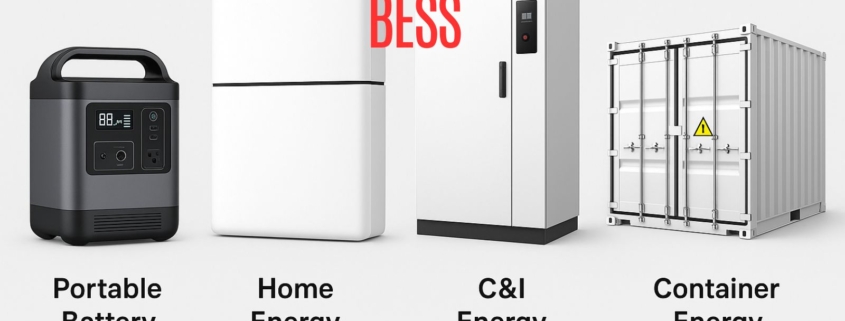
Home and C&I energy storage systems
Solar plus storage solutions
Microgrids and off-grid systems
EV charging stations
Grid stabilization and frequency regulation projects
Peak shaving and demand charge reduction
Whether you’re a homeowner trying to store solar energy or a utility trying to manage grid fluctuations, energy storage PCS is the backbone of your system.
Choosing the Right PCS for Your BESS
Here are a few questions to ask before choosing a PCS:
Q: What voltage and power level does my application need?
A: Match the PCS to your battery bank’s voltage and your energy load.
Q: Is it compatible with my battery chemistry (LFP, NMC, etc.)?
A: Yes. Always confirm with your supplier or integrator.
Q: Does it offer bidirectional operation?
A: For advanced systems, bidirectional PCS is a must.
Q: What kind of grid functions does it support?
A: Look for reactive power control, frequency response, black start, and islanding support.
Q: How efficient is the PCS?
A: A good PCS will offer 96%–98% round-trip efficiency.
Top Features to Look for in Energy Storage PCS
If you’re sourcing or integrating a PCS, here are some must-have features:
Modular design for easy expansion
IP54 or higher protection level for outdoor installations
Liquid or forced air cooling for heat management
LCD/Touchscreen display for monitoring
Remote control and IoT connectivity
CE, UL, IEC, and grid code certifications
Future Trends in Energy Storage PCS
The role of energy storage PCS is evolving with technology. Some exciting trends include:
AI-powered PCS: Real-time learning and optimization
Hybrid PCS: Can integrate solar inverter and battery PCS in one
PCS + EMS integration: Full-stack energy management solutions
These innovations make energy storage more accessible, efficient, and intelligent.
Conclusion: Energy Storage PCS Is the Unsung Hero of Clean Energy
In today’s energy transition journey, energy storage PCS is more important than ever. It acts as a bridge between renewable power and the grid, ensuring smooth, efficient, and safe operations. Whether you are building a small home system or a 100MW utility project, choosing the right PCS will make or break your success.
So, next time you think about a battery storage system, remember—your energy is only as smart as your PCS.
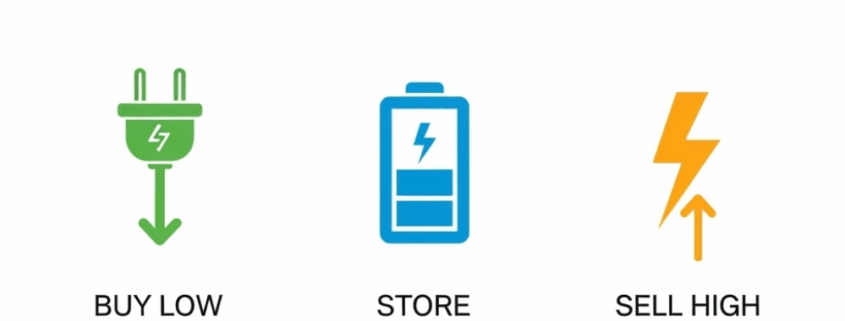
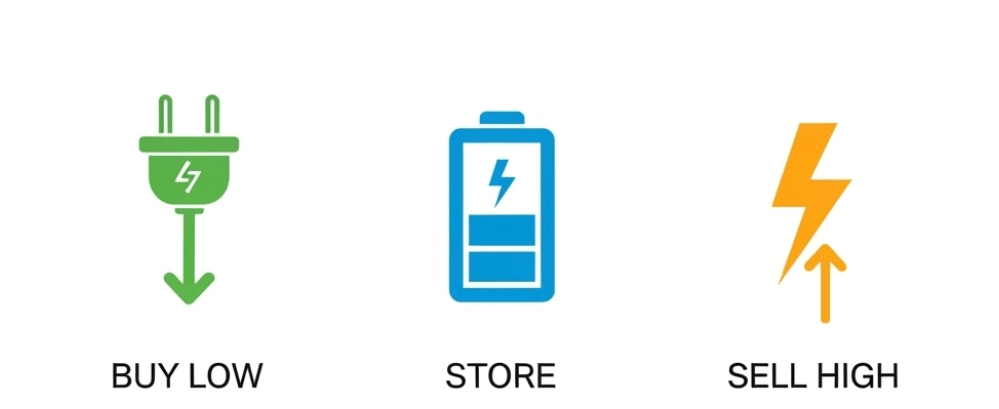
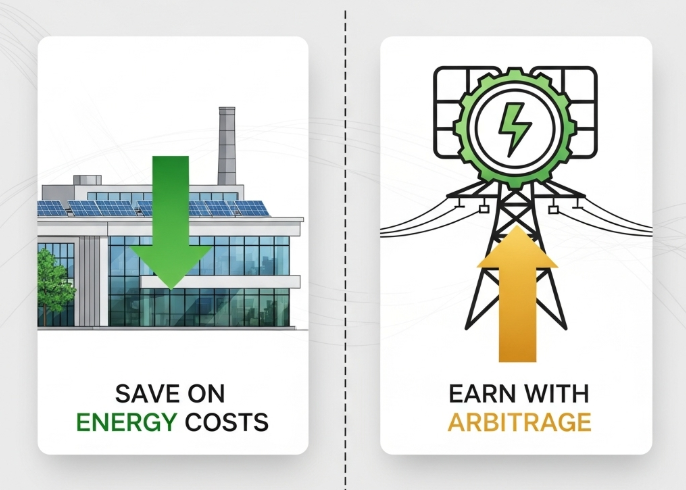
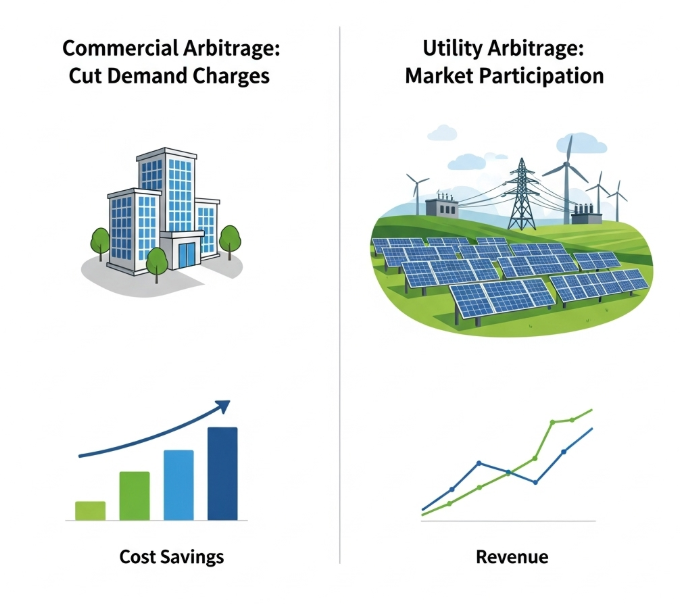
Energy arbitrage is one of the most powerful applications of Battery Energy Storage Systems (BESS). At its core, it means buying electricity when prices are low and selling it when prices are high. For grid operators, businesses, and renewable energy developers, energy arbitrage provides both financial returns and grid stability.
At Sunlith Energy, we specialize in advanced BESS solutions that make energy arbitrage practical, profitable, and sustainable.
In this guide, we will explain everything in a simple and easy-to-understand way.
🔍 What Are TOPCon Solar Cells?
TOPCon stands for Tunnel Oxide Passivated Contact. It is a new type of solar cell that increases power generation by reducing energy loss.
These solar cells use a special design that helps move electricity more smoothly. This means you get more energy from the same amount of sunlight.
Unlike older types of cells, TOPCon solar cells use n-type silicon, which does not degrade as fast and works better in all weather conditions.
🧱 How TOPCon Solar Cells Are Built
Here’s how the structure of a TOPCon solar cell looks:
Layer
Function
N-type Silicon Wafer
Main base of the cell, long-lasting
Tunnel Oxide Layer
Ultra-thin layer to stop energy loss
Polycrystalline Silicon Layer
Helps carry electricity smoothly
Anti-Reflective Coating
Catches more sunlight
Metal Contacts
Transfers electricity to the system
Thanks to this advanced structure, TOPCon solar cells can deliver better results than regular monocrystalline or PERC cells.
⚙️ How Do TOPCon Solar Cells Work?
Solar cells work by changing sunlight into electricity. But some of that energy gets lost along the way.
TOPCon cells solve this problem by using a very thin oxide layer and a special contact layer. This combo helps electrons move faster without getting lost.
Here’s a simple explanation:
Sunlight hits the cell.
Electrons are created.
These electrons move through the tunnel oxide.
The special contact layer helps collect them.
Electricity is sent to your home or battery.
Because there’s less waste, TOPCon solar cells are more efficient.
📈 Efficiency of TOPCon Solar Cells
One of the biggest reasons people are excited about TOPCon technology is its high efficiency.
TOPCon panels can reach 22% to 23.5% efficiency.
Standard panels like polycrystalline reach only 15%–17%.
Monocrystalline and PERC usually reach 18%–21%.
That means with TOPCon, you get more power using the same space.
🔄 TOPCon vs PERC vs Other Solar Cells
Let’s look at how TOPCon solar cells compare to other common technologies:
Feature
Polycrystalline
Monocrystalline
PERC
TOPCon
Silicon Type
P-type
P-type
P-type
N-type
Efficiency Range
15%–17%
18%–20%
20%–21.5%
22%–23.5%
Degradation Rate
Higher
Medium
Medium
Very Low
Low-Light Performance
Poor
Average
Good
Excellent
Cost
Low
Medium
Medium
Slightly High
Lifespan
20–25 years
25–30 years
25–30 years
30+ years
As you can see, TOPCon solar cells are one of the best in almost every category.
✅ Key Benefits of TOPCon Solar Cells
Here are the top reasons why more people are choosing TOPCon technology:
1. Higher Energy Output
TOPCon cells are more efficient. You get more power per panel.
2. Better in Cloudy or Low-Light Conditions
Because of the n-type silicon and advanced design, TOPCon works even when sunlight is not strong.
3. Longer Life and Better Stability
These panels degrade very slowly. That means they keep performing well for more years.
4. Lower Temperature Loss
In hot weather, normal panels lose efficiency. TOPCon handles heat better, so you don’t lose as much energy.
5. Bifacial Ready
Many TOPCon panels are bifacial, which means they generate electricity from both the front and the back side. That adds even more power!
❌ Are There Any Drawbacks?
Even though TOPCon is amazing, it’s not perfect.
Here are some minor drawbacks:
Slightly Higher Price – Because of the advanced structure, TOPCon costs more than regular panels.
Newer Technology – Not all installers are familiar with it yet.
More Precise Manufacturing Needed – It takes better equipment and control to make these cells.
Still, for the performance you get, many believe it’s worth the extra investment.
🌍 Where Can TOPCon Be Used?
TOPCon solar cells are perfect for:
Rooftop solar systems (homes and businesses)
Solar farms and utility-scale projects
Projects where space is limited but high output is needed
Areas with high temperatures or frequent cloudy weather
If you’re planning a long-term project and want high return, TOPCon is a great choice.
🏭 Who Makes TOPCon Panels?
Several major companies have already launched TOPCon-based solar panels:
These manufacturers are expanding their production lines, and prices are slowly becoming more affordable.
🧠 Frequently Asked Questions
🔹 Is TOPCon better than PERC?
Yes, in most ways. It offers more efficiency, better performance in heat and shade, and longer life.
🔹 Does TOPCon cost more?
A little, yes. But the extra power and longer lifespan can make up for that cost over time.
🔹 Is TOPCon good for home solar?
Absolutely! Especially if your roof space is limited and you want to get the most energy per panel.
🚀 Final Thoughts: Is TOPCon the Right Choice for You?
If you care about performance, future value, and reliability, then TOPCon solar cells are a smart pick.
They give you:
More energy
Less loss
Longer life
Better value over time
Yes, the initial price is slightly higher—but the long-term gain is much greater.
TOPCon is not just a technical upgrade—it’s a smarter solar decision.
🔧 Need Help Choosing the Right Solar Panels?
As a sourcing and procurement consultant in the new energy field, I help clients select the best-fit solar technology for their project’s location, budget, and performance needs.
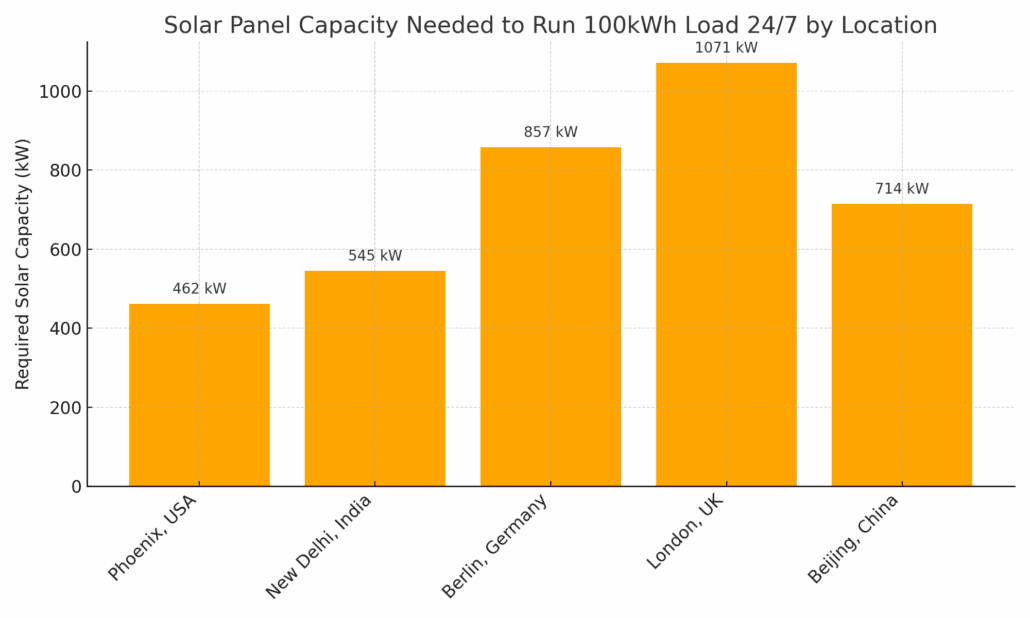
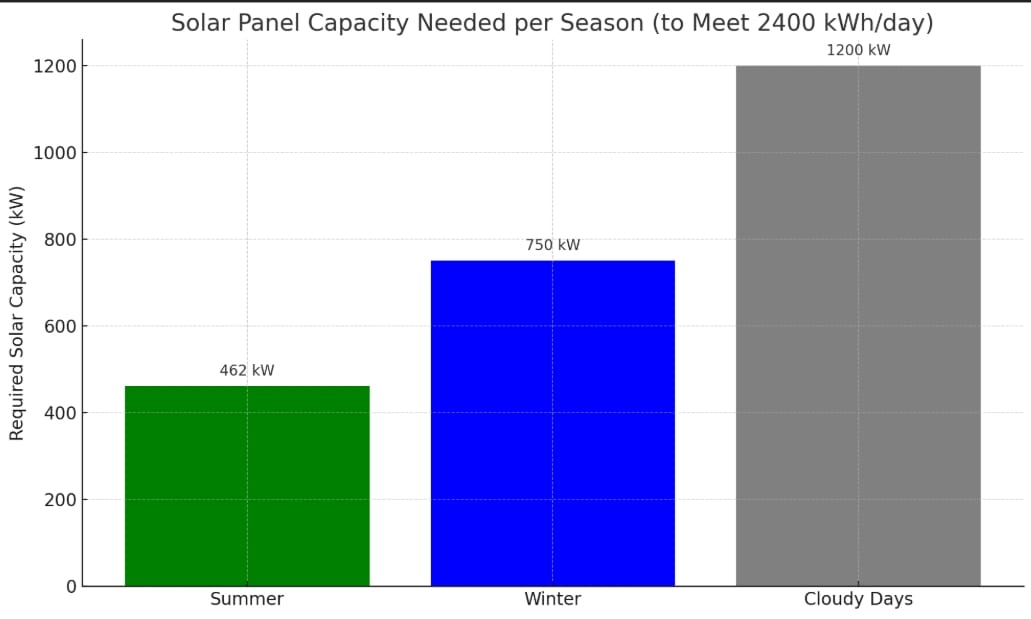
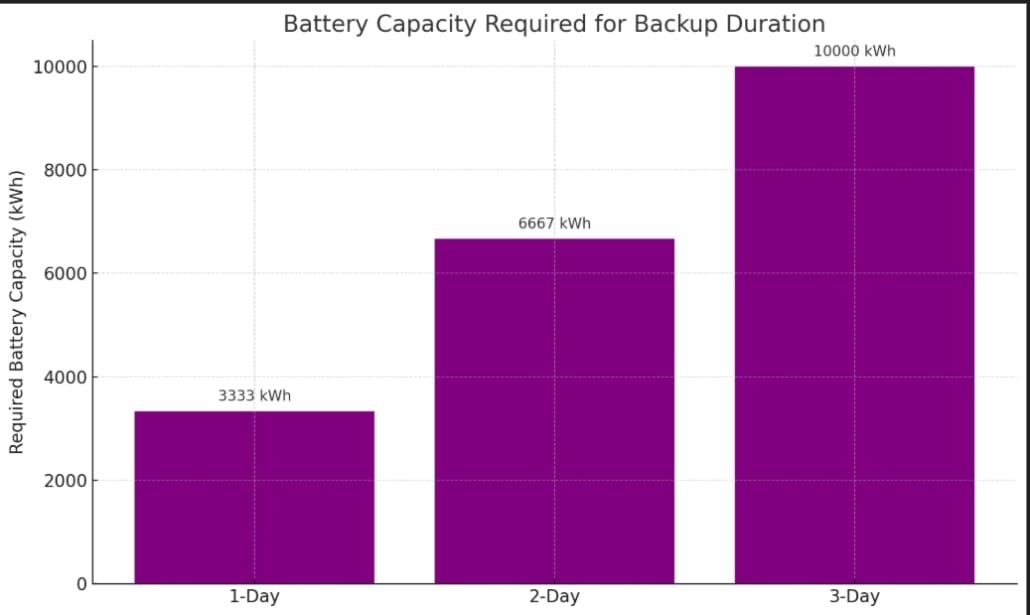
If you’re planning to power a 100kWh load continuously (24/7) using solar panels and a battery energy storage system (BESS), it’s not as simple as just multiplying watts. You need to factor in weather conditions, seasonal sunlight availability, cloudy days, and energy efficiency. This blog will guide you step-by-step on how to size your system properly using formulas, examples, and visual data.
📌 What You’ll Learn:
How to calculate required solar panel capacity
Why yearly weather data is critical
How to handle cloudy days and winter months
Battery sizing for different backup durations
Example formulas and real-world values
🔧 Step 1: Understand Your Load
Let’s say your system must support a 100 kWh per hour load.
24 hours/day × 100 kWh = 2,400 kWh per day
That’s your daily energy demand from solar + battery.
🌍 Step 2: Analyze Your Location’s Solar Irradiance
Your geographic location heavily influences how much sunlight you receive—measured in Peak Sun Hours (PSH).
Location
Peak Sun Hours
Phoenix, USA
6.5 PSH
New Delhi, India
5.5 PSH
London, UK
2.8 PSH
👉 You can get this data from tools like PVWatts, NASA SSE, or Solcast.
Designing a solar + battery system for a 100kWh 24/7 load isn’t just about matching numbers—it’s about planning for the worst day of the year, not the best. Location-specific solar data, battery autonomy, system losses, and seasonal variations must all be part of your sizing strategy.
Why Sodium-Ion Battery Safety Matters for Businesses
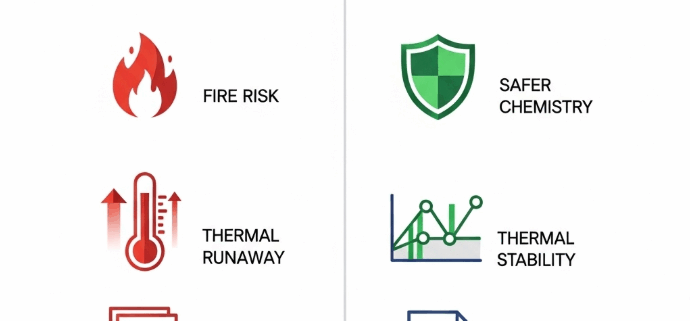
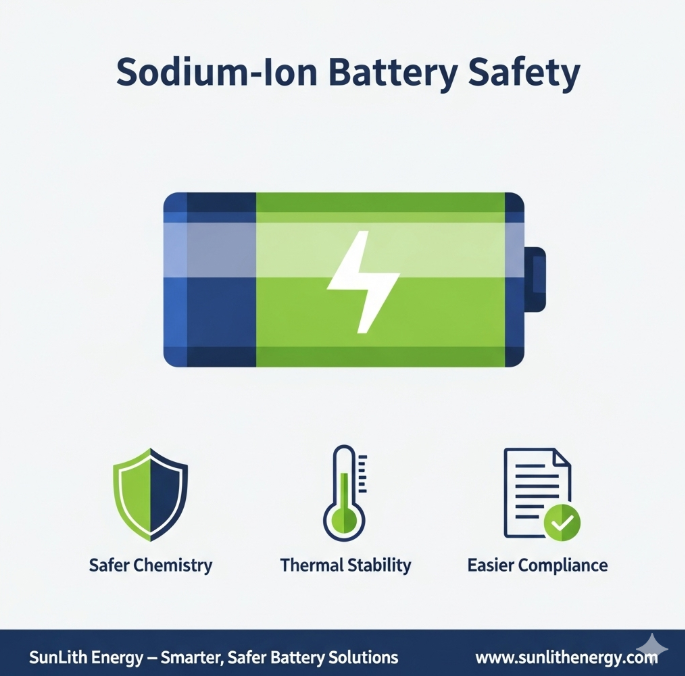
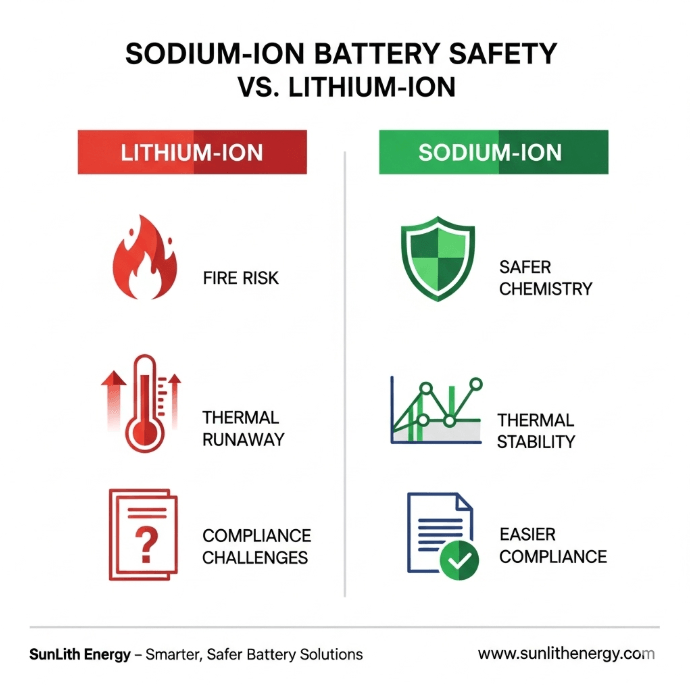
When companies invest in energy storage, safety is often the top priority. Incidents with lithium-ion batteries—fires, thermal runaway, and compliance hurdles—have pushed businesses to seek safer alternatives. This is where sodium-ion battery safety stands out.
Sodium-ion batteries are designed with superior thermal stability, reduced fire risks, and simpler compliance pathways compared to lithium-ion. For businesses navigating strict safety certifications and EU regulations, sodium-ion offers a lower-risk, future-ready solution.
At SunLith Energy, we believe sodium-ion represents the future of safe, scalable energy storage. By prioritizing sodium-ion battery safety, businesses can reduce risks, protect their brand, and stay ahead of global compliance standards.
Sunlith: Every great idea starts with a question. When we started this journey, ours was simple: “How can we help the world move toward clean, reliable, and smart energy?”
That question led to a name: SunLith. Two short syllables—but packed with deep meaning, bold purpose, and big dreams.
🔋 What Does SunLith Mean?
It’s simple:
Sun – The most powerful, natural, and endless source of energy known to us.
Lith – Short for Lithium, the core material in modern battery technology.
Together, SunLith means blending the power of nature with the brilliance of human innovation.
It’s not just a name. It’s a vision of a world where energy is clean, storage is smart, and the future is bright.
💡 Why the Name Matters
We didn’t want a generic name. We wanted something real. Something that speaks to who we are, what we do, and why it matters.
SunLith reminds us every day:
To stay connected to the Earth and its natural power.
To stay committed to clean technology and better battery systems.
To stay focused on building a sustainable world for the next generation.
If you care about a greener, smarter, and more stable energy future, then the name SunLith belongs to you too.
Frequently Asked Questions (FAQs)
Q1: What does the name “SunLith” mean?
A:SunLith is a combination of “Sun”, representing natural solar energy, and “Lith”, derived from lithium, the element at the heart of modern energy storage. It reflects our mission to merge sustainable energy generation with advanced battery technology.
Q2: Is SunLith only focused on solar energy solutions?
A: Not at all. While solar power inspires our name, SunLith provides a full range of energy solutions—including EV batteries, energy storage systems (ESS), lithium-based power packs, and hybrid microgrids for home, commercial, and industrial use.
Q3: What makes SunLith different from other energy companies?
A: SunLith stands out because we combine cutting-edge lithium technology with a strong commitment to sustainability. We offer customized, smart, and reliable energy systems that go beyond the ordinary—built to perform, last, and protect the environment.
Q4: Does SunLith manufacture its own cells?
A: SunLith partners with top-tier certified manufacturers and performs rigorous quality checks, factory audits, and FAT/QC inspections to ensure every product we deliver meets international standards and client expectations.
Q5: Who are SunLith’s typical clients?
A: We serve B2B clients in the new energy sector, including project developers, EPC contractors, system integrators, and distributors who need energy storage solutions for EV, home, C&I, and utility-scale applications.
Q6: Where is SunLith based?
A: SunLith operates out of Shenzhen, China, with strong ties to leading Chinese battery manufacturers and global markets. We also work closely with clients in India, Southeast Asia, the Middle East, and Europe.
Q7: What is SunLith’s long-term vision?
A: Our vision is to create a cleaner, smarter energy future—where renewable sources are efficiently stored and distributed using intelligent, scalable systems. We aim to be a trusted global name in energy storage solutions.
Q8: Can SunLith help with sourcing and procurement?
A: Yes! SunLith doesn’t just sell products—we act as your buying agent, helping with sourcing, supplier verification, price negotiation, logistics coordination, and end-to-end project support for energy solutions.
Q9: How does SunLith ensure product quality and compliance?
A: We conduct detailed factory audits, verify certifications and test reports, and ensure each system complies with international standards like UN38.3, IEC62619, CE, UL, BIS, and more.
Q10: Is SunLith a good partner for new energy startups or projects?
A: Absolutely. Whether you’re a startup or a large EPC, we provide expert consulting, reliable sourcing, and high-performance energy solutions that give you a competitive edge in the fast-growing green energy space.
🌍 Why We Believe in SunLith
At the end of the day, energy isn’t just about power. It’s about people. It’s about the planet. It’s about the promise of a better tomorrow.
That’s why we named our company SunLith. Because we believe the future is bright, clean, and within reach.
When talking about renewable energy and power storage, the difference between BESS and ESS often confuses beginners. These two terms might seem similar, but they’re not the same. Understanding what each means is important if you’re dealing with solar systems, energy projects, or even electric vehicles.
Let’s break it down in simple words.
What Does ESS Mean?
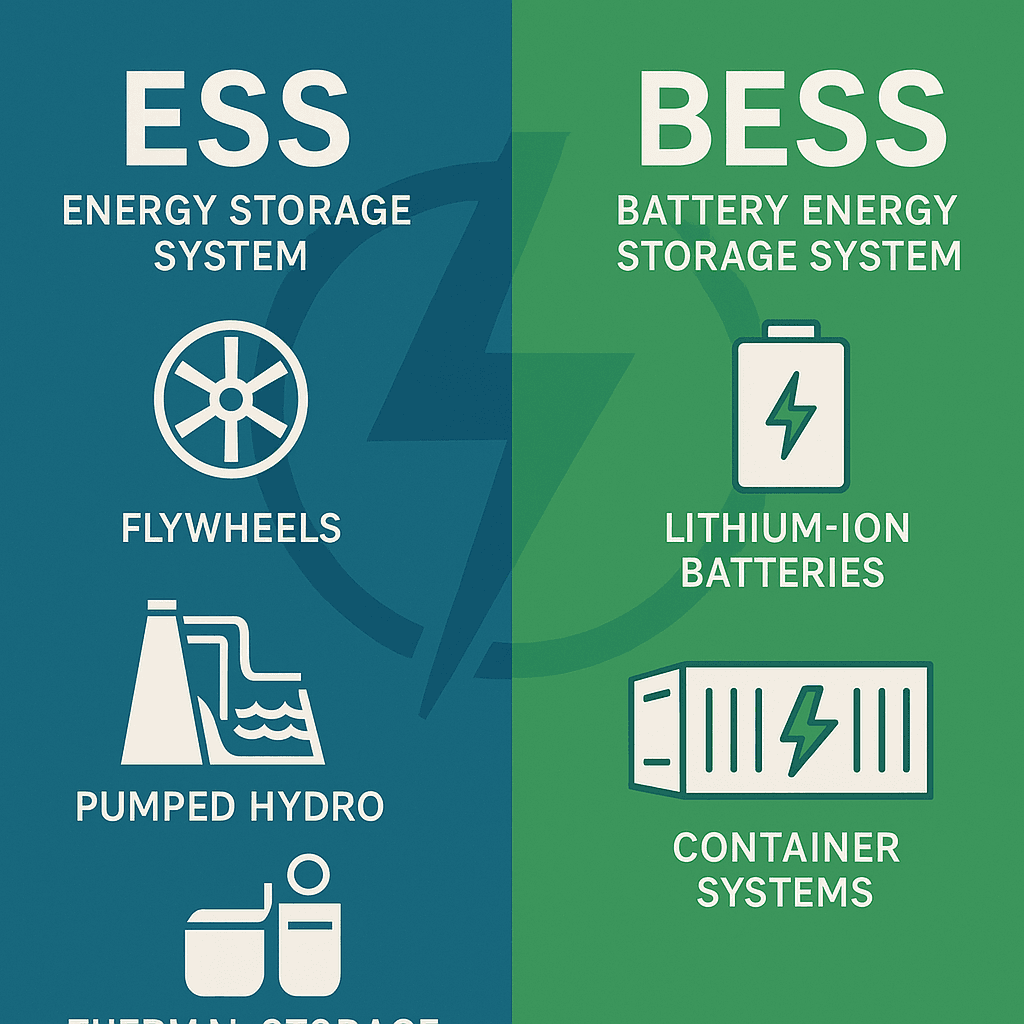
ESS stands for Energy Storage System. It refers to any system that stores energy, not just electricity. This includes a wide range of technologies used to store energy in different forms — chemical, mechanical, thermal, or electrical.
The difference between BESS and ESS is that BESS is battery-specific, while ESS can refer to many other types of storage.
Why Is the Difference Between BESS and ESS Important?
Knowing the difference between BESS and ESS helps you:
✅ Choose the right technology ✅ Communicate clearly with vendors or partners ✅ Understand costs, installation, and maintenance needs ✅ Plan projects efficiently
If you are discussing a specific battery solution, say “BESS.” If you are referring to general energy storage options, use “ESS.”
Common Questions About BESS vs ESS
❓ Is Every BESS Also an ESS?
Yes. Every Battery Energy Storage System (BESS) is a type of Energy Storage System (ESS). But not every ESS is a BESS. Some ESS use water, air, or heat instead of batteries.
❓ Which One Should I Choose for My Project?
If you are storing electricity from solar panels or wind turbines, BESS is usually the best option. It’s compact, scalable, and fast-responding. If you are looking at long-term or large-scale energy storage, you might consider other ESS types like pumped hydro.
❓ Why Do People Use ESS Instead of Just Saying BESS?
Because ESS includes all types of storage, it’s often used in broad industry discussions. For example, when governments talk about energy policy or infrastructure planning, they use “ESS” to include all possibilities.
Real-World Example to Understand the Difference Between BESS and ESS
IEC Certifications for BESS: Battery Energy Storage Systems (BESS) are at the heart of modern energy transition—bridging renewables with grid reliability, enabling peak shaving, and powering homes, businesses, and microgrids. However, with great power comes great responsibility—ensuring these systems are safe, reliable, and compliant. This is where IEC certifications become non-negotiable.
Whether you’re a manufacturer, developer, investor, or end-user, understanding IEC standards for BESS is essential. Let’s explore what they are, why they matter, and how they ensure your system meets international benchmarks.
What Is IEC?
The International Electrotechnical Commission (IEC) is a global organization that prepares and publishes international standards for all electrical, electronic, and related technologies. IEC standards are widely accepted across countries, making them a crucial part of certification for global markets.
Why IEC Certification Matters for BESS
IEC certifications ensure:
Safety: Protects people and infrastructure from battery-related risks like fire, explosion, and electric shock.
Performance: Verifies that the system delivers its rated capacity, efficiency, and lifespan.
Grid Compatibility: Confirms the system won’t disrupt power quality or stability.
Global Market Access: Required for entering many regulated markets in Europe, Asia, and the Americas.
Without proper IEC certification, your BESS project could face project delays, insurance issues, or legal penalties.
Key IEC Certifications for BESS
Here’s a list of the most important IEC standards applicable to BESS, from the cell level to the complete system level.
1. IEC 62619 – Safety of Secondary Lithium Cells and Batteries for Industrial Applications
Focuses on cell and battery safety for industrial use.
Covers thermal runaway, overcharging, short-circuit protection, and more.
Mandatory for Li-ion cells and packs used in BESS.
2. IEC 62933 Series – Electrical Energy Storage Systems (EESS)
IEC 62933 is the international framework governing grid energy storage systems (ESS). Developed by the International Electrotechnical Commission (IEC), it establishes requirements for design, safety, performance, and environmental impact. Its goal is to harmonize ESS deployment worldwide.
The standard applies to all types of storage technologies, including batteries, mechanical storage, and hybrid systems. By creating a unified baseline, IEC 62933 helps reduce risks and improve investor confidence in large-scale ESS projects.
Type Test Report of Full Battery Rack or Container
If these are unavailable, it’s a red flag. You might be dealing with an uncertified, risky product.
Common Pitfalls to Avoid
Assuming cell certificates are enough
Using self-built systems without third-party testing
Mixing components without system-level integration testing
Skipping fire protection compliance
✅ Final Thoughts: IEC Certifications for BESS Is Not Optional
In the rapidly growing energy storage market, shortcuts are tempting—but dangerous. IEC certifications are not just documents; they’re your first line of defense against accidents, project rejections, and long-term failure.
So whether you’re developing a grid-scale BESS or installing a home backup system, insist on IEC-certified solutions. Your safety, investment, and reputation depend on it.
Got Questions About IEC Certifications for BESS?
As a New Energy Consultant, I help clients source, validate, and inspect certified energy storage systems across Asia. If you’re unsure about your battery supplier’s documents or want help with third-party testing, feel free to reach out.
As the world races toward a cleaner future, storing renewable energy efficiently is no longer optional—it’s essential. At the core of this transition is the Battery Energy Storage System (BESS). Among its many forms, the AC Coupled BESS stands out for its flexibility, reliability, and ease of integration. Whether you’re expanding an existing solar setup or starting fresh, this powerful configuration could be the key to true energy freedom. In this post, we’ll uncover what makes AC coupling special—and why it might just be the smarter choice for your energy journey.
AC coupling is a smart, scalable solution often used in retrofit projects, hybrid systems, and microgrids, offering flexibility in design and control.
Core Components of AC Coupled BESS
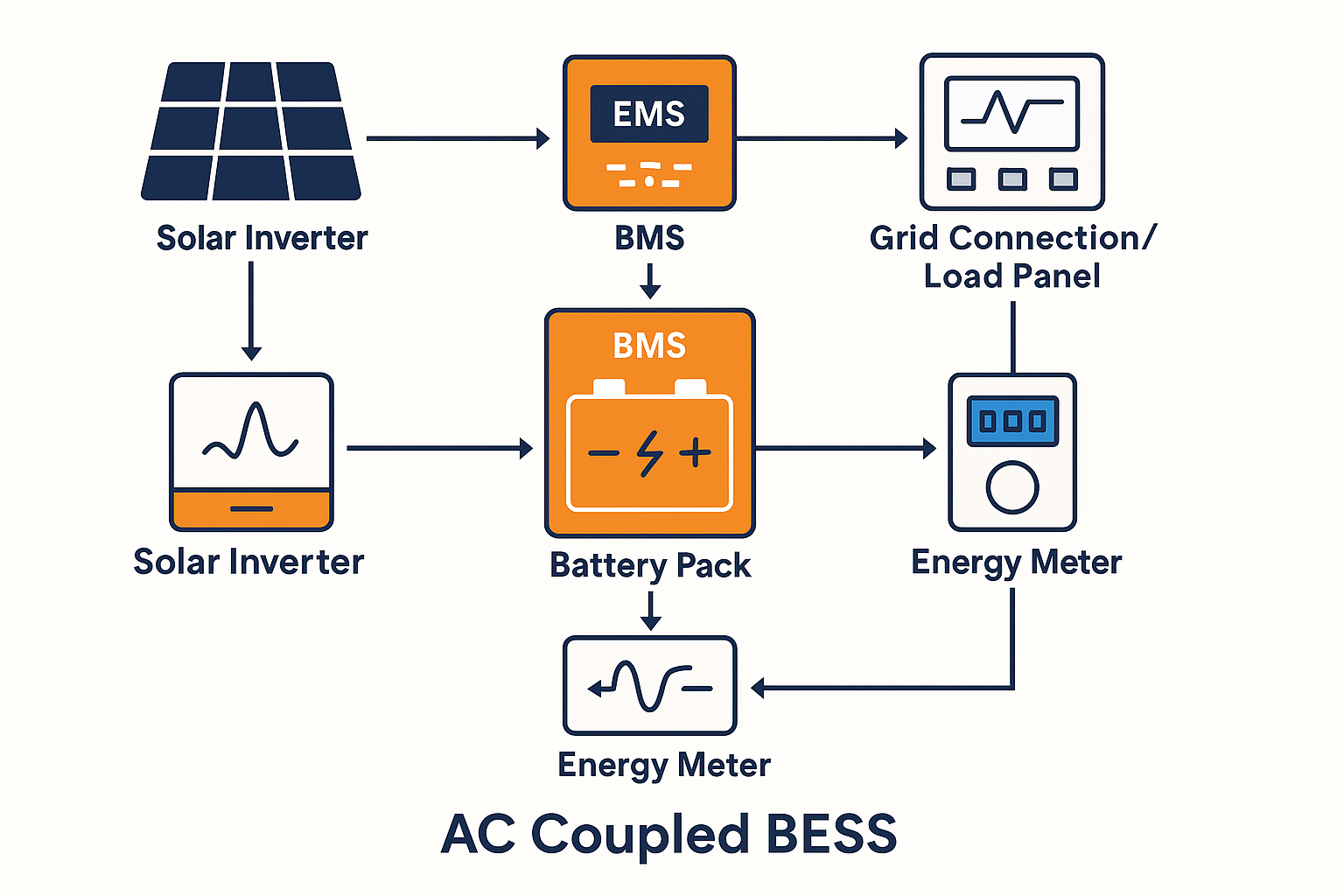
An AC Coupled BESS typically consists of the following key components:
1. Battery Pack
The heart of the system – stores energy chemically and discharges it as needed. Battery types include:
Lithium-ion (most common)
LFP (Lithium Iron Phosphate)
NMC (Nickel Manganese Cobalt)
Lead-acid (less common today)
2. Battery Management System (BMS)
Monitors and protects the battery cells by managing parameters like voltage, temperature, and charge/discharge rates. Prevents overcharging, deep discharging, and ensures system longevity.
3. Battery Inverter (Bidirectional Inverter)
This converts DC power from the battery into AC for grid compatibility, and vice versa during charging. Also known as a PCS (Power Conversion System) in utility-scale deployments.
4. Energy Meter
Monitors and measures the energy flow to and from the battery, PV system, grid, and loads. Helps in performance monitoring and utility compliance.
5. EMS (Energy Management System)
The brain of the system – it manages how and when the battery charges or discharges based on load demand, time-of-use pricing, grid signals, and PV generation.
6. Grid Connection / Load Panel
Where the system connects to the facility’s electrical infrastructure, enabling energy import/export and onsite consumption.
How Does AC Coupled BESS Work?
Here’s a simple breakdown of how an AC Coupled BESS operates:
✅ Energy Generation (Solar or Wind)
A solar PV inverter generates AC electricity from the sun during daylight hours.
✅ AC Flow to Battery Inverter
Excess AC electricity not consumed on-site is routed to the battery inverter, which converts it to DC to charge the battery.
✅ Battery Charging
The battery stores energy as DC power, which is managed by the BMS for optimal health and safety.
✅ Discharge Mode
When the load demand exceeds generation (e.g., at night), the battery inverter converts stored DC power back to AC to power the home or facility.
✅ Grid Interaction
Depending on system configuration, the BESS can import power from or export excess energy to the grid, enabling peak shaving, backup power, and participation in demand response programs.
Advantages of AC Coupled BESS
AC Coupled systems offer several compelling advantages:
Commercial and Industrial facilities needing power backup or time-of-use optimization.
Remote microgrids with multiple sources of energy.
Retrofit projects adding batteries to an existing solar system.
Utility-scale grid support installations where power export, voltage regulation, and load shifting are required.
Conclusion
AC Coupled BESS is a versatile and future-proof energy storage architecture. While it involves slightly more components and costs compared to DC coupling, the flexibility, redundancy, and modularity it offers make it a favorite for professionals designing hybrid systems, microgrids, and energy-resilient facilities.
Whether you’re an engineer, energy consultant, or business owner exploring storage solutions – understanding how AC coupled BESS works is key to making smarter energy decisions.
Need help sourcing or evaluating AC Coupled BESS systems? As a New Energy Consultant with over 13 years in China’s energy sector, I help global clients source reliable BESS products, conduct factory audits, and ensure full compliance with international standards.
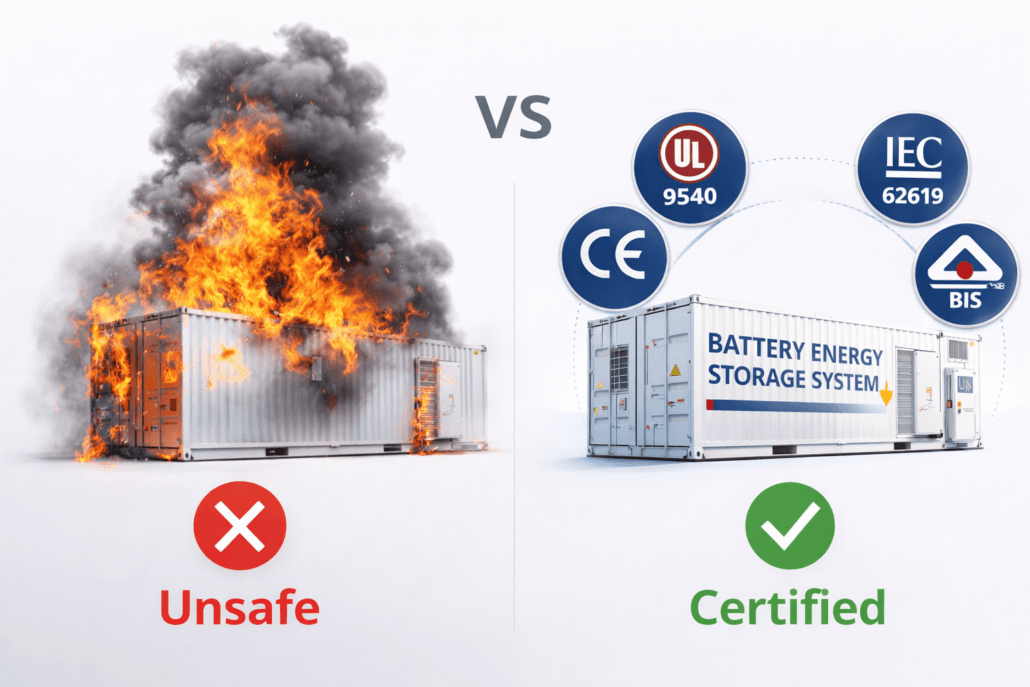
Quick Answer: BESS certifications are mandatory safety approvals for Battery Energy Storage Systems. You need UL 9540 for the USA, CE Marking for Europe, IEC 62619 globally, and BIS IS 17855 for India. Without valid BESS certifications, your system cannot be sold, insured, or grid-connected.
BESS certifications are the first thing you need when buying, selling, or installing a battery energy storage system. They decide whether your project gets permitted and financed — or blocked. As the global BESS market grows toward 500 GW by 2031, regulators everywhere are raising the bar.
This guide covers every major standard in 2026. Moreover, it explains what each certification tests, why it is required, and what it costs. Use it before you sign any BESS purchase agreement.
What This Guide Covers
Why BESS certifications matter — and the real risks of skipping them
All major global standards: UL, IEC, CE, BIS, CEC, NFPA 855, UN 38.3
Quick-reference comparison table
System-level vs. component-level certification — the #1 costly mistake
Factory certifications: ISO 9001, 14001, 45001
How to spot fake or invalid reports
Cost and timeline overview
Buyer’s certification checklist
FAQ — most-searched questions answered
1. Why BESS Certifications Matter More Than Ever in 2026
BESS certifications are not just paperwork. They are your legal license to sell and operate in any serious energy market. High-profile BESS fires across the US, Europe, and Asia have pushed regulators to tighten standards. As a result, the compliance bar in 2026 is higher than at any point before.
Skipping BESS certifications leads to serious, immediate problems. Here is what happens when a system is not properly certified:
Safety failures: Fires from uncertified BESS have caused millions in damage globally
Market access blocked: Products without UL 9540 or CE Marking cannot legally be sold
Insurance denied: Most insurers reject claims involving uncertified systems
Grid connection refused: Utilities require valid certification before any interconnection
Tender disqualification: BIS (India) and CEC (Australia) are mandatory for public projects
Legal liability: Uncertified equipment leads to fines, recalls, and lawsuits
Key Rule: A certified cell does NOT mean the full BESS system is certified. The cell, BMS, PCS, enclosure, and complete assembled system each need their own independent certification. This is the most expensive mistake importers make.
2. All Major BESS Certification Standards by Region (2026)
Different markets require different BESS certifications. Below is a full breakdown of every standard you need to know. Each section explains what is tested, who issues it, and why it matters.
A. UL Standards — United States and Canada
Underwriters Laboratories (UL) issues the core BESS certifications for North America. These are enforced through state building codes, the NEC, and utility agreements. Without them, your product cannot be permitted or installed in most US states.
Standard
Full Name
Covers
Who Needs It
UL 9540
Safety for Energy Storage Systems
Full system safety — the master US standard
All BESS sellers and installers in USA/Canada
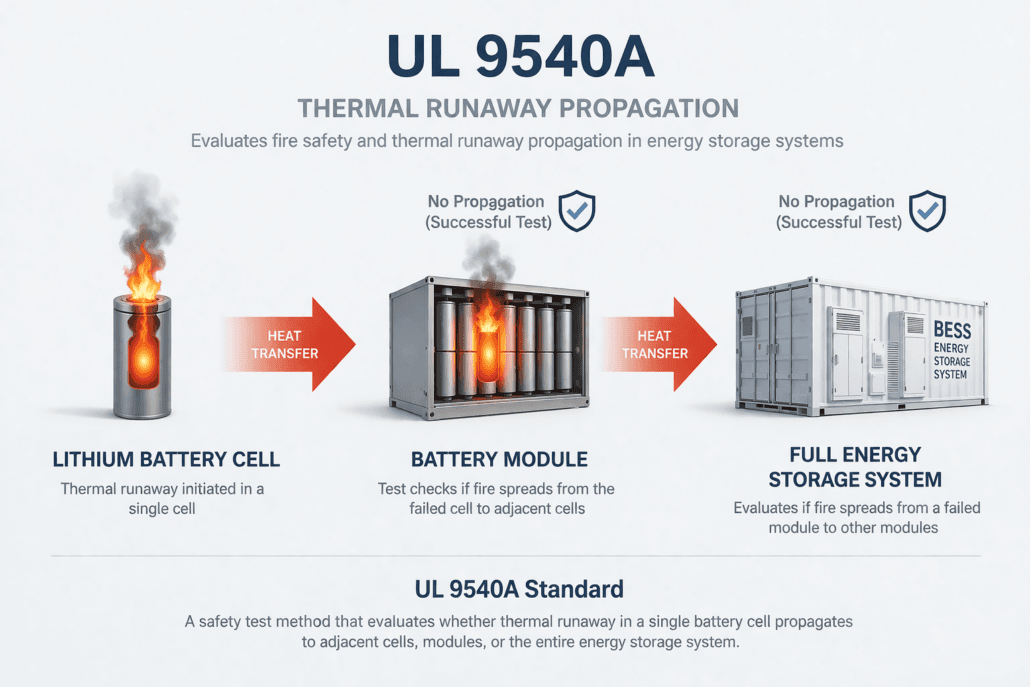
UL 9540A
Thermal Runaway Fire Propagation Test
Fire spread between battery modules
Required before UL 9540 listing
UL 1973
Stationary and Motive Battery Systems
Battery cell and pack safety
Battery pack manufacturers
UL 1741
Inverters and Power Converters
Grid-interactive inverter and PCS safety
PCS and inverter manufacturers
UL 1699B
Lithium-Ion Battery Protection
Arc fault protection in Li-ion systems
Residential and commercial BESS
UL 9540A must be completed at three levels: cell, module, and unit. Many suppliers, however, only show the cell-level report. Consequently, buyers accept incomplete documentation without knowing it. Always demand all three levels before you proceed.
B. IEC Standards — International and European Markets
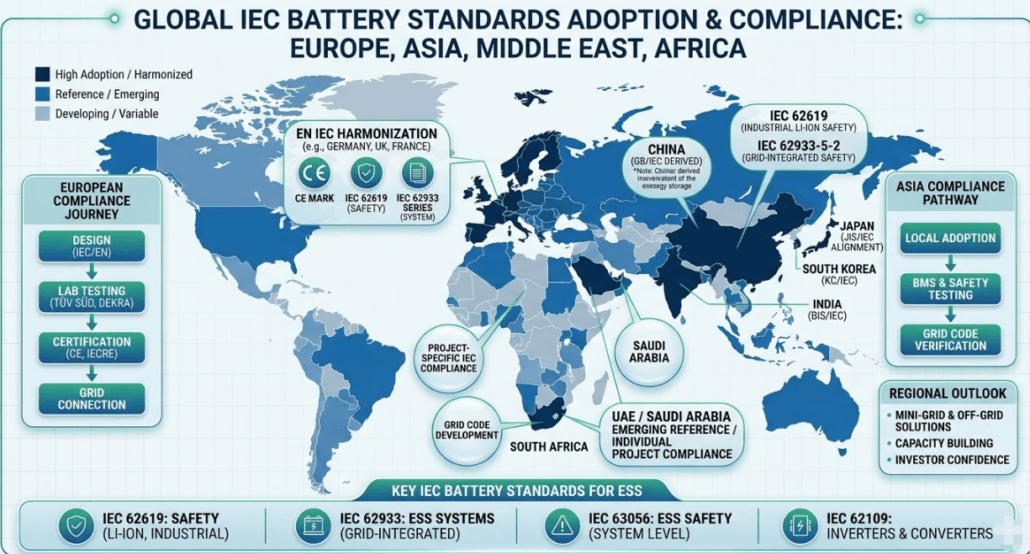
The International Electrotechnical Commission (IEC) sets globally accepted BESS certifications. As a result, IEC standards are referenced by regulators across Europe, Asia, the Middle East, and Africa. Furthermore, many utility tenders worldwide require specific IEC compliance as a minimum baseline.
Standard
Scope
Key Focus
IEC 62619
Lithium cells and batteries for stationary use
Core safety: overcharge, short circuit, thermal abuse
IEC 62933-2-1
ESS unit parameters and test methods
Performance verification of a complete assembled system
IEC 62933-5-2
Safety for grid-integrated energy storage
Cybersecurity, functional safety, grid protection
IEC 61427-2
Batteries for off-grid renewables
Cycle life and performance for solar and wind storage
IEC 61508
Functional safety of electrical systems
Applies to BMS software and firmware safety logic
C. CE Marking — European Union and EEA
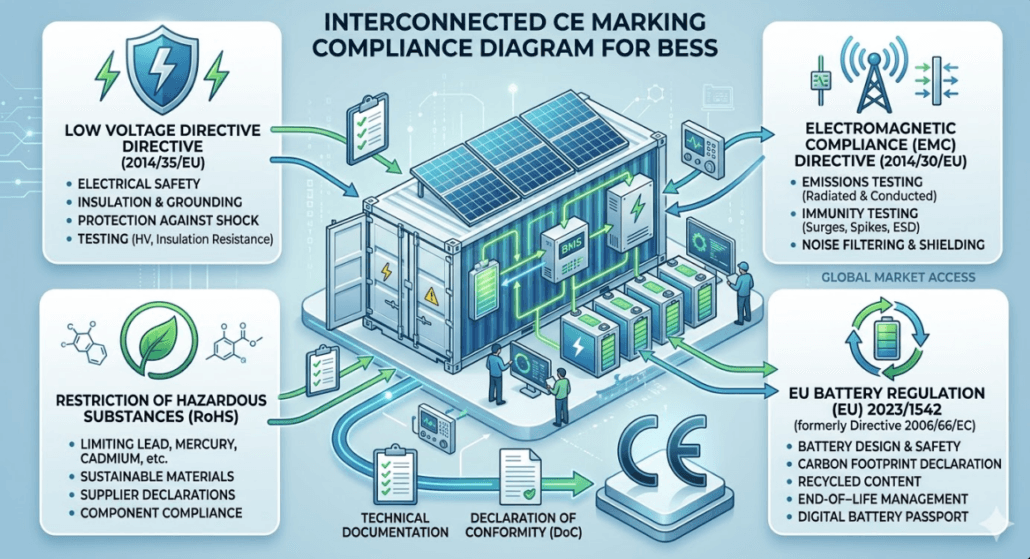
CE Marking is legally required for every battery product sold in the EU. It is not a single test. Instead, it is a Declaration of Conformity that proves compliance with several EU Directives at once. Without it, your product cannot enter the EU market legally.
Low Voltage Directive (LVD) 2014/35/EU — Electrical safety for equipment from 50V to 1000V AC
EMC Directive 2014/30/EU — Ensures BESS does not interfere with other devices
RoHS Directive 2011/65/EU — Restricts lead, mercury, cadmium, and other hazardous substances
EU Battery Regulation 2023/1542 — Adds carbon footprint declaration and Digital Battery Passport from 2024
Machinery Directive 2006/42/EC — Applies if the BESS includes any motorized or moving parts
2026 EU Update: The EU Battery Regulation adds a Digital Battery Passport for BESS above 2 kWh. From 2027, every qualifying battery needs a QR-code-linked passport with carbon footprint and supply chain data. Start compliance preparation now.
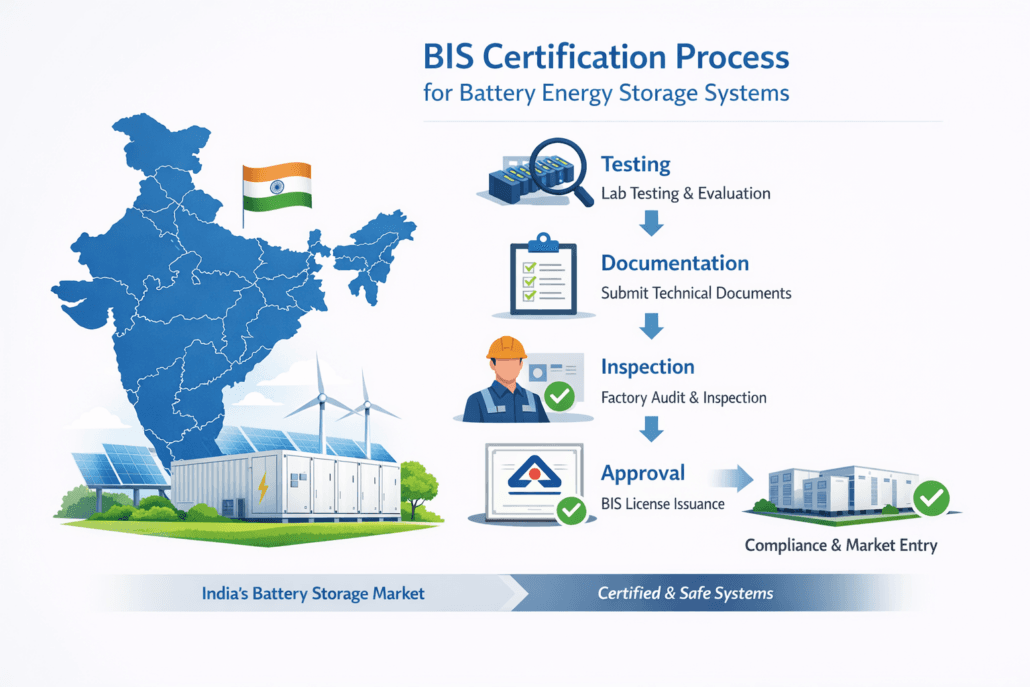
D. BIS Certification — India
In India, the Bureau of Indian Standards (BIS) manages mandatory BESS certifications under the Compulsory Registration Scheme (CRS). Without BIS registration, products cannot clear customs or qualify for government tenders. India is a fast-growing BESS market, so this certification is increasingly important.
IS 16270:2014 — Safety for lithium-ion cells, equivalent to IEC 62133
IS 17855:2022 — Stationary lithium battery safety, aligned with IEC 62619
IEC 62619 (adopted directly) — Required for large-scale utility and industrial BESS tenders
Testing must be done at BIS-approved labs or internationally accredited labs with a BIS agreement. Additionally, registration is model-specific and must be renewed. Typical timeline: three to six months.
E. CEC Approval — Australia
Australia’s Clean Energy Council (CEC) governs BESS certifications for the Australian market. CEC listing is required for grid connection and STC rebate eligibility. Without it, network operators will not approve the connection.
AS/NZS 5139:2019 — Australian standard for battery systems with power conversion equipment
CEC Approved Product List — Products must appear on this list before any grid connection
Installer accreditation — CEC Battery Storage Accreditation is required for all installers
F. NFPA 855 — USA Fire Installation Standard
NFPA 855 governs how BESS certifications translate into safe real-world installations. While UL 9540 covers product safety, NFPA 855 covers how and where BESS is installed. Many US states have adopted it into local building codes.
Sets maximum energy capacity per room and building type
Requires fire suppression systems above defined energy thresholds
Mandates separation distances between battery racks and modules
Requires UL 9540A unit-level results as part of the permit application
Therefore, project developers must design installations to NFPA 855 from day one. Failing to do so results in permit denial — often after costly design work is already complete.
G. UN 38.3 — International Transport Certification
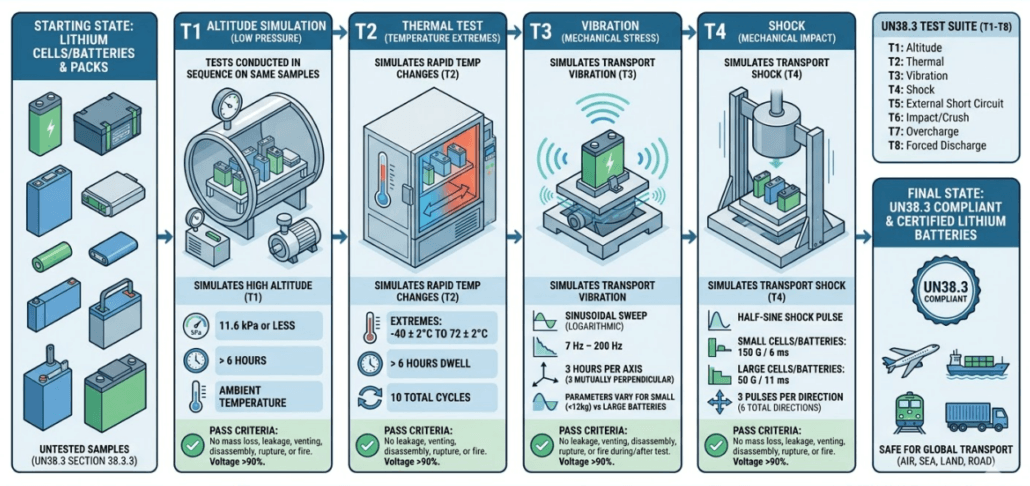
UN 38.3 is one of the most universally required BESS certifications — yet it is often overlooked. Simply put, it is the mandatory transport safety test for all lithium batteries shipped internationally. Without a valid UN 38.3 report, your shipment will be refused by airlines, shipping lines, and road carriers.
Tests include altitude simulation, thermal testing, vibration, shock, short circuit, and overcharge
Required under IATA (air), IMDG (sea), and ADR/RID (road) dangerous goods regulations
Cells, modules, and complete packs each need separate UN 38.3 documentation
Must be done at an accredited laboratory — self-certification is not accepted
Warning: Outdated or cell-only UN 38.3 reports are very common from lower-tier manufacturers. Any design change — including a new BMS version or different cell count — requires a fresh test. Check validity before every shipment.
4. System-Level vs. Component-Level BESS Certifications
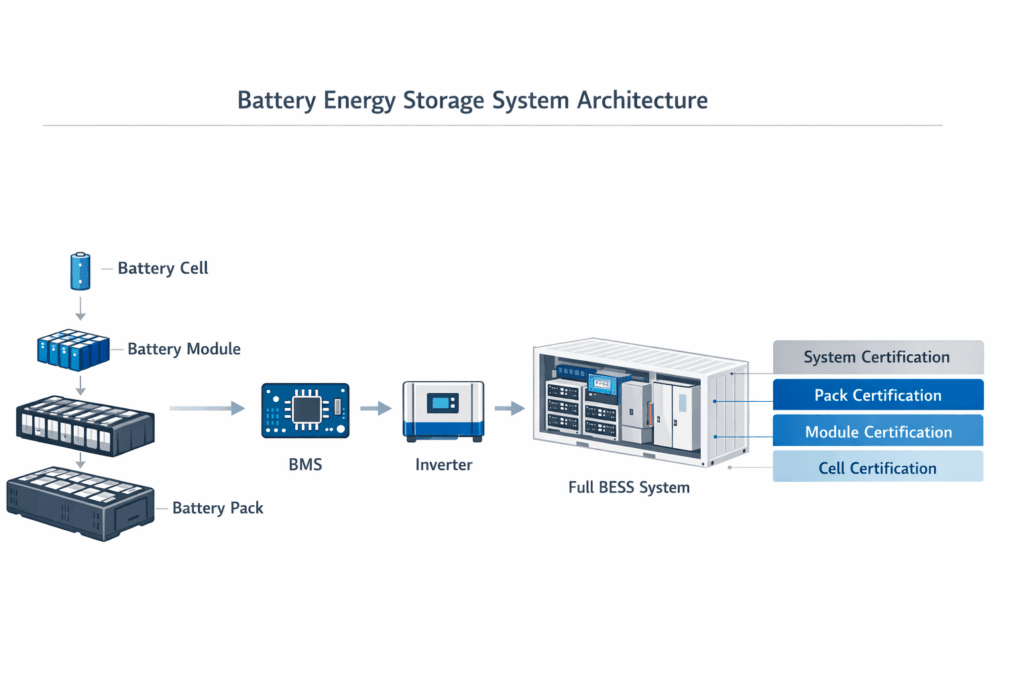
Many buyers assume that a certified component means a certified system. In practice, this is wrong. Every level of a BESS assembly needs its own BESS certifications. Moreover, any change to a component — even a firmware update — can invalidate the existing system certificate.
Component
Relevant BESS Certifications
Why Independent Certification Is Required
Individual cells
UN 38.3, IEC 62133, UL 1973
Cell chemistry, abuse tolerance, and transport safety
Battery module
UL 9540A (cell level), IEC 62619
Module-level thermal runaway fire propagation
Battery pack / rack
UL 9540A (module level), IEC 62619
Pack-level fire propagation and structural safety
BMS
IEC 61508, UL 991
Software functional safety and fault detection logic
PCS / Inverter
UL 1741, IEC 62109, CE LVD
Grid interaction, isolation, and anti-islanding protection
Full assembled system
UL 9540, UL 9540A (unit), CE, IEC 62933
System integration, fire safety, and grid compliance
For this reason, always request the full system-level test report. It must list the exact model numbers, BMS version, cell supplier, and test configuration — matching the product you will actually receive.
5. Factory Certifications That Support BESS Certifications
Product BESS certifications are only part of the picture. The factory itself also needs to meet recognized management standards. Without factory certification, there is no reliable batch traceability — and no accountability when problems arise after delivery.
Certificate
What It Proves
Relevance to BESS Buyers
ISO 9001:2015
Quality Management System
Consistent production quality and batch traceability
ISO 14001:2015
Environmental Management System
Safe handling and disposal of hazardous battery materials
ISO 45001:2018
Occupational Health and Safety
Worker safety in battery manufacturing environments
IATF 16949
Automotive-grade quality standard
Relevant for BESS using automotive-grade LFP or NMC cells
ISO/IEC 27001
Information Security Management
Required for grid-connected BESS with SCADA or IoT systems
6. How to Spot Fake or Invalid BESS Certifications
Fraudulent BESS certifications are surprisingly common — especially in the Chinese supply chain. As a result, buyers who do not know what to check often accept invalid documents. Here are the key red flags to look for:
Cell-only report shown as a system cert: Supplier shows IEC 62619 for the cell but has no system-level UL 9540 or CE Declaration
Wrong model number: The certified model is different from the product being shipped to you
Expired documents: Check the issue date and validity period on every certificate — expired certs are invalid
Unknown test lab: Lab is not listed under ILAC mutual recognition — verify at ilac.org
Missing UL 9540A unit-level test: Only cell-level results are shown; module and unit levels are absent
No Technical Construction File for CE: Self-declaration is legal, but the Technical File must exist and be available
Supplier refuses to verify: UL certs are verifiable at iq.ul.com — refusal to verify is a serious warning sign
7. BESS Certifications Cost and Timeline Overview (2026)
Budgeting early for BESS certifications is essential. Costs vary by lab, system complexity, and region. Furthermore, any change to chemistry, BMS software, or module count after certification may trigger re-testing. These are approximate benchmarks for 2025 to 2026:
BESS Certification
Approx. Cost (USD)
Timeline
Key Notes
UL 9540 — full system
$80,000 – $200,000+
6–12 months
Includes UL 9540A at all three levels
UL 9540A — thermal runaway
$30,000 – $80,000
3–6 months
Cell, module, and unit tested separately
IEC 62619
$15,000 – $40,000
3–5 months
Available at TÜV, SGS, Intertek globally
CE Marking (LVD + EMC)
$10,000 – $30,000
2–5 months
Notified body fees vary by complexity
BIS India — IS 17855
$5,000 – $15,000
3–6 months
Testing at BIS-approved or linked labs
CEC Australia
$5,000 – $20,000
2–4 months
Requires ISO 17025 accredited lab report
UN 38.3
$3,000 – $8,000
4–8 weeks
Required per battery model and configuration
ISO 9001 factory cert
$5,000 – $20,000/yr
3–6 months
Annual surveillance audits required
8. BESS Certification Buyer’s Checklist — Before You Sign
Use this checklist for every BESS certifications review before you finalize a purchase. Go through each point carefully before signing any agreement or paying a deposit:
Request the full system-level test report — confirm the model number, BMS version, and cell supplier all match
Verify certifications match your target market: UL 9540 for USA, CE for EU, BIS IS 17855 for India, CEC for Australia
Check that UL 9540A covers all three levels: cell, module, and unit
Confirm UN 38.3 covers the exact pack size and configuration being shipped
Ask for the ISO 9001 certificate scope — ensure it covers the product type you are buying
Verify all reports are current — expired documents are invalid even if they were once legitimate
Confirm the issuing lab is ILAC-accredited or recognized by the target market regulator
For the EU: request the full Declaration of Conformity and the Technical Construction File index
For India: verify the BIS registration number directly at bis.gov.in
For Australia: check the CEC approved product list before any purchase commitment
Ask whether any design changes occurred after the certification date — changes may require re-testing
9. Frequently Asked Questions About BESS Certifications
Here are the most-searched questions about BESS certifications, with direct and clear answers.
What certifications does a BESS need in the United States?
In the USA, BESS certifications include UL 9540 for the full system, UL 9540A at cell/module/unit levels, UL 1973 for battery packs, and UL 1741 for the inverter or PCS. Additionally, all US installations must comply with NFPA 855 and NEC Article 706.
Is UL 9540 mandatory for BESS in the USA?
Yes — in practice. UL 9540 is technically a voluntary standard. However, it is required by most state building codes, utility interconnection agreements, and insurance policies. Without it, your system will not be permitted or connected to the grid.
What is the difference between UL 9540 and UL 9540A?
UL 9540 is the full product safety standard for a complete BESS system. UL 9540A, however, is a specific test for fire propagation during a thermal runaway event. In other words, UL 9540A is a prerequisite test that must be passed before UL 9540 listing is granted.
Can I sell BESS in Europe without CE Marking?
No. CE Marking is a legal requirement for all electrical products in the EU and EEA. Products without it can be seized at the border. Furthermore, from 2024, the EU Battery Regulation adds extra compliance requirements beyond traditional CE directives.
Does IEC 62619 replace UL 9540?
No — they serve different purposes. IEC 62619 is a component-level standard for lithium battery safety. UL 9540, on the other hand, is a full system safety standard specific to the US market. For US sales you need UL 9540. For global acceptance, IEC 62619 is the recognized baseline.
What is UN 38.3 and is it required for BESS shipments?
UN 38.3 is the mandatory transport safety test for all lithium batteries. It is required for every international shipment of cells, modules, and packs — by air, sea, or road. Without a valid UN 38.3 report, freight forwarders and customs will reject the shipment.
How long does BESS certification take from start to finish?
Full UL 9540 certification takes six to twelve months. IEC 62619 takes three to six months. CE Marking can be completed in two to five months. UN 38.3 is the fastest at four to eight weeks. Most manufacturers apply for several certifications at the same time to reduce total time to market.
What is the EU Battery Passport and when does it apply?
The EU Battery Regulation (2023/1542) introduces a Digital Battery Passport for industrial BESS above 2 kWh sold in the EU. From 2027, each qualifying battery needs a QR-linked passport with carbon footprint and supply chain data. As a result, BESS manufacturers targeting Europe should start compliance preparation immediately.
Related Articles and Useful Links
Add these internal links when publishing on WordPress — they strengthen topical authority and support navigation: