In today’s energy landscape, flexibility is just as important as generation. As renewable energy adoption grows, balancing supply and demand has become a major challenge. Demand Response (DR), when integrated into Virtual Power Plants (VPPs), offers a powerful solution to achieve this balance. By intelligently shifting or reducing electricity usage during peak hours, demand response ensures a more resilient, affordable, and sustainable energy system.
What Is Demand Response?
Demand Response is an energy management strategy where consumers adjust their electricity usage in response to grid conditions, price signals, or incentives. Instead of relying solely on power plants to ramp up supply, DR helps reduce stress on the grid by adjusting demand.
When this capability is connected to a Virtual Power Plant, thousands of distributed assets — from smart appliances to EV chargers — can collectively act as a flexible energy resource.
How Demand Response Works in Virtual Power Plants
Real-Time Monitoring: Smart meters and IoT devices track consumption patterns.
Automated Control: Appliances, batteries, and HVAC systems adjust based on grid signals.
Aggregated Flexibility: Small changes across households and businesses add up to major load reductions.
Bidirectional Benefits: Consumers earn incentives, while grid operators reduce stress on infrastructure.
Decarbonization – Maximizes the integration of renewable energy by reducing reliance on fossil-fuel backup plants.
Resilience – Communities gain more reliable access to electricity during extreme demand peaks.
Real-World Applications
United States: California’s Flex Alert program rewards consumers for reducing usage during peak times, and when tied into VPPs, it supports grid resilience during heatwaves.
Europe: Germany and the UK are experimenting with large-scale DR programs integrated into VPP platforms to balance wind and solar fluctuations.
Asia: Japan’s utilities use DR to manage peak demand from air conditioning loads in summer while leveraging VPP networks.
Demand Response + Smart Grids + Storage
Demand Response becomes even more effective when combined with:
Demand Response is the hidden power of Virtual Power Plants. By engaging consumers and leveraging automation, it transforms passive energy users into active participants in grid management. The result is a system that is smarter, cleaner, and more resilient for everyone.
Peak Shaving vs Load Shifting: Electricity demand is becoming increasingly dynamic as renewable energy adoption grows. Because of these changing consumption patterns, businesses and utilities must manage energy profiles efficiently to avoid high electricity costs.
Businesses and utilities must manage demand efficiently to avoid high electricity costs and maintain grid stability.
Two important strategies used in energy management are peak shaving and load shifting.
Understanding the difference between peak shaving vs load shifting helps organizations optimize energy use, reduce electricity costs, and maximize the value of battery energy storage systems.
Peak Shaving vs Load Shifting (Quick Comparison)
Peak shaving and load shifting are energy management strategies used to reduce electricity costs. Peak shaving lowers electricity demand during peak hours by using stored energy or reducing loads. Load shifting moves energy consumption to off-peak periods when electricity prices are lower. Many businesses combine both strategies using battery energy storage systems.
Strategy
Main Goal
Peak Shaving
Reduce demand spikes
Load Shifting
Move demand to cheaper hours
What Is Peak Shaving?
Peak shaving using battery energy storage to reduce electricity demand spikes.
Utilities often charge commercial customers based on their maximum demand (kW) during a billing cycle. These are known as demand charges.
According to the U.S. Department of Energy, demand charges can represent a significant portion of industrial electricity bills.
Peak shaving reduces this maximum demand by supplying energy from alternative sources.
Common Peak Shaving Methods
Organizations use several technologies to perform peak shaving:
Battery Energy Storage Systems
On-site backup generators
Smart energy management systems
Temporary load reduction strategies
For example, a manufacturing facility may use stored battery energy between 4 PM and 8 PM, when electricity demand is highest.
Instead of drawing power from the grid, the battery supplies electricity to the facility.
This reduces peak demand and lowers electricity costs.
What Is Load Shifting?
Load shifting moves electricity consumption to lower-cost off-peak periods.
Load shifting is an energy management strategy that moves electricity consumption from high-price periods to lower-price periods.
Unlike peak shaving, load shifting does not necessarily reduce total energy consumption. Instead, it changes when electricity is used.
Time-of-use electricity pricing encourages this behavior by charging different rates depending on the time of day.
Energy market analysis from the International Energy Agency shows that flexible demand strategies like load shifting play an important role in modern electricity systems.
Examples of Load Shifting
Common load shifting strategies include:
Charging electric vehicles overnight
Running industrial processes during off-peak hours
Pre-cooling commercial buildings early in the day
Scheduling data processing tasks overnight
By shifting energy usage to cheaper periods, businesses can significantly reduce electricity costs.
📊 Peak Shaving vs Load Shifting Calculator
Estimate potential monthly utility tariff savings for both commercial battery applications.
Peak shaving and load shifting are essential tools for modern energy management.
Peak shaving reduces electricity demand during high-load periods to avoid costly demand charges.
Load shifting moves electricity consumption to lower-cost periods.
Together, these strategies help businesses:
Reduce electricity costs
Improve grid stability
Optimize renewable energy usage
Increase energy efficiency
With the growing adoption of battery energy storage systems, organizations can implement both strategies effectively and create more resilient energy systems.
Peak Shaving vs Load Shifting FAQ
What is peak shaving in energy management?
Peak shaving is the process of reducing electricity demand during the highest consumption periods. Businesses typically use battery energy storage systems or on-site generation to supply electricity during peak hours and avoid demand charges.
What is load shifting in electricity systems?
Load shifting is an energy management strategy that moves electricity consumption from high-cost peak periods to lower-cost off-peak hours.
What is the difference between peak shaving and load shifting?
Peak shaving reduces electricity demand during peak hours, while load shifting changes when electricity is consumed to take advantage of lower electricity prices.
Can battery energy storage systems perform both peak shaving and load shifting?
Yes. Battery energy storage systems can charge during off-peak periods and discharge during peak demand, enabling both strategies.
Why do utilities charge demand charges?
Utilities charge demand charges to encourage customers to reduce peak electricity demand and maintain grid stability.
But VPPs cannot function effectively without the digital infrastructure that allows millions of devices to communicate, share data, and respond instantly to grid conditions. That infrastructure is the Smart Grid.
In this article, we explore how smart grids serve as the backbone of Virtual Power Plants, enabling greater efficiency, flexibility, and resilience in modern energy systems. We will dive into the technology, benefits, challenges, and future potential of this synergy — and why it represents a cornerstone of the clean energy future.
A Smart Grid is an advanced electrical grid that uses digital communication technology, sensors, and automation to manage the flow of electricity more intelligently. Unlike traditional power grids, which were designed for one-way electricity delivery from central power plants to consumers, smart grids enable two-way communication between utilities and consumers.
Key Features of Smart Grids:
Advanced Metering Infrastructure (AMI): Smart meters that provide real-time data on energy usage.
Automation and Control: Systems that automatically detect faults, reroute electricity, and balance supply and demand.
IoT Integration: Devices and sensors that communicate across the grid.
Data-Driven Operations: Predictive analytics and AI-based forecasting for better grid planning.
These innovations make smart grids not just more efficient, but also essential for integrating distributed and variable energy sources.
Why Smart Grids Matter for Virtual Power Plants
Virtual Power Plants aggregate thousands of distributed assets — rooftop solar panels, home batteries, EV chargers, and even smart appliances. Managing such a diverse ecosystem requires a grid that is flexible, intelligent, and responsive. This is exactly where SG come into play.
Real-Time Monitoring and Control Smart grids continuously collect data from sensors and smart meters, feeding it into centralized platforms that allow utilities to monitor conditions and make adjustments instantly. This real-time oversight is critical for VPPs, which rely on quick responses to stabilize grid frequency and voltage.
Integration of Renewable Energy Renewables like solar and wind are intermittent. Smart grids enable the smooth integration of these resources by forecasting production, managing variability, and distributing energy where it’s needed most.
By leveraging automation and predictive analytics, smart grids reduce outages and enable quicker recovery during disturbances. VPPs, supported by smart grids, can instantly dispatch distributed resources to fill supply gaps.
2. Greater Flexibility
Smart grids give VPPs the agility to scale up or down depending on real-time conditions, ensuring that renewable integration does not compromise grid stability.
3. Lower Operational Costs
Through automation and reduced transmission losses, smart grids reduce overall operational expenses. Consumers also benefit from dynamic pricing models enabled by smart meters.
Smart grids turn passive consumers into active prosumers. With rooftop solar, home batteries, and EVs, households can not only consume energy but also produce and trade it.
Real-World Case Studies
Case Study 1: Europe’s Smart Grid-VPP Integration
In Germany, one of the leaders in renewable adoption, smart grids are enabling VPP operators to aggregate thousands of residential solar and storage units. These resources are orchestrated in real-time to stabilize the grid and provide balancing services to transmission operators.
Case Study 2: United States – Smart Grids with Battery Storage
In California, utilities are deploying smart grids integrated with VPPs to reduce strain during peak summer demand. By combining smart meters, automated demand response, and residential battery systems, the state avoids rolling blackouts and reduces reliance on fossil fuel peaker plants.
Challenges and Future Outlook
1. Cybersecurity Risks
As more devices connect to the grid, the potential attack surface grows. Cybersecurity will be critical to protect smart grids and VPPs from malicious threats.
2. High Initial Investment
Building smart grids requires substantial capital for sensors, meters, communication infrastructure, and software platforms. However, the long-term savings often outweigh the upfront costs.
3. Regulatory Framework
Policymakers must adapt regulations to enable smart grid investments, incentivize demand response, and allow for energy trading within VPPs.
4. Data Privacy
With vast amounts of data being collected from consumers, utilities must ensure strong protections for privacy and data ownership.
Conclusion
Smart grids are more than just an upgrade to our existing power infrastructure. They are the foundation that enables Virtual Power Plants to function at scale, making renewable integration seamless, improving grid reliability, and empowering communities to take control of their energy.
As the world accelerates toward a clean energy future, the synergy between smart grids and VPPs will become increasingly indispensable. Together, they represent not just technological innovation, but also a pathway to resilience, sustainability, and shared prosperity.
Peak shaving with a battery energy storage system typically cuts demand charges by 20–40%. That range depends on two things: your load profile, and your local utility’s tariff structure. So what does this look like in dollars? For a commercial site paying $15/kW in demand charges with a 500 kW peak, that’s often $1,500–$3,000 in monthly savings. In other words, a mid-size BESS can pay for itself in 4–7 years, even before you add other revenue streams on top.
This guide walks through exactly how those savings are calculated. First, we’ll cover what drives the range up or down. Then, we’ll work through a real example you can adapt to your own utility bill. If you’re new to the concept itself, start with our full peak shaving vs. load shifting guide — this page focuses specifically on the dollars.
How Demand Charges Work
Most commercial and industrial tariffs bill two separate components. First, energy charges (¢/kWh) are based on total consumption. Second, demand charges ($/kW) are based on your single highest usage spike in the billing period, usually measured over a 15- or 30-minute window. As a result, demand charges can account for 30–70% of a commercial electric bill. Unlike energy charges, one short spike sets the rate for the entire month, regardless of how briefly it occurred. For a deeper look at how utilities structure these rates, the EIA’s guide to electricity pricing factors is a useful primer. For the full mechanics of how demand is measured and billed for BESS applications specifically, see our complete peak shaving guide.
How Much Can Peak Shaving Actually Save?
Savings scale with two factors: how “peaky” your load is, and how aggressive your local demand charge rate is. Specifically, sites with a high peak-to-average ratio see the largest percentage reduction. Why? Because a BESS only needs to shave the top of the curve, not carry the full load.
Facility Type
Typical Peak-to-Average Ratio
Typical Demand Charge Reduction
Retail / light commercial
1.3 – 1.6x
15–25%
Manufacturing (batch processes)
1.8 – 2.5x
30–45%
Data center / server room
1.1 – 1.3x
10–15%
EV charging depot
2.5 – 4x+
40–60%
Cold storage / refrigeration
1.6 – 2.2x
25–35%
Manufacturing and EV charging sites tend to see the largest savings. That’s because their load spikes are sharp, short, and predictable — exactly the profile a BESS handles best. Data centers, on the other hand, run a comparatively flat load around the clock. Consequently, there’s simply less peak to shave.
Worked Example: Calculating Your Peak Shaving Savings
Here’s how that plays out for a manufacturing site on a typical tariff. First, the site starts with a 620 kW peak demand and a $14.50/kW demand charge rate. Next, a 200 kW BESS shaves the peak down to 420 kW. As a result, the monthly savings come to 200 kW × $14.50 = $2,900. Over a year, that’s $34,800 in demand charge savings alone.
It’s worth noting this example doesn’t include energy arbitrage — charging during off-peak rates and discharging during on-peak ones. Nor does it include any grid services revenue. Both stack on top of pure demand charge savings; see our energy arbitrage guide for that math.
Payback Period and ROI
Payback period depends on three things: system cost per kWh, financing structure, and how many revenue streams the BESS is stacking. As a rough guide, here’s what demand-charge-only paybacks typically look like:
BESS Size
Typical Installed Cost
Monthly Savings (demand only)
Simple Payback
100 kWh / 50 kW
$35,000 – $50,000
$700 – $1,000
4 – 6 years
400 kWh / 200 kW
$140,000 – $190,000
$2,500 – $3,200
4.5 – 6.5 years
1 MWh / 500 kW
$320,000 – $420,000
$6,000 – $8,500
4 – 5.5 years
Installed cost ranges reflect LFP BESS pricing; see our BESS cost per kWh breakdown for the full cost model.
Layering in energy arbitrage or frequency regulation typically shortens payback by 20–35%, compared to demand-charge-only savings. For the full revenue-stacking model, see our C&I BESS economics guide.
What Affects Your Specific Savings
Utility tariff structure. Flat demand rates and time-of-use (TOU) demand rates produce very different math. As a result, TOU sites often see larger savings, since their peaks align with the highest-priced windows. You can check your own utility’s rate structure using the DOE’s Utility Rate Database.
Load profile predictability. Predictable, repeating peaks — like manufacturing shifts or EV charging schedules — are easier to shave accurately than erratic, one-off spikes.
Battery sizing accuracy. An undersized BESS shaves less of the peak than needed. Conversely, an oversized one adds unnecessary capital cost without proportional savings. For this reason, proper sizing requires 12 months of interval data, not a single bill.
Existing power factor correction. Sites without PF correction sometimes see apparent demand charge inflation that a BESS alone won’t fully resolve.
Ratchet clauses. Some utilities set your demand charge based on the highest peak in the past 11–12 months, not just the current month. Therefore, this changes the payback calculation, and usually favors more aggressive peak shaving.
Frequently Asked Questions
How much does peak shaving save on electricity bills?
Most sites see 20–40% reductions in demand charges, which typically make up 30–70% of the total bill. However, actual savings depend on your peak-to-average load ratio and local demand charge rate.
What size battery do I need for peak shaving?
Size the power rating (kW) to your target peak reduction, and the energy capacity (kWh) to cover your typical peak duration — usually 1–3 hours for commercial sites. That said, a proper sizing study needs 12 months of 15-minute interval data.
Is peak shaving worth it for small commercial sites?
It depends. Sites with demand charges above $10/kW and a peak-to-average ratio over 1.5x generally see paybacks under 6 years. On the other hand, flatter-load sites — like most data centers — see smaller percentage savings.
Does peak shaving pay back faster with revenue stacking?
Yes. Adding energy arbitrage or grid services typically cuts payback by 20–35%, since the same battery capacity earns value in multiple ways across the day.
Next Steps
Ready to model your own savings? Start by pulling 12 months of interval data from your utility bill. Then, use our BESS cost per kWh guide to estimate installed cost, and apply the formula above to project payback. For the broader strategic picture, including how peak shaving compares to load shifting, see our complete peak shaving vs. load shifting guide.
Community Energy Resilience: The world is entering a period of unprecedented energy challenges. From extreme weather events to increasing energy demand and rising grid failures, communities everywhere are asking the same question: How can we secure reliable, affordable, and clean energy for the future?
The answer lies in community energy resilience—the ability of local energy systems to withstand disruptions and bounce back stronger. A key driver of this resilience is the rise of Virtual Power Plants (VPPs), which integrate renewable energy sources, battery energy storage, and smart software into a flexible, resilient network.
In our previous blog on Virtual Power Plants, we explored their role in transforming global energy systems. In this follow-up, we dive deeper into how VPPs are empowering communities and making resilience a reality.
What Is Community Energy Resilience?
Community energy resilience means ensuring that local households, businesses, and critical facilities can maintain power during disruptions—whether caused by natural disasters, cyberattacks, or unexpected grid failures.
Instead of being entirely dependent on centralized power plants, resilient communities build local energy independence using:
Renewable generation such as rooftop solar and wind turbines.
Smart grid technology to manage energy flow intelligently.
This combination ensures essential services like hospitals, schools, and emergency centers remain operational, even when the central grid fails.
💡 In short: Community energy resilience = energy security + sustainability + independence.
Why Energy Resilience Matters Now More Than Ever
The urgency for resilience is being driven by global trends:
Climate Change and Extreme Weather – Hurricanes, heatwaves, and floods cause frequent blackouts.
Aging Infrastructure – Traditional grids, built decades ago, struggle with modern demands.
Cybersecurity Risks – Power grids are increasingly vulnerable to cyberattacks.
Rising Energy Demand – With the growth of EVs, digital devices, and industrial automation, energy systems face unprecedented loads.
Without resilience, communities risk prolonged outages, economic losses, and social disruption.
How Virtual Power Plants Support Community Energy Resilience
A Virtual Power Plant (VPP) is a digital platform that aggregates distributed energy resources (DERs)—like rooftop solar, home batteries, EV chargers, and smart appliances—and orchestrates them as if they were one large power plant.
When applied to communities, VPPs enhance resilience by:
⚡ Balancing supply and demand instantly, even during sudden surges.
🔋 Storing surplus energy in batteries and releasing it when needed.
The Central Role of Battery Energy Storage in Resilience
While renewable generation provides clean energy, it is intermittent—the sun doesn’t always shine, and the wind doesn’t always blow. Battery Energy Storage Systems (BESS) are the game-changer that unlock resilience.
Key Benefits of BESS in Resilience:
Energy Shifting – Store energy when renewable production is high and use it later.
Backup Power – Keep critical systems running during outages.
Frequency Regulation – Stabilize voltage and frequency to protect local equipment.
Decentralized Independence – Reduce reliance on fragile central grids.
Without BESS, communities cannot achieve true energy resilience. With it, they gain energy security, flexibility, and reliability.
Case Example: A Coastal Town Using VPPs for Resilience
Imagine a coastal community that faces frequent storms. Traditionally, each outage would leave residents without power for days.
Revenue Opportunities – Stored energy can be sold back to the grid or shared within the community.
Sustainability – Reduced dependence on fossil fuels lowers emissions.
Attractiveness for Investment – Resilient communities attract businesses and residents.
Peace of Mind – Security knowing that power supply is reliable, even in emergencies.
Linking Resilience to the Energy Transition
Community energy resilience aligns perfectly with the global energy transition. Instead of top-down, centralized systems, the future is:
Decentralized – Local generation and storage reduce stress on central grids.
Digital – Smart software platforms optimize resources in real-time.
Sustainable – Renewable energy replaces carbon-heavy fuels.
Participatory – Communities become active players in energy markets, not just consumers.
By adopting Virtual Power Plants, communities are not only protecting themselves—they’re contributing to the broader goal of a cleaner, smarter, and more resilient energy future.
Conclusion
As climate change and grid challenges intensify, community energy resilience is no longer optional—it’s essential. Virtual Power Plants, powered by battery energy storage and intelligent software, provide the tools communities need to thrive in uncertain times.
Introduction to Virtual Power Plants: Energy systems around the world are undergoing a massive transformation. The growing demand for renewable energy, the rise of electric vehicles, and the need for smarter grids have created challenges for traditional infrastructure. At the heart of this transformation lies a powerful innovation—Virtual Power Plants (VPPs).
A Virtual Power Plant is a digital platform that integrates distributed energy resources (DERs), such as solar panels, wind turbines, battery storage, and electric vehicles, into a unified system. Unlike conventional plants, which rely on centralized infrastructure, VPPs orchestrate energy flows through advanced software, ensuring that renewable energy becomes both reliable and flexible.
This article explores in detail the role of Virtual Power Plants, their reliance on battery energy storage, their benefits, challenges, and future potential in shaping global energy systems.
What Exactly Are Virtual Power Plants?
Virtual Power Plants (VPPs) are not physical facilities. They are digital networks that connect and control multiple distributed energy assets. These assets can be as small as a household rooftop solar panel or as large as a community-scale wind farm.
Through cloud-based platforms, each connected asset communicates real-time data about its energy production and consumption. The VPP software then aggregates this information, predicting demand, managing supply, and dispatching electricity where it is needed most.
Unlike traditional plants that burn coal or gas, VPPs depend on renewable energy and energy storage. By digitally coordinating thousands of smaller systems, a Virtual Power Plant behaves like a large, flexible power station.
How Virtual Power Plants Operate in Practice
The operation of a VPP involves advanced analytics, artificial intelligence, and real-time communication. The process can be broken down into three key stages:
Data Collection: Smart meters, IoT devices, and sensors track production and demand across distributed resources.
Optimization: The VPP platform forecasts future demand and renewable generation. Algorithms decide when to charge batteries, when to discharge them, and how to balance the grid.
Energy Dispatch: The system distributes power back to the grid, ensures local consumption is met, or stores excess energy for later use.
This digital coordination allows VPPs to react in seconds—something conventional power plants cannot achieve without significant delays.
The Role of Battery Energy Storage in Virtual Power Plants
While Virtual Power Plants integrate many resources, battery energy storage systems (BESS) are at their core. Renewable energy is intermittent—solar panels produce during daylight, and wind turbines depend on weather. Batteries solve this variability by storing excess electricity and releasing it when demand spikes.
Functions of Batteries in VPPs:
Energy Shifting: Store surplus renewable energy and dispatch it later.
Peak Shaving: Replace fossil fuel generation during peak demand hours.
Frequency Regulation: Respond within milliseconds to grid fluctuations.
The combined impact positions Virtual Power Plants as a cornerstone of future energy systems.
Virtual Power Plants vs Traditional Power Plants
The contrast between traditional power plants and Virtual Power Plants highlights the shift in global energy strategy.
Traditional Plants: Centralized, fossil-fuel-based, and slow to adapt. They require heavy investments, produce high emissions, and are vulnerable to single points of failure.
Virtual Power Plants: Decentralized, renewable-focused, and highly flexible. They scale easily, integrate distributed resources, and increase resilience.
Instead of replacing one large plant with another, VPPs aggregate thousands of smaller assets into a reliable, coordinated system. This decentralized model represents the future of global electricity markets.
Real-World Examples of Virtual Power Plants
Several countries are already leading in VPP deployment:
Australia: The South Australia VPP connects thousands of home batteries and solar panels, creating one of the largest distributed power systems in the world. It reduces peak costs and strengthens reliability.
Germany: Operators aggregate wind farms, solar farms, and BESS to provide essential services such as frequency regulation and grid balancing.
United States: Utilities deploy battery-backed VPPs to avoid building new natural gas plants. These systems supply energy during peak demand while lowering carbon emissions.
Each case study demonstrates that VPPs are not experimental—they are already reshaping how energy is produced and consumed.
Challenges Facing Virtual Power Plants
Despite the advantages, Virtual Power Plants face significant challenges.
Cost of Batteries: Large-scale storage remains expensive, though costs are falling steadily.
Technology Integration: Connecting thousands of assets requires advanced and secure communication infrastructure.
Policy Barriers: Regulatory systems in many countries still favor centralized generation, limiting VPP participation.
Resource Availability: Manufacturing batteries at scale requires stable supplies of lithium, cobalt, and nickel.
Addressing these challenges will be key to unlocking the full potential of Virtual Power Plants.
The Impact of Virtual Power Plants on Energy Markets
VPPs are reshaping electricity markets by introducing new business models and trading opportunities. They enable households and businesses to become “prosumers,” meaning they both produce and consume electricity.
This market participation transforms energy from a one-way system into a dynamic, two-way interaction.
The Role of Electric Vehicles in VPPs
Electric vehicles (EVs) are poised to play a massive role in Virtual Power Plants. Each EV battery can act as a mobile storage unit. When thousands of EVs are aggregated into a VPP, they form a powerful distributed energy reserve.
This model, known as Vehicle-to-Grid (V2G), allows EVs to discharge electricity back into the grid when demand rises and recharge when supply is abundant. The combination of EVs and VPPs could provide gigawatts of flexible energy in the future.
The Future of Virtual Power Plants
The future of Virtual Power Plants looks promising as technologies evolve.
AI and Machine Learning: Smarter forecasting and decision-making will optimize energy flows.
Blockchain: Transparent and secure peer-to-peer energy trading.
Next-Generation Batteries: Solid-state and flow batteries will extend lifespan and reduce costs.
Smart Appliances: Homes and businesses will become active participants, further expanding the VPP ecosystem.
By 2030, experts predict that Virtual Power Plants will become a central feature of electricity markets worldwide, replacing many traditional fossil-fuel plants and accelerating the transition to clean energy.
Conclusion
Virtual Power Plants represent a paradigm shift in how the world generates, stores, and consumes electricity. By combining distributed resources, integrating battery energy storage, and leveraging advanced software, VPPs create a system that is cleaner, more flexible, and far more resilient than traditional models.
With falling battery costs, growing renewable adoption, and the rise of electric vehicles, Virtual Power Plants are positioned to become the backbone of future energy systems. The transformation is not only technical—it is economic, social, and environmental.
As nations pursue decarbonization goals and energy independence, Virtual Power Plants will emerge as a key solution for powering the world sustainably.
LiFePO₄ batteries are known for their long lifespan, stable chemistry, and safety. However, like all lithium-based chemistries, their cycle life is highly influenced by operating temperature.
If you want your LiFePO₄ battery to last thousands of cycles, understanding the impact of temperature is critical.
Example: If a LiFePO₄ battery starts at 100 Ah capacity and is considered “end-of-life” at 80 Ah, the number of cycles to reach this point is its cycle life.
Why Temperature Matters
Temperature affects the electrochemical reactions, internal resistance, and degradation rate of LiFePO₄ cells:
High Temperatures (>40 °C)
Speeds up electrolyte decomposition.
Causes lithium plating and faster SEI (Solid Electrolyte Interface) growth.
Shortens cycle life drastically.
Low Temperatures (<0 °C)
Reduces ionic mobility.
Increases internal resistance.
May cause lithium plating during charging.
Optimal Range (15 °C – 30 °C)
Best balance between performance and longevity.
Minimal degradation rate.
Cycle Life at Different Temperatures – Datasheet Example
Let’s take an example from a typical LiFePO₄ cell datasheet (values are representative of many commercial cells):
Temperature
Depth of Discharge (DOD)
Cycle Life (to 80% capacity)
25 °C
100% DOD
3,500 – 4,000 cycles
25 °C
80% DOD
5,000 – 6,000 cycles
45 °C
100% DOD
~2,000 cycles
45 °C
80% DOD
~3,500 cycles
0 °C
100% DOD
~2,500 cycles
0 °C
80% DOD
~4,000 cycles
Key Takeaways from the Table:
Going from 25 °C to 45 °C can cut cycle life almost in half.
Shallower depth of discharge (DOD) greatly extends life at any temperature.
Low temperatures reduce cycle life but not as severely as high heat.
Formula – Estimating Temperature Impact on Cycle Life
Many battery engineers use a simplified Arrhenius equation to estimate how temperature affects degradation:
Meaning:
Every 10 °C increase above 25 °C halves the cycle life.
Every 10 °C decrease below 25 °C increases life slightly, but at the cost of lower performance.
Example Calculation: If a LiFePO₄ battery has 4,000 cycles at 25 °C: At 45 °C
Practical Recommendations for Maximizing LiFePO₄ Batteries Cycle Life
Keep Batteries Cool
Maintain temperature between 15 °C and 30 °C during charging and discharging.
Use ventilation or active cooling for large battery banks.
Avoid Charging in Extreme Cold
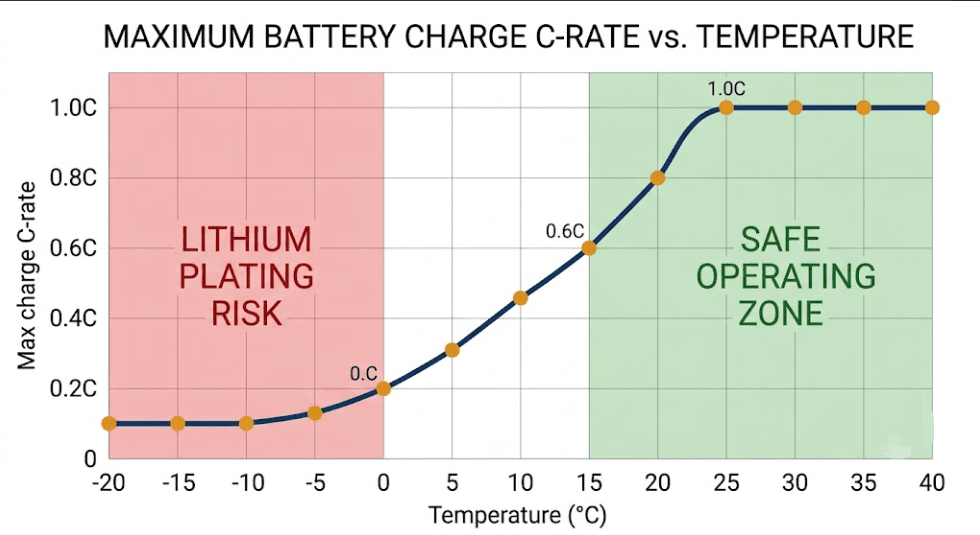
Below 0 °C, charge rates must be reduced or avoided entirely to prevent lithium plating.
Ensures cells are operated within safe voltage and temperature limits.
Final Thoughts
Temperature has a direct, measurable impact on LiFePO₄ cycle life. While the chemistry is far more temperature-tolerant than other lithium-ion types, excessive heat is still the fastest way to kill a battery.
By keeping your batteries in the optimal range, using a good BMS, and managing DOD, you can achieve 5,000+ cycles and over 10 years of reliable performance.
EU Regulations for Battery Energy Storage Systems:Battery Energy Storage Systems (BESS) are at the heart of Europe’s clean energy transition. By storing renewable electricity, they stabilize grids, reduce fossil fuel dependency, and enable smarter energy management. But with great opportunity comes strict regulation.
The European Union (EU) has introduced comprehensive rules to ensure that battery systems are safe, sustainable, and ethically sourced. For manufacturers, developers, and operators, understanding these regulations is critical to avoid penalties and stay competitive.
In this guide, we break down the EU Regulations for Battery Energy Storage Systems, highlight key compliance requirements, and provide a practical roadmap for companies preparing for 2026 and beyond.
Why the EU Is Tightening Battery Regulations
Europe’s ambitious climate goals—cutting greenhouse gas emissions and reaching net-zero by 2050—require a rapid scale-up of renewable energy and storage solutions. BESS plays a central role in integrating solar and wind into the grid.
However, batteries also pose risks:
Environmental impact from mining and disposal
Fire hazards if improperly managed
Supply chain concerns around critical raw materials
That’s why the EU replaced the older Battery Directive (2006/66/EC) with the EU Battery Regulation (2023/1542), introducing stricter sustainability, safety, and transparency rules.
This regulation entered into force on February 18, 2024, and will fully replace the previous Battery Directive by August 2025. It applies to all batteries sold in the EU, including industrial batteries used in energy storage systems.
Main requirements include:
Substance restrictions: Limits on hazardous materials such as mercury, cadmium, and lead.
Labeling & QR codes: Clear labeling of capacity, hazards, and recycling information, along with a scannable QR code.
CE marking: Batteries must carry CE certification, showing compliance with EU directives.
Battery Passport: From February 2027, all industrial batteries >2 kWh must include a digital “Battery Passport” with details on composition, carbon footprint, and recyclability.
Due diligence obligations: Large producers (turnover > €40M) must implement supply chain policies to ensure responsible sourcing.
2. Extended Producer Responsibility (EPR)
The EU applies Extended Producer Responsibility (EPR) to all batteries, including BESS. This means that producers must finance:
Collection and recycling programs
End-of-life treatment
Safe disposal methods
To meet obligations, companies can join Producer Responsibility Organisations (PROs), which handle compliance on their behalf.
This ensures that batteries don’t end up in landfills but are reused or recycled into the supply chain.
3. Clean Energy and Market Integration Rules
BESS isn’t just about hardware—it’s also about market access. The EU’s Clean Energy Package (2019) gives storage systems fairer treatment in electricity markets.
Key highlights:
BESS can participate in wholesale, balancing, and capacity markets.
Grid operators must treat storage fairly, avoiding double charging.
Developers benefit from streamlined permitting under the Net-Zero Industry Act (2024).
The Critical Raw Materials Act (2024) introduces stricter monitoring of strategic materials like lithium and cobalt.
Together, these measures aim to create a level playing field for battery operators while ensuring Europe’s independence from risky supply chains.
4. Safety Standards and Best Practices
Safety is a top concern for utility-scale battery projects. In 2025, the European Association for Storage of Energy (EASE) published Guidelines on Safety Best Practices, covering product design, site management, and emergency response.
For compliance, BESS projects must consider:
Voltage thresholds: DC ≤ 1500 V, AC ≤ 1000 V.
Minimum capacity: Systems above 20 kWh fall under stricter rules.
System-level testing: Incorporating IEC and CE standards into project certification.
In short, regulatory compliance is now a competitive differentiator in the fast-growing BESS sector.
Conclusion: EU Regulations for Battery Energy Storage Systems Preparing for 2026 and Beyond
The EU has set a high bar for Battery Energy Storage Systems. From CE marking and Battery Passports to EPR obligations and safety guidelines, every stakeholder must act now to prepare for full enforcement in 2025–2027.
For BESS companies, compliance isn’t a box-ticking exercise—it’s the foundation for long-term growth in the European market.
Sodium-Ion vs Lithium-Ion Batteries: As renewable energy adoption accelerates, demand for advanced battery energy storage systems (BESS) is rising. For years, lithium-ion batteries have dominated, powering everything from smartphones to large-scale grid storage. But today, a new contender—sodium-ion batteries—is gaining traction as a safer, cheaper, and more sustainable alternative.
In this post, we’ll explore how sodium-ion and lithium-ion batteries compare in performance, cost, safety, and future potential, and what this means for businesses and energy developers.
What Are Sodium-Ion and Lithium-Ion Batteries?
Lithium-Ion Batteries
Widely used in EVs, electronics, and BESS.
Offer high energy density and long cycle life.
Rely on lithium, a limited and costly resource, concentrated in a few countries.
Sodium-Ion Batteries
Emerging technology using sodium instead of lithium.
Sodium is abundant, low-cost, and evenly distributed worldwide.
Still in early commercialization stages but gaining momentum with companies like CATL and Faradion.
Key takeaway: Lithium-ion leads in maturity and energy density, while sodium-ion offers scalability and sustainability.
Performance Comparison: Energy Density and Efficiency
Lithium-Ion: Higher energy density (150–250 Wh/kg). Ideal for applications where space and weight matter, like EVs.
Sodium-Ion: Lower density (90–160 Wh/kg). Better suited for stationary energy storage where space is less critical.
Efficiency: Both achieve 85–95% round-trip efficiency in BESS applications.
👉 For residential and commercial storage, sodium-ion can deliver reliable performance without the premium cost of lithium.
Cost Advantage: Can Sodium-Ion Beat Lithium Prices?
Lithium-ion costs: Fluctuate due to limited supply of lithium, cobalt, and nickel.
Sodium-ion costs: Lower raw material prices (sodium is 1,000x more abundant than lithium).
Manufacturing: Sodium-ion cells can often use similar production lines as lithium-ion, reducing transition barriers.
Result: Sodium-ion is expected to become a cost-effective solution for large-scale BESS, especially as raw material scarcity drives lithium prices higher.
Safety Considerations
Lithium-Ion Risks: Thermal runaway, overheating, and fire hazards. Requires strict BMS (Battery Management Systems) and certifications.
Sodium: Widely available (seawater, salt deposits), eco-friendly extraction, reduces geopolitical risk.
👉 For businesses aiming to meet ESG and sustainability goals, sodium-ion offers a clear advantage.
Sodium-Ion vs Lithium-Ion Batteries Applications: Where Each Technology Shines
Lithium-Ion Best Fit:
Electric vehicles
Consumer electronics
High-density, mobile applications
Sodium-Ion Best Fit:
Grid-scale renewable energy storage
Residential and commercial BESS
Backup power in regions with strict safety standards
Sodium-Ion vs Lithium-Ion Batteries, Future Outlook: Instead of replacing lithium-ion, sodium-ion will likely complement it—dominating stationary storage while lithium retains the EV market.
Market Outlook for 2026 and Beyond
Major players like CATL, HiNa Battery, and Faradion are scaling sodium-ion production.
The EU Battery Regulation 2026 could accelerate adoption, as companies look for safer, sustainable, and compliant alternatives.
Analysts predict sodium-ion to capture a significant share of stationary BESS markets by 2030, especially in Asia and Europe.
Conclusion: (Sodium-Ion vs Lithium-Ion Batteries) The Future of Energy Storage
Both sodium-ion and lithium-ion batteries will play critical roles in the future of renewable energy and storage systems.
Lithium-ion remains the go-to for EVs and high-density needs.
Sodium-ion is set to become a cost-effective, safer, and more sustainable option for stationary BESS.
For businesses, utilities, and developers, the key is to choose the right battery technology for the right application. At SunLith Energy, we track these innovations to help our clients make informed decisions for reliable and future-proof energy storage.