
Battery Management System (BMS) Explained: How It Works, What It Monitors, and Why It Matters for BESS
| ⚡ Quick Answer: What Is a Battery Management System? A battery management system (BMS) is the electronic brain inside every lithium battery pack. It monitors cell voltage, current, and temperature in real time. It also protects cells from overcharge, over-discharge, short circuit, and thermal runaway. Furthermore, it estimates State of Charge (SOC) and State of Health (SOH). Without a BMS, a lithium battery is both unsafe and short-lived. |
Every lithium BESS relies on a battery management system to run safely. This is true for a 10 kWh home install and a 10 MWh grid system alike. In both cases, therefore, the BMS is not optional — it sits between your cells and everything that can destroy them.
Yet the BMS is one of the most overlooked parts of any BESS purchase. Buyers focus on cell chemistry, capacity, and cycle life. Then they treat the battery management system as a given. That is a costly mistake.
A poor BMS, therefore, degrades good cells. A great battery management system, in contrast, extends the life of average cells. It is a lifespan management tool — not just a safety device.
This guide explains how a battery management system works, what it monitors, and how it balances cells. We also cover SOC and SOH calculation and show you how to evaluate a supplier’s BMS before you sign. For context on how the BMS interacts with cell chemistry, first read our LiFePO4 vs NMC battery comparison guide.
1. What Is a Battery Management System?
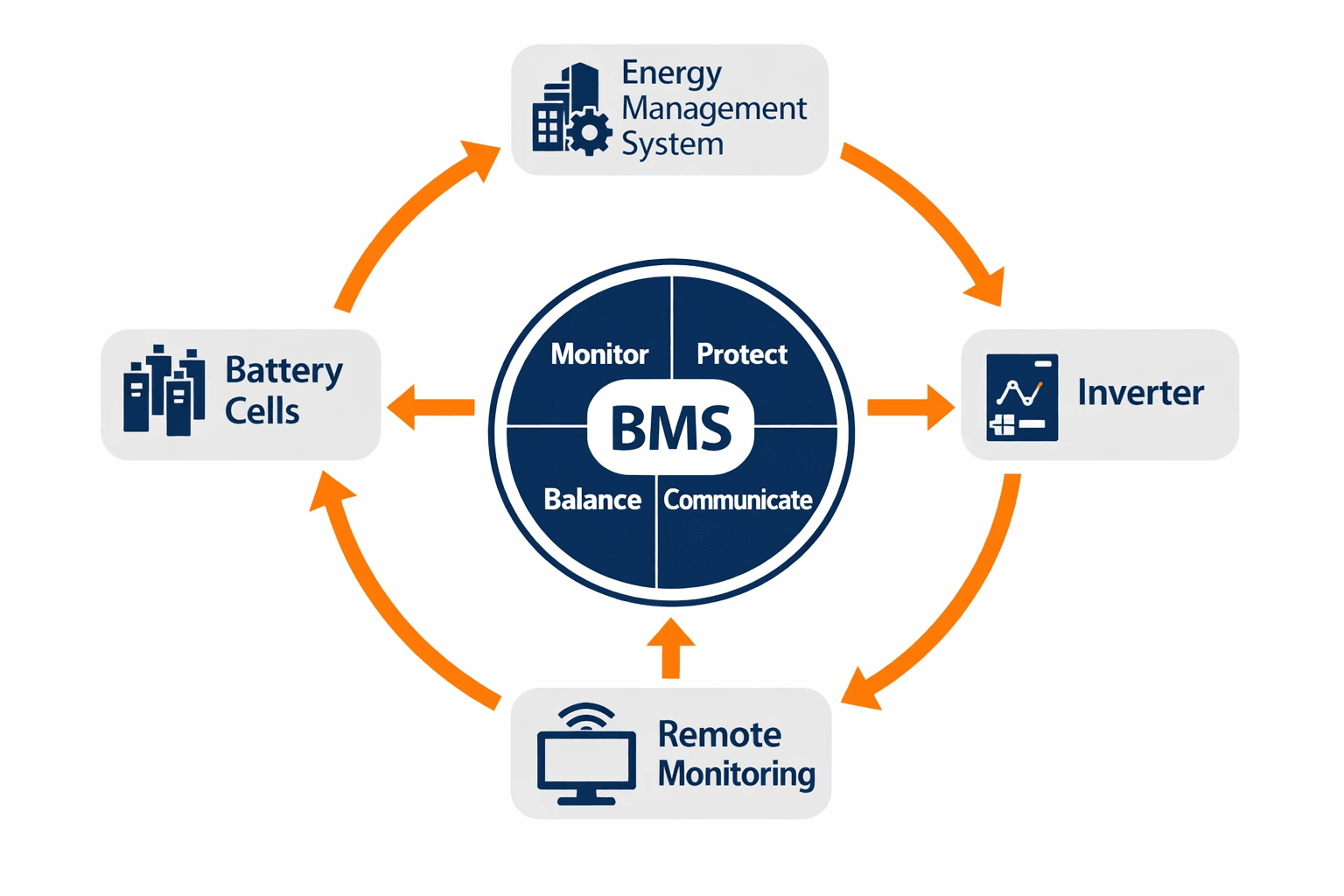
A battery management system (BMS) is an electronic control unit built into a battery pack. Specifically, its job is to protect cells, measure their state, and report data to the rest of the system.
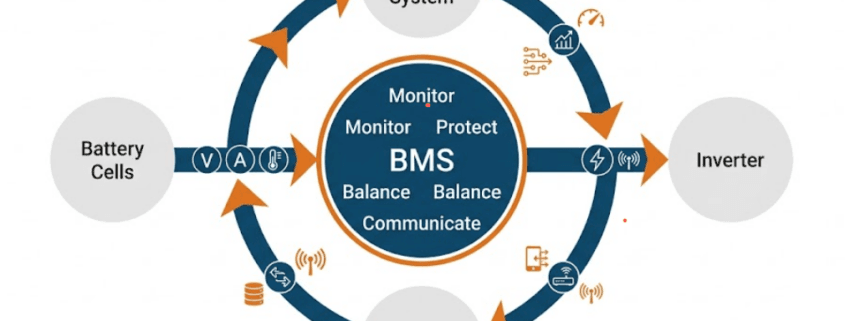
Think of the BMS as doing three jobs at once. First, it acts as a protection circuit — preventing electrical and thermal damage to the cells. Second, it is a measurement system — tracking voltage, current, temperature, SOC, and SOH. Third, it is a communication hub — sending live data to the inverter, EMS, and monitoring platform.
In a simple 12V residential pack, the BMS is a small PCB inside the module. In a commercial BESS, however, it manages hundreds of cells at once. The scale changes — but the core functions stay the same.
| 🔋 Why the Battery Management System Determines Lifespan Two identical cell packs with different BMS implementations deliver very different lifespans. Specifically, a BMS that allows cells to hit voltage limits, run hot, or drift out of balance will shorten cell life — regardless of the chemistry’s rated cycle count. The battery management system is, therefore, as important as the cells themselves. |
2. Battery Management System Functions: The Seven Core Jobs
A well-designed battery management system performs seven distinct functions. Each one protects the battery in a different way. Together, furthermore, they determine whether your BESS is safe, efficient, and long-lived.
2.1 Cell Voltage Monitoring
The BMS monitors every individual cell voltage — not just overall pack voltage. This matters because cells in a multi-cell pack drift apart over time. Specifically, one weak cell can hit its limit before the others do.
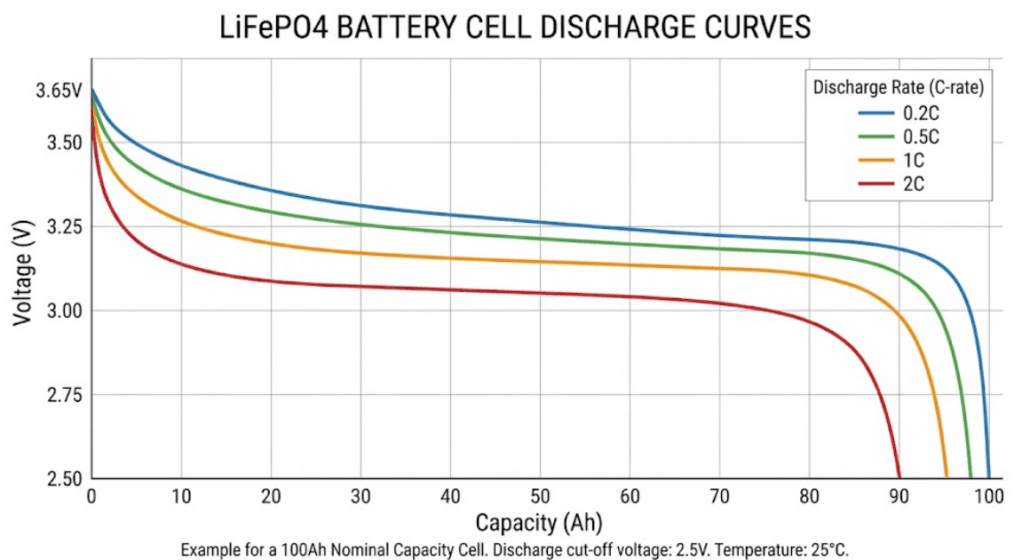
For LiFePO4 cells, the safe range is 2.5V to 3.65V per cell. Going outside this range — even briefly — causes permanent capacity loss. So the BMS must, therefore, detect and respond to violations in milliseconds.
Voltage monitoring also underpins SOC estimation, which we cover in Section 5. Without accurate cell-level data, furthermore, everything else the BMS does becomes unreliable.
2.2 Current Monitoring and Overcurrent Protection
The BMS measures charge and discharge current using a shunt resistor or Hall-effect sensor. Specifically, this data serves four purposes:
- Coulomb counting — integrating current over time to estimate SOC
- Overcurrent protection — detecting short circuits and excessive discharge rates
- C-rate enforcement — ensuring cells never charge or discharge faster than their rated speed
- Power limiting — reducing available power as SOC drops or temperature rises
2.3 Temperature Monitoring
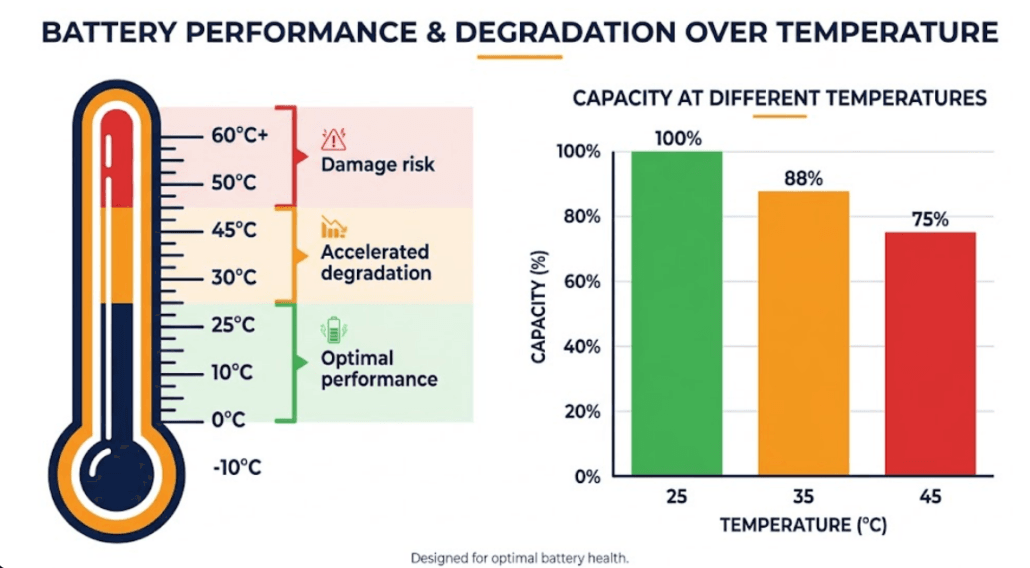
Temperature is one of the biggest drivers of battery degradation. Consequently, the BMS places sensors at multiple points — cell surfaces, busbars, and the enclosure. It uses this data to trigger cooling and reduce current.
It also halts charging below 0°C. Charging below freezing causes lithium plating. This is permanent anode damage that cannot be reversed.
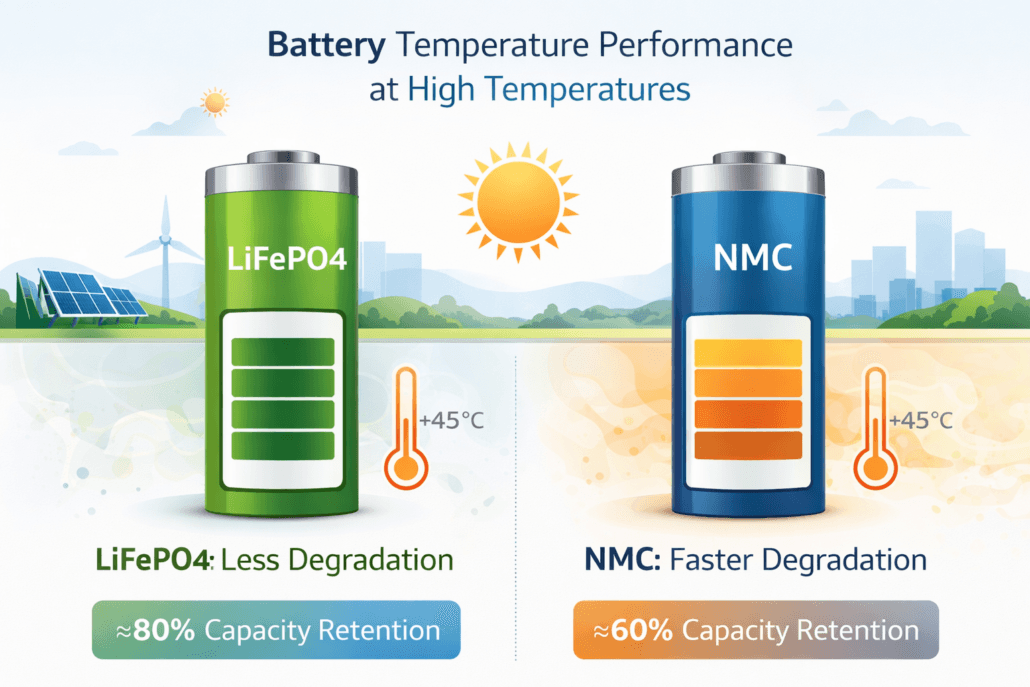
For LiFePO4, the safe charging range is 0°C to 45°C. Discharge, however, runs across a wider range of -20°C to 60°C. The BMS enforces both limits automatically.
2.4 Overcharge and Over-Discharge Protection
These are the two most critical BMS protection functions. Overcharging a lithium cell causes irreversible changes in the cathode. Similarly, over-discharging collapses the anode. Both permanently reduce capacity.
The BMS prevents both by triggering a contactor disconnect when any cell breaches its voltage limit. This happens even if the pack’s overall voltage looks normal. One weak cell can hit its limit while others still have headroom. That is why cell-level monitoring is non-negotiable.
2.5 Short Circuit Detection and Response
A short circuit sends a massive current spike through the pack in milliseconds. Without protection, the heat this creates can trigger thermal runaway. As a result, the BMS detects the spike and opens the contactor in microseconds — before damage occurs. Learn more about how these critical failure paths are analyzed and mitigated in our engineering deep-dive on BMS Functional Safety, HARA, and FMEA.
Furthermore, sustained overcurrent protection prevents operation at damaging C-rates. This applies even without a sudden short circuit event.
2.6 Cell Balancing
Cell balancing is one of the most important long-term BMS functions. It keeps all cells at the same State of Charge. Without it, the weakest cell limits the entire pack — even though the others still have energy to give.
We cover passive vs. active balancing in detail in Section 4. The key point, however, is this: balancing quality directly affects how much rated capacity you can use over time. In other words, poor balancing means lost energy.
2.7 Communication and Data Reporting
A modern battery management system communicates with the inverter, EMS, SCADA, and remote monitoring platforms. In particular, the most common protocols include:
- CAN bus — standard in high-performance BESS and automotive applications
- RS485 / Modbus RTU — common in commercial and industrial storage
- MQTT / TCP-IP — used for cloud monitoring and Battery Passport data exports
For a comprehensive look at how these networks function and talk to one another, read our complete guide on BESS Communication Protocols.
The BMS transmits SOC, SOH, cell voltages, temperatures, current, cycle count, and fault codes. Specifically, this data feeds dispatch decisions in the EMS and enables remote health tracking.
3. Battery Management System Architecture Options
BMS architecture scales with system size. Specifically, there are three implementation levels. Each one adds capability and complexity.
| BMS Tier | Also Called | Scope | Typical Application |
|---|---|---|---|
| Cell-level BMS | CBMS | Monitors individual cells in one module | Residential storage under 30 kWh |
| Module BMS | Slave BMS / MBMS | Manages one group of cells in a module | C&I systems, EV battery packs |
| System / Master BMS | SBMS / Master BMS | Coordinates all modules in the full pack | Utility-scale BESS, multi-rack systems |
Single-Level BMS (Residential)
In smaller systems — typically under 100 kWh — a single BMS manages all cells directly. This is a simple, low-cost architecture. Consequently, the BMS PCB sits inside the battery module and handles monitoring, protection, and balancing on its own.
However, as cell count grows, wiring becomes complex and processing load increases. Beyond a certain size, single-level BMS becomes impractical.
Master-Slave BMS (Commercial and Utility Scale)
In larger systems — typically above 100 kWh — a master-slave design is used. Each battery module has its own Slave BMS. It handles local cell monitoring and balancing. All Slave units then report to a central Master BMS, which coordinates the full system.
The Master BMS aggregates data from all modules and manages system-level protection. Furthermore, it communicates with the inverter and EMS. As a result, this architecture scales well to multi-megawatt-hour systems.
| ⚠️ Key Evaluation Point: Master-Slave Independence In a quality master-slave battery management system, each slave module should protect its own cells independently — even if communication with the master is lost. A BMS where cell protection depends entirely on the master, however, creates a single point of failure. Therefore, always ask: what happens to cell-level protection if the master controller fails? |
🔗 Read Also: For a deeper comparison including wiring protocols and wireless BMS, see our full BMS architecture guide
4. Cell Balancing in a Battery Management System: Passive vs. Active
Why Cells Need Balancing
No two lithium cells are identical. Manufacturing tolerances mean cells leave the factory with slightly different capacities. Moreover, temperature gradients within a pack cause some cells to age faster. Self-discharge rates also vary slightly between cells.
[!NOTE] For the manufacturing step that happens before balancing even starts, see our cell matching guide.
Over time, cells drift apart in State of Charge. The cell with the lowest SOC determines when discharge must stop. Similarly, the cell with the highest SOC determines when charging must stop. If cells are out of balance, the weakest cell constrains the entire pack — even though the others still have capacity.
The BMS corrects this drift through balancing. As a result, all cells stay at the same SOC and the full rated capacity remains usable.
Passive Balancing: Simpler and More Common
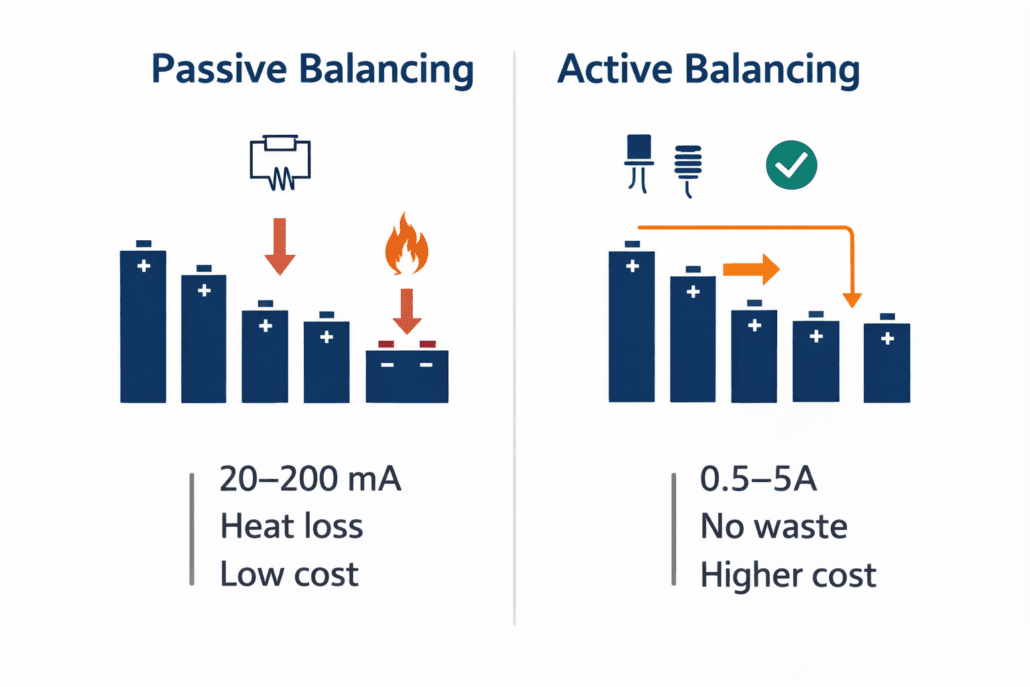
Passive balancing is, specifically, the most common approach. The BMS bleeds off excess charge from higher-SOC cells as heat through a resistor. It keeps doing this until, eventually, all cells match the lowest cell.
Advantages: Low cost, simple, reliable, and well-proven across millions of systems.
Disadvantages: Energy is wasted as heat. Balancing current is typically low (20–200 mA), so it is slow. In large packs with heavy imbalance, furthermore, passive balancing cannot keep up.
Passive balancing is, therefore, best suited to residential and small commercial systems. It works particularly well where cell quality is high and cycle frequency is moderate.
Active Balancing: Better for High-Cycle Systems
Unlike passive balancing, active balancing transfers energy from higher-SOC cells to lower-SOC cells using inductive or capacitive circuits. Energy is not wasted — instead, it is redistributed within the pack.
Advantages: No energy waste. Higher balancing currents (0.5–5A) mean faster correction. Better long-term capacity retention in high-cycle applications.
Disadvantages: Higher cost and more complexity. There are, therefore, more potential failure points in the balancing circuitry.
Active balancing is, therefore, best specified for utility-scale BESS, frequency regulation, and systems designed for 15+ year lifespans where long-term capacity retention is critical to ROI.
| Factor | Passive Balancing | Active Balancing |
|---|---|---|
| How it works | Burns excess charge as heat via resistor | Transfers charge between cells electronically |
| Energy efficiency | Low — energy wasted as heat | High — energy redistributed within pack |
| Balancing speed | Slow: 20–200 mA typical | Fast: 0.5–5A typical |
| System complexity | Simple and reliable | More complex, more failure points |
| Cost | Low | Higher (2–5x passive) |
| Best for | Residential and small C&I (under 500 kWh) | Utility-scale and high-cycle BESS (over 500 kWh) |
🧠 Interactive BMS Balancing Simulator
Simulate how a BMS manages individual cell drift and balances a 4-cell LFP pack.
*Visualized example based on a standard 4S LiFePO4 configuration operating near upper knee voltage thresholds.*
5. How the Battery Management System Estimates SOC (State of Charge)
Essentially, SOC is the fuel gauge of your battery. It shows how much energy is stored, expressed as a percentage of full capacity. Accurate SOC is essential for safe operation and efficient dispatch.
Importantly, SOC cannot be measured directly. Instead, it must be estimated from measurable quantities — voltage, current, and temperature. The BMS uses one or more algorithms to do this. Each method has distinct strengths and trade-offs.
Method 1: Open Circuit Voltage (OCV) Lookup
Specifically, this is the simplest SOC estimation method. When a battery has rested for 30–60 minutes, its Open Circuit Voltage maps to SOC via a lookup table. The table is built from cell characterisation tests.
However, OCV works poorly for LiFePO4. LFP has a very flat voltage curve between 20% and 80% SOC. Small voltage changes correspond to large SOC swings in this region. As a result, OCV-based SOC is inaccurate during normal operation. It is mainly useful for setting the initial estimate after a long rest period.
Method 2: Coulomb Counting
Coulomb counting integrates current over time. It tracks how much charge has entered or left the battery. As a result, it is the most widely used SOC method in real-time operation.
Coulomb counting is accurate over short periods. However, it accumulates error over time due to sensor tolerances, temperature effects, and small unmeasured currents. Without periodic recalibration, the estimate drifts.
Best practice: In practice, reset SOC to 0% or 100% when the battery hits its cutoff voltage. These anchor points correct accumulated drift effectively.
Method 3: Extended Kalman Filter (EKF)
The Extended Kalman Filter is the most accurate SOC method available. It combines Coulomb counting with a mathematical model of the battery’s electrochemical behaviour. Consequently, it corrects the estimate continuously based on the gap between model prediction and actual voltage.
EKF handles LFP’s flat voltage curve far better than OCV. It adapts in real time to temperature changes, aging effects, and varying loads. Furthermore, premium BMS platforms from Texas Instruments, Analog Devices, and Orion BMS use EKF or adaptive Kalman variants.
The trade-off: EKF requires significant processing power and a well-characterised cell model. It is, consequently, computationally demanding and needs careful tuning for each chemistry.
| SOC Method | Accuracy | LFP Suitability | Typical Use |
|---|---|---|---|
| Open Circuit Voltage | ±5–10% in flat region | Poor — flat curve limits accuracy | Initial SOC after rest period only |
| Coulomb Counting | ±3–5% short term, drifts over time | Good for real-time tracking | Residential and most C&I systems |
| Extended Kalman Filter | ±1–2% with good cell model | Excellent — handles flat curve well | Utility-scale BESS and precision apps |
6. How the Battery Management System Tracks SOH (State of Health)
State of Health (SOH) measures how much of a battery’s original capacity remains. A new battery starts at 100% SOH. Each cycle causes a small, permanent capacity loss. Consequently, the BMS tracks this degradation over the system’s lifetime.
Specifically, SOH is defined as: SOH (%) = (Current Capacity ÷ Original Rated Capacity) × 100.
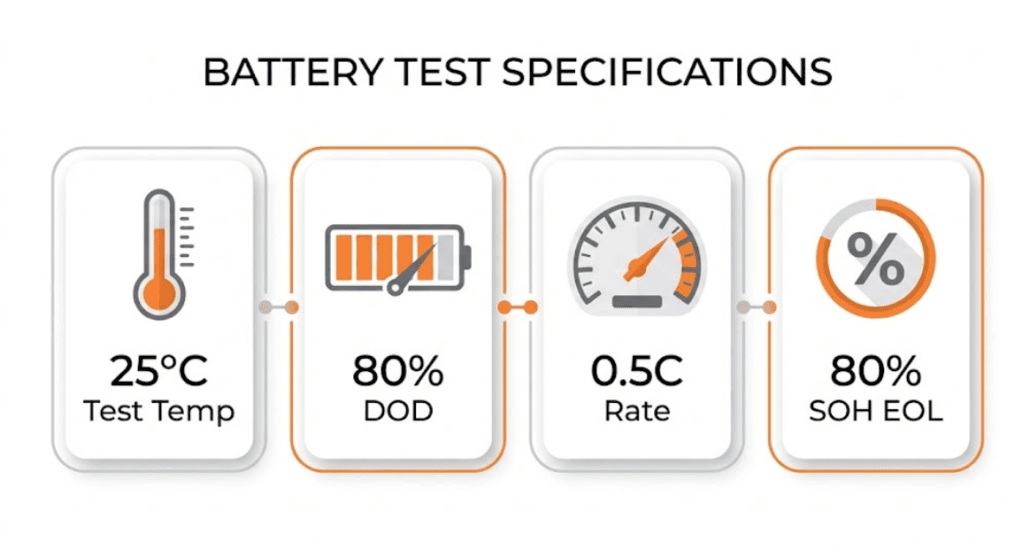
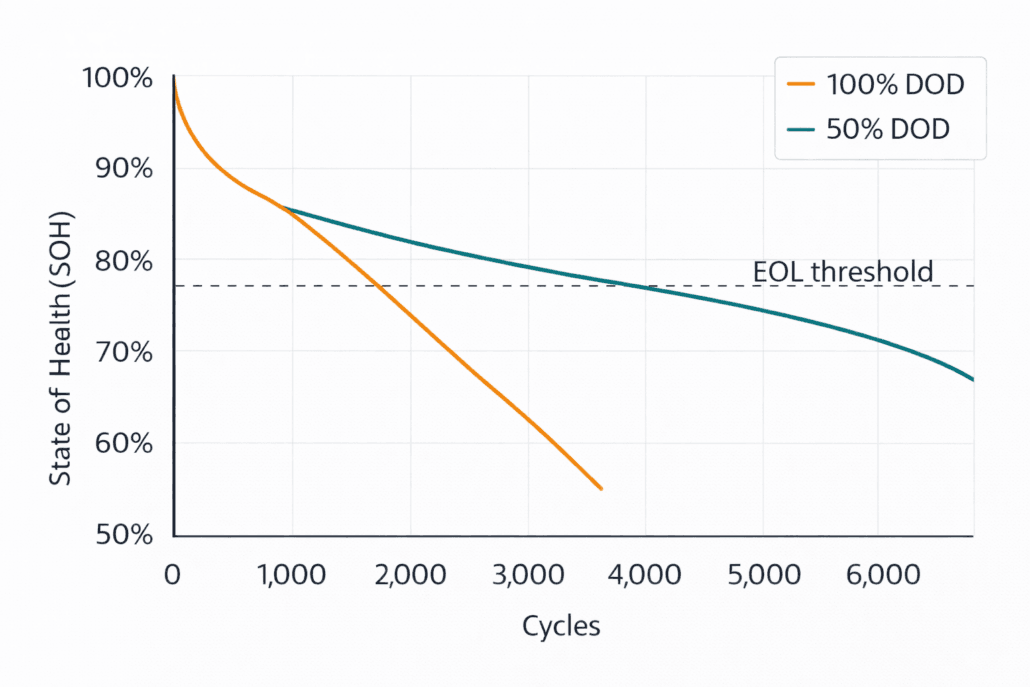
Notably, End of Life (EOL) is declared when SOH drops to 80% — or 70% in some industrial applications. For more on how EOL thresholds work in practice, see our Battery Cycle Standards guide.
How SOH Is Estimated Over Time
SOH cannot be measured with a single reading. Instead, the BMS builds up estimates using several data sources accumulated over time:
- Capacity fade tracking — comparing measured full-charge capacity against original rated capacity
- Internal resistance measurement — resistance increases as cells age; higher resistance correlates with lower SOH
- Cycle counting — simple but imprecise; does not account for partial cycles or varying depth of discharge
- Incremental Capacity Analysis (ICA) — an advanced technique that analyses the dV/dQ curve to detect electrochemical aging signatures
SOH Logging and Warranty Compliance
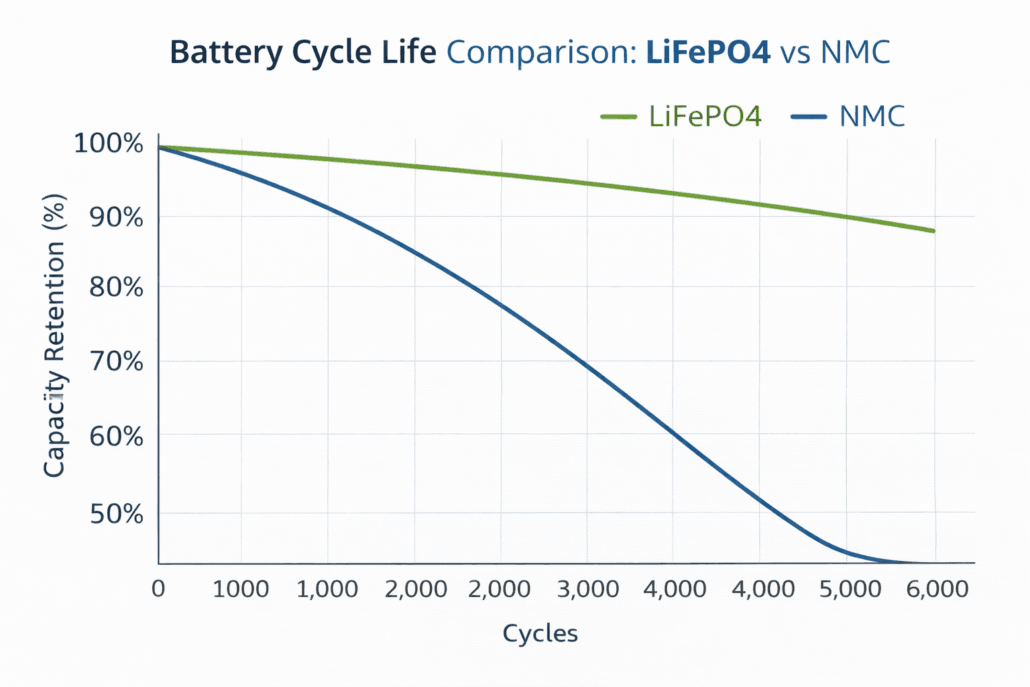
Accurate SOH logging matters for two reasons. First, it supports warranty claims. Most BESS warranties guarantee a minimum SOH at a set cycle count — for example, 80% SOH at 6,000 cycles. The BMS is the primary evidence source for any claim.
Second, SOH logging is becoming a regulatory requirement. The EU Digital Battery Passport, mandatory from February 2027 under EU Batteries Regulation 2023/1542, requires SOH history, cycle count, and energy throughput data. The battery management system is the primary source for all of it.
| 📊 Battery Management System SOH and Warranty Compliance A BMS that accurately logs SOH over time — with timestamped cycle data — makes warranty claims straightforward. A BMS without proper SOH logging, however, creates disputes. Always ask what SOH data is recorded, how long it is stored, and in what format it can be exported. |
7. Battery Management System Requirements: LiFePO4 vs. NMC
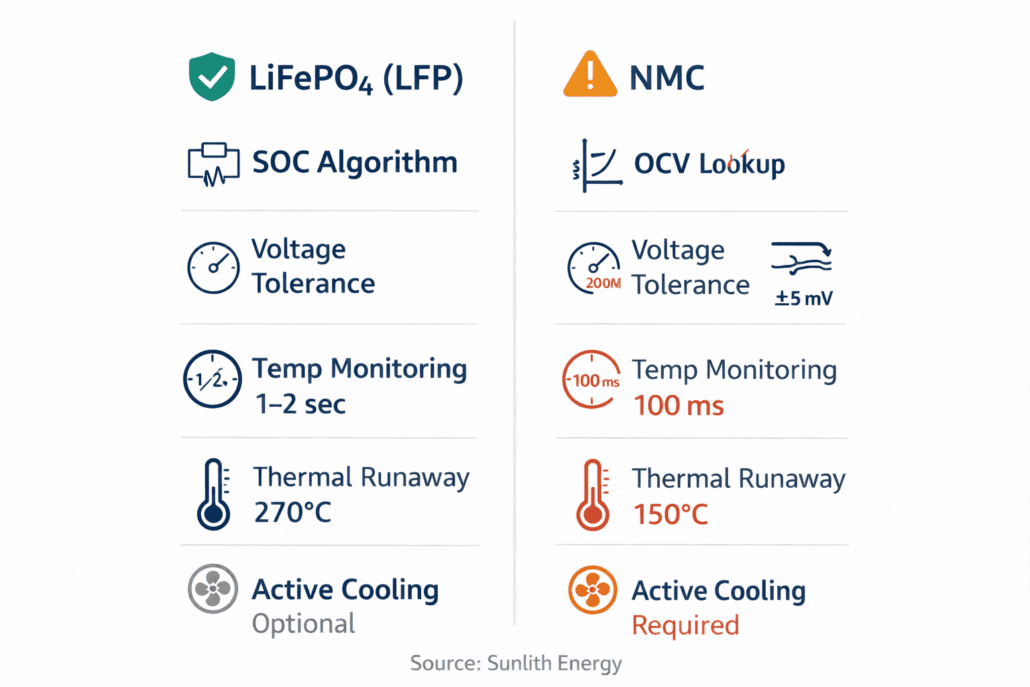
LiFePO4 (LFP) and NMC place very different demands on the battery management system. Understanding these differences, therefore, helps you confirm that a supplier’s BMS is genuinely designed for their stated chemistry. A BMS reused from a different application, for instance, will often perform poorly on LFP.
SOC Accuracy: Why LFP and NMC Differ
LFP’s flat voltage curve — discussed in Section 5 — makes SOC measurement significantly harder than NMC. An NMC cell’s voltage, in contrast, changes continuously and predictably with SOC. LFP, however, sits near 3.2V–3.3V across 80% of its SOC range. As a result, OCV lookup is unreliable for LFP in real-time operation.
Consequently, a BMS designed for NMC but deployed on LFP cells will show poor SOC accuracy. This leads to premature shutdowns or unexpected overcharge events. Always, therefore, confirm the BMS SOC algorithm is specifically calibrated for LFP chemistry.
Thermal Monitoring: NMC Is More Demanding
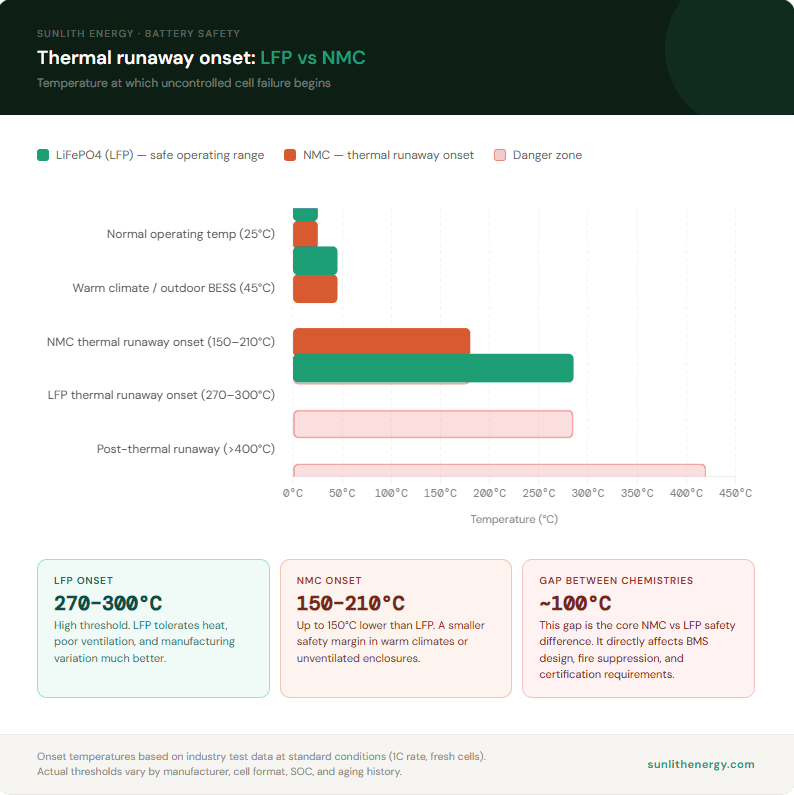
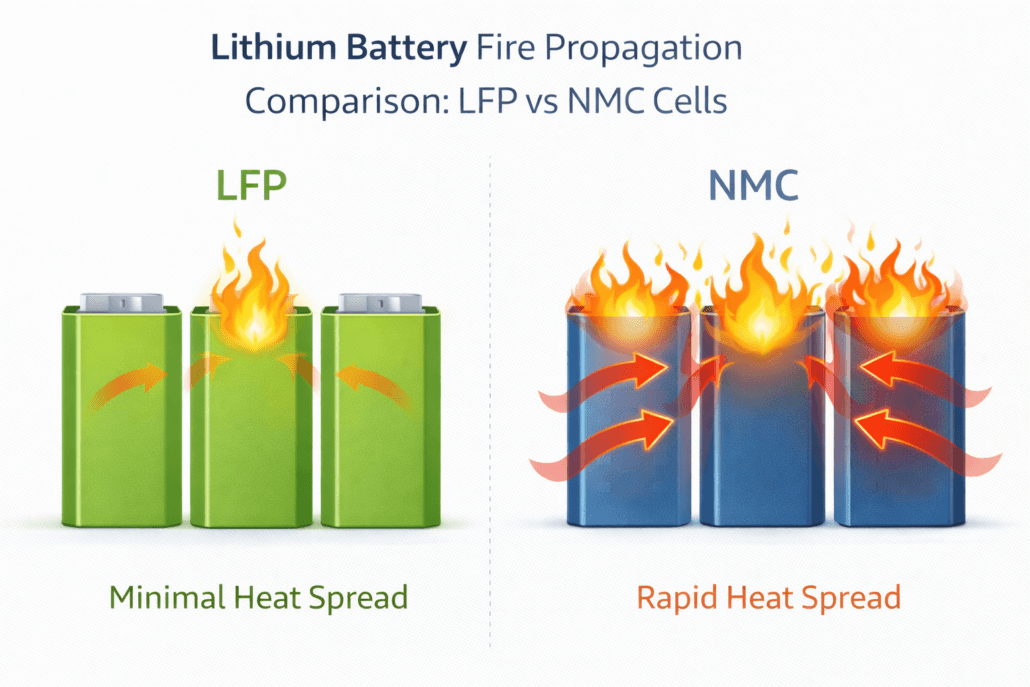
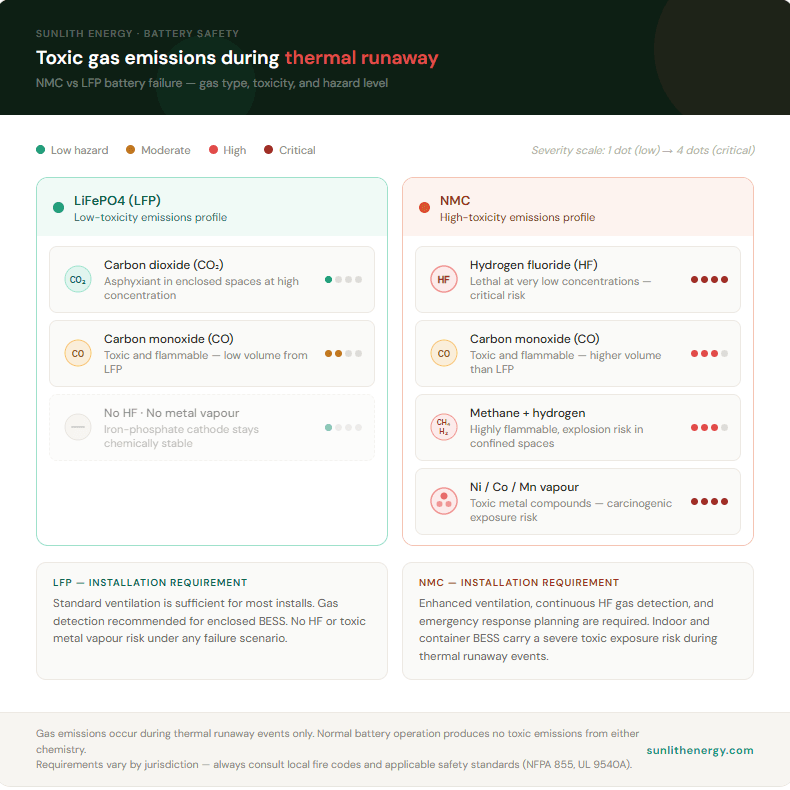
NMC cells are more temperature-sensitive than LFP. Specifically, they degrade significantly above 35°C and have a lower thermal runaway threshold — 150°C to 210°C versus 270°C to 300°C for LFP.
As a result, an NMC battery management system requires:
- Temperature monitoring intervals of every 100–500ms — versus every 1–2 seconds for LFP
- Faster thermal runaway response — disconnection in milliseconds when temperature spikes
- More temperature sensors per module — to catch hot spots before they spread
- Integration with active liquid cooling systems — which are common in NMC BESS
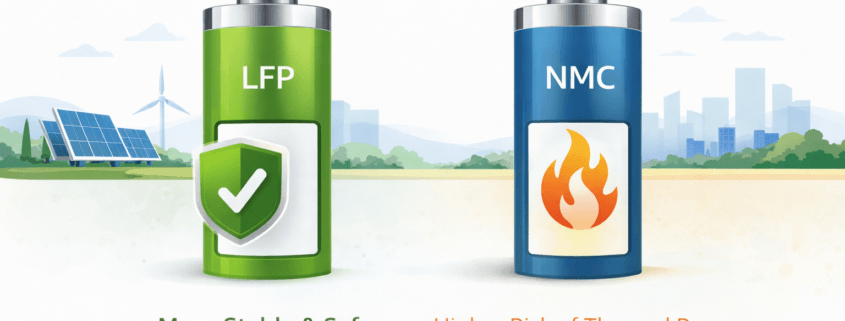
For more on how NMC and LFP compare on safety, see our complete NMC vs LFP safety guide.
Voltage Tolerance: Tighter Windows for NMC
NMC cells are damaged more easily by small voltage excursions above the charge cutoff. As a result, a BMS protecting NMC must enforce tighter tolerances — typically ±5mV per cell versus ±10–20mV for LFP. It must also respond faster when a cell approaches its limit.
| BMS Function | LiFePO4 (LFP) | NMC |
|---|---|---|
| SOC algorithm required | Coulomb counting or Kalman filter essential (flat curve) | OCV lookup or Coulomb counting (clearer voltage slope) |
| Voltage tolerance per cell | ±10–20mV | ±5mV — much tighter |
| Temperature monitoring interval | Every 1–2 seconds typical | Every 100–500ms — faster response needed |
| Thermal runaway response | Standard — higher threshold | Fast — lower runaway threshold (150–210°C) |
| Active cooling integration | Optional in most deployments | Often required |
| Overall BMS complexity | Standard | Higher on all parameters |
8. Battery Management System Certifications: Which Standards Apply
As a safety-critical component, the battery management system must, therefore, comply with the relevant standards for each market where the BESS will be installed. Certification covers both the BMS hardware itself and the complete battery system.
| Standard | Scope | BMS Relevance |
|---|---|---|
| UL 1973 | Stationary lithium battery systems | Cell, module, and BMS safety — required for US market access |
| UL 9540 | Complete BESS system safety | BMS must demonstrate system-level protection functions |
| IEC 62619 | Safety for lithium-ion batteries | International standard covering BMS protection requirements |
| IEC 62933-5 | ESS safety framework | Covers BMS communication, monitoring, and fault response |
| UN 38.3 | Transport safety for lithium batteries | BMS must survive vibration, altitude, and thermal tests |
| EU 2023/1542 | EU Batteries Regulation | BMS data required for Digital Battery Passport from 2027 |
The EU Digital Battery Passport and BMS Data
Specifically, the EU Digital Battery Passport becomes mandatory in February 2027 for industrial and EV batteries above 2 kWh. It is a QR-code record containing a battery’s full lifecycle data — SOH history, cycle count, energy throughput, and temperature exposure.
The battery management system is the primary data source for this passport. Consequently, any BESS sold into the EU after 2027 must have a BMS that records and exports this data in a compliant format. BMS data logging is, therefore, no longer just a technical feature. It is a regulatory requirement. For a full breakdown, see our EU 2023/1542 compliance guide.
9. How to Evaluate a Commercial Battery Management System
Most buyers evaluate batteries on capacity, cycle life, and price. The BMS is then treated as a given. That is a mistake. These eight questions, therefore, separate a robust battery management system from one that will cause problems in the field.
Questions 1–4: Protection and Accuracy
- Question 1: Is cell-level voltage monitoring standard — or only pack-level?
Cell-level monitoring is non-negotiable. A BMS that only monitors overall pack voltage cannot prevent localised overcharge or over-discharge. Always, therefore, confirm cell-level monitoring is standard — not an add-on.
- Question 2: What SOC algorithm is used — and is it calibrated for the cell chemistry?
If a supplier cannot answer this clearly, that is a red flag. OCV-based SOC on LFP is inaccurate. Ask whether Coulomb counting, Kalman filtering, or a hybrid method is used. Furthermore, confirm it is tuned for the specific cell chemistry in your system.
- Question 3: Is balancing passive or active — and what is the balancing current?
For high-cycle applications or systems above 500 kWh, active balancing is preferable. For smaller residential systems, passive balancing at 100 mA or above is adequate. In contrast, a balancing current under 50 mA in a large pack is a warning sign.
- Question 4: How fast does the BMS respond to overcurrent and thermal events?
Short circuit response must be in microseconds. Thermal runaway disconnection must happen in under 100ms. Specifically, ask for the fault response time in the specification — not just a general claim that protection exists.
Questions 5–8: Communication, Data, and Certification
- Question 5: What communication protocols are supported?
Confirm the BMS communicates with your inverter and EMS. CAN bus and Modbus RTU are the most common protocols. Additionally, cloud connectivity via MQTT or TCP-IP is increasingly important for monitoring and Battery Passport data exports.
- Question 6: Does the BMS log SOH and cycle data — and for how long?
SOH logging is essential for warranty claims and EU Battery Passport compliance. Ask how many years of data is stored, which parameters are logged, and how the data is exported. Consequently, a BMS with no data export capability is a liability for EU market sales after 2027.
- Question 7: What happens to cell protection if the master controller fails?
In a master-slave BMS, slave modules must maintain cell-level protection independently — even without master communication. A system where protection depends entirely on the master creates a single point of failure. Therefore, always ask this question before signing.
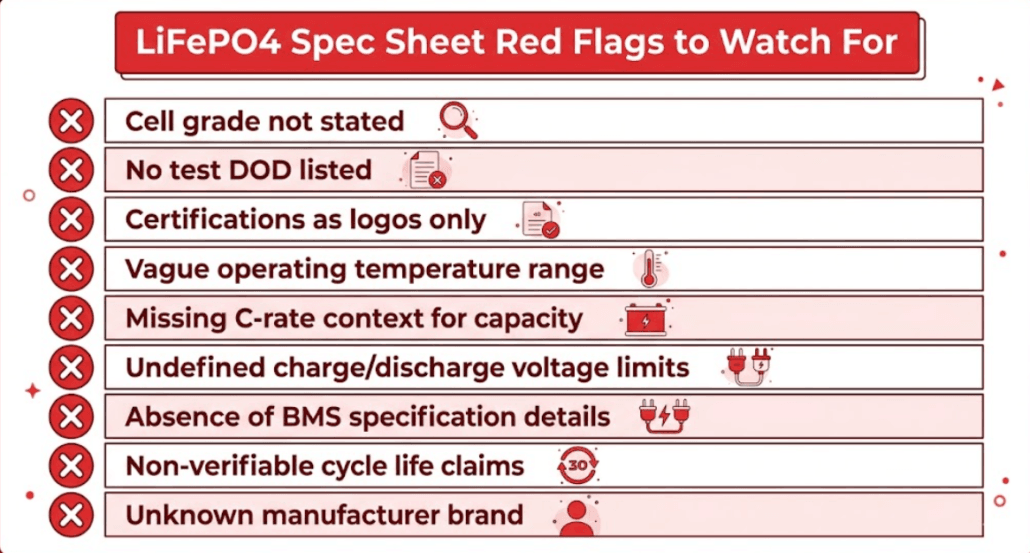
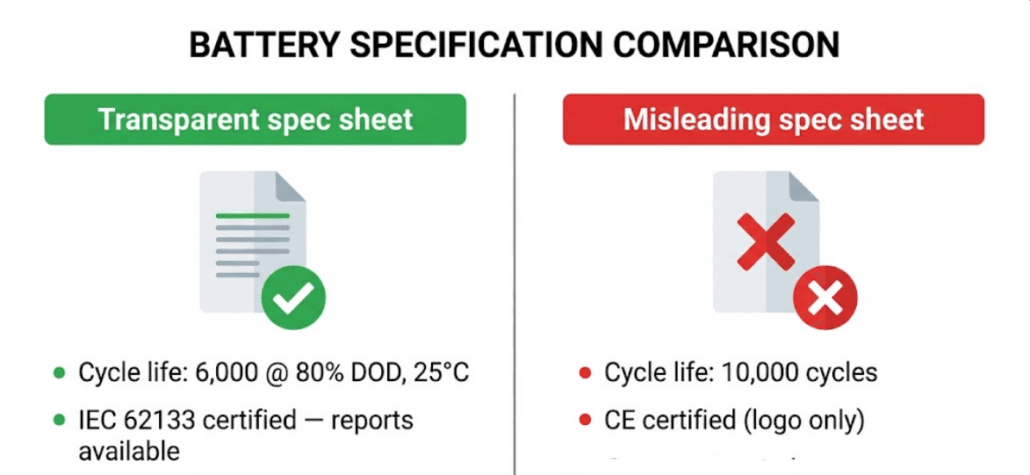
- Question 8: Which certifications does the BMS hold — and can you provide test reports?
UL 1973, IEC 62619, and IEC 62933-5 are the key standards. A reputable supplier provides full test documentation — not just a certificate summary. If they hesitate, that is therefore a red flag.
10. Common Battery Management System Failure Modes
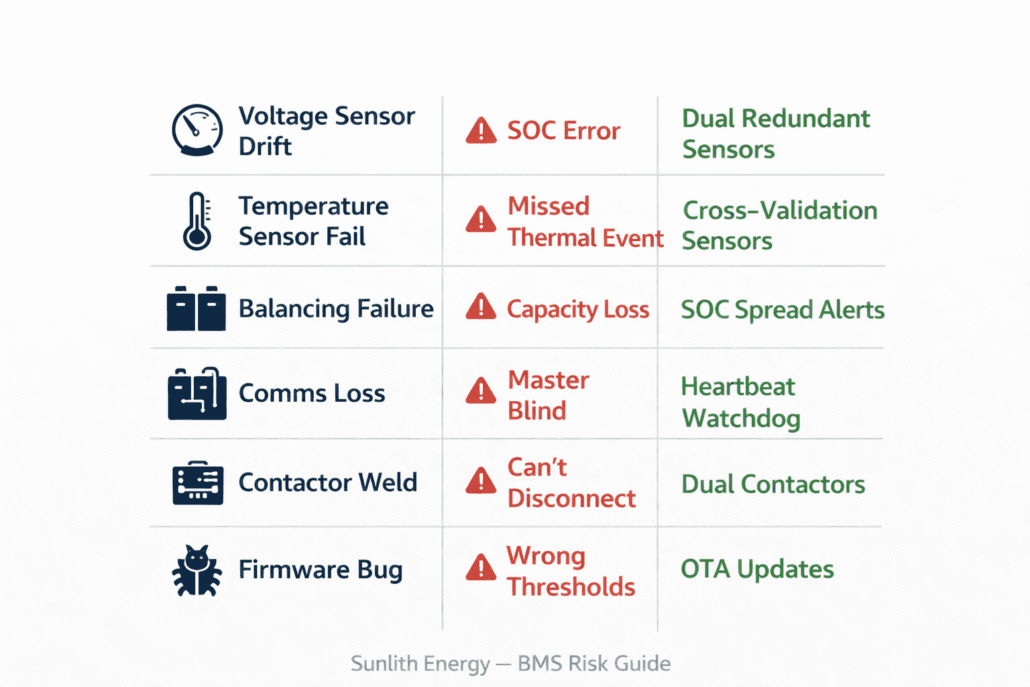
Understanding how a battery management system can fail helps you design systems with the right redundancy. It also helps you evaluate suppliers whose BMS architecture accounts for these risks.
| Failure Mode | Consequence | Prevention |
|---|---|---|
| Voltage sensor drift | Incorrect SOC — risk of overcharge or over-discharge | Dual redundant sensors; periodic recalibration against known references |
| Temperature sensor failure | Missed thermal event — possible thermal runaway | Multiple sensors per module; cross-validation between sensors |
| Balancing circuit failure | Cell imbalance grows; usable capacity shrinks | Active monitoring of balancing currents; SOC spread alerts |
| Master-slave communication loss | Master loses visibility of module status | Slaves maintain local protection; heartbeat watchdog triggers alarm |
| Contactor weld failure | BMS cannot disconnect pack during a fault | Pre-charge circuits; contactor health monitoring; dual contactors on large systems |
| Firmware bugs | Incorrect protection thresholds; SOC errors; unexpected lockouts | OTA firmware updates; staged rollouts; version logging with rollback capability |
11. The Battery Management System in a Complete BESS: System Integration
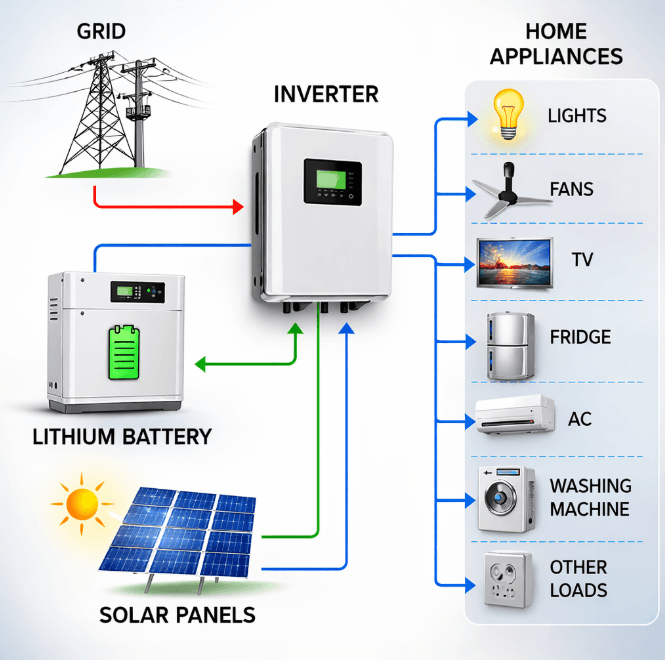
Importantly, the battery management system does not operate in isolation. In a complete BESS, it sits at the centre of a data and control network — connecting cells to the inverter, the EMS, the monitoring platform, and the thermal management system.
Connecting to the Inverter
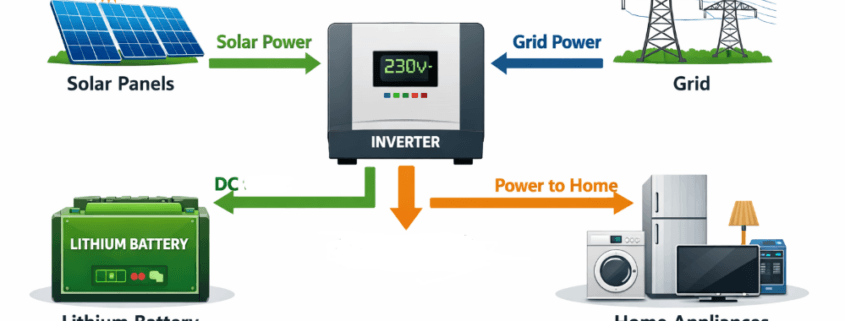
The BMS sends SOC, available power, voltage, and fault status to the inverter in real time. The inverter uses this data to manage charge and discharge rates and respect SOC limits. It also triggers a soft shutdown when the battery approaches empty.
Without reliable BMS-to-inverter communication, the inverter operates blind. As a result, overcharge or deep discharge events become possible.
Connecting to the Energy Management System (EMS)
The EMS sits above the BMS in the control hierarchy. It uses BMS data to decide when to charge, when to discharge, and how much power to commit to a grid services contract. Consequently, a BMS that cannot communicate reliably with the EMS limits the system’s ability to optimise for economics.
To understand how BESS economics work in practice, see our guide on calculating BESS ROI.
Connecting to Remote Monitoring Platforms
Cloud-connected monitoring platforms use BMS data to track performance and flag early warnings. Typical parameters include SOC, SOH, cell voltage spread, temperatures, energy throughput, and fault logs. Moreover, this data is increasingly required for EU Battery Passport compliance after 2027.
Connecting to Thermal Management Systems
In systems with active cooling — fans or liquid cooling — the BMS directly controls the thermal hardware. It turns cooling on and off based on real-time cell temperature readings. In liquid-cooled NMC systems, this link is especially critical. In LFP systems, thermal management is simpler — but still important in warm climates or poorly ventilated enclosures.
Conclusion: The Battery Management System Is Not a Commodity
The battery management system determines whether a BESS is safe. It also determines whether cells reach their rated cycle life — and whether capacity is fully used. It is, therefore, not a component to be cut from the bill of materials.
Here are the key takeaways from this guide:
- Cell-level voltage and temperature monitoring are non-negotiable in any lithium system
- SOC algorithm choice matters enormously — especially for LFP’s flat voltage curve
- Balancing method should match your cycle frequency and system size
- SOH logging is now a regulatory requirement under the EU Battery Passport — not just a technical feature
- BMS architecture must scale with system size: single-level for residential, master-slave for commercial and utility
- Use the eight evaluation questions above before accepting any supplier’s BMS specification
Overall, whether you are designing a 10 kWh home system or a 10 MWh grid-scale BESS, the battery management system deserves the same scrutiny as the cells. A good BMS extends the life of average cells. A poor BMS, in contrast, shortens the life of great ones.
| ☀️ Need a Battery Management System Review for Your BESS Project? Sunlith Energy reviews BMS specifications and supplier documentation for BESS projects from 50 kWh upward. Specifically, we identify gaps in protection architecture, SOC algorithm suitability, and certification compliance — before you sign a purchase order. Contact us |
Frequently Asked Questions About the Battery Management System
Does a LiFePO4 battery need a BMS?
Yes — without exception. LiFePO4 is chemically stable, but it still needs a battery management system. Specifically, the BMS prevents overcharge, over-discharge, short circuit, and thermal damage. No reputable BESS supplier ships lithium cells without one.
What is the difference between a BMS and a battery controller?
The battery management system monitors and protects individual cells and modules. A battery controller — or Master BMS — manages the full system and coordinates with the inverter and EMS. In simple residential systems, one device does both. In large commercial systems, however, they are typically separate hardware.
Can a BMS extend battery life?
Yes — significantly. A BMS keeps cells within safe voltage and temperature limits. It also maintains good cell balance and enforces appropriate C-rate limits. As a result, it extends cell life considerably compared to unprotected operation.
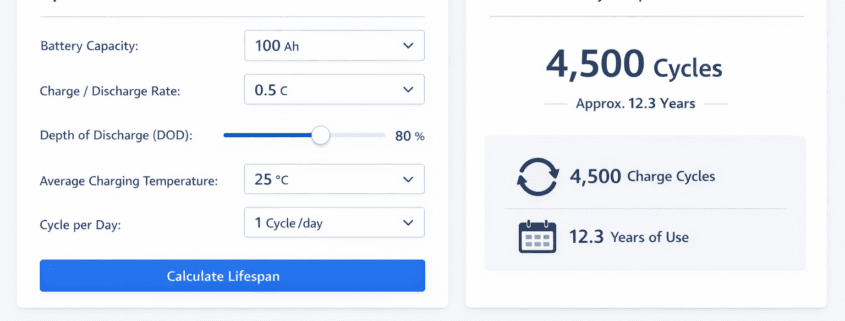
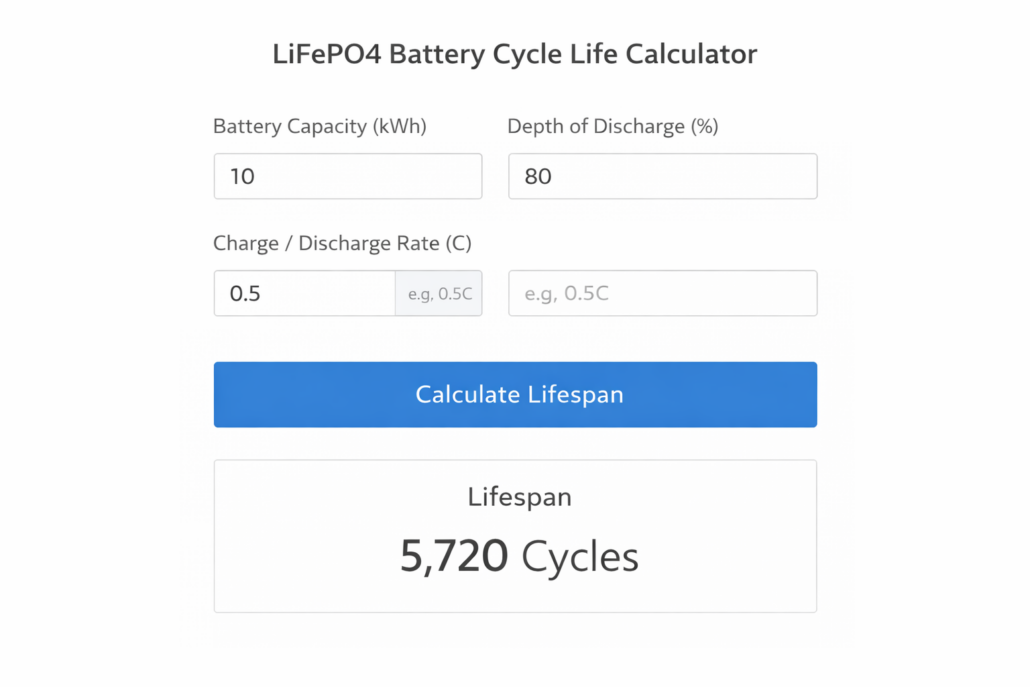
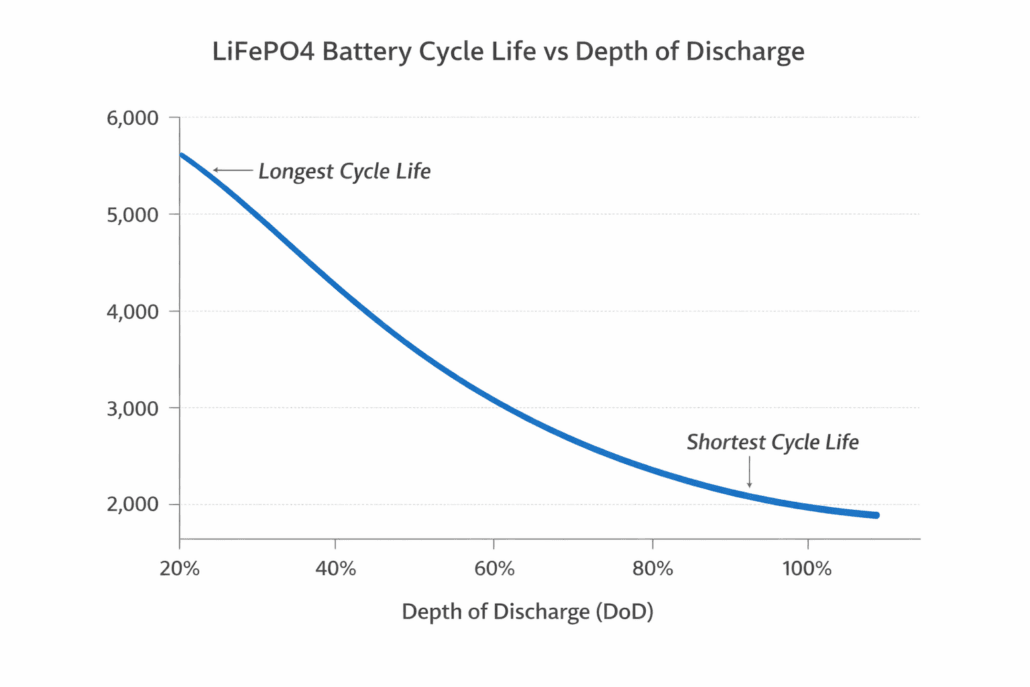
To see how lifespan translates to real-world cost, furthermore, use our Battery Cycle Life Calculator.
What communication protocol should my BMS use?
This depends on your inverter and EMS. CAN bus is most common in high-performance systems. Modbus RTU over RS485, however, is standard in commercial and industrial storage. Check your inverter’s compatibility list first — mismatched protocols require additional gateway hardware and add cost and complexity.
How do I know if my BMS is failing?
Watch for these warning signs: SOC readings that jump unexpectedly; growing cell voltage spread, which indicates poor balancing; shutdowns not caused by actual low SOC; temperature readings that are static or incorrect; and fault codes that repeat in the log without a clear cause. In particular, growing cell voltage spread is often the earliest signal of BMS trouble.
Remote monitoring platforms are, therefore, the most reliable early detection tool. They flag SOC spread and temperature anomalies before they become failures.
Sources and Further Reading
NLR Battery Degradation Research
IEC 62619 Standard — Safety requirements for secondary lithium cells and batteries
IATA Lithium Battery Guidance Document
EU Batteries Regulation (EU 2023/1542) — European Commission
Related Reading from Sunlith Energy
Learn how the BMS coordinates data across the entire storage network in our full guide to BESS Communication Protocols.
LiFePO4 vs NMC Battery: Why LFP Delivers Lower Lifetime Cost
NMC Battery vs LFP Safety: The Complete BESS Risk Breakdown
Battery Cycle Standards Explained: SOH, DOD, and EOL
Battery Cycle Life Calculator — sunlithenergy.com/battery-cycle-life-calculator/
EU 2023/1542: Compliance Deadlines and Battery Passport Guide