
LiFePO4 vs NMC Battery: Why LFP Delivers Lower Lifetime Cost for Energy Storage
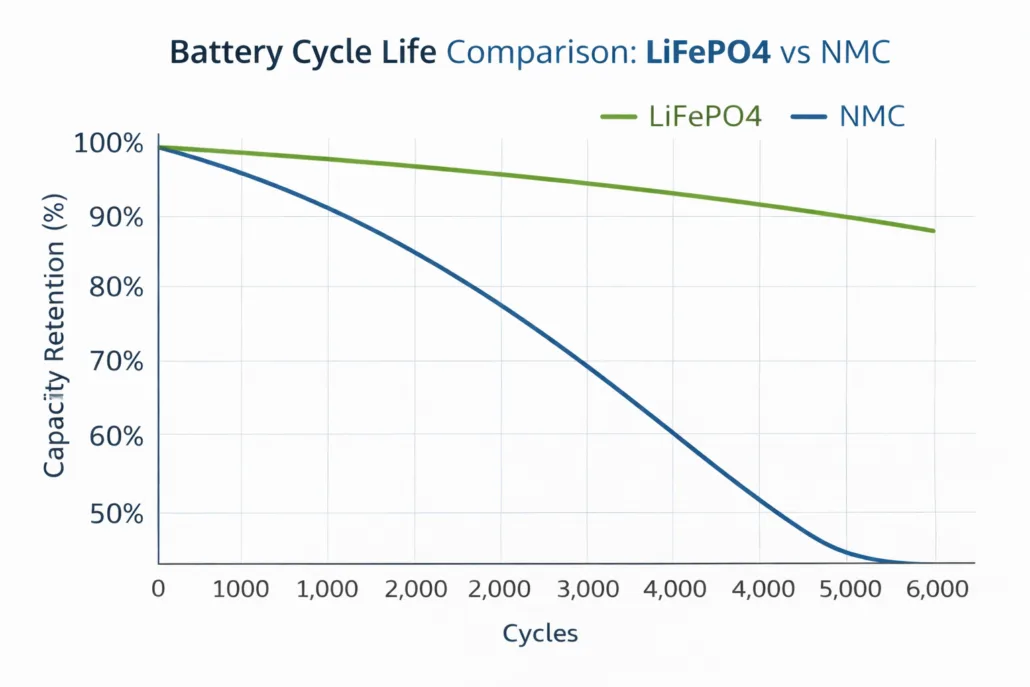
LiFePO4 vs NMC battery cycle life tells the real story: LFP delivers 3,000–10,000+ cycles, NMC typically 1,000–3,000 under the same conditions. That gap determines your total cost of ownership, replacement schedule, and real-world BESS performance over a 10–20 year project life.
In this guide, we compare LiFePO4 vs NMC battery performance across cycle life, State of Health (SOH), Depth of Discharge (DOD), temperature sensitivity, and End of Life (EOL). As a result, you’ll be able to compare options accurately — and avoid expensive mistakes.
Already familiar with SOH, DOD, and EOL? Jump straight to the comparison table below. New to these terms? Start with our Battery Cycle Standards Explained guide.
What Are LiFePO4 and NMC Batteries?
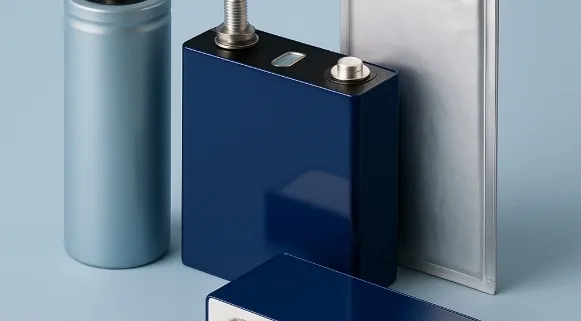
LiFePO4 (Lithium Iron Phosphate — LFP)
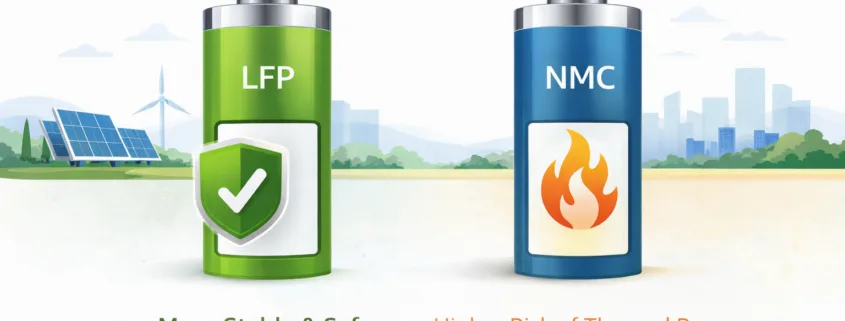
LiFePO4 uses an iron-phosphate cathode. It has a lower energy density than NMC. However, it is chemically far more stable. This stability gives LFP its well-known safety and longevity advantages.
Common applications: Solar energy storage, BESS, backup power, C&I storage, off-grid systems.
NMC (Nickel Manganese Cobalt)
NMC uses a combination of nickel, manganese, and cobalt in the cathode. Therefore, it delivers higher energy density per kilogram. This makes it popular in applications where space and weight matter most.
Common applications: Electric vehicles, portable electronics, space-constrained C&I BESS.
LiFePO4 vs NMC Battery: Cycle Life
This is where most buyers start — and where most buyers get misled.
LiFePO4 Cycle Life
LFP cells tested under standard conditions (25°C, 80–100% DOD, EOL at 80% SOH) typically deliver:
- 3,000–6,000 cycles for standard-grade cells
- 6,000–10,000+ cycles for premium-grade cells (e.g., CATL, BYD, EVE)
The reason LFP lasts longer is its chemistry. The iron-phosphate bond is extremely stable. As a result, it does not break down as quickly during repeated charge-discharge cycles.
NMC Cycle Life
NMC cells tested under comparable conditions typically deliver:
- 1,000–3,000 cycles for standard-grade cells
- 2,000–4,000 cycles for premium-grade cells
The cobalt and nickel cathode structure is less stable than iron-phosphate. Therefore, each cycle causes slightly more lattice degradation. Over time, this accumulates faster.
The Spec Sheet Trap
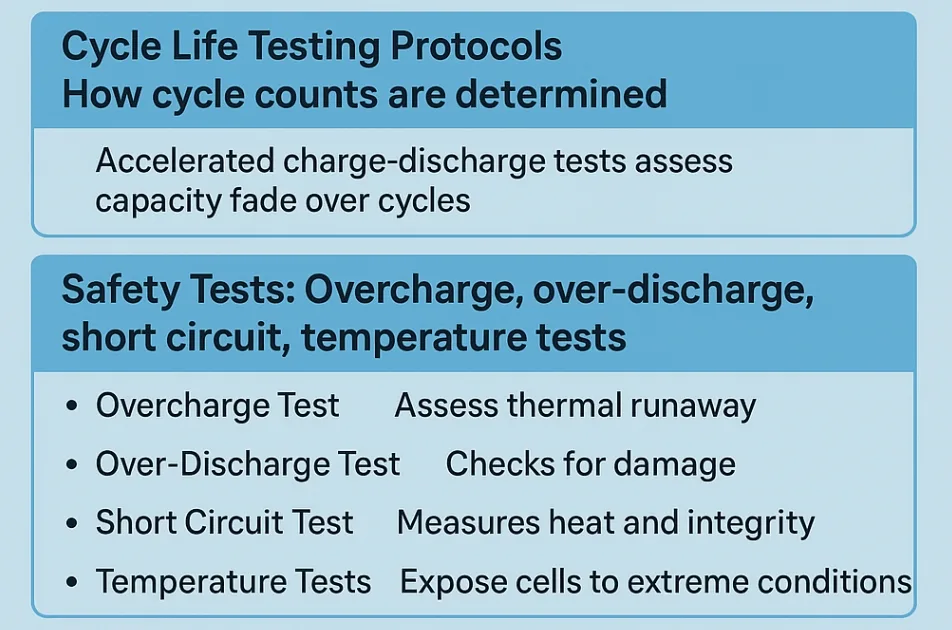
Both chemistries suffer from the same problem. Manufacturers test at favourable conditions to inflate the published cycle number. For example, a common tactic is to test NMC at shallow DOD (e.g., 50%) to produce an impressive cycle count. They then compare that figure against LFP tested at full DOD. The result is a misleading comparison.
✅ Always compare cycle life tested under the same DOD, temperature, and EOL threshold. If these three conditions don’t match, the comparison is meaningless.
✅ The battery management system is also tested under these conditions — understanding what it monitors helps you read those numbers more critically.
LiFePO4 vs NMC Battery: State of Health (SOH)
SOH tells you how much capacity a battery retains compared to when it was new. A battery starts at 100% SOH. It then degrades with each cycle.
How LFP Ages
LFP degrades slowly and predictably. The capacity fade curve is relatively flat. In other words, most degradation happens gradually across the full lifespan. It does not drop sharply at a certain point.
A typical LFP cell looks like this over its life:
| Cycles | SOH |
|---|---|
| 0 | 100% |
| 1,000 | 96–97% |
| 3,000 | 90–92% |
| 6,000 | 80% (EOL) |
This predictability makes LFP ideal for long-term performance planning. For example, it works well for BESS ROI models, warranty structuring, and grid contracts.
How NMC Ages
NMC degrades faster. In addition, its degradation curve is less linear. In particular, NMC experiences accelerated degradation when operated at high temperature, high SOC (above 90%), or deep DOD. These conditions are all common in energy storage applications.
A typical NMC cell under similar conditions:
| Cycles | SOH |
|---|---|
| 0 | 100% |
| 500 | 94–95% |
| 1,500 | 85–87% |
| 2,500 | 78–80% (approaching EOL) |
For storage applications that cycle daily — such as solar self-consumption or peak shaving — NMC will therefore reach EOL significantly faster than LFP.
LiFePO4 vs NMC Battery: Depth of Discharge (DOD)
DOD directly affects how long your battery lasts. The deeper you discharge, the fewer total cycles you get.
LFP and DOD
LFP handles deep discharge well. Most LFP systems are designed for 80–100% DOD in daily operation. As a result, there are no dramatic cycle life penalties.
Practical guidance for LFP:
- 100% DOD: Full rated cycle life (e.g., 6,000 cycles)
- 80% DOD: Slight extension (~10–15% more cycles)
- 50% DOD: Significant extension — some LFP cells reach 12,000+ cycles
NMC and DOD
NMC is much more sensitive to deep discharge. Operating NMC at 100% DOD regularly will substantially shorten its life. Because of this, many NMC-based storage systems are deliberately limited to 80–90% usable capacity to protect the cells.
Practical guidance for NMC:
- 100% DOD: Significantly accelerates degradation — not recommended for daily cycling
- 80% DOD: Standard operating range; spec sheet cycle figures often assume this
- 50% DOD: Can double the effective cycle count vs. 100% DOD
⚠️ If your application requires deep daily discharge — solar storage, overnight backup, peak shaving — LFP’s tolerance for high DOD is therefore a major practical advantage.
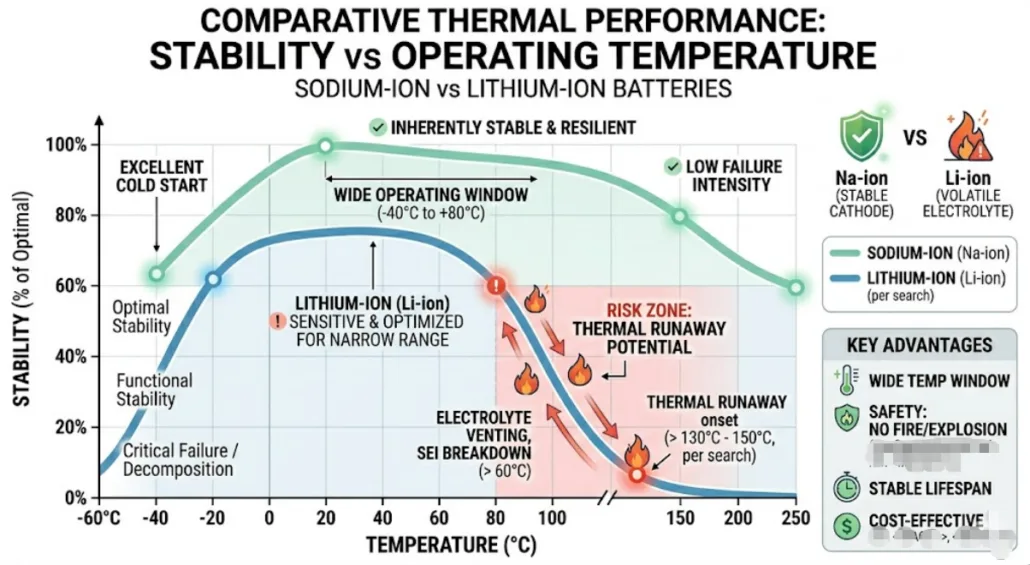
LiFePO4 vs NMC Battery: Temperature Sensitivity
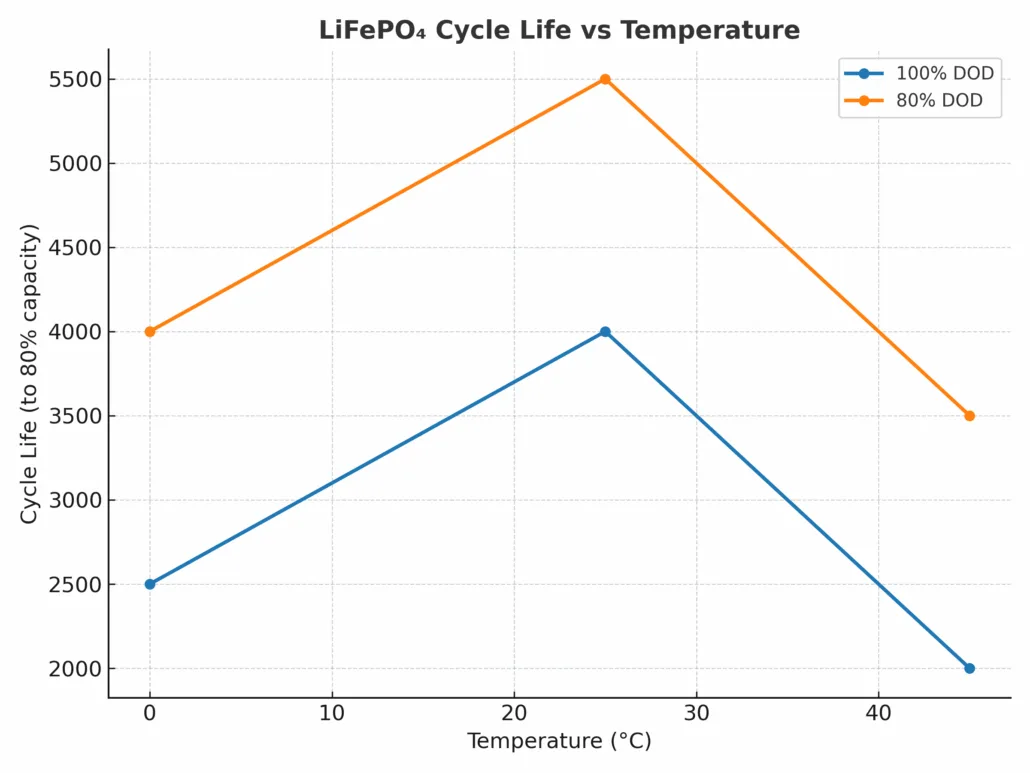
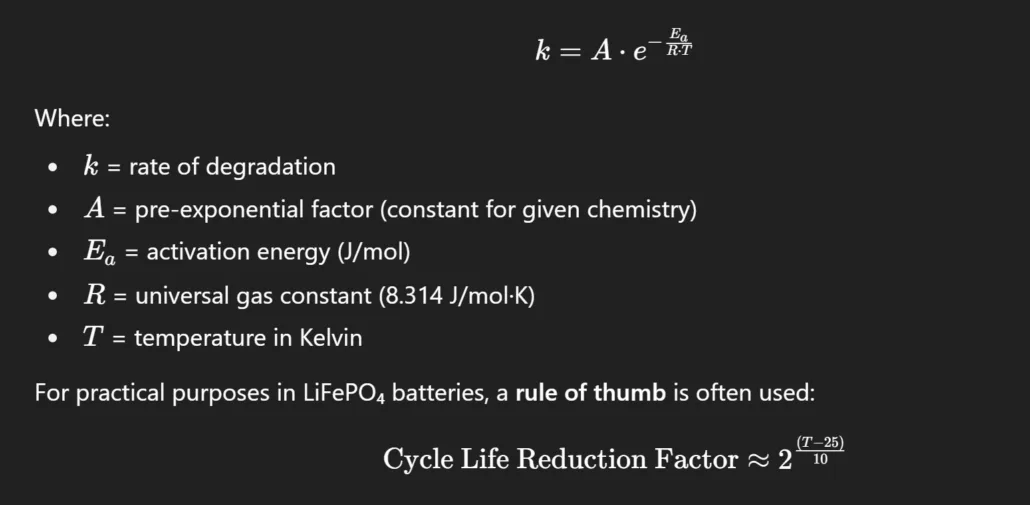
Temperature is one of the biggest hidden variables in battery lifespan. Furthermore, it is where the LiFePO4 vs NMC battery gap widens most dramatically.
LFP and Temperature
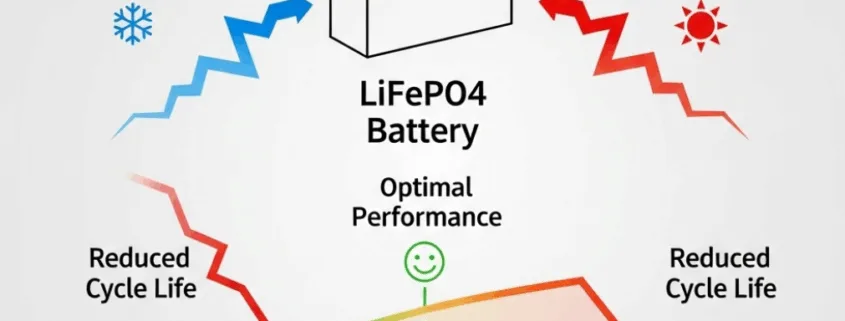
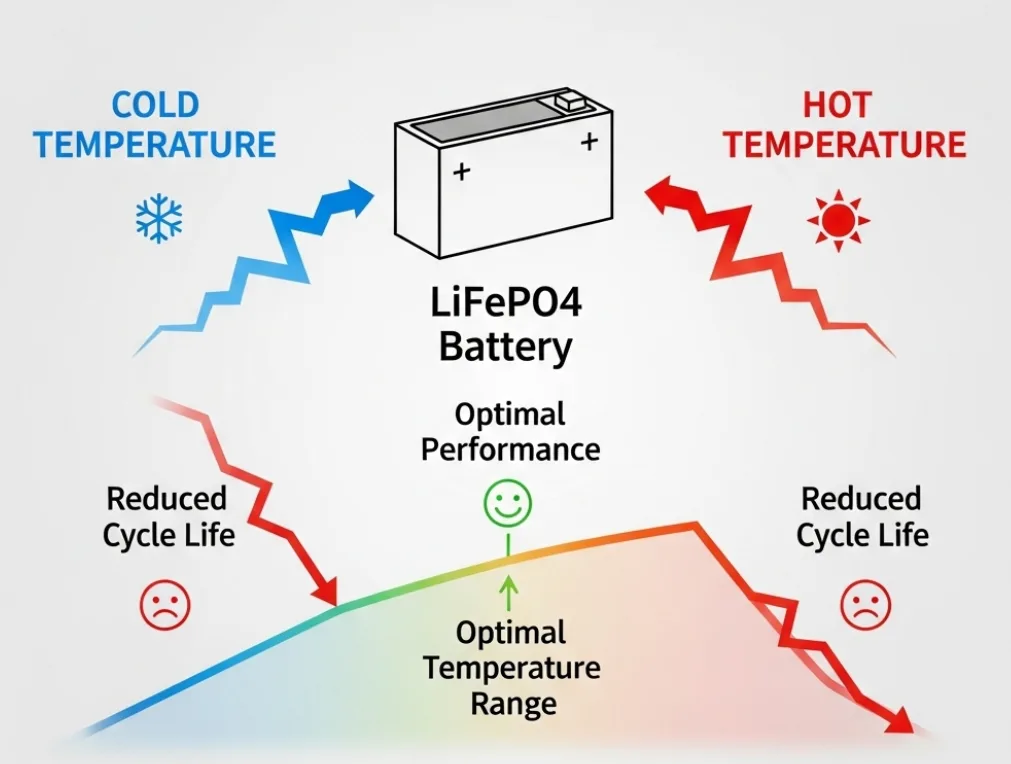
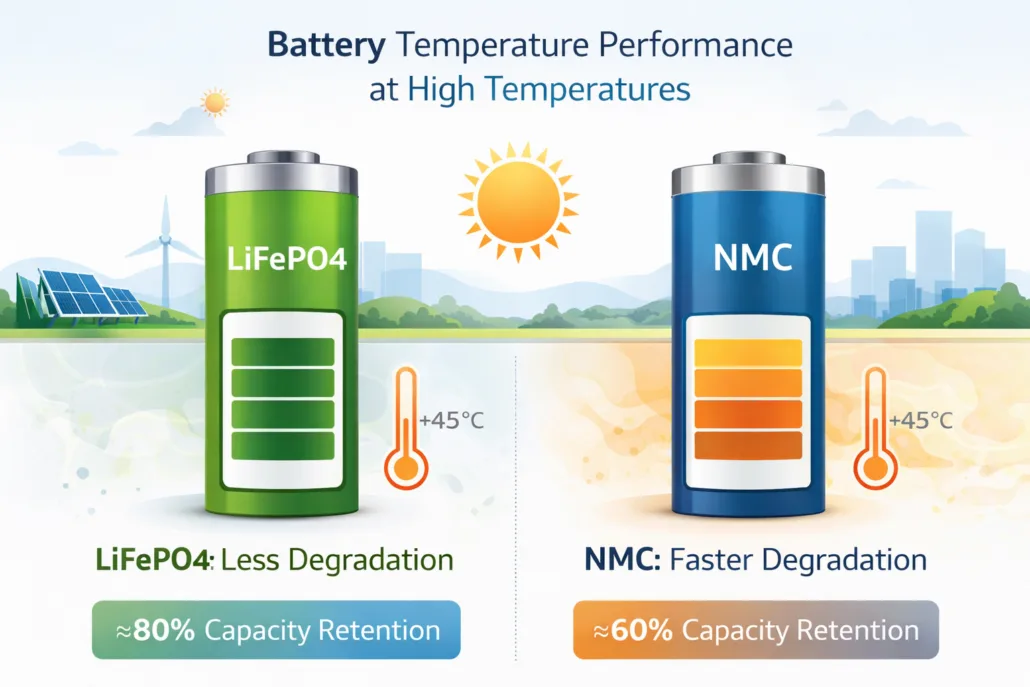
LFP is thermally stable. The iron-phosphate chemistry has a higher thermal runaway threshold. As a result, it degrades less when exposed to elevated temperatures.
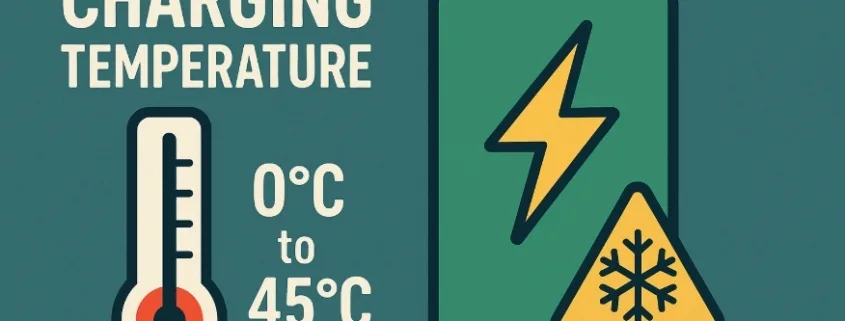
- Optimal range: 15°C–35°C
- Performance at 45°C: Cycle life reduces by roughly 20–30% vs. 25°C test conditions
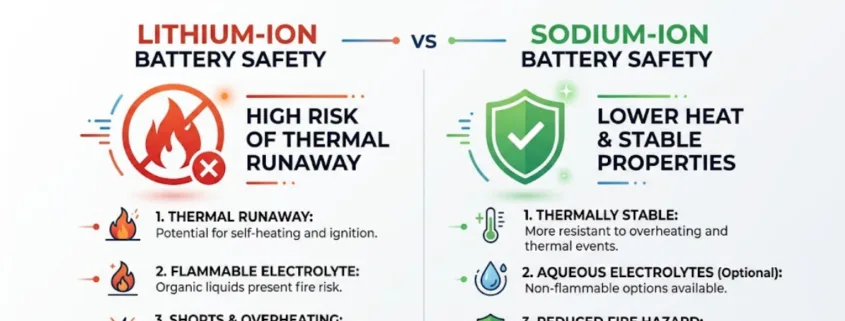
- Safety: LFP does not combust easily, even under abuse conditions
For outdoor BESS installations, rooftop solar storage, or warm-climate deployments, LFP’s thermal resilience is therefore a critical advantage.
NMC and Temperature
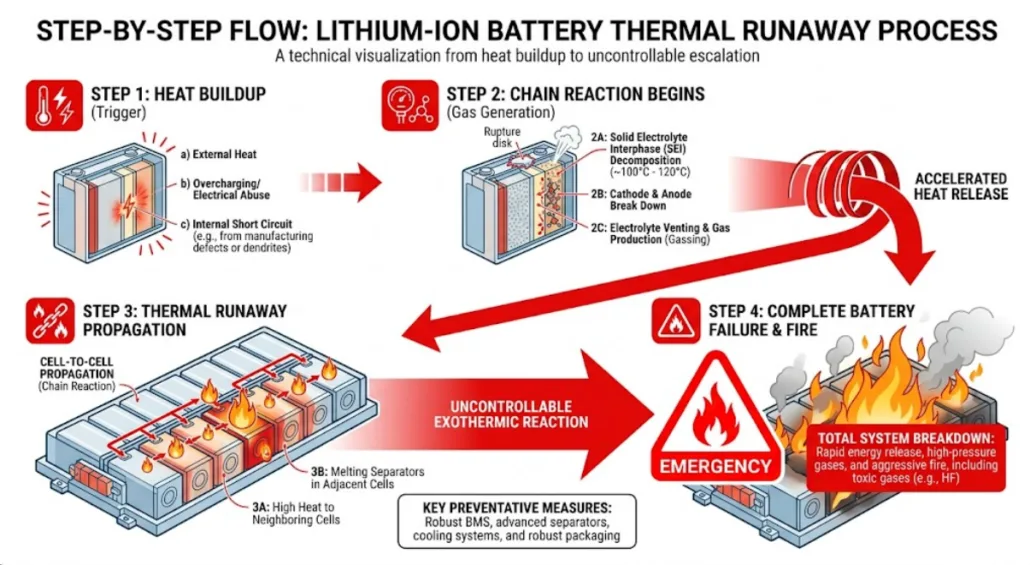
NMC is more sensitive to heat. At elevated temperatures, the cobalt-rich cathode degrades faster. In addition, the risk of thermal runaway — while still manageable with a proper BMS — is higher than with LFP.
- Optimal range: 15°C–30°C
- Performance at 45°C: Cycle life can reduce by 40–50% vs. 25°C test conditions
- High-temperature risk: Accelerated electrolyte decomposition and faster capacity fade
Most NMC spec sheets are tested at 25°C in a controlled lab. However, if your installation is in a warm climate or poorly ventilated enclosure, the actual lifespan will be considerably shorter than the published figure. A properly configured battery management system with active thermal monitoring is what catches these conditions before they damage cells.
For more detail on how temperature affects cycle life, see our guide on the impact of temperature on LiFePO4 battery cycle life.
LiFePO4 vs NMC Battery: End of Life (EOL)
EOL is typically defined as the point when a battery’s capacity drops to 70% or 80% of its original rated capacity. However, the practical implications differ between LFP and NMC.
LFP at EOL
When LFP reaches 80% SOH, it still behaves predictably. The capacity has declined. Nevertheless, the battery remains safe, functional, and usable for second-life applications — such as backup power or stationary storage with reduced capacity requirements.
LFP cells at EOL often still have 10+ years of second-life ahead of them.
NMC at EOL
NMC reaching EOL is a different situation. Some NMC cells experience non-linear degradation after 80% SOH. As a result, capacity can drop faster than expected and internal resistance increases more sharply. This reduces power delivery and makes the battery less predictable in operation.
Second-life applications for NMC are possible. However, they require more careful vetting and BMS management.
LiFePO4 vs NMC Battery: Head-to-Head Comparison
| Factor | LiFePO4 (LFP) | NMC |
|---|---|---|
| Typical cycle life (EOL 80%, 100% DOD, 25°C) | 3,000–6,000+ | 1,000–2,500 |
| Premium cell cycle life | 6,000–10,000+ | 2,000–4,000 |
| SOH degradation curve | Slow and linear | Faster, less predictable |
| Deep DOD tolerance | Excellent (handles 100% DOD well) | Moderate (80% DOD recommended) |
| Temperature sensitivity | Low — handles heat well | High — significant life reduction at >35°C |
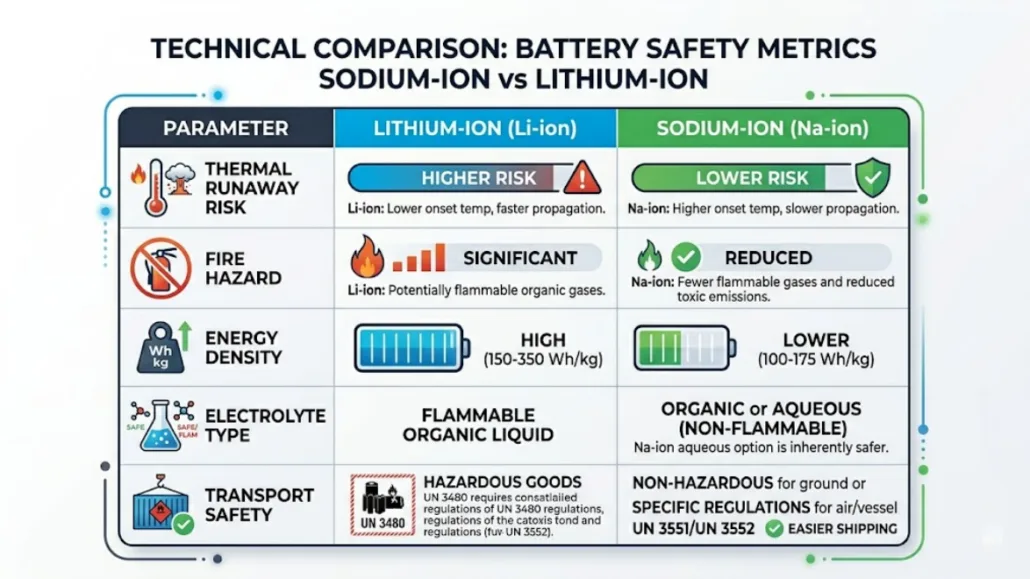
| Thermal safety | Very high — low runaway risk | Moderate — requires robust BMS |
| Energy density | Lower (~120–180 Wh/kg) | Higher (~180–280 Wh/kg) |
| Cost per kWh (upfront) | Slightly lower to comparable | Slightly higher |
| Cost per kWh over lifetime | Significantly lower | Higher |
| Best for | Solar storage, BESS, C&I, long-duration use | EVs, space-constrained apps |
| Second-life potential | Excellent | Moderate |
Which Chemistry Should You Choose?
Choose LFP if:
- You’re building a solar storage, C&I BESS, or utility-scale project
- Your system will cycle daily (peak shaving, self-consumption, backup)
- Your installation is in a warm climate or non-climate-controlled environment
- You need predictable, long-term performance for ROI modelling and warranties
- You’re comparing total cost of ownership over 10+ years, not just upfront price
- Safety and reduced maintenance are priorities
Consider NMC if:
- Space and weight are the primary constraints (e.g., mobile applications, small footprint)
- The system will cycle infrequently and at shallow DOD
- Temperature is well-controlled throughout the system’s life
- You need maximum energy density in a fixed physical volume
The Bottom Line
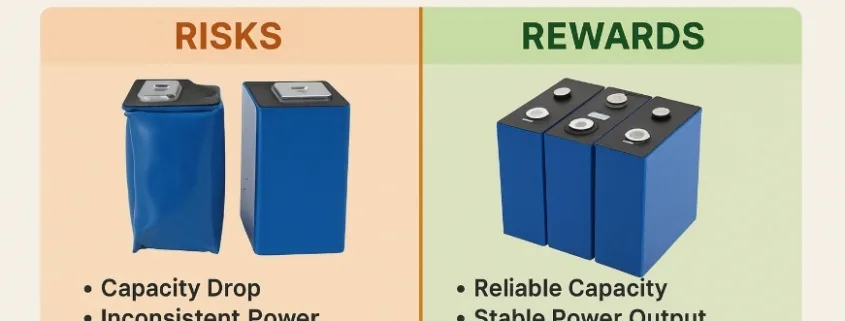
For the vast majority of stationary energy storage applications, LFP wins on total cost of ownership. The higher cycle life, better temperature resilience, and predictable degradation mean you get more energy throughput per dollar over the system’s life.
NMC’s energy density advantage is real. However, it matters most where weight and volume are the primary constraints. That is why NMC dominates electric vehicles and consumer electronics — not grid storage.
A Word on Spec Sheet Claims
Everything in this article assumes you’re comparing batteries tested under the same conditions. In practice, manufacturers don’t always make this easy.
Before trusting any cycle life claim — LFP or NMC — always verify:
- ✅ Test temperature (25°C is standard; higher = fewer cycles)
- ✅ DOD used in testing (80% DOD inflates cycle count vs. 100% DOD)
- ✅ EOL threshold (80% SOH vs. 70% SOH gives very different numbers)
- ✅ C-rate (charging/discharging speed affects degradation)
- ✅ Full test report (not just the headline number)
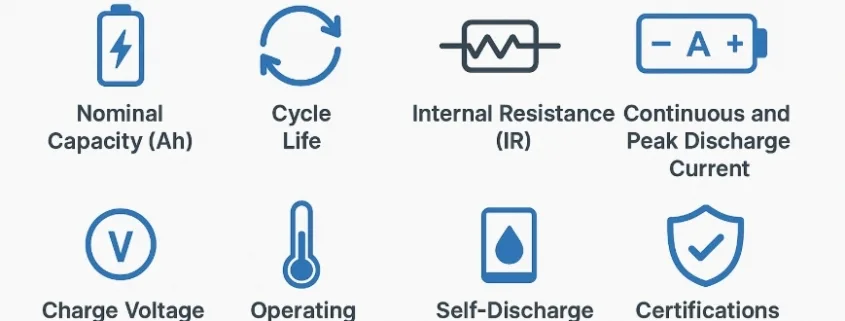
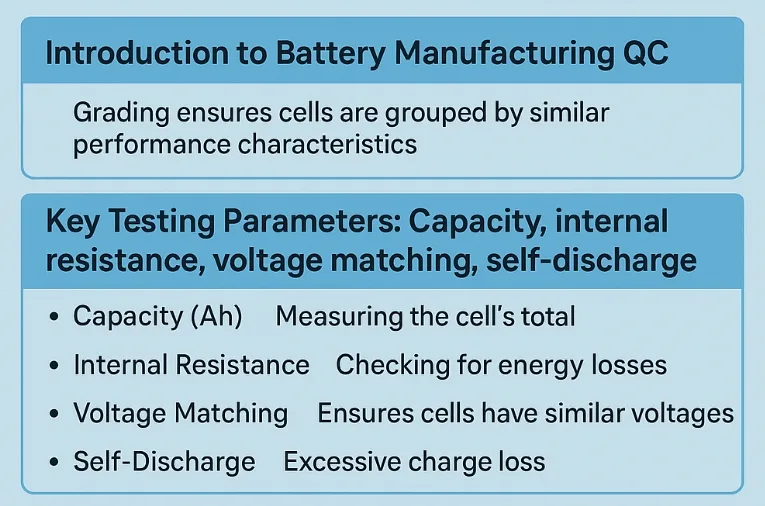
For a full breakdown of how these testing standards work, see our Battery Cycle Standards Explained guide. In addition, our LiFePO4 cell testing and grading guide explains how to evaluate what’s actually inside a spec sheet.
FAQ About LiFePO4 vs NMC Battery
Is LFP always better than NMC for energy storage?
For stationary storage with daily cycling, LFP typically offers better total cost of ownership. This is because LFP has longer cycle life, better DOD tolerance, and lower temperature sensitivity. However, NMC remains competitive where energy density is the primary constraint.
Can I compare LFP and NMC cycle life directly from spec sheets?
Only if both are tested at the same DOD, temperature, and EOL threshold. A common mistake is comparing LFP at 100% DOD vs. NMC at 80% DOD. As a result, the NMC figure looks artificially strong.
Why does NMC have higher energy density than LFP?
NMC’s cathode chemistry allows more lithium ions to be stored per unit of weight and volume. However, the tradeoff is lower stability and shorter cycle life under equivalent conditions.
What happens to NMC batteries in hot climates?
Elevated temperatures above 35°C significantly accelerate NMC degradation. At 45°C, NMC cycle life can be 40–50% lower than the spec sheet figure. LFP is therefore considerably more resilient to heat.
Is LFP safer than NMC?
Yes. LFP has a higher thermal runaway threshold. In addition, it is less prone to fire under abuse conditions such as overcharging, physical damage, or extreme heat. As a result, LFP is preferred for large-scale BESS where safety certifications and insurance requirements are strict.
What is the real-world lifespan difference between LFP and NMC?
For a system cycling once daily, a quality LFP system can last 15–20+ years before reaching EOL. A comparable NMC system in the same application might reach EOL in 6–10 years. Therefore, over a 20-year project life, that could mean one LFP system vs. two or more NMC replacements.
Final Thoughts
When comparing a LiFePO4 vs NMC battery for stationary storage, LFP is the stronger choice in most scenarios. It offers longer cycle life, superior temperature tolerance, better deep discharge handling, and lower lifetime cost. As a result, it is the dominant chemistry for solar storage, BESS, and C&I applications.
NMC earns its place where energy density is non-negotiable — primarily EVs and space-constrained installations. However, for stationary storage where the battery will cycle hard, in variable temperatures, over a decade or more, LFP is the more bankable choice.
The rule is simple: compare under the same conditions, ask for the full test report, and plan for real operating conditions — not lab results.
For deeper technical validation:
National Renewable Energy Laboratory (NREL) – Battery Lifespan Research
Related reading: