

ACIR LFP Battery Testing: The 1kHz Window into Cell Health
Introduction: Why ACIR LFP Battery Testing Matters
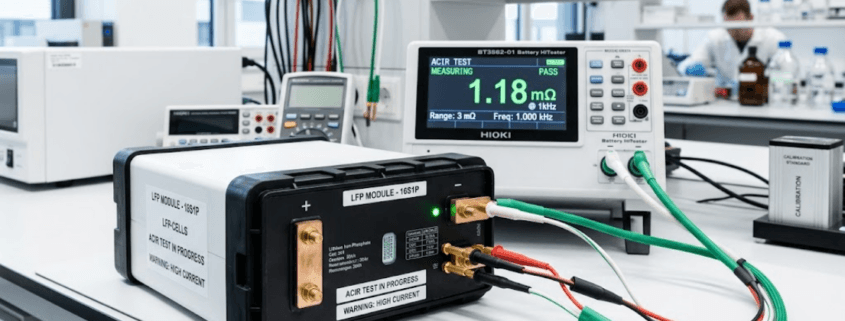
ACIR LFP battery testing is critical in Battery Energy Storage Systems (BESS). It checks each cell before assembly. As a result, it prevents hidden defects early.
In contrast, DCIR measures performance under load. However, ACIR focuses on physical structure. Therefore, it gives a fast and clear view of cell quality.
At SunLith Energy, every LFP cell is tested at 1kHz. Thus, only stable cells move forward.
The Science of ACIR LFP Battery Testing: Ohmic Resistance
ACIR uses a small alternating current to measure internal resistance. The signal runs at 1kHz.
Z=IV
Because the signal is fast, chemical reactions do not respond. Therefore, the result reflects only ohmic resistance.
What This Method Measures
- Current collector resistance
- Electrolyte conductivity
- Weld integrity
- Contact resistance
In short, it shows the physical build quality of the cell.
Why 1kHz is the Industry Standard for ACIR LFP Battery Testing
The 1kHz frequency is widely used. This is because it balances speed and accuracy.
At lower frequencies, chemical effects appear. On the other hand, very high frequencies add noise. Therefore, 1kHz gives stable readings.
As a result, this method provides:
- Fast measurement
- High repeatability
- Clean data
High-Precision ACIR LFP Battery Testing via the Kelvin Method
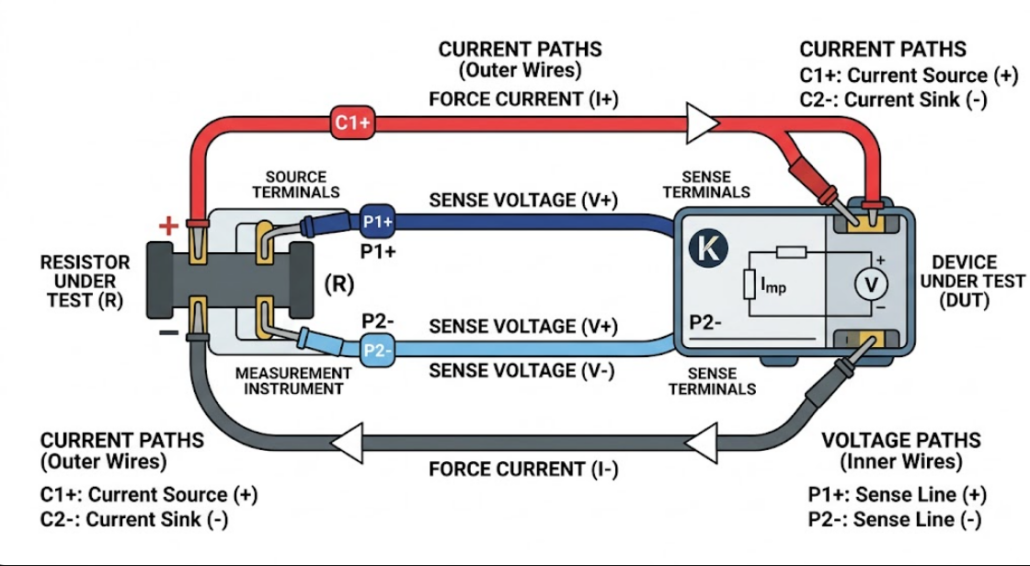
Measuring milliohm resistance requires precision. Small cable resistance can affect results and lead to inaccurate data.
Therefore, engineers use the 4-pin Kelvin method.
How the Kelvin Method Works
- Two probes inject current
- Two probes measure voltage
Because of this separation, lead resistance is removed.
Key Benefits
- Higher accuracy
- Better consistency
- True resistance values
Why ACIR Testing Improves BESS Reliability
Incoming Quality Control
First, this test detects defects early. For example, high resistance may indicate poor welds.
As a result, faulty cells are removed before assembly.
Cell Matching for Long Life
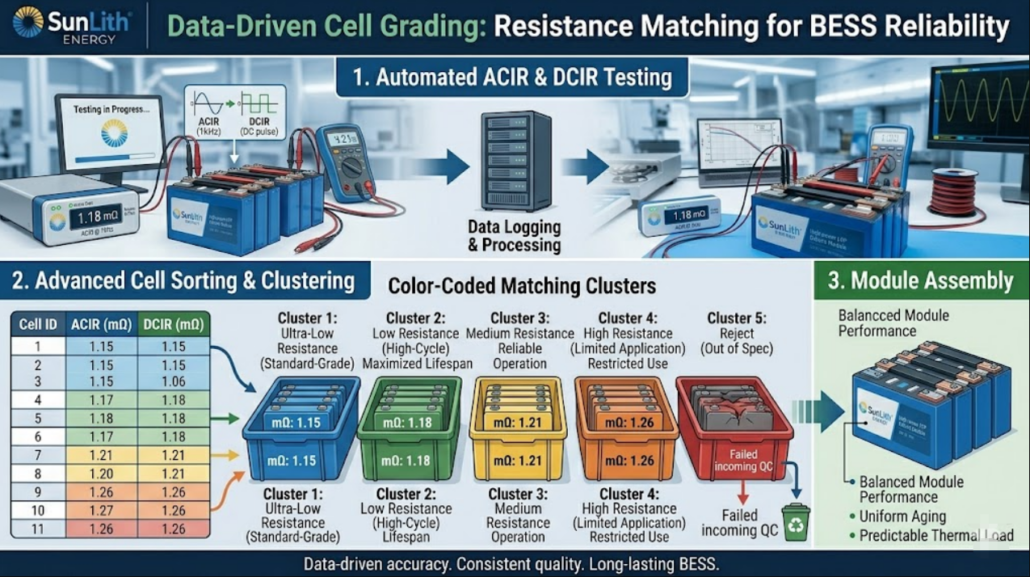
Next, uniform cells are critical. Otherwise, imbalance occurs.
If resistance varies:
- Heat increases
- Aging becomes uneven
Therefore, cells are grouped by similar values. This improves lifespan and stability.
Early Failure Detection
ACIR also helps detect early degradation.
For instance:
- Rising resistance may signal internal damage
- Sudden change may indicate failure risk
Thus, it supports predictive maintenance.
ACIR LFP Battery Testing vs DCIR
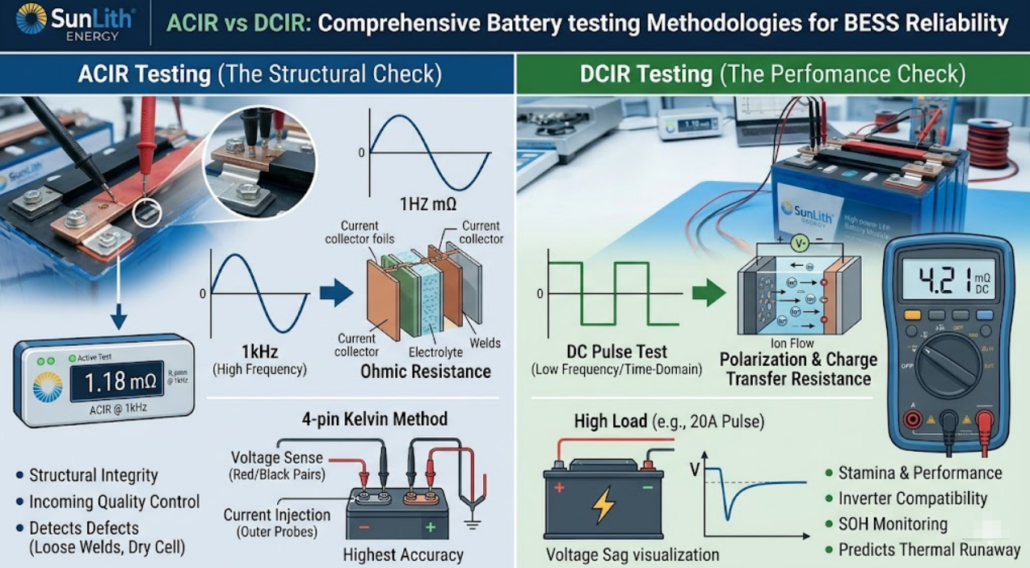
Both methods are important. However, they serve different roles.
| Parameter | ACIR | DCIR |
|---|---|---|
| Frequency | High (1kHz) | Low |
| Focus | Structure | Performance |
| Speed | Fast | Slower |
👉 Read our internal guide on DCIR performance testing in LFP batteries.
💡 Want to learn the fundamentals? Read our comprehensive guide on Cell Internal Resistance: What It Is, Why It Rises, and How to Measure It The foundational guide to ohmic, charge-transfer, and diffusion resistance
Standards Supporting ACIR Testing
Battery testing must follow global standards. Therefore, this method aligns with the International Electrotechnical Commission.
Specifically, IEC 62619 defines safety rules for industrial batteries.
As a result, compliance ensures:
- Safe operation
- Reliable validation
- Consistent quality
Best Practices for Accurate Results
Control Temperature
Resistance changes with temperature. Therefore, keep it stable.
Use Calibrated Equipment
Accurate tools improve reliability.
Ensure Good Contact
Proper probe contact prevents errors.
Automate Testing
Automation improves consistency and traceability.
Conclusion: ACIR LFP Battery Testing is Essential
ACIR LFP battery testing gives a clear view of internal structure. It is fast, precise, and reliable.
In contrast, DCIR shows performance under load. Therefore, both methods are needed.
At SunLith Energy, we combine both approaches. As a result, we deliver safe and long-lasting BESS systems.
FAQ
What is ACIR in LFP batteries?
It measures internal resistance at high frequency to evaluate physical cell condition.
Why is 1kHz used?
Because it isolates ohmic resistance and avoids chemical effects.
What is the Kelvin method?
It uses four probes to remove lead resistance and improve accuracy.
Technical References & Standards
For further technical reading on safety and testing requirements for Lithium-ion BESS, refer to the following global standards:
- IEC 62619:2022 – Secondary cells and batteries containing alkaline or other non-acid electrolytes.