

Sodium-ion vs LiFePO4 Winter Performance: What Changes in 2026?
The debate over Sodium-ion vs LiFePO4 winter performance has reached a tipping point in 2026. While Lithium Iron Phosphate (LiFePO4) is the industry leader, its struggles in the cold are well-known. Consequently, many users now want better options for cold weather.
As energy storage expands, Sodium-ion (Na-ion) is emerging as a top choice. In this guide, we break down the technical differences and why your choice depends on your local weather.
Key Takeaway
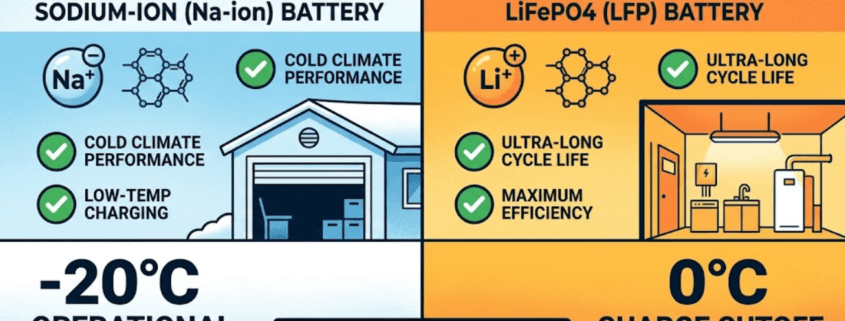
Quick Verdict: Use Sodium-ion for unheated outdoor storage in extreme cold (down to -20°C). In contrast, LiFePO4 is better for indoor or heated setups. It provides higher efficiency and a longer 10-year lifespan.
How Lithium Plating Limits LiFePO4 Winter Performance
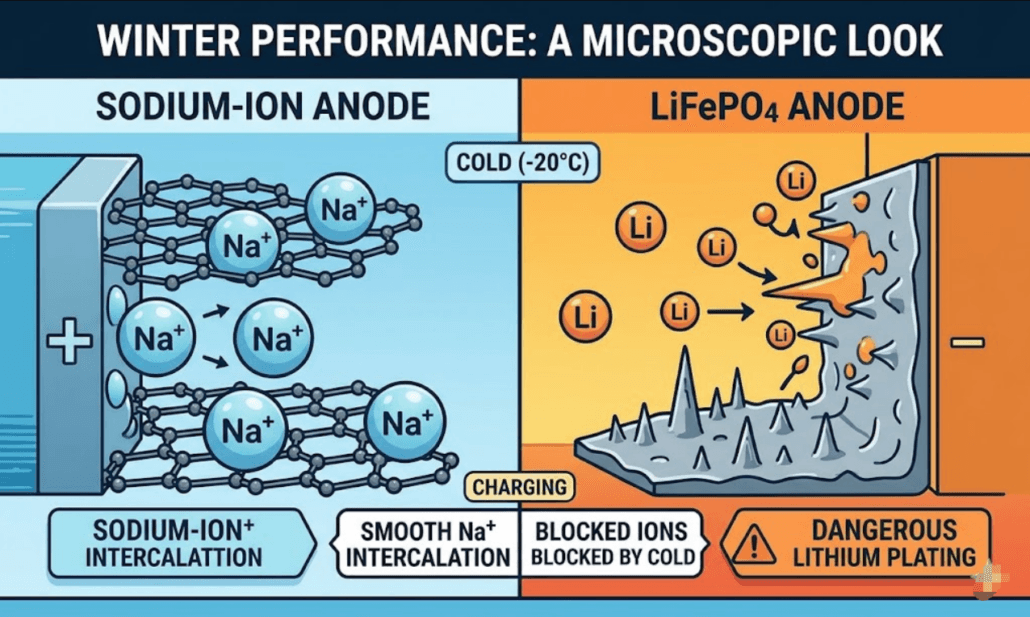
The main challenge with LiFePO4 in winter is “lithium plating.” When you charge an LFP battery below 0°C (32°F), lithium ions move too slowly. Instead of entering the anode, they coat the surface. This leads to permanent damage or shorts.
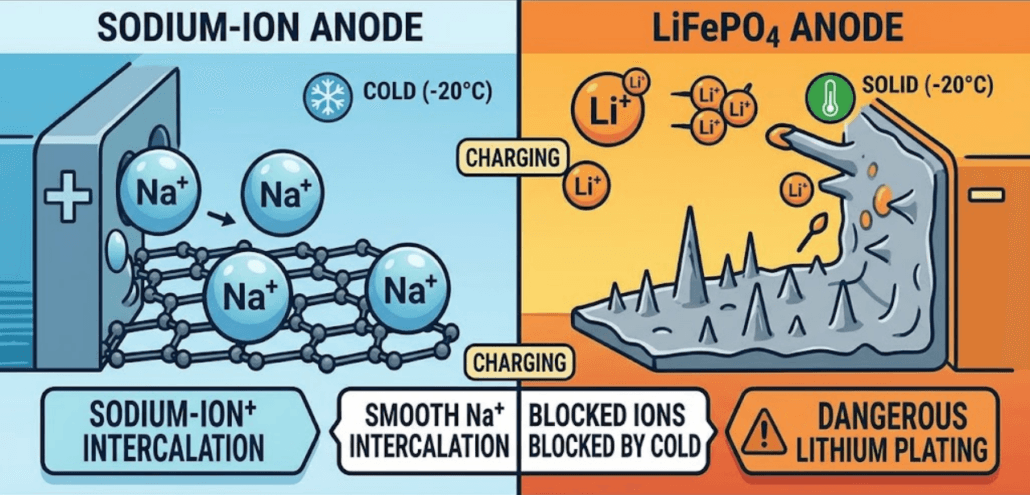
- The Risk: Permanent capacity loss.
- The Solution: Most BMS systems will stop the charge. Because of this, your solar system may stop working on cold days.
Why Sodium-ion vs LiFePO4 Winter Performance Favors New Tech
Unlike lithium, sodium ions move easily in freezing conditions. Furthermore, Sodium-ion batteries do not have the same plating risks. Because they are stable, they remain operational even when LFP systems fail.
Key Metrics at -20°C (-4°F):
- Sodium-ion: Retains 90% of its capacity.
- LiFePO4: Retains only 50-60% of its capacity.
Technical Insight: In 2026, many commercial BESS are switching to Sodium-ion. This is done to avoid the “Heating Tax,” which is the energy wasted just to keep batteries warm.
Comparing Sodium-ion vs LiFePO4 Winter Performance
When we look at the data, the differences are clear. Specifically, use this table to compare the two chemistries in extreme cold.
| Feature | LiFePO4 (LFP) | Sodium-Ion (Na-ion) |
| Charge Temp Range | 0°C to 55°C | -20°C to 55°C |
| Capacity at -20°C | ~60% | ~90% |
| Cycle Life | 4,000 – 8,000 | 2,000 – 3,500 |
| Safety State | Stable (30% SOC) | Ultra-Stable (0V Shipping) |
The Efficiency Trade-Off: Is Sodium Always Better?
While Sodium-ion wins in the cold, it is less efficient overall. Moreover, this can change your total ROI.
- LiFePO4 Efficiency: Offers ~96% efficiency.
- Sodium-ion Efficiency: Usually hovers around 92%.
In other words, you lose more energy as heat with Sodium-ion. However, if your batteries are kept in an unheated garage, the cold-weather reliability makes Sodium-ion a better choice.
Shipping Safety: Another Win for Sodium-ion vs LiFePO4 Winter Performance
Another benefit of Sodium-ion is shipping. Because they use aluminum foil, they can be discharged to 0 Volts.
- LiFePO4: Must ship at 30% charge. As a result, they are “Hazardous Goods.”
- Sodium-ion: Can ship fully empty. Consequently, transport is cheaper and safer for remote winter projects.
Final Choice: Sodium-ion vs LiFePO4 Winter Performance
Ultimately, your choice depends on your location.
- Choose Sodium-ion if: You have an unheated shed or garage in a very cold climate.
- Choose LiFePO4 if: Your energy storage setup is in a heated basement and you want the longest lifespan.
Read More: Learn more about the Impact of Temperature on LiFePO4 Batteries Cycle Life to see how heat and cold affect long-term ROI.
Sodium-ion vs LiFePO4 Winter Performance: FAQ
Can Sodium-ion batteries charge in the cold?
Yes. Sodium-ion batteries charge safely down to -20°C (-4°F). They charge in the cold without heaters.
Does freezing weather damage LiFePO4 batteries?
Cold air does not hurt the battery itself. But, charging below 0°C (32°F) causes “Lithium Plating.” This creates permanent damage.
Is Sodium-ion as efficient as LiFePO4?
Sodium-ion is slightly less efficient at about 92%. In contrast, LiFePO4 is higher at 96%. Furthermore, Sodium-ion saves energy because it doesn’t need heaters.
How much capacity does Sodium-ion lose in winter?
Sodium-ion batteries keep about 90% of their power at -20°C. In contrast, standard LiFePO4 batteries may lose up to 50%.