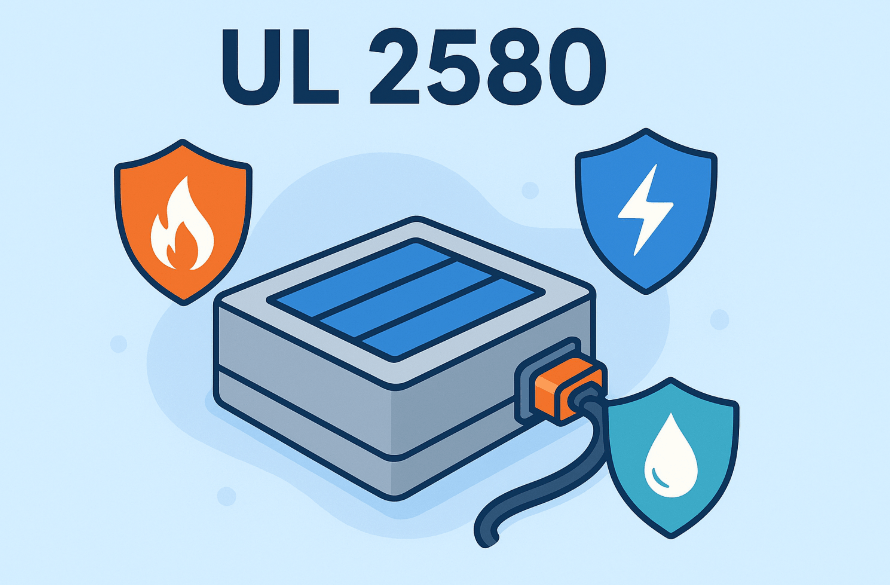
Electric vehicles are driving the future of transportation. As adoption grows, battery safety has become a critical focus for manufacturers and regulators. To ensure reliability, UL 2580 certification was introduced as a dedicated safety standard for electric vehicle batteries.
This blog explains what UL 2580 covers, why it’s important, and how it differs from other UL certifications.
What is UL 2580?
UL 2580 is a safety standard for lithium-ion battery packs and modules used in electric vehicles. Developed by Underwriters Laboratories, it focuses on testing how batteries perform under electrical, mechanical, and environmental stresses.
Unlike standards aimed at small devices or stationary storage, UL 2580 addresses the unique demands of automotive applications, where batteries face high loads, vibrations, and varied climate conditions.
Scope of the UL 2580 Standard
The requirements apply to complete battery packs and modules used in passenger cars, buses, and commercial EVs. The goal is to minimize risks like fire, leakage, or explosion by verifying:
Electrical protection (overcharge, short circuit, insulation resistance)
Mechanical resilience (impact, crush, vibration)
Environmental durability (temperature extremes, water exposure, corrosion)
These evaluations simulate real-world driving scenarios, from high-speed crashes to operation in extreme weather.
Benefits of Compliance
1. Safety Assurance
Certification confirms that EV batteries can withstand demanding conditions without compromising driver or passenger safety.
2. Market Access
Many global regions expect compliance with UL2580 or equivalent standards before EVs can be sold.
3. Consumer Confidence
When automakers highlight UL-certified batteries, it reassures buyers that the technology is tested and reliable.
4. Brand Advantage
Certification demonstrates a manufacturer’s commitment to high-quality and safe energy storage solutions.
UL 2580 vs. Other Certifications
Battery standards vary depending on application. Here’s how UL 2580 compares:
This comparison highlights UL2580 as the benchmark for road-going electric vehicles.
Looking Ahead
As battery technologies evolve—such as solid-state and advanced chemistries—standards like UL2580 will also adapt. This ensures future EVs continue to meet stringent safety requirements while supporting global electrification goals.
Conclusion
UL 2580 plays a key role in making electric vehicles safer and more reliable. By verifying battery pack safety under extreme electrical, mechanical, and environmental stresses, it protects consumers and strengthens trust in EV technology.
For manufacturers, certification isn’t just about compliance—it’s about staying competitive in a fast-growing market.
FAQs
1. What is tested under UL 2580?
Electrical, mechanical, and environmental safety of EV battery packs.
2. Is it mandatory?
In many regions, yes, or an equivalent standard is required for market approval.
What is UL 1642 Certification?: Lithium-ion batteries power nearly every aspect of our modern lives—electric vehicles, energy storage systems (ESS), consumer electronics, and medical devices. With this widespread adoption comes a heightened need for safety.
UL 1642 Certification is one of the most widely recognized safety standards for lithium-ion cells. It provides rigorous testing criteria to ensure that these cells perform reliably and minimize risks of fire, explosion, or leakage. For companies like Sunlith Energy, aligning products with UL 1642 builds trust and demonstrates commitment to global safety standards.
Understanding UL 1642: The Scope of Certification
UL 1642 specifically applies to lithium-ion and lithium-metal cells, not complete battery packs or energy storage systems.
Scope: Evaluates individual battery cells.
Objective: Ensures cells resist hazardous conditions such as overcharging, short circuits, and high temperatures.
Coverage: Tests for mechanical, electrical, and environmental stress conditions.
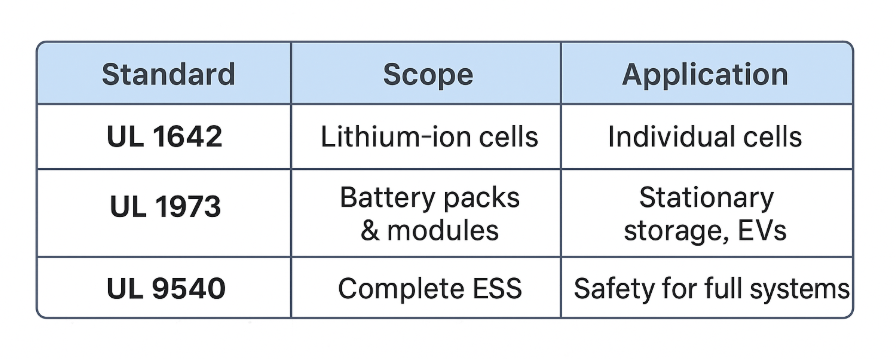
By certifying cells under UL 1642, manufacturers establish a solid foundation for further certifications like UL 1973 (batteries for stationary use) and UL 9540 (energy storage systems).
To achieve UL 1642 compliance, lithium-ion cells undergo rigorous testing protocols designed to simulate real-world hazards. These include:
1. Electrical Abuse Testing
Overcharge tests
Forced discharge conditions
Short-circuit simulation
2. Mechanical Stress Testing
Crush resistance
Impact/shock exposure
Vibration endurance
3. Environmental Testing
High and low temperature cycles
Humidity and pressure variations
Altitude simulations
4. Fire and Safety Checks
Flammability and explosion risk assessment
Venting and leakage monitoring
These tests ensure that cells can handle extreme operating environments without catastrophic failure.
Why UL 1642 Certification Matters
Lithium-ion batteries are known for their high energy density, but that also makes them prone to thermal runaway if not properly managed. UL 1642 provides manufacturers, regulators, and end-users with confidence in battery safety.
Benefits of UL 1642:
✅ Safety Assurance: Demonstrates resistance to overheating and fire risks.
✅ Regulatory Compliance: Required for global exports and OEM partnerships.
✅ Market Trust: Strengthens brand reputation and product acceptance.
✅ Foundation for System Certification: A stepping stone for UL 1973 and UL 9540.
For Sunlith Energy, integrating UL 1642-certified cells into solutions ensures maximum reliability in battery energy storage systems (BESS) and beyond.
UL 1642 vs. Other UL Standards
Many people confuse UL 1642 with other UL certifications. Here’s how they differ:
By ensuring compliance, companies reduce liability and improve adoption across global markets.
Sunlith Energy and UL Compliance
At Sunlith Energy, we prioritize safety and compliance in every solution. Our expertise in battery energy storage systems (BESS) integrates UL-certified components, ensuring our clients meet international safety standards without compromise.
Whether you’re developing grid-scale energy projects or industrial ESS solutions, choosing UL 1642-certified cells is the first step in building a safe, reliable, and future-ready system.
Conclusion: Building Trust with UL 1642 Certification
As the global demand for lithium-ion batteries accelerates, UL 1642 certification remains the gold standard for cell-level safety assurance. It reduces risks, improves market acceptance, and lays the groundwork for advanced certifications like UL 1973 and UL 9540.
For energy storage innovators and partners working with Sunlith Energy, compliance isn’t just a checkbox—it’s a commitment to safety, reliability, and global leadership.
✅ Key Takeaway: UL 1642 Certification ensures lithium-ion cells meet the highest safety standards, making it a cornerstone for trusted energy storage solutions.
1. What is UL 1642 Certification?
UL 1642 is a safety standard that applies to lithium-ion and lithium-metal cells. It ensures cells can withstand electrical, mechanical, and environmental stress without causing fire, explosion, or leakage.
Frequently Asked Questions (FAQ) about UL 1642 Certification
2. Does UL 1642 cover battery packs or just cells?
UL 1642 applies only to individual cells. Battery packs and modules require additional certifications such as UL 1973 for stationary applications and UL 9540 for full energy storage systems.
3. Why is UL 1642 Certification important for lithium-ion batteries?
Because lithium-ion cells have high energy density, they can pose fire or explosion risks if not properly designed. UL 1642 testing validates that cells meet the highest safety standards, reducing liability and building market trust.
4. How does UL 1642 Certification differ from UL 1973 and UL 9540?
UL 1642: Tests individual lithium-ion cells.
UL 1973: Covers full battery modules and packs for stationary storage and EVs.
UL 9540: Ensures complete energy storage systems (ESS) meet fire and safety requirements.
While not legally required in every country, UL 1642 is considered a global benchmark for lithium-ion cell safety. Most manufacturers and system integrators require it for compliance and international trade.
6. Which industries rely on UL 1642-certified cells?
UL 1642 is critical in:
Aerospace & Defense
Energy Storage Systems (ESS)
Electric Vehicles (EVs)
Medical Devices
Consumer Electronics
7. How does Sunlith Energy use UL 1642-certified cells?
At Sunlith Energy, we integrate UL 1642-certified cells into our battery energy storage systems (BESS) to ensure maximum safety, reliability, and compliance for our global partners.
UL 2271 Certification: A Safety Standard for Modern Mobility
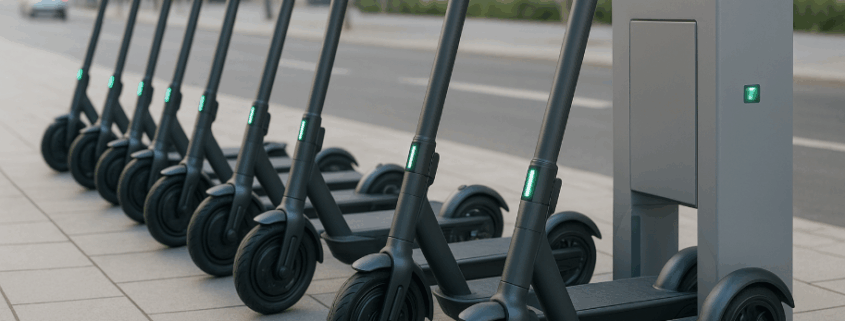
The popularity of light electric vehicles (LEVs) such as e-bikes and scooters has surged in cities worldwide. With this growth comes an urgent need for reliable and safe batteries. UL 2271 certification provides a trusted benchmark, ensuring lithium-ion batteries used in LEVs are tested for safety, reliability, and durability.
At Sunlith Energy, we understand that safety is not optional—it is the foundation of innovation in clean mobility. That is why UL 2271 plays a vital role in our approach to powering the next generation of transport solutions.
What is UL 2271?
UL 2271 is a standard developed by UL Solutions, titled “Batteries for Use in Light Electric Vehicle Applications.” It applies to rechargeable lithium-ion batteries and battery packs designed for vehicles like:
Electric bicycles (e-bikes)
Electric scooters
Utility carts and campus shuttles
Personal mobility devices
This certification addresses risks such as fire, thermal runaway, and electrical failure, giving users peace of mind while adopting electric transport.
Why UL 2271 Matters for LEVs
Lithium-ion batteries can fail under stress or misuse, sometimes causing dangerous incidents. UL 2271 reduces these risks through rigorous testing and quality checks. The benefits extend across the ecosystem:
For Consumers – Safer rides with fewer risks of overheating or fires.
For Manufacturers – Compliance that strengthens brand trust and accelerates market approval.
For Regulators – A standardized approach to evaluating battery safety. Agencies such as the U.S. Consumer Product Safety Commission (CPSC) reference UL certifications when assessing risks.
For Fleet Operators – Fewer breakdowns, lower insurance risks, and higher uptime.
By aligning with UL 2271, manufacturers demonstrate a commitment to safety and long-term reliability.
Core Testing Areas in UL 2271
The certification process is extensive, covering every aspect of battery behavior:
Electrical Performance
Overcharge and discharge protection
Short-circuit resistance
Abnormal charging safety
Mechanical Safety
Crush resistance
Drop impact testing
Vibration endurance
Environmental Conditions
Temperature cycling (hot and cold)
Humidity and corrosion exposure
Thermal stability
Abuse Scenarios
Nail penetration
Fire exposure
Forced discharge tests
These simulations ensure that batteries are safe not only under normal use but also in extreme and unexpected conditions.
Where UL 2271 Certified Batteries Are Used
Certified batteries can be found across a variety of mobility applications:
Micromobility fleets – Shared e-scooters and bikes in urban environments
Logistics and delivery – Small electric utility vehicles for last-mile transport
Campus and industrial transport – Electric carts in universities, resorts, and warehouses
Personal recreation – Electric skateboards, hoverboards, and other small vehicles
As cities embrace greener mobility, UL 2271 ensures these devices meet the highest standards of safety.
How UL 2271 Compares to Other Standards
Different UL standards apply to batteries depending on their use case. Here’s how UL 2271 fits into the bigger picture:
This distinction makes UL 2271 the go-to certification for smaller mobility solutions, bridging the gap between consumer electronics and large electric vehicles.
Benefits for Manufacturers
For companies producing batteries and light mobility systems, UL 2271 certification unlocks significant advantages:
Global Market Access – Many import and sales channels require UL approval.
Consumer Trust – Certified products carry the UL mark, a symbol of safety.
Fewer Recalls – Certified designs lower the risk of costly failures.
Brand Differentiation – Compliance shows leadership in product responsibility.
At Sunlith Energy, we believe certification is not only about meeting regulations but also about earning customer confidence.
Global Adoption of UL 2271
Though it originates in the United States, UL2271 is recognized worldwide. European markets, as well as regions in Asia-Pacific, increasingly request UL-certified products. Organizations like the European Committee for Electrotechnical Standardization (CENELEC) often align their safety requirements with UL or IEC standards such as IEC 62133.
Challenges in Certification
Adopting UL 2271 isn’t without hurdles:
Testing and approval costs can be high.
Certification takes time, which may affect product launches.
Standards evolve as technology advances, requiring ongoing compliance updates.
However, for manufacturers committed to long-term success, the benefits outweigh the costs.
The Future of UL 2271
As micromobility grows, the importance of UL2271 will only increase. We expect:
Tighter adoption by regulators and fleet operators.
Integration with international standards like IEC 62133.
Adjustments for new technologies such as semi-solid and solid-state batteries.
UL2271 will remain a critical part of ensuring that e-mobility remains safe, sustainable, and trusted.
Conclusion
UL 2271 certification is more than a technical requirement—it is a safety guarantee. For consumers, it provides assurance that their rides are reliable. For manufacturers, it opens global markets and builds trust. For regulators, it creates consistency.
At Sunlith Energy, we see UL2271 as a cornerstone in shaping a secure, innovative, and eco-friendly mobility future. Learn more about our work in certification and compliance by exploring global battery certifications.
FAQs
Q1: Does UL 2271 apply to large EVs like cars?
No. Large EVs fall under UL 2580. UL2271 is specifically designed for smaller vehicles such as scooters and e-bikes.
Q2: Is certification mandatory?
While not always legally required, many retailers, regulators, and fleet programs demand UL compliance before accepting products.
Q3: How long does certification take?
Timelines vary, but manufacturers should prepare for several weeks to months depending on design complexity.
Q4: Does UL 2271 cover battery management systems (BMS)?
Yes. The standard includes evaluations of cells, packs, and electronic control systems.
Q5: Can UL 2271 certified batteries be used in storage systems?
No. Stationary energy storage solutions fall under UL 9540/9540A.
As the demand for clean energy grows, energy storage systems (ESS) are playing a crucial role in stabilizing the grid and enabling renewable integration. With safety and compliance at the forefront, UL 9540 certification has become the global benchmark for energy storage systems.
In this guide, we’ll explain what UL 9540 is, why it matters, and how it ensures the safety of battery energy storage systems (BESS).
What is UL 9540?
UL 9540 is the Standard for Safety of Energy Storage Systems and Equipment, developed by Underwriters Laboratories (UL). It sets the requirements for the safe design, construction, installation, and performance of energy storage systems.
This standard covers:
Battery systems (lithium-ion, lead-acid, flow batteries, etc.)
Power conversion systems (PCS)
Control and protection systems
Thermal management
Fire safety measures
By meeting UL 9540 certification, an ESS demonstrates that it can operate safely under normal and fault conditions.
Why UL 9540 Certification is Important
Energy storage systems involve high energy densities, complex electronics, and thermal risks. UL 9540 provides a structured safety framework that:
Prevents fire hazards through strict testing protocols.
Protects end-users by ensuring reliable and safe operation.
Simplifies compliance with local building and fire codes.
Supports market acceptance by meeting utility, AHJ (Authorities Having Jurisdiction), and global standards.
Without UL 9540, energy storage projects may face delays, higher insurance costs, or rejection from local authorities.
Key Components of UL 9540
UL 9540 certification is not just a single test. It integrates results from multiple safety standards, including:
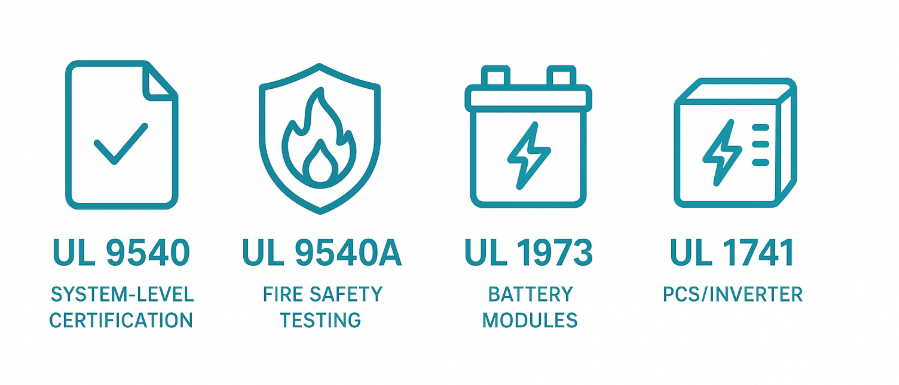
UL 9540A → Fire safety test method to evaluate thermal runaway and propagation.
In practice, many jurisdictions require both UL 9540 certification and UL 9540A test reports before granting project approval.
👉 You can read our in-depth article on UL 9540A Test Method to understand how fire safety testing complements UL 9540 certification.
Applications of UL 9540 Certified Systems
UL 9540 certified systems are used across various industries:
Commercial & Industrial facilities – backup power and peak shaving.
Residential ESS – safe home battery storage.
Utility-scale projects – grid balancing and renewable integration.
Microgrids – reliable off-grid power supply.
Challenges in Achieving UL 9540 Certification
While critical, certification is not always easy. Common challenges include:
Cost and testing timelines – Full certification can take months.
System design complexity – Integrating batteries, PCS, and controls safely.
Evolving standards – New revisions often add requirements.
Manufacturers must work with experienced certification partners to streamline the process.
Future of UL 9540
As energy storage technology evolves, UL continues to update its standards. Upcoming editions are expected to address:
Hydrogen detection systems
Enhanced rooftop installation guidelines
New battery chemistries (like sodium-ion and solid-state)
Staying aligned with these updates will be key for manufacturers and developers.
Conclusion
UL 9540 certification is the cornerstone of safety for energy storage systems. It combines multiple safety evaluations, ensures compliance with fire codes, and builds confidence among regulators, insurers, and end-users.
For anyone developing or deploying ESS solutions, UL 9540 is not optional—it’s essential.
👉 Learn more about how we support certification-ready solutions at Sunlith Energy.
FAQ: UL 9540 Certification
Q1. What does UL 9540 cover?
UL 9540 covers the safety of energy storage systems, including batteries, power conversion systems, and fire safety measures.
Q2. Is UL 9540 mandatory?
While not always legally required, many local codes and utilities demand UL 9540 certification for permitting and grid connection.
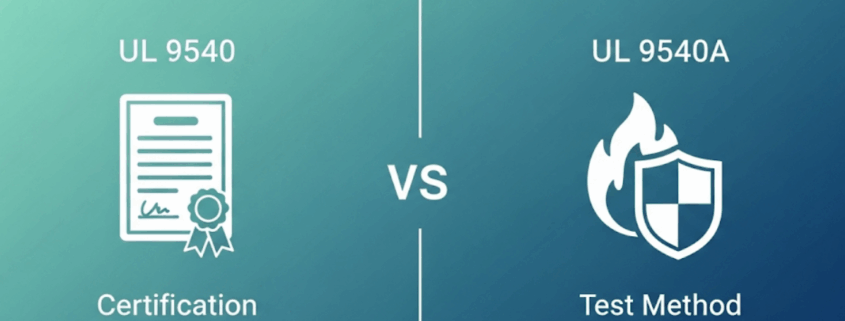
UL 9540 vs UL 9540A: As the adoption of battery energy storage systems (BESS) grows, safety and compliance remain top priorities for regulators, manufacturers, and end-users. Two of the most recognized standards in this space are UL 9540 and UL 9540A.
Scope: Applies to the entire system, not just components.
Integration: Requires batteries certified to UL 1973 and inverters certified to UL 1741.
Safety Focus: Covers electrical, mechanical, thermal, and fire safety aspects.
Market Approval: Often mandatory for utility-scale and commercial projects.
👉 If you’re exploring how PCS technology integrates into storage systems, check our detailed guide on Energy Storage PCS.
What is UL 9540A?
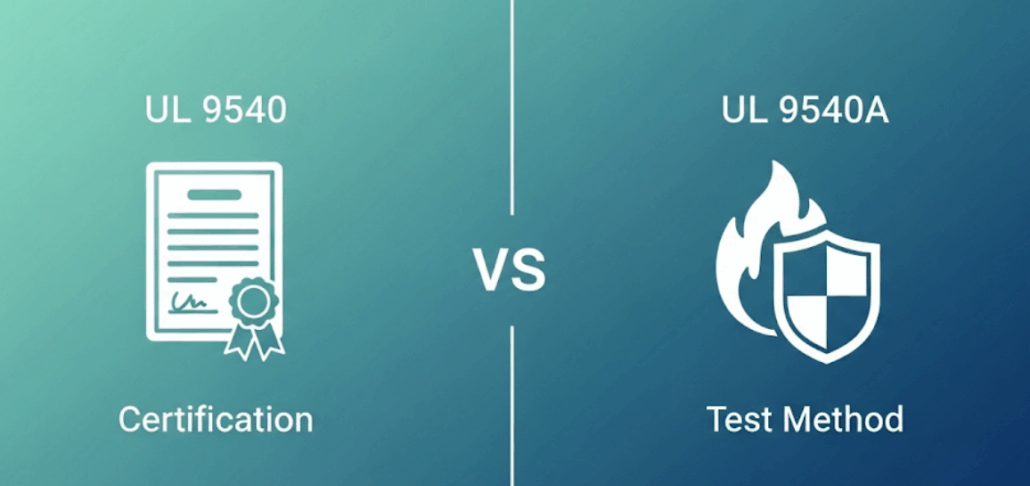
UL 9540A is the Test Method for Evaluating Thermal Runaway Fire Propagation in Battery Energy Storage Systems. Unlike UL 9540, it is not a certification but a test procedure.
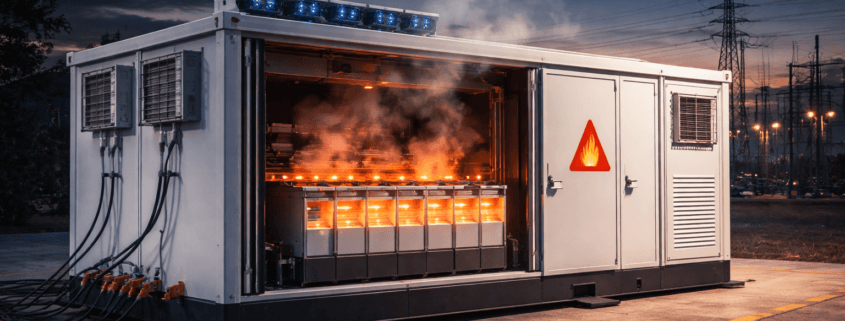
This method provides critical data on how batteries behave under extreme conditions. It identifies risks such as fire spread, explosion potential, and gas emissions.
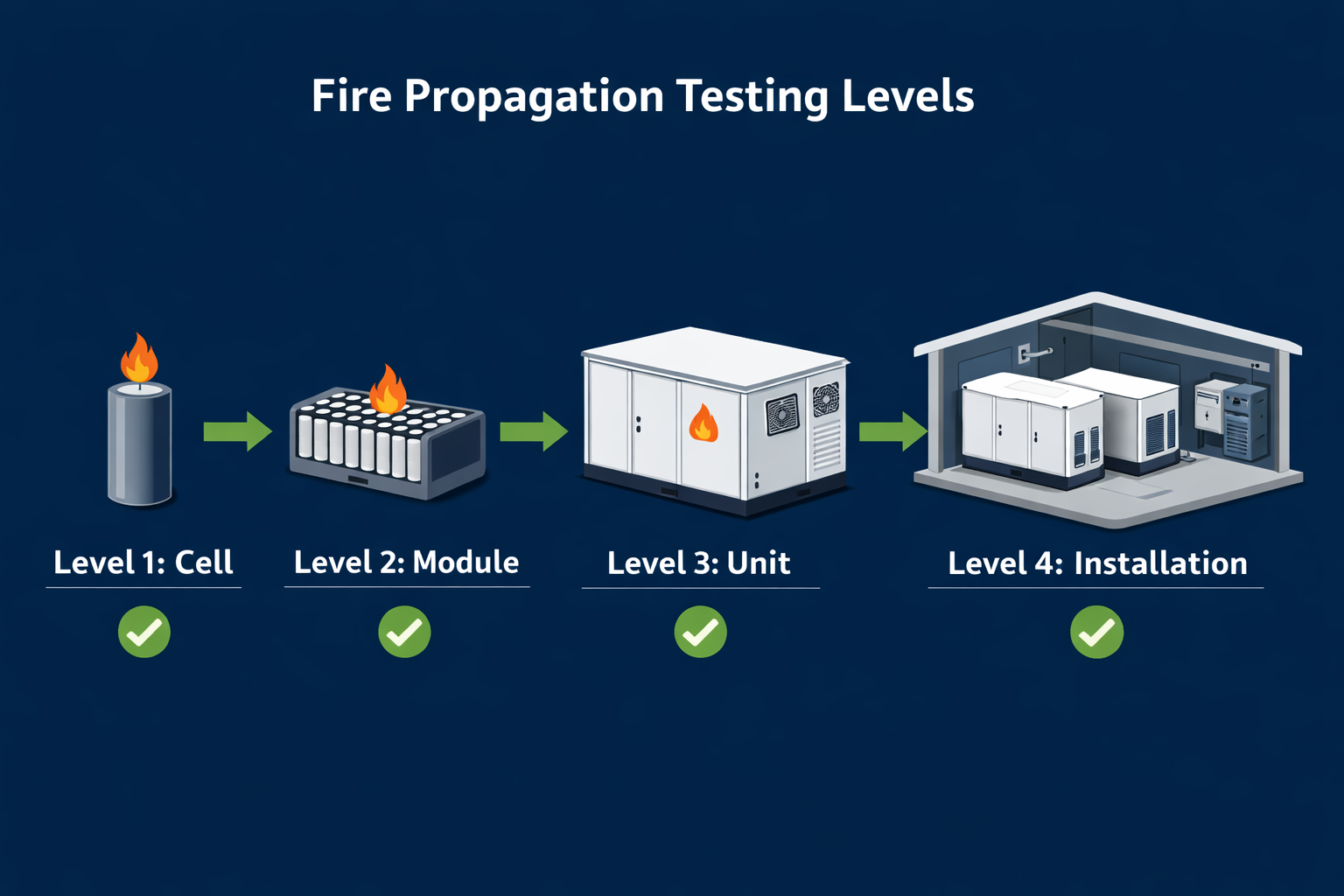
Testing Levels in UL 9540A:
Cell Level – Individual cell behavior under failure.
Module Level – How cells interact inside a battery module.
Unit Level – Fire propagation within a system enclosure.
Installation Level – Real-world system performance in buildings or outdoor setups.
👉 To understand why thermal management matters in these tests, see our post on Cooling Solutions for BESS.
Authorities Having Jurisdiction (AHJs) frequently demand UL 9540A reports before granting installation permits. Manufacturers, meanwhile, use test results to design safer enclosures, improve fire suppression systems, and integrate better thermal management.
Battery Energy Storage Systems (BESS) are becoming essential in today’s energy landscape. Whether for renewable integration, grid stability, or backup power, ensuring the safety and reliability of these systems is critical. This is where UL certifications for battery systems play a crucial role.
UL (Underwriters Laboratories) is one of the most trusted global safety certification organizations. Its standards verify that battery energy storage systems meet strict safety, fire prevention, and performance requirements. For project developers, manufacturers, and operators, understanding these certifications is not optional—it’s necessary.
In this guide, we’ll explore key UL standards such as UL 9540, UL 9540A, UL 1973, and others. You’ll also learn how these certifications impact compliance, insurance, and deployment.
At Sunlith Energy, we help businesses navigate energy storage safety and compliance while building reliable battery solutions.
Why UL Certifications Matter for Battery Energy Storage
1. Safety and Risk Mitigation
Battery systems, if not designed properly, can pose fire hazards or thermal runaway risks. UL standards ensure that systems undergo rigorous testing to minimize these risks.
2. Regulatory Approval
Most jurisdictions require UL-certified equipment for permitting. Without it, projects can face delays, redesigns, or rejection.
3. Market Trust and Bankability
Investors, insurers, and end-users trust certified systems. A BESS with UL certifications demonstrates credibility and long-term reliability.
UL 9540 – Standard for Energy Storage Systems and Equipment
UL 9540 is the primary certification for energy storage systems. It evaluates the safety, performance, and construction of complete systems, not just individual components.
Covers batteries, Power Conversion Systems (PCS), control systems, and enclosures.
Required for grid-scale, commercial, and residential BESS installations.
Ensures systems meet fire safety and electrical safety standards.
Why it matters: Without UL 9540, your BESS may not receive local authority approval.
👉 Learn more about Energy Storage PCS and how it integrates into certified systems.
UL 9540A – Test Method for Evaluating Thermal Runaway Fire Propagation
UL 9540A is not a certification itself but a test method. It assesses how thermal runaway in one cell can propagate through modules, units, and installations.
Provides data on fire propagation and suppression.
Often required by fire marshals and building authorities.
Supports UL 9540 certification by demonstrating safe design.
Regulatory Compliance – Smooth project approvals and grid interconnection.
Enhanced Safety – Reduced risk of fire, explosion, and system failure.
Market Acceptance – Easier financing and insurance.
Long-Term Reliability – Certified systems undergo rigorous life-cycle testing.
Future-Proofing – UL standards evolve with technology, ensuring systems stay relevant.
Challenges in Achieving UL Certification
Cost and Time: Certification requires extensive testing, which can delay projects.
Design Changes: If a component fails testing, redesign may be necessary.
Complex Standards: Navigating multiple UL standards can overwhelm new manufacturers.
This is where industry partners like Sunlith Energy provide support—helping companies design systems aligned with certification requirements from day one.
How Sunlith Energy Helps with UL-Compliant Solutions
At Sunlith Energy, we ensure that every battery system we design aligns with UL safety and certification standards. Our approach includes:
Design Consulting: Guiding OEMs and EPCs on compliance from the design phase.
Testing Support: Preparing systems for UL 9540, UL 9540A, and UL 1973 evaluations.
End-to-End Solutions: Delivering certified-ready BESS with integrated PCS, battery modules, and fire safety systems.
Whether you’re deploying grid-scale storage, C&I projects, or hybrid solar + storage, our certified solutions meet the highest safety benchmarks.
It is a safety and performance evaluation that ensures battery energy storage systems meet global standards for fire safety, electrical reliability, and environmental resilience.
2. Do all BESS need UL 9540 certification?
Yes. For commercial and residential deployment in most regions, UL 9540 is mandatory.
Depending on system complexity, UL certification can take 6–12 months.
5. Can second-life batteries be certified?
Yes, through UL 1974, which evaluates repurposed batteries for safe use in stationary storage.
Conclusion
UL certifications for battery systems are the foundation of safe, compliant, and bankable energy storage projects. From UL 9540 system-level approvals to UL 9540A fire safety testing and UL 1973 battery-level compliance, these standards ensure that energy storage systems perform reliably under real-world conditions.
As energy storage adoption accelerates, ensuring compliance with UL standards will not just be a regulatory requirement—it will be a competitive advantage.
At Sunlith Energy, we’re committed to helping businesses deploy safe, certified, and future-ready energy storage systems.
The UL 9540A Test Method is the only national standard that measures how thermal runaway fire spreads inside a battery energy storage system. It covers everything from a single cell all the way to a full real-world installation.
Most U.S. states require this test. Both NFPA 855 and the International Fire Code reference it directly. Without UL 9540A test data, large BESS projects simply cannot receive AHJ approval.
This guide covers everything you need:
What UL 9540A tests and why it matters
All 4 test levels with pass/fail criteria
Real costs, timelines, and lab selection tips
Every change in the 2025 Fifth Edition
How UL 9540A connects to UL 9540 certification
Who needs it and exactly when
WWhat is the UL 9540A Test Method?
The UL 9540A Test Method — formally titled “Standard for Evaluating Thermal Runaway Fire Propagation in Battery Energy Storage Systems” — measures specifically how a battery fire behaves once it starts.
Most safety certifications cover general equipment performance. This standard, however, focuses purely on fire propagation. In other words, it answers one critical question: will a failure in one cell, module, or unit spread to the rest of the system?
That narrow focus makes it the go-to reference for engineers, installers, and Authorities Having Jurisdiction (AHJs) across the United States. According to UL Solutions, the standard is widely adopted because it provides reproducible, science-based data that fire authorities can consistently apply across different projects and jurisdictions.
The standard answers three specific safety questions:
Cell propagation — whether thermal runaway in a single cell spreads to adjacent cells or the full module
Fire behaviour — how a battery module or full ESS unit reacts during a fire, including flame height, gas release, and heat output
Suppression effectiveness — whether built-in or external fire suppression systems can prevent explosion, deflagration, or reignition
No other national standard addresses all three at once.
BESS installations — whether residential, commercial, or utility-scale — fall under NFPA 855 and the International Fire Code in most U.S. states. Both codes reference the UL 9540A Test Method directly as the required fire safety test for stationary energy storage systems. Moreover, the National Fire Protection Association updates NFPA 855 regularly to reflect new battery technologies and installation environments.
This standard ensures three important things for the industry:
Manufacturers can prove their systems are safe using science-based, reproducible test data
Installers receive clear installation parameters — separation distances, suppression specifications, and ventilation requirements — all derived directly from test results
Authorities Having Jurisdiction gain a reliable, nationally recognised safety benchmark for permit reviews
Without UL 9540A test data, a BESS product cannot be permitted in most U.S. commercial, industrial, or utility-scale projects. Therefore, it is not simply a competitive advantage — it is the entry ticket to the market.
UL 9540A four-level test hierarchy cell module unit and installation level
The UL 9540A Test Method uses a hierarchical four-level structure. Testing stops at the earliest level where no fire propagation is detected. As a result, not every product needs all four levels. This can significantly reduce cost and time for manufacturers whose chemistry performs well at cell or module level.
Level 1: Cell-Level Testing
Cell-level testing is where every UL 9540A program begins. A heater strip or nail penetration forces thermal runaway in a single cell while sensors record what happens next.
What gets measured:
Gas volume and composition, including hydrogen, CO, and CO₂
Peak heat release rate in kilowatts and total heat energy
Flame height, duration, and whether flames self-extinguish
Surface temperature of adjacent cells
Whether neighbouring cells ignite
Pass condition: Adjacent cells do not reach thermal runaway. When no propagation is detected, the test program stops here. Consequently, the manufacturer receives cell-level data and can move toward UL 9540 certification without module or unit testing.
What triggers escalation: If heat or gas from the first cell causes a second cell to enter thermal runaway, testing moves to Level 2.
Chemistry guidance: Most modern LiFePO₄ (LFP) cells pass at this stage because of their inherently stable chemistry and lower heat release. NMC and NCA chemistries, on the other hand, release significantly more heat and gas. Therefore, they are more likely to escalate to Level 2.
When cell-level testing shows propagation risk, the UL 9540A program moves to the module — a group of cells assembled exactly as they appear in a real BESS product. The same thermal runaway trigger applies to a single cell inside the fully assembled module.
What gets measured:
Whether thermal runaway spreads from the triggered cell to all other cells
Gas volume and composition vented from the full module
Flame spread across the module casing
Peak and sustained temperature of the module exterior
Whether the module casing ignites or deforms
Pass condition: Thermal runaway does not spread beyond the module boundary. Furthermore, the casing contains the event without external flaming or structural failure. When this condition is met, the manufacturer holds module-level data and can define safe installation spacing without moving to unit-level testing.
What triggers escalation: Flames, heat, or gas that could ignite an adjacent module in a real installation will push testing to Level 3.
Design insight: Module-level testing frequently reveals weaknesses in cell spacing, busbar design, and casing vent placement. For this reason, many manufacturers make design changes after Level 2 results before spending money on unit and installation tests.
At Level 3, the complete battery system — exactly as it would ship to a customer — undergoes testing. This includes battery modules, BMS, thermal management components, enclosure, and all internal wiring. Importantly, suppression systems are typically disabled at this level unless they are permanently integrated and cannot be removed.
What gets measured:
Whether thermal runaway spreads from the triggered module to other modules
Total gas volume vented from the enclosure
Explosion and deflagration risk from accumulated vented gases
Flame spread across the enclosure exterior
Peak temperatures on all external surfaces
Structural integrity of the enclosure after the event
Pass condition: No sustained external flaming occurs. Additionally, there is no detonation or deflagration of vented gases, and the enclosure does not fail in a way that exposes people or adjacent equipment to flames or hot gas.
What triggers escalation: If the unit vents enough flammable gas to create an explosion risk, or if external surfaces reach temperatures that could ignite surrounding materials, testing proceeds to Level 4.
Why AHJs focus here: Most Authorities Having Jurisdiction review unit-level data first when evaluating a BESS permit. The unit-level report defines minimum separation distances, ventilation requirements, and suppression specifications — all of which feed directly into the installation design.
Level 4 is the most comprehensive stage of the UL 9540A Test Method. Here, the system undergoes testing exactly as it would be installed — including active fire suppression, ventilation systems, and surrounding structural elements like walls and floors. Unlike Level 3, suppression systems are fully enabled.
What gets measured:
Whether active suppression successfully controls the fire event
Explosion and deflagration of vented gases in the confined installation space
Flame spread to surrounding structural elements
Reignition within 24 hours after suppression
Gas concentration levels during and after the event
Structural integrity of the installation environment post-event
Pass condition: No detonation or deflagration occurs. The suppression system controls the event. No sustained flaming spreads to surrounding structures. Furthermore, no reignition appears during the 24-hour post-test monitoring window.
What a pass unlocks: Installation-level data is the gold standard for AHJ approvals at commercial and utility scale. In addition, it defines the exact suppression system specification — type, activation threshold, and flow rate — that must be replicated in every real-world installation.
The UL 9540A Test Method uses four sequential levels. Cell-level testing checks whether a single cell’s thermal runaway spreads. Module-level testing then examines propagation across a full battery module. Next, unit-level testing evaluates the complete ESS with suppression disabled. Finally, installation-level testing runs the complete real-world scenario with suppression fully active. Because testing stops at the earliest clean level, many manufacturers never need to reach Level 4.
UL 9540A Pass/Fail Criteria: What Does the Test Actually Measure?
A BESS system passes the UL 9540A Test Method when all of the following conditions are met during and after the induced thermal runaway event:
Criteria
Pass Condition
Fire propagation
No spread beyond the unit boundary
Detonation / deflagration
Not observed at any point
Sustained flaming
Ceases within the post-test observation window
Suppression effectiveness
Active system controls the event
Reignition
None observed 24 hours post-test
What happens on a failure? A single failed criterion requires a design modification and re-testing from that specific level — not from the beginning. Most manufacturers use the results to improve cell spacing, separator design, or suppression placement before committing to the more expensive installation-level test.
UL 9540A Test Method Costs, Timelines, and Accredited Labs
One of the first questions manufacturers ask about the UL 9540A Test Method is simple: how much does it cost and how long will it take?
Test Level
Typical Duration
Estimated Cost (USD)
Cell level
2–4 weeks
$8,000–$20,000
Module level
3–6 weeks
$15,000–$40,000
Unit level
4–8 weeks
$25,000–$60,000
Installation level
6–12 weeks
$40,000–$100,000+
Full 4-level program
3–6 months
$80,000–$200,000+
Costs vary based on system size, chemistry, and lab availability. Retesting adds time and cost at the specific level that failed.
How to Choose a UL 9540A Accredited Test Lab
Not every lab can run all four test levels. Before booking, verify these four things:
IAS or A2LA accreditation specifically covering UL 9540A scope
Physical capacity for your unit or installation test size
Experience with your battery chemistry — LFP, NMC, or sodium-ion
Hydrogen detection capability, which the Fifth Edition now requires for relevant chemistries
Well-known accredited labs include UL Solutions, Intertek, TÜV SÜD, and SGS. Importantly, the best labs book out 3–6 months in advance. Start conversations before you are ready to test, not after.
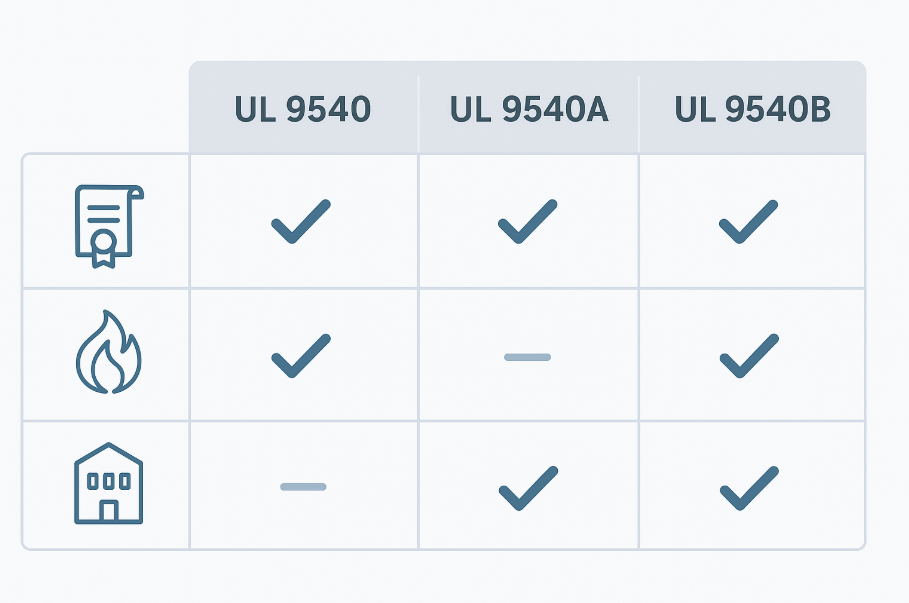
UL 9540A vs UL 9540 vs UL 9540B: Key Differences
These three standards are closely related, yet they serve very different purposes. Confusing them is one of the most common and expensive mistakes in BESS certification.
Standard
Type
Scope
Who It Applies To
UL 9540
Certification
Full ESS system safety
Manufacturers seeking UL listing
UL 9540A
Test Method
Thermal runaway fire propagation
Anyone needing AHJ / NFPA 855 compliance
UL 9540B
Test Method
Residential vent gas ignition
Home BESS installers
The critical distinction: The UL 9540A Test Method produces a test report, not a certificate. That report feeds into UL 9540 certification and satisfies NFPA 855 and IFC requirements. In practice, you can hold UL 9540A data without being UL 9540 certified. However, you cannot achieve UL 9540 certification without it.
Together, these three standards form a complete safety framework — covering fire propagation at every scale from a single residential battery to a 100 MWh grid-scale installation.
Fifth Edition (2025): What Changed and What It Means for You
UL Solutions released the UL 9540A Test Method Fifth Edition on March 12, 2025. This update is the most significant revision since the standard’s introduction. Three forces drove the changes: rapid adoption of new battery chemistries, a surge in rooftop and residential BESS deployments, and real-world fire incidents that exposed gaps in the previous edition.
Below is every major change — and specifically what each one means in practice.
Change 1: Hydrogen Detection Protocols Now Explicitly Addressed
What changed: The Fifth Edition formally adds hydrogen sensor protocols to the test setup. Previously, hydrogen monitoring was optional and inconsistently applied across different labs.
What it means for you: If your BESS uses any chemistry that off-gasses hydrogen during thermal runaway — including lead-acid, certain NMC variants, and some older lithium chemistries — your chosen lab must now have hydrogen-rated enclosures and calibrated sensors. However, not all accredited labs have upgraded their facilities yet.
Action required: Before booking, specifically ask: “Are you equipped for hydrogen detection under the UL 9540A Fifth Edition?” Discovering this gap after scheduling typically adds several weeks to your timeline.
Change 2: Rooftop and Open Garage Installations Have Dedicated Criteria
What changed: The Fifth Edition adds specific test scenarios and pass/fail criteria for rooftop-mounted BESS and open garage installations — two of the fastest-growing deployment environments in commercial solar-plus-storage.
What it means for you: Before this update, AHJs evaluating rooftop BESS had to interpret indoor criteria and apply them to rooftop conditions, which led to inconsistent approvals. Now, if your product targets commercial rooftop projects, your UL 9540A test report must explicitly cover the rooftop installation scenario. A report based only on indoor unit-level testing will therefore not satisfy AHJ requirements for rooftop deployments.
Action required: Tell your test lab upfront that you need rooftop installation scenario data in the final report. This change affects test setup, not just documentation.
Change 3: Rest Times After Conditioning and Charging Are Clarified
What changed: The Fifth Edition specifies exact rest periods between cell conditioning, charging, and the thermal runaway trigger. Previously, labs interpreted these intervals differently, which produced inconsistent results across facilities.
What it means for you: Standardised rest times make results more reproducible and comparable across labs. If you have older UL 9540A data from before March 2025, some AHJs may request updated data under the Fifth Edition protocols. Consequently, you should confirm with your certification body whether existing reports are still accepted for new project applications.
Change 4: Thermocouple Placement Is More Precisely Defined
What changed: The Fifth Edition introduces tighter specifications for sensor placement during cell-level testing, including continuous temperature ramping rather than the stepped increments some labs previously used.
What it means for you: More precise thermocouple placement captures temperature gradients more accurately — particularly at cell edges where propagation typically begins. As a result, cell-level tests may take slightly longer to set up correctly under the new specifications.
Change 5: Module Casing Temperature Limits Are Now Specified
What changed: Previously, the standard measured casing temperature but did not define a clear pass/fail threshold. The Fifth Edition now introduces specific maximum temperature limits for module casings during Level 2 testing.
What it means for you: This change directly affects module enclosure design. If your module casing reaches the new temperature threshold, the test escalates to Level 3 regardless of whether flame propagation was observed. Manufacturers using thin-wall aluminium enclosures are most likely to be affected by this change.
Action required: Review your module casing material and wall thickness against the new thresholds before testing. Adding a ceramic fibre layer or increasing casing thickness can prevent an unexpected escalation to Level 3 — and save $25,000–$60,000 in additional testing costs.
Change 6: New Chemistries — Lead-Acid, NiCd, and Flow Batteries Now Covered
What changed: The original standard focused almost entirely on lithium-ion chemistry. In contrast, the Fifth Edition adds dedicated test protocols for lead-acid, nickel-cadmium, and flow battery systems.
What it means for you: If you manufacture or integrate non-lithium BESS technology, the Fifth Edition finally gives you a clear test roadmap. Previously, testing these chemistries required significant negotiation with both the lab and the AHJ to agree on appropriate protocols. For flow battery manufacturers in particular, this is a major development — vanadium flow and zinc-bromine systems behave fundamentally differently from lithium thermal runaway, and the Fifth Edition addresses this directly.
What changed: The Fourth Edition used an NFPA 286 fire room for residential installation-level testing. The Fifth Edition replaces this with an instrumented wall assembly, which better represents how home batteries are actually mounted — on a garage or utility room wall.
What it means for you: If you sell residential BESS products, your installation-level test setup looks different now. The instrumented wall assembly is generally less expensive to construct than a full NFPA 286 fire room. Nevertheless, if you have existing residential installation-level data from before March 2025, confirm with your certification body whether the new wall assembly requirement affects your report’s validity.
Fifth Edition Changes at a Glance
Change
Who Is Affected Most
Action Required
Hydrogen detection protocols
Lead-acid, NMC, NCA chemistries
Confirm lab has H₂-rated enclosures
Rooftop & garage criteria
Commercial rooftop solar-plus-storage
Add rooftop scenario to test scope
Clarified rest times
All manufacturers with pre-2025 data
Verify older reports still accepted
Thermocouple placement
All cell-level tests
Allow extra lab setup time
Module casing temp limits
Thin-wall aluminium enclosures
Review casing design before testing
New chemistry protocols
Lead-acid, NiCd, flow batteries
Follow chemistry-specific protocols
Residential wall assembly
Home / residential BESS products
Update installation test setup
The March 2025 UL 9540A Fifth Edition introduced seven significant changes. The most impactful changes for manufacturers are the new hydrogen detection protocols — which affect lab selection for chemistries that off-gas hydrogen — and the dedicated rooftop installation criteria, which now require a separate test scenario for any product targeting commercial rooftop solar-plus-storage. Furthermore, manufacturers with test reports issued before March 12, 2025 should confirm with their AHJ and certification body whether existing data is still accepted for new project applications.
Do You Need to Retest Under the Fifth Edition?
The answer depends on three factors.
First, check when your existing report was issued. Reports from before March 12, 2025 were conducted under the Fourth Edition. Most AHJs still accept these for projects already in the permitting pipeline. However, new applications submitted after mid-2025 increasingly require Fifth Edition data.
Second, check whether your product design has changed. Any change to cell chemistry, module configuration, casing material, or suppression system after your original test date requires a new UL 9540A test — regardless of which edition is current.
Third, confirm what your AHJ specifically requires. California, New York, and Massachusetts fire authorities have been quickest to adopt the Fifth Edition. Always verify the edition requirement directly with your AHJ before scheduling any testing.
Who Is Required to Complete UL 9540A Testing?
The UL 9540A Test Method is not optional for most BESS projects in the United States. Here is a breakdown of exactly who needs it, why, and when.
1. Battery Manufacturers
Manufacturers are the first and most critical party in the UL 9540A chain. Without cell or module level test data, no downstream party can use the product in a code-compliant installation.
Specifically, manufacturers need UL 9540A data before submitting for UL 9540 system certification, before launching any product commercially in the U.S. or Canadian markets, and whenever a significant design change occurs — whether to cell chemistry, module configuration, or enclosure design.
Real example: A South Korean LFP cell manufacturer entering the U.S. market completes cell-level testing and passes with no propagation at Level 1. Because they include the test report in their product datasheet, every integrator using their cells can reference it in permit applications — significantly shortening approval timelines for everyone downstream.
2. BESS Integrators and System Builders
Integrators who assemble cells or modules into complete ESS units need UL 9540A data at the unit level. Even when the cells inside already carry cell-level data from the manufacturer, the assembled unit must still be tested separately — because different enclosures, cell spacing, and thermal management all change how the system behaves.
The most common mistake integrators make: Many assume that their cell supplier’s cell-level data covers their assembled system. It does not. AHJs want unit-level or installation-level data for the specific product being installed — not just the cells inside it.
Real example: A U.S.-based integrator builds a 500 kWh containerised system using LFP cells with existing cell-level test data. Despite this, they still need unit-level testing on the complete container. The reason is straightforward — cell-level data does not account for how heat and gas behave inside that specific enclosure design.
3. Project Developers and EPCs
Developers and EPC firms typically do not conduct UL 9540A testing themselves. Instead, they rely on the manufacturer or integrator to provide the report. However, they remain responsible for ensuring the correct report exists and covers the specific installation scenario before permit submission.
The financial risk of missing documentation: Permit delays on utility-scale projects can cost $50,000–$500,000 or more per month in carrying costs, grid connection fees, and contractor standby charges. Getting UL 9540A documentation right at the permit stage is therefore one of the most cost-effective risk management steps a developer can take.
Real example: A California solar-plus-storage developer submits a permit for a 2 MWh commercial BESS. The AHJ requests installation-level data. Unfortunately, the integrator only holds unit-level data. As a result, the permit is held for 11 weeks while the integrator arranges additional testing — delaying commercial operation and triggering a penalty clause in the PPA.
4. Commercial and Industrial Installers
C&I installers are responsible for ensuring the physical installation meets all fire code requirements. Although they do not conduct UL 9540A testing themselves, they need to understand what the test data means — because it determines the installation parameters they must follow on site.
Specifically, test data defines minimum separation distances, required suppression system type and specifications, ventilation requirements, and whether the system can be installed in occupied spaces.
Real example: A C&I installer receives a BESS unit with a UL 9540A report covering indoor ground-level installation. The customer, however, wants the unit in a rooftop plant room. After reviewing the report, the installer identifies that rooftop installation is not covered. Because this is now a separate test scenario under the Fifth Edition, the installer flags the issue to the developer before installation — successfully avoiding a failed inspection and costly remediation.
5. Residential Installers
Residential installers need to verify that the products they install carry UL 9540A data specifically covering residential installation scenarios. Under the Fifth Edition, residential installation-level testing now uses an instrumented wall assembly rather than the previous NFPA 286 fire room.
In California, New York, Massachusetts, and several other leading states, residential BESS installations above a certain capacity also require a fire marshal review. During that review, the fire marshal will specifically examine the UL 9540A report. An outdated Fourth Edition report covering only indoor ground-level scenarios may not pass that review.
6. Authorities Having Jurisdiction (AHJs)
Understanding how AHJs use UL 9540A data helps manufacturers, integrators, and developers prepare the right documentation on the first submission.
When reviewing a permit application, AHJs check four specific things. First, they confirm the test covers the specific installation type — indoor, outdoor, rooftop, or residential. Second, they verify the report is under the current edition. Third, they ensure the suppression system in the report matches what is being installed. Fourth, they check that the separation distances in the design match the test data requirements.
The most common reason AHJs reject a BESS permit: The UL 9540A report covers a different installation configuration than what is being proposed. In almost every case, this is avoidable with proper planning.
Quick Reference: Who Needs What
Party
Needs UL 9540A?
At What Level
When
Battery manufacturer
Yes
Cell + Module
Before product launch
BESS integrator
Yes
Unit level minimum
Before UL 9540 certification
Project developer / EPC
Must obtain from supplier
Unit or Installation
Before permit application
C&I installer
Must verify it exists
Unit or Installation
Before accepting product
Residential installer
Must verify it exists
Installation — residential wall
Before installation
AHJ
Reviews it
Installation level preferred
At permit application stage
How Passing UL 9540A Accelerates Project Approvals
For manufacturers and integrators new to the UL 9540A Test Method, testing can feel like a cost centre. In reality, the test data is one of the most commercially valuable documents a BESS company can hold. Here is exactly what it delivers.
1. Unlocks the U.S. and Canadian Markets
Without UL 9540A test data, a BESS product cannot receive permits for most U.S. commercial, industrial, or utility-scale installations. According to Wood Mackenzie, the U.S. utility-scale BESS market is projected to exceed 100 GWh of annual deployments by 2027. Every gigawatt-hour of that capacity requires UL 9540A documentation before installation can begin.
2. Speeds Up AHJ Approvals Dramatically
When a permit application arrives with a complete, current UL 9540A report covering the correct installation scenario, AHJ reviews move quickly. Without one — or with a report covering the wrong configuration — projects stall.
Documentation Status
Typical AHJ Review Time
Full report — correct edition and scenario
2–6 weeks
Partial report — unit level only
6–14 weeks
No UL 9540A report
3–6 months or permit denied
Wrong installation scenario
8–16 weeks while retesting is arranged
For a utility-scale developer carrying $500,000 per month in project costs, the difference between a 4-week and a 16-week AHJ review represents $6 million in carrying costs alone.
The test report tells installers and engineers exactly how to install a system safely. Specifically, it provides minimum separation distances, suppression system type and specifications, ventilation requirements, and occupancy separation rules. Without test data, engineers must apply conservative worst-case assumptions to every parameter — resulting in larger equipment rooms and more expensive suppression systems than the product actually requires.
Real example: A 1 MWh commercial BESS without test data is conservatively specced with 3-metre separations and a full FM-200 suppression system. After unit-level UL 9540A testing shows minimal gas release and no external flaming, the AHJ approves 1.5-metre separations and a standard sprinkler system instead — saving the developer $180,000 in installation costs on a single project.
4. Strengthens Credibility With Buyers and Investors
Most utility and large C&I tenders now include UL 9540A documentation as a mandatory submission requirement. Beyond procurement, project finance lenders review it during technical due diligence. BESS project insurers also base premiums and coverage terms partly on test results — systems with complete data typically receive 10–25% lower annual premiums. In competitive RFP processes where two products are technically similar, the one with more complete and current documentation consistently wins.
5. Delivers Valuable Design Feedback
The UL 9540A Test Method is not simply a pass/fail gate. Rather, it is the most rigorous thermal event simulation most BESS products will ever undergo. Manufacturers routinely learn which cells in a module are most vulnerable to propagation, whether casing vent design adequately directs hot gas away from adjacent modules, how the BMS responds when thermal runaway begins, and whether suppression activates early enough. Each test cycle generates specific, quantified data about failure modes that competitors without that test history simply do not possess.
6. Reduces Insurance Costs and Liability Exposure
Systems with complete installation-level UL 9540A data typically receive 10–25% lower annual premiums than systems with partial or no documentation. Furthermore, in the event of a fire incident, a manufacturer with complete test data has documented evidence that their product was tested to the applicable national standard. Without that documentation, liability exposure in litigation increases significantly.
7. Supports International Market Access
Beyond North America, several international markets reference or accept UL 9540A data as part of their BESS approval processes. Australia’s Clean Energy Council accepts UL 9540A reports as supporting documentation. Similarly, Japan’s Fire and Disaster Management Agency references the standard in guidance for large-scale BESS. In addition, South Korea has incorporated UL 9540A style propagation testing following high-profile fire incidents, and several Gulf states including the UAE and Saudi Arabia reference it in their developing BESS procurement standards.
The True Cost of Skipping UL 9540A Testing
Consequence
Typical Cost Impact
Permit application rejected or delayed
$50K–$500K+ per month
AHJ requires retesting mid-project
$80K–$200K + 3–6 month delay
Insurance coverage limited
15–30% higher annual premiums
Excluded from mandatory RFP requirement
Full contract value lost
Fire incident without test documentation
Unlimited liability in litigation
Project finance delayed pending documentation
Higher borrowing costs or lost financing window
A full four-level UL 9540A program costs $80,000–$200,000 and takes 3–6 months. Against any single item in the table above, that investment pays for itself many times over.
Conclusion: Is Your BESS Ready for UL 9540A Testing?
The UL 9540A Test Method is not a box to check — it is the technical foundation that determines whether your BESS project gets built or stalls at the permit stage. With the 2025 Fifth Edition now in effect, manufacturers and integrators working with newer chemistries or rooftop installations need to revisit their test plans immediately.
Here is a quick recap of everything covered in this guide:
The UL 9540A Test Method measures thermal runaway fire propagation at four levels — cell, module, unit, and installation
Testing stops at the earliest clean level, so not every product needs all four
A full four-level program costs $80,000–$200,000 and takes 3–6 months — yet the cost of not having it is far higher
The 2025 Fifth Edition introduced seven significant changes — verify your existing data is still accepted for new applications
Every party in the BESS value chain interacts with UL 9540A data at a different stage of the project lifecycle
The Three Most Expensive UL 9540A Mistakes
Mistake 1: Assuming cell-level data covers the assembled system Cell-level data from your supplier does not cover your assembled unit. AHJs require unit-level or installation-level data for the specific product being installed.
Mistake 2: Testing the wrong installation scenario An indoor ground-level report does not satisfy AHJ requirements for rooftop deployment. Under the Fifth Edition, rooftop and open garage installations are separate test scenarios entirely. Always match your test scope to your target installation environment before testing begins.
Mistake 3: Using Fourth Edition data for new Fifth Edition projects Reports issued before March 12, 2025 were conducted under the Fourth Edition. Verify the edition requirement with your AHJ before submitting any new applications.
Three Steps to Take Right Now
Step 1 — Confirm your installation scenario Indoor or outdoor? Ground-level, rooftop, or garage? Residential or commercial? The answers determine which UL 9540A test levels and scenarios your report must cover. Getting this wrong wastes months and significant budget.
Step 2 — Verify your existing test data Check the edition under which it was issued, the installation scenarios it covers, and whether any product design changes have occurred since the test date. When in doubt, confirm directly with your certification body.
Step 3 — Select an accredited lab early The best labs book out 3–6 months in advance. Start conversations before you are ready to test. Confirm hydrogen detection capability if your chemistry requires it under the Fifth Edition.
Related Guides on SunLith Energy
Before you go, these articles will help you build a complete picture of the UL certification landscape:
SunLith Energy works with BESS manufacturers and integrators at every stage of the UL 9540A process:
✅ Test scope planning — confirming which levels and scenarios your program needs to cover ✅ Lab selection and scheduling — matching your chemistry, system size, and timeline to the right accredited facility ✅ Documentation preparation — building the test report package that gets AHJ approvals on first submission ✅ Fifth Edition gap assessment — identifying what, if anything, needs updating in your existing test data
The best time to start planning your UL 9540A program is before your next project enters the pipeline — not after the permit application is submitted.
The UL 9540A Test Method is the only national standard that evaluates whether thermal runaway fire in a battery cell will spread to adjacent cells, modules, or a full BESS installation. It is required by NFPA 855 and the International Fire Code for most commercial and utility-scale energy storage projects in the United States.
Q2. Is UL 9540A a certification?
No. UL 9540A is a test method, not a certification. It produces a test report that manufacturers use to achieve UL 9540 system certification and satisfy local fire code requirements. A BESS product can hold UL 9540A test data without being UL 9540 certified, but cannot achieve UL 9540 certification without it.
Q3. What are the four levels of UL 9540A testing?
The UL 9540A Test Method uses four levels: (1) cell-level, (2) module-level, (3) unit-level, and (4) installation-level with suppression active. Testing stops at the earliest level where no fire propagation is detected, reducing cost and time for manufacturers.
Q4. How much does UL 9540A testing cost and how long does it take?
A full four-level UL 9540A test program typically costs $80,000–$200,000 and takes 3–6 months. Individual levels range from $8,000–$20,000 for cell-level testing to $40,000–$100,000+ for installation-level testing. Costs vary based on system size, battery chemistry, and whether retesting is required.
Q5. What changed in the UL 9540A Fifth Edition released in 2025?
The March 2025 Fifth Edition added hydrogen detection protocols, rooftop BESS installation criteria, new chemistry coverage for flow batteries and lead-acid, module casing temperature limits, and clarified rest times between test stages.