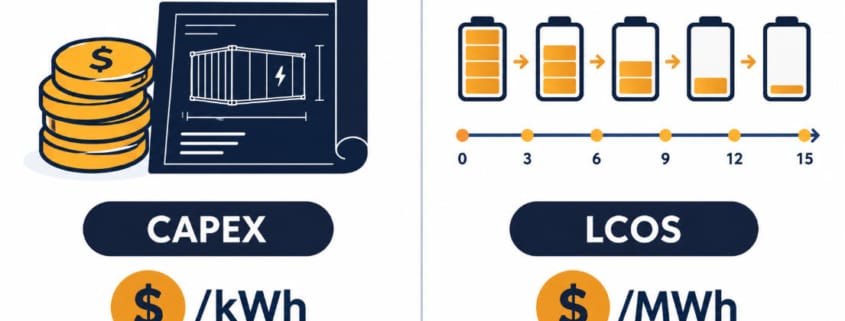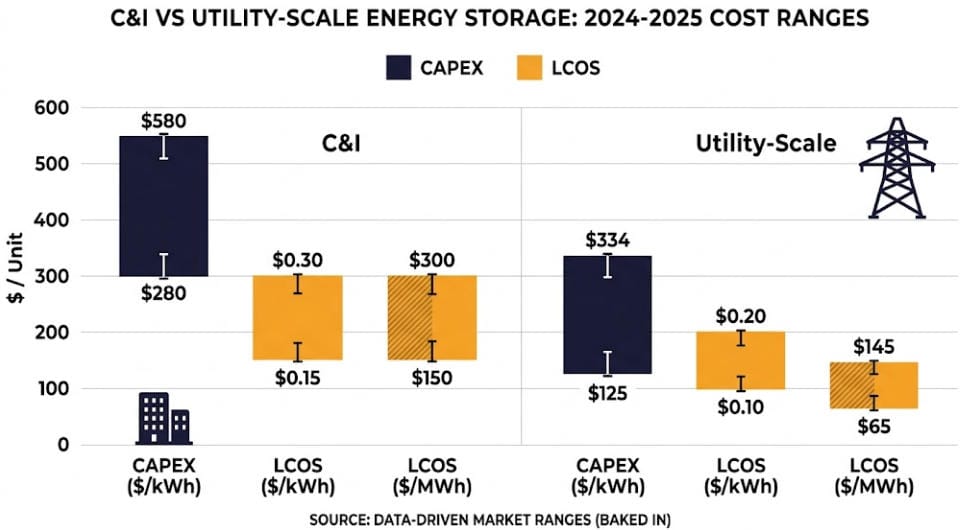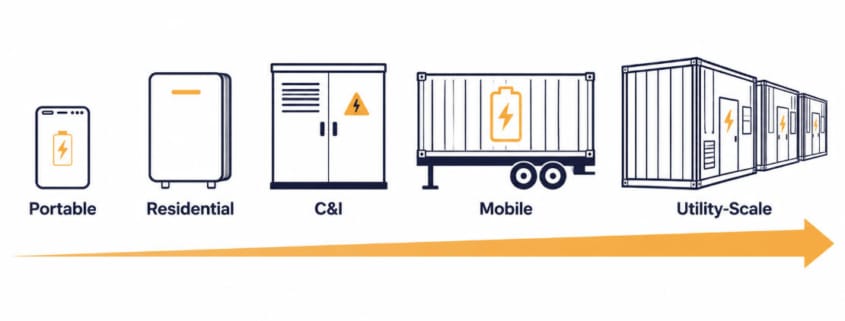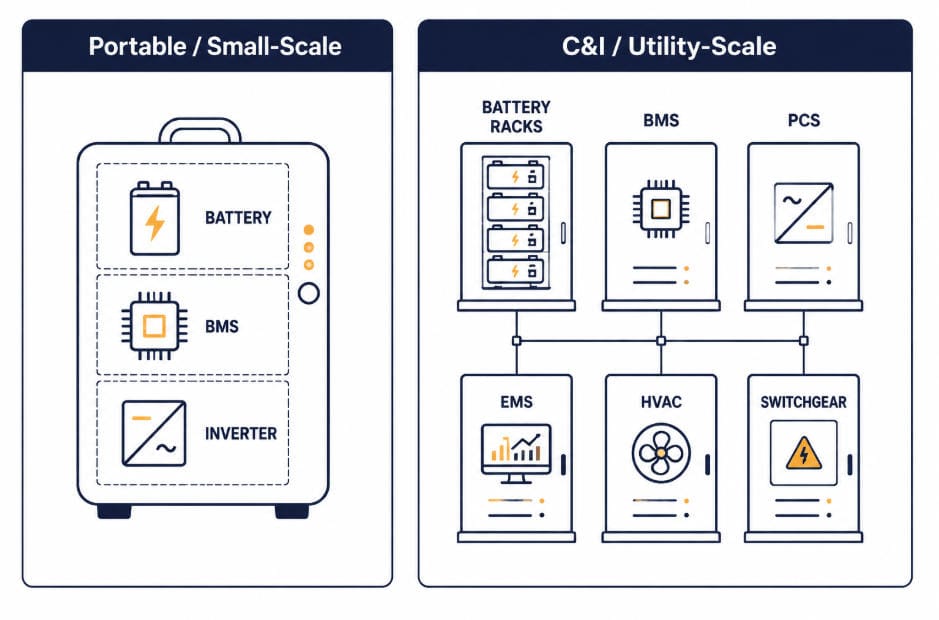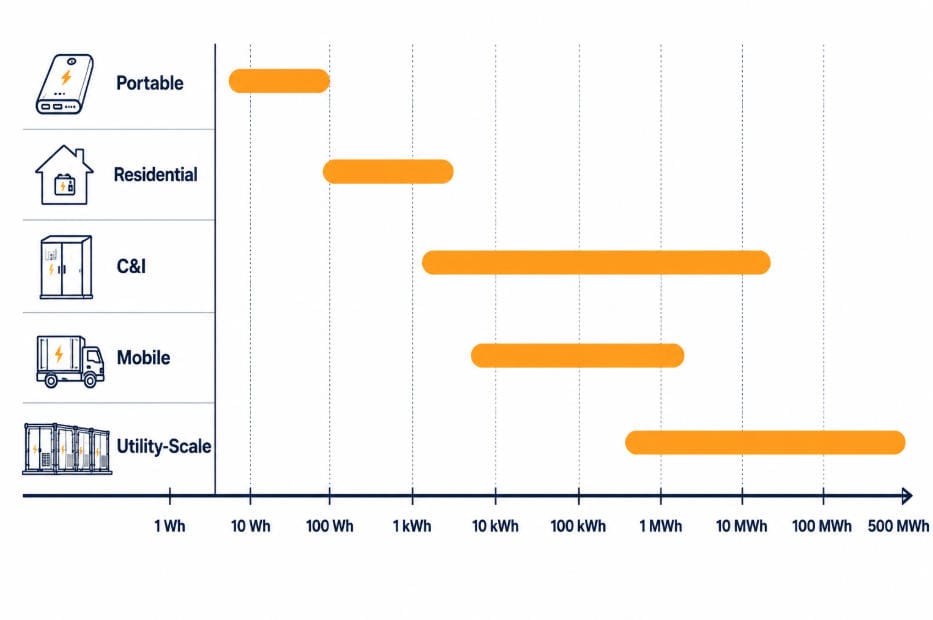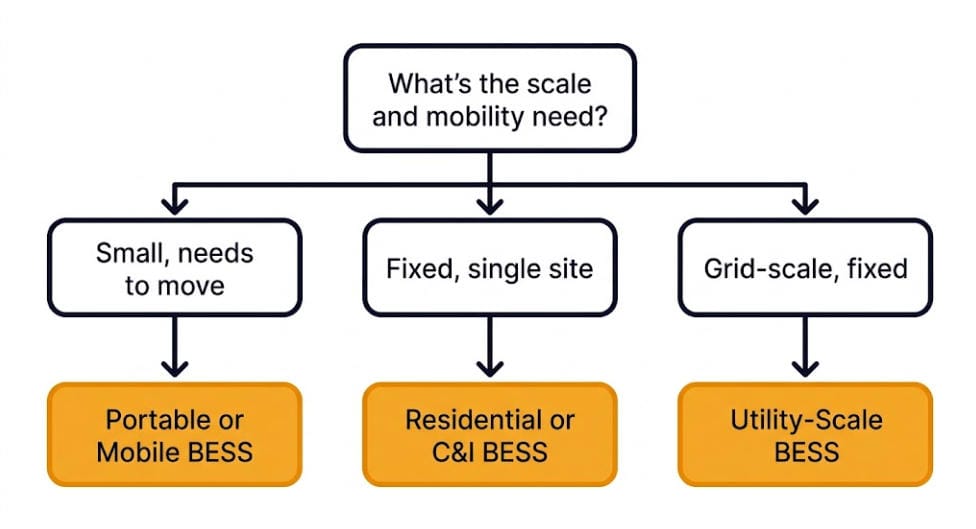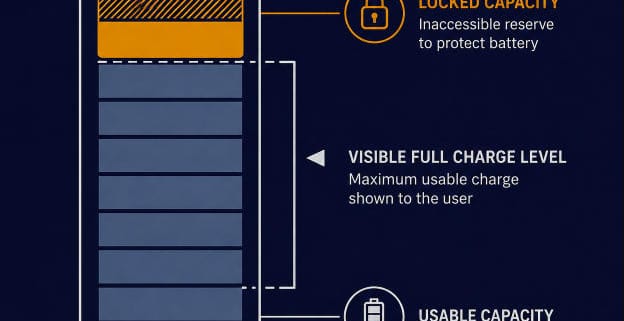
Energy Storage Calculation is essential for designing reliable solar and battery systems. In simple terms, it helps you determine how much energy you need to store and how large your solar system should be.
In this guide, you will learn step-by-step formulas, real examples, and practical sizing methods. As a result, you can design a system that is both efficient and cost-effective.
How do you calculate energy storage requirements?
Parameter
Formula
Battery Storage
Daily Energy × Backup Time ÷ DoD
Solar Size
Daily Energy ÷ Peak Sun Hours
Energy storage requirements are calculated by multiplying daily energy consumption by backup duration. Then, divide by battery depth of discharge (DoD). Similarly, solar size is calculated by dividing daily energy consumption by peak sun hours.
What is energy storage calculation?
Energy Storage Calculation is the process of determining battery capacity based on energy usage and backup time. In other words, it ensures your system can handle real demand.
Moreover, accurate calculation prevents system failure and overspending. Therefore, it is a critical step in system design.
How do you calculate your daily load?
First, list all appliances. Then, multiply power by usage hours.
Formula:
Energy (Wh) = Power (W) × Time (hours)
Example:
Appliance
Power
Hours
Energy
Lights
50W
6
300 Wh
Fan
75W
8
600 Wh
Refrigerator
150W
10
1500 Wh
TV
100W
4
400 Wh
Total daily load = 2800 Wh (2.8 kWh)
As you can see, even small loads add up quickly. Therefore, accurate listing is important.
How do you account for system losses?
#image_title
In real systems, energy losses always occur. For example, losses come from inverters, wiring, and battery conversion.
Formula:
Adjusted Load = Total Load ÷ Efficiency
Typically, efficiency ranges from 80% to 90%.
Example: 2800 ÷ 0.85 = 3294 Wh
As a result, your system must be slightly larger than the raw load.
A major mistake is underestimating system losses — read more about real-world loss factors in our Energy Storage Losses BESS guide
How do you calculate battery storage requirements?
Next, calculate battery size based on backup duration.
Battery sizing depends on how long backup is required. For short outages, smaller batteries work. However, for multi-day backup, large systems are needed.
Therefore, always define backup duration clearly before design.
Residential system example
Let’s consider a typical home.
Daily load: 5 kWh
Backup: 1 day
DoD: 80%
Battery: 5 ÷ 0.8 = 6.25 kWh
Solar: 5000 ÷ 5 = 1 kW
So, the system requires:
~6.5 kWh battery
~1 kW solar
Commercial system example
Now consider a commercial case.
Load: 50 kWh
Backup: 2 days
Battery: 50 × 2 ÷ 0.8 = 125 kWh
Solar: 50000 ÷ 5 = 10 kW
Clearly, commercial systems scale quickly. Therefore, precise calculation is critical.
What are common mistakes in energy storage calculation?
Many systems fail due to simple errors. For example:
Ignoring efficiency losses
Underestimating backup time
Using incorrect sun hours
Not applying DoD
Skipping safety margin
As a result, systems may underperform or fail early.
To build a more efficient energy storage system, factor in real losses. Our energy storage loss guide breaks this down with practical examples and tips.
Best practices for accurate system design
To improve system performance, follow these best practices:
Always add 20% safety margin
Use LiFePO4 batteries
Design using real load data
Plan for worst-case conditions
Additionally, separating peak load from energy load improves design accuracy.
To build a more efficient energy storage system, factor in real losses. Our energy storage loss guide breaks this down with practical examples and tips.
Resources
For deeper understanding and system design support:
These resources help validate calculations and improve system design accuracy.
Frequently Asked Questions (FAQ)
How much battery storage do I need for my home?
Battery storage depends on daily energy use and backup time. Typically, homes require 5–15 kWh for 1-day backup.
How many solar panels are required?
It depends on energy consumption and sunlight. On average, 1 kW solar requires 2–3 panels (400W each).
What is the best battery type?
LiFePO4 batteries are the best choice due to long life, high safety, and deep discharge capability.
What happens if battery size is too small?
If the battery is undersized, backup time reduces. In some cases, the system may fail during outages.
Can solar panels run load and charge battery together?
Yes. A properly designed system can supply load and charge batteries simultaneously.
Conclusion
Energy Storage Calculation is the backbone of any solar and battery system. By following the correct steps, you can design a system that is reliable, efficient, and cost-effective.
Moreover, accurate sizing improves performance and extends battery life. Therefore, always use proper formulas and real data.
⚡ Quick Answer: What Is a Battery Management System? A battery management system (BMS) is the electronic brain inside every lithium battery pack. It monitors cell voltage, current, and temperature in real time. It also protects cells from overcharge, over-discharge, short circuit, and thermal runaway. Furthermore, it estimates State of Charge (SOC) and State of Health (SOH). Without a BMS, a lithium battery is both unsafe and short-lived.
Every lithium BESS relies on a battery management system to run safely. This is true for a 10 kWh home install and a 10 MWh grid system alike. In both cases, therefore, the BMS is not optional — it sits between your cells and everything that can destroy them.
Yet the BMS is one of the most overlooked parts of any BESS purchase. Buyers focus on cell chemistry, capacity, and cycle life. Then they treat the battery management system as a given. That is a costly mistake.
A poor BMS, therefore, degrades good cells. A great battery management system, in contrast, extends the life of average cells. It is a lifespan management tool — not just a safety device.
This guide explains how a battery management system works, what it monitors, and how it balances cells. We also cover SOC and SOH calculation and show you how to evaluate a supplier’s BMS before you sign. For context on how the BMS interacts with cell chemistry, first read our LiFePO4 vs NMC battery comparison guide.
1. What Is a Battery Management System?
How a battery management system connects cells, inverter, EMS, and monitoring platform
A battery management system (BMS) is an electronic control unit built into a battery pack. Specifically, its job is to protect cells, measure their state, and report data to the rest of the system.
Think of the BMS as doing three jobs at once. First, it acts as a protection circuit — preventing electrical and thermal damage to the cells. Second, it is a measurement system — tracking voltage, current, temperature, SOC, and SOH. Third, it is a communication hub — sending live data to the inverter, EMS, and monitoring platform.
In a simple 12V residential pack, the BMS is a small PCB inside the module. In a commercial BESS, however, it manages hundreds of cells at once. The scale changes — but the core functions stay the same.
🔋 Why the Battery Management System Determines Lifespan Two identical cell packs with different BMS implementations deliver very different lifespans. Specifically, a BMS that allows cells to hit voltage limits, run hot, or drift out of balance will shorten cell life — regardless of the chemistry’s rated cycle count. The battery management system is, therefore, as important as the cells themselves.
2. Battery Management System Functions: The Seven Core Jobs
A well-designed battery management system performs seven distinct functions. Each one protects the battery in a different way. Together, furthermore, they determine whether your BESS is safe, efficient, and long-lived.
2.1 Cell Voltage Monitoring
The BMS monitors every individual cell voltage — not just overall pack voltage. This matters because cells in a multi-cell pack drift apart over time. Specifically, one weak cell can hit its limit before the others do.
For LiFePO4 cells, the safe range is 2.5V to 3.65V per cell. Going outside this range — even briefly — causes permanent capacity loss. So the BMS must, therefore, detect and respond to violations in milliseconds.
Voltage monitoring also underpins SOC estimation, which we cover in Section 5. Without accurate cell-level data, furthermore, everything else the BMS does becomes unreliable.
2.2 Current Monitoring and Overcurrent Protection
The BMS measures charge and discharge current using a shunt resistor or Hall-effect sensor. Specifically, this data serves four purposes:
Coulomb counting — integrating current over time to estimate SOC
Overcurrent protection — detecting short circuits and excessive discharge rates
C-rate enforcement — ensuring cells never charge or discharge faster than their rated speed
Power limiting — reducing available power as SOC drops or temperature rises
2.3 Temperature Monitoring
Temperature is one of the biggest drivers of battery degradation. Consequently, the BMS places sensors at multiple points — cell surfaces, busbars, and the enclosure. It uses this data to trigger cooling and reduce current.
It also halts charging below 0°C. Charging below freezing causes lithium plating. This is permanent anode damage that cannot be reversed.
For LiFePO4, the safe charging range is 0°C to 45°C. Discharge, however, runs across a wider range of -20°C to 60°C. The BMS enforces both limits automatically.
2.4 Overcharge and Over-Discharge Protection
These are the two most critical BMS protection functions. Overcharging a lithium cell causes irreversible changes in the cathode. Similarly, over-discharging collapses the anode. Both permanently reduce capacity.
The BMS prevents both by triggering a contactor disconnect when any cell breaches its voltage limit. This happens even if the pack’s overall voltage looks normal. One weak cell can hit its limit while others still have headroom. That is why cell-level monitoring is non-negotiable.
2.5 Short Circuit Detection and Response
A short circuit sends a massive current spike through the pack in milliseconds. Without protection, the heat this creates can trigger thermal runaway. As a result, the BMS detects the spike and opens the contactor in microseconds — before damage occurs.
Furthermore, sustained overcurrent protection prevents operation at damaging C-rates. This applies even without a sudden short circuit event.
2.6 Cell Balancing
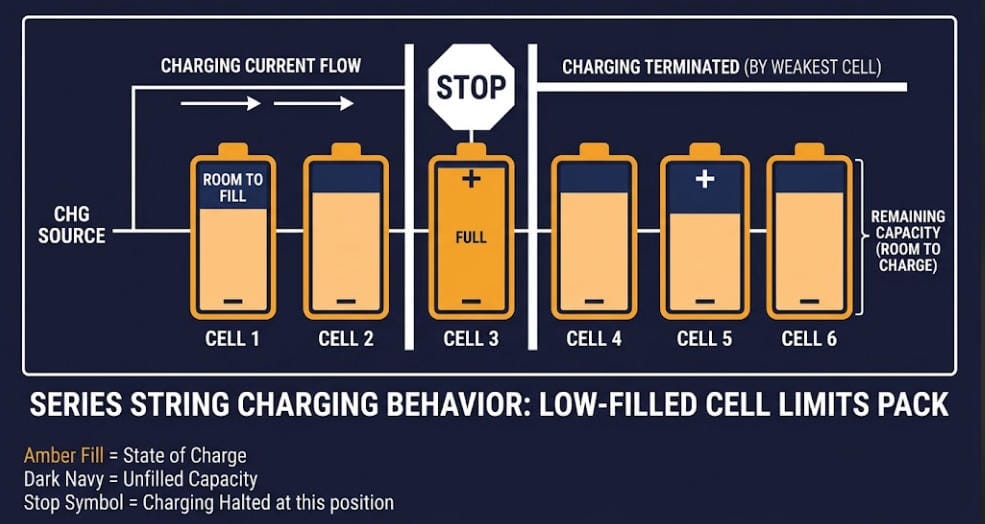
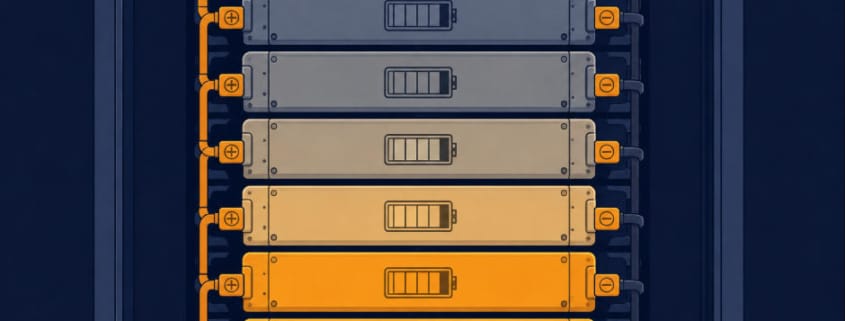
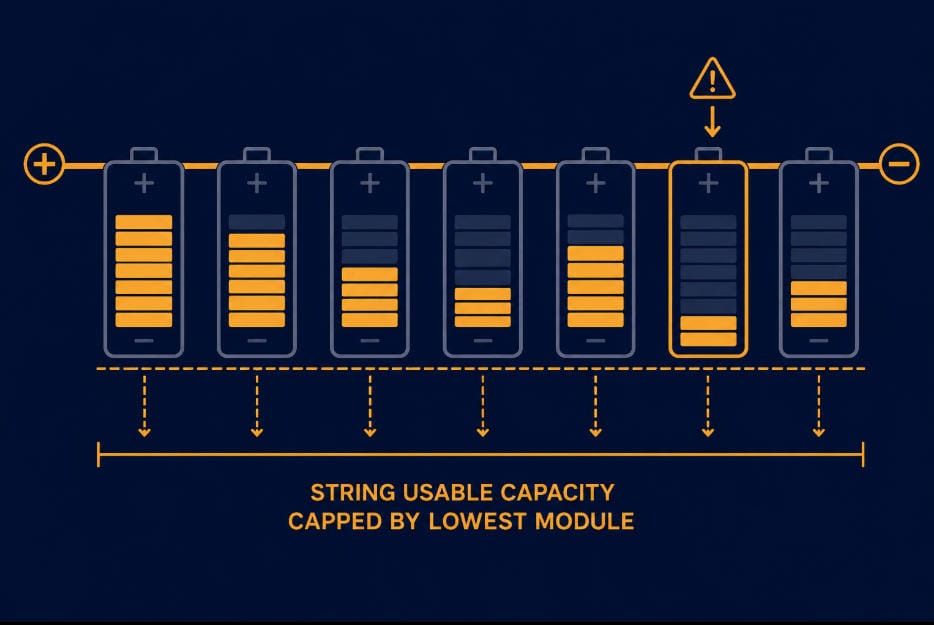
Cell balancing is one of the most important long-term BMS functions. It keeps all cells at the same State of Charge. Without it, the weakest cell limits the entire pack — even though the others still have energy to give.
We cover passive vs. active balancing in detail in Section 4. The key point, however, is this: balancing quality directly affects how much rated capacity you can use over time. In other words, poor balancing means lost energy.
2.7 Communication and Data Reporting
A modern battery management system communicates with the inverter, EMS, SCADA, and remote monitoring platforms. In particular, the most common protocols include:
CAN bus — standard in high-performance BESS and automotive applications
RS485 / Modbus RTU — common in commercial and industrial storage
MQTT / TCP-IP — used for cloud monitoring and Battery Passport data exports
The BMS transmits SOC, SOH, cell voltages, temperatures, current, cycle count, and fault codes. Specifically, this data feeds dispatch decisions in the EMS and enables remote health tracking.
3. Battery Management System Architecture: Three Tiers Explained
BMS architecture scales with system size. Specifically, there are three implementation levels. Each one adds capability and complexity.
BMS Tier
Also Called
Scope
Typical Application
Cell-level BMS
CBMS
Monitors individual cells in one module
Residential storage under 30 kWh
Module BMS
Slave BMS / MBMS
Manages one group of cells in a module
C&I systems, EV battery packs
System / Master BMS
SBMS / Master BMS
Coordinates all modules in the full pack
Utility-scale BESS, multi-rack systems
Single-Level BMS (Residential)
In smaller systems — typically under 100 kWh — a single BMS manages all cells directly. This is a simple, low-cost architecture. Consequently, the BMS PCB sits inside the battery module and handles monitoring, protection, and balancing on its own.
However, as cell count grows, wiring becomes complex and processing load increases. Beyond a certain size, single-level BMS becomes impractical.
Master-Slave BMS (Commercial and Utility Scale)
In larger systems — typically above 100 kWh — a master-slave design is used. Each battery module has its own Slave BMS. It handles local cell monitoring and balancing. All Slave units then report to a central Master BMS, which coordinates the full system.
The Master BMS aggregates data from all modules and manages system-level protection. Furthermore, it communicates with the inverter and EMS. As a result, this architecture scales well to multi-megawatt-hour systems.
⚠️ Key Evaluation Point: Master-Slave Independence In a quality master-slave battery management system, each slave module should protect its own cells independently — even if communication with the master is lost. A BMS where cell protection depends entirely on the master, however, creates a single point of failure. Therefore, always ask: what happens to cell-level protection if the master controller fails?
4. Cell Balancing in a Battery Management System: Passive vs. Active
Passive balancing dissipates excess charge as heat. Active balancing transfers charge between cells electronically.
Why Cells Need Balancing
No two lithium cells are identical. Manufacturing tolerances mean cells leave the factory with slightly different capacities. Moreover, temperature gradients within a pack cause some cells to age faster. Self-discharge rates also vary slightly between cells.
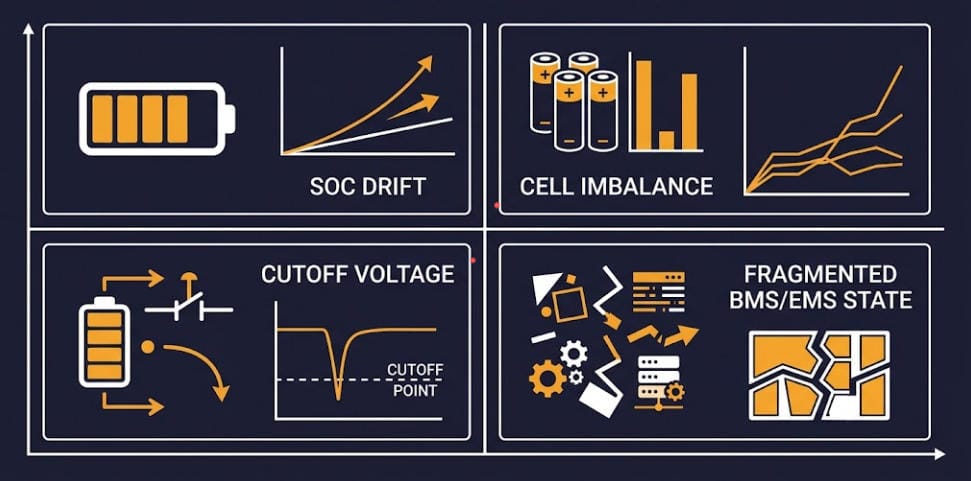
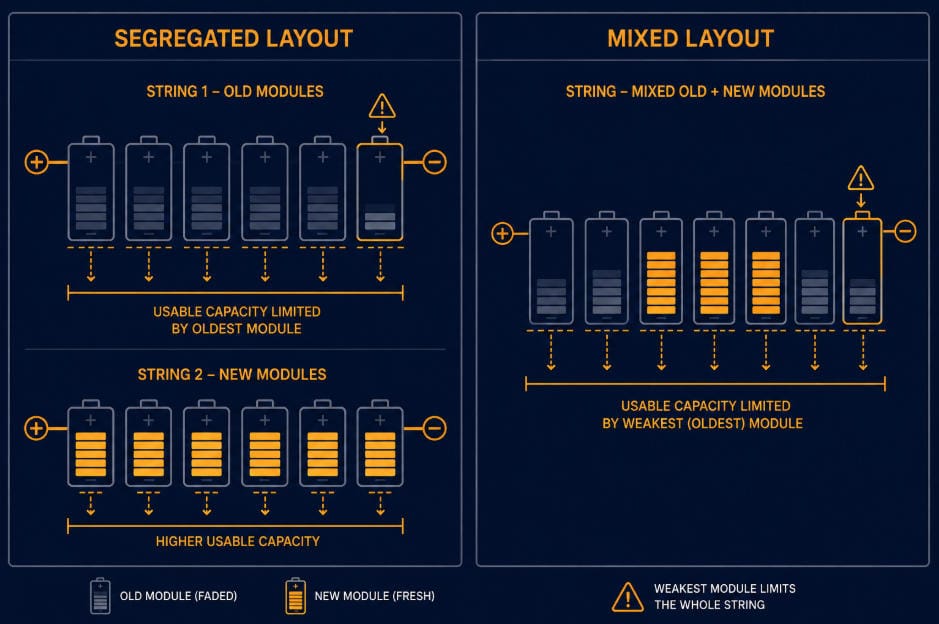
Over time, cells drift apart in State of Charge. The cell with the lowest SOC determines when discharge must stop. Similarly, the cell with the highest SOC determines when charging must stop. If cells are out of balance, the weakest cell constrains the entire pack — even though the others still have capacity.
The BMS corrects this drift through balancing. As a result, all cells stay at the same SOC and the full rated capacity remains usable.
Passive Balancing: Simpler and More Common
Passive balancing is, specifically, the most common approach. The BMS bleeds off excess charge from higher-SOC cells as heat through a resistor. It keeps doing this until, eventually, all cells match the lowest cell.
Advantages: Low cost, simple, reliable, and well-proven across millions of systems.
Disadvantages: Energy is wasted as heat. Balancing current is typically low (20–200 mA), so it is slow. In large packs with heavy imbalance, furthermore, passive balancing cannot keep up.
Passive balancing is, therefore, best suited to residential and small commercial systems. It works particularly well where cell quality is high and cycle frequency is moderate.
Active Balancing: Better for High-Cycle Systems
Unlike passive balancing, active balancing transfers energy from higher-SOC cells to lower-SOC cells using inductive or capacitive circuits. Energy is not wasted — instead, it is redistributed within the pack.
Advantages: No energy waste. Higher balancing currents (0.5–5A) mean faster correction. Better long-term capacity retention in high-cycle applications.
Disadvantages: Higher cost and more complexity. There are, therefore, more potential failure points in the balancing circuitry.
Active balancing is, therefore, best specified for utility-scale BESS, frequency regulation, and systems designed for 15+ year lifespans where long-term capacity retention is critical to ROI.
Factor
Passive Balancing
Active Balancing
How it works
Burns excess charge as heat via resistor
Transfers charge between cells electronically
Energy efficiency
Low — energy wasted as heat
High — energy redistributed within pack
Balancing speed
Slow: 20–200 mA typical
Fast: 0.5–5A typical
System complexity
Simple and reliable
More complex, more failure points
Cost
Low
Higher (2–5x passive)
Best for
Residential and small C&I (under 500 kWh)
Utility-scale and high-cycle BESS (over 500 kWh)
5. How the Battery Management System Estimates SOC (State of Charge)
Essentially, SOC is the fuel gauge of your battery. It shows how much energy is stored, expressed as a percentage of full capacity. Accurate SOC is essential for safe operation and efficient dispatch.
Importantly, SOC cannot be measured directly. Instead, it must be estimated from measurable quantities — voltage, current, and temperature. The BMS uses one or more algorithms to do this. Each method has distinct strengths and trade-offs.
Method 1: Open Circuit Voltage (OCV) Lookup
Specifically, this is the simplest SOC estimation method. When a battery has rested for 30–60 minutes, its Open Circuit Voltage maps to SOC via a lookup table. The table is built from cell characterisation tests.
However, OCV works poorly for LiFePO4. LFP has a very flat voltage curve between 20% and 80% SOC. Small voltage changes correspond to large SOC swings in this region. As a result, OCV-based SOC is inaccurate during normal operation. It is mainly useful for setting the initial estimate after a long rest period.
Method 2: Coulomb Counting
Coulomb counting integrates current over time. It tracks how much charge has entered or left the battery. As a result, it is the most widely used SOC method in real-time operation.
Coulomb counting is accurate over short periods. However, it accumulates error over time due to sensor tolerances, temperature effects, and small unmeasured currents. Without periodic recalibration, the estimate drifts.
Best practice: In practice, reset SOC to 0% or 100% when the battery hits its cutoff voltage. These anchor points correct accumulated drift effectively.
Method 3: Extended Kalman Filter (EKF)
The Extended Kalman Filter is the most accurate SOC method available. It combines Coulomb counting with a mathematical model of the battery’s electrochemical behaviour. Consequently, it corrects the estimate continuously based on the gap between model prediction and actual voltage.
EKF handles LFP’s flat voltage curve far better than OCV. It adapts in real time to temperature changes, aging effects, and varying loads. Furthermore, premium BMS platforms from Texas Instruments, Analog Devices, and Orion BMS use EKF or adaptive Kalman variants.
The trade-off: EKF requires significant processing power and a well-characterised cell model. It is, consequently, computationally demanding and needs careful tuning for each chemistry.
SOC Method
Accuracy
LFP Suitability
Typical Use
Open Circuit Voltage
±5–10% in flat region
Poor — flat curve limits accuracy
Initial SOC after rest period only
Coulomb Counting
±3–5% short term, drifts over time
Good for real-time tracking
Residential and most C&I systems
Extended Kalman Filter
±1–2% with good cell model
Excellent — handles flat curve well
Utility-scale BESS and precision apps
6. How the Battery Management System Tracks SOH (State of Health)
State of Health (SOH) measures how much of a battery’s original capacity remains. A new battery starts at 100% SOH. Each cycle causes a small, permanent capacity loss. Consequently, the BMS tracks this degradation over the system’s lifetime.
Specifically, SOH is defined as: SOH (%) = (Current Capacity ÷ Original Rated Capacity) × 100.
Notably, End of Life (EOL) is declared when SOH drops to 80% — or 70% in some industrial applications. For more on how EOL thresholds work in practice, see our Battery Cycle Standards guide.
How SOH Is Estimated Over Time
SOH cannot be measured with a single reading. Instead, the BMS builds up estimates using several data sources accumulated over time:
Capacity fade tracking — comparing measured full-charge capacity against original rated capacity
Internal resistance measurement — resistance increases as cells age; higher resistance correlates with lower SOH
Cycle counting — simple but imprecise; does not account for partial cycles or varying depth of discharge
Incremental Capacity Analysis (ICA) — an advanced technique that analyses the dV/dQ curve to detect electrochemical aging signatures
SOH Logging and Warranty Compliance
Accurate SOH logging matters for two reasons. First, it supports warranty claims. Most BESS warranties guarantee a minimum SOH at a set cycle count — for example, 80% SOH at 6,000 cycles. The BMS is the primary evidence source for any claim.
Second, SOH logging is becoming a regulatory requirement. The EU Digital Battery Passport, mandatory from February 2027 under EU Batteries Regulation 2023/1542, requires SOH history, cycle count, and energy throughput data. The battery management system is the primary source for all of it.
📊 Battery Management System SOH and Warranty Compliance A BMS that accurately logs SOH over time — with timestamped cycle data — makes warranty claims straightforward. A BMS without proper SOH logging, however, creates disputes. Always ask what SOH data is recorded, how long it is stored, and in what format it can be exported.
7. Battery Management System Requirements: LiFePO4 vs. NMC
LFP and NMC place very different demands on the battery management system — especially for SOC estimation and thermal monitoring speed
LiFePO4 (LFP) and NMC place very different demands on the battery management system. Understanding these differences, therefore, helps you confirm that a supplier’s BMS is genuinely designed for their stated chemistry. A BMS reused from a different application, for instance, will often perform poorly on LFP.
SOC Accuracy: Why LFP and NMC Differ
LFP’s flat voltage curve — discussed in Section 5 — makes SOC measurement significantly harder than NMC. An NMC cell’s voltage, in contrast, changes continuously and predictably with SOC. LFP, however, sits near 3.2V–3.3V across 80% of its SOC range. As a result, OCV lookup is unreliable for LFP in real-time operation.
Consequently, a BMS designed for NMC but deployed on LFP cells will show poor SOC accuracy. This leads to premature shutdowns or unexpected overcharge events. Always, therefore, confirm the BMS SOC algorithm is specifically calibrated for LFP chemistry.
Thermal Monitoring: NMC Is More Demanding
NMC cells are more temperature-sensitive than LFP. Specifically, they degrade significantly above 35°C and have a lower thermal runaway threshold — 150°C to 210°C versus 270°C to 300°C for LFP.
As a result, an NMC battery management system requires:
Temperature monitoring intervals of every 100–500ms — versus every 1–2 seconds for LFP
Faster thermal runaway response — disconnection in milliseconds when temperature spikes
More temperature sensors per module — to catch hot spots before they spread
Integration with active liquid cooling systems — which are common in NMC BESS
NMC cells are damaged more easily by small voltage excursions above the charge cutoff. As a result, a BMS protecting NMC must enforce tighter tolerances — typically ±5mV per cell versus ±10–20mV for LFP. It must also respond faster when a cell approaches its limit.
BMS Function
LiFePO4 (LFP)
NMC
SOC algorithm required
Coulomb counting or Kalman filter essential (flat curve)
OCV lookup or Coulomb counting (clearer voltage slope)
Voltage tolerance per cell
±10–20mV
±5mV — much tighter
Temperature monitoring interval
Every 1–2 seconds typical
Every 100–500ms — faster response needed
Thermal runaway response
Standard — higher threshold
Fast — lower runaway threshold (150–210°C)
Active cooling integration
Optional in most deployments
Often required
Overall BMS complexity
Standard
Higher on all parameters
8. Battery Management System Certifications: Which Standards Apply
As a safety-critical component, the battery management system must, therefore, comply with the relevant standards for each market where the BESS will be installed. Certification covers both the BMS hardware itself and the complete battery system.
Standard
Scope
BMS Relevance
UL 1973
Stationary lithium battery systems
Cell, module, and BMS safety — required for US market access
UL 9540
Complete BESS system safety
BMS must demonstrate system-level protection functions
IEC 62619
Safety for lithium-ion batteries
International standard covering BMS protection requirements
IEC 62933-5
ESS safety framework
Covers BMS communication, monitoring, and fault response
UN 38.3
Transport safety for lithium batteries
BMS must survive vibration, altitude, and thermal tests
EU 2023/1542
EU Batteries Regulation
BMS data required for Digital Battery Passport from 2027
The EU Digital Battery Passport and BMS Data
Specifically, the EU Digital Battery Passport becomes mandatory in February 2027 for industrial and EV batteries above 2 kWh. It is a QR-code record containing a battery’s full lifecycle data — SOH history, cycle count, energy throughput, and temperature exposure.
The battery management system is the primary data source for this passport. Consequently, any BESS sold into the EU after 2027 must have a BMS that records and exports this data in a compliant format. BMS data logging is, therefore, no longer just a technical feature. It is a regulatory requirement. For a full breakdown, see our EU 2023/1542 compliance guide.
9. How to Evaluate a Battery Management System: 8 Questions to Ask
Most buyers evaluate batteries on capacity, cycle life, and price. The BMS is then treated as a given. That is a mistake. These eight questions, therefore, separate a robust battery management system from one that will cause problems in the field.
Questions 1–4: Protection and Accuracy
Question 1: Is cell-level voltage monitoring standard — or only pack-level?
Cell-level monitoring is non-negotiable. A BMS that only monitors overall pack voltage cannot prevent localised overcharge or over-discharge. Always, therefore, confirm cell-level monitoring is standard — not an add-on.
Question 2: What SOC algorithm is used — and is it calibrated for the cell chemistry?
If a supplier cannot answer this clearly, that is a red flag. OCV-based SOC on LFP is inaccurate. Ask whether Coulomb counting, Kalman filtering, or a hybrid method is used. Furthermore, confirm it is tuned for the specific cell chemistry in your system.
Question 3: Is balancing passive or active — and what is the balancing current?
For high-cycle applications or systems above 500 kWh, active balancing is preferable. For smaller residential systems, passive balancing at 100 mA or above is adequate. In contrast, a balancing current under 50 mA in a large pack is a warning sign.
Question 4: How fast does the BMS respond to overcurrent and thermal events?
Short circuit response must be in microseconds. Thermal runaway disconnection must happen in under 100ms. Specifically, ask for the fault response time in the specification — not just a general claim that protection exists.
Questions 5–8: Communication, Data, and Certification
Question 5: What communication protocols are supported?
Confirm the BMS communicates with your inverter and EMS. CAN bus and Modbus RTU are the most common protocols. Additionally, cloud connectivity via MQTT or TCP-IP is increasingly important for monitoring and Battery Passport data exports.
Question 6: Does the BMS log SOH and cycle data — and for how long?
SOH logging is essential for warranty claims and EU Battery Passport compliance. Ask how many years of data is stored, which parameters are logged, and how the data is exported. Consequently, a BMS with no data export capability is a liability for EU market sales after 2027.
Question 7: What happens to cell protection if the master controller fails?
In a master-slave BMS, slave modules must maintain cell-level protection independently — even without master communication. A system where protection depends entirely on the master creates a single point of failure. Therefore, always ask this question before signing.
Question 8: Which certifications does the BMS hold — and can you provide test reports?
UL 1973, IEC 62619, and IEC 62933-5 are the key standards. A reputable supplier provides full test documentation — not just a certificate summary. If they hesitate, that is therefore a red flag.
10. Battery Management System Failure Modes: What Goes Wrong
Common battery management system failure modes and how to prevent each one in a BESS installation
Understanding how a battery management system can fail helps you design systems with the right redundancy. It also helps you evaluate suppliers whose BMS architecture accounts for these risks.
Failure Mode
Consequence
Prevention
Voltage sensor drift
Incorrect SOC — risk of overcharge or over-discharge
Dual redundant sensors; periodic recalibration against known references
Temperature sensor failure
Missed thermal event — possible thermal runaway
Multiple sensors per module; cross-validation between sensors
Balancing circuit failure
Cell imbalance grows; usable capacity shrinks
Active monitoring of balancing currents; SOC spread alerts
Master-slave communication loss
Master loses visibility of module status
Slaves maintain local protection; heartbeat watchdog triggers alarm
Contactor weld failure
BMS cannot disconnect pack during a fault
Pre-charge circuits; contactor health monitoring; dual contactors on large systems
OTA firmware updates; staged rollouts; version logging with rollback capability
11. The Battery Management System in a Complete BESS: System Integration
Importantly, the battery management system does not operate in isolation. In a complete BESS, it sits at the centre of a data and control network — connecting cells to the inverter, the EMS, the monitoring platform, and the thermal management system.
Connecting to the Inverter
The BMS sends SOC, available power, voltage, and fault status to the inverter in real time. The inverter uses this data to manage charge and discharge rates and respect SOC limits. It also triggers a soft shutdown when the battery approaches empty.
Without reliable BMS-to-inverter communication, the inverter operates blind. As a result, overcharge or deep discharge events become possible.
Connecting to the Energy Management System (EMS)
The EMS sits above the BMS in the control hierarchy. It uses BMS data to decide when to charge, when to discharge, and how much power to commit to a grid services contract. Consequently, a BMS that cannot communicate reliably with the EMS limits the system’s ability to optimise for economics.
To understand how BESS economics work in practice, see our guide on calculating BESS ROI.
Connecting to Remote Monitoring Platforms
Cloud-connected monitoring platforms use BMS data to track performance and flag early warnings. Typical parameters include SOC, SOH, cell voltage spread, temperatures, energy throughput, and fault logs. Moreover, this data is increasingly required for EU Battery Passport compliance after 2027.
Connecting to Thermal Management Systems
In systems with active cooling — fans or liquid cooling — the BMS directly controls the thermal hardware. It turns cooling on and off based on real-time cell temperature readings. In liquid-cooled NMC systems, this link is especially critical. In LFP systems, thermal management is simpler — but still important in warm climates or poorly ventilated enclosures.
Conclusion: The Battery Management System Is Not a Commodity
The battery management system determines whether a BESS is safe. It also determines whether cells reach their rated cycle life — and whether capacity is fully used. It is, therefore, not a component to be cut from the bill of materials.
Here are the key takeaways from this guide:
Cell-level voltage and temperature monitoring are non-negotiable in any lithium system
SOC algorithm choice matters enormously — especially for LFP’s flat voltage curve
Balancing method should match your cycle frequency and system size
SOH logging is now a regulatory requirement under the EU Battery Passport — not just a technical feature
BMS architecture must scale with system size: single-level for residential, master-slave for commercial and utility
Use the eight evaluation questions above before accepting any supplier’s BMS specification
Overall, whether you are designing a 10 kWh home system or a 10 MWh grid-scale BESS, the battery management system deserves the same scrutiny as the cells. A good BMS extends the life of average cells. A poor BMS, in contrast, shortens the life of great ones.
☀️ Need a Battery Management System Review for Your BESS Project? Sunlith Energy reviews BMS specifications and supplier documentation for BESS projects from 50 kWh upward. Specifically, we identify gaps in protection architecture, SOC algorithm suitability, and certification compliance — before you sign a purchase order. Contact us
Frequently Asked Questions About the Battery Management System
Does a LiFePO4 battery need a BMS?
Yes — without exception. LiFePO4 is chemically stable, but it still needs a battery management system. Specifically, the BMS prevents overcharge, over-discharge, short circuit, and thermal damage. No reputable BESS supplier ships lithium cells without one.
What is the difference between a BMS and a battery controller?
The battery management system monitors and protects individual cells and modules. A battery controller — or Master BMS — manages the full system and coordinates with the inverter and EMS. In simple residential systems, one device does both. In large commercial systems, however, they are typically separate hardware.
Can a BMS extend battery life?
Yes — significantly. A BMS keeps cells within safe voltage and temperature limits. It also maintains good cell balance and enforces appropriate C-rate limits. As a result, it extends cell life considerably compared to unprotected operation.
This depends on your inverter and EMS. CAN bus is most common in high-performance systems. Modbus RTU over RS485, however, is standard in commercial and industrial storage. Check your inverter’s compatibility list first — mismatched protocols require additional gateway hardware and add cost and complexity.
How do I know if my BMS is failing?
Watch for these warning signs: SOC readings that jump unexpectedly; growing cell voltage spread, which indicates poor balancing; shutdowns not caused by actual low SOC; temperature readings that are static or incorrect; and fault codes that repeat in the log without a clear cause. In particular, growing cell voltage spread is often the earliest signal of BMS trouble.
Remote monitoring platforms are, therefore, the most reliable early detection tool. They flag SOC spread and temperature anomalies before they become failures.
The Ah vs Wh debate comes up every time you shop for a battery. You see both numbers on every spec sheet. However, most buyers ignore one of them. That is a costly mistake. Ah and Wh measure different things. Confusing them leads to choosing the wrong battery size.
In this guide, Sunlith Energy breaks down both measurements. You will learn the formula that links them. Additionally, you will see real conversion examples. Furthermore, we share a step-by-step method to size your own battery system correctly.
According to the International Energy Agency, battery storage is central to the global clean energy transition. Therefore, understanding how battery capacity is measured matters more than ever. Every buyer deserves to get this right.
⚡ Quick Answer: Ah vs Wh Ah measures electric charge — how much current a battery delivers over time. Wh measures actual energy — charge multiplied by voltage. The formula: Wh = Ah × Voltage. For example, 100 Ah at 48V = 4,800 Wh. In contrast, 100 Ah at 12V = only 1,200 Wh. As a result, Wh is always the better metric for comparing batteries across different systems.
What Does Ah Mean? The Charge Side of Ah vs Wh
Ah stands for Amp-hours. It measures electric charge. Specifically, it tells you how many Amps a battery delivers and for how long.
The rule is simple. One Ah means 1 Amp delivered for exactly 1 hour. However, it could also mean 2 Amps for 30 minutes. Alternatively, it could be 10 Amps for 6 minutes. The total charge is always the same — only the rate changes.
🚿 Think of Ah Like a Garden Hose Ah is the tank size. A 100 Ah battery holds enough charge for 100 Amps over 1 hour. Turn the tap up — it drains faster. Turn it down — it lasts longer. However, the total water in the tank stays the same.
When to Use Ah in the Ah vs Wh Decision
Calculating runtime — how long a battery powers a fixed-current device
Setting charge rates — C-rate is always expressed relative to Ah
Designing battery banks — when all batteries share the same voltage
Comparing batteries of identical voltage side by side
There is one important limitation. Ah is voltage-independent. Therefore, a 100 Ah battery at 12V and a 100 Ah battery at 48V have the same Ah rating. Even so, they store very different amounts of energy. That is the most common battery-buying mistake.
Wh stands for Watt-hours. It measures actual energy. Because it accounts for voltage, Wh is the more complete measurement.
Furthermore, battery energy density is expressed in Wh/kg. So understanding Wh also helps you compare weight-to-energy ratios across different chemistries.
💧 Wh = Pressure × Volume If Ah is the tank size, Wh is the total force the water delivers. That force depends on volume AND pressure (voltage). In contrast to Ah, Wh gives you the full energy picture. More voltage means more energy for the same Ah.
When to Use Wh in the Ah vs Wh Decision
Comparing batteries at different voltages — for example, 12V vs 48V
Good news: only one formula connects Ah and Wh. Voltage is the bridge between them.
Wh = Ah × Voltage (V) Reversed: Ah = Wh ÷ Voltage For mAh: Wh = (mAh ÷ 1000) × Voltage
This explains why two batteries with the same Ah can store very different energy. Higher voltage multiplies charge into more usable Wh. As a result, 48V systems deliver far more energy per Ah than 12V setups. That is why 48V has become the standard for modern residential solar.
Ah vs Wh Conversion Examples — Real Numbers
Below are three practical examples. Each one shows how to apply the Ah vs Wh formula step by step.
Example 1 — Home Solar Battery (LiFePO4, 48V) → Battery rated: 100 Ah at 48V nominal → Formula: Wh = 100 × 48 ✅ 4,800 Wh (4.8 kWh) — runs a full-size fridge for about 2 full days
Example 2 — Portable Power Station (12V) → Battery rated: 50 Ah at 12V nominal → Formula: Wh = 50 × 12 ✅ 600 Wh — charges a laptop approximately 10 times
Example 3 — Smartphone Battery (mAh to Wh) → Battery rated: 5,000 mAh at 3.7V → Step 1: 5,000 ÷ 1,000 = 5 Ah → Step 2: Wh = 5 × 3.7 ✅ 18.5 Wh — a typical mid-range smartphone battery
⚡ Quick mAh Shortcut For 3.7V lithium cells: Wh ≈ mAh × 0.0037. Therefore, a 10,000 mAh power bank ≈ 37 Wh. Never compare mAh values from batteries with different voltages. Because voltage differs, the mAh number alone tells you nothing about energy.
Ah vs Wh — Which Metric Should You Use?
Both measurements are useful. However, the right choice depends on your question. Use this table as a quick reference:
Your Question
Use
Why
How long will my device run?
Ah
Runtime = Ah ÷ current draw
Which battery stores more energy?
Wh
Wh compares across voltages
Can I run a 100 W device for 3 hrs?
Wh
300 Wh needed — easy math
How fast can I charge this battery?
Ah
C-rate is always Ah-based
LiFePO4 vs NMC — which has more?
Wh
Different voltages make Ah wrong
Sizing solar panels and controller?
Ah
Fixed-voltage design uses Ah
Airline carry-on battery limits?
Wh
IATA rules: 100 Wh / 160 Wh
In summary: use Ah for current and time calculations within a fixed-voltage system. For everything else, use Wh. Comparing batteries across voltages or chemistries? Wh is always the right choice.
Same Ah, Very Different Energy — Why Voltage Changes Everything
Many buyers compare batteries on Ah alone. This is a common and expensive mistake. Voltage changes everything. Below is a clear example:
Battery
Ah
Voltage
Energy (Wh)
Powers…
Van / camping pack
50 Ah
12V
600 Wh
Laptop ~10×
Home 12V bank
100 Ah
12V
1,200 Wh
Fridge ~12 hrs
Home 24V bank
100 Ah
24V
2,400 Wh
Fridge ~24 hrs
Solar 48V system
100 Ah
48V
4,800 Wh
Fridge ~2 days
C&I 48V system
200 Ah
48V
9,600 Wh
Office ~1 day
As the table shows, identical Ah ratings hide very different energy levels. Consequently, always convert to Wh before comparing. For more on how chemistry affects this, see our LiFePO4 vs NMC battery guide.
What Reduces Your Real-World Ah vs Wh Capacity?
Battery labels show the theoretical maximum. In practice, usable capacity is always lower. Several factors reduce what you actually get. Understanding them is essential for accurate sizing.
1. Depth of Discharge (DoD)
Most batteries should not be fully drained. Doing so permanently damages cells. The safe depth of discharge varies by chemistry:
LiFePO4: 80–90% DoD — consequently, usable Wh = 80–90% of rated Wh
Lead-acid: only 50% DoD — therefore, you lose half your rated capacity
NMC: typically 80–85% for a long cycle life
2. Temperature
Cold weather hurts batteries significantly. Below 10°C, deliverable Ah drops by 20–30%. Temperature directly impacts LiFePO4 cycle life — a rise of 10°C above 25°C can halve total cycle life. Heat, on the other hand, temporarily boosts apparent capacity. However, it accelerates permanent degradation at the same time.
3. Discharge Rate (C-Rate)
Drawing current too fast reduces total Wh delivered. For example, a battery discharged at 2C gives fewer Wh than the same battery at 0.5C. Always check the C-rate used during the manufacturer’s Ah test. Because a 0.2C rating looks far better than real-world 1C performance.
4. Battery Aging
Every cycle causes a small, permanent capacity loss. At 500 cycles, most batteries retain about 90%. At 1,000+ cycles, the best LiFePO4 cells still retain 70–80%. Consequently, factor aging into your long-term Wh budget when sizing.
5. System Efficiency Losses
Inverters, charge controllers, wiring, and BMS all consume energy. Modern lithium systems typically achieve 85–95% round-trip efficiency. Therefore, add a 10–15% buffer on top of your calculated Wh need. This protects you from real-world losses.
This efficiency depends heavily on how well the battery management system manages charge and discharge cycles — learn how a BMS works
How to Size Your Battery System Using Ah vs Wh
Now let’s put it all together. Below is a simple four-step sizing method. It is the same approach used in our solar battery sizing guide.
Step 1 — Calculate Your Daily Wh Requirement
List every appliance you want to power. Write down its wattage and daily run hours. Multiply watts by hours for each device. Then add them all together. For example: a 50W fridge runs 24 hours = 1,200 Wh. Four 25W LED lights run 5 hours = 500 Wh. Total: 1,700 Wh per day. Additionally, add 10% for hidden standby loads — bringing the total to about 1,870 Wh.
Step 2 — Apply the Depth of Discharge
Divide your daily Wh by the safe DoD. For LiFePO4 at 80% DoD: 1,870 ÷ 0.80 = 2,338 Wh of rated capacity needed. This step is essential. It ensures you never drain the battery below its safe limit. As a result, both lifespan and warranty are protected.
Step 3 — Add a Safety Margin
Multiply your result by 1.15 to 1.20. This covers system losses, aging, and seasonal variation. In our example: 2,338 × 1.20 = 2,806 Wh minimum rated capacity. Therefore, look for a battery bank rated at or above 2,800 Wh.
Step 4 — Convert Wh Back to Ah
Use Ah = Wh ÷ Voltage. At 48V: 2,806 ÷ 48 ≈ 58 Ah. At 24V: 2,806 ÷ 24 ≈ 117 Ah. At 12V: 2,806 ÷ 12 ≈ 234 Ah. As a result, higher-voltage systems need far fewer Ah. That is why 48V has become the industry standard for residential solar.
☀️ Sunlith Off-Grid Tip For solar or off-grid systems, size for at least 2 days without sun. Multiply your daily Wh by 2 before applying DoD and the safety margin. This protects against cloudy days and seasonal dips. → Read more: Ultimate Guide to Battery Energy Storage Systems (BESS)
Ah vs Wh — Frequently Asked Questions
Q: Is a higher Ah battery always better?
No — not always. A higher Ah means more charge, not more energy. Voltage is the missing piece. For example, 200 Ah at 12V = 2,400 Wh. However, 100 Ah at 48V = 4,800 Wh. Therefore, always compare Wh — not Ah alone.
Q: Can I compare a 12V 100 Ah battery with a 24V 100 Ah battery?
No — not on Ah alone. Convert both to Wh first. 100 × 12 = 1,200 Wh. In contrast, 100 × 24 = 2,400 Wh. The 24V battery stores twice the energy. For a full chemistry breakdown, see our LiFePO4 vs NMC battery guide.
Q: What does 100 Ah mean in practical terms?
A 100 Ah battery delivers 100 Amps for 1 hour. Alternatively, it delivers 10 Amps for 10 hours. Furthermore, it delivers 1 Amp for about 100 hours. In a 12V system, 100 Ah = 1,200 Wh. In a 48V system, 100 Ah = 4,800 Wh. Additionally, apply the DoD to find the safe, usable portion.
Q: How many Wh do I need for an off-grid solar system?
A small cabin typically needs 1–3 kWh per day. A home averages 10–30 kWh per day. Furthermore, size for 2 days of autonomy for cloudy periods. Our detailed solar sizing guide walks through the full calculation with examples.
Q: Does temperature affect Ah vs Wh?
Yes — it affects both. Cold temperatures reduce deliverable Ah. Consequently, usable Wh also drops. High heat temporarily boosts apparent capacity. However, it causes permanent degradation over time. LiFePO4 handles temperature extremes better than NMC. For the full data, see our post on temperature impact on LiFePO4 cycle life.
Q: What is the difference between mAh and Ah?
mAh means milliamp-hours. There are 1,000 mAh in 1 Ah. Consumer devices use mAh because the numbers are easier to read. To convert: divide mAh by 1,000 to get Ah. Then multiply by voltage to get Wh. For example: 5,000 mAh ÷ 1,000 × 3.7V = 18.5 Wh.
Q: What Wh limits apply to lithium batteries on aeroplanes?
According to IATA’s Lithium Battery Guidance, passengers may carry batteries up to 100 Wh without airline approval. Batteries between 100 Wh and 160 Wh require specific approval. Batteries above 160 Wh are generally not allowed in carry-on. Because rules vary by carrier, always confirm with your airline before travelling.
Q: Is LiFePO4 better than NMC for solar storage?
In most cases, yes. LiFePO4 offers better thermal safety and a longer cycle life. Its thermal runaway threshold is ~270–300°C, versus ~150°C for NMC. Furthermore, LiFePO4 performs more consistently in extreme temperatures. In contrast, NMC offers higher energy density — so it suits weight-constrained applications better. Compare both in our NMC vs LFP safety guide.
Q: Do BESS systems need certifications?
Yes — especially for commercial or grid-connected installations. Key certifications include UL 9540, IEC 62619, and CE Marking. Our BESS certifications guide covers every major standard required in 2026, what each tests, and the cost of skipping them.
Q
Conclusion — Ah vs Wh Made Simple
Knowing the Ah vs Wh difference saves you from bad battery decisions. Ah measures charge. Wh measures energy. The formula Wh = Ah × Voltage connects them. Use Ah for runtime and charge rate calculations. For everything else — especially cross-voltage comparisons — use Wh.
Additionally, always apply DoD, temperature effects, C-rate, and aging when estimating real-world usable capacity. The number on the label is a theoretical maximum. Your actual usable capacity will always be lower.
Whether you are planning a home solar install or a commercial BESS project, the Ah vs Wh distinction is the right place to start. Get it right — and every other sizing decision becomes easier.
Need Help Choosing the Right Battery? Our Sunlith Energy experts size your system — solar, BESS, off-grid, or C&I. No jargon. No pressure. Contact us: sunlithenergy.com/contact Browse our solutions: sunlithenergy.com
Yes — peak shaving and load shifting can work at the same time. In fact, combining both is one of the most effective ways to cut commercial electricity costs.
However, many businesses use only one approach. As a result, they leave significant savings on the table every month.
In this guide, you will learn how each strategy works, why they complement each other, and how to run both together — with examples from India and global markets.
Can You Do Peak Shaving and Load Shifting at the Same Time?
The short answer is yes. These two strategies target different parts of your electricity bill. Because of this, they do not compete — they complement each other.
Peak shaving cuts your highest power demand in any 15-minute billing window.
Load shifting moves energy-heavy tasks to cheaper, off-peak hours.
Together, peak shaving and load shifting attack your bill from two sides at once. One flattens demand spikes. The other cuts energy costs during expensive periods.
Therefore, any business running both will always save more than one using just one strategy.
What Each Strategy Does on Its Own
Peak shaving cuts demand spikes. Load shifting moves usage to cheaper hours. Both reduce costs differently.
Before combining them, it helps to understand what each approach does separately.
What Is Peak Shaving?
Peak shaving cuts your highest power draw during the billing period. Most businesses use a Battery Energy Storage System (BESS) to do this.
Your BESS charges during low-demand periods. It then discharges during spikes. As a result, your utility records a lower peak — and your demand charge drops.
Load shifting reschedules energy-heavy tasks to times when electricity is cheaper. For example, you might run heavy machinery at night instead of during peak afternoon hours.
Moreover, in markets with Time of Use (TOU) tariffs — including many Indian states — this directly lowers your energy charge.
When you combine peak shaving and load shifting, each strategy makes the other more effective.
Load Shifting Reduces the Work Your BESS Has to Do
If you shift heavy loads to off-peak hours, you create fewer spikes during peak periods. That means your BESS has less work to do.
Your system can then be smaller — and cheaper. As a result, upfront investment drops and payback time improves.
Peak Shaving Covers the Spikes Load Shifting Cannot Plan For
Not every power spike is predictable. For example, emergency equipment, HVAC surges, or unplanned production runs can create sudden peaks.
This is where peak shaving steps in. Your BESS responds automatically — even when load shifting cannot plan ahead.
Together They Cut Both Parts of Your Bill
Load shifting lowers your energy charge — the cost per kWh consumed. Peak shaving lowers your demand charge — the cost based on your peak kW.
In contrast, using only one strategy leaves one part of your bill untouched. That means you are always leaving savings behind.
Combined Savings Example A manufacturing facility shifts startup loads to 6 AM (off-peak). This drops their afternoon peak from 800 kW to 600 kW. Their BESS then shaves that 600 kW peak down to 420 kW. Result: demand charge falls by 47% and energy charges drop by 18% — a combined saving of over Rs 3.2 lakh per month.
Using peak shaving and load shifting together produces far greater savings than either strategy alone.
Peak Shaving and Load Shifting in India
In fact, combining both strategies is especially powerful in India. This is because Indian tariffs penalise peak demand heavily — and TOU pricing is now common across most major states.
How TOU Tariffs Make Load Shifting More Valuable
Many Indian DISCOMs now apply Time of Day (ToD) tariffs. These charge higher rates during peak grid hours — typically 6 PM to 10 PM.
For example, in Maharashtra (MSEDCL), peak-hour energy rates can be 20–50% higher than off-peak rates. Therefore, shifting loads out of these hours directly cuts your energy bill.
How MD Charges Make Peak Shaving Essential
Indian DISCOMs charge Maximum Demand (MD) fees in Rs/kVA or Rs/kW per month. A single high-demand event sets your fee for the whole month.
Importantly, exceeding your contracted MD even once triggers a penalty of 1.5x to 2x the standard rate. As a result, BESS-based peak shaving protects against both the base MD charge and unexpected penalties.
The Recommended Approach for Indian Businesses
First, use load shifting to move planned loads out of ToD peak hours. This reduces your demand before it even registers on the meter.
Then, size your BESS to handle only the remaining unplanned spikes. This minimises both capital cost and your monthly bill at the same time.
India Strategy Tip Apply load shifting first — it is low-cost and takes effect in the very first billing cycle. Then right-size your BESS based on what peak demand remains. This order gives you the fastest payback and the lowest upfront investment.
How to Combine Peak Shaving and Load Shifting in Your Facility
Running both strategies does not have to be complex. Modern energy management systems (EMS) can automate them both at the same time.
Step 1 — Map Your Load Profile for Peak Shaving and Load Shifting
First, get a clear picture of when and how your facility uses electricity. Your utility meter data or an energy audit will show your daily load curve.
Look for two things: predictable high-load events and unpredictable spikes. This step tells you where to apply load shifting and how large a BESS you need.
Step 2 — Apply Load Shifting to Cut Planned Peaks
Move every predictable high-load task out of peak pricing windows. For example, pre-cool your facility before peak hours start, or reschedule batch production to night shifts.
Moreover, this step costs very little to implement. It also reduces the size — and cost — of the BESS you will need in the next step.
Step 3 — Install a BESS to Handle Remaining Demand Spikes
After load shifting, review what peak demand remains. Size your BESS to shave those remaining spikes down to your target peak level.
A well-designed system handles both planned and unplanned spikes automatically. As a result, you get consistent savings every month — with no manual work required.
Step
Action
Targets
Typical Saving
1 — Load audit
Map your full load profile
Understanding baseline
—
2 — Load shifting
Move predictable loads to off-peak
Energy charge + smaller peaks
10–20% on energy charge
3 — BESS install
Shave remaining demand spikes
Demand / MD charge
20–40% on demand charge
Combined result
Both strategies running together
Full bill optimisation
25–50% total bill saving
FAQ — Peak Shaving and Load Shifting
Q: Do peak shaving and load shifting work for all business sizes?
A: Yes. Load shifting suits almost any business with flexible operations. Peak shaving with BESS is most cost-effective above 100 kW demand, but smaller systems are now available for mid-sized businesses too.
Q: Can I use solar to support both peak shaving and load shifting?
A: Yes. Solar charges your BESS during the day. Your BESS then discharges during evening demand peaks — supporting peak shaving. At the same time, solar reduces daytime energy consumption, which complements load shifting.
Q: Is a BESS required to combine both strategies?
A: Load shifting does not need a BESS — it is a scheduling strategy. However, peak shaving requires a BESS to be effective. Combining both gives you the greatest savings and the most flexibility.
Q: How do Indian DISCOM tariffs affect the combined strategy?
A: Indian ToD tariffs make load shifting highly valuable. Moving loads out of peak hours (6–10 PM) saves 20–50% on energy charges in many states. BESS peak shaving then handles MD charges and unplanned spikes — covering both main cost components of an Indian electricity bill.
Q: How quickly will I see savings from combining both strategies?
A: Load shifting savings appear in your very first billing cycle — within 30 days. BESS payback takes 4–6 years, but monthly savings begin immediately after installation.
Sources and Further Reading
The data and benchmarks in this article are drawn from:
Peak shaving and load shifting are not competing strategies. So using both at the same time always delivers better results than using just one.
However, the order matters. Start with load shifting — it is low-cost and cuts peaks right away. Then use a BESS to handle what remains.
Together, these strategies can cut your total electricity bill by 25–50%. For Indian businesses, the combination is especially powerful — ToD tariffs reward load shifting, and MD charges make peak shaving essential.
Sunlith Energy designs BESS systems that support both peak shaving and load shifting for maximum savings.
Want to Run Both Strategies in Your Facility? Sunlith Energy designs integrated C&I energy systems that combine BESS peak shaving and load shifting — built for Indian commercial and industrial businesses. Get a free energy assessment and find out how much your facility could save.
Your electricity bill has two main parts. One charges you for how much energy you use. The other — the demand charge — charges you for how fast you use it.
In fact, this fee can make up 30–70% of a commercial electricity bill. However, most business owners have never had it explained clearly.
In this guide, you will learn what a demand charge is, why it is so expensive, and how to reduce it — in India and globally.
What Is a Demand Charge?
A demand charge is a monthly fee based on the highest amount of power your business draws at any single point during the billing period.
Utilities measure your power use every 15 minutes. The single highest reading — in kilowatts (kW) — sets this fee for the whole month.
Think of it this way. Imagine a highway toll based on your fastest speed — not total distance. Even if you hit that speed just once, you pay the premium for the whole trip.
That means cutting total energy use will not lower this cost alone. You need to control your power peaks.
Energy Charge vs Demand Charge
Most electricity bills have two main cost components. It helps to understand both.
Energy Charge
Demand Charge
Measures
Total kWh used over the month
Highest kW in any 15-min window
Analogy
Total distance driven
Fastest speed driven
Bill share
30–60%
30–70%
How to cut
Use less electricity overall
Flatten or avoid power spikes
As a result, these two costs need very different solutions. Switching off lights helps with energy charges. However, to cut the peak-based fee, you need to manage power spikes directly.
A single 15-minute spike sets your demand charge for the entire month.
Why Is a Demand Charge So Expensive?
Utilities apply a demand charge to recover the cost of grid infrastructure. They must build enough capacity to serve your worst-case power need — even if that peak happens just once.
For example, if your factory peaks at 800 kW for 15 minutes, the utility must maintain cables, transformers, and substations capable of delivering 800 kW. That infrastructure is expensive.
Because of this, you pay for that capacity all month — even if you never spike again. One bad moment on one day sets your cost for 30 days.
A Simple Cost Example
Global Example A factory peaks at 600 kW. The utility charges $12/kW per month. Monthly fee = 600 x $12 = $7,200. If the factory had kept its peak to 400 kW, it would save $2,400 every single month.
India Example — Maharashtra (MSEDCL) A factory has a contracted Maximum Demand of 500 kVA. The DISCOM charges Rs 350/kVA/month. Monthly MD charge = 500 x Rs 350 = Rs 1,75,000. If the factory exceeds 500 kVA even once, a penalty of 1.5x to 2x applies on the excess.
How Demand Charges Work in India
In India, this fee appears as a Maximum Demand (MD) charge on bills from state DISCOMs. The rules are similar to global practice. However, the Indian tariff system has some unique features businesses should know.
Contracted MD and the Minimum Billing Rule
When you apply for a commercial or industrial electricity connection, you declare a contracted MD. This is the peak power level you expect to draw.
Importantly, many DISCOMs charge you for the higher of your actual peak or 75–85% of your contracted MD. As a result, businesses often pay for capacity they never use.
Penalties for Exceeding Contracted MD
If your actual peak goes above your contracted MD, a penalty applies. It is typically 1.5x to 2x the standard MD rate for the excess amount.
In addition, many states now have Time of Day (ToD) tariffs. These apply higher rates during peak grid hours — usually 6 PM to 10 PM. So a spike during that window costs even more.
State Rates Vary Across India Maharashtra (MSEDCL) charges in Rs/kVA/month with ToD multipliers. Gujarat (UGVCL/DGVCL) has separate peak and off-peak rates. Tamil Nadu (TANGEDCO) uses seasonal adjustments. Always check your state DISCOM’s latest tariff order for current figures.
Which Industries Are Affected Most?
In fact, this cost affects almost all commercial and industrial users. However, some sectors feel the impact more than others.
Industry
Typical Share of Bill
Main Cause of Peaks
Data Centers
50–70%
Sudden cooling surges and continuous high loads
Manufacturing
40–60%
Heavy machinery startups during shift changes
Hospitals
30–50%
24/7 operations with imaging and HVAC spikes
Cold Storage
35–55%
Compressor cycles causing frequent short peaks
Retail / Malls
25–40%
HVAC and lighting peaks during business hours
Offices
20–35%
Morning startup and afternoon cooling peaks
Therefore, businesses in these sectors have the most to gain from actively managing their peak power use.
How to Reduce Demand Charges for Your Business
There are three proven ways to reduce this cost. Most businesses get the best results by combining two or more of them.
1. Peak Shaving with Battery Storage
Peak shaving is the most effective way to cut a demand charge. A Battery Energy Storage System (BESS) charges during quiet periods. It then discharges automatically during power peaks. As a result, it flattens your load curve and lowers your recorded peak kW.
A well-sized BESS can reduce this fee by 20–40%. Payback periods are typically 4–6 years.
How a BESS system flattens peak demand and reduces your monthly demand charge.
2. Load Shifting to Off-Peak Hours
Load shifting means moving energy-heavy tasks — like production runs or EV charging — to off-peak hours. This avoids creating spikes during the window that sets your monthly peak.
However, load shifting alone is less powerful than battery storage. It works best as a low-cost first step, or combined with BESS.
Solar panels alone have limited impact on this fee. Peaks often occur in early morning or evening — outside solar generation hours.
On the other hand, solar combined with a BESS works very well. The battery stores solar energy during the day. It then discharges during peak windows at any time of day.
Q: Is a demand charge the same as an energy charge?
A: No. An energy charge is based on total kWh consumed. A demand charge is based on your highest kW in any 15-minute window. You could use little energy overall but still face a high fee if you had one large power spike.
Q: Can a small business be affected by this fee?
A: Yes. Many utilities — including Indian DISCOMs — apply it to businesses above a threshold, sometimes as low as 10–20 kW. Check your bill or tariff category to confirm whether MD charges apply to your connection.
Q: How is the demand charge calculated in India?
A: In India, DISCOMs apply MD charges in Rs/kVA or Rs/kW per month. If your actual peak exceeds your contracted MD, a penalty of 1.5x to 2x the MD rate typically applies on the excess. Rates vary by state and tariff category.
Q: What is the fastest way to reduce this cost?
A: The fastest and most effective method is peak shaving using a BESS. It discharges during peak windows, flattening your load curve automatically. Combined with solar and load shifting, most C&I businesses can save 30–50% on this fee.
Q: Do solar panels help reduce a demand charge?
A: Solar panels alone have limited impact because peaks often fall outside solar hours. However, solar combined with a BESS is very effective. The battery stores solar energy and releases it during peaks — at any time of day.
Sources and Further Reading
The data and benchmarks in this article are drawn from:
A demand charge is one of the biggest hidden costs in any commercial electricity bill. One 15-minute spike can set your fee for the entire month — in India and globally.
However, this cost is manageable. With battery storage, load shifting, and solar, most businesses can cut it significantly.
The first step is understanding what drives the spike. The second is acting on it.
Sunlith Energy installs custom C&I battery storage systems across India to help businesses cut demand charges.
Ready to Cut Your Demand Charges? Sunlith Energy designs custom C&I battery storage systems for businesses across India. Get a free demand charge analysis and find out exactly how much your facility could save. Talk to an expert today.
Reading a LiFePO4 battery spec sheet correctly is one of the most valuable skills a buyer can have.
However, most spec sheets are written for engineers — not procurement teams.
This guide covers every field of a LiFePO4 battery spec sheet in plain language.
Furthermore, you will learn what each number means and which red flags to watch for.
In addition, understanding your LiFePO4 battery spec sheet is the first step before using our Battery Cycle Life Calculator.
📌 Key rule: Two batteries with identical spec sheet headlines can perform very differently.The difference is always in the test conditions — not the headline number.Therefore, always read the conditions first.
⚠️ Why a LiFePO4 Battery Spec Sheet Can Be Misleading
Spec sheets are marketing documents as much as technical ones.
However, that does not mean the numbers are wrong. As a result, you need to read the conditions — not just the headline.
Three issues cause the most confusion for buyers:
Issue
What it looks like
Why it matters
Optimistic test conditions
Cycle life tested at 25°C and shallow DOD
Your real project runs hotter and deeper — so lifespan is lower
Inconsistent EOL threshold
One supplier uses 80% SOH, another uses 70% EOL
In other words, the numbers are not comparable
Missing test parameters
C-rate, temperature, DOD not stated
Consequently, you cannot verify or compare the number
Therefore, always apply a conservative adjustment to any headline number.
📋 Section 1 of Your LiFePO4 Battery Spec Sheet: Cell Chemistry
First, always check the nominal voltage. For LiFePO4, this is 3.2V per cell.
In contrast, NMC cells show 3.6–3.7V. As a result, a wrong voltage means a wrong chemistry.
What the LiFePO4 Battery Spec Sheet Shows for Cell Grade
Grade A cells are new and have passed full quality screening.
Moreover, Grade B cells are factory seconds. Consequently, the grade directly determines system reliability.
Always insist on Grade A for any commercial project.
Field
What to look for
Nominal Voltage
3.2V per cell for LiFePO4. However, if it shows 3.6–3.7V, the chemistry is NMC — not LFP.
Nominal Capacity
Rated in Ah at 0.2C. For example, 100Ah at 3.2V = 320Wh per cell.
Cell Format
Prismatic, cylindrical, or pouch. Furthermore, format affects thermal design and replacement logistics.
Cell Grade
Grade A = new and full-spec. Grade B = factory second. Therefore, always confirm grade before ordering.
🚨 Red flag: A spec sheet that does not state the cell grade is hiding something.Ask directly — and request a grade certificate from the cell manufacturer.
⚡ Section 2 of Your LiFePO4 Battery Spec Sheet: Electrical Specs
Capacity, Energy, and Internal Resistance
Furthermore, the electrical section contains the numbers most often misread by buyers.
Capacity is stated at 0.2C in the lab. However, your system likely runs at 0.5C or 1C.
In addition, internal resistance is a key quality signal. Consequently, a high value often means an older or lower-grade cell.
Field
What to look for
Capacity (Ah)
Stated at 0.2C. In practice, expect 90–95% of this at 1C. Therefore, ask what C-rate was used.
Energy (Wh)
Capacity × Voltage. For example, 100Ah × 3.2V = 320Wh. However, usable energy depends on your cutoff voltage.
Internal Resistance
0.15–0.35mΩ for Grade A 100Ah prismatic. Higher values indicate age or lower cell quality.
Voltage Range and Self-Discharge
Voltage limits define the safe operating range for each cell.
Moreover, operating outside these limits permanently damages the cell. Consequently, your BMS must enforce both cutoffs at all times.
Self-discharge for LiFePO4 is typically 1–3% per month. In contrast, anything above 5% signals a quality issue.
Field
What to look for
Charge Cutoff Voltage
3.65V per cell. Overcharging even slightly above this causes permanent capacity loss.
Discharge Cutoff Voltage
2.5V per cell. Over-discharging below this causes irreversible damage. Therefore, BMS protection is mandatory.
Self-Discharge Rate
1–3% per month is normal. However, above 5% per month suggests a cell quality issue.
💡 Pro tip: Ask for the discharge curve chart at multiple C-rates.A supplier confident in their cells will share this without hesitation.In other words, transparency is the strongest quality signal.
🔋 Section 3 of Your LiFePO4 Battery Spec Sheet: Cycle Life
Cycle life is the most important section of any LiFePO4 battery spec sheet.
However, it is also the most abused. As a result, the headline number alone tells you very little.
In other words, 6,000 cycles tested at 50% DOD is very different from 6,000 cycles at 80% DOD.
How Cycle Life Is Measured on a LiFePO4 Battery Spec Sheet
Manufacturers test cycle life under the best possible lab conditions.
Consequently, four variables determine whether the number applies to your project.
For example, a 25°C test result does not apply to a 38°C deployment. Furthermore, the C-rate and DOD used in testing must match your real use.
Condition
What to check
Test DOD
The discharge depth used in the test. 80% is standard. However, some suppliers test at 50% DOD to inflate cycle counts.
Test Temperature
Always 25°C in the lab. However, every 10°C above that reduces effective lifespan by 15–25%.
Test C-Rate
0.5C is standard for both charge and discharge. As a result, tests at 0.2C will show better results than real use.
EOL Definition
80% SOH or 70% EOL? Furthermore, a 70% EOL battery has 10–15% more usable cycles than an 80% SOH one.
The 4 Questions to Ask About Cycle Life
Before accepting any cycle life number, ask all four questions below.
Moreover, a supplier who hesitates on any of them is a supplier to be cautious about.
1. What DOD was used in the cycle life test? 2. What temperature was the test run at? 3. What C-rate was used for charge and discharge? 4. Is the cycle count to 80% SOH or 70% EOL?
Converting Cycle Life Numbers on a LiFePO4 Battery Spec Sheet
Different suppliers use different EOL thresholds. Therefore, direct comparison is often misleading.
For instance, 6,000 cycles at 80% SOH and 6,000 cycles at 70% EOL are not the same number.
First, check the standard charge rate. For LiFePO4, this is typically 0.5C.
Consequently, charging faster than 0.5C every day accelerates degradation.
Sustained fast charging at 2C+ can cause lithium plating. Therefore, this permanently reduces capacity over time.
Field
What to look for
Standard Charge Rate
Typically 0.5C. This is the recommended daily charge rate for maximum cycle life.
Max Charge Rate
Often 1C or 2C. However, sustained 2C+ causes lithium plating and permanent capacity loss.
Charge Cutoff Voltage
3.65V per cell. Furthermore, overcharging even slightly above this causes irreversible damage.
Discharge Rate and Protection Limits
Standard discharge for BESS is 0.5–1C. Moreover, this is within safe limits for most applications.
Above 3C continuous discharge, significant heat is generated. Consequently, always confirm your BMS has current limiting.
Discharge cutoff is 2.5V per cell. Going below this causes copper dissolution — irreversible damage.
Field
What to look for
Standard Discharge Rate
Typically 1C. Real-world BESS applications discharge at 0.5–1C — therefore, within safe limits.
Max Continuous Discharge
Often 2C or 3C. As a result, confirm your BMS has current limiting for grid events.
Discharge Cutoff Voltage
2.5V per cell. Consequently, BMS low-voltage protection must always be active.
Peak Discharge Rate
Short-duration maximum — typically 5C for 10 seconds. In particular, important for frequency response.
🚨Discharge Cutoff Voltage: 2.5V per cell. Over-discharging below this causes irreversible damage. Therefore, BMS protection is mandatory.
🚨 Red flag: Any spec sheet showing 3C+ continuous discharge with no temperature derating chart is overstating capability.Furthermore, sustained 3C+ discharge causes heat that accelerates degradation well beyond the spec sheet cycle count.
🌡️ Section 5 of Your LiFePO4 Battery Spec Sheet: Thermal Specs
Furthermore, the thermal section is the most commonly skimmed. However, for hot climate deployments it is the most critical.
In particular, charging below 0°C causes lithium plating — permanent damage that cannot be reversed.
Above 45°C, electrolyte breakdown accelerates. Therefore, always confirm your BMS has temperature-gated charging.
Field
What to look for
Operating Temp (charge)
0°C to 45°C is typical. Charging outside this range causes permanent damage. Therefore, BMS temperature protection is mandatory.
Operating Temp (discharge)
-20°C to 60°C. However, capacity at -10°C drops to 70–80% of rated. As a result, account for this in cold climates.
Storage Temperature
-20°C to 35°C at 50% SOC. Furthermore, storing at 100% SOC above 35°C significantly accelerates calendar aging.
Thermal Runaway
Above 270°C for LiFePO4 — compared to 170–210°C for NMC. Consequently, LFP is safer in enclosed environments.
IP Rating
IP65 is standard for outdoor BESS. In contrast, anything below IP54 should not be used outdoors.
💡 For hot climates: the temperature range on a LiFePO4 battery spec sheet is a survival range — not a performance guarantee.As a result, apply a 15–25% cycle life reduction for average ambient temperatures above 30°C.
🏅 Section 6: Safety Standards and Certifications
Finally, certifications confirm the battery has been independently tested for safety.
However, logos on a spec sheet are not the same as valid certificates. Therefore, always request original test reports.
For example, UL 1973 is required for US grid-tied projects. In addition, CE marking is required for all EU market products.
Certification
What it covers
Why it matters
UN 38.3
Transport safety for lithium batteries
Required for any shipped battery — if absent, insurance may be void
IEC 62133
Cell-level safety standard
Covers overcharge, short circuit, crush, and thermal abuse tests
IEC 62619
System-level safety for stationary storage
Required for most commercial BESS projects
UL 1973
US stationary battery standard
Required for US and Canadian grid-tied projects
UL 9540 / 9540A
System-level thermal runaway standard
Required by many US and EU jurisdictions for large BESS
CE Marking
European conformity
Required for all products sold into the EU market
GB/T Standards
Chinese national standards
Present on most Chinese cells — verify equivalence to IEC
🚨 Red flag: A supplier who cannot provide original certification documents should not be trusted for any commercial project.Moreover, always request the actual test report — not a certificate copy or a logo on a brochure.
🚩 Complete LiFePO4 Battery Spec Sheet Red Flag Checklist
Use this before approving any LiFePO4 battery spec sheet for procurement.
In addition, if any of these are present, ask for clarification before placing an order.
Red Flag
Risk
What to request
Cell grade not stated
Grade B or C sold at Grade A price
Ask for grade certificate from cell manufacturer
Cycle life — no test conditions
Cannot verify or plan from the number
Ask for DOD, temperature, C-rate, and EOL threshold
DOD 50% or less for cycle test
Inflated cycle count for shallow cycling
Request 80% DOD test data instead
No discharge curve chart
Cannot assess real-load performance
Request multi-C-rate discharge curves
Certifications as logos only
May be expired or fabricated
Request original test reports from the certification body
Calendar life not stated
Unknown degradation for low-cycle use
Ask for calendar aging data at 25°C and 35°C
Thermal derating not provided
Performance at high temperature unknown
Ask for capacity vs temperature chart
Internal resistance not stated
Cannot assess cell quality
Request DC internal resistance at 50% SOC
Warranty threshold not stated
Warranty may cover fewer cycles than spec claims
Confirm warranty EOL matches the spec sheet
📋 Transparent vs Misleading: Two Real Examples
Here are two examples of how the same LiFePO4 battery spec sheet data can be presented.
Furthermore, the difference in transparency directly affects how accurately you can plan costs.
Example A — A Transparent LiFePO4 Battery Spec Sheet
In this example, all test conditions are clearly stated. As a result, the numbers are fully comparable.
Field
What it shows
Capacity
100Ah @ 0.2C, 25°C
Cycle Life
6,000 cycles @ 80% DOD, 25°C, 0.5C/0.5C, to 80% SOH
Internal Resistance
0.25mΩ @ 50% SOC, 25°C
Certifications
IEC 62133, UL 1973 — original test reports available
Calendar Life
10+ years @ 25°C, 50% SOC storage
Assessment
✅ All conditions stated. Safe to use for planning and comparison.
Example B — A Misleading LiFePO4 Battery Spec Sheet
In contrast, this example hides all test conditions. Consequently, none of the headline numbers can be trusted.
Field
What it shows
Capacity
100Ah
Cycle Life
10,000 cycles
Internal Resistance
Not stated
Certifications
CE, UL (logos only — no reports)
Calendar Life
Not stated
Assessment
🚨 10,000 cycles likely tested at 50% DOD. Cannot verify certifications. Do not use for planning.
✅ 10 Questions to Ask Before Accepting Any Spec Sheet
Send these questions to every supplier before requesting a quote.
Furthermore, a trustworthy supplier will answer all ten within 24 hours. In other words, their speed and completeness is itself a quality signal.
1.
What cell grade is this — A, B, or C? Can you provide the manufacturer’s grade certificate?
2.
What DOD, temperature, and C-rate were used for the cycle life test?
3.
Is cycle life measured to 80% SOH or 70% EOL?
4.
Can you provide the full discharge curve chart at 0.2C, 0.5C, 1C, and 2C?
5.
What is the DC internal resistance at 50% SOC and 25°C?
6.
Can you provide original certification test reports — not just certificate copies?
7.
What is the calendar aging rate at 25°C and at 35°C?
8.
Does the cell have a thermal derating chart showing capacity at different temperatures?
9.
What is the minimum and maximum operating temperature for charging?
10.
Does your warranty cycle count use the same DOD and EOL threshold as the spec sheet?
🔍 Want a second opinion on your supplier’s LiFePO4 battery spec sheet? SunLith’s engineering team reviews spec sheets and flags misleading claims.Furthermore, this service is free for qualified BESS projects above 50kWh.As a result, you go into procurement with full clarity and confidence.→ Request a free spec sheet review: Contact us
❓ Frequently Asked Questions
What is a LiFePO4 battery spec sheet?
A LiFePO4 battery spec sheet is a technical document from the manufacturer. However, it is written under optimal lab conditions. Therefore, real-world performance is typically 10–20% lower than stated. In other words, always check the test conditions behind every headline number.
What is the most important section of a LiFePO4 battery spec sheet?
Cycle life is the most critical section. However, it is only useful with all four test conditions stated. For example, the DOD, temperature, C-rate, and EOL threshold must all be present. As a result, a cycle count without these conditions cannot be used for planning.
How do I verify a LiFePO4 battery spec sheet is accurate?
First, ask for original certification test reports — not just certificate copies. Furthermore, request the full discharge curve chart at multiple C-rates. In other words, transparency is the strongest quality signal from a supplier.
What does Grade A mean?
Grade A cells are new and have passed full quality screening. In contrast, Grade B cells are factory seconds that failed one or more checks. Therefore, always insist on Grade A for any commercial BESS project.
Why do two batteries with the same Ah rating perform differently?
Several factors cause this difference. For example, internal resistance, cell grade, and test C-rate all vary between manufacturers. Moreover, two 100Ah batteries tested at different C-rates produce incomparable results. Consequently, always compare capacity figures tested at the same C-rate.
A battery cycle life calculator helps you estimate the real lifespan of a LiFePO4 battery. Most datasheets show ideal lab values. However, real systems behave differently.
For instance, suppliers often test batteries at 25°C and 80% DOD. In real projects, conditions vary. As a result, actual lifespan is often lower.
Because of this, using a battery cycle life calculator is important. It helps you plan costs and avoid early battery replacement.
🔢 How to Calculate Battery Cycle Life
#image_title
Battery lifespan depends mainly on depth of discharge (DOD). So, a correction formula is used to estimate real cycles.
Steps:
First, take rated cycles from the datasheet. Next, check the test DOD value. Then, enter your actual DOD. After that, apply the formula. Finally, adjust for temperature if needed.
As a result, you get a realistic estimate. In fact, this is what a battery cycle life calculator does instantly.
⚡ What Is Battery Cycle Life?
A battery cycle is one full charge plus one full discharge. However, cycle life numbers on spec sheets are almost never tested under your real conditions. Instead, they are tested under the best possible lab conditions to produce the highest possible number.
Most manufacturers test under fixed conditions. For example:
25°C temperature
80% DOD
Standard charge rate
Even so, these conditions rarely match real use. Because of this, datasheet values can be misleading.
In other words, the real lifespan depends on your application. Three variables change everything:
DOD (Depth of Discharge) — How deeply you drain the battery before recharging. Deeper DOD means fewer total cycles.
Temperature — Every 10°C above 25°C accelerates degradation. Because of this, hot climates can lose 15–30% of rated cycle life.
EOL threshold — Is the cycle count measured to 80% SOH or 70% EOL? In other words, these are not the same number.
📌 The rule: Always compare cycle life at the same DOD, temperature, and EOL threshold. If even one differs, the numbers are not comparable.
Furthermore, according to NREL’s battery degradation research, real-world LiFePO4 cycle life under field conditions is typically 10–20% lower than laboratory spec sheet values. Therefore, always treat spec sheet numbers as a starting point — not a guarantee.
🔢 Battery Cycle Life Calculator
Use this battery cycle life calculator to estimate your actual lifespan.
🔋
LiFePO4 Battery Cycle Life Calculator
Adjust spec sheet numbers to your real operating conditions
cycles
The headline number on your datasheet
%
DOD used during the cycle life test
%
Residential solar: 50–70% · EV fleet: 70–90%
/ day
Solar storage: 1 · Frequency response: 2–4
Your adjusted results
Adjusted cycle life
—
real-world cycles
Estimated lifespan
—
years at your DOD
vs. spec sheet
—
cycle difference
—
010,000 cycles
Spec sheet (rated)
Your adjusted result
Formula: Adjusted cycles = Rated cycles × (Spec DOD ÷ Your DOD)0.55 · Lifespan = Adjusted cycles ÷ (Daily cycles × 365) · Exponent 0.55 calibrated for LiFePO4 chemistry.
📖 How to Read Your Results
Adjusted Cycle Life
This is your estimated real-world cycle count at your actual DOD. The calculator uses the standard power-law formula for LiFePO4 cells:
Formula Adjusted Cycles = Rated Cycles × (Spec DOD ÷ Your DOD)^0.55Exponent 0.55 is calibrated for LiFePO4 chemistry based on published degradation studies.
The exponent 0.55 is a conservative estimate for LiFePO4 chemistry. In contrast, NMC typically uses 0.6–0.7. As a result, NMC degrades faster with deeper discharge than LiFePO4.
Estimated Years
Calculated as: Adjusted Cycles ÷ (Daily Cycles × 365). It assumes consistent daily use. However, for seasonal solar storage, winter months may see fewer cycles. Therefore, adjust your planning accordingly.
The Warning Badge
Green — Your shallower DOD gives you more cycles than the spec sheet claims. This is good news for your project budget.
Amber — Your DOD is close to the test DOD. Therefore, expect near-spec real-world performance.
Red — Your deeper DOD will significantly reduce lifespan. As a result, factor this into your replacement cost schedule.
Note: This battery cycle life calculator covers DOD correction only. For projects above 30°C, apply an additional 10–25% reduction. See the SunLith temperature impact guide for exact correction factors: Impact of Temperature on LiFePO4 Battery Cycle Life
🌡️ What Affects Battery Lifespan Beyond DOD?
DOD plays a major role. Still, other factors also matter.
1. Temperature
Heat speeds up battery aging. For example, every 10°C rise reduces lifespan.
As a result, systems in hot climates degrade faster.
C-rate shows how fast the battery operates. Higher rates increase internal stress.
Consequently, the battery wears out faster.
The battery management system enforces C-rate limits automatically — this is one of the key ways it extends real-world cycle life beyond what lab specs show.
3. Calendar Aging
Batteries age over time, even without use. This effect is called calendar aging.
Therefore, backup systems still lose capacity.
4. End-of-Life (EOL)
Different suppliers define end-of-life differently. Some use 80% SOH, while others use 70%.
🏭 Real-World Examples: Same Calculator, Three Projects
To show how the battery cycle life calculator works in practice, here are three real deployment scenarios. Each uses different inputs and produces a very different result.
Example 1 — C&I Solar + Storage, India (Rooftop, 100kWh)
#image_title
Spec sheet cycles
6,000 (80% SOH)
Spec sheet DOD
80%
Actual daily DOD
70%
Daily cycles
1
Adjusted cycle life
~6,560 cycles
Estimated lifespan
~18 years
Lower DOD improves lifespan. However, high temperature reduces it.
As a result, both factors must be balanced
However, ambient temperature is 38°C — not 25°C. Applying a 20% temperature correction brings realistic lifespan closer to 14–15 years.
Example 2 — EV Fleet Depot, Night Charging
Spec sheet cycles
5,000 (70% EOL)
Spec sheet DOD
80%
Actual daily DOD
70% (charges 90% → 20%)
Daily cycles
1
Adjusted cycle life
~5,480 cycles
Estimated lifespan
~15 years
Moderate DOD gives stable performance. In addition, daily cycling remains predictable.
Example 3 — Telecom Tower Backup, Float Use
Spec sheet cycles
6,000 (80% SOH)
Spec sheet DOD
80%
Actual daily DOD
20% (float, rare deep discharge)
Daily cycles
0.5 average
Adjusted cycle life
~10,800 cycles
Estimated lifespan
~59 years (cycle-limited)
Very low DOD increases cycle life. Even so, calendar aging becomes the main limit.
For this use case, calendar aging dominates long before cycle life is reached. Therefore, plan for a 12–15 year calendar life regardless of cycle count.
Very low DOD increases cycle life. Even so, calendar aging becomes the main limit.
✅ Questions to Ask Your Supplier Before Signing
Use this checklist when reviewing any battery spec sheet or tender response. A trustworthy supplier will answer all seven without hesitation.
1.
What DOD was used during the cycle life test?
2.
What temperature was the test run at?
3.
What C-rate was used for charge and discharge?
4.
Is the cycle count measured to 80% SOH or 70% EOL?
5.
Can you provide the full cycle-life test chart — not just the headline number?
6.
Does your warranty use the same EOL threshold as the spec sheet?
7.
Has the cell been tested to IEC 62933-2 or UL 1973 standards?
If your supplier cannot answer all seven clearly, that is a red flag. In addition, always request the full test report — not just the summary slide.
📚 Related Terms You Will See on Spec Sheets
Term
What it means
Why it matters
C-Rate
Charge/discharge speed relative to capacity
Higher C-rate during testing means fewer real-world cycles
Calendar aging
Degradation over time, without cycling
Dominates in low-cycle, high-temperature applications
SOP
State of Power — max power at current SOH
Drops as battery ages; critical for peak-shaving
IEC 62933-2
International ESS performance testing standard
Confirms the supplier used a recognised test method
A battery cycle life calculator estimates real battery lifespan. It adjusts cycles based on DOD.
In addition, temperature affects degradation. Lower DOD increases lifespan.
Therefore, always compare real use with datasheet values.
❓ FAQ
Is this battery cycle life calculator accurate for all chemistries?
The DOD correction formula is calibrated for LiFePO4 / LFP chemistry. This is the most common for stationary BESS, solar storage, and commercial EV applications. However, for NMC chemistry, the exponent is typically 0.6–0.7. As a result, DOD changes affect NMC cycle life more dramatically. The calculator is not suitable for lead-acid batteries.
Why does my result show more cycles than the spec sheet?
If your actual DOD is shallower than the test DOD, you will get more real-world cycles. This is correct — shallower cycling is gentler on the cell. For example, if the spec was tested at 100% DOD but you discharge to only 60%, you will significantly outlast the rated cycle number.
How do I find what DOD my supplier used for testing?
It should be stated on the spec sheet under Test Conditions or Cycle Life Test Parameters. If it is not stated, ask your supplier directly and request the full test report. Furthermore, a reputable supplier will provide this without hesitation. If they cannot, that is a warning sign.
Should I use this battery cycle life calculator for warranty planning?
Use it as a planning estimate — not a warranty substitute. Your warranty terms define the legal obligation. Therefore, check whether the warranty cycle count uses the same DOD and EOL threshold as the spec sheet. Many warranties use different thresholds that result in fewer covered cycles than the headline spec implies.
What if I have multiple daily cycles?
Enter your average daily cycle count in the Daily cycles field. A solar + storage system with a morning charge and evening discharge counts as approximately 1 cycle per day. In contrast, a grid frequency response system may accumulate 2–4 partial cycles per day. In that case, enter the total equivalent full cycles.
📞 Need Expert Help?
If your project is large, basic estimates may not be enough. In that case, expert review is useful.
The NMC battery vs LFP safety gap starts with one number: LFP triggers thermal runaway at 270–300°C — NMC reaches it at just 150–210°C. That 150°C difference determines fire risk, toxic gas exposure, BMS complexity, and real installation cost for any BESS project.
This guide covers the full NMC battery vs LFP safety comparison. Specifically, we look at thermal runaway, fire risk, gas emissions, BMS needs, and real-world installation differences. By the end, you will know which chemistry is safer — and why.
Lithium-ion batteries store a lot of energy in a small space. So when something goes wrong, the results can be severe. However, not all chemistries fail the same way.
The cathode material is the key factor. It determines how much heat is released during failure. Fire spread speed also depends on the cathode. Therefore, picking the right chemistry is a safety decision — not just a performance one.
NMC Battery vs LFP Safety: Thermal Runaway Risk
#image_title
Thermal runaway is the main safety hazard in lithium-ion batteries. Specifically, it happens when a cell overheats and starts a chain reaction. As a result, the cell releases heat, gas, and possibly fire — faster than any cooling system can stop.
What causes thermal runaway?
Common causes include:
Overcharging — voltage pushed above the safe limit
External heat — high ambient temperature or nearby fire
Internal short circuit — from a defect or physical damage
Deep over-discharge — damages the anode structure
Mechanical abuse — crushing, puncture, or impact
Both LFP and NMC can suffer thermal runaway. However, the temperature at which it starts — and what happens next — is very different.
NMC battery vs LFP safety: thermal runaway temperature
LFP cells begin thermal runaway at around 270°C–300°C. This is a high threshold. Because of this, LFP handles heat, poor ventilation, and temperature spikes much better.
NMC cells, on the other hand, begin thermal runaway at around 150°C–210°C. At up to 150°C lower than LFP, NMC reaches the danger zone much faster under the same conditions.
This gap matters a lot in practice. For example, a BESS in a warm climate or a poorly ventilated enclosure can easily reach 40°C–50°C. LFP handles that temperature comfortably. NMC, however, has a much smaller safety margin at that point.
✅ For outdoor BESS, rooftop solar, or any site without active cooling — LFP’s higher thermal runaway threshold is a critical safety advantage.
NMC Battery vs LFP Safety: Fire Risk and Propagation
#image_title
Even if one cell enters thermal runaway, a good system should stop it from spreading. However, chemistry determines how hard that containment is.
LFP fire risk
When an LFP cell fails, the reaction is relatively slow. In addition, the iron-phosphate cathode releases very little oxygen. As a result, fire spreading to nearby cells is much less likely — especially with proper spacing and thermal management.
LFP fires can still happen. Nevertheless, they are generally manageable with standard fire suppression systems. This includes systems required under NFPA 855 and UL 9540A.
NMC battery fire risk
NMC thermal runaway is more energetic. Notably, the cathode releases oxygen as it breaks down. That oxygen feeds the fire directly. As a result, NMC fires can spread to adjacent cells very fast. Experts call this thermal runaway cascade or cell-to-cell propagation.
NMC fires also burn hotter and produce more toxic smoke. Therefore, they need stronger fire suppression, more cell spacing, and better containment in module design.
This is exactly why UL 9540A testing exists. In short, it measures how far a fire can spread in a battery system. For more on certifications, see our guide to UL certifications for battery systems.
NMC Battery vs LFP Safety: Toxic Gas Emissions
#image_title
Battery failures produce dangerous gases. Importantly, the type and amount of gas depend on the chemistry.
LFP gas emissions
LFP cells mainly release carbon dioxide (CO₂) and small amounts of carbon monoxide (CO) during failure. Both are hazardous in enclosed spaces. However, LFP produces much lower volumes of toxic or flammable gas than NMC.
NMC battery gas emissions
NMC cells release a more dangerous mix of gases, including:
Hydrogen fluoride (HF) — highly toxic even at low levels
Carbon monoxide (CO) — toxic and flammable
Methane and hydrogen — highly flammable
Nickel and cobalt compounds — toxic metal vapours
Because of this, NMC failures in enclosed spaces carry a much higher toxic exposure risk. Container BESS, basement installs, and indoor commercial storage all fall into this category. Therefore, NMC systems need better ventilation and gas detection than LFP.
NMC Battery vs LFP Safety: BMS Requirements
A Battery Management System (BMS) is the main electronic protection against battery failure. However, NMC and LFP place very different demands on the BMS. For a full overview, see our BMS monitoring and protection guide.
LFP BMS needs
LFP has a flat charge-discharge voltage curve. Consequently, this makes State of Charge (SOC) harder to measure. However, the chemistry is stable. So the BMS has more time to catch a developing fault before it becomes dangerous.
Key BMS functions for LFP:
Cell balancing — important due to the flat voltage curve
Temperature monitoring — less critical than NMC, but still needed
Overcharge and over-discharge protection
NMC battery BMS needs
NMC is far more sensitive to voltage and temperature changes. Speed and precision matter more. As a result, the BMS must react faster and with tighter tolerances. In particular, NMC requires:
Tighter voltage windows — NMC is damaged more easily by overcharge or deep discharge
Continuous temperature monitoring — the low thermal runaway threshold means any heat spike is a risk
Faster fault response — the BMS must disconnect the system quickly
Cell-level monitoring — NMC cells age unevenly, so individual cell data matters
Therefore, NMC-based BESS systems need a more advanced BMS than LFP. Consequently, this adds cost, complexity, and more potential points of failure in the safety chain. The BMS is just one piece — but it is the one that ties all the others together.
NMC Battery vs LFP Safety: Certification Standards
Safety certifications test how battery systems behave under fault conditions. Because NMC and LFP behave so differently, the effort required to pass differs too.
Key standards for NMC battery vs LFP safety
Standard
What it covers
Key note
UL 9540
Complete BESS system safety
Both chemistries must comply for US market
UL 9540A
Fire propagation testing
Harder to pass for NMC
UL 1973
Stationary battery safety
Cell and module level
IEC 62619
Lithium-ion battery safety
International standard for both
NFPA 855
Fire code for energy storage
Stricter spacing often needed for NMC
IEC 62933-5
ESS safety framework
Applies to both
Why NMC faces a harder certification path
UL 9540A tests fire propagation. Specifically, it checks whether a thermal runaway event in one cell can spread to the rest of the system. Oxygen is released by NMC during failure. Because of this, fire propagation is more likely. As a result, systems using NMC often need more cell spacing, stronger thermal barriers, and better fire suppression to pass.
NFPA 855 also applies stricter spacing rules to higher-hazard systems. In practice, this means NMC BESS may need more floor area and more separation from occupied spaces. For a full overview, see our guide to IEC 62933-5 safety standards.
NMC Battery vs LFP Safety: Real-World Installation Differences
The NMC battery vs LFP safety difference is not just theory. It shows up in real project decisions every day.
Outdoor and warm-climate BESS
LFP is strongly preferred for outdoor BESS and warm-climate deployments. In particular, its high thermal runaway threshold means it handles heat without the active cooling NMC needs.
NMC in warm or outdoor settings, on the other hand, needs robust thermal management. Active liquid cooling or high-capacity HVAC is usually required. Therefore, the safety system becomes more complex and more expensive.
Indoor and occupied-building storage
NMC’s higher gas toxicity and fire spread risk make it harder to use near occupied spaces. In contrast, LFP’s lower emissions and slower failure mode make it a better fit for behind-the-meter C&I storage in commercial buildings.
Moreover, insurers and building inspectors are increasingly aware of the chemistry difference. As a result, LFP installations often get through planning and permitting faster than NMC.
Container-based utility-scale BESS
For large container BESS, both chemistries are used. However, NMC containers need more fire suppression, more cell spacing, and more thermal management. As a result, LFP containers can be packed more efficiently and at lower cost — while still meeting the same safety standards.
NMC Battery vs LFP Safety: Head-to-Head Summary
Safety factor
LFP
NMC
Thermal runaway threshold
~270–300°C
~150–210°C
Oxygen release during failure
Very low
High
Fire propagation risk
Low
High
Toxic gas emissions
Low (CO, CO₂)
High (HF, CO, metal vapour)
BMS complexity needed
Standard
High
UL 9540A difficulty
Lower
Higher
NFPA 855 spacing
Standard
Often stricter
Outdoor BESS suitability
Excellent
Moderate — needs active cooling
Indoor / occupied-space use
Good
Needs extra mitigation
Overall BESS safety risk
Lower
Higher
Which Is Safer? The NMC Battery vs LFP Safety Verdict
For stationary energy storage — BESS, solar storage, C&I, utility-scale — LFP is the safer choice. Its higher thermal runaway threshold makes it more tolerant of heat. Lower fire spread risk and reduced toxic emissions add to that advantage. Overall, every key safety dimension favours LFP.
NMC is not unsafe when it is designed and installed correctly. However, it needs more thermal management, a more advanced BMS, stronger fire suppression, and stricter installation controls to reach the same safety level as LFP. As a result, the cost of making NMC safe for stationary storage is higher.
Most utility-scale and C&I BESS projects globally now specify LFP for exactly this reason. Indeed, the safety profile — combined with longer cycle life and lower lifetime cost — makes LFP the dominant choice for stationary storage.
Frequently Asked Questions
Is NMC battery vs LFP safety a big difference in practice?
Yes. The gap is significant. A thermal runaway threshold up to 150°C lower than LFP is a major difference. More oxygen, more toxic gas, and faster fire spread come with it. Therefore, NMC needs more safety infrastructure to reach the same risk level as LFP.
Is NMC dangerous for BESS?
Not inherently — when properly designed, certified, and installed, NMC is manageable. However, the lower thermal runaway threshold and higher fire risk compared to LFP mean more work is required. As a result, more sophisticated thermal management and fire suppression are needed.
Why does LFP have a higher thermal runaway threshold than NMC?
The iron-phosphate bond in LFP is chemically more stable than the nickel-cobalt-manganese structure in NMC. Consequently, LFP needs much more heat to trigger decomposition and thermal runaway.
Can NMC pass UL 9540A?
Yes. Many NMC systems have passed UL 9540A. However, passing often requires more cell spacing, thermal barriers, and fire suppression than LFP needs. As a result, NMC certification takes more effort and cost.
Is LFP safe for indoor BESS installations?
Absolutely. LFP’s lower fire spread risk and reduced toxic gas profile make it more suitable than NMC for indoor and occupied-building installs. However, all BESS installations must still comply with local fire codes and applicable standards.
What happens if a single NMC cell fails in a large BESS?
In a well-designed NMC system, a single cell failure should be contained by the BMS, thermal management, and module-level barriers. However, because NMC releases oxygen during thermal runaway, fire can spread to adjacent cells if containment is not strong enough. Specifically, this is what UL 9540A testing is designed to evaluate.
Final Thoughts
The NMC battery vs LFP safety comparison has a clear result for stationary storage. Overall, LFP wins on thermal runaway threshold, fire propagation, toxic gas emissions, and BMS simplicity. As a result, it is the safer and more practical choice for BESS, solar storage, and C&I projects.
NMC works well where energy density is the top priority and where the extra safety infrastructure can be justified. However, for most stationary storage projects, LFP is the lower-risk option — in safety terms and in cost terms.
One final rule: always evaluate safety at the system level. Chemistry is just one piece. The BMS, thermal management, fire suppression, and installation conditions all matter equally. Therefore, always check that your supplier’s certification covers the full installed system — not just individual cells.
LiFePO4 vs NMC battery cycle life tells the real story: LFP delivers 3,000–10,000+ cycles, NMC typically 1,000–3,000 under the same conditions. That gap determines your total cost of ownership, replacement schedule, and real-world BESS performance over a 10–20 year project life.
In this guide, we compare LiFePO4 vs NMC battery performance across cycle life, State of Health (SOH), Depth of Discharge (DOD), temperature sensitivity, and End of Life (EOL). As a result, you’ll be able to compare options accurately — and avoid expensive mistakes.
Already familiar with SOH, DOD, and EOL? Jump straight to the comparison table below. New to these terms? Start with our Battery Cycle Standards Explained guide.
What Are LiFePO4 and NMC Batteries?
LiFePO4 (Lithium Iron Phosphate — LFP)
LiFePO4 uses an iron-phosphate cathode. It has a lower energy density than NMC. However, it is chemically far more stable. This stability gives LFP its well-known safety and longevity advantages.
Common applications: Solar energy storage, BESS, backup power, C&I storage, off-grid systems.
NMC (Nickel Manganese Cobalt)
NMC uses a combination of nickel, manganese, and cobalt in the cathode. Therefore, it delivers higher energy density per kilogram. This makes it popular in applications where space and weight matter most.
Common applications: Electric vehicles, portable electronics, space-constrained C&I BESS.
LiFePO4 vs NMC Battery: Cycle Life
LiFePO4 vs NMC Battery cycle life comparison
This is where most buyers start — and where most buyers get misled.
LiFePO4 Cycle Life
LFP cells tested under standard conditions (25°C, 80–100% DOD, EOL at 80% SOH) typically deliver:
3,000–6,000 cycles for standard-grade cells
6,000–10,000+ cycles for premium-grade cells (e.g., CATL, BYD, EVE)
The reason LFP lasts longer is its chemistry. The iron-phosphate bond is extremely stable. As a result, it does not break down as quickly during repeated charge-discharge cycles.
NMC Cycle Life
NMC cells tested under comparable conditions typically deliver:
1,000–3,000 cycles for standard-grade cells
2,000–4,000 cycles for premium-grade cells
The cobalt and nickel cathode structure is less stable than iron-phosphate. Therefore, each cycle causes slightly more lattice degradation. Over time, this accumulates faster.
The Spec Sheet Trap
Both chemistries suffer from the same problem. Manufacturers test at favourable conditions to inflate the published cycle number. For example, a common tactic is to test NMC at shallow DOD (e.g., 50%) to produce an impressive cycle count. They then compare that figure against LFP tested at full DOD. The result is a misleading comparison.
✅ Always compare cycle life tested under the same DOD, temperature, and EOL threshold. If these three conditions don’t match, the comparison is meaningless.
✅ The battery management system is also tested under these conditions — understanding what it monitors helps you read those numbers more critically.
LiFePO4 vs NMC Battery: State of Health (SOH)
SOH tells you how much capacity a battery retains compared to when it was new. A battery starts at 100% SOH. It then degrades with each cycle.
How LFP Ages
LFP degrades slowly and predictably. The capacity fade curve is relatively flat. In other words, most degradation happens gradually across the full lifespan. It does not drop sharply at a certain point.
A typical LFP cell looks like this over its life:
Cycles
SOH
0
100%
1,000
96–97%
3,000
90–92%
6,000
80% (EOL)
This predictability makes LFP ideal for long-term performance planning. For example, it works well for BESS ROI models, warranty structuring, and grid contracts.
How NMC Ages
NMC degrades faster. In addition, its degradation curve is less linear. In particular, NMC experiences accelerated degradation when operated at high temperature, high SOC (above 90%), or deep DOD. These conditions are all common in energy storage applications.
A typical NMC cell under similar conditions:
Cycles
SOH
0
100%
500
94–95%
1,500
85–87%
2,500
78–80% (approaching EOL)
For storage applications that cycle daily — such as solar self-consumption or peak shaving — NMC will therefore reach EOL significantly faster than LFP.
LiFePO4 vs NMC Battery: Depth of Discharge (DOD)
DOD directly affects how long your battery lasts. The deeper you discharge, the fewer total cycles you get.
LFP and DOD
LFP handles deep discharge well. Most LFP systems are designed for 80–100% DOD in daily operation. As a result, there are no dramatic cycle life penalties.
Practical guidance for LFP:
100% DOD: Full rated cycle life (e.g., 6,000 cycles)
NMC is much more sensitive to deep discharge. Operating NMC at 100% DOD regularly will substantially shorten its life. Because of this, many NMC-based storage systems are deliberately limited to 80–90% usable capacity to protect the cells.
Practical guidance for NMC:
100% DOD: Significantly accelerates degradation — not recommended for daily cycling
80% DOD: Standard operating range; spec sheet cycle figures often assume this
50% DOD: Can double the effective cycle count vs. 100% DOD
⚠️ If your application requires deep daily discharge — solar storage, overnight backup, peak shaving — LFP’s tolerance for high DOD is therefore a major practical advantage.
LiFePO4 vs NMC Battery: Temperature Sensitivity
Temperature impact on LiFePO4 vs NMC battery lifespan
Temperature is one of the biggest hidden variables in battery lifespan. Furthermore, it is where the LiFePO4 vs NMC battery gap widens most dramatically.
LFP and Temperature
LFP is thermally stable. The iron-phosphate chemistry has a higher thermal runaway threshold. As a result, it degrades less when exposed to elevated temperatures.
Optimal range: 15°C–35°C
Performance at 45°C: Cycle life reduces by roughly 20–30% vs. 25°C test conditions
Safety: LFP does not combust easily, even under abuse conditions
For outdoor BESS installations, rooftop solar storage, or warm-climate deployments, LFP’s thermal resilience is therefore a critical advantage.
NMC and Temperature
NMC is more sensitive to heat. At elevated temperatures, the cobalt-rich cathode degrades faster. In addition, the risk of thermal runaway — while still manageable with a proper BMS — is higher than with LFP.
Optimal range: 15°C–30°C
Performance at 45°C: Cycle life can reduce by 40–50% vs. 25°C test conditions
High-temperature risk: Accelerated electrolyte decomposition and faster capacity fade
Most NMC spec sheets are tested at 25°C in a controlled lab. However, if your installation is in a warm climate or poorly ventilated enclosure, the actual lifespan will be considerably shorter than the published figure. A properly configured battery management system with active thermal monitoring is what catches these conditions before they damage cells.
EOL is typically defined as the point when a battery’s capacity drops to 70% or 80% of its original rated capacity. However, the practical implications differ between LFP and NMC.
LFP at EOL
When LFP reaches 80% SOH, it still behaves predictably. The capacity has declined. Nevertheless, the battery remains safe, functional, and usable for second-life applications — such as backup power or stationary storage with reduced capacity requirements.
LFP cells at EOL often still have 10+ years of second-life ahead of them.
NMC at EOL
NMC reaching EOL is a different situation. Some NMC cells experience non-linear degradation after 80% SOH. As a result, capacity can drop faster than expected and internal resistance increases more sharply. This reduces power delivery and makes the battery less predictable in operation.
Second-life applications for NMC are possible. However, they require more careful vetting and BMS management.
LiFePO4 vs NMC Battery: Head-to-Head Comparison
Factor
LiFePO4 (LFP)
NMC
Typical cycle life (EOL 80%, 100% DOD, 25°C)
3,000–6,000+
1,000–2,500
Premium cell cycle life
6,000–10,000+
2,000–4,000
SOH degradation curve
Slow and linear
Faster, less predictable
Deep DOD tolerance
Excellent (handles 100% DOD well)
Moderate (80% DOD recommended)
Temperature sensitivity
Low — handles heat well
High — significant life reduction at >35°C
Thermal safety
Very high — low runaway risk
Moderate — requires robust BMS
Energy density
Lower (~120–180 Wh/kg)
Higher (~180–280 Wh/kg)
Cost per kWh (upfront)
Slightly lower to comparable
Slightly higher
Cost per kWh over lifetime
Significantly lower
Higher
Best for
Solar storage, BESS, C&I, long-duration use
EVs, space-constrained apps
Second-life potential
Excellent
Moderate
Which Chemistry Should You Choose?
Choose LFP if:
You’re building a solar storage, C&I BESS, or utility-scale project
Your system will cycle daily (peak shaving, self-consumption, backup)
Your installation is in a warm climate or non-climate-controlled environment
You need predictable, long-term performance for ROI modelling and warranties
You’re comparing total cost of ownership over 10+ years, not just upfront price
Safety and reduced maintenance are priorities
Consider NMC if:
Space and weight are the primary constraints (e.g., mobile applications, small footprint)
The system will cycle infrequently and at shallow DOD
Temperature is well-controlled throughout the system’s life
You need maximum energy density in a fixed physical volume
The Bottom Line
For the vast majority of stationary energy storage applications, LFP wins on total cost of ownership. The higher cycle life, better temperature resilience, and predictable degradation mean you get more energy throughput per dollar over the system’s life.
NMC’s energy density advantage is real. However, it matters most where weight and volume are the primary constraints. That is why NMC dominates electric vehicles and consumer electronics — not grid storage.
A Word on Spec Sheet Claims
Everything in this article assumes you’re comparing batteries tested under the same conditions. In practice, manufacturers don’t always make this easy.
Before trusting any cycle life claim — LFP or NMC — always verify:
✅ Test temperature (25°C is standard; higher = fewer cycles)
✅ DOD used in testing (80% DOD inflates cycle count vs. 100% DOD)
✅ EOL threshold (80% SOH vs. 70% SOH gives very different numbers)
For stationary storage with daily cycling, LFP typically offers better total cost of ownership. This is because LFP has longer cycle life, better DOD tolerance, and lower temperature sensitivity. However, NMC remains competitive where energy density is the primary constraint.
Can I compare LFP and NMC cycle life directly from spec sheets?
Only if both are tested at the same DOD, temperature, and EOL threshold. A common mistake is comparing LFP at 100% DOD vs. NMC at 80% DOD. As a result, the NMC figure looks artificially strong.
Why does NMC have higher energy density than LFP?
NMC’s cathode chemistry allows more lithium ions to be stored per unit of weight and volume. However, the tradeoff is lower stability and shorter cycle life under equivalent conditions.
What happens to NMC batteries in hot climates?
Elevated temperatures above 35°C significantly accelerate NMC degradation. At 45°C, NMC cycle life can be 40–50% lower than the spec sheet figure. LFP is therefore considerably more resilient to heat.
Is LFP safer than NMC?
Yes. LFP has a higher thermal runaway threshold. In addition, it is less prone to fire under abuse conditions such as overcharging, physical damage, or extreme heat. As a result, LFP is preferred for large-scale BESS where safety certifications and insurance requirements are strict.
What is the real-world lifespan difference between LFP and NMC?
For a system cycling once daily, a quality LFP system can last 15–20+ years before reaching EOL. A comparable NMC system in the same application might reach EOL in 6–10 years. Therefore, over a 20-year project life, that could mean one LFP system vs. two or more NMC replacements.
Final Thoughts
When comparing a LiFePO4 vs NMC battery for stationary storage, LFP is the stronger choice in most scenarios. It offers longer cycle life, superior temperature tolerance, better deep discharge handling, and lower lifetime cost. As a result, it is the dominant chemistry for solar storage, BESS, and C&I applications.
NMC earns its place where energy density is non-negotiable — primarily EVs and space-constrained installations. However, for stationary storage where the battery will cycle hard, in variable temperatures, over a decade or more, LFP is the more bankable choice.
The rule is simple: compare under the same conditions, ask for the full test report, and plan for real operating conditions — not lab results.
The sodium ion battery is becoming a key solution in energy storage. Today, industries need safer and cheaper systems. Because of this, many experts are exploring new battery technologies.
Unlike lithium systems, sodium-based batteries use common materials. As a result, costs are lower. In addition, supply risks are reduced. Therefore, this technology is gaining global attention.
At the same time, energy demand is rising. So, better storage solutions are required. Because of these factors, sodium batteries are now seen as a strong alternative.
What Is a Sodium Ion Battery?
A sodium ion battery is a rechargeable system. It stores and releases energy using sodium ions.
It works in a similar way to lithium batteries. However, it replaces lithium with sodium. Because sodium is abundant, production becomes easier.
In simple terms, the battery moves ions between two electrodes. During this process, energy is stored and released. Therefore, it can power devices and systems efficiently.
Are sodium batteries better than lithium batteries?
Sodium batteries are better in some areas. For example, they are cheaper and safer. However, lithium batteries store more energy. Therefore, each technology serves a different purpose.
Why are sodium-based batteries cheaper?
They are cheaper because sodium is widely available. In addition, it does not require rare metals. As a result, material costs are lower.
Can sodium batteries be used for solar storage?
Yes, they are suitable for solar storage. They provide stable performance. In addition, they are safe for long-term use. Therefore, they are ideal for renewable energy systems.
Do sodium batteries last long?
Yes, they offer good cycle life. However, performance depends on design and usage. In general, they are reliable for stationary storage.
Are sodium batteries safe?
Yes, they are considered very safe. They are less prone to overheating. As a result, fire risk is lower compared to many other battery types.
What is the biggest disadvantage of sodium batteries?
The main limitation is lower energy density. Therefore, they store less energy per weight. However, this is less important for grid storage.
Who is developing sodium battery technology?
Many companies are working on it, including CATL and BYD. As a result, development is moving quickly.
Can sodium batteries replace lithium batteries?
They will not fully replace lithium batteries. However, they will complement them. For example, they are ideal for large storage systems.
Are sodium batteries good for electric vehicles?
They are suitable for small vehicles. However, lithium batteries are still better for long-range EVs. Therefore, usage depends on application.
What is the future of sodium battery technology?
The future is promising. Production is increasing. As a result, costs will decrease. In addition, performance will improve over time.
Conclusion
The sodium ion battery is becoming a strong option for energy storage. It offers safety, low cost, and reliable performance.
Although it has some limitations, improvements are happening fast. Therefore, Sodium Ion Battery will play an important role in future energy systems.