
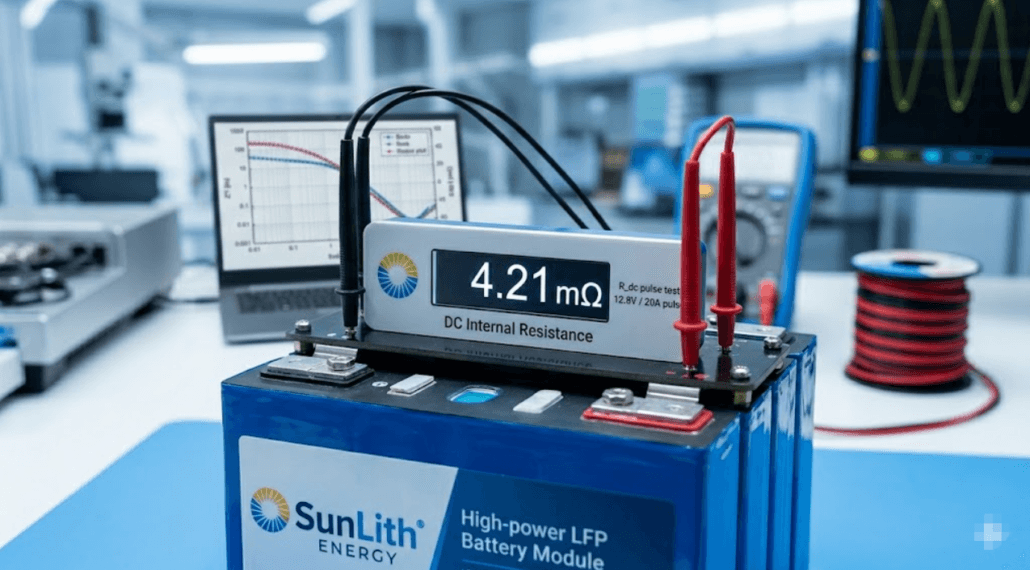
The Power Test: Why DCIR is the True Measure of BESS Performance
| ACIR gives us a snapshot of a cell’s physical integrity. However, DC Internal Resistance (DCIR) tells us how that cell performs when the grid calls for power. |
Understanding DC Internal Resistance LFP metrics is critical for managing grid-scale BESS
. ACIR provides a snapshot of physical integrity. However, DCIR determines performance during immediate power demands
This article breaks down the fundamentals of DCIR. Moreover, it explains why this is the definitive metric for grid-scale storage and how we engineer around it.
Why DC Internal Resistance LFP Metrics Matter
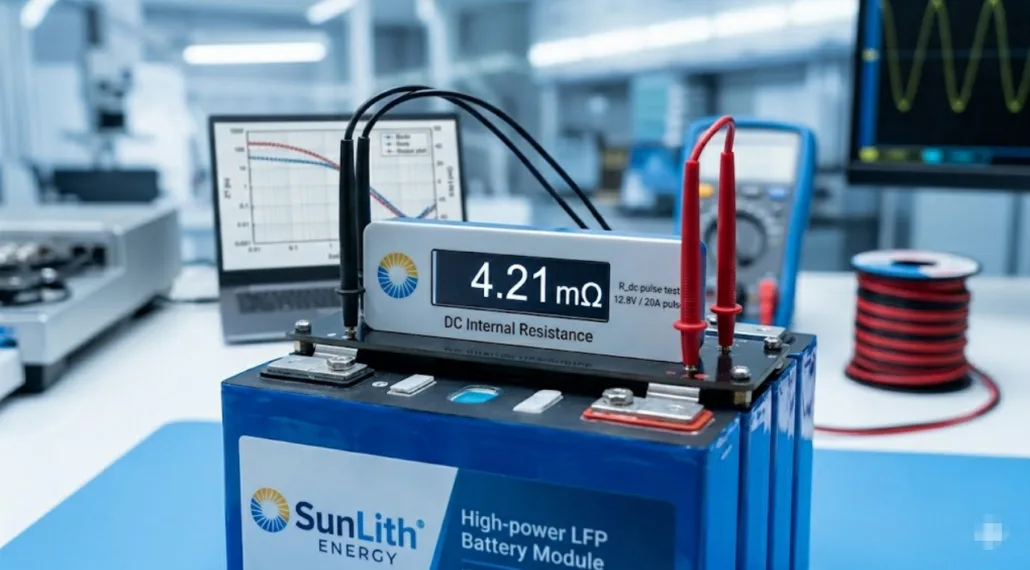
Specifically, DCIR measures the voltage drop during a high-current DC pulse. ACIR uses a 1 kHz frequency to bypass electrochemical reactions. In contrast, DCIR forces the battery to move ions. This provides a “real-world” measurement of the battery’s actual ability to deliver power under load.
Mathematically, it is calculated from the change in voltage (ΔV) over the change in current (ΔI):
| DCIR FORMULA R₂ₙ = (Vᵢₙᵢₜᵢₐₗ − Vₗₒₐ₂) / Iₗₒₐ₂ R₂ₙ = DC Internal Resistance Vᵢₙᵢₜᵢₐₗ = Open circuit voltage Vₗₒₐ₂ = Voltage under load Iₗₒₐ₂ = Applied current |
This single measurement captures two distinct resistance sources:
| DCIR includes: |
| Ohmic Resistance — The physical resistance of tabs, current collector foils, and the electrolyte itself. Furthermore, this is what ACIR also measures. |
| Polarization Resistance — The “chemical friction” lithium ions face as they diffuse through the electrolyte and intercalate into electrode particles. Specifically, this is invisible to ACIR, and it’s where the real performance story lives. |
Why DC Internal Resistance LFP Is the “Real-World” Metric for BESS
In a Battery Energy Storage System, cells are never sitting idle — they are responding to dynamic, unpredictable grid demands. Here is why DCIR monitoring is non-negotiable for any serious integrator.
1. Predicting Heat Generation
| Thermal stress is driven by DCIR, not ACIR Furthermore, according to Joule’s Law (P = I²R), heat generation is directly proportional to resistance. Because DCIR is significantly higher than ACIR, it is the primary driver of thermal stress in a running cell. High DC Internal Resistance LFP leads to hot spots. Therefore, it can trigger BMS shutdowns or accelerate aging This relationship is defined by Joule’s Law, which states that heat increases with the square of the current |
2. Eliminating Voltage Sag
| In addition, high DC Internal Resistance LFP causes trips even at 20% SOC Have you ever seen a BESS unit trip even though the State of Charge showed 20%? That is often due to high DCIR. For instance, under a heavy load, high resistance causes the voltage to “sag.” This often drops below the inverter’s cutoff threshold even though charge remains. Therefore, lower DCIR ensures a stable power delivery curve that your inverter can trust. |
3. State of Health (SOH) Tracking
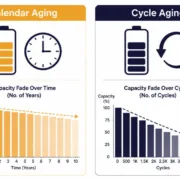
| DC Internal Resistance LFP rises before capacity degrades visibly While ACIR is great for initial cell grading, DCIR is a superior indicator of aging. As LFP cells age and the SEI layer thickens, DCIR increases significantly — long before capacity degrades visibly. In addition, monitoring this trend allows for predictive maintenance and avoids unexpected field failures. Specifically,, monitoring these trends allows for predictive maintenance. |
DC Internal Resistance LFP vs. ACIR: A Quick Comparison
Both measurements have a role to play in a rigorous quality program. The key is knowing which question each one actually answers.
| Feature | ACIR (1 kHz) | DCIR (Pulse Test) |
|---|---|---|
| Method | Small AC sine wave | Large DC current pulse |
| What it captures | Ohmic / physical resistance only | Ohmic + polarization resistance |
| Primary focus | Physical & mechanical cell health | Chemical & kinetic performance |
| Best used for | Cell sorting & incoming QC | System modeling & thermal planning |
| Aging sensitivity | Low – changes slowly with age | High – rises with SEI layer growth |
| Measurement speed | Very fast (<1 second) | Seconds to minutes per cell |
| Real-world accuracy | Indicative only | Directly predictive of field behavior |
| Engineering for Reliability at SunLith Energy Our integration process goes beyond simple module assembly. Specifically, we implement rigorous testing protocols to ensure every module meets strict DCIR benchmarks. — aligning our practices with global standards including IEC 62619 and UL 1973, as well as BIS and GB/T requirements for grid-scale safety.6,000+ target cycles <20% max resistance growth 0.5C peak C-rate optimized Our DCIR-optimized systems deliver: Thermal stability at high C-rates 6,000+ cycles with minimal resistance growth Full compliance: IEC 62619 · UL 1973 · BIS · GB/T |
| The Bottom Line: ACIR is the heartbeat — it tells you the cell is physically alive. In contrast, DCIR is the stamina—it tells you whether that cell can perform. when the grid calls. Ultimately, to build a truly bankable BESS, you must master both. |
Want to learn more about how we optimize LFP performance?
| → The 1 kHz Window: Using ACIR for LFP Cell Grading Deep dive into ACIR methodology and incoming QC protocols |
| → Cell Internal Resistance: What It Is, Why It Rises, and How to Measure It Start here for the fundamentals — the three resistance components and what changes them |
Technical References & Standards
For further technical reading on safety and testing requirements for Lithium-ion BESS, refer to the following global standards:
- IEC 62619:2022 – Secondary cells and batteries containing alkaline or other non-acid electrolytes.
- UL 1973 – Standard for Batteries for Use in Stationary and Motive Auxiliary Power Applications.
- Joule’s Law of Heating – The physics governing thermal stress in battery cells.





Trackbacks & Pingbacks
[…] In a new LFP prismatic cell, DCIR typically sits at 0.10–0.25 mΩ per Ah of rated capacity. The Sunlith DCIR technical article covers IEC 61960-standard measurement in […]
[…] 👉 Read our internal guide on DCIR performance testing in LFP batteries. […]
[…] Tracking that degradation over time matters just as much as the SoC strategy itself. For more on how suppliers estimate remaining battery health, see our guide to DCIR-based State of Health estimation for BESS. […]
[…] SoH is most commonly estimated using DC Internal Resistance (DCIR) measurements. This is because internal resistance increases predictably as cells age. For a detailed explanation of how this works in practice, see our guide on DCIR-Based State of Health Estimation for BESS. […]
[…] Read How DCIR Estimates Battery State of Health […]
Leave a Reply
Want to join the discussion?Feel free to contribute!