
Understanding Energy Storage System BESS Architectures
BESS architectures refers to the system design that connects batteries, power electronics, and control systems in a battery energy storage system. A typical BESS architecture includes battery modules, battery management systems (BMS), power conversion systems (PCS), and energy management systems (EMS) that work together to store and deliver electricity efficiently.
Battery energy storage systems are now critical infrastructure for renewable energy integration and grid stability.
What is a BESS Architecture?
A BESS architecture is the overall design and arrangement of the hardware and software components that make up the energy storage system. This includes the batteries, Battery Management System (BMS), Power Conversion System (PCS), control systems, and the way they are integrated and operated.
Why Understanding BESS Architecture is Important
The architecture determines how efficiently a BESS can store and deliver energy. It affects safety, scalability, cost, and performance. A well-designed BESS architecture ensures optimal energy usage, reduces losses, and prolongs battery life.
Key Components in a BESS Architecture
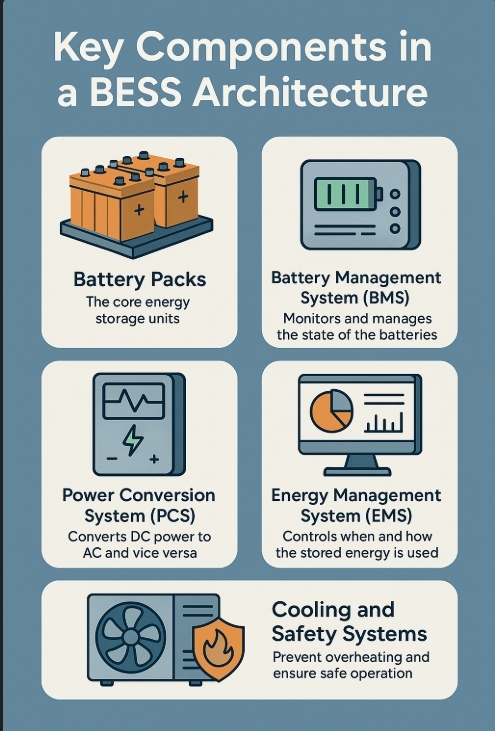
A typical BESS architecture includes:
- Battery Packs: The core energy storage units.
- Battery Management System (BMS): Monitors and manages the state of the batteries.
- Power Conversion System (PCS): Converts DC power to AC and vice versa.
- Energy Management System (EMS): Controls when and how the stored energy is used.
- Cooling and Safety Systems: Prevent overheating and ensure safe operation.
Learn more about Key Components in a BESS Architecture
Common Types of BESS Architectures
Understanding BESS architectures means knowing the different configurations used in the industry:
1. AC-Coupled BESS Architecture
In AC-coupled BESS systems, the battery storage is connected to the grid through an inverter separate from the solar PV inverter. This design is popular for retrofitting existing solar systems.
Advantages:
- Flexibility to add storage to existing installations.
- Separate optimization of PV and storage.
Disadvantages:
- More components can increase cost and complexity.
2. DC-Coupled BESS Architecture
Advantages:
- Higher efficiency due to fewer conversion losses.
- Lower installation costs.
Disadvantages:
- Less flexible for retrofits.
3. Modular BESS Architecture
A modular architecture allows scaling up the system by adding standardized battery modules. This is common in containerized BESS solutions.
Advantages:
- Easy scalability.
- Simplified maintenance.
Disadvantages:
- Initial setup can be more expensive.
4. Hybrid BESS Architecture
This combines features of both AC and DC coupling. It is ideal for complex systems requiring high flexibility.
Advantages:
- Maximizes energy capture.
- Adapts to different grid conditions.
Disadvantages:
- More complex design and higher upfront costs.
How to Choose the Right BESS Architecture
When selecting a BESS architecture, consider:
- Project Size: Small residential vs. large utility-scale.
- Energy Goals: Backup power, peak shaving, grid services.
- Budget: Upfront cost vs. long-term savings.
- Scalability: Future expansion needs.
Consult with experienced energy consultants to ensure the architecture matches your project’s requirements.
What are the Benefits of a Good BESS Architecture?
A well-planned BESS architecture provides:
- Higher Efficiency: Less energy lost during storage and conversion.
- Better Reliability: Consistent performance over time.
- Improved Safety: Lower risk of overheating or failure.
- Cost Savings: Optimized use of energy reduces utility costs.
Questions About BESS Architectures
What is the difference between AC-coupled and DC-coupled BESS?
The main difference is where the battery connects to the system. AC-coupled uses a separate inverter, while DC-coupled shares an inverter with solar PV.
Can BESS be retrofitted into existing solar systems?
Are modular BESS systems better?
Modular BESS architectures are ideal for projects that need easy scalability and flexibility. However, they can have higher upfront costs.
Final Thoughts on BESS Architectures
Understanding Battery Energy Storage System architectures is key to building efficient, safe, and future-ready energy storage solutions. Whether you’re installing a residential system or a large grid-connected project, choosing the right BESS architecture can maximize your return on investment and help you get the most from your renewable energy.
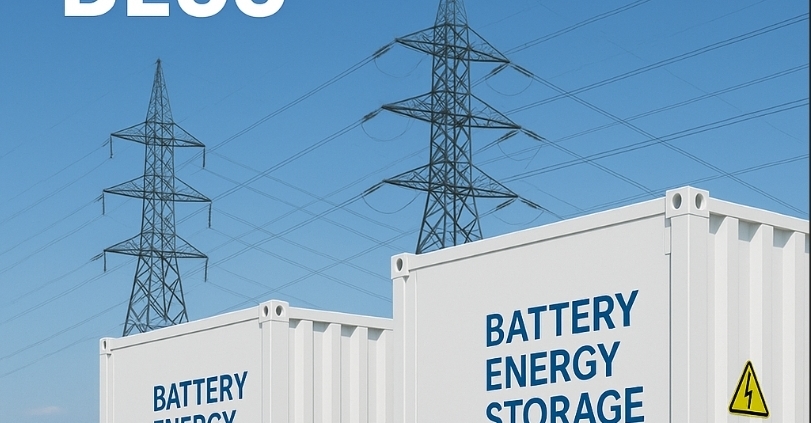
Understanding Utility-Scale BESS: The Backbone of a Resilient Energy Future
Utility-scale Battery Energy Storage Systems (BESS) are becoming an essential part of today’s power grids. As we use more renewable energy like solar and wind, grid operators have to deal with issues such as fluctuating supply and sudden peaks in demand. Utility-scale BESS solves these problems by storing extra electricity when there’s plenty of it and releasing it when it’s needed most. This makes our power supply more stable, efficient, and reliable for everyone.
What is Utility-Scale BESS?
Utility-scale BESS refers to large-scale battery storage installations typically rated in megawatts (MW) or gigawatts (GW). Unlike residential or commercial storage systems, these projects serve the grid directly and can deliver energy for hours or even days, depending on system design.
Key characteristics:
- Capacity ranges from tens of MW to several hundred MW.
- Located near generation sites or substations.
- Provide grid services like frequency response, voltage control, and peak shaving.
How Does a Utility-Scale BESS Work?
A utility-scale battery storage system typically consists of:
- Battery modules: Usually lithium-ion, but other chemistries like flow batteries or sodium-sulfur are emerging.
- Battery Management System (BMS): Monitors cell performance, state-of-charge, and safety.
- Power Conversion System (PCS): Converts DC from batteries to AC for the grid and vice versa.
- Energy Management System (EMS): Controls dispatch, optimization, and integration with other grid assets.
When generation exceeds demand (e.g., during midday solar peaks), the BESS stores excess energy. When demand surpasses generation (e.g., evening peak), the BESS discharges to stabilize the grid.
Key Benefits of Utility-Scale BESS
1. Grid Stability and Frequency Regulation
One of the primary benefits of utility-scale BESS is rapid response to frequency deviations. Unlike traditional peaker plants, batteries can react within milliseconds, maintaining grid balance.
2. Renewable Integration
Wind and solar are variable by nature. Utility-scale battery storage smooths out fluctuations, stores surplus during high production, and releases energy during lulls — helping achieve higher renewable penetration.
3. Peak Shaving and Load Shifting
BESS helps utilities defer costly grid upgrades by managing peak demand. It stores energy when electricity is cheap and abundant, then discharges when prices and demand are high.
4. Backup Power and Black Start Capabilities
Large battery storage systems can support critical infrastructure during outages and help restart a power grid after a blackout — known as “black start.”
Types of Utility-Scale BESS Technologies
| Technology | Features | Typical Use Cases |
|---|---|---|
| Lithium-Ion | High energy density, fast response | Frequency regulation, peak shaving |
| Flow Batteries | Long duration, scalable, deep cycling | Renewable firming, load shifting |
| Sodium-Sulfur | High temperature, long discharge duration | Base-load shifting, remote microgrids |
| Advanced Lead-Acid | Low cost, moderate performance | Short-term backup, frequency response |
Challenges Facing Utility-Scale BESS
While utility-scale BESS brings immense benefits, some challenges remain:
- High upfront capital costs: Though prices are falling, large installations require significant investment.
- Supply chain constraints: Dependence on critical minerals like lithium and cobalt can affect availability and cost.
- Degradation and lifespan: Batteries degrade over time, impacting performance and replacement cycles.
- Regulatory and market barriers: In some regions, market structures don’t fully value storage services yet.
Recent Trends and Global Outlook
According to industry reports, global utility-scale BESS installations are expected to grow exponentially. Markets like the US, China, Australia, and Europe lead the way with supportive policies and ambitious renewable energy targets.
Key trends include:
- Hybrid projects combining solar, wind, and storage.
- Longer-duration storage technologies (8+ hours).
- Second-life batteries and recycling solutions.
- Grid services monetization through virtual power plants (VPPs).
Case Study: Notable Utility-Scale BESS Projects
- Hornsdale Power Reserve (Australia): 150 MW/193.5 MWh — one of the world’s largest lithium-ion storage projects, providing frequency control and grid support.
- Crimson Energy Storage (California, USA): 350 MW/1,400 MWh — supports California’s push for 100% clean energy.
- UK National Grid Projects: Multiple installations delivering fast frequency response and capacity market services.
Future of Utility-Scale BESS: What’s Next?
As we aim for net-zero goals, the role of utility-scale BESS will only expand. The focus will shift toward:
- Integrating with renewable mega-projects.
- Supporting decarbonization of hard-to-abate sectors.
- Enabling community energy storage and distributed resources.
Policy support, continued cost reductions, and technological breakthroughs will be crucial to unlocking the full potential of grid-scale energy storage.
Final Thoughts
Utility-scale BESS is more than just a technological solution — it’s the backbone of a flexible, reliable, and low-carbon energy future. By bridging the gap between intermittent renewables and constant demand, these systems are paving the way for a resilient grid that works for everyone.
FAQs about Utility-Scale BESS
Q1: How long can a utility-scale BESS supply power?
Depending on the system’s energy capacity, it can range from minutes (for frequency response) to multiple hours (for peak shaving or load shifting).
Q2: Is lithium-ion the only option for utility-scale BESS?
No, while lithium-ion dominates the market today, flow batteries, sodium-sulfur, and other chemistries are gaining traction for longer-duration applications.
Q3: How is utility-scale BESS different from residential storage?
Utility-scale systems are grid assets providing large-scale services, while residential storage focuses on individual homes’ energy needs.
Q4: What’s the biggest challenge for utility-scale BESS?
High upfront costs and market barriers to monetizing all available services remain significant challenges.
Are you exploring how utility-scale battery storage can transform your energy project? Let’s connect and discuss tailored solutions for your grid needs!
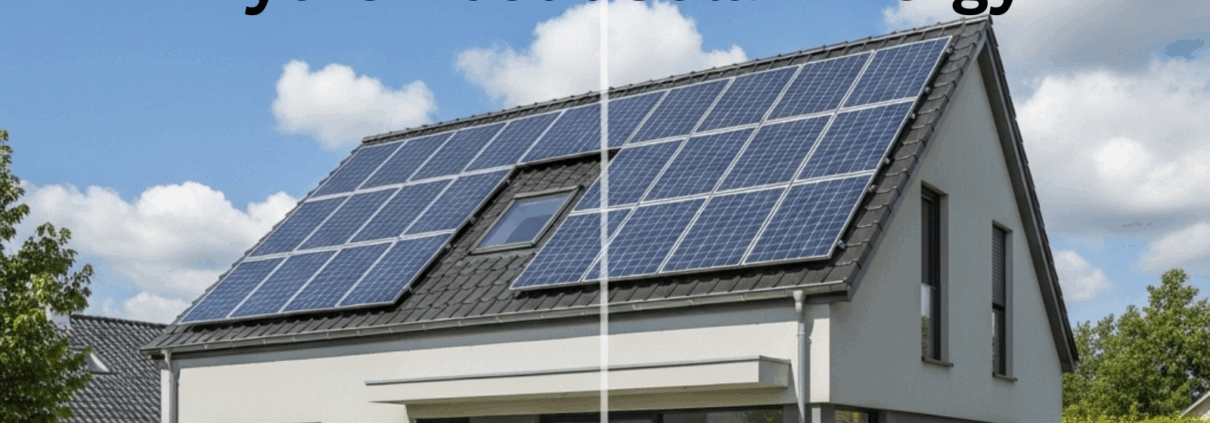
Debunking the Top 10 Myths About Solar Energy
When it comes to switching to clean energy, solar power is often surrounded by myths and misconceptions. These myths can prevent homeowners and businesses from making smart, eco-friendly decisions. Today, we’re setting the record straight by debunking the top 10 myths about solar energy.
Myth 1: Solar Panels Don’t Work on Cloudy Days
Truth: Modern solar panels are more efficient than ever. While production does drop on cloudy days, panels still generate electricity thanks to diffuse sunlight. Germany, which gets less sunlight than many countries, is a global leader in solar energy adoption.
Myth 2: Solar Energy is Too Expensive
Truth: The cost of solar panels has dropped over 80% in the last decade. With government incentives, tax credits, and financing options, going solar is more affordable than you think — and the long-term savings on your energy bills can be substantial.
Myth 3: Solar Panels Require Constant Maintenance
Truth: Solar panels are designed to withstand the elements. They require minimal maintenance — just occasional cleaning and a professional check-up every few years to ensure optimal performance.
Myth 4: Solar Panels Will Damage My Roof
Truth: When installed by certified professionals, solar panels can actually protect your roof from the elements and extend its lifespan. Installers use mounting systems that do not compromise the structural integrity of your roof.
Myth 5: Solar Energy Can’t Power a Home at Night
Truth: It’s true that solar panels don’t produce energy at night, but battery storage solutions and net metering programs allow you to store or draw energy when the sun isn’t shining. Many households run smoothly on solar day and night.
Myth 6: Solar Panels Don’t Work in Cold Climates
Truth: Solar panels actually perform better in cooler temperatures. Snow can even help by reflecting more sunlight onto panels. Many cold-climate regions, like parts of Canada and the Northern US, benefit greatly from solar.
Myth 7: Solar Will Make My Home Look Ugly
Truth: Solar technology and aesthetics have come a long way. Sleek, low-profile panels and integrated solar shingles are designed to blend with your roof, adding a modern touch that many homeowners find attractive.
Myth 8: Solar Panels Decrease Property Value
Truth: Multiple studies show that solar panels can actually increase property value. Homebuyers appreciate lower utility bills and energy independence, making solar-equipped homes more attractive in the real estate market.
Myth 9: I Won’t Live in My Home Long Enough to See Savings
Truth: Many homeowners recoup their investment in solar within 5–8 years, and homes with solar often sell faster and at higher prices. Even if you move, you could see a return on your solar investment.
Myth 10: Solar Energy Alone Can’t Make a Difference
Truth: Every solar installation reduces reliance on fossil fuels, cuts carbon emissions, and contributes to a more sustainable future. Millions of small actions add up — and solar energy is a crucial part of the global clean energy transition.
Frequently Asked Questions (FAQs) About Solar Energy Myths
✅ Do solar panels work during a power outage?
Most standard grid-tied solar systems shut down during a power outage to protect utility workers. However, if you have a battery backup or an off-grid system, you can still use your solar power when the grid goes down.
✅ Is it true that solar panels lose efficiency over time?
Yes, but only slightly. Most high-quality solar panels lose about 0.5% of efficiency per year, which means they still operate at about 85–90% capacity after 20–25 years.
✅ Are solar incentives and tax credits still available?
Yes! Many countries, states, and local governments offer tax credits, rebates, or net metering programs to make solar more affordable. Always check current local incentives when planning your installation.
✅ Can I install solar panels myself?
DIY solar is possible for experienced homeowners, but it’s best to hire certified professionals to ensure proper installation, warranty coverage, and compliance with local building codes.
✅ How do I know if my roof is suitable for solar panels?
A solar professional can assess your roof’s age, orientation, shading, and structure. Ideally, a roof should face south (in the northern hemisphere) with minimal shading for maximum efficiency.
✅ Is solar energy really environmentally friendly?
Absolutely. Solar energy produces zero emissions during operation, significantly reduces your carbon footprint, and requires minimal resources compared to fossil fuels.
Final Thoughts
Don’t let outdated myths about solar energy hold you back. With modern technology, favorable incentives, and proven benefits, there’s never been a better time to switch to solar. Have more questions? Reach out to a trusted solar professional and see how clean, affordable energy can work for you.
Ready to Go Solar?Are you considering solar energy for your home or business? Contact a local installer today and take the first step toward energy independence and a greener future.
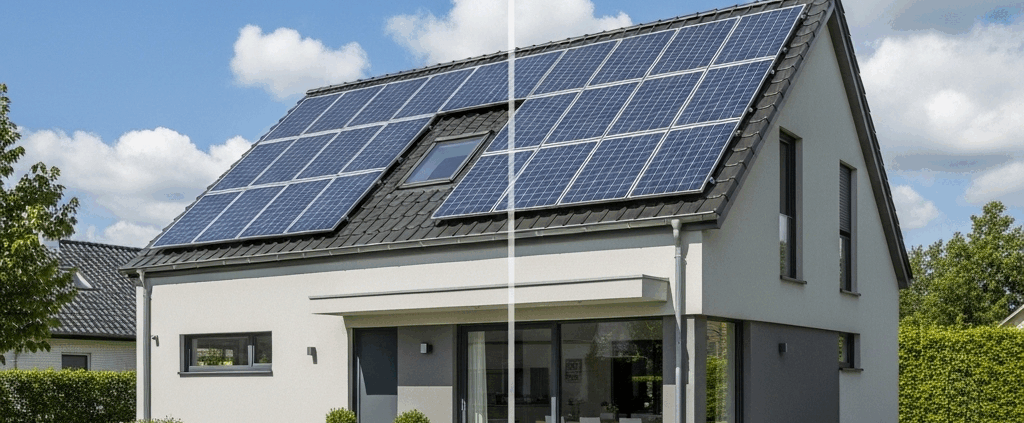
The Pros and Cons of Solar Energy: A Balanced View
Switching to solar power is a big decision, so it’s important to know the pros and cons of solar energy before you invest. In this guide, you’ll learn the key benefits and potential drawbacks, so you can decide if solar is the right fit for your home and lifestyle.
Why Understanding the Pros and Cons of Solar Energy Matters
Every homeowner wants to save money and reduce their environmental impact. Solar panels can help you do both. But they also come with upfront costs and practical considerations that can’t be ignored. By knowing the pros and cons of solar energy, you’ll be prepared to make the best decision for your situation.
The Pros of Solar Energy
✅ 1. Solar Energy Is Renewable and Clean
One of the biggest pros of solar energy is that it’s a clean, renewable source of power. The sun provides more energy in an hour than the entire world uses in a year. Unlike fossil fuels, solar doesn’t emit harmful greenhouse gases during operation.
✅ 2. It Helps Lower Electricity Bills
Another major advantage of solar energy is that it can reduce your monthly electricity bills. Depending on your system size and local energy rates, you may save thousands over the life of your system. Some homeowners even generate surplus electricity and get credit for feeding it back into the grid.
✅ 3. Minimal Maintenance
Modern solar panels are designed to last 25 years or more. They require little upkeep — mostly occasional cleaning and inspections to ensure they’re operating efficiently. This makes solar a hassle-free solution once installed.
✅ 4. Solar Increases Home Value
Homes with solar panels are often more attractive to buyers. Many homeowners recoup a portion of their investment through a higher resale value when they sell their home.
✅ 5. Government Incentives and Tax Credits
Many countries and states offer tax credits, rebates, and incentives for solar installations. These programs help reduce the initial investment and shorten the payback period.
The Cons of Solar Energy
❌ 1. High Upfront Cost
One of the main disadvantages of solar energy is the upfront price tag. A complete system, including installation and batteries, can cost thousands of dollars. Although costs have dropped significantly, it’s still a major investment.
❌ 2. Weather Dependence
Solar panels depend on sunlight. On cloudy days, rainy seasons, or in regions with less sun, energy production drops. While you’ll still generate some power, you may rely more on the grid during bad weather.
❌ 3. Energy Storage Costs Extra
If you want to store excess energy for nighttime or cloudy days, you’ll need batteries. Solar batteries can add significant cost to your system and may need replacement after a certain number of cycles.
❌ 4. Space Requirements
Not every home has enough roof space or a suitable angle for efficient solar panels. Shaded roofs or structural limitations can affect your system’s output.
❌ 5. It’s Not Always a Perfect Fit
Solar isn’t a one-size-fits-all solution. For some homes, the payback period can be longer than expected, especially if local energy rates are low.
Questions to Ask Before You Install Solar Panels
Q1: Is my roof suitable for solar panels?
Your roof should have enough sun exposure, the right angle, and no major shading from trees or buildings.
Q2: How long will I stay in my home?
If you plan to move in a few years, you might not see the full return on investment.
Q3: Are there local incentives I can use?
Check if your city or state offers rebates, tax credits, or net metering programs to offset your upfront costs.
Q4: Should I install batteries?
Batteries can help you store excess power, but they add to your costs. Weigh the pros and cons based on your budget and needs.
Q5: Who should install my solar system?
Always work with certified, reputable installers. A professional will ensure your system is safe, efficient, and eligible for incentives.
Tips to Maximize the Pros of Solar Energy
✅ Combine Solar with Energy Efficiency:
Use energy-efficient appliances and lighting to get the most out of your system.
✅ Monitor Your System Regularly:
Track your production to catch any drop in performance early.
✅ Keep Panels Clean:
Dust, debris, and snow can reduce efficiency. Periodic cleaning helps maintain optimal output.
✅ Understand Local Policies:
Know your utility’s net metering rules and any fees that may apply.
Conclusion: Weighing the Pros and Cons of Solar Energy
The pros and cons of solar energy depend on your home, location, and budget. Solar is an excellent option for many homeowners, offering long-term savings and a cleaner footprint. But it’s not for everyone. By carefully weighing the advantages and disadvantages, you’ll make the best choice for your situation.
FAQs About the Pros and Cons of Solar Energy
Does solar energy really save you money?
Yes — most homeowners save money over time, but the exact savings depend on system size, local energy rates, and incentives.
What happens if I produce more solar power than I use?
In many places, you can sell excess electricity back to the grid through net metering, lowering your bills even more.
How long does it take to break even?
The average payback period is 6–10 years, depending on installation costs, incentives, and your energy usage.
Can I run my home on solar power alone?
If you have enough panels and battery storage, it’s possible. Most homes remain connected to the grid for backup power.
✅ Key Takeaway
Knowing the pros and cons of solar energy helps you make an informed, confident decision. Solar can be a smart step toward energy independence — just be sure it works for your needs and budget.
How to Calculate the ROI of Your Commercial Solar Installation
Switching to solar energy is a smart move for businesses looking to cut costs, gain energy independence, and reduce their carbon footprint. But before investing, it’s crucial to understand how to calculate the ROI of your commercial solar installation. This guide will walk you through the key factors, provide a clear framework, and offer a sample calculation so you can estimate your returns with confidence.
What is ROI in a Commercial Solar Installation?
Return on Investment (ROI) measures how much money you’ll earn or save compared to what you spend on the system. For solar, ROI typically includes energy savings, tax incentives, rebates, and potential income from excess power sold back to the grid.
Key Factors That Influence Solar ROI
Before you crunch the numbers, be aware of the variables that affect ROI:
✅ Upfront Costs: Total system cost, including equipment, installation, permits, and maintenance contracts.
✅ Energy Usage & Rates: How much electricity your business uses and your current utility rates.
✅ Available Incentives: Federal tax credits (ITC), state rebates, accelerated depreciation (MACRS), and local incentives.
✅ System Performance: The solar system’s size, efficiency, and local sun exposure.
✅ Operations & Maintenance Costs: Annual costs for cleaning, monitoring, and upkeep.
✅ Financing Method: Cash purchase, solar loan, lease, or Power Purchase Agreement (PPA).
Simple Framework to Calculate ROI
Here’s a step-by-step outline to estimate the ROI for your business solar project:
1. Calculate Total System Cost
Include panels, inverters, mounting, installation, permits, and any other related fees.
Example:
- Total cost: $200,000
2. Deduct Available Incentives
Subtract the Federal Investment Tax Credit (currently 30%) and any local incentives.
Example:
- ITC savings: $200,000 x 30% = $60,000
- Net cost after ITC: $140,000
3. Estimate Annual Energy Savings
Multiply your annual electricity usage (kWh) offset by solar by your current utility rate.
Example:
- Annual usage offset: 100,000 kWh
- Utility rate: $0.15 per kWh
- Annual savings: 100,000 kWh x $0.15 = $15,000/year
4. Consider Additional Revenue Streams
If net metering is available, include income from selling excess power back to the grid.
Example:
- Annual excess power income: $2,000/year
5. Factor in Operations & Maintenance Costs
Subtract annual O&M costs from savings.
Example:
- Annual O&M: $1,000
- Net annual savings: ($15,000 + $2,000) – $1,000 = $16,000
6. Calculate Payback Period
Divide your net system cost by net annual savings.
Example:
- Payback period: $140,000 ÷ $16,000 ≈ 8.75 years
7. Calculate ROI Over System Lifetime
Most commercial systems last 25-30 years. Multiply net annual savings by expected lifespan, then divide by net cost and multiply by 100 for a percentage.
Example:
- Lifetime savings: $16,000 x 25 years = $400,000
- ROI: ($400,000 ÷ $140,000) x 100 = 286%
Why Your ROI Might Be Higher Than You Think
- Rising Energy Costs: As utility rates climb, your annual savings grow.
- Tax Advantages: Accelerated depreciation through MACRS can boost your payback.
- Green Branding: Businesses that go solar often enjoy goodwill and marketing value.
- Increased Property Value: A building with solar may be worth more to future buyers or tenants.
Tips to Maximize Your Solar ROI
🔍 Get a Professional Energy Audit: Ensure your system is sized accurately.
🗂️ Explore All Incentives: Don’t leave money on the table — research local programs.
💰 Choose Quality Equipment: High-efficiency panels and reliable inverters reduce maintenance headaches.
🤝 Work with Trusted Installers: A reputable installer can design a system for optimal performance.
📈 Monitor Performance: Use monitoring tools to track output and detect issues early.
FAQs About Commercial Solar ROI
Q: How long does it take for a commercial solar system to pay for itself?
A: Most businesses see a payback period between 5 and 10 years, depending on system cost, incentives, and local energy rates.
Q: Does financing a solar system reduce ROI?
A: It can affect your upfront cash flow but may still deliver positive ROI, especially with tax advantages and rising utility costs.
Q: Is solar worth it for small businesses?
A: Yes! Small businesses often benefit from lower operating costs, increased property value, and improved sustainability credentials.
Final Thoughts
Calculating the ROI of your commercial solar installation helps you make a well-informed decision that aligns with your business goals. With proper planning, incentives, and smart system design, your investment can deliver significant long-term savings — and a strong competitive edge.
DIY Solar Panel Installation vs. Hiring a Professional: Which Is Best for You?
Solar energy is no longer a futuristic concept — it’s a mainstream, cost-effective solution for homeowners worldwide. Falling panel prices, tax incentives, and financing programs make it easier than ever to install solar. But one big question remains: Should you install solar panels yourself (DIY solar panel installation), or hire a professional installer?
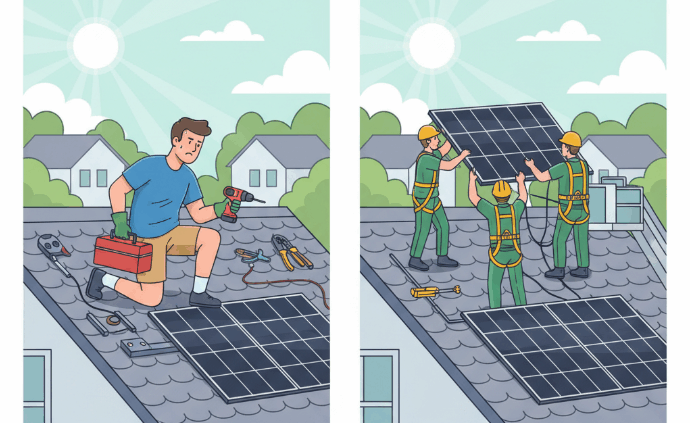
At first glance, DIY solar panel installation seems appealing — you cut labor costs and get full control over the project. On the other hand, professional solar installation provides safety, warranty protection, and long-term performance optimization.
This article compares both options in terms of cost, safety, compliance, and return on investment — and provides resources from Sunlith Energy and trusted organizations like the Department of Energy to guide your decision.
Why Homeowners Choose DIY Solar Panel Installation
DIY solar has gained traction thanks to online tutorials, hardware kits, and the rise of DIY culture. Let’s explore why some homeowners take this route.
Cost Savings from DIY Solar Panel Installation
The biggest attraction of DIY solar is cost reduction. Professional labor can account for 10–20% of total system costs. For a $20,000 installation, that’s $2,000–$4,000 in savings.
However, it’s important to factor in potential risks. Incorrect installation can cause long-term efficiency losses, which might erase your upfront savings.
💡 Many warranties and incentives, like those tied to UL Certifications for Battery Systems, require professional installation to remain valid.
Customization and Control
DIY installation gives you freedom to pick every component — from panels to inverters to storage systems. This level of customization is attractive for those building off-grid systems or experimenting with BESS vs ESS solutions.
The Learning Experience
If you enjoy hands-on projects, DIY solar is an opportunity to learn about electrical systems, panel orientation, and energy production. The sense of pride in generating power from a system you installed yourself is a big motivator.
Risks and Challenges of DIY Solar Panel Installation
While the benefits of DIY solar are tempting, the risks are real.
Safety Concerns
Solar panels generate high-voltage DC electricity, which can be dangerous if mishandled. Rooftop work also introduces fall hazards. The Occupational Safety and Health Administration (OSHA) highlights the importance of proper training and safety gear when working with solar equipment.
Warranty and Insurance Issues
DIY installations often void equipment warranties. For instance, UL 1642 battery certifications stress safe handling requirements that are usually tied to certified installations.
Insurance can also be an issue — some homeowner policies won’t cover damage caused by unlicensed work.
Navigating Permits and Codes
Every solar installation must comply with building codes, zoning laws, and utility interconnection rules. If you install panels incorrectly or skip inspections, you may face penalties or be forced to redo the system.
The U.S. Department of Energy provides guidelines for permits, inspections, and interconnection to the grid — but managing them without professional support can be overwhelming.
Time and Efficiency Tradeoffs
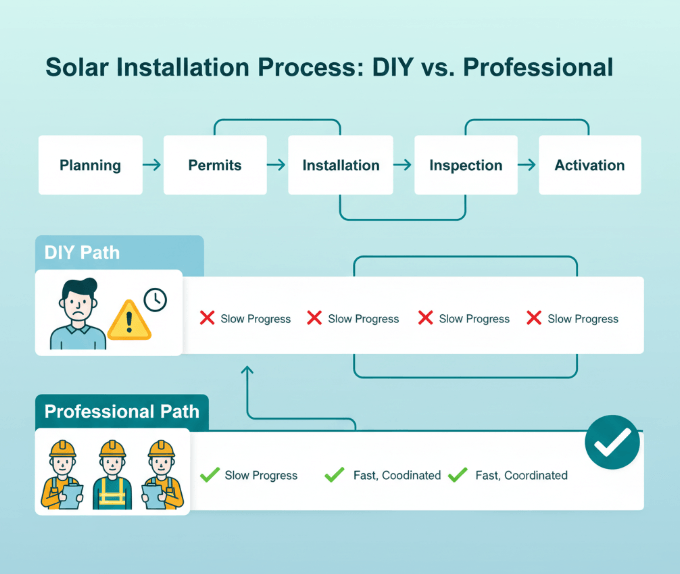
DIY projects often stretch into weeks or months. Meanwhile, a professional team can complete installation in a few days, including permits and inspections. Delays can slow down your access to solar savings.
Benefits of Hiring a Professional Solar Installer
Professional installation remains the preferred choice for most homeowners. Here’s why.
Expert System Design
Professional installers assess your roof orientation, shading, and energy usage to design a system that maximizes efficiency. According to the National Renewable Energy Laboratory (NREL), design optimization can improve system output by up to 20%.
Safety and Compliance
Licensed contractors ensure compliance with IEC and UL certifications — key for long-term system reliability. For example, IEC certifications for BESS guide safety and performance for energy storage systems. Professionals ensure your system passes inspection and qualifies for rebates.
Warranty and After-Sales Support
Professional installations typically include workmanship warranties (5–10 years). If panels fail, the installer handles replacements. This is especially valuable when working with advanced systems like UL 2580 certified EV batteries that require strict safety compliance.
Faster Installation and Paperwork Handling
Professionals handle permitting, inspections, and utility approvals — reducing your workload. According to Energy.gov, certified installers also ensure your system qualifies for federal solar tax credits, something DIY projects may not guarantee.
DIY Solar Panel Installation vs. Hiring a Professional: Side-by-Side Comparison
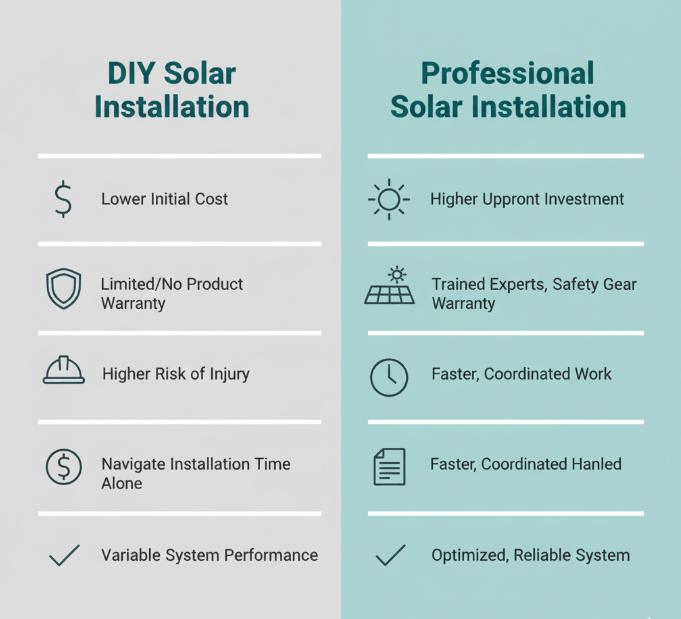
| Factor | DIY Installation | Professional Installation |
|---|---|---|
| Cost Savings | Saves ~10–20% on labor | Higher upfront, but reliable ROI |
| Control Over Components | Full customization | Expert recommendations |
| Warranty Eligibility | Often voided | Full coverage maintained |
| Permits & Paperwork | Homeowner manages | Installer handles |
| Safety & Risk | High (rooftop + electrical hazards) | Low with trained crew |
| Installation Time | Weeks to months | Few days |
| Reliability | Dependent on skill | High consistency & support |
| Long-Term Value | May decline if errors occur | Optimized for decades |
DIY Solar Panel Installation vs. Hiring a Professional FAQ
Is DIY solar panel instalation legal?
Yes, but you must comply with local codes and permitting requirements. See DOE’s solar permitting guide for details.
How much can I save with DIY solar?
Typically 10–20% on labor. But errors, lost warranties, and insurance exclusions can erase those savings.
Do DIY systems qualify for rebates and tax credits?
Some programs require professional installation. Always check requirements before starting.
Can a DIY system perform as well as a professional one?
Yes — if designed and installed correctly. However, the risk of inefficiency is higher without professional expertise.
What’s the biggest hidden cost of DIY solar?
Lost warranties and rework if your system fails inspections or underperforms.
H
Conclusion: Which Path Should You Take?
- DIY solar panel installation may be right for skilled homeowners who are comfortable with electrical work, confident with permits, and eager to save on labor costs.
- Professional installation is the safer, more reliable choice for those who prioritize performance, warranty protection, and eligibility for incentives.
As the International Energy Agency (IEA) reports, global adoption of solar energy continues to accelerate. Whether you go DIY or professional, you’re joining a growing movement toward renewable, sustainable power.
For most homeowners, the peace of mind, warranty coverage, and optimized system performance from professional installation far outweigh the initial savings of DIY.
👉 Want to explore more? Check out our guides on UL certifications for battery systems, BESS vs ESS, and IEC compliance to better understand how certified installations add long-term value.