
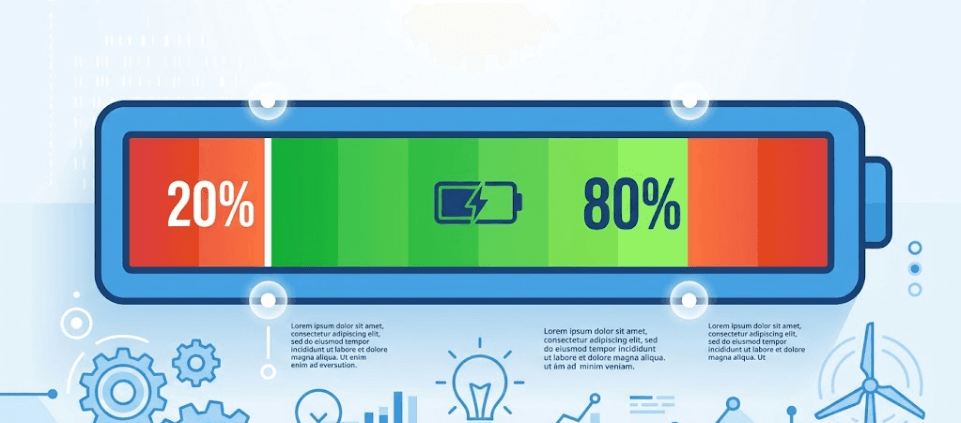
The 20/80 Rule for Batteries: SOC Charging Limits Explained for BESS
The 20/80 rule for batteries is one of the most repeated tips in battery care. It is also one of the most misunderstood. Open any EV forum or BESS manual, and you will read the same line. Keep the battery between 20% and 80% state of charge.
For lithium-ion batteries, the 20/80 rule sets a charging window. It avoids the two extremes of state of charge (SoC) that speed up wear. Stay above 20% SoC. Stay below 80% SoC. Do that, and the battery lasts longer. This applies to a phone, an EV, or a multi-megawatt BESS alike.
But for BESS buyers, the 20/80 rule raises a hard question. If 60% of capacity is the “safe zone,” what happens to the rest? Is 40% just stranded capital, sitting idle in a container? And does a rule built for phones and EVs even fit a grid-connected LFP system, built for daily cycling over 15 to 20 years?
This guide answers that question from first principles. First, we cover the electrochemistry behind the rule. Next, we compare it with other SoC windows. Then, we look at how chemistry and BMS design change the picture. Most importantly, we ask whether the cycle life gains are worth the lost capacity in real BESS projects.
1. What Is the 20/80 Rule for Batteries?
The Basic Definition
State of charge (SoC) measures how much energy a battery holds right now. It is shown as a percentage of usable capacity. A battery at 100% SoC is full. A battery at 0% SoC has hit its lower cutoff. That cutoff is not zero volts, though. The BMS always keeps a safety margin below it.
In short, the 20/80 rule means one thing. Keep charging and discharging inside the 20% to 80% SoC band. Do not let the battery swing from empty to full on every cycle. As a result, the operating window equals 60% of usable capacity.
Here is the formula, stated plainly:
| Formula — the 20/80 rule for batteries: Effective Depth of Discharge (DoD) = Upper SoC limit − Lower SoC limit 20/80 rule → Effective DoD = 80% − 20% = 60% A battery cycled strictly within 20–80% SoC never exceeds a 60% depth of discharge on any single cycle, regardless of nameplate capacity. |
The 20/80 Rule Is Not a Safety Limit
It helps to separate the 20/80 rule from the absolute safety limits set by the Battery Management System (BMS). The BMS hard cutoffs sit close to 0% and 100%, on the cell’s true voltage range. These exist for one reason: to stop over-charge and over-discharge events that cause safety failures.
Those safety limits are not arbitrary, either. They trace back to formal standards such as IEC 62619, which sets safety requirements for industrial lithium battery systems. The 20/80 rule, by contrast, operates well inside those hard limits. It is simply a usage strategy for longevity, not a safety boundary.
The table below shows how SoC windows map to depth of discharge. This is the same language used on every BESS datasheet.
| SoC Window | Effective DoD | Description | Common Context |
| 0–100% | 100% | Full range cycling, no reserve | Maximum usable capacity, shortest cycle life |
| 10–90% | 80% | Small reserve at both ends | Common LFP grid-scale default |
| 20–80% | 60% | The 20/80 rule for batteries | Popular consumer EV/phone guidance |
| 30–70% | 40% | Conservative storage window | Long-term standby / storage SoC |
For background on how stationary batteries are evaluated more broadly, the NREL battery storage technology overview is a useful starting reference.
2. The Science Behind the 20/80 Rule for Batteries
Why does the 20/80 rule exist at all? The answer sits inside the cell. Specifically, it comes down to what happens physically at the extremes of state of charge.
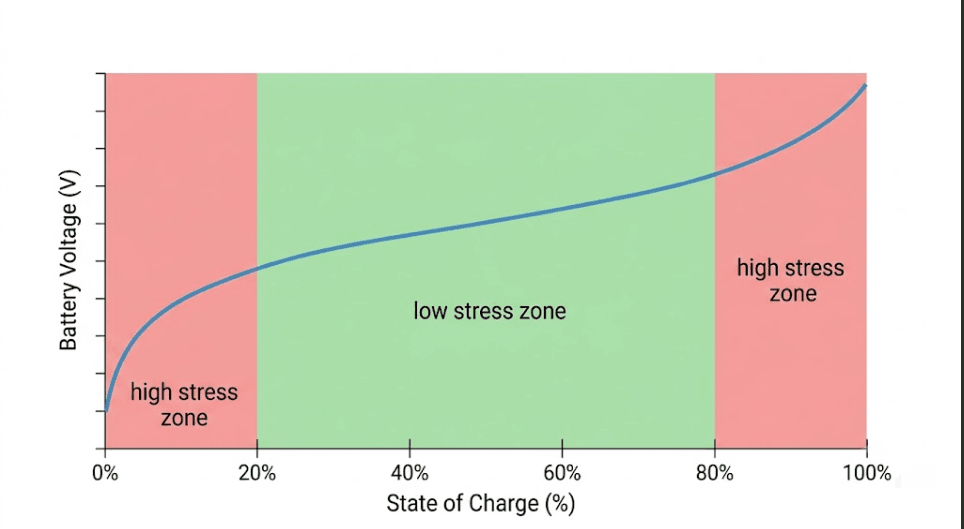
Why High SoC (Above 80%) Speeds Up Degradation
As a cell nears full charge, the cathode reaches peak lithium depletion. Voltage peaks too. As a result, this high-voltage state strains the cathode’s crystal lattice. Over many cycles, that strain adds up to real structural wear.
At the same time, the electrolyte faces its highest oxidative stress near full charge. This, in turn, speeds up electrolyte breakdown. It also drives further growth of the solid electrolyte interphase (SEI) layer on the anode.
The SEI layer is a thin film that forms naturally on the anode. In small amounts, it is actually useful. It protects the anode from further reaction with the electrolyte. However, SEI growth consumes active lithium over time. It also raises internal resistance. Because SEI growth depends heavily on voltage and temperature, both factors climb when a cell sits near 100% SoC, especially during storage.
Why Low SoC (Below 20%) Also Speeds Up Degradation
At the other extreme, very low SoC pushes the cell close to its minimum voltage cutoff. This raises the risk of copper dissolution from the anode’s current collector. The risk grows further still if the cell drifts below its minimum voltage during storage, through normal self-discharge.
Repeated deep discharges add a different kind of stress, too. On the next charge, lithium ions must fully repopulate the lattice. This places real mechanical strain on the cathode. This places real mechanical strain on the cathode. For the full mechanism behind that strain — including why deep cycling causes particle cracking over time — see our guide on Why Deep Discharge and High C-Rate Stress LFP Cells.
This is not just theory. A widely cited 2023 study on Tesla lithium-ion cells tested several SoC windows. The pattern was clear. Cells held at very high or very low SoC degraded faster than cells held at moderate SoC. Notably, the shortest service life showed up in cells cycled below 25% SoC.
The Electrochemical “Sweet Spot” in the Middle
Between these two extremes sits a calmer stretch of the voltage curve. Here, both electrodes face comparatively low stress. This, in fact, is the electrochemical basis for the 20/80 rule. By skipping the top and bottom 20% of the SoC range, a battery spends its life in the zone where SEI growth, electrode strain, and electrolyte oxidation all move slowest.
Separately, research into partial state of charge (PSoC) cycling backs this up further. Cycle life improves when a fixed amount of charge is cycled from a partial state, rather than from full charge. One widely referenced study confirmed this directly. The effect grew stronger still when depth of discharge was also reduced. In effect, this is the scientific backbone of the 20/80 rule, applied right at the cell level.
3. The 20/80 Rule for Batteries vs Other SoC Windows
The 20/80 rule is the most common SoC window in consumer guidance. But it is not the only one in use. BESS specs, EV guidance, and standby power systems each favour slightly different windows. The right choice depends on how usable capacity and cycle life get weighted for that specific application.
How the 20/80 Rule for Batteries Compares to Other SoC Windows
| SoC Window | Effective DoD | Relative Cycle Life Impact | Usable Capacity Retained | Typical Use Case |
| 0–100% | 100% | Baseline (shortest cycle life) | 100% | Maximum-capacity applications; rarely recommended for daily cycling |
| 10–90% | 80% | Moderate improvement over 0–100% | 80% | Grid-scale LFP BESS, EV daily-use presets |
| 20–80% | 60% | Significant improvement; the 20/80 rule for batteries | 60% | Consumer EV/phone guidance, residential storage |
| 30–70% | 40% | Maximum improvement for calendar aging | 40% | Long-term standby SoC, seasonal storage, shipping |
Two Patterns Worth Noting
First, SoC window width and cycle life do not scale in a straight line. The jump from 0–100% to 10–90% brings a meaningful gain. But the next jump, from 10–90% to 20–80%, brings a smaller gain. This holds true even though both moves cut DoD by 20 points.
Second, the 30/70 window rarely gets used for daily cycling. It simply gives up too much usable capacity. Instead, it works best as a storage SoC — the level a battery should sit at when idle for weeks or months. During storage, calendar aging drives degradation, not cycling.
Why BESS Often Defaults to 10–90% Instead
For BESS specifically, the 10–90% window has become the common middle ground for LFP systems. Here is why. LFP’s flat voltage curve, covered in Section 5, makes the gain from 10–90% to 20–80% quite small. Meanwhile, that extra 10% of usable capacity carries real commercial value.
4. How the 20/80 Rule for Batteries Affects BESS Sizing
Every BESS datasheet draws a line between two figures. Nameplate capacity is the total rated energy storage of the system. Usable energy is nameplate capacity multiplied by the operating depth of discharge. The SoC window sets this usable energy figure directly. As a result, it becomes one of the most consequential decisions in BESS sizing.
For more on how DoD interacts with other specs, see our guide to BESS specifications.
A Worked Sizing Example
Consider a 1 MWh nameplate BESS under three SoC strategies:
| SoC Window | Effective DoD | Usable Energy (1 MWh nameplate) | “Lost” Capacity |
| 0–100% | 100% | 1,000 kWh | 0 kWh |
| 10–90% | 80% | 800 kWh | 200 kWh |
| 20–80% (20/80 rule) | 60% | 600 kWh | 400 kWh |
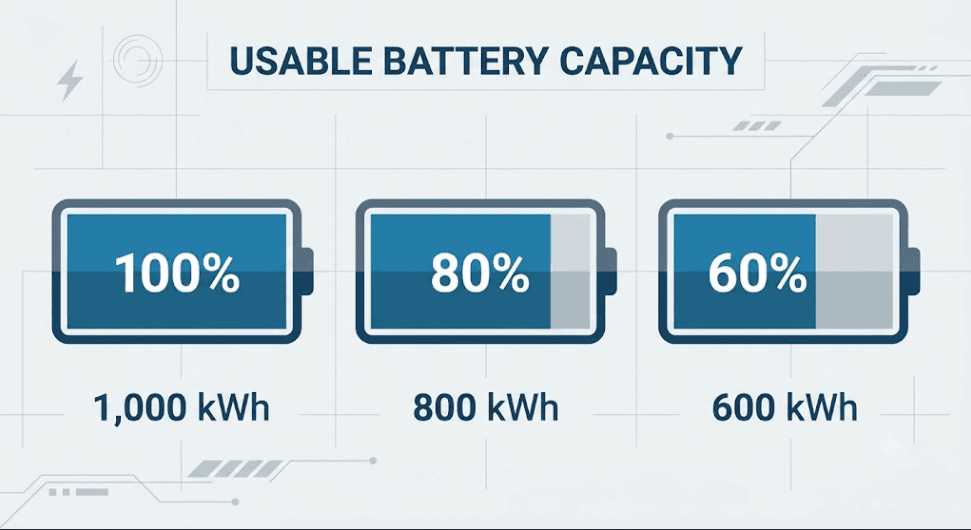
On paper, the 20/80 rule strands 400 kWh out of every cycle. That is 40% of the installed asset. In practice, however, BESS designers handle this two ways.
The first approach is to oversize the nameplate capacity. This way, usable energy under the chosen SoC window still meets the project’s requirement. For example, a project needing 600 kWh of usable energy, under a 20/80 window, must size the nameplate capacity near 1 MWh, not 600 kWh.
The second approach is to accept the narrower usable energy figure instead. From day one, the dispatch strategy, tariff arbitrage, or backup duration gets designed around that smaller number. Both approaches work. The right choice depends on whether capital cost or long-term degradation is the binding constraint for that project.
Sizing Formula and Worked Example
| Sizing rule of thumb: Required nameplate capacity = Required usable energy ÷ Effective DoD Example: a site needs 600 kWh of usable energy and will operate at 20/80 (60% DoD). Required nameplate capacity = 600 kWh ÷ 0.60 = 1,000 kWh (1 MWh) By comparison, the same 600 kWh requirement under a 10/90 window (80% DoD) needs only 750 kWh nameplate — a smaller, lower-cost system. |
Why Warranty Terms Matter Just as Much
Warranty terms matter just as much as the SoC window itself. A BESS warranted for a set cycle count at 90% DoD reaches end-of-life on a different timeline than the same cell warranted at 60% DoD. So, always confirm which DoD figure the warranty’s cycle-life guarantee assumes. Manufacturers calculate end-of-life projections against one specific operating window, not whatever SoC range the system ends up running in practice.
5. The 20/80 Rule for Batteries by Chemistry: LFP vs NMC vs NCA vs LTO
Why NMC and NCA Are More Sensitive to SoC Extremes
The 20/80 rule did not start in the BESS industry. Instead, it became popular through consumer electronics and EV guidance, where NMC and NCA cathode chemistries dominate. These chemistries carry a steep voltage curve across the SoC range. So, small changes in SoC produce larger changes in cell voltage. That, in turn, means larger swings in the electrochemical stress covered in Section 2.
Why LFP Tolerates a Much Wider Window
LFP (Lithium Iron Phosphate) behaves quite differently. It is now the leading chemistry for stationary BESS. LFP has a notably flat voltage curve across most of its range. As a result, the voltage gap between 30% SoC and 70% SoC stays small. Compare that to an NMC cell, where the same gap is much larger. Consequently, LFP cells care less about exactly where the SoC window sits. They also tolerate the top and bottom of the range far better than NMC or NCA.
Chemistry Comparison Table
| Chemistry | Voltage Curve Shape | Sensitivity to SoC Extremes | Typical Recommended Window | Common BESS DoD Spec |
| LFP | Flat across most of range | Low — tolerant of wide windows | 5–95% (or wider) | 90–95% DoD |
| NMC | Steep, especially at high SoC | High — benefits significantly from 20/80 | 20–80% | 50–80% DoD |
| NCA | Steep, similar to NMC | High — most sensitive to high SoC | 20–80% | 50–80% DoD |
| LTO | Very flat, stable anode | Very low — minimal benefit from narrowing | 0–100% viable | 95–100% DoD |
Why This Matters for Buyers
This is exactly why DoD specifications on commercial LFP BESS datasheets sit at 90–95%. Meanwhile, consumer guidance for NMC-based phones and EVs sticks with the much narrower 20/80 window. After all, forcing a strict 20/80 rule onto a grid-scale LFP system would strand a large slice of installed capacity. Given LFP’s flat curve, the degradation benefit simply would not justify it.
Chemistry is not the only factor that shapes how hard a cell can be pushed, though. Charge and discharge rate matters too, which we cover in our guide to BESS C-rate.
That said, the underlying principle still applies to LFP. Avoid long dwell time at very high or very low SoC, especially during idle storage. The difference is one of degree, not of kind. LFP systems can run much closer to the 0% and 100% extremes during active cycling, without the same penalty NMC or NCA cells would face.
6. How the BMS and EMS Enforce the 20/80 Rule for Batteries
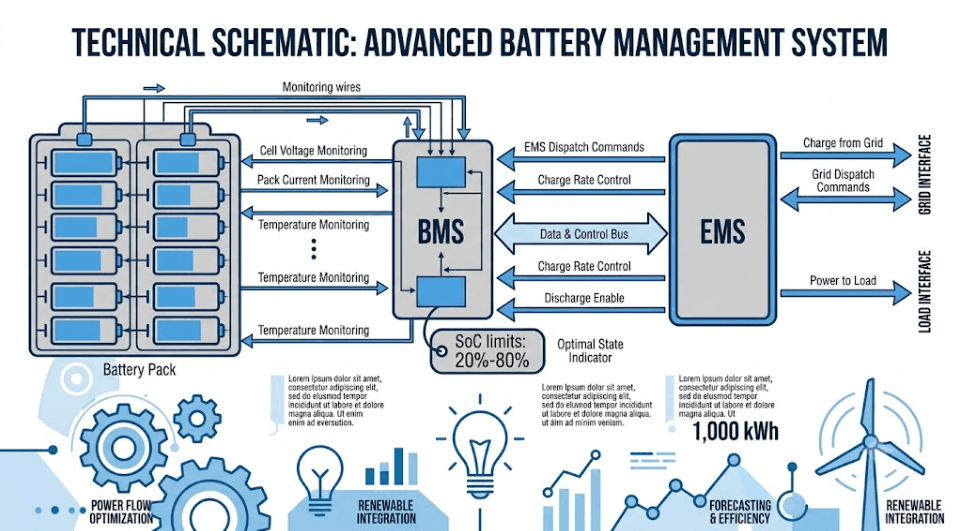
In a real BESS, the 20/80 rule — or whichever SoC window applies — is not left to chance. Instead, it gets enforced through two systems working together. The Battery Management System (BMS) handles cell and pack-level protection. The Energy Management System (EMS) handles dispatch planning.
For a deeper look at the first system, see our guide to how a battery management system (BMS) works.
BMS-Level Enforcement: Translating SoC Limits Into Voltage Cutoffs
The BMS does not directly “see” SoC as a clean percentage. Instead, it measures cell voltage and current. From there, it estimates SoC using coulomb counting, which tracks current flow over time. This estimate then gets cross-checked against the cell’s open-circuit voltage (OCV) curve. To enforce a 20/80 window, the BMS applies soft limits. These limits map to the voltage levels tied to 20% and 80% SoC, for that specific chemistry. So, when the pack nears either limit, the BMS signals the EMS to stop charging or discharging in that direction.
Why SoC Estimation Drifts — and Why Occasional Full Cycles Matter
Coulomb counting builds up small errors over time. As a result, the BMS’s SoC estimate slowly drifts from the cell’s true SoC. The fix is simple, though. Periodically, the cell gets allowed to reach a known reference point on its voltage curve, typically near full charge. There, SoC can be recalibrated with high confidence.
This creates a practical tension with the 20/80 rule. A system run permanently within 20–80% SoC may see growing estimation error over months. Without occasional full-range calibration cycles, that drift only gets worse.
Fortunately, most commercial BMS platforms handle this automatically. They schedule a periodic calibration charge to a higher SoC, during a low-demand period. Then, they return to the configured operating window. This is simply a normal part of long-term SoC accuracy. It is not a violation of the SoC window strategy.
EMS-Level Enforcement: Dispatch Planning Within the Window
The BMS protects the cells from exceeding configured SoC limits. The EMS, meanwhile, plans dispatch so the battery rarely needs to hit those limits at all. A well-tuned EMS schedules charge and discharge events carefully. So, the battery’s SoC trajectory stays comfortably inside the operating window throughout a typical day. In this way, the BMS’s hard limits remain a safety backstop, not a routine operating boundary.
7. The 20/80 Rule for Batteries Across Different BESS Applications
The 20/80 rule often gets presented as a universal recommendation. In reality, though, the best SoC strategy varies a lot by application. The table below summarises how SoC strategy typically shifts, depending on use case.
| Application | Typical SoC Strategy | Rationale |
| Residential solar + storage (NMC) | 20–80% to 10–90% | Balances cycle life with daily self-consumption value; NMC benefits most from narrower windows |
| C&I peak shaving (LFP) | 5–95% (90% DoD) | LFP’s flat voltage curve and high cycle life tolerate wide windows; ROI favours maximum usable energy |
| Grid-scale arbitrage (LFP) | 5–95% to 0–100% | Revenue per cycle often outweighs marginal degradation cost at LFP’s cycle-life scale |
| Frequency regulation | Centred near 50% SoC | Symmetrical headroom needed to inject or absorb power in either direction at short notice |
| Backup / UPS standby | Held near 50–60% SoC | Minimises calendar aging during long idle periods between discharge events |
| Second-life EV battery packs (NMC) | 20–80% | Already-degraded cells benefit most from the gentlest possible operating window |
Frequency Regulation: Why the Middle of the Range Matters Most
Frequency regulation systems sit deliberately near the middle of their SoC range, often close to 50%. This is not really about the 20/80 rule. Instead, it is about headroom. The system must absorb or inject power within milliseconds of a frequency deviation, in either direction. A battery at 95% SoC has little room left to absorb more charge. One at 5% SoC has little room left to discharge. So, the middle of the range maximises bidirectional response capability.
Backup and UPS: A Different Kind of SoC Challenge
Backup and UPS systems face the opposite challenge. Long idle periods at a fixed SoC get punctuated only occasionally by discharge events. For these systems, the relevant guidance is less about the 20/80 rule. It is more about storage SoC — holding the battery at a moderate level, commonly 50–60%, during idle periods. This approach limits the calendar aging effects covered in Section 2. Both very high and very low storage SoC accelerate SEI growth, even when the battery just sits unused.
Off-grid and islanded systems face a related challenge, since they cannot fall back on the wider grid during a SoC excursion. For more on how that changes BESS design, see our Island Grid BESS engineering guide.
8. Quantifying the 20/80 Rule for Batteries: Cycle Life vs Capacity
Here is the central question for any BESS operator. Does the cycle life gain from a narrower SoC window actually offset the lost usable energy per cycle? The best way to compare strategies is not cycle count alone. Instead, look at total lifetime energy throughput — the cumulative kWh the system delivers before reaching end-of-life capacity.
Illustrative Throughput Comparison
The table below illustrates this trade-off for an NMC-type cell. The figures are illustrative, but they stay broadly consistent with partial state-of-charge cycling research.
| SoC Window | Effective DoD | Illustrative Cycle Life (to 80% SoH) | Usable Energy per Cycle (1 MWh nameplate) | Approx. Lifetime Throughput |
| 0–100% | 100% | ~2,500 cycles | 1,000 kWh | ~2,500 MWh |
| 10–90% | 80% | ~4,000 cycles | 800 kWh | ~3,200 MWh |
| 20–80% (20/80 rule) | 60% | ~6,000 cycles | 600 kWh | ~3,600 MWh |
| 30–70% | 40% | ~9,000 cycles | 400 kWh | ~3,600 MWh |
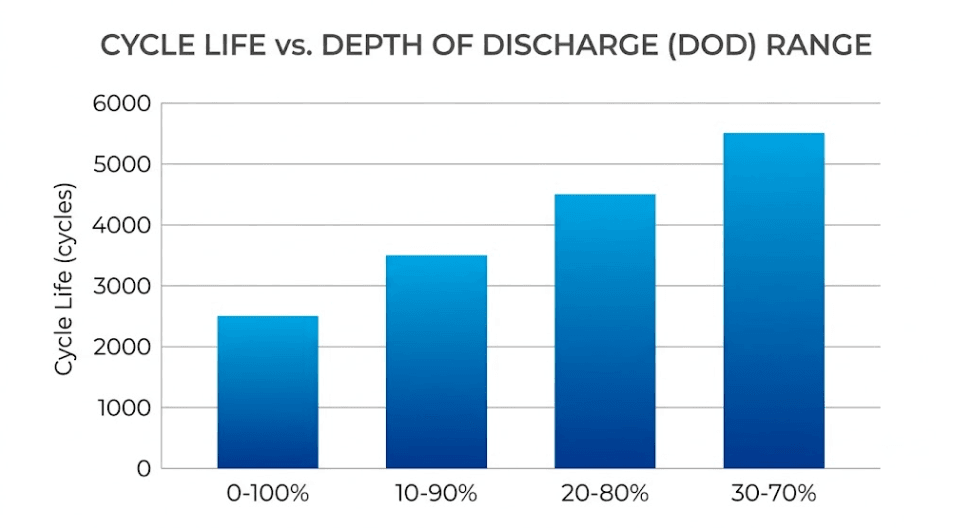
Two Things Stand Out
First, narrowing from 0–100% to 20–80% boosts lifetime throughput in a real way. In this example, the gain is roughly 44%. Second, that gain flattens out past a certain point. Moving from 20–80% to 30–70% adds many more cycles. Yet total throughput barely moves, because each extra cycle delivers proportionally less energy.
What This Means in Practice
| The key insight on lifetime throughput: Total energy delivered ≈ Cycle life × Usable energy per cycle Narrowing the SoC window increases the first term and decreases the second. There is a point — often somewhere between 20/80 and 30/70 for NMC chemistries — beyond which the two effects roughly cancel out. Past that point, further narrowing mainly stretches the calendar timeline, not the total energy delivered. |
This carries a direct, practical lesson. The 20/80 rule does not always mean more total energy over the system’s life. What it reliably does, instead, is spread that throughput over a longer calendar period, with lower peak stress per cycle. That matters most when calendar life, warranty terms, or thermal limits are the binding constraint, not total cycle count.
9. Is the 20/80 Rule for Batteries Worth It for BESS Buyers?
From a pure capital-cost view, every point of SoC window removed from the operating range costs something. Either more hardware gets installed to keep the same usable energy, or output gets sacrificed. At typical commercial LFP BESS costs of $220 to $320 per kWh, the math gets concrete fast.
Moving from a 90% DoD strategy to a strict 60% DoD (20/80) strategy, for the same usable energy, means installing roughly 33% more nameplate capacity. That is a substantial capex increase. And it is a steep price for a chemistry whose flat voltage curve already makes the degradation benefit fairly small.
Why LFP Buyers Should Look Beyond 20/80
The calculus changes for NMC and NCA-based systems, where the 20/80 rule’s degradation benefit runs largest. For these chemistries, the extra upfront cost of oversizing is more often worth it. The payoff is a real extension of warranty-covered service life. This matters most where replacement logistics are difficult, such as second-life EV packs or remote and offshore installations.
Tracking that degradation over time matters just as much as the SoC strategy itself. For more on how suppliers estimate remaining battery health, see our guide to DCIR-based State of Health estimation for BESS.
Three Reasons LFP Favours a Wider Window
For most grid-connected commercial and utility-scale LFP BESS, the economically optimal SoC window sits much closer to 5–95% or 10–90% than to 20/80. There are three clear reasons why:
- LFP’s flat voltage curve means the marginal degradation cost of the additional 10–30% of usable energy is small.
- Revenue-generating applications (arbitrage, demand charge reduction, frequency services) are typically valued per kWh cycled, so reduced usable energy directly reduces revenue.
- LFP cycle life figures (3,000–8,000+ cycles to 80% SoH) already provide 10–15+ years of service even at high DoD for most daily-cycling applications.
Overall, the 20/80 rule still earns its place as a default heuristic for NMC/NCA-based systems. It also works well as a long-term storage SoC guideline, across all chemistries. And it remains a sensible starting point for buyers who do not yet have chemistry-specific degradation curves. But it should not be treated as a fixed engineering spec for LFP-dominated stationary storage. Instead, the right SoC window is chemistry-specific and application-specific, not a universal constant.
SoC strategy is just one input into overall project returns. Round-trip losses matter too, and we cover those in our guide to BESS round-trip efficiency (RTE).
10. Best Practices and Common Mistakes With the 20/80 Rule for Batteries
Best Practices
- Request chemistry-specific degradation curves (cycle life vs DoD) from your cell supplier rather than relying on generic 20/80 guidance.
- For LFP systems, evaluate the 5–95% or 10–90% range as the realistic operating window, reserving 20/80-style restrictions for long-term storage SoC rather than daily cycling.
- For NMC/NCA-based systems — including residential storage and second-life EV packs — the 20/80 rule remains a reasonable and well-supported default.
- Confirm which DoD value the manufacturer’s cycle-life warranty is based on, and ensure your operating SoC window matches that assumption.
- If a system will be idle for extended periods (shipping, seasonal storage, commissioning delays), set the storage SoC to a moderate level — commonly 30–60% — regardless of the chemistry.
- Allow the BMS to perform periodic full-range calibration cycles even if the operating SoC window is narrower; this maintains SoC estimation accuracy over the system’s life.
Common Mistakes
- Applying consumer EV/phone-based 20/80 guidance directly to a grid-scale LFP BESS without accounting for the chemistry’s much flatter voltage curve.
- Sizing a system’s nameplate capacity around a 0–100% assumption, then discovering that the operating SoC policy reduces usable energy below the project’s requirement.
- Treating the 20/80 rule as a hard safety limit rather than a usage strategy — and consequently disabling BMS calibration cycles, leading to SoC estimation drift over time.
- Ignoring the interaction between SoC window and temperature: high-SoC storage in hot climates compounds calendar aging far more than the same SoC window in a temperate climate.
- Comparing two BESS quotes on nameplate capacity and price alone, without checking whether each supplier’s cycle-life warranty assumes a different operating DoD.
11. Frequently Asked Questions: The 20/80 Rule for Batteries
What is the 20/80 rule for batteries?
The 20/80 rule for batteries is a usage guideline. It calls for keeping a lithium-ion battery’s SoC between 20% and 80% during normal use, instead of cycling between 0% and 100%. This creates an effective depth of discharge of 60%. The goal is simple: reduce electrochemical stress at very high and very low SoC.
Does the 20/80 rule apply to LFP batteries used in BESS?
The underlying principle applies to all lithium-ion chemistries. However, LFP’s flat voltage curve makes it far less sensitive to SoC extremes than NMC or NCA. As a result, most commercial LFP BESS datasheets specify depth of discharge in the 90–95% range. That is far wider than the 60% implied by a strict 20/80 rule, with no proportional drop in cycle life.
What SoC should a battery be stored at long-term?
For extended idle periods, such as shipping, seasonal storage, or commissioning delays, most manufacturers recommend a storage SoC in the 30–60% range. This applies regardless of chemistry. Both very high and very low storage SoC speed up calendar aging mechanisms, such as SEI layer growth, even when the battery just sits unused.
Is the 20/80 rule the same as an 80% depth of discharge specification?
No, these are different specifications. An 80% DoD spec, for example a 10–90% SoC window, is a wider operating range than the 20/80 rule’s 60% effective DoD. The two get confused often, since both involve the number 80. But they describe different SoC windows, with different usable capacity implications.
Does charging a BESS to 100% damage the battery?
Generally, no. Occasional full charges are not harmful. In fact, they are often necessary for BMS SoC calibration. The real degradation concern is prolonged dwell time at or near 100% SoC, such as leaving a battery fully charged for extended idle periods. Briefly passing through 100% during normal cycling carries a much smaller risk.
How much usable capacity do I lose by following the 20/80 rule?
Following a strict 20/80 rule cuts usable energy to 60% of nameplate capacity. Compare that with 80% under a 10–90% window, or close to 100% under a 5–95% window. For a 1 MWh nameplate BESS, that is the gap between 600 kWh, 800 kWh, and roughly 950 kWh of usable energy per cycle. This is a real factor in system sizing and project economics.
Conclusion: The 20/80 Rule for Batteries Is a Useful Heuristic, Not a Universal Specification
In summary, the 20/80 rule for batteries captures something real. Lithium-ion cells degrade fastest at the extremes of state of charge. Operating within a narrower SoC window reduces that stress. For NMC and NCA-based systems, including most consumer electronics, EVs, and residential storage, the 20/80 rule remains a sound, evidence-backed default.
For commercial and utility-scale BESS built on LFP chemistry, though, the picture shifts. The same flat voltage curve that makes LFP so well-suited to daily cycling also makes a strict 20/80 window economically inefficient. So, the right approach is to treat the SoC window as a chemistry-specific design variable. Size it against the manufacturer’s cycle-life warranty, the application’s revenue model, and the project’s calendar-life needs, rather than importing a rule of thumb from an entirely different product category.
Need help defining the right SoC operating window, DoD specification, and BMS configuration for your next BESS project? Contact the SunLith Energy engineering team to work through the chemistry-specific trade-offs for your application.
BESS Power Factor Explained: Complete Guide
What Is BESS Power Factor?
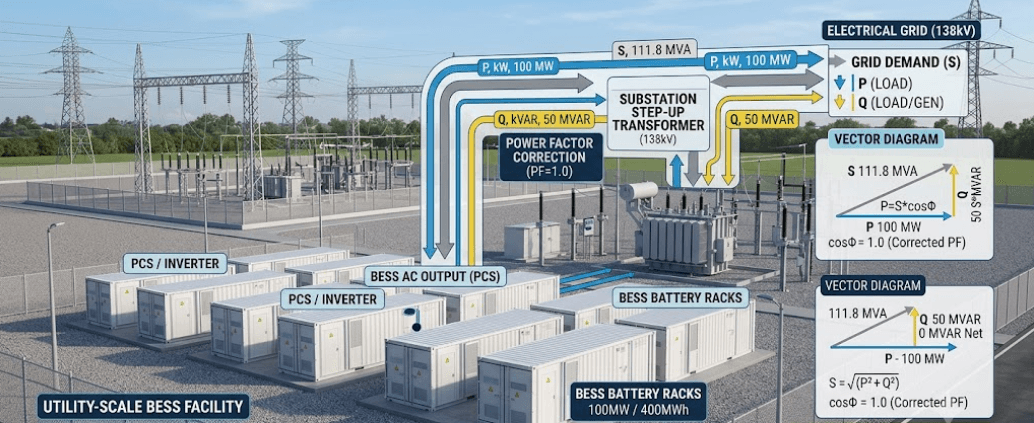
BESS Power Factor is one of the most important design parameters in a Battery Energy Storage System (BESS). It affects inverter sizing, reactive power capability, voltage regulation, grid compliance, and project economics. As utilities require more grid support from energy storage systems, understanding BESS Power Factor has become essential for developers, EPC contractors, utilities, and industrial energy users.
A modern Battery Energy Storage System does much more than store energy, as it can also provide vital voltage support, reactive power compensation, and grid stabilization. Consequently, managing the BESS Power Factor has become a foundational requirement in utility-scale and commercial energy storage projects worldwide.
To understand how a BESS supports the grid, it is important to understand active power, reactive power, and apparent power.
For a complete overview of how these configurations work, see our comprehensive guide to battery energy storage systems (BESS).
- What Is BESS Power Factor?
- Why BESS Power Factor Matters
- What Is Power Factor?
- Understanding Active Power, Reactive Power, and Apparent Power
- How BESS Power Factor Works
- BESS Power Factor Modes
- BESS Power Factor and PCS Sizing
- BESS Power Factor Calculation Example
- Leading vs Lagging BESS Power Factor
- Utility Requirements for BESS Power Factor
- IEEE 1547 and BESS Power Factor
- Can a BESS Provide Reactive Power Without Discharging?
- BESS Power Factor Correction vs Capacitor Banks
- BESS Power Factor in Commercial and Industrial Projects
- Power Factor Challenges in Renewable Energy Projects
- Future Trends in BESS Power Factor Management
- Frequently Asked Questions About BESS Power Factor
- Conclusion
Why BESS Power Factor Matters
A system’s power factor directly dictates how efficiently an inverter utilizes its total capacity, while simultaneously determining the volume of active and reactive power it can deliver. Because modern utilities increasingly mandate that energy storage installations actively support grid voltage, developers must carefully account for these power factor constraints during the early stages of system design.
Furthermore, a properly designed BESS can successfully achieve the following:
A properly designed BESS can:
- Improve voltage stability
- Reduce transmission losses
- Support renewable energy integration
- Meet utility interconnection requirements
- Provide ancillary services
- Improve power quality
Consequently, BESS Power Factor plays a major role in project performance and profitability.
What Is Power Factor?
Power factor measures how effectively electrical power is converted into useful work.
The formula is:
Power Factor = kW ÷ kVA
A power factor of 1.0 indicates ideal operation. However, most electrical systems operate below unity power factor because they require reactive power.
Generally:
- 1.0 PF = Excellent
- 0.95 PF = Very Good
- 0.90 PF = Acceptable
- Below 0.90 PF = Often penalized by utilities
Understanding Active Power, Reactive Power, and Apparent Power
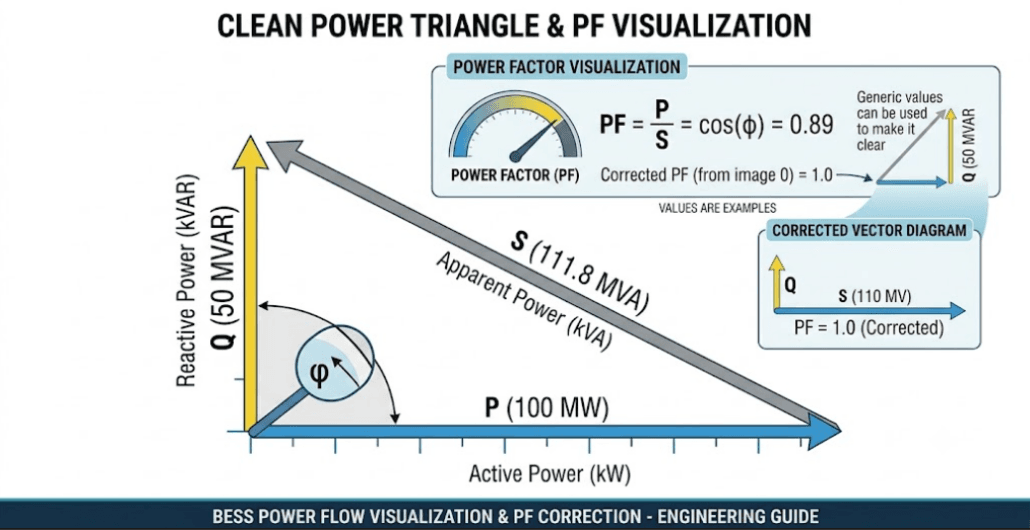
Before discussing BESS Power Factor in detail, it is important to understand the three types of power found in AC systems.
Active Power (kW)
Active power performs useful work.
Examples include:
- Running motors
- Powering equipment
- Charging batteries
- Operating lighting systems
This is the power customers actually consume.
Reactive Power (kVAR)
Reactive power supports magnetic and electric fields.
For example, motors, transformers, and inductive loads require reactive power to operate correctly.
Although reactive power does not perform useful work directly, it remains essential for grid stability.
Apparent Power (kVA)
Apparent power combines active power and reactive power.
PCS inverters are usually rated in kVA because they must handle both types of power simultaneously.
To learn more about how inverter technology manages these loads, read about the role of the power conversion system (PCS).
How BESS Power Factor Works
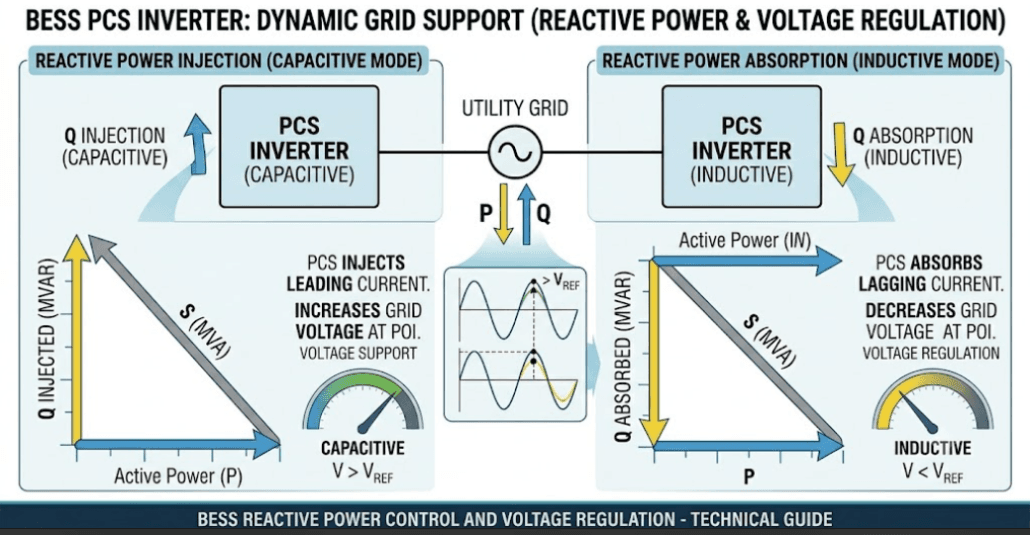
Modern Battery Energy Storage Systems utilize advanced PCS platforms to seamlessly manage both active and reactive power. Unlike traditional static capacitor banks, these intelligent inverters respond dynamically to real-time grid fluctuations, allowing them to inject or absorb reactive power within milliseconds. As a result, the PCS automatically modulates its output as grid conditions shift, which ultimately helps maintain long-term voltage stability and superior power quality across the network.
Consequently, the BESS helps maintain voltage stability and power quality.
Reactive Power Injection
When grid voltage falls, the inverter can inject reactive power.
This mode:
- Supports voltage recovery
- Helps weak grids
- Supports inductive loads
Reactive Power Absorption
When grid voltage rises, the inverter can absorb reactive power.
This mode:
- Reduces overvoltage conditions
- Supports solar-rich networks
- Improves voltage regulation
Unity Power Factor Operation
At unity power factor, the inverter delivers only active power.
In this case:
PF = 1.0
No reactive power support is provided.
BESS Power Factor Modes
Modern PCS platforms support several control modes.
Constant BESS Power Factor Mode
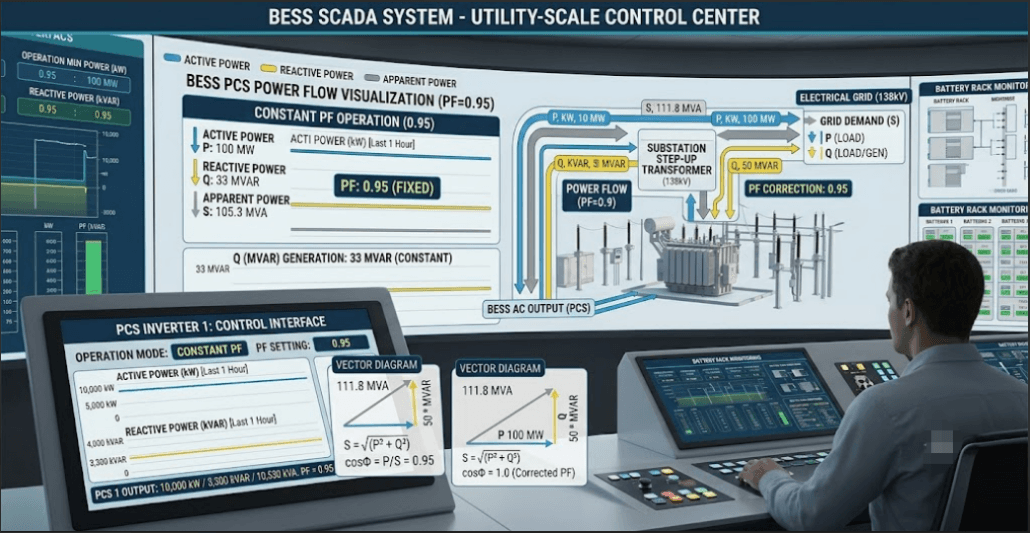
In this mode, the inverter maintains a fixed power factor.
Common settings include:
- 1.0 PF
- 0.98 PF
- 0.95 PF
- 0.90 PF
As active power changes across the system, the reactive power automatically adjusts to maintain this target. Therefore, utilities often mandate this specific mode for strict grid compliance purposes.
Volt-VAR Control Mode
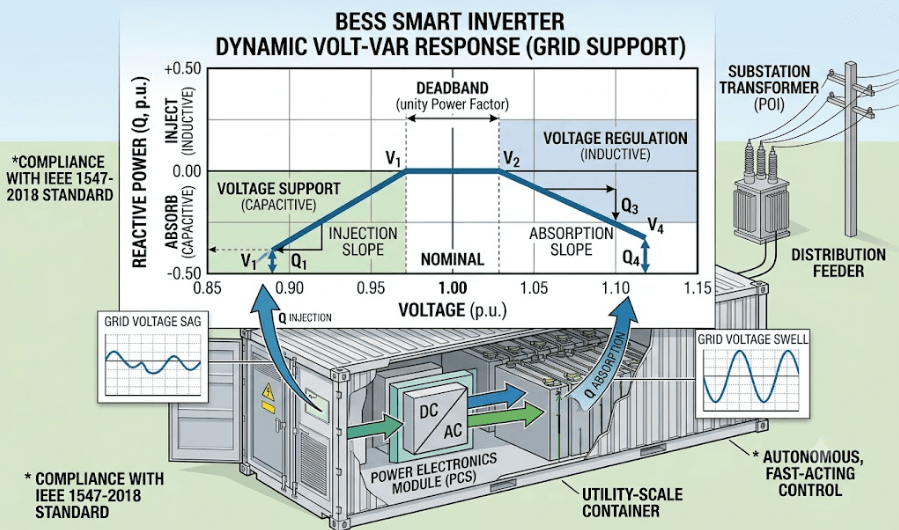
Volt-VAR control adjusts reactive power according to voltage levels.
When voltage falls:
- Reactive power increases
When voltage rises:
- Reactive power decreases
As a result, the system dynamically maintains a highly stable voltage profile across the distribution network.
Reactive Power Setpoint Mode
In this mode, operators directly specify reactive power output.
Examples include:
- +500 kVAR
- -1000 kVAR
This approach is common in transmission applications.
Dynamic Grid Support Mode
Advanced systems continuously adjust reactive power based on grid conditions.
These systems support:
- Frequency regulation
- Voltage control
- Black start capability
- Fault ride-through
For advanced inverter operation, explore the differences between BESS grid-forming technology
and standard BESS grid-following (GFL) configurations.
BESS Power Factor and PCS Sizing
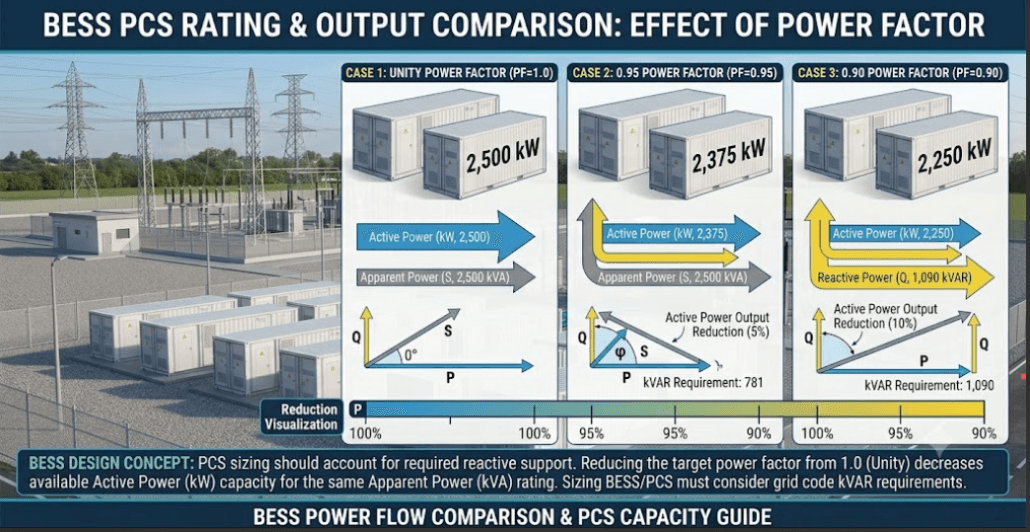
PCS sizing is one of the most important considerations in BESS design.
Many developers assume a 1 MW PCS can always deliver 1 MW. However, that is only true at unity power factor.
Consider this example:
PCS Rating = 1 MVA
Required PF = 0.90
Maximum Active Power:
1 MVA × 0.90 = 900 kW
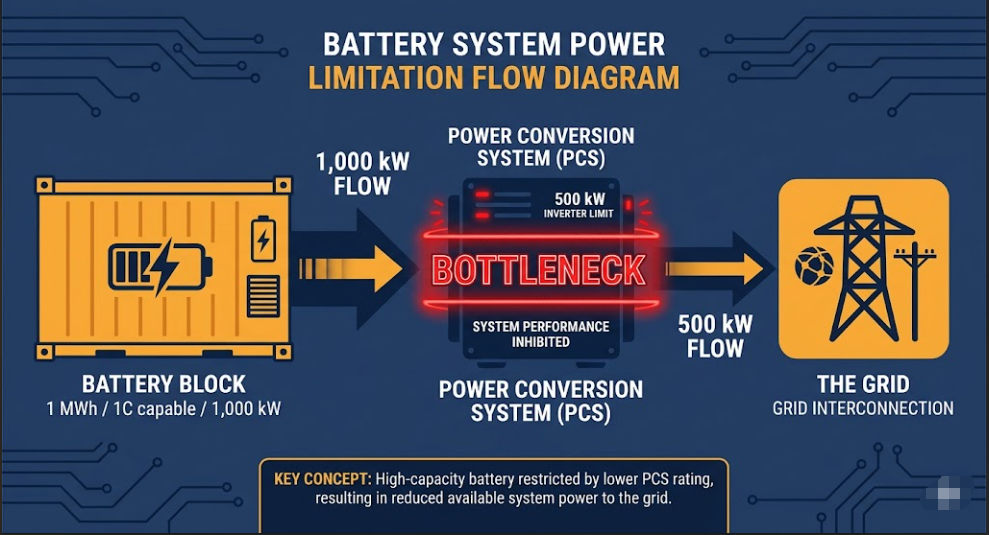
This calculation reveals that 100 kVA of capacity must remain strictly reserved for reactive grid support. Consequently, these stringent utility requirements frequently force engineering teams into oversizing their PCS hardware to avoid bottlenecking active power delivery.
BESS Power Factor Calculation Example
Assume:
- Active Power = 1000 kW
- Reactive Power = 484 kVAR
Apparent Power:
S = √(1000² + 484²)
S = 1111 kVA
Power Factor:
PF = 1000 ÷ 1111
PF = 0.90
Therefore, the Battery Energy Storage System operates at a 0.90 power factor.
Leading vs Lagging BESS Power Factor
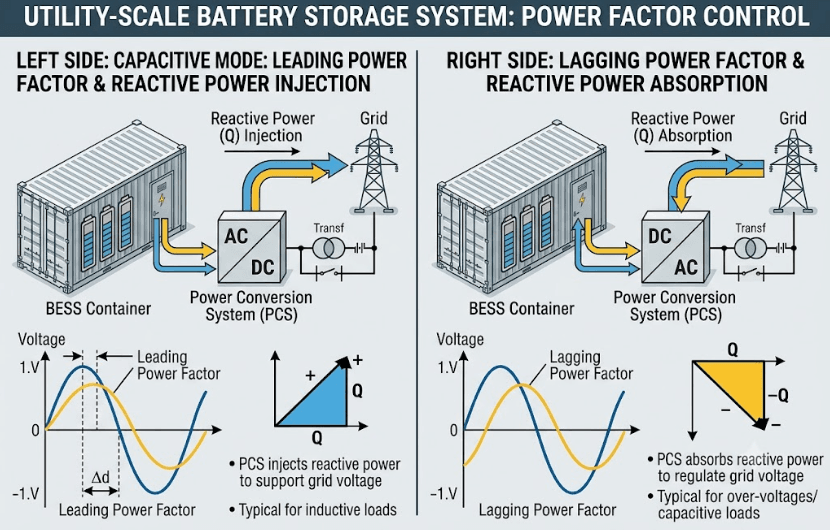
Leading BESS Power Factor
A leading power factor occurs when the inverter injects reactive power.
Characteristics include:
- Capacitive behavior
- Voltage support
- Improved weak-grid performance
Lagging BESS Power Factor
A lagging power factor occurs when the inverter absorbs reactive power.
Characteristics include:
- Inductive behavior
- Overvoltage mitigation
- Renewable energy integration support
Because modern electrical grids face highly volatile load profiles, utilizing both of these operating modes dynamically is absolutely essential for stabilizing modern distribution networks.
Utility Requirements for BESS Power Factor
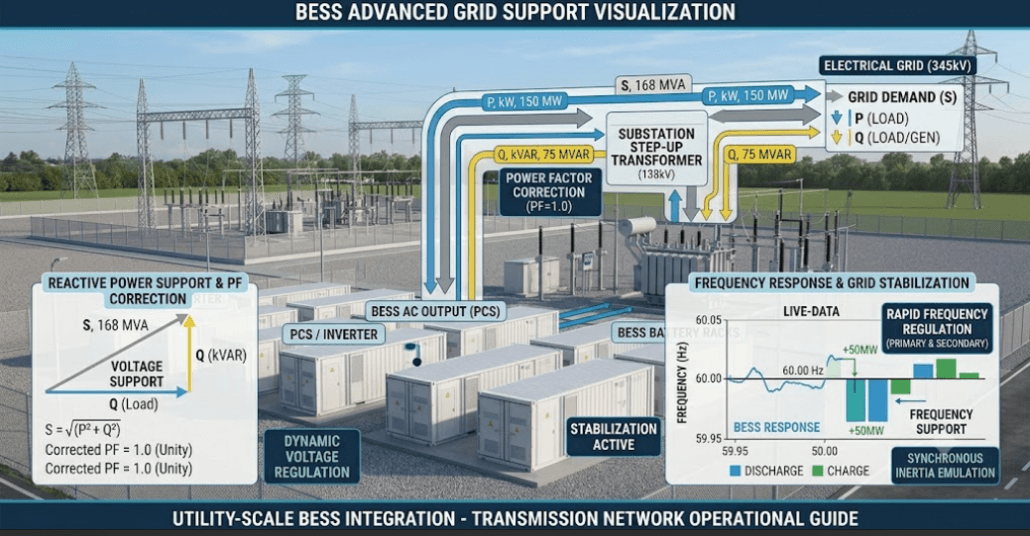
Most utilities require energy storage projects to operate within specific power factor limits.
Common requirements include:
- 0.95 Leading
- 0.95 Lagging
Some transmission operators require:
- 0.90 Leading
- 0.90 Lagging
Therefore, developers must understand local interconnection requirements before selecting PCS equipment.
IEEE 1547 and BESS Power Factor
IEEE 1547 established new requirements for inverter-based resources.
Today, Battery Energy Storage Systems must provide:
- Voltage regulation
- Reactive power support
- Power factor control
- Grid support functions
As renewable penetration grows, these capabilities become increasingly important.You can review the official compliance mandates in the IEEE 1547 standard for interconnection.
Can a BESS Provide Reactive Power Without Discharging?
Yes.
Modern PCS technology can provide reactive power even when the battery is idle.
This is because reactive power primarily uses inverter capacity rather than stored battery energy.
As a result, BESS projects can provide grid services without significant battery cycling.
BESS Power Factor Correction vs Capacitor Banks
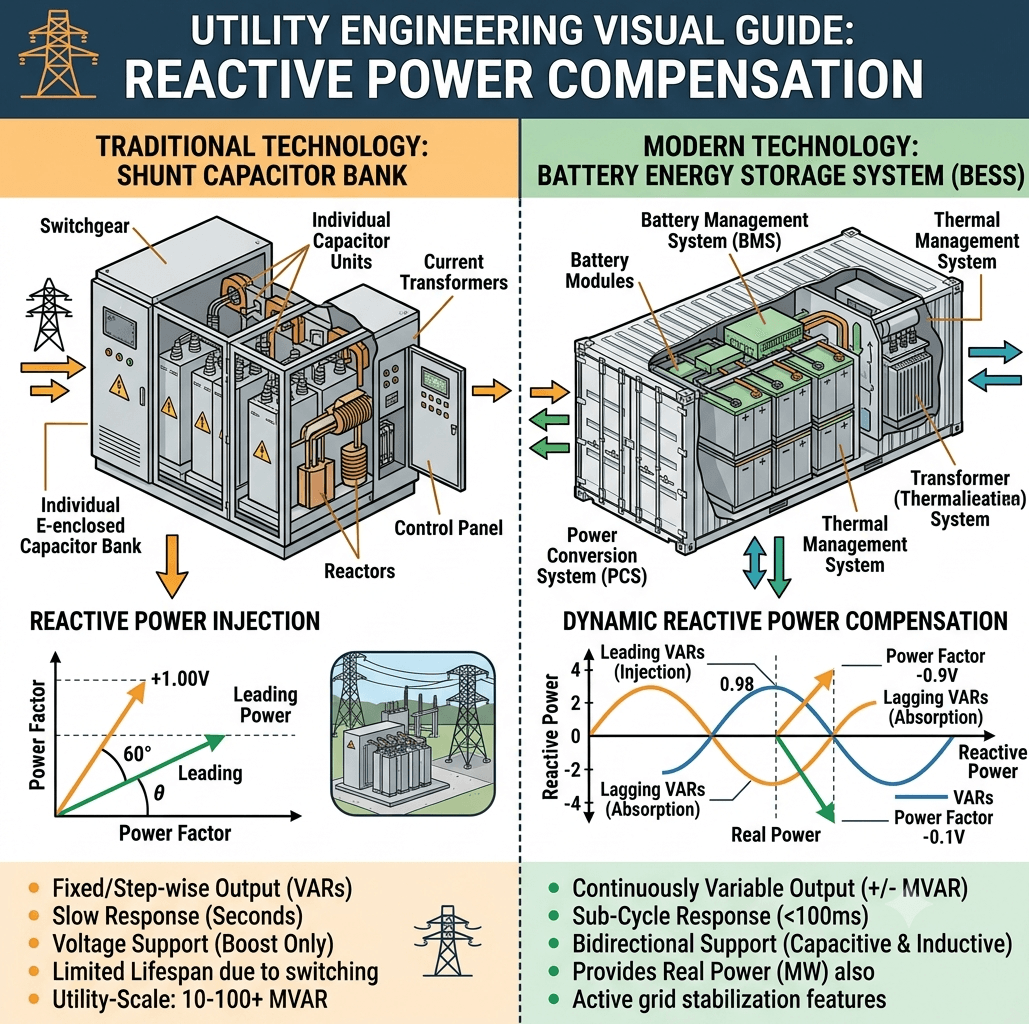
Traditional capacitor banks have been used for decades. However, Battery Energy Storage Systems provide greater flexibility.
Benefits of BESS include:
- Fast response times
- Dynamic voltage support
- Energy storage capability
- Frequency regulation
- Multiple revenue streams
Because of these operational advantages, many modern utilities now heavily prefer flexible BESS-based reactive power solutions over static equipment.
To understand how these components integrate into the overall system design, see our breakdown of BESS architecture.
BESS Power Factor in Commercial and Industrial Projects
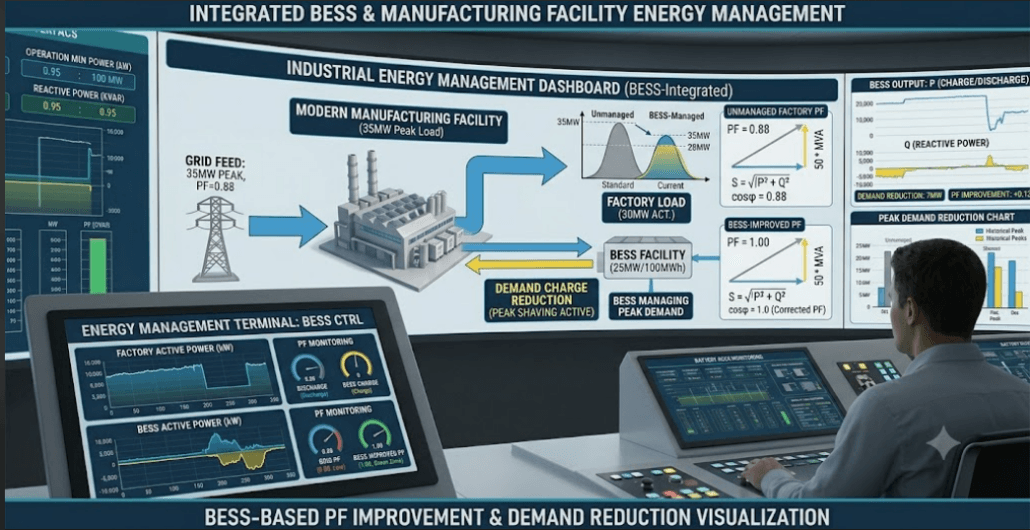
Commercial facilities often face utility penalties for poor power factor.
A Battery Energy Storage System can help:
- Reduce utility penalties
- Improve power quality
- Support motor starting
- Stabilize voltage
- Reduce demand charges
Consequently, BESS installations often provide value beyond energy storage alone.
Power Factor Challenges in Renewable Energy Projects
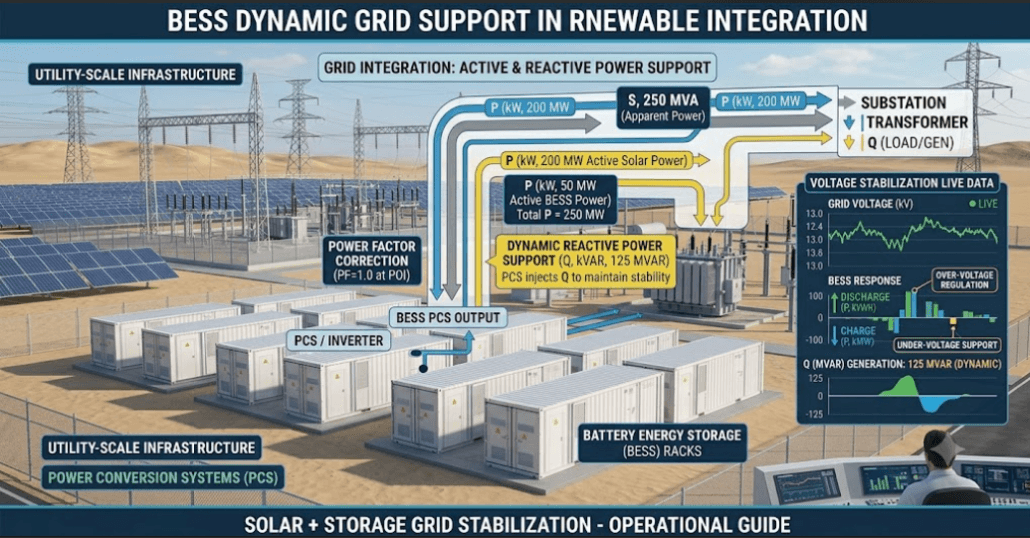
Renewable energy projects introduce unique complexities for BESS power factor control, primarily stemming from highly variable generation profiles and weak grid conditions. Because solar and wind plants do not produce static power, local voltage levels frequently fluctuate throughout the day, which can cause the overall power factor to become highly unstable if it is not proactively managed.
Key Challenges in Renewable Energy Systems
1. Voltage Fluctuations
Solar output changes rapidly with moving cloud cover, causing grid voltage to rise and fall frequently throughout the day.
2. Reverse Power Flow
When localized solar generation exceeds immediate demand, power flows backward into the distribution system and creates severe voltage spikes.
3. Weak Grid Conditions
High concentrations of inverter-based resources inherently reduce natural grid inertia, which ultimately degrades overall frequency and voltage stability.
4. Low System Inertia
Inverter-based systems reduce natural grid inertia. As a result, frequency and voltage stability decrease.
Future Trends in BESS Power Factor Management

The future of BESS Power Factor management is moving beyond simple correction.
Emerging technologies include:
- Grid-forming inverters
- Synthetic inertia
- AI-driven optimization
- Dynamic VAR compensation
- Virtual synchronous machines
As grids become more renewable, these technologies will become increasingly important.
Furthermore, future Battery Energy Storage Systems will provide even greater grid support capabilities.
Frequently Asked Questions About BESS Power Factor
What is BESS Power Factor?
BESS Power Factor is the ratio between active power and apparent power delivered by a Battery Energy Storage System.
Why is BESS Power Factor important?
It affects PCS sizing, grid compliance, voltage regulation, and system performance.
Can a BESS improve power factor?
Yes. Modern PCS inverters can inject or absorb reactive power to improve power factor.
Does reactive power consume battery energy?
Reactive power primarily uses inverter capacity. Therefore, it typically causes minimal battery energy consumption.
What power factor is required for utility-scale BESS?
Most utilities require operation between 0.95 leading and 0.95 lagging. However, requirements vary by region.
Conclusion
BESS Power Factor is no longer a secondary design consideration. Instead, it has become a critical requirement for modern Battery Energy Storage Systems.
A properly designed BESS can provide voltage support, reactive power compensation, and grid stabilization. In addition, it can improve renewable energy integration and create new revenue opportunities.
As utility requirements continue to evolve, understanding BESS Power Factor will remain essential for developers, EPC contractors, and energy asset owners.
For this reason, power factor analysis should be included in every Battery Energy Storage System design process.

Understanding BESS Specifications: A Complete Technical Guide for Buyers and Engineers
Introduction to BESS Specifications
Every Battery Energy Storage System (BESS) comes with a datasheet full of numbers. These include kW, kWh, C-rates, efficiency percentages, cycle life figures, and operating temperature ranges. For buyers, developers, and engineers, understanding BESS specifications is essential. In short, it is the difference between choosing a system that performs well for 15 to 20 years and one that underdelivers from day one. If you are new to energy storage, our introductory guide on What Is BESS? Understanding Battery Energy Storage Systems covers the fundamentals first.
This guide walks through every major BESS specification you will find on a datasheet. For each one, we explain what it means, how it is measured, and why it matters for your project. We also show how to compare BESS specifications across suppliers on a like-for-like basis. Whether you are evaluating a containerized utility-scale system or a smaller commercial and industrial (C&I) installation, the same core principles apply throughout this guide.
1. Power Rating vs. Energy Capacity: Core BESS Specifications
The single most important pair of BESS specifications is the distinction between power rating (kW or MW) and energy capacity (kWh or MWh). These two values are independent. Therefore, confusing them is the most common mistake made by first-time buyers. For a deeper look at how these standardized baselines are regulated, you can review the U.S. DOE — Lithium-ion Battery Storage Technical Specifications.
- Power Rating (kW/MW): The maximum rate at which the system can charge or discharge electricity at any instant.
- Energy Capacity (kWh/MWh): The total amount of energy the system can store and deliver over time.
A useful way to think about this is the bathtub analogy. In other words, power rating is the size of the tap (how fast water flows), while energy capacity is the size of the tub (how much water it holds).
The Power-to-Energy Ratio in BESS Specifications
Dividing energy capacity by power rating gives the duration of the system, expressed in hours. For example, a 2 MW / 4 MWh BESS has a 2-hour duration, while a 1 MW / 4 MWh BESS has a 4-hour duration. Both store the same total energy. However, they serve very different applications.
| System Configuration | Duration | Typical Application |
| 1 MW / 1 MWh | 1 hour | Frequency regulation, fast response |
| 1 MW / 2 MWh | 2 hours | Peak shaving, short-duration arbitrage |
| 1 MW / 4 MWh | 4 hours | Solar shifting, demand charge reduction |
| 1 MW / 8 MWh+ | 8+ hours | Overnight backup, island grid applications |
When evaluating a quote, always check both numbers separately. For instance, a supplier advertising a “2 MWh system” without specifying the power rating has not given you a complete set of BESS specifications.
In addition, for a broader overview of how these components fit into a complete system, see our Ultimate Guide to Battery Energy Storage Systems (BESS).
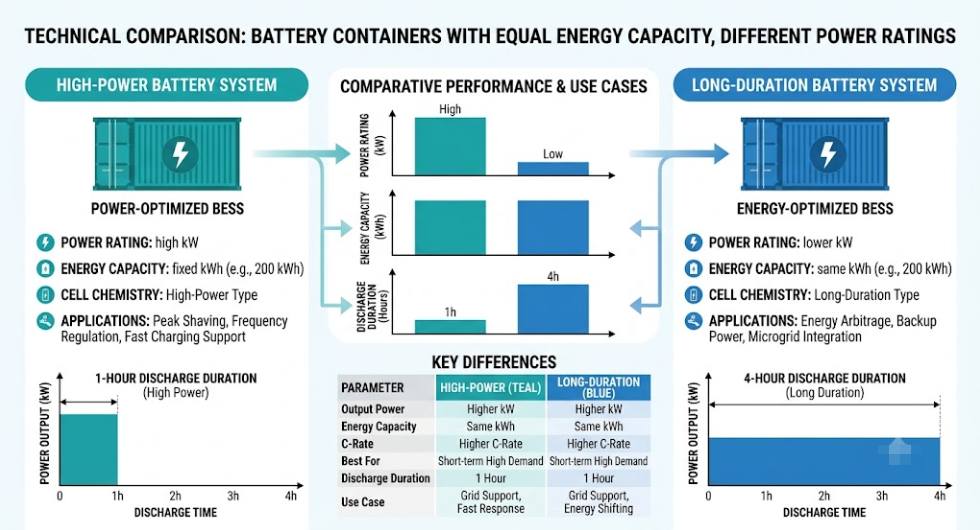
Figure 1: Power rating and energy capacity together determine discharge duration.
2. C-Rate Specifications: Linking Power and Energy Together
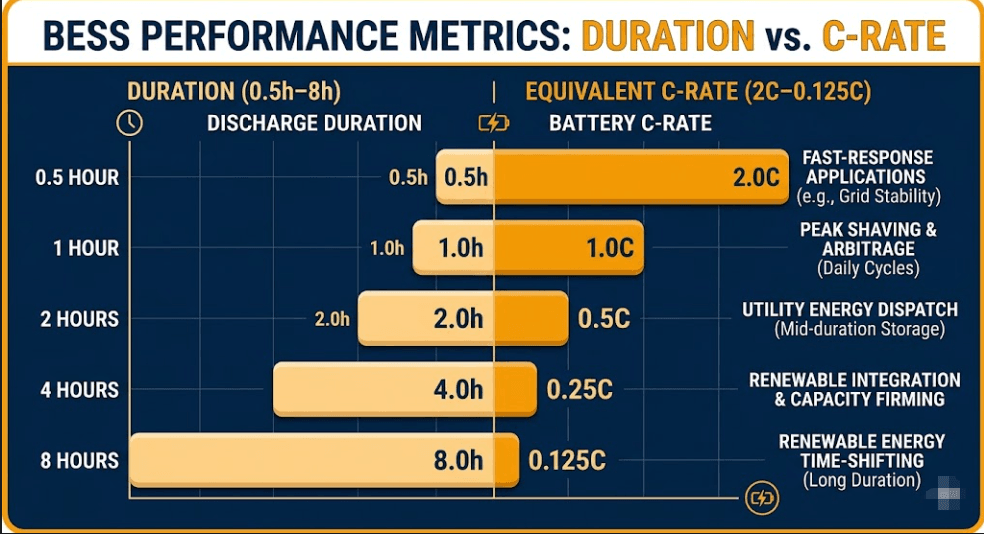
Among the key BESS specifications, the C-rate expresses the charge or discharge current relative to the battery’s total capacity. For example, a 1C rate means the battery can be fully charged or discharged in one hour. Similarly, a 0.5C rate means two hours, while a 2C rate means 30 minutes.
C-rate = Power (kW) ÷ Energy Capacity (kWh)
For most stationary BESS applications — such as peak shaving, solar shifting, and frequency regulation — systems are designed in the 0.25C to 1C range. As a result, higher C-rates increase heat generation, accelerate degradation, and typically require more robust thermal management.
- LFP cells: commonly rated for continuous operation up to 1C, with short bursts to 2–3C
- NMC cells: often support slightly higher continuous C-rates but with faster capacity fade at high rates
- High C-rate specifications (>1C) should always be cross-checked against the cell manufacturer’s datasheet and thermal design
Therefore, for a deeper technical breakdown of how C-rate affects performance across battery chemistries, see our guide on Battery C-Rates Explained for BESS Buyers.
3. Round-Trip Efficiency: A Critical BESS Specification
Round-trip efficiency measures how much of the energy used to charge a battery is recovered on discharge. As a result, it is one of the most commercially significant BESS specifications, because it directly affects the revenue and savings a system can generate over its lifetime.
RTE (%) = Energy Discharged ÷ Energy Charged × 100
| Battery Technology | DC Efficiency | AC Efficiency |
| Lithium Iron Phosphate (LFP) | 96–98% | 88–94% |
| Lithium NMC | 95–97% | 87–92% |
| Sodium-ion | 90–94% | 82–90% |
| Flow Batteries | 70–85% | 65–80% |
| Lead-Acid | 80–90% | 70–85% |
Always confirm whether a quoted RTE figure is AC (system-level) or DC (battery-level). AC efficiency includes inverter, transformer, and auxiliary losses. Therefore, it is the figure that matters most for project economics. For the full formula, worked examples, and an interactive calculator, see our dedicated guide on BESS Round Trip Efficiency (RTE).
4. Depth of Discharge and Usable Energy BESS Specifications
Depth of Discharge (DoD) describes how much of the battery’s total (nameplate) capacity is used during normal operation. It is expressed as a percentage. The remaining portion is reserved to protect the battery from degradation. This degradation is caused by very high or very low states of charge. As a result of applying DoD to nameplate capacity, we get Usable Energy — the figure that actually matters for sizing and project economics.
- Nameplate Capacity: The total rated energy storage of the system (e.g., 4,000 kWh)
- Usable Energy: Nameplate capacity × DoD (e.g., 4,000 kWh × 90% = 3,600 kWh usable)
- LFP systems commonly operate at 90–95% DoD due to their flat voltage curve and stable chemistry
- NMC and older lead-acid systems often specify lower DoD limits (50–80%) to preserve cycle life
Usable Energy is also a moving target over the system’s lifetime. Specifically, as the battery degrades, both nameplate capacity and usable energy decline. For this reason, project sizing should be based on usable energy at end-of-life (EOL), not at beginning-of-life (BOL). Otherwise, a system that meets duration requirements in year one may fall short by year ten.
When comparing two quotes with identical nameplate capacity, the system with the higher usable DoD effectively delivers more usable energy. In other words, it delivers more value per dollar, assuming cycle life and warranty terms are comparable.
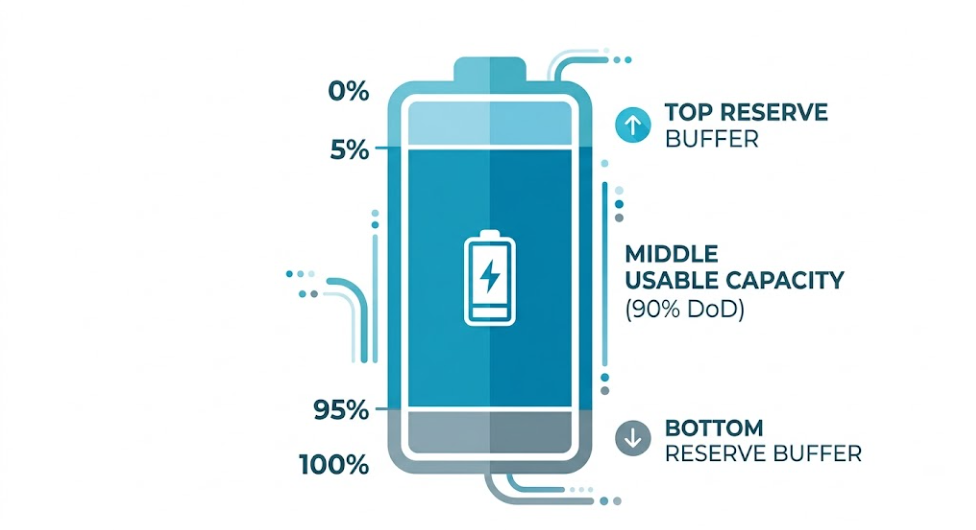
Figure 2: Nameplate capacity vs. usable capacity under a typical 90% DoD specification.
5. State of Charge and State of Health BESS Specifications
State of Charge (SoC) Specification
SoC is a real-time measurement of how much energy is currently stored in the battery. It is expressed as a percentage of usable capacity. The Battery Management System (BMS) manages SoC continuously. As a result, it sets safe operating windows. For example, cycling may be restricted to a 10–95% SoC band to protect cell longevity.
State of Health (SoH) Specification
SoH indicates how much capacity and performance the battery retains compared to when it was new. It is typically expressed as a percentage. For instance, a battery at 80% SoH can store only 80% of its original rated energy. Most BESS warranties therefore guarantee a minimum SoH — commonly 70–80% — at the end of a stated warranty period, such as 10 years.
SoH is most commonly estimated using DC Internal Resistance (DCIR) measurements. This is because internal resistance increases predictably as cells age. For a detailed explanation of how this works in practice, see our guide on DCIR-Based State of Health Estimation for BESS.
6. Battery Management System (BMS) Specifications
The BMS is the electronic brain of the battery. Therefore, its specifications deserve as much scrutiny as the cells themselves. Key BMS specifications to evaluate include the following:
- Cell-level voltage and temperature monitoring resolution (number of monitored points per module/rack)
- Cell balancing method — passive vs. active balancing, and balancing current capability
- Communication protocol — CAN bus, Modbus TCP/RTU, or proprietary protocols, and compatibility with the EMS
- Protection functions — over-voltage, under-voltage, over-current, over-temperature, and short-circuit protection thresholds
- Insulation resistance monitoring and ground fault detection
- State estimation algorithms for SoC and SoH accuracy (typically ±2–3% for quality systems)
A well-specified BMS should provide granular cell-level data, not just pack-level averages. This granularity is essential for early fault detection. In addition, it ensures accurate SoH tracking over the system’s lifetime.
The BMS is just one subsystem within the overall system design. For a complete picture of how the BMS, PCS, EMS, and thermal systems are arranged together, see our guide on Understanding Energy Storage System BESS Architectures.
7. Power Conversion System (PCS) Specifications
The Power Conversion System (PCS), or inverter, converts DC battery power to AC grid power and back. Therefore, key PCS specifications include the following:
- Rated AC power output (kW/MW) and overload capability (e.g., 110% for 10 minutes)
- Conversion efficiency — typically 96–99% for modern PCS units
- Control mode — grid-following (GFL) or grid-forming (GFM)
- Power factor range and reactive power capability (kVAR)
- Total Harmonic Distortion (THD) — typically below 3% for grid-compliant systems
- Grid code compliance — IEEE 1547, IEC 62116, and relevant regional grid codes
The choice between grid-following and grid-forming PCS specifications has become one of the most consequential decisions in modern BESS procurement. This is especially true for projects with high renewable penetration or islanded operation. For a full comparison, see Grid Forming vs Grid Following BESS: What Is the Difference?, and our complete reference on Power Conversion System (PCS) for BESS.
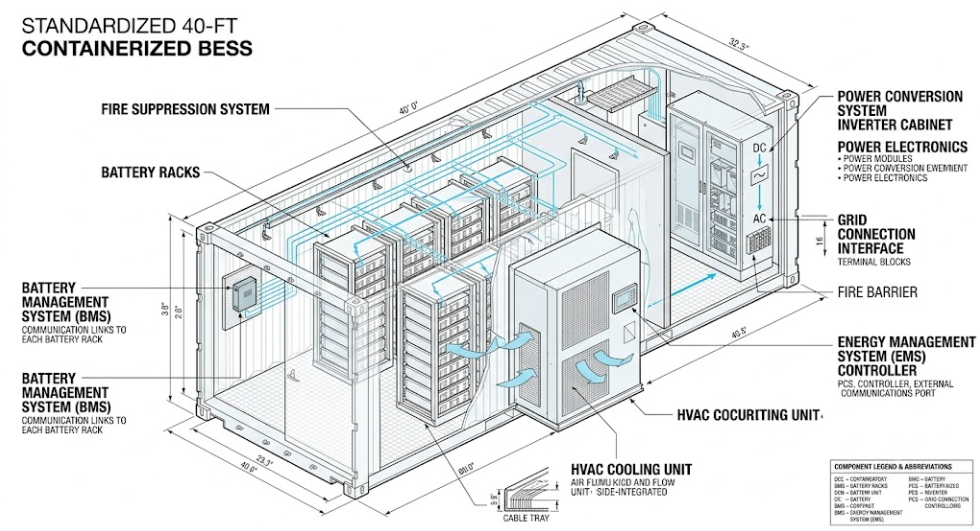
Figure 3: Major subsystems referenced across a typical BESS specification sheet.
8. Cycle Life and Calendar Life BESS Specifications
Cycle life specifies the number of full charge-discharge cycles a battery can complete. After this number is reached, capacity falls to a defined end-of-life threshold, commonly 80% of original capacity. By contrast, Calendar life specifies the expected service life in years. This is independent of cycling, and is due to chemical aging over time.
Therefore, always request the test conditions behind any cycle life claim. You can also consult the NREL — Grid-Scale Battery Storage FAQs to see how baseline degradation model assumptions impact long-term project planning.
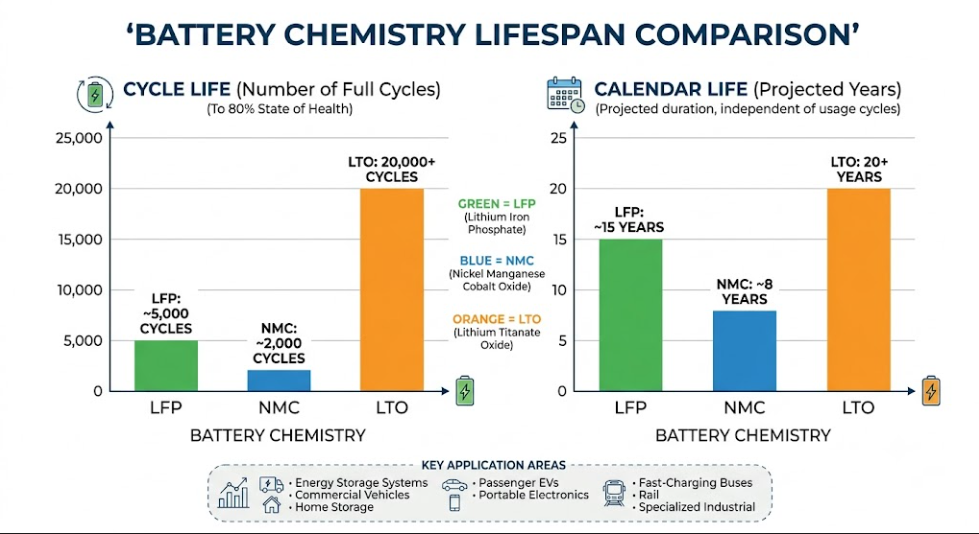
| Battery Chemistry | Typical Cycle Life (to 80% SoH) | Typical Calendar Life |
| LFP (Lithium Iron Phosphate) | 4,000–8,000 cycles | 10–15 years |
| NMC (Lithium Nickel Manganese Cobalt) | 3,000–6,000 cycles | 8–12 years |
| LTO (Lithium Titanate) | 10,000–20,000 cycles | 15–20 years |
Cycle life ratings are always tied to specific test conditions, such as DoD, C-rate, and temperature. For example, a cycle life figure quoted at 100% DoD and 1C will be significantly lower than the same cell’s life at 80% DoD and 0.5C. Therefore, always request the test conditions behind any cycle life claim.
9. Thermal Management BESS Specifications
Thermal management directly affects safety, efficiency, and degradation rate. As a result, specifications to review include the following:
- Cooling method — air cooling, liquid cooling, or hybrid systems
- Operating temperature range — typically -20°C to 55°C for the enclosure, with cell-level targets of 15–35°C
- Temperature uniformity across racks (a key driver of uneven degradation); see our analysis on gradient-limit depth)
- HVAC redundancy (N+1 configurations for utility-scale projects)
- Thermal runaway detection and suppression systems (aerosol, water mist, or other agents)
Liquid cooling has become the default for high-density utility-scale systems, mainly due to better temperature uniformity. Meanwhile, air cooling remains common and cost-effective for smaller C&I systems. For a detailed comparison, see Liquid vs Air Cooling Systems in BESS.
10. Ingress Protection and Operating Condition BESS Specifications
The IP (Ingress Protection) rating describes how well the BESS enclosure resists solid objects, dust, and water. As a result, it is a critical specification for outdoor and harsh-environment installations. The rating is expressed as IP followed by two digits. The first digit indicates protection against solids, such as dust and debris. The second digit indicates protection against liquids, such as moisture, rain, and washdown.
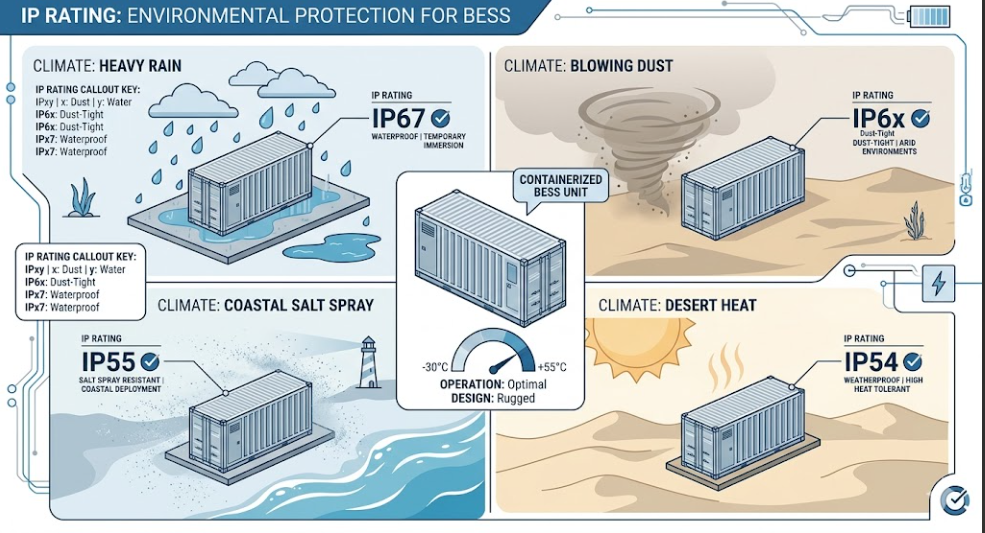
| IP Rating | Solids Protection | Liquids Protection | Typical Application |
| IP54 | Dust-protected (limited ingress) | Splash-protected from any direction | Sheltered or indoor C&I installations |
| IP55 | Dust-protected | Protected against low-pressure water jets | Outdoor C&I, moderate exposure |
| IP65 | Dust-tight | Protected against water jets from any direction | Utility-scale outdoor containers, coastal sites |
| IP67 | Dust-tight | Protected against temporary immersion | Flood-prone or extreme weather sites |
Beyond the enclosure rating, the broader operating conditions specification defines the environmental envelope. Within this envelope, the BESS is warranted to perform. Key items to check include the following:
- Ambient operating temperature range — commonly -20°C to 55°C for the container, narrower (15–35°C) for the cells themselves
- Storage temperature range (for the system when not in active operation)
- Relative humidity range — typically 5–95% non-condensing
- Altitude derating — power output may be derated above 1,000–2,000 m due to reduced cooling performance
- Corrosion protection — coastal or high-salinity sites typically require C3–C5 corrosion class enclosures and coatings
- Wind and snow load ratings for the container or enclosure structure
For projects in tropical, coastal, desert, or high-altitude locations, these BESS specifications should be checked carefully against local climate data. Otherwise, a system rated for temperate climates may require derating, additional cooling capacity, or enhanced corrosion protection to meet its advertised performance and warranty terms.
11. Safety and Compliance BESS Specifications
Safety certifications are non-negotiable BESS specifications. In fact, they should appear on every datasheet:
- UL 9540 / UL 9540A Test Method — fire safety and thermal runaway propagation testing
- IEC 62619 Standard Overview / IEC 63056 — safety requirements for industrial lithium batteries
- UN 38.3 — transportation safety for lithium batteries
- NFPA 855 — installation standards for energy storage systems (US)
- Seismic certification where applicable (e.g., IBC seismic design categories)
Missing certifications are a red flag. This is particularly true for utility interconnection and insurance underwriting, where documentation of UL 9540A test results is increasingly a hard requirement. To streamline your evaluation, you can reference the U.S. DOE — BESS Procurement Checklist to verify required project documentation.
12. BESS Specifications Comparison Checklist
When comparing quotes from multiple suppliers, build a side-by-side table using the BESS specifications below. As a result, this ensures you are comparing systems on equal terms, rather than being swayed by a single headline number.
| Specification | Why It Matters | What to Ask For |
| Power rating (kW/MW) | Determines instantaneous load-serving capability | Continuous and peak (overload) ratings |
| Energy capacity (kWh/MWh) | Determines total stored energy and duration | Nameplate vs. usable capacity, BOL vs. EOL |
| C-rate | Affects degradation and thermal design | Continuous and pulse C-rate limits |
| Round-trip efficiency | Drives lifetime energy losses and revenue | AC vs. DC efficiency, test conditions |
| Depth of Discharge / Usable Energy | Determines real usable energy at BOL and EOL | Recommended cycling band (e.g., 10–95%); usable kWh at year 1 and year 10 |
| Cycle life / Calendar life | Drives augmentation and replacement schedule | Test conditions (DoD, C-rate, temperature) |
| Warranty SoH guarantee | Protects against early degradation | Guaranteed SoH at 10/15/20 years |
| Thermal management | Affects safety and long-term performance | Cooling method, redundancy, operating range |
| IP rating & operating conditions | Determines suitability for site climate and exposure | IP rating, temperature/humidity range, corrosion class, altitude derating |
| PCS efficiency & control mode | Affects conversion losses and grid compatibility | GFL vs. GFM, THD, grid code compliance |
| Safety certifications | Required for permitting, insurance, financing | UL 9540A test reports, IEC 62619 |
Frequently Asked Questions About BESS Specifications
Which BESS specification should a buyer understand first?
Power rating and energy capacity, along with the relationship between them (duration), form the foundation of every other specification. If you get this wrong, the system either cannot meet peak demand or cannot supply energy for long enough. As a result, the other specifications matter much less.
Is a higher round-trip efficiency always better in BESS specifications?
Generally yes, but it should be weighed against cost, chemistry, and application. For example, a 2–3 percentage point difference in AC round-trip efficiency can meaningfully affect lifetime revenue for high-cycling arbitrage projects. However, it matters less for systems used primarily for backup power.
Why do nameplate capacity and usable energy differ in BESS specifications?
The difference comes from the Depth of Discharge (DoD) reserve. This reserve protects the battery from operating at extreme states of charge, which would otherwise accelerate degradation. Therefore, this reserve is intentional and is factored into warranty terms.
How do I verify a supplier’s cycle life specifications?
Request the specific test conditions — DoD, C-rate, and ambient temperature — used to derive the cycle life figure. In addition, ask for third-party cell-level test data where available. Then, compare these conditions to your expected operating profile.
What BESS specifications matter most for island grid or off-grid projects?
For islanded systems, grid-forming PCS capability, black start capability, and energy duration (MWh, not just MW) become critical BESS specifications. By contrast, these may not matter for grid-connected projects. See our Island Grid BESS Engineering Guide for a full sizing methodology.
Conclusion: Why BESS Specifications Matter
BESS specifications are not just numbers on a datasheet. Instead, each one represents a design decision with direct consequences for performance, safety, and lifetime economics. By understanding power rating, energy capacity, C-rate, round-trip efficiency, depth of discharge, State of Health, and the supporting BMS, PCS, thermal, IP rating, and safety specifications, buyers and engineers can compare systems meaningfully. As a result, they can avoid costly mismatches between design intent and real-world performance.
For project-specific guidance on specifying or sizing a BESS for your application, contact the SunLith Energy engineering team.
BESS C-Rate Explained: Charge, Discharge Rate & How It Affects System Price
Introduction: Why BESS C-Rate Changes Everything About System Price and Performance
Every Battery Energy Storage System (BESS) datasheet carries a C-rate figure. It sits alongside capacity in kWh, chemistry type, and cycle life. Yet the BESS C-rate is almost always the least-explained number on the page — and, in practice, the most consequential one.
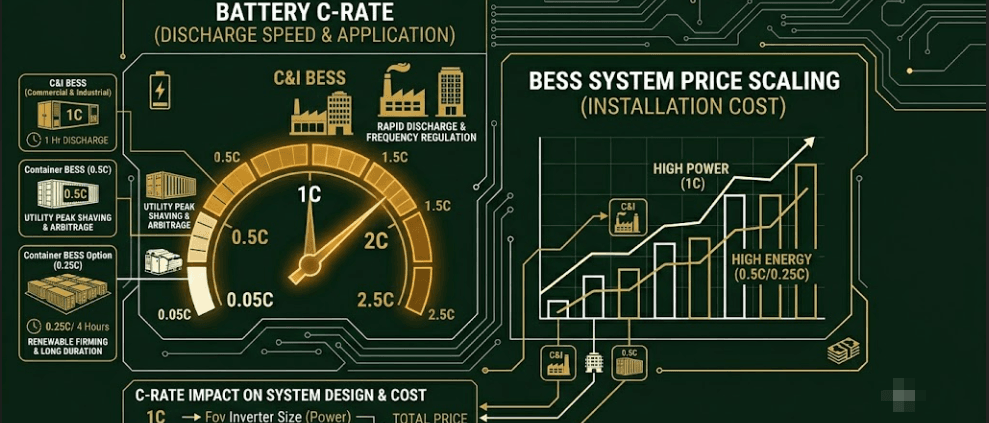
Understanding BESS C-rate matters because it governs three things at once. First, it sets how much peak power the system can deliver. Second, it controls how quickly the battery recharges between dispatch events. Third, it predicts how long cells will last under real operating conditions. As a result, BESS C-rate has a direct, measurable effect on installed system cost. In fact, the price gap can be large. Between a 0.5C energy-type system and a 2C power-type system of identical kWh capacity, the difference is often 50 to 100 per cent.
This guide explains the BESS C-rate concept from first principles. It covers both charge and discharge C-rates based on foundational National Laboratory of the Rockies (NLR) battery storage technology basics with worked examples. It also maps the full relationship between C-rate tier, application, and installed price. By the end, therefore, you can read any BESS datasheet with confidence. You will also be able to compare quotations on a like-for-like basis.
1. What Is BESS C-Rate? Definition, Formula and Notation
BESS C-rate is a standardised measure of how fast a battery is charged or discharged relative to its total storage capacity. The “C” stands for capacity. The number in front of it acts as a multiplier of that capacity.
| 📐 | BESS C-rate formula: C-rate = Current (A) ÷ Nominal Capacity (Ah) Example — 200 Ah LFP battery: • Discharged at 200 A → 1C → full discharge in 1 hour • Discharged at 400 A → 2C → full discharge in 30 minutes • Discharged at 100 A → 0.5C → full discharge in 2 hours |
Importantly, BESS C-rate is chemistry-independent and capacity-independent. For example, a 1C discharge of a 10 kWh residential BESS delivers 10 kW. In contrast, a 1C discharge of a 2 MWh grid system delivers 2 MW. In both cases, the rate is relative — it describes discharge speed as a proportion of total storage, regardless of system size.
BESS C-Rate Notation: Reading the Two Datasheet Formats
Two notation formats appear on datasheets and both describe the same BESS C-rate value. The multiplier format uses a number before C: 2C means discharge at double the 1-hour rate, giving a full drain in 30 minutes. The fractional format divides capacity: C/2 means discharge at half the 1-hour rate, giving a full drain in 2 hours.
Therefore, C/2 and 0.5C are identical. Similarly, C/10 and 0.1C are identical. When a datasheet shows a charge rate of C/5 alongside a discharge rate of 1C, the system charges five times more slowly than it discharges. As explained in Section 2, this asymmetry is a deliberate engineering choice — not a product limitation.
BESS C-Rate Quick Reference: From 0.1C to 10C
| C-Rate | Meaning | Discharge Time | Charge Time (at same rate) | Real-World Parallel |
|---|---|---|---|---|
| C/10 (0.1C) | Discharge at 1/10th capacity current | 10 hours | 10 hours | Solar trickle charge / overnight backup reserve |
| C/5 (0.2C) | Discharge at 1/5th capacity current | 5 hours | 5 hours | Long-duration island grid storage |
| C/2 (0.5C) | Discharge at half capacity current | 2 hours | 2 hours | C&I energy arbitrage, solar self-consumption |
| 1C | Discharge at full capacity current | 1 hour | 1 hour | Peak shaving, daily cycling BESS |
| 1.5C | Discharge at 1.5× capacity current | 40 minutes | — | Aggressive demand charge reduction |
| 2C | Discharge at double capacity current | 30 minutes | — | Grid frequency response, EV charging buffer |
| 3C | Discharge at 3× capacity current | 20 minutes | — | Fast-response ancillary services |
| 10C | Discharge at 10× capacity current | 6 minutes | — | Ultra-fast EV charging, power electronics |
2. BESS Charge C-Rate vs Discharge C-Rate: Why the Two Figures Differ
Most explanations of BESS C-rate focus only on discharge — how fast the battery empties. However, charge C-rate is equally important for dispatch planning and cell longevity. In most commercial BESS installations, moreover, the two figures are deliberately set at different levels.
Why BESS Charge C-Rate Must Stay Below Discharge C-Rate
Charging a lithium-ion cell forces lithium ions back into the anode. If this process happens too fast, ions arrive at the anode surface faster than the graphite lattice can absorb them. Consequently, excess lithium deposits as metallic lithium on the surface — a process called lithium plating. Lithium plating is irreversible. It permanently reduces capacity and, in extreme cases, creates internal short circuits that cause thermal runaway. For the full electrochemistry behind why lithium plating happens, how it differs from ordinary SEI layer growth, and why it’s largely preventable, see our guide on SEI layer growth and lithium plating in LFP cells.
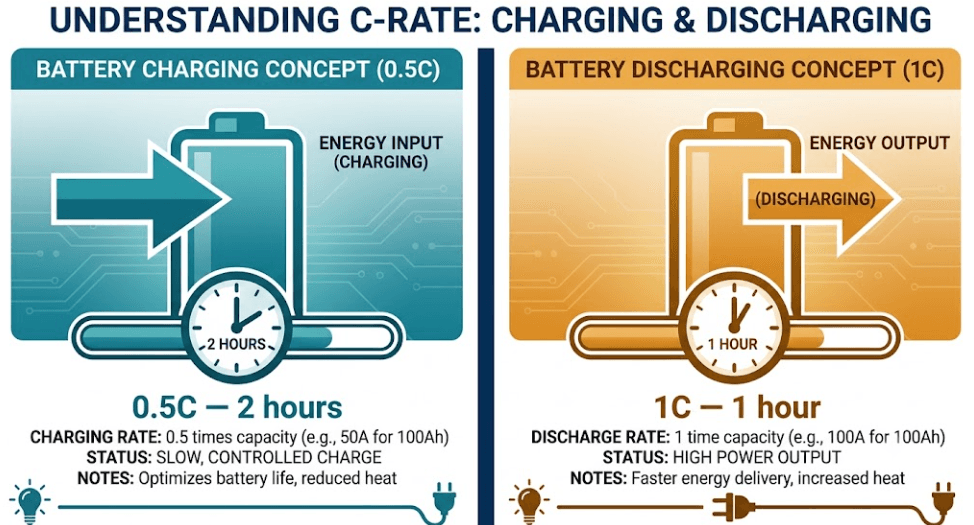
For this reason, LFP manufacturers specify a maximum continuous charge C-rate that is lower than the discharge limit. The most common commercial BESS pairing — 0.5C charge and 1C discharge — reflects this constraint directly.
| ⚡ | Standard C&I LFP BESS charge vs discharge C-rate: Charge rate: 0.5C → fills in 2 hours → protects anode, maximises cycle life Discharge rate: 1C → empties in 1 hour → delivers full rated peak power This asymmetry is intentional — not a limitation. |
The practical implication is straightforward. A 500 kWh / 1C BESS delivers 500 kW to the grid in one hour. However, it needs two hours to recharge at 0.5C. Therefore, always plan your dispatch schedule around the slower charge rate — not just the discharge figure.
BESS Charge C-Rate Worked Examples: 100 Ah LFP Cell
| Charge C-Rate | Charge Time (100 Ah cell) | Charge Current | BESS Application | LFP Cell Impact |
|---|---|---|---|---|
| C/10 (0.1C) | 10 hours | 10 A | Overnight trickle from small solar array | Excellent — maximum cycle life, zero thermal risk |
| C/5 (0.2C) | 5 hours | 20 A | Slow solar charge, low-irradiance days | Excellent — best for calendar longevity |
| C/2 (0.5C) | 2 hours | 50 A | Standard C&I BESS grid or solar charge | Very good — recommended daily charge rate for LFP |
| 1C | 1 hour | 100 A | Fast recharge between morning/afternoon peaks | Good — within spec; monitor cell temperature |
| 2C | 30 minutes | 200 A | Rapid recharge for EV charging buffer BESS | Moderate — active cooling essential; reduces cycle life |
| 3C+ | <20 minutes | 300 A+ | Ultra-fast charging stations | Risk of lithium plating — requires specialist cells only |
BESS Discharge C-Rate Worked Examples: 100 Ah LFP Cell
| Discharge C-Rate | Discharge Time (100 Ah) | Power Output | BESS Application | LFP Cell Impact |
|---|---|---|---|---|
| C/4 (0.25C) | 4 hours | 25 A | Frequency regulation support, overnight levelling | Excellent — minimal degradation, long cycle life |
| C/2 (0.5C) | 2 hours | 50 A | Residential shifting, off-grid night supply | Excellent — standard low-stress operating point |
| 1C | 1 hour | 100 A | C&I peak shaving (30–60 min demand events) | Very good — standard commercial BESS daily operation |
| 1.5C | 40 minutes | 150 A | Aggressive demand charge reduction | Good — within LFP spec with adequate thermal management |
| 2C | 30 minutes | 200 A | Grid frequency regulation, EV buffer discharge | Moderate — higher heat, faster degradation per cycle |
| 10C | 6 minutes | 1,000 A | EV ultra-fast charging station power burst | Requires high-power LFP or specialist cell chemistry |
Full BESS C-Rate Cycle: Real Charge and Discharge Example
To anchor both BESS C-rate concepts in a real project, consider a 500 kWh LFP BESS at a cold-storage facility. The site faces a peak demand charge triggered above 400 kW. Consequently, the system runs two discharge events per day:
| 🏭 | System: 500 kWh LFP | Nominal voltage: 614 V | Capacity: ~815 Ah NIGHT CHARGE (22:00–00:00) — BESS C-rate: 0.5C, from off-peak grid Current: 408 A | Power: 250 kW | Duration: 2 hours Result: fully charged at midnight using cheap off-peak tariff MORNING DISCHARGE (08:00–09:00) — BESS C-rate: 1C, peak shaving Current: 815 A | Power: 500 kW | Duration: 1 hour Result: production ramp absorbed; grid import held below 400 kW AFTERNOON CHARGE (12:00–14:00) — BESS C-rate: 0.5C, from rooftop solar Current: 408 A | Power: 250 kW | Duration: 2 hours Result: battery refilled by solar for the afternoon peak AFTERNOON DISCHARGE (15:00–16:00) — BESS C-rate: 1C, peak shaving Current: 815 A | Power: 500 kW | Duration: 1 hour Result: second demand peak suppressed — demand charge avoided |
This 0.5C charge / 1C discharge pattern keeps LFP cells within their optimal BESS C-rate operating window. As a result, cycle life typically exceeds 4,000 full cycles at 80% depth of discharge — sufficient for over 10 years of daily operation.
| 📌 | BESS C-rate rule of thumb: if your system is specified for 1C discharge, plan to charge at 0.5C. If it operates at 2C discharge, confirm that the cell chemistry and BMS support at least 1C charging without lithium plating risk. |
3. How the BMS Enforces BESS C-Rate Limits in Real Operation
The Battery Management System (BMS) is the component that enforces BESS C-rate limits at the cell level during both charge and discharge. It monitors current, cell temperature, and state of charge (SoC) in real time. Whenever any parameter approaches its safe boundary, the BMS intervenes immediately to protect the cells.
BMS Charge Control: CC/CV Protocol and BESS C-Rate Tapering
During charging, the BMS applies a constant-current / constant-voltage (CC/CV) protocol. The constant-current phase runs at the rated charge C-rate until cell voltage approaches its upper limit. At that point, the BMS transitions to constant-voltage mode and tapers current down to zero as the cell reaches full charge. This taper phase is critical — without it, sustained high-current charging causes the lithium plating described in Section 2.
BMS Discharge Control: BESS C-Rate Curtailment and SoH Tracking
During discharge, the BMS monitors current and cell temperatures continuously. When current exceeds the rated BESS C-rate, the BMS issues a curtailment command within milliseconds. This typically happens because of a load spike or an inverter fault. High-C-rate BESS systems operating at 2C or above require particularly fast BMS response. For this reason, systems designed for sustained 2C operation use BMS platforms with sub-10 ms cell-level sampling. This specification adds cost, but it also prevents thermal cascades.
In addition to real-time protection, the BMS tracks the cumulative effect of each C-rate event on State of Health (SoH). SoH is the ratio of current capacity to the original rated capacity. Understanding what a battery management system (BMS) is and how its topology handles cell balancing during high-discharge events reveals why operating consistently at or below the rated BESS C-rate is one of the most effective ways to preserve SoH while extending your warranty-covered cycle count.
4. How High BESS C-Rate Reduces Usable Capacity: The Rate-Capacity Effect
A battery discharged at a high BESS C-rate typically delivers less total energy than the same battery at a lower rate. This happens even though the nameplate capacity is identical. Consequently, this fact surprises many buyers. It is also one of the most important concepts to understand before specifying a system.
Why BESS C-Rate Affects How Much Energy You Actually Receive
Inside a lithium-ion cell, energy is released as lithium ions migrate from cathode to anode through the electrolyte. This migration has a physical speed limit, set by the ionic conductivity of the electrolyte and the diffusion rate of lithium within the electrode materials.
At low BESS C-rates, ions cross the electrolyte in an orderly process and the full stored capacity is accessible. At high C-rates, however, ions are forced to move faster than the cell structure allows. This causes electrode polarisation — a phenomenon documented in peer-reviewed research on the Nature Energy rate-capacity effect in Li-ion batteries — causing a voltage drop that pushes terminal voltage below the cutoff threshold before all stored lithium has been extracted.
The result is measurable. At 2C BESS C-rate, an LFP cell rated at 100 Ah may only deliver 88–92 Ah of usable capacity. At 0.5C, moreover, the same cell may deliver 101–103 Ah because slower discharge allows more complete lithium extraction.
| 📌 | Always ask your BESS supplier for the capacity derating curve: How much kWh does the system deliver at your operating BESS C-rate — not just at 1C nameplate? A responsible supplier provides derating figures at 0.5C, 1C, and 2C. If they cannot supply this data, treat the capacity claim with caution. |
Heat Generation at High BESS C-Rate: The I²R Effect
High BESS C-rates also increase internal heat generation through ohmic heating. The heat load follows the I²R relationship — doubling the discharge current quadruples the heat generated inside the cell. Over time, this heat degrades the electrolyte and the SEI layer, accelerating capacity fade per cycle and reducing total cycle life. Managing this heat, therefore, is the primary engineering challenge at C-rates above 1C.
Read How DCIR Estimates Battery State of Health
5. BESS C-Rate by Application: Matching Discharge Speed to Your Use Case
The correct BESS C-rate for any project is determined by the application. Specifically, it depends on how fast energy must be delivered and how long the discharge event lasts. The following subsections cover the most common commercial and grid-scale use cases, with the appropriate C-rate for each.
Solar Self-Consumption and Energy Arbitrage: BESS C-Rate 0.25C – 0.5C
Storing solar generation during the day and releasing it in the evening requires a slow, multi-hour discharge. A 0.5C BESS C-rate, discharging over two hours, maximises energy extracted per cycle and keeps cells cool. This C-rate is also appropriate for time-of-use tariff arbitrage — buying cheap overnight energy and dispatching it into high-tariff afternoon hours.
Off-Grid and Island Grid BESS: C-Rate 0.125C – 0.5C
Island grid systems — remote communities, mine sites, and island networks — typically size their BESS for 4 to 8 hours of overnight supply. Consequently, the discharge C-rate falls between 0.125C and 0.25C. The charge rate is set to match available solar or diesel generation, usually 0.2C to 0.5C. Sizing hardware for these remote, microgrid environments requires special attention, as lower C-rates in island systems also reduce the risk of frequency excursions caused by high-power discharge events on a weak grid. For a deeper dive into microgrid design, consult our island grid BESS engineering guide.
C&I Peak Shaving and Demand Charge Control: BESS C-Rate 1C – 1.5C
Commercial and industrial sites with a utility demand charge need a BESS that discharges at full power for 30 to 60 minutes. A 1C BESS C-rate delivers full rated output for exactly one hour. A 1.5C rate covers a 40-minute demand event at higher power. This is the dominant commercial BESS application globally and the segment where LFP chemistry operates most comfortably.
Grid Frequency Regulation: BESS C-Rate 1C – 3C
Frequency regulation requires the BESS to inject or absorb power within seconds of a deviation signal. Response windows of 200 ms to 2 seconds are common in the UK, Australian, and US ancillary service markets. Sustained cycling at 1C to 2C BESS C-rate is achievable with commercial LFP. Above 2C, however, specialist high-power LFP or NMC cells are needed and system cost rises sharply.
EV DC Fast Charging Buffer: BESS C-Rate 2C – 5C
A BESS behind an EV fast charging station must absorb and re-release energy in short, high-power bursts — often at 2C to 5C. The buffer prevents those bursts from appearing on the site’s utility demand meter. Standard commercial LFP cells are not rated for sustained operation at this BESS C-rate. Therefore, high-power LFP or NMC cylindrical cells are required, along with mandatory liquid cooling.
Ultra-Fast EV Charging: BESS C-Rate 5C – 10C
350 kW ultra-fast chargers require the buffer BESS to sustain 5C to 10C discharge bursts for several minutes. Lithium Titanate Oxide (LTO) chemistry handles this C-rate range thanks to its exceptional rate capability and 10,000+ cycle life. However, LTO’s cell cost of $400–$600/kWh makes it unviable for most stationary BESS applications outside ultra-fast charging.
6. How BESS C-Rate Drives System Price: Chemistry, Cooling and Power Electronics
Two BESS systems with identical kWh ratings can carry installed prices that differ by 70 to 100 per cent. The BESS C-rate specification is the primary explanation for that gap. Every component — from cell to inverter — must be engineered for the maximum current the system handles. Higher BESS C-rate means higher current. Higher current, in turn, means more expensive cells, more capable cooling, and heavier power electronics, aligning with global cost benchmarks detailed in the IRENA electricity storage report.
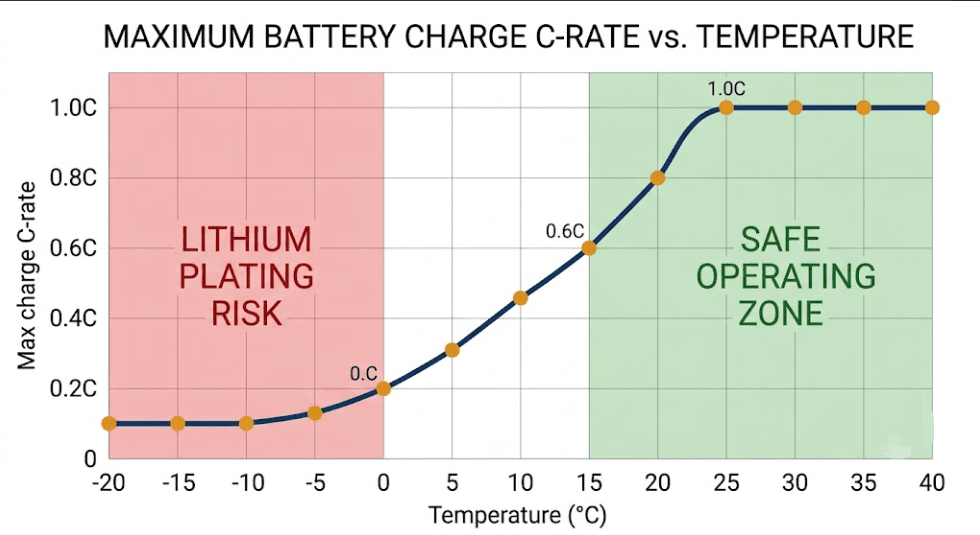
A. How Cell Chemistry Determines Maximum BESS C-Rate
Standard LFP prismatic cells — the foundation of most commercial BESS — are engineered for energy density first. Their thick electrode coatings store more lithium per unit volume but slow ion migration, capping continuous discharge C-rate at 1C to 2C. Cells capable of 3C to 5C use thinner coatings, higher-porosity separators, and electrolyte additives that improve ionic conductivity. Each refinement adds manufacturing cost, which flows directly into system price.
| Chemistry | Full Name | Cont. Discharge C-Rate | Max Charge C-Rate | Cycle Life | Cell Cost ($/kWh) | Best BESS Use |
|---|---|---|---|---|---|---|
| LFP | Lithium Iron Phosphate | 0.5C – 2C | 0.3C – 1C | 3,000 – 6,000+ | $80–$120 | C&I, grid storage, solar — the commercial standard |
| NMC | Nickel Manganese Cobalt | 1C – 3C | 0.5C – 1.5C | 1,000 – 2,000 | $100–$150 | High-power BESS, EV charging buffers |
| NCA | Nickel Cobalt Aluminium | 1C – 3C | 0.5C – 1C | 500 – 1,500 | $110–$160 | EV traction, high energy-density applications |
| High-Power LFP | Power-optimised prismatic | 2C – 5C | 1C – 2C | 2,000 – 4,000 | $100–$140 | Demand response, fast-response grid services |
| LTO | Lithium Titanate Oxide | 5C – 10C | 5C – 10C | 10,000–20,000+ | $400–$600 | Rail, UPS, ultra-fast charging — not cost-viable for BESS |
B. How Cooling System Cost Scales With BESS C-Rate
Heat generation scales with the square of current (I²R). Doubling BESS C-rate from 1C to 2C therefore quadruples the thermal load on the cell stack. A BESS designed for 2C continuous operation requires a proportionally more capable cooling system. As a result, thermal management is often the largest single incremental cost driver between a 1C and 2C system.
| Cooling System | C-Rate Supported | Heat Removal | System Cost Premium | Typical BESS Application |
|---|---|---|---|---|
| Passive air (natural convection) | Up to 0.5C | Low | +0% (baseline) | Residential BESS, low-cycle backup |
| Forced air (fan cooling) | 0.5C – 1C | Moderate | +5–10% | C&I BESS, standard daily cycling |
| Air-conditioned HVAC enclosure | 1C – 1.5C | Good | +10–20% | Containerised grid BESS |
| Liquid cooling (glycol plates) | 1.5C – 3C | Excellent | +20–35% | High-power BESS, EV charging hub buffer |
| Direct liquid immersion | 3C – 10C burst | Superior | +40–60% | Ultra-fast charging, power-critical grid services |
C. Power Electronics and BMS Cost at Higher BESS C-Rate
The inverter and DC/DC converters must be rated for the peak current the battery delivers. A 2C inverter requires larger switching transistors, heavier copper busbars, and more sophisticated short-circuit protection than a 1C inverter of the same kWh capacity. The cost premium for power electronics typically runs at 15 to 30 per cent between a 1C and 2C BESS system.
The BMS also costs more at higher BESS C-rates. Millisecond-level cell sampling, faster protection relay actuation, and more detailed thermal runaway prediction algorithms are all required above 2C. None of these features are standard on entry-level BMS hardware, so they represent a real and quantifiable cost premium.
D. BESS C-Rate Price Tier Framework: From 0.25C to 10C
Combining chemistry, cooling, and power electronics, the following table maps each BESS C-rate tier to its indicative installed system cost and target application.
| C-Rate Tier | Chemistry | Installed Cost ($/kWh) | Peak Power (500 kWh system) | Target Application | What Drives the Price? |
|---|---|---|---|---|---|
| 0.25C–0.5CEnergy Tier | Standard LFP prismatic | $180–$260 | 125–250 kW | Solar arbitrage, long-duration storage, off-grid | Lowest-cost cells, passive/fan cooling, simple BMS and inverter |
| 0.5C–1CCommercial Standard | LFP prismatic | $220–$320 | 250–500 kW | C&I peak shaving, daily energy shifting, grid support | Standard market spec — most competitive $/kWh segment |
| 1C–2CPower Tier | High-power LFP or NMC | $300–$450 | 500 kW – 1 MW | Demand charge reduction, fast-response grid services | Costlier cells, liquid cooling, higher-rated inverter and BMS |
| 2C–5CHigh-Power | NMC cylindrical | $450–$700 | 1 MW – 2.5 MW | Frequency regulation, EV DC fast charging (150 kW+) | Specialist cells, advanced ms-level BMS, mandatory liquid cooling |
| 5C–10C+Ultra-High-Power | LTO or specialist NMC | $700–$1,500 | 2.5 MW – 5 MW | Ultra-fast EV (350 kW+), rail, aerospace | LTO chemistry premium, extreme cooling, custom power electronics |
| 💡 | The most important buyer insight on BESS C-rate and price: Do not compare BESS quotations on $/kWh alone. Always calculate $/kW = total installed cost ÷ peak power output (kW). A 0.5C BESS delivers only half the peak power of a 1C BESS at the same kWh. If your peak shaving application needs 500 kW for one hour, the 0.5C system will fail the dispatch event — making the cheaper quote the more expensive mistake. |
E. Same 500 kWh, Three BESS C-Rates, Three Very Different Prices
| BESS Profile | Capacity | C-Rate | Peak Power | Cooling | Est. Installed Cost | Designed For |
|---|---|---|---|---|---|---|
| Energy-type LFP(solar storage) | 500 kWh | 0.5C | 250 kW for 2 hrs | Fan / HVAC | ~$130,000 | Solar self-consumption, off-grid overnight, slow energy shifting |
| Standard commercial LFP(C&I peak shaving) | 500 kWh | 1C | 500 kW for 1 hr | HVAC | ~$175,000 | Daily peak shaving, demand charge control, grid-tied C&I |
| High-power LFP / NMC(EV charging buffer) | 500 kWh | 2C | 1,000 kW for 30 min | Liquid cooling | ~$250,000 | EV DC fast charging hub, grid frequency services, rapid response |
All three systems store exactly 500 kWh and all use lithium-ion technology. However, peak power output ranges from 250 kW to 1,000 kW — a factor of four. Installed cost, moreover, varies from $130,000 to $250,000. The BESS C-rate specification alone explains both of those differences entirely.
7. BESS C-Rate vs Power-to-Energy Ratio: Converting Duration to C-Rate
When EPCs and project developers discuss BESS sizing, they rarely say ‘1C’. Instead, they say ‘1-hour system’ or ‘4-hour battery’. These two languages describe the same thing from different angles — and converting between them is essential for accurate specification.
The power-to-energy ratio (P/E ratio) describes how much power (kW) a BESS delivers per unit of stored energy (kWh). A 1-hour system delivers its full energy in one hour — which is exactly a 1C BESS C-rate. As a result, duration and C-rate are mathematical inverses of each other.
| 📐 | BESS C-rate to duration conversion: C-Rate = 1 ÷ Duration (hours) | Duration (hours) = 1 ÷ C-Rate Examples: 0.5-hour system → 2C | 2C BESS C-rate → 0.5-hour duration 1-hour system → 1C | 1C BESS C-rate → 1-hour duration 2-hour system → 0.5C | 0.5C BESS C-rate → 2-hour duration 4-hour system → 0.25C | 0.25C BESS C-rate → 4-hour duration 8-hour system → 0.125C| 0.125C BESS C-rate → 8-hour duration |
| System Duration | Equivalent BESS C-Rate | Power-to-Energy Ratio (kW/kWh) | Typical Application | SEO Keyword Captured |
|---|---|---|---|---|
| 0.5-hour BESS | 2C | 2 kW per kWh | Fast-response frequency regulation, EV charging buffer | 0.5 hour battery storage, 2C BESS |
| 1-hour BESS | 1C | 1 kW per kWh | C&I peak shaving, demand charge reduction | 1 hour battery storage, 1C BESS |
| 2-hour BESS | 0.5C | 0.5 kW per kWh | C&I energy arbitrage, solar self-consumption | 2 hour battery storage, 2 hour BESS |
| 4-hour BESS | 0.25C | 0.25 kW per kWh | Grid energy arbitrage, utility time-shifting | 4 hour battery energy storage, 4 hour BESS |
| 8-hour BESS | 0.125C | 0.125 kW per kWh | Long-duration storage, island grid, overnight off-grid supply | 8 hour BESS, long duration energy storage |
| 10–12-hour BESS | 0.1C | 0.1 kW per kWh | Seasonal shifting, remote area power, hydrogen hybrid | long duration battery storage, 10 hour BESS |
This table is directly useful for RFP and tender documents. For example, when a grid operator specifies a 4-hour BESS at 100 MW, they are asking for 400 MWh of storage at 0.25C BESS C-rate. Similarly, when a C&I site asks for a 2-hour peak shaving BESS at 500 kW, they need 1 MWh at 0.5C.
| 📌 | When comparing BESS quotations, confirm both the energy (MWh) AND the power (MW or kW). The duration — which is the inverse of BESS C-rate — is the figure that ties them together. Example: ‘500 kWh BESS’ without a stated duration is an incomplete specification. 500 kWh at 1C = 500 kW for 1 hour. The same 500 kWh at 0.5C = 250 kW for 2 hours. Same energy, very different power — and a very different price. |
8. PCS Rating and BESS C-Rate: Why the Inverter Can Limit Your System Output
One of the most common and costly mistakes in BESS procurement is assuming that the battery’s C-rate alone determines maximum power output. In practice, this is not the case. The Power Conversion System (PCS) is the inverter or bidirectional converter that connects the battery to the AC grid. It also sets a hard ceiling on power. That ceiling can be significantly lower than the battery’s C-rate capability.
| ⚠️ | Classic BESS C-rate bottleneck example: Battery capacity: 1 MWh LFP Battery C-rate: 1C → capable of 1,000 kW (1 MW) PCS rating: 500 kW Actual system output: 500 kW (limited by PCS, not battery BESS C-rate) Effective C-rate: 0.5C (not 1C) The battery can run at 1C BESS C-rate. The system cannot. The PCS is the bottleneck. |
This situation arises when a developer uses an undersized inverter to reduce upfront cost, or when a site’s grid connection capacity limits the inverter size. In both cases, the battery is paying the price premium for a 1C BESS C-rate it cannot exercise in real operation. Additionally, whether you deploy grid-forming vs grid-following BESS inverters will dictate how the PCS handles these localized capacity constraints and dynamic grid response demands.
PCS Sizing Rules Matched to BESS C-Rate and Application
| Application | Recommended Duration | BESS C-Rate | Required PCS Rating | PCS Sizing Rule |
|---|---|---|---|---|
| Solar self-consumption | 2–4 hours | 0.25C–0.5C | 25–50% of battery kWh as kW | PCS ≥ Battery kWh × C-rate |
| C&I peak shaving | 1–2 hours | 0.5C–1C | 50–100% of battery kWh as kW | PCS must match peak shaving kW target |
| Demand charge reduction | 30–60 min | 1C–1.5C | 100–150% of battery kWh as kW | PCS sized to full 1C discharge power |
| Grid frequency regulation | 15–30 min | 2C–3C | 200–300% of battery kWh as kW | PCS and protection relays rated for peak current |
| EV fast charging buffer | 15–30 min | 2C–5C | 200–500% of battery kWh as kW | Both battery AND PCS must support full BESS C-rate |
The correct approach is to size the PCS first, matching it to the application’s power requirement. Then, size the battery to deliver that power for the required duration. Therefore, always start from the load, not from the battery specification.
- Step 1 — Define peak power (kW): what is the maximum power the system must deliver? This sets the PCS rating.
- Step 2 — Define duration (hours): how long must the system sustain that power? Combined with Step 1, this gives the energy requirement in kWh.
- Step 3 — Confirm BESS C-rate: divide peak power (kW) by total energy (kWh) to get the C-rate. Confirm the battery chemistry supports it.
- Step 4 — Verify PCS–battery match: the PCS kW rating must equal or exceed Battery (kWh) × Operating BESS C-rate. Navigating these technical boundaries is a core reason why establishing strong EPC + battery integrator partnerships in C&I energy early in the design phase prevents costly hardware mismatches.
| 📌 | PCS sizing shortcut for BESS C-rate verification: Required PCS rating (kW) = Battery capacity (kWh) × Operating BESS C-rate For a 500 kWh battery at 1C BESS C-rate: PCS ≥ 500 kW For a 500 kWh battery at 2C BESS C-rate: PCS ≥ 1,000 kW For a 500 kWh battery at 0.5C BESS C-rate: PCS ≥ 250 kW If the PCS is undersized, the effective BESS C-rate is: PCS (kW) ÷ Battery (kWh) |
9. Temperature and BESS C-Rate: How Cold Weather Derate Your System
Laboratory BESS C-rate specifications are measured at 25°C. Real-world BESS projects operate in temperatures ranging from -30°C in Nordic and Canadian sites to +45°C in Middle Eastern and Australian installations. Temperature directly affects both the charge C-rate and discharge C-rate that the BMS will permit — and the impact can be dramatic.
How Low Temperature Reduces Charge C-Rate in BESS
Cold temperatures reduce the ionic conductivity of the electrolyte and slow lithium diffusion within the graphite anode. As a result, lithium ions cannot intercalate into the anode fast enough to accommodate a standard charge rate. The excess lithium then plates onto the anode surface instead. This is the same lithium plating risk described in Section 2. However, it is now triggered at much lower charging currents. Modern BMS platforms address this through temperature-dependent charge derating, automatically reducing the charge C-rate as cell temperature falls.
| Cell Temperature | Max Charge BESS C-Rate (LFP) | Charge Time Impact | Lithium Plating Risk | BMS Action |
|---|---|---|---|---|
| Above 25°C | 0.5C–1C (full rated) | Standard (2–1 hour) | Low | Full charge current permitted |
| 15°C–25°C | 0.3C–0.5C | +20–40% longer | Low–moderate | Mild current reduction |
| 5°C–15°C | 0.2C–0.3C | +50–100% longer | Moderate | Significant derating applied |
| 0°C–5°C | 0.1C–0.2C | 5–10 hours | High | Strong derating; pre-heat recommended |
| -10°C–0°C | 0.05C or disabled | Charging impractical | Very high | BMS may disable charging entirely |
| Below -10°C | Charging disabled | Not permitted | Severe | Cell heating required before charge |
How Temperature Affects BESS Discharge C-Rate
Discharge is less temperature-sensitive than charging because the electrochemical reactions are thermodynamically favoured during discharge. However, cold temperatures do increase internal cell resistance. Consequently, available power decreases and effective capacity falls. For example, a 100 Ah LFP cell rated at 1C discharge and 25°C may only safely sustain 0.7C at 0°C. Beyond that point, terminal voltage drops below the BMS cutoff threshold.
| Cell Temperature | Discharge BESS C-Rate Available | Capacity Available (%) | Notes |
|---|---|---|---|
| Above 25°C | Full rated (0.5C–2C) | 100% | Full performance. Monitor for overheating at 2C+. |
| 10°C–25°C | Full rated | 95–100% | Negligible impact for most commercial BESS. |
| 0°C–10°C | ~80% of rated | 85–95% | Mild derating. Pre-heat recommended for 2C BESS systems. |
| -10°C–0°C | ~60% of rated | 70–85% | Noticeable power and capacity reduction. |
| Below -20°C | ~40% of rated | 50–70% | Significant derating. Active heating system essential. |
Cold-Weather BESS Design: Four Strategies to Protect C-Rate Performance
- Insulated enclosures: containerised BESS in cold climates should use insulated steel enclosures with low-wattage heating elements to maintain cell temperature above 5°C during idle periods.
- Battery heating mats: direct cell-level heating pads activate when temperature falls below 5–10°C. The BMS controls this automatically. As a result, the system can recharge at its rated BESS C-rate even in sub-zero ambient conditions.
- Thermal buffer in C-rate spec: for projects in cold climates, specify the BESS C-rate at 10°C rather than 25°C. This gives a realistic worst-case recharge window. It also prevents dispatch planning errors.
- Liquid thermal management: Liquid-cooled systems with a heat pump can both cool cells in summer and heat them in winter. For sites with a wide temperature range, this is the most capable engineering solution.
| 💡 | Cold-climate BESS C-rate project rule: Always request the manufacturer’s charge derating curve from -20°C to +40°C. Size the recharge window based on the minimum expected cell temperature, not the standard 25°C BESS C-rate specification. A system with a 2-hour recharge at 25°C may need 5+ hours at 5°C. If the site has two peak events per day, this gap can cause missed dispatch. |
Deploying these climate control and thermal safety measures ensures your system remains compliant with international risk management protocols. For a complete breakdown of these compliance requirements, check our guide to the IEC 62933-5 safety standards for ESS frameworks.
10. BESS C-Rate and Battery Warranty: What Manufacturers Actually Guarantee
Battery warranties are frequently misread by buyers. Most manufacturers do not simply warrant a number of years or a number of cycles in isolation. Instead, they warrant a specific combination of cycles, throughput, depth of discharge, operating temperature — and BESS C-rate. Operate outside the warranted C-rate and the warranty may be void, even if every other parameter is within limits.
How BESS C-Rate Appears in the Three Main Warranty Structures
- Cycle-based warranty: warrants a number of full charge/discharge cycles (e.g. 4,000 cycles to 80% SoH). The warranted cycle count is stated at a specific BESS C-rate and depth of discharge (DoD). For example: ‘4,000 cycles at 1C / 80% DoD / 25°C’. Operating at 2C BESS C-rate and 80% DoD may reduce the warranted cycle count to 2,500.
- Throughput-based warranty: warrants a total energy throughput in MWh (e.g. 3,000 MWh per MWh of installed capacity). This approach is nominally BESS C-rate-agnostic, but manufacturers typically include a maximum continuous C-rate clause that, if exceeded, voids the throughput warranty.
- Calendar-based warranty: warrants a minimum SoH at a future date (e.g. 70% capacity retention after 10 years). Calendar warranties almost always include an operating envelope — BESS C-rate, temperature, DoD — that defines the conditions under which the warranty applies.
| Warranty Type | Typical BESS C-Rate Condition | What Changes If C-Rate Limit Is Exceeded | What to Ask the Supplier |
|---|---|---|---|
| Cycle-based | 1C charge / 1C or 2C discharge at 25°C, 80% DoD | Warranted cycle count reduces; some manufacturers publish a BESS C-rate adjustment table | Request cycle-life curve at your operating C-rate and DoD |
| Throughput-based | Max continuous BESS C-rate clause (e.g. 1C or 2C) | Throughput warranty voided if max C-rate exceeded | Confirm the maximum C-rate clause and whether burst C-rate is treated differently |
| Calendar-based | Operating envelope includes BESS C-rate, temp, DoD | Warranty void if operating envelope breached | Request the full BESS C-rate operating envelope in the warranty document — not just the summary term sheet |
| ⚠️ | Real BESS C-rate warranty example (illustrative): Supplier warranty states: ‘6,000 cycles to 80% capacity retention at 0.5C charge / 0.5C discharge / 80% DoD / 25°C’ Your project operates at: 0.5C charge / 2C discharge / 80% DoD / 25°C Warranted cycles at 2C BESS C-rate may be only 3,000–4,000 — half the headline figure. Consequently, always request the C-rate adjustment table before signing. |
BESS C-Rate Warranty Checklist: Five Questions to Ask
- Request the cycle-life warranty condition in full — BESS C-rate, DoD, temperature, and SoH end-point.
- Ask for a cycle-life vs BESS C-rate adjustment table: how does the warranted cycle count change at your operating rate?
- Confirm whether burst BESS C-rate events (e.g. 2C for 30 seconds) are counted differently from continuous C-rate.
- Verify that the PCS-enforced maximum C-rate matches the warranty’s maximum BESS C-rate clause — any gap is a warranty risk. Ensure these limits map structurally to the battery cell’s factory compliance standards, as outlined in our overview of IEC certifications for BESS, which dictate the thermal and current boundaries manufacturers are legally allowed to warrant.
- For throughput warranties, calculate total expected throughput over the project life and confirm it falls within the warranted limit at your operating C-rate.
Tracking these complex lifetime metrics is becoming highly standardized across the industry. To see how manufacturers are beginning to openly disclose this operational data, see our guide on how the battery passport drives transparency in the energy transition by providing immutable health and C-rate logs.
11. Real Utility-Scale BESS C-Rate Examples: Three Grid Project Profiles
The BESS C-rate concepts in this guide apply across all system scales — from a 50 kWh rooftop unit to a 400 MWh grid project. Reflecting utility deployment patterns tracks in the IEA battery storage report, the three utility-scale examples below show how BESS C-rate, duration, PCS rating, and application interconnect in real project structures.
Example 1 — 100 MW / 400 MWh Grid BESS at 0.25C C-Rate: 4-Hour Energy Arbitrage
| 🏭 | Project profile: Capacity: 400 MWh LFP | Power: 100 MW | Duration: 4 hours BESS C-rate: 0.25C (100 MW ÷ 400 MWh) | P/E Ratio: 0.25 kW per kWh Operation: Charges overnight at 0.125C–0.25C BESS C-rate (off-peak wholesale tariff) Discharges 08:00–12:00 at 0.25C (morning peak tariff window) Cycle target: 1 full cycle per day × 365 days × 20-year project life Why 0.25C BESS C-rate? 4-hour discharge maximises revenue capture across the full morning peak. Lower BESS C-rate reduces cell degradation and minimises thermal management cost. At this scale, 0.25C is the dominant grid arbitrage BESS specification globally. |
Example 2 — 50 MW / 100 MWh Frequency Regulation BESS at 0.5C C-Rate
| ⚡ | Project profile: Capacity: 100 MWh LFP Power: 50 MW Duration: 2 hours (nominal) C-Rate: 0.5C (50 MW ÷ 100 MWh) P/E Ratio: 0.5 kW per kWh Operation: Participates in Frequency Containment Reserve (FCR) or equivalent market. Injects or absorbs up to 50 MW in response to frequency deviations. Actual average C-rate in operation: ~0.1C–0.2C (short bursts, not full cycles). Nominally sized at 0.5C to maintain full power availability throughout the day. Why 0.5C? The 2-hour energy buffer ensures the system can sustain a prolonged frequency event without exhausting its state of charge. The PCS is sized for 50 MW regardless of how often it is called to respond. |
Example 3 — 20 MW / 20 MWh Fast-Response BESS at 1C C-Rate: 1-Hour Duration
| 🔋 | Project profile: Capacity: 20 MWh LFP Power: 20 MW Duration: 1 hour C-Rate: 1C (20 MW ÷ 20 MWh) P/E Ratio: 1 kW per kWh Operation: Paired with a large solar farm for curtailment avoidance and grid services. Discharges at up to 1C during grid frequency events or export constraint windows. An automated energy management system (EMS) for BESS orchestrates this dispatch logic, safely recharging the battery at 0.5C from solar generation within a 2-hour window. Why 1C? 1-hour BESS is the standard grid services configuration: full power for 60 minutes covers most frequency regulation and peak shaving events. 1C is LFP’s commercial sweet spot — maximum performance, competitive price. |
| Project | Capacity | Power | Duration | C-Rate | Chemistry | Primary Application |
|---|---|---|---|---|---|---|
| Grid arbitrage BESS | 400 MWh | 100 MW | 4 hours | 0.25C | LFP prismatic | Wholesale energy arbitrage, time-shifting |
| Frequency regulation BESS | 100 MWh | 50 MW | 2 hours | 0.5C | LFP prismatic | FCR / FFR grid ancillary services |
| Fast-response solar BESS | 20 MWh | 20 MW | 1 hour | 1C | LFP prismatic | Grid services, curtailment avoidance |
12. Battery Chemistry Comparison: C-Rate, Charge, Discharge and Emerging Options
The chemistry table in Section 6 covered the main commercial options. This expanded version adds sodium-ion — an emerging chemistry entering the BESS market — and separates typical charge and discharge C-rates for direct comparison.
| Chemistry | Typical Charge C-Rate | Typical Discharge C-Rate | Cycle Life | Energy Density | Cell Cost ($/kWh) | BESS Suitability | Status |
|---|---|---|---|---|---|---|---|
| LFP (LiFePO4) | 0.3C–1C | 0.5C–2C | 3,000–6,000+ | Low–medium | $80–$120 | Excellent — commercial standard for all BESS | Mature, dominant |
| NMC (LiNiMnCoO2) | 0.5C–1.5C | 1C–3C | 1,000–2,000 | High | $100–$150 | Good — high-power BESS, EV charging buffers | Mature |
| NCA (LiNiCoAlO2) | 0.5C–1C | 1C–3C | 500–1,500 | Very high | $110–$160 | Moderate — mainly EV; cost and safety limit BESS use | Mature |
| LTO (Li4Ti5O12) | 5C–10C | 5C–10C+ | 10,000–20,000 | Very low | $400–$600 | Niche — ultra-fast charging, rail; too costly for BESS | Niche, high cost |
| High-Power LFP (prismatic) | 1C–2C | 2C–5C | 2,000–4,000 | Medium | $100–$140 | Good — demand response, fast-response grid services | Growing |
| Sodium-Ion (Na-ion) | 0.5C–2C | 1C–4C | 2,000–4,000 | Low–medium | $60–$90* | Promising — emerging competitor to LFP in grid storage | Emerging (2024–) |
| 📌 | Sodium-Ion (Na-ion) — what to know for BESS procurement: Sodium-ion batteries use sodium instead of lithium as the charge carrier. Key advantages: no cobalt, no lithium, lower raw material cost, better low-temperature performance. Current limitations: lower energy density than LFP (~20–30% less); limited commercial track record. CATL and BYD have both announced sodium-ion cells for stationary storage. Typical charge C-rate: 0.5C–2C. Typical discharge: 1C–4C. Low-temperature performance is notably better than LFP — may suit cold-climate projects. * Current Na-ion cell cost structures reflect ongoing 2026 early commercial production volumes. These baseline figures are projected to compress further as gigafactory manufacturing scales and supply chains mature. |
13. BESS C-Rate Decision Matrix: Matching Application to Specification
Use this matrix as a starting point for any BESS specification. Find your primary application, read across to the recommended C-rate, chemistry, cooling type, and indicative installed cost range.
| Application | Recommended C-Rate | Duration | Chemistry | Cooling | PCS/kWh Ratio | Indicative Installed Cost |
|---|---|---|---|---|---|---|
| Solar self-consumption | 0.25C–0.5C | 2–4 hours | Standard LFP | Passive / fan | 0.25–0.5 kW/kWh | $180–$260/kWh |
| Energy arbitrage (off-peak) | 0.5C | 2 hours | Standard LFP | Fan / HVAC | 0.5 kW/kWh | $220–$280/kWh |
| Peak shaving (C&I) | 1C | 1 hour | LFP prismatic | HVAC | 1 kW/kWh | $250–$320/kWh |
| Demand charge reduction | 1C–1.5C | 40–60 min | LFP prismatic | HVAC | 1–1.5 kW/kWh | $270–$350/kWh |
| Frequency regulation | 1C–2C | 30–60 min | LFP / NMC | HVAC / liquid | 1–2 kW/kWh | $300–$450/kWh |
| Island / off-grid grid | 0.125C–0.5C | 2–8 hours | Standard LFP | Fan / HVAC | 0.125–0.5 kW/kWh | $200–$300/kWh |
| EV charging buffer | 2C–5C | 15–30 min | High-power LFP/NMC | Liquid cooling | 2–5 kW/kWh | $380–$700/kWh |
| Ultra-fast EV charging | 5C–10C | 6–15 min | NMC / LTO | Liquid / immersion | 5–10 kW/kWh | $700–$1,500/kWh |
14. Five Common C-Rate Specification Mistakes — and How to Avoid Them
While capturing the advantages of a battery energy storage system (BESS) can dramatically improve a project’s ROI, design errors during procurement can quickly erase those gains. These five errors appear repeatedly in BESS engineering and EPC tendering, but each is entirely preventable with the knowledge in this guide.
Mistake 1: Specifying a 2C C-Rate When 0.5C Is Sufficient
This is the most expensive and most common mistake. A developer specifying a 2-hour peak shaving system asks for a ‘2C BESS’ when the application actually requires 0.5C. As a result, the system costs 60–80% more than necessary. It also uses liquid cooling the application never demands, and it is built with high-power cells whose extra capability is never exercised. Therefore, always derive C-rate from duration: if you need 2 hours of discharge, you need 0.5C, not 2C.
Mistake 2: Ignoring Charge C-Rate When Planning Dispatch
A BESS specified for 1C discharge is typically limited to 0.5C charge. Yet dispatch schedules are frequently planned around the discharge rate alone. Consequently, the system cannot recharge in time for a second peak event, because the 2-hour recharge window was never accounted for. To avoid this, always plan dispatch around the slower of charge and discharge C-rates.
Mistake 3: Ignoring Temperature Derating on Charge C-Rate
Cold-climate projects often specify a 0.5C charge rate at 25°C. However, the same system may only charge at 0.2C at 5°C, tripling the recharge time. This affects both daily dispatch planning and revenue model accuracy. For this reason, always request the charge derating curve for the minimum expected ambient temperature at the project site.
Mistake 4: Comparing BESS C-Rate Quotations on $/kWh Alone
A 500 kWh system at $220/kWh and a 500 kWh system at $320/kWh look like a simple $50,000 saving in favour of the cheaper option. But the $220/kWh system may be rated at 0.5C, while the $320/kWh system is rated at 1C. In that case, the cheaper system delivers only 250 kW. The more expensive system, meanwhile, delivers 500 kW. For a peak shaving application requiring 500 kW, the cheaper system simply cannot do the job. Always compare $/kW alongside $/kWh.
Mistake 5: Forgetting PCS Limitations on BESS C-Rate
A 1 MWh battery with a 1C rating is technically capable of 1 MW output. But if the PCS is rated at only 500 kW, the system is effectively a 0.5C system, regardless of the battery’s rating. Therefore, confirm that the PCS kW rating is equal to or greater than the battery capacity (kWh) multiplied by the required operating C-rate. This check takes only 30 seconds. Yet it can save months of project rework.
| 📌 | Quick specification health-check: 1. C-Rate = Duration inverse? Duration 2 hours → 0.5C ✓ 2. PCS ≥ Battery (kWh) × C-Rate? 500 kWh × 1C = 500 kW PCS minimum ✓ 3. Charge C-rate in dispatch plan? 0.5C charge = 2 hr recharge window ✓ 4. Warranty states C-rate condition? Confirm cycle count at operating C-rate ✓ 5. Temperature derating requested? Get charge curve from -10°C to +40°C ✓ |
15. C-Rate Procurement Checklist: Eight Questions to Ask Every Supplier
Before signing any BESS supply agreement, confirm the following C-rate parameters in writing:
- 1. Rated continuous C-rate: maximum C-rate the system sustains indefinitely without thermal or SoH risk. Confirm for both charge and discharge independently.
- 2. Peak C-rate and burst duration: maximum C-rate for short bursts (typically 10–30 seconds). Confirm the burst duration before BMS curtailment activates.
- 3. Capacity derating curve: how much kWh does the system actually deliver at your operating C-rate — not just at the 1C nameplate condition?
- 4. Cycle life at operating C-rate: request the cycle-life warranty condition (C-rate, DoD, temperature) and a C-rate adjustment table in writing.
- 5. Charge derating curve vs temperature: request the charge C-rate curve from the minimum expected site temperature to +40°C.
- 6. PCS–battery C-rate match: confirm the PCS kW rating equals or exceeds Battery (kWh) × Operating C-rate.
- 7. Thermal management design C-rate: confirm the cooling system is sized for your intended C-rate, not nominal conditions.
- 8. Warranty C-rate operating envelope: request the full warranty operating envelope and confirm your project’s C-rate falls within the warranted range.
16. Frequently Asked Questions: BESS C-Rate
What is a good C-rate for a BESS?
For most commercial and industrial BESS applications, 0.5C to 1C is the optimal range. A 0.5C system (2-hour duration) suits solar self-consumption and energy arbitrage. A 1C system (1-hour duration) is the standard for peak shaving and demand charge reduction. Higher C-rates are only justified for grid frequency regulation (1C–2C) or EV fast charging buffers (2C–5C).
Is a higher C-rate always better?
No. A higher C-rate means higher peak power output — but it also means higher system cost, faster cell degradation, and greater thermal management requirements. Specifying a higher C-rate than your application requires wastes capital and shortens battery life. Match the C-rate to the application, not to the maximum available specification.
What C-rate is used for peak shaving?
Peak shaving typically uses a 1C discharge rate, which delivers full rated power for one hour. Sites with sharp, short demand spikes may specify 1.5C for a 40-minute discharge window. Sites with longer, flatter demand peaks may use 0.5C for a 2-hour window. The correct C-rate depends on the duration and shape of the demand event, not a single standard answer.
What C-rate is used for solar energy storage?
Solar self-consumption BESS typically operates at 0.25C to 0.5C — discharging over 2 to 4 hours through the evening peak. This slow discharge maximises the energy extracted per cycle, minimises heat generation, and extends cycle life. LFP cells at 0.5C can sustain over 6,000 – 8,000 cycles — enough for 16+ years of daily operation at 80% depth of discharge.
How does C-rate affect battery lifespan?
Higher C-rates accelerate three degradation mechanisms. These are electrolyte oxidation from heat (I²R), mechanical stress from rapid lithium intercalation, and SEI layer growth from elevated temperatures. For the full mechanism behind that mechanical stress — including why deep discharge and high C-rate damage electrode particles through different pathways — see our guide on Why Deep Discharge and High C-Rate Stress LFP Cells. As a result, a battery cycled at 2C will typically reach 80% SoH in only 2,000–3,000 cycles. The same battery at 0.5C, however, may sustain 5,000–6,000 cycles. Overall, operating at or below 1C is the single most effective way to extend LFP battery life.
What Is the Difference Between a 0.5C and 1C BESS C-Rate?
A 0.5C system takes twice as long to discharge as a 1C system. For a 500 kWh battery, 0.5C delivers 250 kW for 2 hours, while 1C delivers 500 kW for 1 hour. Both deliver the same total energy of 500 kWh. However, the 1C system delivers it at twice the power. Consequently, a 1C system costs roughly 20–40% more than a 0.5C system of the same kWh capacity. This premium reflects higher-rated power electronics and more capable thermal management.
Does a higher C-rate increase battery cost?
Yes, and the increase is significant. Every major cost component scales with C-rate. Cell chemistry costs more for higher-power cells. Thermal management shifts from air to liquid cooling above 1.5C. The inverter and PCS need larger transistors and busbars for higher current. The BMS also needs faster sampling and protection. Overall, a 2C system typically costs 50–80% more per kWh than a 0.5C system of identical capacity.
What C-rate is common in utility-scale BESS?
Utility-scale BESS varies widely by application. Grid arbitrage projects, which are typically 4-hour systems, operate at 0.25C. Frequency regulation projects, usually 2-hour systems, operate at 0.5C. Meanwhile, grid services BESS paired with solar farms commonly use 1C. In 2024–2025, the dominant global configuration is 2-hour to 4-hour LFP at 0.25C to 0.5C. This trend is largely driven by the falling cost of large-format LFP prismatic cells.
Conclusion: Getting BESS C-Rate Right From the Start
BESS C-rate is not a secondary datasheet figure. Instead, it is the specification that determines how much power your system delivers, how quickly it recharges, and how long the cells last. Directly, it also determines how much the system costs. Furthermore, it connects to the duration language EPCs use, such as 1-hour or 4-hour systems. It links to the PCS sizing your electrical engineer specifies. It links, too, to the warranty conditions your finance team relies on. Finally, it links to the temperature performance your operations team will encounter on site.
For LFP BESS in commercial and grid-scale applications, the 0.5C to 2C range covers the vast majority of real-world deployments. Before selecting a chemistry, a PCS, or a cooling system, map your application to the correct C-rate tier first. This single step is the highest-value part of the procurement process.
Need help sizing a BESS to the right C-rate for your load profile and grid requirements? Contact SunLith Energy to speak with a storage engineer.
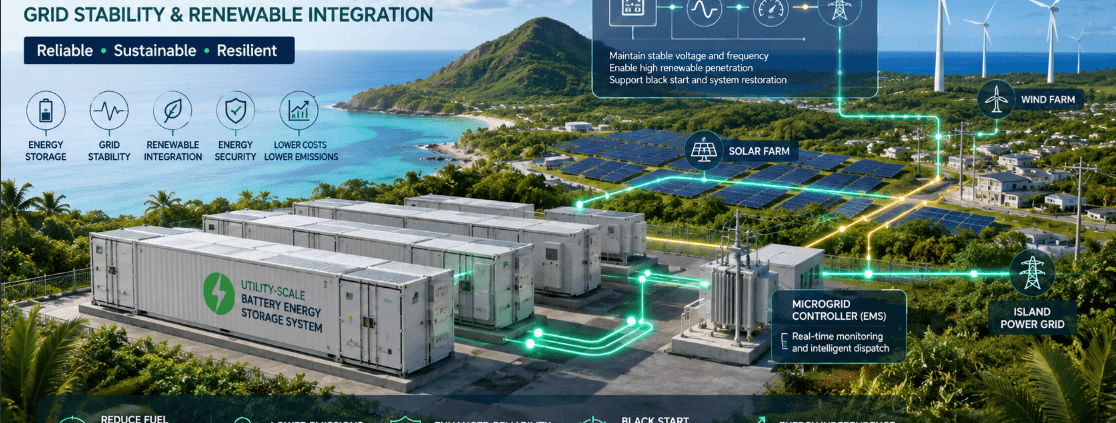
Island Grid BESS: Full Engineering Guide 2026 (Design & Sizing)
Deploying an Island Grid BESS is the definitive technology fixing one of the most overlooked power problems in the world. More than 10,000 inhabited islands still run on diesel generators. Add remote mining camps, offshore platforms, and rural areas with no grid access — and the scale of the challenge becomes clear.
All of these locations share the same problem. They need a stable, reliable grid, but they have no utility to rely on. For decades, diesel was the only answer. Today, in 2026, Island Grid BESS is replacing diesel as the backbone technology. It does so faster, more reliably, and at a lower lifetime cost.
This guide covers everything you need. It explains how Island Grid BESS works and how it differs from standard storage. It also shows you how to size a system, which control architecture to pick, and how to build a strong financial case.
📌 QUICK DEFINITION
What is Island Grid BESS?
Island Grid BESS is a Battery Energy Storage System that acts as the main voltage and frequency source on an isolated network. It has no connection to a utility grid. Unlike a grid-connected BESS that follows an existing grid signal, an Island Grid BESS creates the grid itself. It keeps power stable for all loads using stored energy, renewables, or both.
Table of Contents
- 01 — Why Island Grids Are a Different Engineering Problem
- 02 — Island Grid BESS vs Grid-Connected BESS: Core Differences
- 03 — The Four Critical Functions of Island Grid BESS
- 04 — Control Architecture: Why Island Grids Need Grid-Forming BESS
- 05 — Island Grid BESS Sizing: A Four-Step Method
- 06 — Battery Chemistry: Why LFP Dominates Island Grid BESS in 2026
- 07 — Solar-Plus-BESS Island Grid Architecture
- 08 — Wind-Plus-BESS Island Grid Architecture
- 09 — Diesel Hybrid Island Grids: The Three-Phase Transition Path
- 10 — Real-World Island Grid BESS Case Studies
- 11 — Island Grid BESS Sizing Reference Table
- 12 — Financial Case: Island Grid BESS vs Diesel Over 25 Years
- 13 — Key Technical Challenges and Practical Solutions
- 14 — Frequently Asked Questions
- What is Island Grid BESS and how does it differ from standard BESS?
- Can a grid-following BESS be used on an island grid?
- How many hours of storage does an Island Grid BESS need?
- What battery chemistry is best for Island Grid BESS?
- How does Island Grid BESS handle a complete power failure?
- Can renewable energy cover 100% of an island's power needs with Island Grid BESS?
- What does an Island Grid BESS project typically cost?
- 15 — Related Articles on SunLith Energy
- External References
01 — Why Island Grids Are a Different Engineering Problem
A standard grid-connected BESS has a utility grid behind it as backup. If renewable generation drops or demand spikes, the utility absorbs the imbalance. Frequency and voltage stay stable because thousands of generators share the load.
Island grids, however, have none of that.
No Backup, No Room for Error
On an island grid, every watt consumed must be generated or discharged locally. There is no utility to fill the gap. When a cloud shadow crosses a solar array, the BESS must respond in milliseconds. When a pump starts, the island grid must match that load instantly.
This is why Island Grid BESS is a different engineering discipline. The physics are harder. The control requirements are stricter. Also, the cost of failure is much higher — a blackout means the entire island or facility loses power.
The Good News: The Technology Has Matured Fast
Despite those challenges, Island Grid BESS technology has improved a great deal since 2022. Systems now running on remote islands in Australia, the Pacific, and Scandinavia are hitting 99.98% availability. That figure is better than the diesel generators they replaced.

02 — Island Grid BESS vs Grid-Connected BESS: Core Differences
The difference between these two systems matters greatly for engineering and procurement. The table below shows the ten most important distinctions.
| Dimension | Grid-Connected BESS | Island Grid BESS |
|---|---|---|
| Voltage reference | Utility grid provides it | BESS creates it internally |
| Inverter control mode | Grid-following (GFL) | Grid-forming (GFM) required |
| Frequency regulation | Supports grid frequency | IS the frequency — no backup |
| Black start | Not typically required | Mandatory |
| Fault current | Utility provides it | BESS must supply it |
| Spinning reserve | Not required | Required at all times |
| Load sensitivity | Low — utility absorbs swings | High — every load step must be matched |
| Renewable integration | Flexible | Precise EMS essential |
| Comms loss tolerance | High | Low — latency affects stability |
| Design complexity | Moderate | High — full power system design needed |
In short: a grid-connected BESS follows the grid. An Island Grid BESS is the grid.
For the full breakdown of inverter control modes, see our guide to grid-forming vs grid-following BESS.
03 — The Four Critical Functions of Island Grid BESS
A well-designed Island Grid BESS must carry out four functions at the same time. These are not extras — they are core requirements.
Function 1 — Voltage and Frequency Formation
The BESS inverter must create a stable AC voltage — typically 50 Hz or 60 Hz — with no external signal to copy. This is the grid-forming function. Without it, nothing on the island can run. That is why grid-forming BESS technology is the baseline spec for any Island Grid BESS project.
Function 2 — Real-Time Power Balance
At every moment, generation must equal consumption. When solar output falls due to cloud, the BESS must discharge the difference right away. When a load switches off, the BESS must absorb the surplus. Otherwise, frequency drifts and the grid becomes unstable.
Function 3 — Energy Shifting and Overnight Supply
Beyond second-by-second balancing, the BESS must also store enough energy to carry the island through long periods of zero generation. In a solar-only system, that means overnight. In a wind-heavy setup, it can mean multi-day low-wind periods. This need drives the MWh capacity spec — which is separate from the MW power spec.
Function 4 — Black Start and Grid Restoration
If the island grid goes down — due to a fault, a protection trip, or a battery shutdown — the BESS must restart the entire network with no outside help. This black start capability is a must-have for Island Grid BESS. A standard grid-following inverter cannot do it.
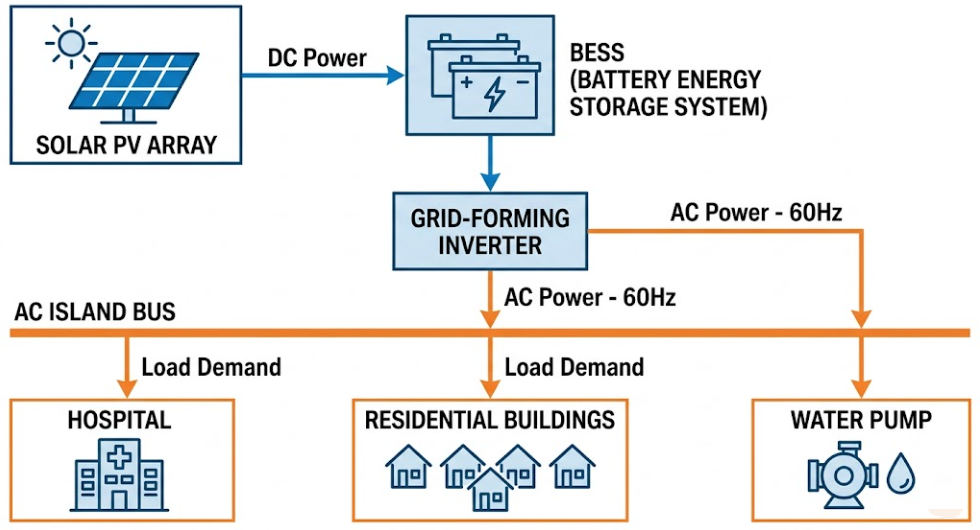
04 — Control Architecture: Why Island Grids Need Grid-Forming BESS
This is the area where most Island Grid BESS projects go wrong. The mistake often shows up late — at commissioning — and it is expensive to fix.
Why Grid-Following Inverters Fail Alone on an Island
A grid-following BESS uses a Phase-Locked Loop (PLL) to lock onto an existing grid voltage signal. If there is no grid signal — which is always the case at black start — the PLL has nothing to lock to. As a result, the inverter shuts down.
For a grid-connected project, this is fine. The utility is always there as a backup. For an Island Grid BESS, however, there is no utility. The battery is the only power source. So a grid-following inverter alone is not suitable.
Grid-Forming Control: The Right Architecture for Island BESS
A grid-forming inverter creates its own internal voltage and frequency reference. Everything else on the network — loads, other inverters, generators — then syncs to that reference. Because of this, it can:
- Black-start a fully de-energised island network
- Hold stable frequency with no external signal
- Respond to load steps in milliseconds — far faster than a PLL-based inverter
- Keep running during faults that would trip a grid-following inverter
Three Control Strategies: Which One to Specify?
Choosing the right strategy depends on your island’s size, renewable mix, and load profile. Here is how the three main options compare.
Droop Control is the simplest option. It mimics a generator’s governor — it adjusts power output in line with frequency changes. Droop control works well for smaller islands with stable loads and modest renewable penetration.
Virtual Synchronous Generator (VSG) goes further. It copies the inertial response of a real synchronous generator. It reacts to both frequency deviation and Rate of Change of Frequency (ROCOF). Because of this, it works best on islands with high renewable penetration, where frequency can shift fast. Moreover, it replicates the behaviour that protection systems were designed around when diesel was the primary source.
Power Synchronisation Control (PSC) is the most advanced option. Instead of using frequency as the sync signal, it uses active power. This makes it the most stable choice for very weak or very small island grids — especially where the Short Circuit Ratio (SCR) falls below 1.5.
For most Island Grid BESS projects, VSG mode is the best default. It mimics diesel generator behaviour closely, so commissioning and protection coordination are simpler.
05 — Island Grid BESS Sizing: A Four-Step Method
Sizing an Island Grid BESS involves two dimensions: power capacity (MW or kW) and energy duration (MWh or kWh). Getting either one wrong causes serious operational and financial problems down the line.
Step 1 — Establish Peak Load and Load Profile
First, the BESS must meet peak demand with room to spare. A standard design rule is to size BESS power at 120–130% of peak island load. That extra headroom is your spinning reserve — the buffer that stops frequency from collapsing when demand spikes.
Example: An island with 500 kW peak demand needs a BESS rated at 600–650 kW minimum.
Step 2 — Determine Energy Duration Requirements
Next, consider how long the BESS must run on stored energy alone. For a solar-only island, that is typically 10–14 hours overnight. For a mixed solar-wind island, it can stretch to 48–72 hours during low-generation periods.
Design rule: Size the BESS to carry 100% of average island load through the worst-case zero-generation window. Then add a 20% safety margin on top.
Worked example — solar-only island, 200 kW average load, 12-hour overnight period:
- Base energy: 200 kW × 12 h = 2,400 kWh
- Plus 20% margin: 2,400 × 1.2 = 2,880 kWh usable
- Adjusted for LFP 90% DoD: 2,880 ÷ 0.90 = 3,200 kWh nameplate
Step 3 — Define State of Charge Operating Bands
Unlike a grid-connected BESS, Island Grid BESS has no utility backup if the battery runs low. SoC management must therefore be strict:
- Minimum SoC: 20% — load shedding starts below this point
- Maximum SoC: 95% — renewable generation is curtailed above this level
- Normal cycling band: 20–95%
- Emergency reserve: Keep 10% SoC set aside exclusively for black-start restoration
Step 4 — Define Spinning Reserve Allocation
Finally, set your spinning reserve. This is the share of BESS capacity that stays ready but does not discharge. It must be large enough to cover the biggest single generation loss on the island without letting frequency fall below relay trip thresholds.
Rule of thumb: Spinning reserve ≥ the rated output of the largest single renewable unit on the island.
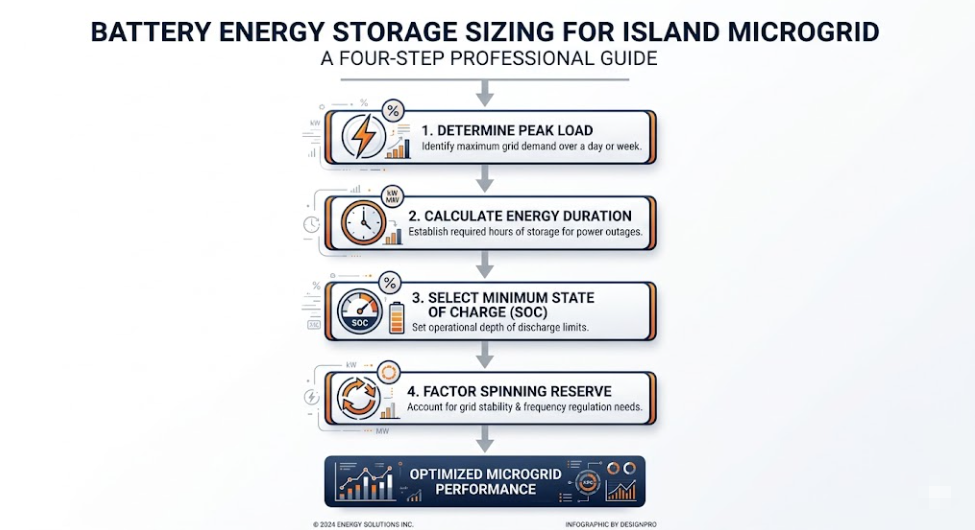
06 — Battery Chemistry: Why LFP Dominates Island Grid BESS in 2026
Battery chemistry for Island Grid BESS has largely settled on one answer. As of 2026, Lithium Iron Phosphate (LFP) accounts for about 95% of new island grid BESS procurement globally. That figure comes from BloombergNEF and IEA tracking data. The reasons make sense for island grid conditions specifically.
Why LFP Wins for Island Grid BESS
Thermal stability is the top reason. Many island grid sites sit in tropical climates where ambient temperatures exceed 40°C. LFP cells have a thermal runaway threshold of around 270°C. NMC cells, by contrast, run into trouble at 150–180°C. Furthermore, LFP releases far less heat if a cell does fail. In a remote location where fire response is slow, that difference is critical.
Cycle life is the second major factor. Island Grid BESS systems cycle daily, often deeply. LFP cells rated for 4,000–6,000 full cycles at 80% DoD give 10–15 years of service before capacity augmentation is needed. NMC degrades faster under the same conditions.
Cost per cycle has also shifted in LFP’s favour. LFP manufacturing capacity expanded a great deal between 2022 and 2025. As a result, prices dropped, and the per-cycle economics are now clearly better for high-cycle island grid use.
Simpler thermal management is a practical bonus. LFP is less sensitive to temperature than NMC. Therefore, the HVAC system can be simpler — an advantage on remote islands where air conditioning maintenance is hard to schedule.
The one exception: very space-constrained sites, such as offshore platforms, may justify NMC for its higher energy density per cubic metre. In all other island grid cases, however, LFP is the correct default.
07 — Solar-Plus-BESS Island Grid Architecture
Solar-plus-BESS is the most common Island Grid BESS setup. It also has the longest track record in the field. Solar PV replaces diesel as the primary energy source. The BESS then provides grid stability and overnight energy supply.
AC-Coupled vs DC-Coupled: Which Is Right for Your Project?
DC-coupled architecture links the solar array directly to the BESS DC bus via a charge controller. The solar array and battery share the same inverter. This approach captures energy before conversion losses. It also uses solar power that would otherwise be clipped and wasted. As a result, DC-coupled systems typically cut installed cost by 5–8% and improve overall round-trip efficiency.
AC-coupled architecture connects the solar inverter to the island AC bus. The BESS connects to the same bus through a separate inverter. This setup is more flexible. Existing diesel generators integrate more easily because they simply plug into the same AC bus. For this reason, AC-coupled is usually the better choice for retrofit projects.
In summary: use DC-coupled for greenfield Island Grid BESS projects with high solar penetration. Use AC-coupled when you are transitioning away from diesel and need to keep the generators running during the process.
Renewable Penetration Targets by Project Stage
| Renewable Penetration | BESS Configuration | Diesel Role |
|---|---|---|
| Up to 50% | BESS supports frequency; diesel is primary | Diesel runs continuously |
| 50–80% | BESS is primary; diesel backs up | Diesel starts on demand |
| 80–100% | BESS is sole grid-forming source | Diesel on emergency standby |
| 100% + storage | Full diesel replacement | Diesel removed or cold standby |
At 80–100% renewable penetration, grid-forming BESS technology becomes operationally essential. At that point, the diesel generator can no longer serve as the frequency reference.
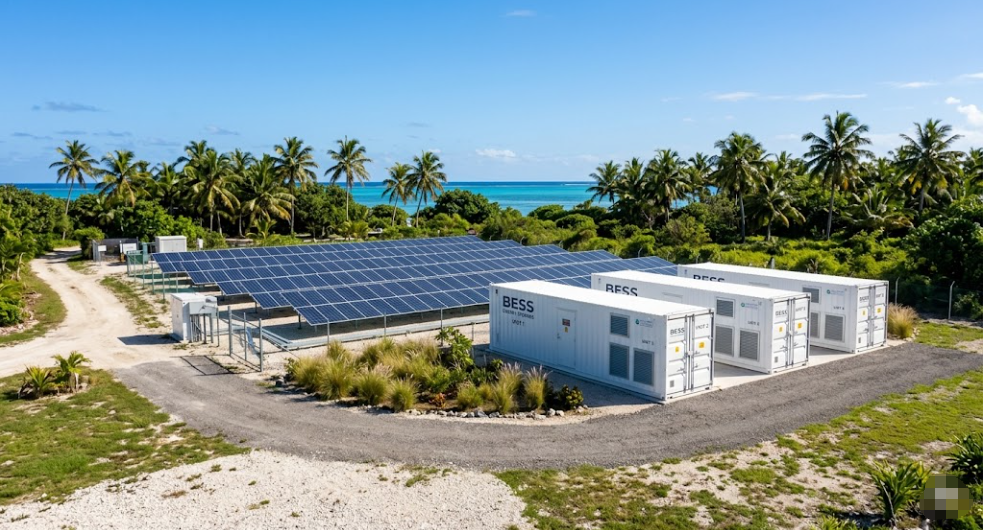
08 — Wind-Plus-BESS Island Grid Architecture
Wind-plus-BESS island grids work differently from solar setups. In many island locations, they also perform better. Wind is not limited to daylight hours. Moreover, many islands have steady trade winds that deliver higher annual capacity factors than solar PV.
Three Unique Challenges of Wind-Plus-BESS Island Grids
Rapid generation variability is the first challenge. Wind output can shift a great deal within seconds due to gusts or direction changes. Consequently, the BESS must respond faster to wind variability than it typically does to solar variability. Solar output changes more gradually, except during sudden cloud shadow events.
Frequency interaction with wind turbines is the second challenge. Modern variable-speed wind turbines use power electronics interfaces. This makes them inverter-based resources (IBR) — not rotating machines with physical inertia. Therefore, when every generation source on the island is IBR, the Island Grid BESS must provide all synthetic inertia on its own. That is a harder job than in systems where some diesel generation is still running.
Extended low-wind periods are the third challenge. Unlike solar droughts, which reset each morning, wind droughts can run for multiple days. As a result, energy duration sizing for wind-plus-BESS island grids must account for multi-day low-generation periods. This pushes BESS capacity much higher than in equivalent solar designs.
For more on how inverter-based resources interact with Island Grid BESS, see our guide on grid-forming BESS technology and the grid-forming vs grid-following BESS comparison.
09 — Diesel Hybrid Island Grids: The Three-Phase Transition Path
Most Island Grid BESS projects in 2026 are not greenfield builds. Rather, they are retrofits of existing diesel-dependent island grids. Understanding the three phases of transition is therefore essential for developers and asset owners.
Phase 1 — Diesel-Dominant with BESS Support (0–40% Renewable)
In this first phase, diesel generators still provide the voltage and frequency reference. The BESS operates in grid-following mode. It handles peak shaving, frequency regulation, and spinning reserve. As a result, diesel runtime drops, fuel costs fall, and maintenance intervals lengthen. This phase only needs a grid-following BESS. It is also the simplest and cheapest entry point.
Typical outcomes: 20–35% diesel fuel reduction; 30–40% fewer generator starts.
Phase 2 — Diesel-Backup with BESS Primary (40–80% Renewable)
In this second phase, solar or wind capacity grows. The BESS then takes over as the main generation source for larger parts of each day. Diesel generators shift from continuous running to demand-start mode. At this stage, the BESS inverter must also be able to switch into grid-forming mode whenever the diesel is offline. This requires either a grid-forming capable inverter or a static transfer switch.
Typical outcomes: 50–70% diesel fuel reduction; diesel-on to diesel-off transitions in under 10 seconds.
Phase 3 — Full Diesel Replacement (80–100% Renewable)
In this third and final phase, diesel generators move to emergency-only standby or are removed. The Island Grid BESS runs continuously as the sole grid-forming source. Before commercial operation, the system needs full grid-forming BESS specification and comprehensive black start testing.
Typical outcomes: 85–95% diesel fuel reduction; full energy independence with diesel as last-resort backup only.
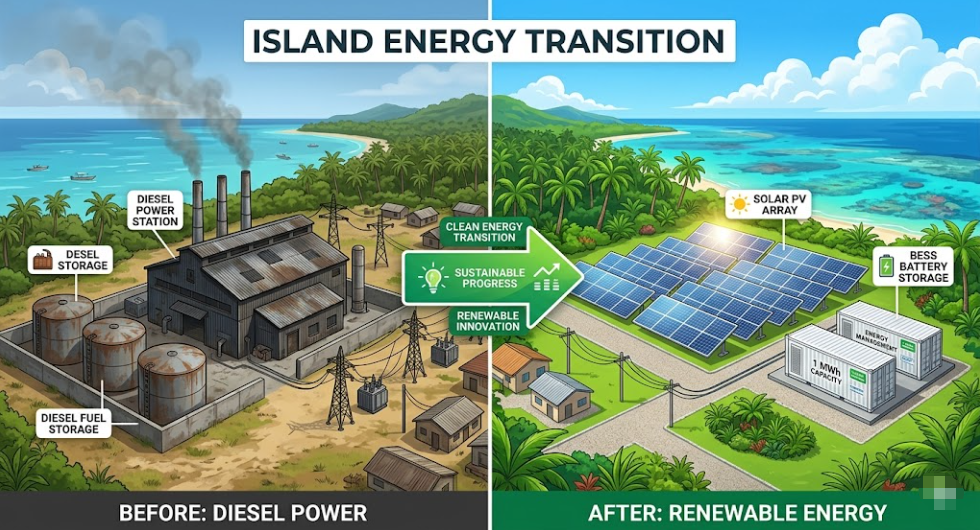
10 — Real-World Island Grid BESS Case Studies
Case Study 1 — El Hierro, Canary Islands (Spain)
El Hierro has run a wind-hydro-BESS hybrid island grid since 2014. Since then, it has steadily raised renewable penetration to above 90% for extended periods. The BESS absorbs wind variability and manages the link between turbines and pumped hydro storage. Peak demand on the island is about 7 MW. In short, El Hierro shows that 100% renewable island grids are viable at community scale.
Key results: Over 90% renewable penetration sustained over multiple consecutive days; diesel fuel use cut by more than 60%.
External reference: El Hierro Gorona del Viento — IRENA Case Study
Case Study 2 — Flinders Island, Australia
Flinders Island in Tasmania installed a solar-plus-BESS system that has cut diesel dependency sharply. The Island Grid BESS runs in grid-forming mode. Diesel generators have moved to demand-start backup. The Horizon Power-managed grid shows that grid-forming BESS can serve as the primary voltage and frequency source for a real remote community.
Key results: Diesel use down roughly 55%; Island Grid BESS availability above 99.5% since commissioning.
External reference: ARENA Australia — Grid-Forming Battery Revolution
Case Study 3 — Hospital Microgrid, Lombok (Indonesia)
Research published in Energy and Buildings (2025) modelled a PV-BESS microgrid for a hospital on Lombok Island. The study tested a 3-day outage scenario. A correctly sized Island Grid BESS — supplying 7 MWh per day of critical load — maintained 100% hospital reliability with no diesel. The findings highlight the life-critical value of Island Grid BESS beyond day-to-day economics.
Case Study 4 — Mining Operation, Western Australia
A remote mining site replaced three diesel gensets with a solar Island Grid BESS. The system uses VSG grid-forming control. Droop settings were calibrated to match the frequency response that the mining equipment’s protection relays were designed around. In year one, diesel use fell by 78%. By year two, after a solar expansion, diesel was phased out entirely.
11 — Island Grid BESS Sizing Reference Table
Use the table below as a starting point for project scoping. All figures assume LFP chemistry, 90% depth of discharge, 10% spinning reserve headroom, and a solar-plus-BESS setup with 12-hour overnight supply duration.
| Island Peak Load | Min BESS Power | Min BESS Energy | Typical Solar PV | Target Renewable % |
|---|---|---|---|---|
| 50 kW | 65 kW | 400 kWh | 80 kWp | 80% |
| 100 kW | 130 kW | 800 kWh | 150 kWp | 80% |
| 250 kW | 325 kW | 2,000 kWh | 380 kWp | 80% |
| 500 kW | 650 kW | 4,000 kWh | 750 kWp | 80% |
| 1 MW | 1.3 MW | 8 MWh | 1.5 MWp | 80% |
| 5 MW | 6.5 MW | 40 MWh | 7.5 MWp | 80% |
| 10 MW | 13 MW | 80 MWh | 15 MWp | 80% |
These are indicative scoping figures only. Final sizing must be based on measured load profiles, site-specific resource data, and full power systems modelling. Contact SunLith Energy for a project-specific Island Grid BESS analysis.
12 — Financial Case: Island Grid BESS vs Diesel Over 25 Years
The financial case for Island Grid BESS has shifted a great deal since 2022. LFP battery costs have fallen to $90–130/kWh installed in competitive markets. Meanwhile, diesel delivery costs to remote islands have risen — when you include logistics, shipping, and storage. Together, these trends make Island Grid BESS the economically dominant choice in almost every isolated grid context.
The Diesel Costs That Most Analyses Miss
Simple comparisons often undercount the true cost of diesel on island grids. A full cost assessment must include all of the following:
- Fuel logistics: Diesel price plus shipping, handling, and on-island storage
- Generator replacement: Diesel gensets need full replacement every 15,000–25,000 running hours
- Maintenance and travel: Regular servicing requires technicians to travel by air or sea to remote sites
- Environmental liability: Diesel storage creates spill risk, especially in ecologically sensitive island areas
- Carbon costs: Where carbon pricing applies, diesel grids face costs that grow each year
Why Island Grid BESS Wins on Lifetime Cost
Island Grid BESS offers several clear cost advantages over diesel. First, there is no ongoing fuel cost — solar and wind energy have zero marginal cost. Second, LFP BESS have no moving parts, so maintenance is far cheaper than for diesel generators. Third, modern LFP BESS are built for 20–25-year project life. Battery capacity augmentation at year 10–12 is the main lifecycle cost event. Finally, for islands weighing a submarine cable connection against Island Grid BESS, the battery solution is typically cheaper at scales below 10 MW peak demand.
Indicative 25-Year Cost Comparison: 500 kW Island Grid
| Cost Item | Diesel Island Grid | Solar + Island Grid BESS |
|---|---|---|
| Fuel cost per year (Year 1) | $350,000–500,000 | $0 |
| Annual maintenance | $80,000–120,000 | $15,000–25,000 |
| Capital replacement at Year 10 | $400,000–600,000 (gensets) | $150,000–250,000 (augmentation) |
| Carbon cost exposure | High and rising | None |
| 25-year NPV advantage | Baseline | $3–6 million in BESS’s favour |
These figures are indicative, based on 2026 market pricing. Site-specific financial modelling is required before any investment decision.
13 — Key Technical Challenges and Practical Solutions
Challenge 1 — Protection Coordination
Standard relay settings are built around the fault current that synchronous generators produce. Island Grid BESS inverters, however, typically produce lower fault currents — around 1.0–1.2 per-unit versus 5–10 per-unit for a generator. As a result, relay settings must be reconfigured to match the BESS fault current range.
Solution: Run a full protection coordination study before specifying relay settings. Some grid-forming BESS inverters now offer fault current up to 1.5–2.0 per-unit. That helps improve protection discrimination and simplifies the relay setup.
Challenge 2 — Large Load Steps on Small Island Grids
On a small Island Grid BESS under 500 kW, a single large motor — a pump, an air conditioner, a welding set — can represent a large share of total load. Each start is a sudden demand that the BESS must absorb without letting frequency collapse.
Solution: Specify VSG mode with tight droop settings and a low-pass filter on the load measurement. For large motors, add soft starters or variable frequency drives. These reduce inrush current sharply and make each load step manageable.
Challenge 3 — Battery Degradation in Hot Climates
Island Grid BESS sites in tropical areas face high ambient temperatures. Without good thermal management, LFP cell ageing speeds up significantly.
Solution: Use active thermal management to keep cells between 20–30°C. Do not rely on passive cooling alone in any tropical installation. Size the HVAC system for the worst-case ambient temperature — not the annual average.
Challenge 4 — Energy Management System Latency
On an island grid, the delay between a measured grid event and the BESS response directly affects frequency stability. Grid-connected BESS systems can tolerate 500–1,000 ms EMS response times. Island Grid BESS, however, needs inverter-level response within 20–50 ms. The EMS should only handle the slower strategic scheduling.
Solution: Specify inverter-integrated droop and VSG control that runs autonomously at the hardware level. The EMS then updates set-points on a scheduling cycle measured in minutes — not milliseconds.
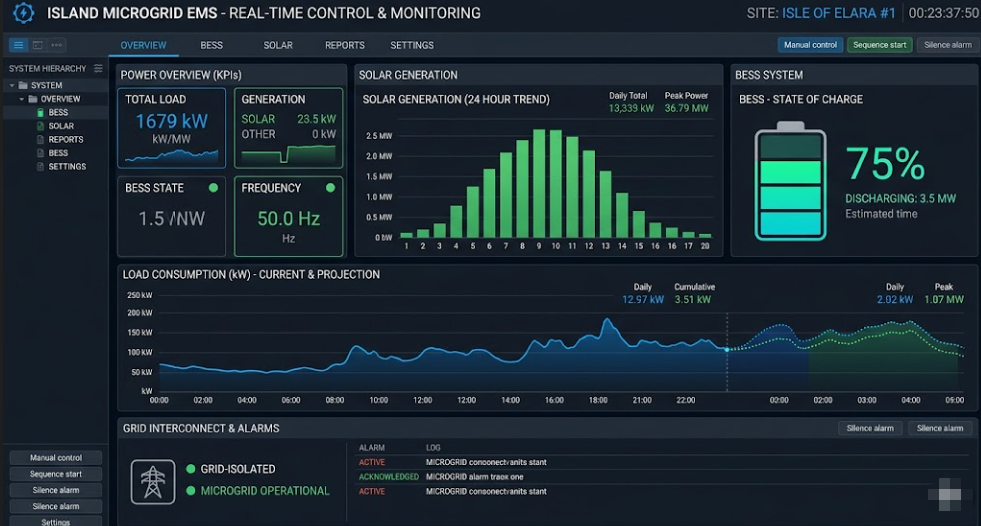
14 — Frequently Asked Questions
What is Island Grid BESS and how does it differ from standard BESS?
Island Grid BESS must act as the sole voltage and frequency reference on an isolated network. There is no utility grid as backup. This requires grid-forming inverter control, black start capability, and continuous power balance management. In contrast, a standard grid-connected BESS needs none of these. The engineering scope is therefore much broader. For the full inverter control comparison, see our guide on grid-forming vs grid-following BESS.
Can a grid-following BESS be used on an island grid?
Not as the sole power source. A grid-following inverter needs an existing voltage reference to operate. On an island grid with no diesel generator running, that reference does not exist. However, a grid-following BESS can participate in an island grid if a diesel generator or grid-forming BESS is already providing the reference voltage. For the full technical details, see our guide to grid-following BESS.
How many hours of storage does an Island Grid BESS need?
The minimum is typically 4 hours for a solar-heavy island with a strong, consistent solar resource. However, 8–16 hours is more common for reliable overnight supply. Furthermore, systems in high-latitude or wind-heavy locations may need 24–72 hours to cover extended low-generation periods. Sizing must always be based on site-specific load profiles and measured generation data.
What battery chemistry is best for Island Grid BESS?
LFP (Lithium Iron Phosphate) is the right choice for almost all Island Grid BESS projects in 2026. Its thermal stability, 4,000–8,000 cycle life, and safety profile make it clearly better than NMC for remote island sites where fire response and maintenance access are limited.
How does Island Grid BESS handle a complete power failure?
Through black start. A correctly specified grid-forming Island Grid BESS can energise the island AC network from a fully dead state using stored battery energy alone. The inverter creates a stable AC voltage and then reconnects loads in a controlled sequence — starting with critical loads first. Diesel generators, if retained, can then sync to the re-established BESS reference.
Can renewable energy cover 100% of an island’s power needs with Island Grid BESS?
Yes — and real-world projects already prove it. Island grids are operating at 90–100% renewable penetration today. However, the remaining challenge is cost. Storing enough energy to cover extended zero-generation periods requires a large BESS. For most islands, 80–90% renewable penetration is the economically optimal starting point. Full diesel elimination follows as storage costs continue to fall.
What does an Island Grid BESS project typically cost?
Turnkey 4-hour LFP Island Grid BESS systems were priced at about $180–260/kWh installed in European and Pacific markets in 2026. Therefore, a 500 kW / 4,000 kWh system represents a BESS capital cost of $720,000–$1,040,000, before solar, civil works, and EMS. In high diesel-cost island markets, payback typically falls within 5–8 years.
15 — Related Articles on SunLith Energy
The following SunLith Energy guides provide the deeper technical detail that supports Island Grid BESS design and procurement:
- Grid-Forming vs Grid-Following BESS: What Is the Difference? — The essential inverter control comparison for any island grid project.
- Grid-Forming BESS Technology: Complete Guide — Full technical deep dive on VSG, droop, and PSC control for island grid applications.
- Grid-Following BESS: Comprehensive Technical Guide — The definitive reference for grid-following architecture and its island grid limitations.
- C&I BESS with Renewable Energy: Solar Self-Consumption and Beyond — Relevant for C&I island grid operators optimising behind-the-meter renewable integration.
- BESS Peak Shaving and Demand Charge Reduction — Demand management strategies applicable to island grids with commercial and industrial loads.
External References
- IRENA — Renewable Energy for Islands — The leading global body on island renewable energy transition and Island Grid BESS deployment.
- ARENA Australia — Grid-Forming Battery Revolution — Australia’s experience with grid-forming BESS at utility and island grid scale.
- NREL — Grid-Scale Battery Storage: FAQs — Foundational reference for BESS sizing methodology applicable to island grid projects.
- Nature Scientific Reports — Optimal Sizing of BESS in Islanded Microgrids (2025) — Peer-reviewed research on frequency droop sizing for Island Grid BESS.
- IEA — Batteries and Secure Energy Transitions — Global battery storage market data and outlook for 2025–2030.
SunLith Energy provides technical guidance, project development support, and commercial BESS solutions for island grid, microgrid, and utility-scale energy storage projects. Contact our engineering team for project-specific Island Grid BESS sizing and design support.
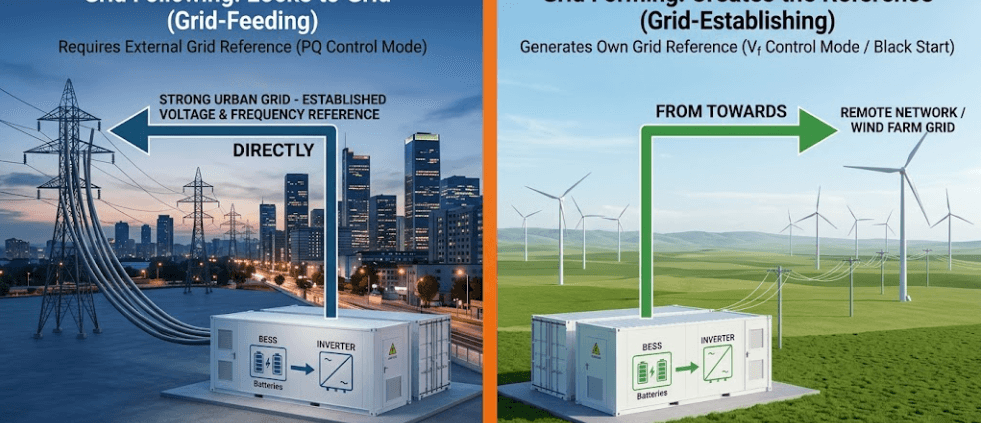
Grid Forming vs Grid Following BESS: What Is the Difference?
Grid forming vs grid following BESS is the most important inverter control decision in battery storage today. In April 2025, Spain and Portugal lost power within minutes. The cascade knocked out supply across most of the Iberian Peninsula. Investigators found one root cause: too many grid-following inverters and not enough grid-forming ones to arrest the frequency collapse.
What is the difference between grid forming and grid following BESS?
The fundamental difference between grid forming and grid following BESS lies in their reference source. A grid following (GFL) BESS operates as a controlled current source. It requires an existing, stable grid voltage and frequency to lock onto via a Phase-Locked Loop (PLL). Conversely, a grid forming (GFM) BESS acts as an independent voltage source. By synthesising its own internal reference, it can operate on weak grids or completely isolated networks.
That event changed the industry conversation permanently. For developers, engineers, and asset owners, this choice now carries regulatory, financial, and grid-safety consequences — not just technical ones.
This guide covers everything you need to make the right decision. We break down how each inverter type works before comparing them head-to-head. From there, you will explore optimal applications, hybrid architectures, 2025 mandates, and real-world case studies.
Most developers already know both technologies exist. So start here, not with theory. Answer these five questions — each answer points to the right grid forming vs grid following BESS choice.
Question 1 — Short Circuit Ratio (SCR): Choosing Grid Forming vs Grid Following BESS
Question 2 — Does Your BESS Project Need Black Start or Islanding?
- No — grid following BESS is sufficient
- Occasional backup power only — grid following plus STS works well
- Sustained islanding or off-grid — grid forming BESS is required
Question 3 — What Is the Renewable Penetration at Your Grid Connection?
- Below 50% IBR penetration — grid following BESS is fine
- 50 to 70% IBR penetration — hybrid grid forming and grid following is recommended
- Above 70% IBR penetration — grid forming preferred; may be mandated
Question 4 — Is a Grid Forming BESS Mandate Active in Your Jurisdiction?
- USA (MISO territory), EU, or Australia — check mandate applicability before specifying
- Other markets — monitor; mandates are spreading globally
- No mandate yet — grid following remains fully eligible today
Question 5 — What Is Your BESS Project Timeline?
- 3 to 5 years, strong urban grid, C&I focus — grid following BESS maximises ROI today
- 10 or more years, utility scale — future-proof with grid forming or hybrid
Bottom line: Strong urban grid + no islanding + C&I project = grid following BESS. Weak grid + black start + high-IBR or mandate zone = grid forming BESS. Utility-scale with a long horizon = specify grid forming firmware from Day 1.
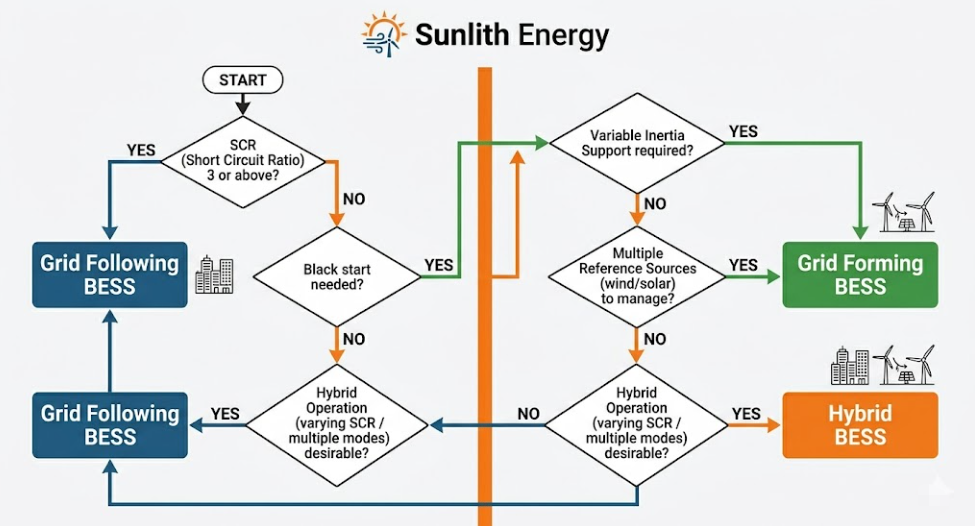
- Grid Following BESS: The PLL Control Architecture
- Grid Following BESS: Key Strengths on Strong Grids
- Grid Following BESS: The Fundamental Limitation
- Grid Forming BESS: The Voltage-Source Architecture
- Unique Stability Capabilities of Grid Forming BESS
- Grid Forming BESS: Three Control Strategies Explained
- Grid Forming vs Grid Following BESS — 10-Dimension Head-to-Head Table
- Grid Forming vs Grid Following BESS — EPFL Campus Study Results
- Western Downs Battery: Grid Forming Upgrade Proven at 540 MW Scale
- What the Performance Data Means for Your Grid Forming vs Grid Following BESS Decision
- Why the Grid Forming BESS Cost Premium Is Shrinking in 2025
- Grid Forming vs Grid Following BESS: 10-Year Financial Summary
- Profile 1 — Grid Following BESS for C&I Peak Shaving & Demand Reduction
- Profile 2 — Grid Following BESS for Solar-Plus-Storage
- Profile 3 — Grid Following BESS for Fast Frequency Response Markets
- Profile 4 — Grid Following BESS for Capacity Market Participation
- Profile 5 — Grid Following BESS for Time-of-Use Energy Arbitrage
- Profile 1 — Grid Forming BESS for Weak Grid and Remote Industrial Sites
- Profile 2 — Grid Forming BESS for Island Microgrids and Off-Grid Systems
- Profile 3 — Grid Forming BESS for Black Start Requirements
- Profile 4 — Grid Forming BESS for High-IBR Grid Zones
- Profile 5 — Grid Forming BESS for Stability Market Revenue
- How a Hybrid Grid Forming and Grid Following BESS Architecture Works
- What the Hybrid Grid Forming and Grid Following BESS System Delivers
- Seamless Mode Switching Between Grid Forming and Grid Following BESS
- United States — MISO Grid Forming BESS Mandate (November 2024)
- Europe — EU Grid Forming BESS Rule from 2026
- Australia — Grid Forming BESS Is Now the Industry Default
- United Kingdom — Grid Forming BESS and the Stability Pathfinder
- What is the main difference between grid forming and grid following BESS?
- Can a grid following BESS be upgraded to grid forming later?
- What SCR does a grid following BESS need to work safely?
- Is grid forming BESS now required by regulation in some markets?
- Is grid forming BESS always better than grid following BESS?
- What happens if you use a grid following BESS on a weak grid?
- Related Articles on Sunlith Energy
- External References
Grid Following BESS: The PLL Control Architecture
A grid following BESS inverter acts as a controlled current source. Its job is to inject active power and reactive power into the grid at the exact voltage and frequency already running there. To do this, it relies on a Phase-Locked Loop (PLL). The PLL reads the grid voltage, frequency, and phase angle at the Point of Common Coupling thousands of times per second — then locks the inverter’s internal reference to that signal. Because of this, the inverter follows the grid rather than setting it.
Grid Following BESS: Key Strengths on Strong Grids
Grid following is the dominant technology today — about 80% of all BESS systems worldwide use this architecture. It is mature, cost-effective, and well-suited to strong-grid environments with a Short Circuit Ratio above 3. Peak demand charge reduction, time-of-use arbitrage, fast frequency response, and solar self-consumption are all well within its capabilities on a strong urban grid.
Grid Following BESS: The Fundamental Limitation
The core limit is simple: a grid following inverter needs the grid to exist. Without a stable voltage reference, the PLL has nothing to lock to. As a result, a grid following BESS cannot black-start a dead network — and it cannot sustain an islanded microgrid on its own.
For a complete technical breakdown, read our comprehensive guide to grid-following BESS.
Grid Forming BESS: The Voltage-Source Architecture
A grid forming BESS inverter acts as a controlled voltage source. Rather than reading and copying the grid signal, it synthesises its own voltage and frequency internally. Everything else on the network — other inverters, loads, generators — synchronises to the grid forming inverter. Because of this fundamental reversal, the inverter can operate with no external grid signal at all.
Unique Stability Capabilities of Grid Forming BESS
Black start, sustained islanding, synthetic inertia, and meaningful fault current contribution are all grid forming only capabilities. None are available from a standard grid following BESS. In Australia, 1,070 MW of grid forming BESS technology is already operating across ten sites as of mid-2025, according to AEMO.
Grid Forming BESS: Three Control Strategies Explained
Three main strategies power grid forming inverters commercially today. Droop control mimics a synchronous generator’s governor — the simplest and most widely deployed approach. Virtual Synchronous Generator (VSG) explicitly emulates inertial response and reacts to both frequency deviation and Rate of Change of Frequency (ROCOF). Power Synchronisation Control (PSC) is the most advanced option, using active power as the sync signal rather than frequency — the most stable choice at very low SCR values below 1.5.
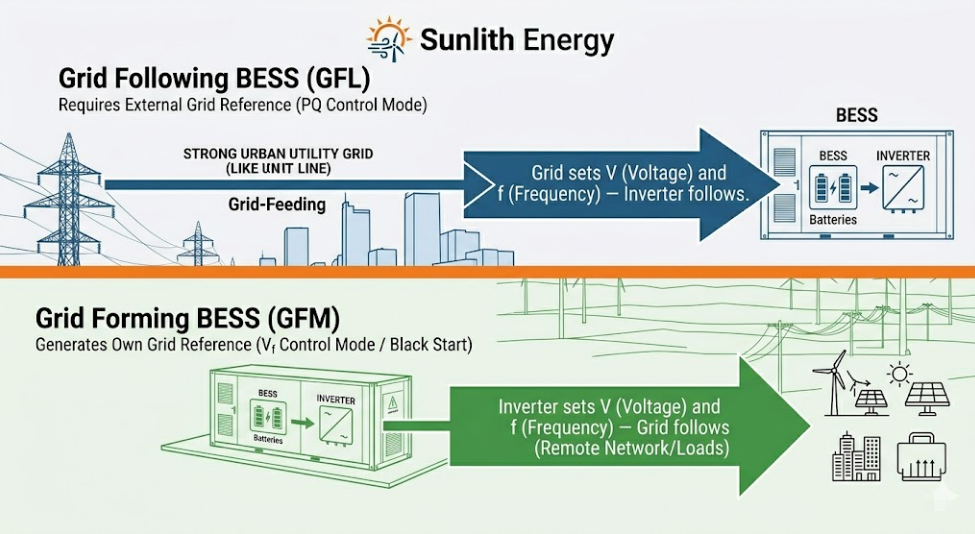
Grid Forming vs Grid Following BESS — 10-Dimension Head-to-Head Table
Use the table below for engineering evaluations and procurement decisions. It covers the ten dimensions that matter most when choosing between grid forming and grid following BESS.
| Dimension | Grid Following BESS (GFL) | Grid Forming BESS (GFM) |
|---|---|---|
| Inverter behaviour | Controlled current source | Controlled voltage source |
| Synchronisation | PLL locks to grid voltage and frequency | Internal oscillator — no external reference |
| Requires grid to operate? | Yes — needs stable voltage reference | No — creates its own reference |
| Black start | None | Full black start capability |
| Sustained islanding | No | Yes — while battery has energy |
| Synthetic inertia | Limited — indirect only | Native — instantaneous ROCOF response |
| Frequency response | 200–500 ms (droop-based) | < 20 ms (voltage-source response) |
| Minimum SCR at PCC | SCR ≥ 3; unstable below 1.5 | Stable at SCR < 1.5; tested at SCR 1.0 |
| Fault current | Very limited | Significant — supports protection coordination |
| Cost vs baseline | Baseline | 0–20% premium (shrinking in 2025) |
Grid Forming vs Grid Following BESS — EPFL Campus Study Results
Real-world data from independent research confirms the performance difference between grid forming and grid following BESS. The most rigorous comparison to date used a 720 kVA / 500 kWh BESS on the EPFL campus in Switzerland. Researchers ran both control modes on identical hardware. The result was clear: grid forming outperformed grid following on every frequency regulation metric tested.
Specifically, the grid forming inverter arrested frequency deviations before they reached protection relay trip thresholds. By contrast, the grid following inverter could only respond after the deviation was already measurable. In low-inertia conditions, those extra milliseconds compound quickly and can cause cascading failures.
Source: EPFL — Performance Assessment of Grid-Forming and Grid-Following BESS on Frequency Regulation in Low-Inertia Power Grids (arXiv, 2021)
Western Downs Battery: Grid Forming Upgrade Proven at 540 MW Scale
At utility scale, the Western Downs Battery in Queensland was upgraded from grid following to grid forming in March 2025. The upgrade used firmware changes — not new hardware. After the upgrade, AEMO confirmed measurable system strength improvements in the surrounding network, with voltage recovery during Fault Ride-Through events confirmed within 300 ms under grid forming control.
Source: ARENA — Australia’s Grid-Forming Battery Revolution, November 2025
What the Performance Data Means for Your Grid Forming vs Grid Following BESS Decision
On strong grids with SCR above 5, the performance gap between grid forming and grid following BESS narrows considerably. For pure peak shaving or energy arbitrage on a strong urban grid, grid following performance is completely adequate. The extra cost of grid forming is not recovered through performance gains in that scenario.
However, in weak or high-IBR grids, grid forming outperforms grid following on every stability metric that matters — exactly the conditions the EPFL and Western Downs data reflect.
Engineering rule: The question is not which is better overall. It is which is better for this specific grid, at this specific node, for these specific services.
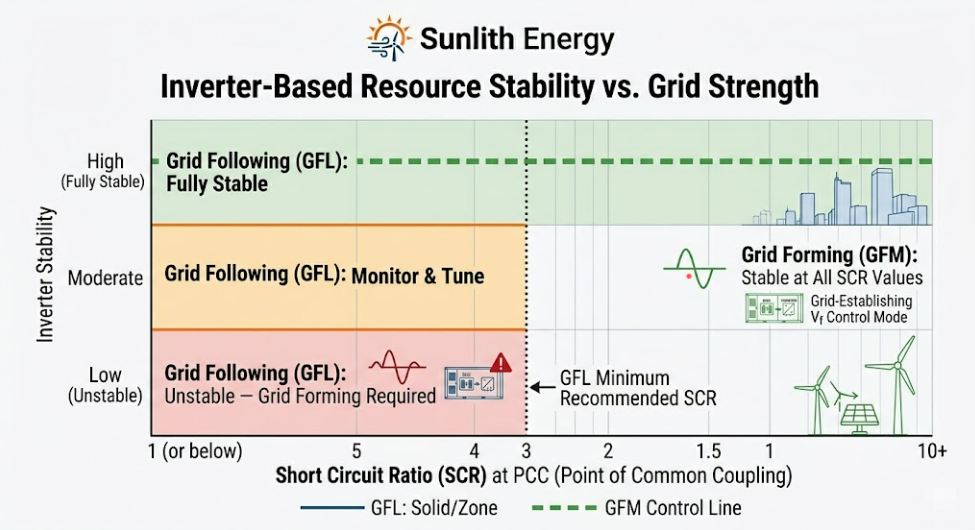
Why the Grid Forming BESS Cost Premium Is Shrinking in 2025
Three factors are compressing the cost gap between grid forming and grid following BESS. First, firmware upgrades now unlock grid forming on existing grid following hardware — exactly as the Western Downs Battery proved in March 2025. Second, manufacturing volume is driving inverter costs down broadly. Third, grid forming BESS earns revenue from stability markets that grid following cannot access.
Modo Energy’s September 2025 analysis of Australia’s NEM found no real cost difference between grid forming and grid following in that market. Meanwhile, National Grid’s Stability Pathfinder programme pays specifically for synthetic inertia and system strength — both grid forming only capabilities. Over a 10-year project life, those payments more than recover any upfront premium in mandate-affected markets.
Grid Forming vs Grid Following BESS: 10-Year Financial Summary
| Cost Factor | Grid Following BESS | Grid Forming BESS |
|---|---|---|
| Upfront capex premium | Baseline | 0–20% (market-dependent; shrinking) |
| Commissioning | Standard | Higher — grid forming tuning required |
| Stability market revenue | None | Significant in UK, Australia, Germany |
| Firmware upgrade path | Available on most modern PCS | Native from Day 1 |
| 10-year value — strong grid C&I | Higher net return | Lower unless stability revenue applies |
| 10-year value — weak grid / utility | Lower (mandate risk) | Higher in mandate-affected markets |
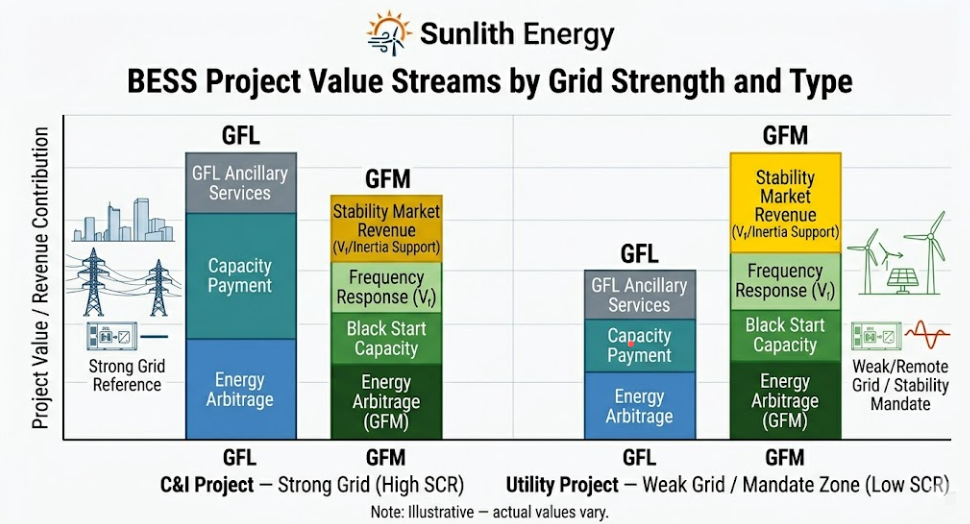
For detailed financial modelling, read our C&I BESS economics and ROI breakdown.
Grid following BESS is the right choice for most projects today. Below are the five scenarios where it delivers the strongest return on investment.
Profile 1 — Grid Following BESS for C&I Peak Shaving & Demand Reduction
Manufacturing facilities, data centres, and logistics hubs on strong urban grids (SCR typically 5 to 20) are ideal for grid following BESS. A well-configured Energy Management System dispatches the battery in real time to prevent demand charge spikes, cutting bills by 30 to 40%. Add a Static Transfer Switch and the same system also delivers seamless backup power.
See also: benefits of C&I BESS for manufacturing facilities.
Profile 2 — Grid Following BESS for Solar-Plus-Storage
In solar-plus-storage systems, the solar PV inverter provides the AC voltage reference. The grid following BESS inverter runs in parallel — absorbing surplus solar and wind generation and discharging when output falls. This is a well-proven configuration deployed across thousands of sites globally.
Profile 3 — Grid Following BESS for Fast Frequency Response Markets
A grid following inverter detects frequency deviation via the PLL and responds in under 200 to 500 milliseconds. That is well within the threshold for FFR products in most grid codes. As a result, grid following BESS is fully eligible and actively operating in FFR markets in Great Britain, Australia, Ireland, and the United States.
Profile 4 — Grid Following BESS for Capacity Market Participation
Grid following BESS can provide committed MW capacity through auctions in the UK, US, and Australia. Combined with energy arbitrage strategies and FFR, capacity payments create a strong multi-revenue stack without requiring grid forming capabilities.
Profile 5 — Grid Following BESS for Time-of-Use Energy Arbitrage
In liquid spot markets — ERCOT, Australia’s NEM, GB day-ahead — significant arbitrage value comes purely from charge and discharge timing. A well-configured Battery Management System and EMS handle this automatically. Grid following is the lower-cost, right-fit choice for this application.
When do you need a grid forming BESS?
A grid forming BESS is technically required or recommended over a grid following system in the following scenarios:
- Weak Grid Integration: When the Short Circuit Ratio (SCR) at the Point of Common Coupling (PCC) falls below 2.0 or 1.5.
- Island Microgrids: For remote, off-grid systems that have no utility grid to provide a voltage reference.
- Black Start Capability: When the battery system must independently energise a completely dead network.
- High Renewable Penetration: In grid zones where inverter-based resource (IBR) penetration exceeds 60% to 70%.
- Stability Market Revenue: To participate in specialised grid services like synthetic inertia and system strength contracts.
Grid forming BESS is not optional in these scenarios. In each case it is technically required or the only viable choice. Here is the detail behind each one.
Profile 1 — Grid Forming BESS for Weak Grid and Remote Industrial Sites
Grid following inverters typically become unstable when the SCR at the PCC falls below 2. In fact, dropping below SCR 1.5 risks triggering sub-synchronous oscillations if multiple grid following units run in parallel — a real engineering risk at remote mining operations, oil and gas facilities, and industrial sites on long radial feeders. For a full breakdown of why this happens, read our comprehensive guide to grid-following BESS stability.
Profile 2 — Grid Forming BESS for Island Microgrids and Off-Grid Systems
An islanded microgrid has no utility grid to provide a voltage reference — so a grid following inverter cannot operate on its own there. The grid forming BESS becomes the grid itself. It creates and holds the voltage and frequency reference that all other devices synchronise to.
Profile 3 — Grid Forming BESS for Black Start Requirements
A grid following inverter cannot energise a dead network. A grid forming inverter can. For any project where black start is a design requirement — contractual, regulatory, or operational — grid forming is the only technology that delivers this capability. There is no workaround or hybrid substitute for this specific requirement.
Profile 4 — Grid Forming BESS for High-IBR Grid Zones
As renewable penetration rises above 60 to 70%, grid following inverters in aggregate no longer have a stable signal to lock to without grid forming support. The April 2025 Iberian blackout was a direct consequence of this imbalance. Grid forming BESS, combined with a well-specified Power Conversion System, is the primary technical response.
Profile 5 — Grid Forming BESS for Stability Market Revenue
Grid forming inverters are the only technology eligible for stability market contracts — synthetic inertia in the UK Stability Pathfinder, System Strength services in Australia’s NEM, and fast FCAS premiums. These revenue streams are grid forming only. If your business model includes stability market products, grid forming is not an optional upgrade. It is the core product.
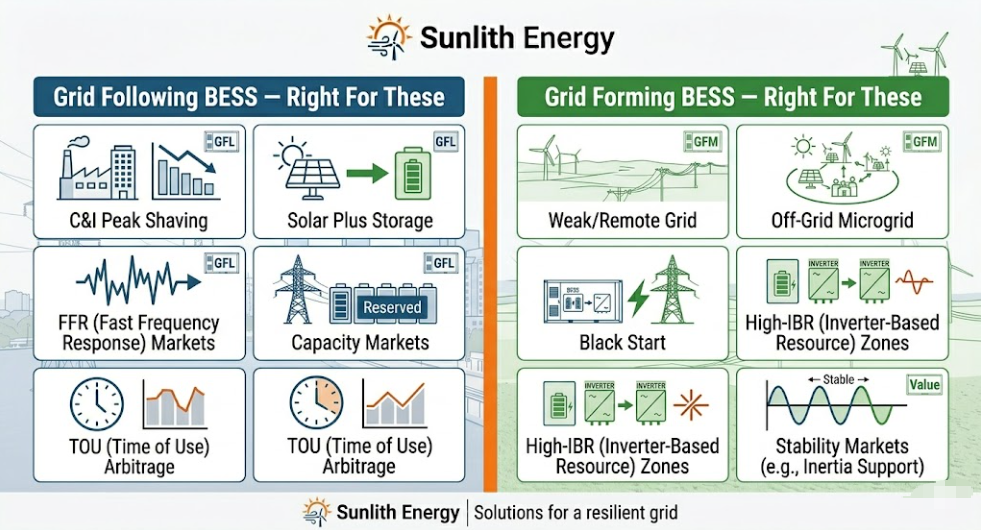
How a Hybrid Grid Forming and Grid Following BESS Architecture Works
The choice between grid forming vs grid following BESS is increasingly not a binary one. Modern inverter platforms support both control modes in the same hardware, with automatic switching between them.
In a typical hybrid design, 20 to 30% of the BESS units operate in grid forming mode. These units establish and hold the voltage and frequency reference for the whole site. The remaining units run in grid following mode against that reference — maximising total output at lower average cost than an all-grid forming fleet.
When the utility grid is strong, the grid forming units benefit from additional system strength. Should the grid weaken or disconnect, those units hold the microgrid reference autonomously. The grid following units simply continue to follow that reference, unaware that the utility has gone.
What the Hybrid Grid Forming and Grid Following BESS System Delivers
- Lower average cost than specifying all units in grid forming mode
- Full black start capability from the grid forming anchor units
- Seamless islanding with no manual intervention needed
- Stable operation at low SCR where an all-GFL system would oscillate
- Future-proofing — grid forming firmware is already on the hardware, ready when mandates arrive
Seamless Mode Switching Between Grid Forming and Grid Following BESS
Hitachi Energy’s patent filings (WO2024193866A1 and WO2024193867A1) describe supervisory control that switches individual inverter units between VSG (grid forming) and PLL (grid following) modes automatically — based on real-time voltage thresholds — without interrupting power delivery. This is production firmware, not experimental technology.
Sunlith Energy recommendation: For any new BESS project above 5 MW, specify PCS hardware with grid forming firmware capability regardless of Day 1 operating mode. The option value vastly exceeds its marginal cost.
Regulatory requirements for grid forming vs grid following BESS changed substantially in 2024 and 2025. Here is the current status across four key markets.
United States — MISO Grid Forming BESS Mandate (November 2024)
MISO finalised grid forming BESS performance requirements in November 2024. New stand-alone BESS systems seeking interconnection in MISO territory must demonstrate synthetic inertia emulation, fast frequency response, and minimum short-circuit current contribution. Grid following only systems do not meet these requirements.
Source: MISO GFM BESS Performance Requirements Whitepaper, July 2024
Europe — EU Grid Forming BESS Rule from 2026
In November 2025, ENTSO-E and key national regulators announced that all new storage projects above 1 MW must carry grid forming capability from 2026. Germany’s Bundesnetzagentur, France’s RTE, and Spain’s REE all signalled fast-track implementation timelines following the April 2025 Iberian blackout.
Source: ESS News — Europe Moves to Mandate Grid-Forming for New Storage Over 1 MW, November 2025
Australia — Grid Forming BESS Is Now the Industry Default
Australia has no formal mandate, but AEMO’s market design has made grid forming BESS the standard for new large-scale projects. Over 1,070 MW is already operating across ten sites. Modo Energy confirms that Australian developers now treat grid forming as a standard specification rather than an optional upgrade.
Source: ARENA — Australia’s Grid-Forming Battery Revolution, November 2025
United Kingdom — Grid Forming BESS and the Stability Pathfinder
National Grid ESO’s Stability Pathfinder issues multi-year contracts for synthetic inertia and system strength — both grid forming only capabilities. Grid code updates under Engineering Recommendation G99 are underway to formally require grid forming performance specifications.
See also: UL 9540 and IEC certification standards for BESS.
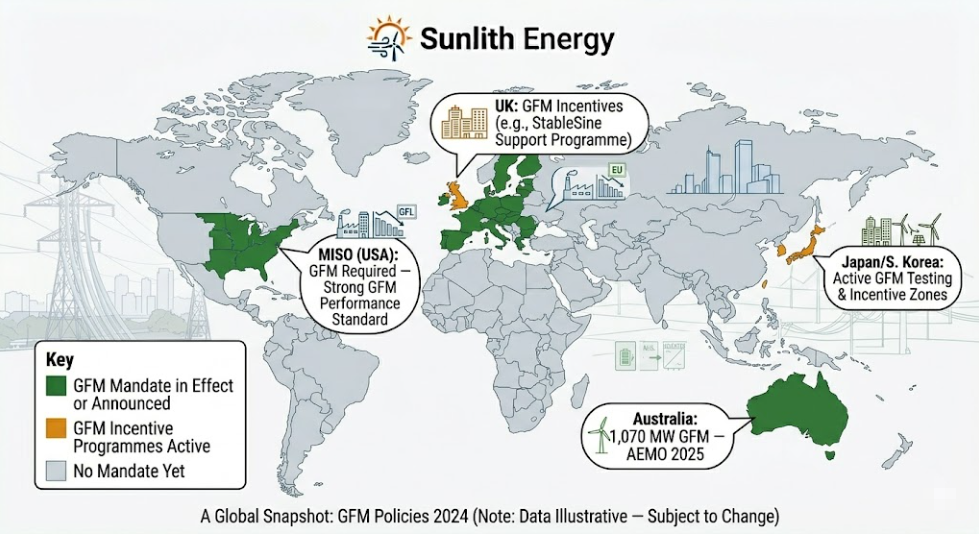
At Sunlith Energy, the grid forming vs grid following BESS decision is an engineering analysis on every project — never a default. Our four-step process ensures every system is specified correctly.
- SCR Analysis — We measure or obtain the SCR at the Point of Common Coupling before writing any specification. This single number anchors the grid forming vs grid following BESS recommendation.
- Revenue Stack Assessment — We model the full value stack — demand charge reduction, arbitrage, FFR, capacity markets, backup power, solar self-consumption, and stability market products. This determines whether grid forming’s cost premium is recovered through incremental revenue.
- Regulatory and Horizon Review — We check the applicable grid code, interconnection requirements, and announced mandates. For projects with a 10-year or longer horizon in MISO, Europe, or Australia, grid forming firmware capability is specified as standard.
- PCS Hardware Specification — We select Power Conversion System hardware from manufacturers that support both grid forming and grid following firmware. This gives the system full flexibility to adapt over its lifetime without hardware replacement.
Related reading: how BMS and EMS work together in a BESS system and our Battery Management System explainer.
What is the main difference between grid forming and grid following BESS?
Grid following BESS reads the grid’s existing voltage and frequency and injects current to match it — it follows the grid. Grid forming BESS synthesises its own voltage and frequency reference internally — it forms the grid. The key result is that grid following needs a strong external grid to operate stably, while grid forming can function with no grid signal at all.
Can a grid following BESS be upgraded to grid forming later?
Yes, in many cases. Australia’s Western Downs Battery proves this at 540 MW scale: the 2025 upgrade used firmware changes, not new hardware. However, not all inverters support grid forming control at the firmware level. When specifying new hardware, always confirm grid forming firmware availability with your PCS manufacturer.
What SCR does a grid following BESS need to work safely?
A minimum SCR of 3 at the PCC is the standard engineering threshold for grid following BESS. A formal stability study becomes mandatory once the system drops below SCR 2. If the node falls past SCR 1.5, specifying a grid forming BESS is strongly recommended. At or below SCR 1.0, a grid forming system using Power Synchronisation Control (PSC) is your only viable option.
Is grid forming BESS now required by regulation in some markets?
Yes. MISO finalised grid forming requirements for new BESS interconnection in November 2024. Europe announced the 1 MW+ grid forming rule for 2026. Australia’s AEMO has made grid forming the de facto standard for new large-scale BESS. Developers in these markets should treat grid forming firmware as a baseline specification.
Is grid forming BESS always better than grid following BESS?
No. On strong grids with SCR above 3 and adequate synchronous generation, grid following BESS performs excellently for peak shaving, arbitrage, and FFR. The additional capabilities of grid forming add no commercial value at a well-connected C&I site. Grid forming is better where it is needed; grid following is the right choice where grid strength is not a constraint.
What happens if you use a grid following BESS on a weak grid?
Below SCR 3, grid following inverters begin to show PLL instability. Below SCR 1.5, multiple units in parallel can enter sub-synchronous oscillations — a condition that can cascade into protection trips across the network. The April 2025 Iberian blackout demonstrated exactly this failure mode at grid scale.
The grid forming vs grid following BESS decision now carries regulatory deadlines, financial consequences, and grid-safety implications. After the April 2025 Iberian blackout, MISO’s November 2024 mandate, Europe’s 2026 rule, and Australia’s operational scale-up past 1,000 MW of grid forming BESS, this is not a decision any project developer can treat as an afterthought.
For most C&I projects on strong grids today, grid following BESS delivers faster payback, lower upfront capital, and all the commercial capabilities the project needs. For weak grids, remote sites, black start applications, high-IBR zones, and stability market participation, grid forming BESS is the technically correct — and increasingly regulatory-required — choice. For utility-scale projects above 5 MW with a long horizon, the hybrid architecture gives both capabilities at the lowest combined cost.
At Sunlith Energy, every project starts with an SCR analysis and a revenue stack model. The right grid forming vs grid following BESS specification follows from that analysis — not from a default catalogue choice.
Talk to the Sunlith Energy Engineering Team →
Related Articles on Sunlith Energy
- BESS Grid-Following (GFL): Complete Guide
- BESS Grid-Forming Technology: The Architecture Stabilising Tomorrow’s Grid
- The Role of Static Transfer Switch (STS) in C&I BESS
- How C&I BESS Peak Shaving Lowers Demand Charges
- How EMS Enables Advanced Grid Services Through BESS
- Power Conversion System (PCS): The Heart of a BESS
- C&I BESS Economics and ROI: Full Breakdown
- How C&I BESS Enhances Solar and Wind Power Integration
- Battery Management System (BMS) Explained
- UL 9540 and IEC Standards Compliance for BESS
- Benefits of C&I BESS for Manufacturing Facilities
- BMS vs EMS: Understanding the Control Layers in BESS
External References
- EPFL — Performance Assessment of Grid-Forming and Grid-Following BESS (arXiv, 2021)
- MISO — GFM BESS Performance Requirements Whitepaper, July 2024
- ARENA — Australia’s Grid-Forming Battery Revolution, November 2025
- Modo Energy — The Rise of Grid-Forming Batteries in the NEM, September 2025
- ESS News — Europe Moves to Mandate Grid-Forming for New Storage Over 1 MW, November 2025
- National Grid ESO — Stability Pathfinder Programme
- IEEE Standard 2800-2022 — Interconnection Requirements for IBRs
- ENTSO-E — Network Code on Requirements for Grid Connection of Generators
- NREL — Grid Integration of Battery Storage Research
- IEA — Batteries and Secure Energy Transitions Report
- BloombergNEF — Energy Storage Market Outlook