
AC vs DC Round Trip Efficiency in Battery Energy Storage Systems
Introduction
Understanding AC vs DC round trip efficiency is essential when evaluating the performance of modern Battery Energy Storage Systems (BESS). Efficiency determines how much stored electricity can actually be delivered back to the grid or facility after charging.
Energy storage systems are increasingly used to support renewable energy integration, improve grid stability, and reduce electricity costs. However, every battery storage system experiences some level of energy loss during charging and discharging cycles.
The efficiency of a battery system is usually measured using round trip efficiency (RTE), which represents the percentage of energy recovered compared to the energy used to charge the battery.
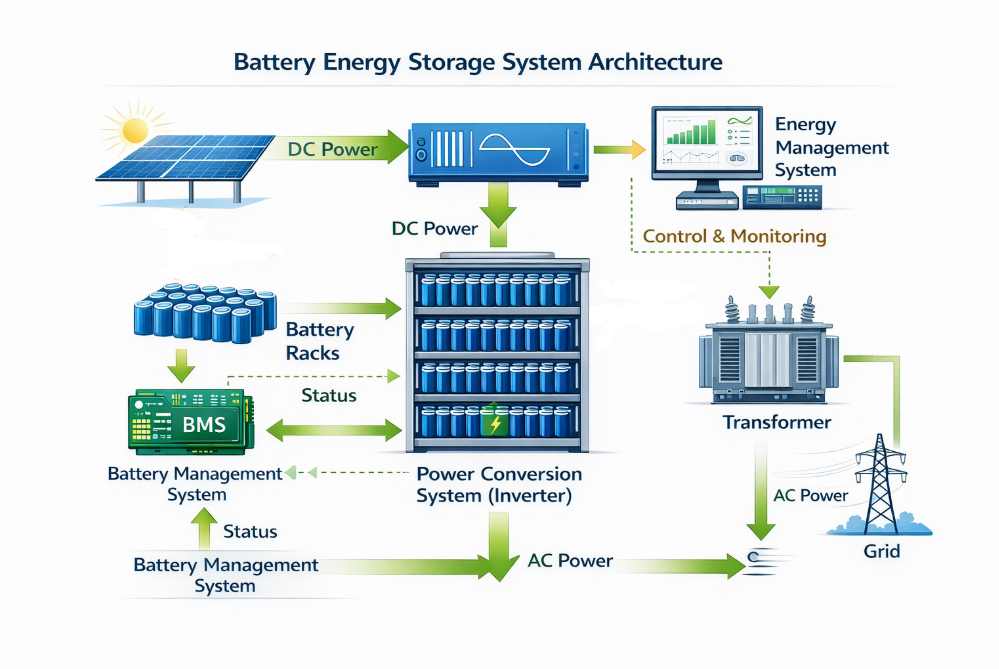
For a deeper understanding of BESS design and system architecture, read our Battery Energy Storage System Complete Guide.
What is Round Trip Efficiency in BESS?
Round trip efficiency measures the ratio of usable energy output to energy input during a full charge and discharge cycle.
The formula is:
Round Trip Efficiency = Energy Output ÷ Energy Input × 100
Example:
Energy charged into battery: 100 kWh
Energy discharged: 90 kWh
Round trip efficiency = 90%
This metric is widely used in energy storage project evaluation. If you want to understand how this value is calculated in detail, see our guide on BESS Round Trip Efficiency calculation.
According to research from the National Renewable Energy Laboratory, modern lithium battery systems typically achieve round trip efficiencies between 85% and 95% depending on system design.
What is DC Round Trip Efficiency?
DC round trip efficiency measures the energy efficiency of the battery itself, excluding most external components such as inverters and transformers.
This measurement focuses mainly on the electrochemical performance of the battery cells.
DC efficiency accounts for losses related to:
- internal battery resistance
- chemical reactions within cells
- battery management system operations
Because it excludes several system components, DC round trip efficiency is typically higher than AC efficiency.
Typical DC Efficiency Values
| Battery Type | DC Round Trip Efficiency |
|---|---|
| Lithium-ion | 95–98% |
| Lithium Iron Phosphate (LFP) | 94–97% |
| Lead-acid | 80–90% |
These values represent the intrinsic performance of the battery technology itself.
What is AC Round Trip Efficiency?
AC round trip efficiency measures the efficiency of the entire energy storage system, including all electrical conversion equipment.
Energy flow in an AC measurement typically follows this path:
Grid → Inverter → Battery → Inverter → Grid
Since electricity passes through several components, additional energy losses occur.
AC efficiency includes losses from:
- Power Conversion System (PCS)
- Transformers
- Thermal management systems
- Auxiliary equipment
As a result, AC round trip efficiency is usually lower than DC efficiency.
Typical AC efficiency values for modern lithium battery storage systems range from 85% to 92%.
Key Differences Between AC vs DC Round Trip Efficiency
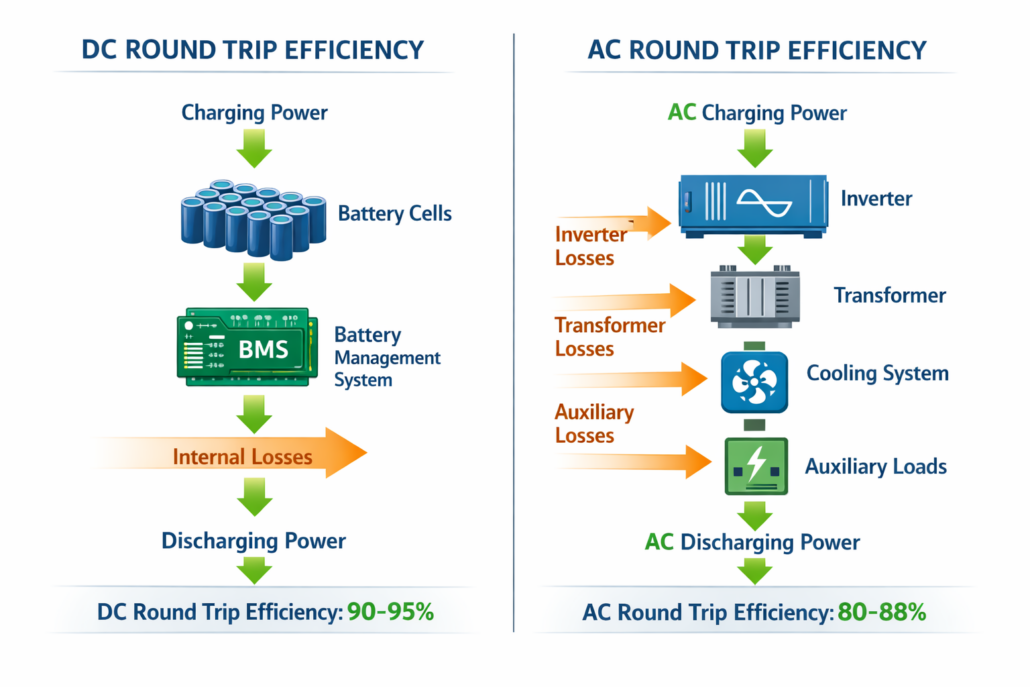
Understanding AC vs DC round trip efficiency is important when comparing energy storage solutions.
| Metric | DC Efficiency | AC Efficiency |
|---|---|---|
| Measurement scope | Battery cells only | Entire system |
| Includes inverter losses | No | Yes |
| Includes cooling loads | No | Yes |
| Typical efficiency range | 94–98% | 85–92% |
| Used for project evaluation | Limited | Yes |
While DC efficiency measures battery chemistry performance, AC efficiency reflects real-world system performance.
Where Energy Losses Occur in Battery Storage Systems
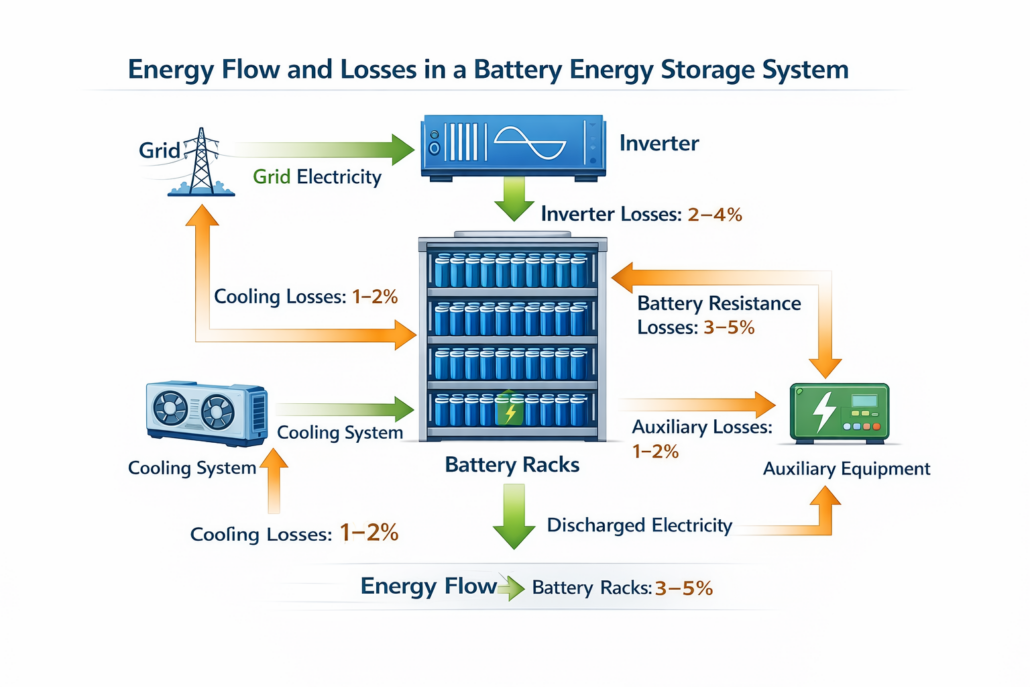
Energy losses occur at several stages within a battery energy storage system.
Power Conversion Losses
Inverters convert electricity between alternating current (AC) and direct current (DC).
Even high-performance inverters operate at 96–98% efficiency, meaning small energy losses occur during every conversion.
These losses accumulate because electricity passes through the inverter multiple times during charging and discharging.
The International Energy Agency highlights that inverter losses are one of the most important factors affecting overall energy storage efficiency.
Thermal Management Losses
Battery systems generate heat during operation. Without effective cooling, excessive temperatures can damage battery cells and reduce performance.
Thermal management systems such as:
- air cooling systems
- liquid cooling systems
- HVAC units
consume energy continuously, which reduces overall system efficiency.
Efficient cooling design is therefore critical for large-scale battery storage installations.
Auxiliary System Consumption
BESS installations include several supporting components that operate continuously.
Examples include:
- battery management systems
- monitoring equipment
- fire suppression systems
- communication hardware
Although each device consumes relatively little energy, their combined power usage contributes to overall energy losses.
AC vs DC Round Trip Efficiency in Solar + Storage Systems
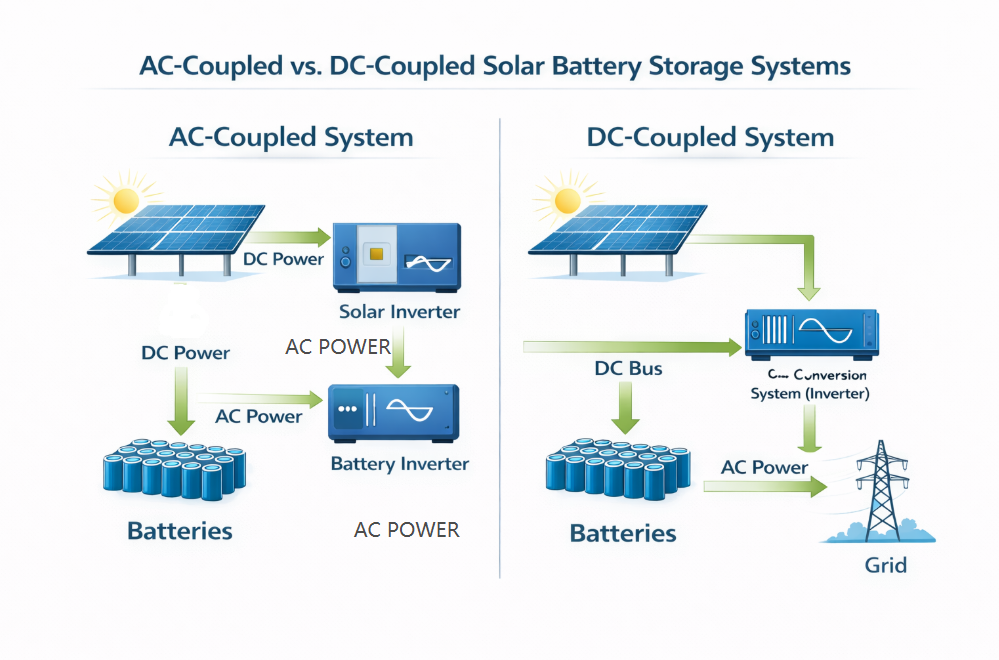
Solar energy systems combined with battery storage can be designed using AC-coupled or DC-coupled configurations.
DC-coupled systems usually achieve higher efficiency because solar energy can be stored directly in the battery without multiple conversions.
AC-coupled systems provide greater flexibility but may introduce additional energy losses due to extra inverter stages.
Choosing the appropriate architecture depends on system design goals, project scale, and grid integration requirements.
Why AC Round Trip Efficiency Matters for Energy Projects
While DC efficiency provides insight into battery chemistry performance, AC round trip efficiency is the most important metric for real-world projects.
Energy developers evaluate systems based on the amount of usable electricity delivered to the grid.
Higher AC efficiency leads to:
- increased usable stored energy
- improved project profitability
- lower operating costs
- better renewable energy utilization
This is particularly important for applications such as:
- peak shaving
- renewable energy integration
- grid stabilization
Strategies to Improve Battery Storage Efficiency
Developers can improve system efficiency through several engineering approaches.
High-Efficiency Power Conversion Systems
Modern inverters using advanced semiconductor technologies such as silicon carbide (SiC) can significantly reduce conversion losses.
Optimized Thermal Management
Efficient cooling technologies reduce auxiliary power consumption while maintaining optimal battery temperatures.
Intelligent Energy Management Systems
Advanced energy management software optimizes charging and discharging cycles to maximize system efficiency.
Conclusion
Understanding AC vs DC round trip efficiency in battery energy storage systems is essential for evaluating system performance and project economics.
DC efficiency measures the intrinsic performance of battery cells, while AC efficiency reflects the efficiency of the complete energy storage system.
For most real-world applications, AC round trip efficiency provides the most accurate indicator of system performance.
As battery technology and power electronics continue to evolve, energy storage systems will achieve even higher levels of efficiency and reliability.
FAQ About AC vs DC Round Trip Efficiency
What is AC round trip efficiency?
AC round trip efficiency measures the percentage of energy recovered from a battery after accounting for all system losses including inverters, cooling systems, and auxiliary equipment.
What is DC round trip efficiency?
DC round trip efficiency measures the efficiency of the battery cells themselves, excluding most system-level components.
Why is AC efficiency lower than DC efficiency?
AC efficiency includes losses from power conversion systems, cooling equipment, and other components that are not included in DC efficiency calculations.
What is the typical round trip efficiency of lithium battery storage systems?
Most lithium-ion battery energy storage systems achieve round trip efficiencies between 85% and 95% depending on system design.
BESS Round Trip Efficiency (RTE): How to Calculate Efficiency in Battery Energy Storage Systems
BESS Round Trip Efficiency (RTE) measures how much energy a battery returns compared to the energy used to charge it. In other words, it shows how efficiently the storage system operates.
Battery Energy Storage Systems play a critical role in modern power grids. They store electricity when supply is high and release it when demand increases. However, every storage system loses some energy during the process.
This is why Round Trip Efficiency (RTE) is one of the most important performance metrics in energy storage projects.
A higher BESS RTE means lower energy losses and better system economics. Therefore, utilities, renewable developers, and commercial energy users carefully evaluate this metric when selecting battery storage solutions.
To understand battery storage performance, engineers calculate BESS round trip efficiency using a simple formula.
BESS Round Trip Efficiency Formula
BESS Round Trip Efficiency (RTE) measures how much energy a battery energy storage system returns after charging.
Formula
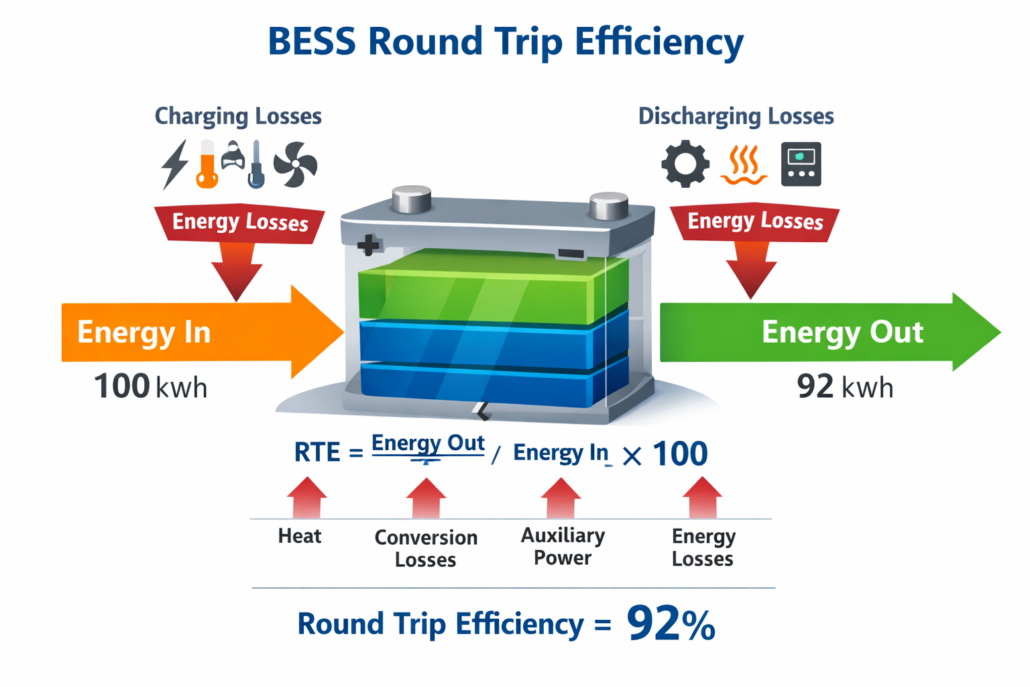
RTE (%) = Energy Discharged ÷ Energy Charged × 100
Example
Energy Charged = 100 kWh
Energy Discharged = 92 kWh
BESS Round Trip Efficiency = 92%
Most lithium battery energy storage systems achieve 88–94% AC round trip efficiency.
What Is BESS Round Trip Efficiency (RTE)?
BESS RTE represents the percentage of energy that can be recovered from a battery after a full charge and discharge cycle.
During energy storage, electricity flows through several system components. Each component introduces small losses. As a result, the output energy is always slightly lower than the input energy.
These losses typically occur in:
- battery cells
- power conversion systems
- thermal management systems
- auxiliary equipment
Therefore, BESS round trip efficiency reflects the combined efficiency of the entire storage system.
Why BESS Round Trip Efficiency (RTE) Matters
Understanding BESS round trip efficiency is important because it directly affects project performance and profitability.
First, higher efficiency means more usable electricity. This improves overall system performance.
Second, improved BESS RTE reduces operational energy losses. As a result, storage projects can generate higher revenue from energy trading and peak-shaving services.
In addition, efficient battery systems support grid stability. They store renewable energy during periods of excess generation and release it during high demand.
Modern energy storage solutions such as those offered by SunLith Energy are designed to maximize efficiency through advanced battery design and system integration.
How to Calculate BESS Round Trip Efficiency
The calculation of BESS round trip efficiency is straightforward. However, engineers must carefully measure the energy entering and leaving the system.
BESS Round Trip Efficiency Formula
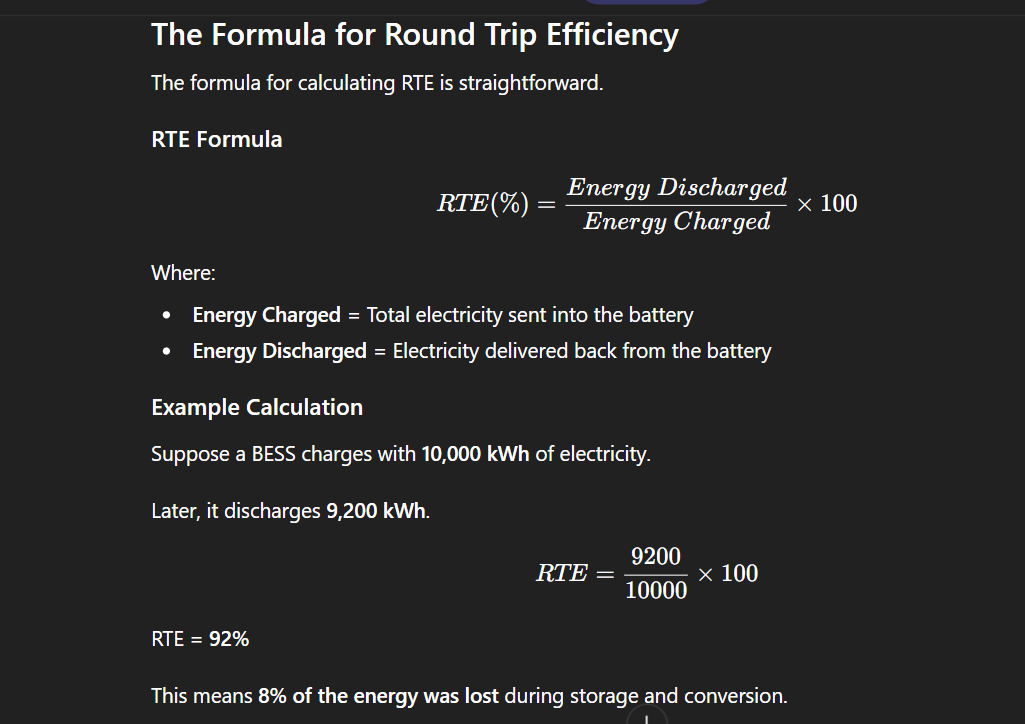
RTE (%) = Energy Discharged ÷ Energy Charged × 100
Where:
- Energy Charged = total electricity stored in the battery
- Energy Discharged = electricity delivered from the battery
This formula helps determine the overall efficiency of the storage cycle.
Step 1: Measure Charging Energy
First, record the total electricity supplied to the battery system during charging.
This measurement usually occurs at the grid connection point or the inverter input.
Example:
Energy charged = 5 MWh
Step 2: Measure Discharge Energy
Next, measure the electricity delivered by the battery during discharge.
Example:
Energy discharged = 4.6 MWh
Step 3: Calculate BESS Round Trip Efficiency
Using the formula:
RTE = 4.6 ÷ 5 × 100
Result:
BESS Round Trip Efficiency = 92%
Therefore, the system lost 8% of energy during the storage cycle.
AC vs DC BESS Round Trip Efficiency
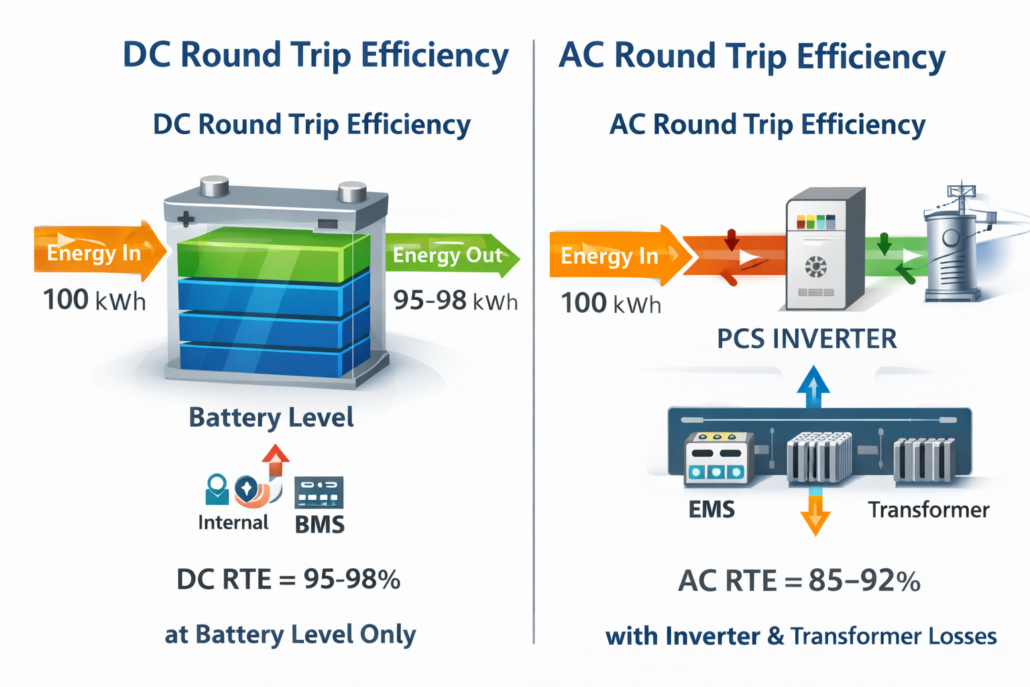
Engineers often calculate BESS round trip efficiency using two different system boundaries.
These measurements are known as DC efficiency and AC efficiency.
Read more about AC vs DC BESS Round Trip Efficiency
DC Round Trip Efficiency
DC efficiency measures performance at the battery level.
It includes losses from:
- battery cells
- internal resistance
- battery management systems
However, DC efficiency does not include inverter losses.
Typical DC BESS round trip efficiency:
95–98%
AC Round Trip Efficiency
AC efficiency measures performance at the grid connection level.
It includes losses from:
- batteries
- inverters
- transformers
- auxiliary systems
Therefore, AC efficiency represents real-world performance.
Typical AC BESS round trip efficiency:
85–92%
Because it reflects system-level performance, AC efficiency is the metric most often used in commercial BESS projects.
Factors That Affect BESS Round Trip Efficiency
Several technical factors influence BESS round trip efficiency.
Understanding these factors helps engineers design more efficient systems.
Battery Cell Efficiency
Battery chemistry strongly influences system performance.
Lithium iron phosphate batteries are widely used because they offer:
- high efficiency
- long cycle life
- strong thermal stability
These characteristics help maintain high BESS RTE over many operating cycles.
Power Conversion Systems
Power conversion systems convert electricity between AC and DC.
During charging:
AC → DC conversion occurs.
During discharge:
DC → AC conversion occurs.
Each conversion introduces small energy losses. Therefore, inverter efficiency plays an important role in overall BESS round trip efficiency.
Modern PCS systems typically achieve 96–99% efficiency.
Thermal Management Systems
Thermal management systems may include:
- HVAC units
- cooling fans
- temperature monitoring sensors
Although necessary, these systems consume energy and slightly reduce BESS RTE.
Auxiliary Power Consumption
Battery containers use additional electrical loads such as:
- control systems
- lighting
- safety equipment
While these loads are relatively small, they still contribute to energy losses during storage operations.
Typical BESS Round Trip Efficiency by Battery Type
Different battery technologies have different efficiency levels.
Below is a comparison of common energy storage technologies.
| Battery Technology | DC Efficiency | AC Efficiency |
|---|---|---|
| Lithium Iron Phosphate | 96–98% | 88–94% |
| Lithium NMC | 95–97% | 87–92% |
| Sodium-ion | 90–94% | 82–90% |
| Flow Batteries | 70–85% | 65–80% |
| Lead-Acid | 80–90% | 70–85% |
Lithium-based batteries dominate modern energy storage because they deliver high BESS RTE and long operational life.
More details about integrated storage technology can be found on our Blogs
Example: Solar + Battery Storage Efficiency
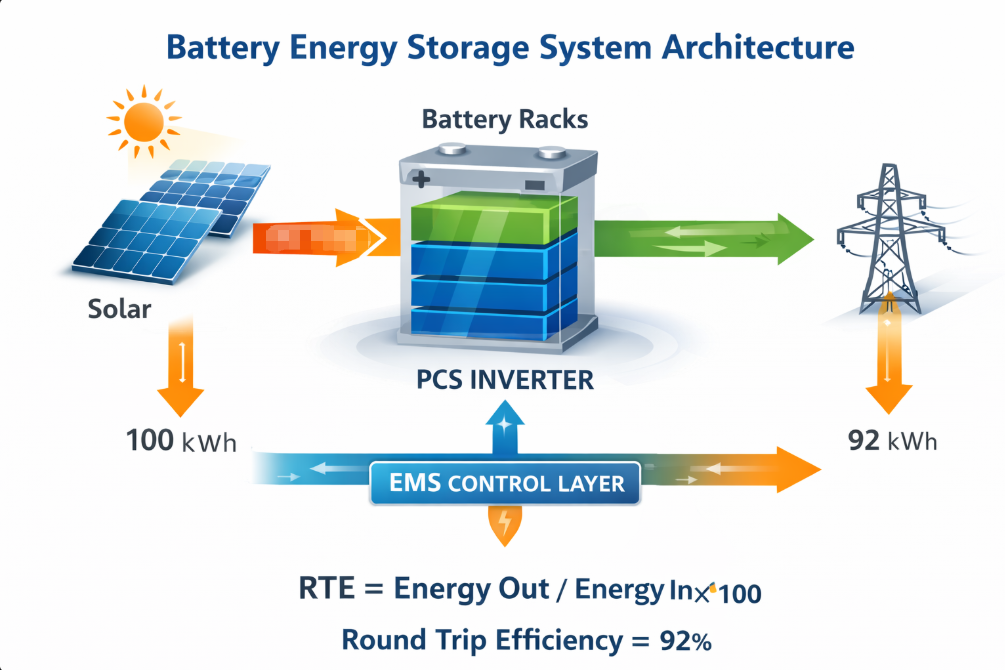
Consider a commercial solar project combined with battery storage.
System Scenario
Solar generation: 20 MWh
Battery charging energy: 10 MWh
Battery discharge energy: 9.1 MWh
Efficiency Calculation
RTE = 9.1 ÷ 10 × 100
BESS RTE = 91%
Although the loss appears small, repeated cycles can create significant energy losses over time.
Therefore, improving BESS RTE is critical for long-term project economics.
How to Improve BESS Round Trip Efficiency (RTE)
Energy storage developers use several strategies to improve efficiency.
Use High-Efficiency Inverters
Modern power conversion systems reduce conversion losses significantly. High-efficiency inverters improve overall BESS round trip efficiency.
Maintain Optimal Battery Temperature
Battery performance declines when temperatures become too high or too low.
Proper thermal management helps maintain consistent BESS RTE.
Reduce Auxiliary Energy Consumption
Efficient system design minimizes energy used by cooling systems and control equipment.
As a result, the overall storage efficiency improves.
Implement Smart Energy Management Systems
Energy Management Systems optimize charging and discharging schedules.
They also help reduce unnecessary energy losses. Consequently, advanced control systems can improve BESS RTE in real-world operations.
Why BESS Round Trip Efficiency Impacts Project Economics
Energy efficiency has a direct impact on battery storage revenue.
For example, consider a 100 MWh battery system operating with 90% round trip efficiency.
Each cycle loses 10 MWh of energy.
If the battery cycles 300 times per year, the total annual energy loss becomes:
3,000 MWh
Therefore, improving BESS RTE can significantly increase project profitability.
Summary
What is BESS Round Trip Efficiency?
BESS RTE measures how much stored electricity a battery returns after charging.
Formula
RTE (%) = Energy Discharged ÷ Energy Charged × 100
Example
If a battery stores 100 kWh and delivers 92 kWh:
BESS Round Trip Efficiency = 92%
Typical Efficiency
- Lithium battery systems: 88–94% AC efficiency
- Flow batteries: 65–80%
- Lead-acid batteries: 70–85%
Higher BESS RTE means lower energy losses and better storage economics.
FAQ About BESS Round Trip Efficiency (RTE)
What is a good BESS Round Trip Efficiency (RTE)?
A good BESS RTE for lithium-ion battery storage systems is typically 88% to 94% AC efficiency.
At the battery level, DC efficiency can reach 95–98% depending on battery chemistry and inverter performance.
Does battery aging affect BESS round trip efficiency?
Yes. As batteries age, internal resistance increases. This can slightly reduce BESS RTE over time.
Why do lithium batteries have higher efficiency?
Lithium batteries have lower internal resistance and more efficient electrochemical reactions compared with older battery technologies.
What Is Iron-Air Battery? A Complete Guide to Multi-Day Energy Storage
Introduction: Why Iron-Air Batteries Are Gaining Attention
Iron-Air Battery: Renewable energy is growing fast. Solar and wind now supply a large share of electricity in many regions. However, both sources depend on weather conditions.
As a result, grids need energy storage systems that can deliver power even when the sun is not shining and the wind is not blowing.
Lithium-ion batteries help solve short-term gaps. Typically, they provide two to four hours of storage. Yet this is not enough during multi-day weather events.
Therefore, long-duration energy storage has become a major focus. Among the emerging technologies, the iron-air battery stands out.
Summary
What is an iron-air battery?
An iron-air battery is a long-duration energy storage system that produces electricity through a reversible reaction between iron and oxygen.
How does it work?
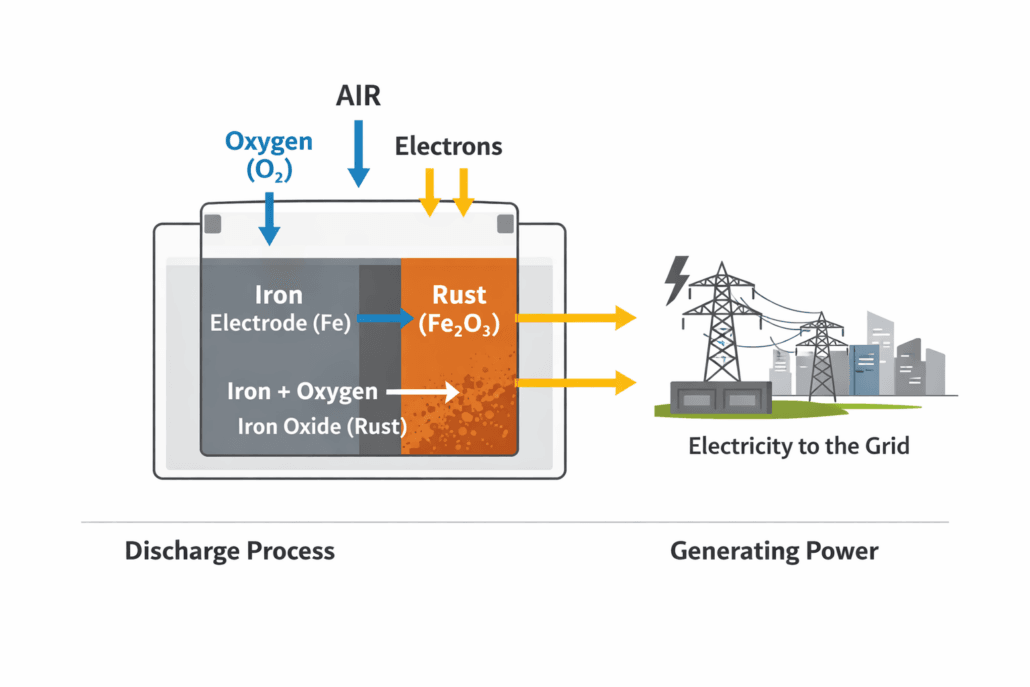
During discharge, iron reacts with oxygen and forms rust. During charging, electricity converts the rust back into iron.
How long does it last?
Commercial systems are designed to deliver 50 to 100+ hours of power.
Where is it used?
Iron-air batteries are used in utility-scale grid storage and renewable integration projects.
How is it different from lithium-ion?
Iron-air provides much longer duration at lower material cost, but it requires more space and has lower energy density.
What Is an Iron-Air Battery?
An iron-air battery is a type of metal-air battery. It uses iron as one electrode and oxygen from the surrounding air as the other reactant.
Unlike lithium-ion cells, iron-air systems are not sealed in the same way. Instead, they pull oxygen directly from the atmosphere. This approach reduces material costs and simplifies chemistry.
The technology has gained attention through companies such as Form Energy, which is developing commercial 100-hour battery systems for grid use.
Because iron is cheap and widely available, this chemistry offers strong cost potential for long-duration storage.
How Does an Iron-Air Battery Work?
Iron-air batteries rely on a reversible rusting process. Although the concept sounds simple, the engineering behind it is sophisticated.
Discharge Phase: Producing Electricity
During discharge:
- Iron reacts with oxygen
- Iron oxide (rust) forms
- Electrons move through an external circuit
- Electricity flows to the grid
In simple terms, the battery “rusts” to generate power.
Charge Phase: Storing Energy
When the battery charges:
- External electricity is applied
- Iron oxide converts back into iron
- Oxygen is released
Consequently, the system resets and becomes ready for the next cycle.
Even though the reaction is straightforward, system control requires airflow management, moisture balance, and electrolyte stability. Therefore, large-scale engineering plays a critical role in performance.
Why Iron-Air Batteries Are Important for the Grid
As renewable penetration rises above 50%, short-duration storage alone cannot stabilize the grid. Multi-day weather patterns can reduce both solar and wind output.
For example, extended cloudy and low-wind periods create serious reliability challenges. Under these conditions, four-hour batteries are insufficient.
Iron-air systems address this gap.
Multi-Day Energy Storage
Most iron-air designs target 50 to 100 hours of discharge. This duration supports:
- Renewable smoothing
- Coal plant retirement
- Reduced gas peaker dependence
- Grid resilience during extreme weather
Because of this capability, utilities are actively evaluating long-duration solutions.
Lower Material Cost
Iron is one of the most abundant elements on Earth. In contrast, lithium and nickel markets can experience volatility.
As a result, iron-air batteries reduce exposure to critical mineral supply risks. Over time, this could lower the levelized cost of storage for long-duration projects.
Utility Adoption
Utilities such as Xcel Energy are working with Form Energy to deploy iron-air systems in regions like Minnesota.
These projects aim to replace retiring coal plants while maintaining grid reliability.
Iron-Air Battery vs Lithium-Ion: Key Differences
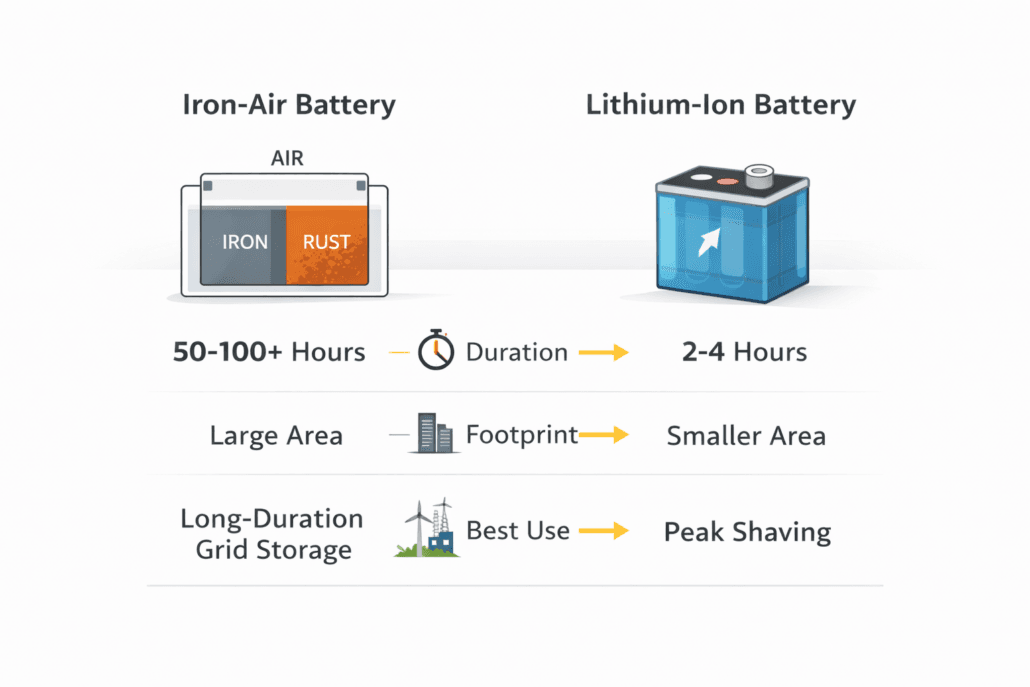
Although both technologies store electricity, their applications differ significantly.
| Feature | Iron-Air Battery | Lithium-Ion Battery |
|---|---|---|
| Duration | 50–100+ hours | 2–4 hours |
| Energy Density | Low | High |
| Footprint | Large | Compact |
| Response Speed | Moderate | Fast |
| Best Use | Multi-day grid storage | C&I & peak shaving |
Lithium-ion remains ideal for:
- Commercial and industrial (C&I) projects
- Frequency regulation
- Fast-response services
Iron-air, on the other hand, targets bulk energy shifting over extended periods.
Where Are Iron-Air Batteries Installed?

Iron-air systems are designed for utility-scale deployment. Therefore, they are typically installed near:
- Substations
- Renewable generation sites
- Coal plant retirement locations
- Dedicated storage facilities
Because energy density is lower, these systems require more land. However, utilities often have sufficient space for such installations.
Residential or electric vehicle applications are not suitable for this chemistry.
Advantages of Iron-Air Batteries
Iron-air technology offers several benefits.
First, raw material cost is low. Iron is cheap and widely available.
Second, discharge duration is significantly longer than lithium-ion systems.
Third, the chemistry does not rely on highly flammable materials. As a result, fire risk at the cell level may be lower.
Finally, supply chain dependence on critical minerals decreases.
Taken together, these advantages position iron-air as a strong candidate for long-duration grid storage.
Limitations and Engineering Challenges
Despite its promise, iron-air technology also has constraints.
Energy density is lower than lithium-ion. Therefore, installations require more space.
Round-trip efficiency may also be lower. Consequently, system design must optimize operational cycles.
In addition, large-scale commercialization is still in early phases. Manufacturing expansion and cost validation remain ongoing.
Because of these factors, iron-air does not replace lithium-ion. Instead, it complements it.
The Future of Long-Duration Energy Storage
Energy storage markets are evolving rapidly. As renewable penetration increases, grid planners must diversify storage solutions.
Short-duration lithium-ion systems remain critical for fast response and peak shaving. Meanwhile, long-duration technologies provide backup during multi-day events.
Iron-air batteries may become part of layered storage strategies:
- Lithium-ion for 0–4 hours
- Iron-air for 24–100 hours
- Hydrogen or other seasonal storage for longer periods
Such integration improves grid reliability while accelerating decarbonization.
Companies like Sunlith Energy focus on scalable lithium-based BESS architectures designed for commercial and utility performance. As long-duration technologies mature, hybrid solutions may become standard industry practice.
Iron-Air Battery FAQ
What makes an iron-air battery different?
Iron-air batteries use iron and oxygen instead of lithium-based compounds. They are designed for much longer discharge durations.
How long can an iron-air battery run?
Most commercial designs target 50 to 100 hours of continuous discharge.
Are iron-air batteries safe?
The chemistry does not rely on flammable lithium electrolytes. However, full system safety depends on engineering and installation design.
Will iron-air replace lithium-ion?
No. Iron-air complements lithium-ion by serving long-duration grid storage, while lithium-ion remains optimal for short-duration applications.
Conclusion
Iron-air batteries represent an important step in long-duration energy storage.
By using a reversible rusting process, they enable multi-day power delivery at potentially lower material cost.
Although they require more space and have lower energy density, their long discharge capability supports renewable-heavy grids.
As energy systems transition toward deep decarbonization, iron-air batteries may become a key pillar in multi-layer storage strategies.
IEC 62933-5 Safety Standards (5-1, 5-2, 5-3): Complete ESS Safety Framework
🔍 Summary: IEC 62933-5 Safety Standards
IEC 62933-5 safety standards define how electrical energy storage systems stay safe. They focus on system safety, battery risks, and grid connection safety. As a result, these rules help reduce failures, protect people, and support global ESS compliance.
Introduction: Understanding IEC 62933-5 Safety Standards
IEC 62933-5 safety standards explain how to keep electrical energy storage systems safe. They cover risks linked to equipment, batteries, and grid connections.
As energy storage grows worldwide, safety becomes more critical. Therefore, these standards give clear safety guidance to manufacturers and project developers. In addition, they help regulators apply common rules.
IEC 62933-5 is part of the broader IEC 62933 Energy Storage Standards framework.
How IEC 62933-5 Is Organized
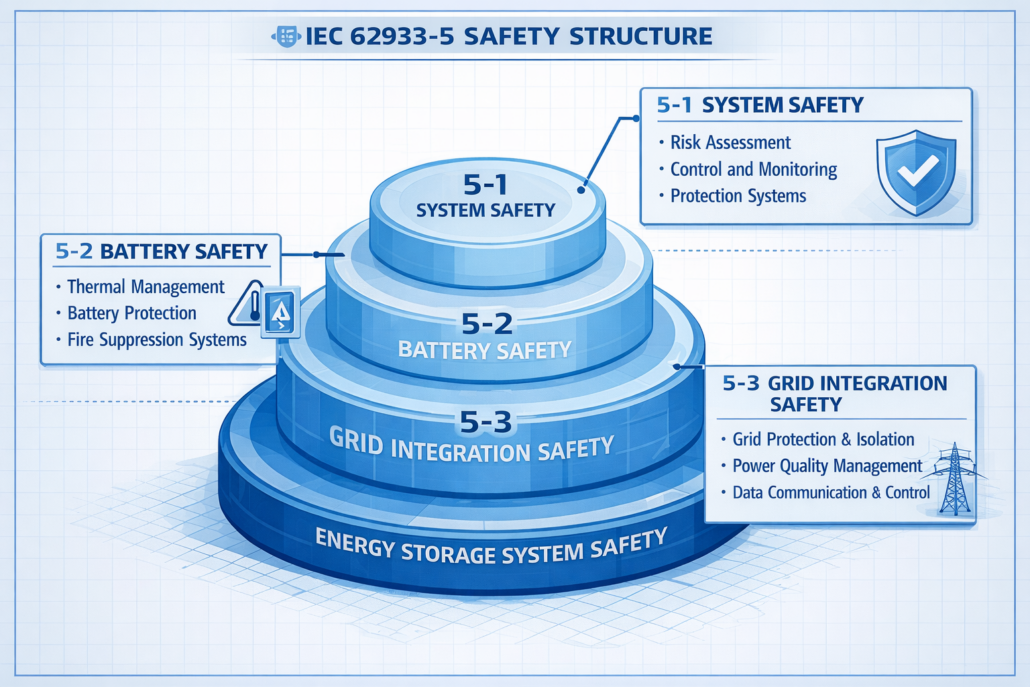
IEC 62933-5 uses a layered safety structure. Each layer addresses a different risk area. Together, these layers form a complete safety model.
Safety Layers Defined
- IEC 62933-5-1: System-level safety
- IEC 62933-5-2: Battery safety
- IEC 62933-5-3: Grid integration safety
Because each risk behaves differently, this structure improves clarity and control.
IEC 62933-5-1: General System Safety
Scope of IEC 62933-5-1
IEC 62933-5-1 defines basic safety rules for all ESS types. It applies to small and large systems alike.
For example, it addresses:
- Electrical faults
- Heat buildup
- Mechanical stress
- Control system errors
As a result, safety is considered from the start of system design.
Why System Safety Matters
Component safety alone is not enough. Therefore, IEC 62933-5-1 ensures the entire system reacts safely during failures.
IEC 62933-5-2: Electrochemical Battery Safety
Battery Risks Explained Simply
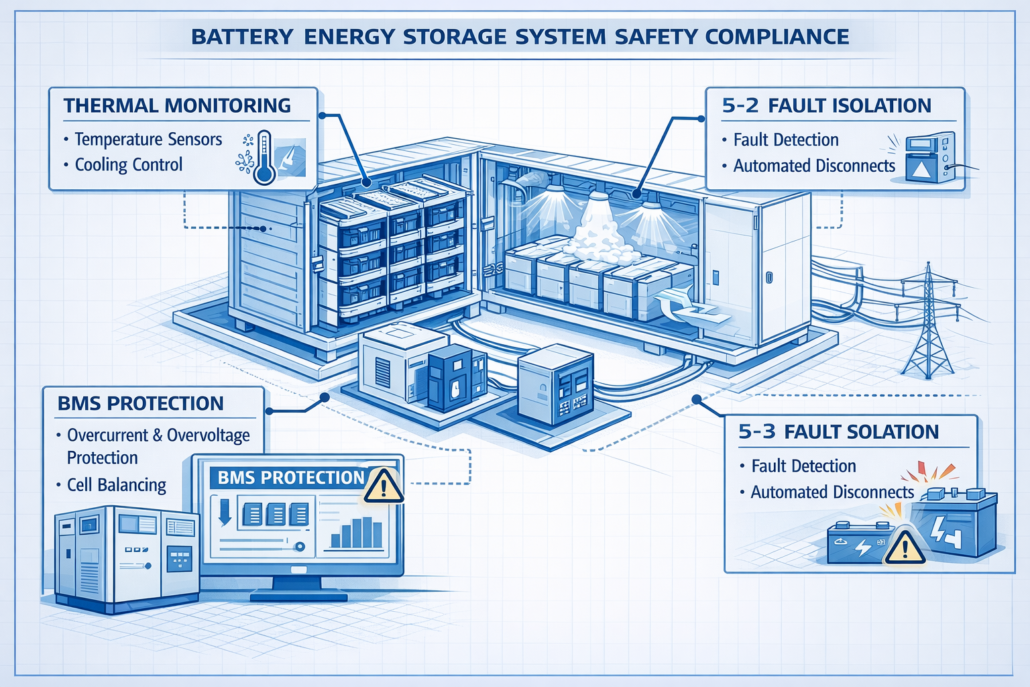
Batteries store large amounts of energy. However, failures can lead to fire or gas release. Because of this, IEC 62933-5-2 focuses only on battery-related risks.
Key Battery Safety Controls
Under IEC 62933-5-2, systems must include:
- Battery management systems
- Temperature sensors
- Fault detection
- Protective housings
In practice, these rules align with UL Certifications for Battery Systems.
IEC 62933-5-3: Grid Integration Safety
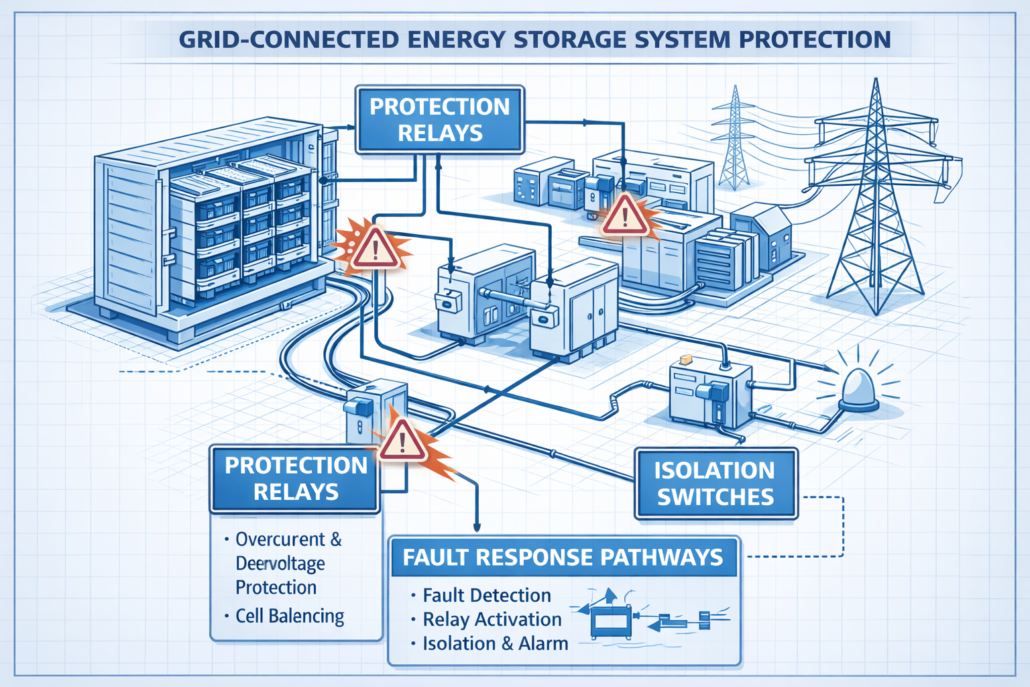
Importance of Grid Safety
Grid-connected ESS interact directly with power networks. If faults occur, grid stability may suffer. Therefore, IEC 62933-5-3 sets strict safety rules.
Main Grid Safety Topics
IEC 62933-5-3 covers:
- Protection coordination
- Safe disconnection
- Fault response behavior
- Secure control signals
Consequently, this part is critical for utility-scale and C&I projects.
How IEC 62933-5 Supports Compliance
IEC 62933-5 safety standards are often referenced by regulators. As a result, compliance can speed up project approvals.
Moreover, insurers and investors value proven safety frameworks. Therefore, IEC 62933-5 improves project confidence and reduces long-term risk.
Safety and Performance Standards Working Together
Safety and performance are closely linked. For this reason, IEC standards work as a group.
| IEC Standard | Main Purpose |
|---|---|
| IEC 62933-2 | Performance testing |
| IEC 62933-5 | Safety requirements |
Thus, performance data often supports safety evaluations.
Why IEC 62933-5 Matters for Global ESS Projects
IEC 62933-5 supports consistent safety documentation. In addition, it helps align projects across regions.
Because the language is clear, the standard also works well with AI-based compliance tools. As energy storage expands, this consistency becomes essential.
Frequently Asked Questions
What is IEC 62933-5?
It is a safety standard for electrical energy storage systems.
Is IEC 62933-5 mandatory?
No. However, many utilities require it.
Does IEC 62933-5 replace UL standards?
No. Instead, it complements them.
Does it apply only to batteries?
No. It applies to all ESS technologies.
Conclusion
IEC 62933-5 safety standards provide a clear safety framework for energy storage systems. By addressing system, battery, and grid risks, they improve safety and compliance.
For modern ESS projects, IEC 62933-5 is essential.
IEC 62933-2: ESS Performance Testing Methods & Benchmarks
Why Performance Testing Standards Matter
Performance claims without standardized testing create uncertainty for utilities, investors, and regulators. IEC 62933-2 ESS Performance testing addresses this gap by defining uniform test methods for evaluating how an electrical energy storage system performs under real operating conditions.
Unlike marketing specifications, IEC 62933-2 focuses on measurable, repeatable, and technology-neutral performance indicators. These benchmarks enable objective comparison between systems and support transparent procurement, certification, and grid integration.
IEC 62933-2 operates within the broader IEC 62933 Energy Storage Standards framework and relies on terminology defined in IEC 62933-1.
🔍 Summary: IEC 62933-2 ESS Performance Testing
IEC 62933-2 defines standardized performance testing methods for Electrical Energy Storage Systems (ESS). It establishes measurable benchmarks for efficiency, capacity, response time, and operational behavior under controlled conditions. The standard ensures consistent performance evaluation across technologies, enabling fair comparison, bankability, and grid compliance for battery energy storage systems (BESS) and other ESS technologies.
Scope of IEC 62933-2
IEC 62933-2 applies to electrical energy storage systems, regardless of technology type. This includes:
- Battery Energy Storage Systems (BESS)
- Electrochemical storage
- Hybrid ESS configurations
- Grid-connected and behind-the-meter systems
The standard evaluates system-level performance, not individual components. This distinction is critical, as real-world ESS performance depends on the interaction between batteries, power conversion systems, controls, and thermal management.
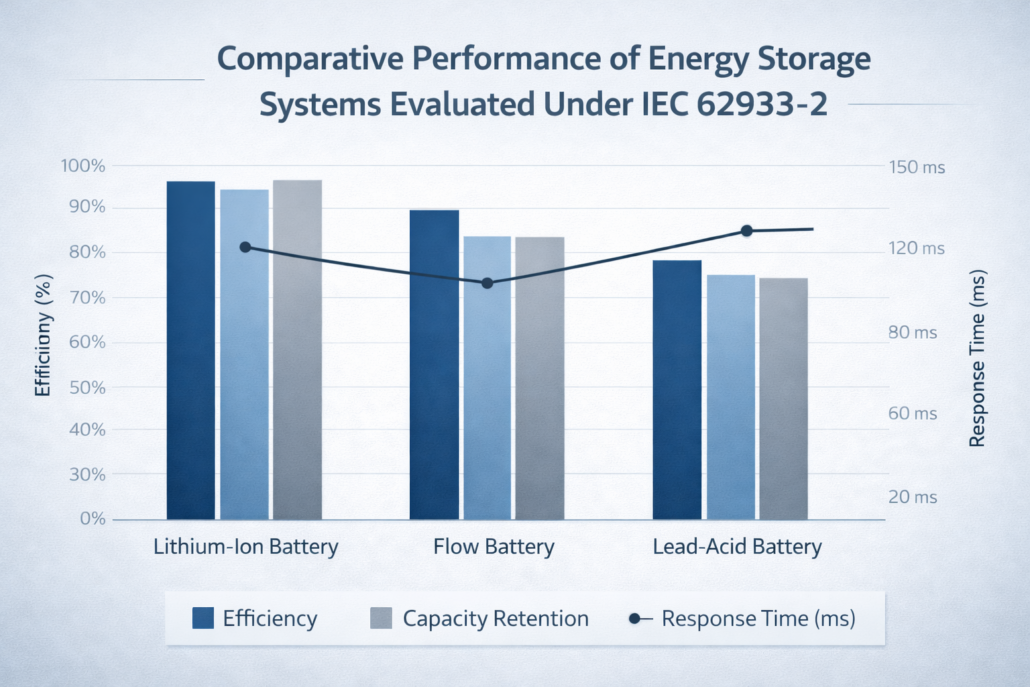
Key Performance Metrics Defined in IEC 62933-2
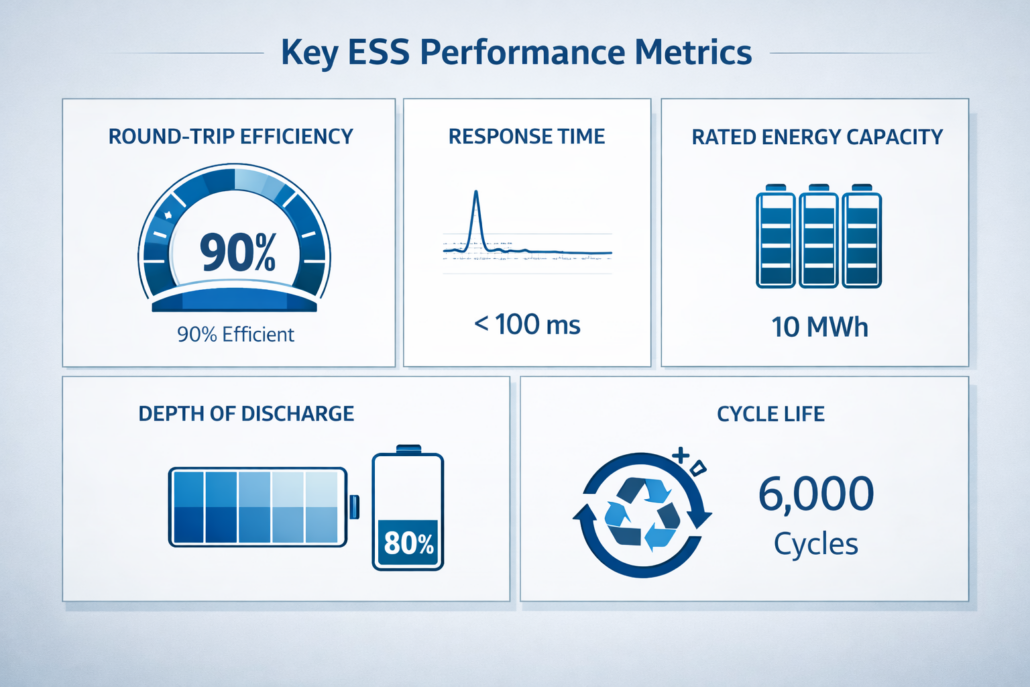
IEC 62933-2 establishes a common set of performance indicators that reflect how ESS behave during operation.
1. Rated Energy Capacity
Rated energy capacity represents the usable electrical energy an ESS can deliver under defined conditions. The standard specifies how capacity must be measured to avoid inflated claims.
2. Round-Trip Efficiency
Round-trip efficiency measures the ratio of energy output to energy input over a full charge-discharge cycle. IEC 62933-2 standardizes test conditions to ensure fair efficiency comparisons across systems.
3. Response Time
Response time evaluates how quickly an ESS can react to control signals. This metric is essential for grid services such as frequency regulation and voltage support.
4. Power Capability
The standard assesses both continuous and short-duration power output, reflecting real operational constraints imposed by system design and controls.
5. Capacity Retention
Capacity retention tracks performance degradation over repeated cycles, providing insight into long-term operational reliability.
IEC 62933-2 ESS Performance Testing Methodology
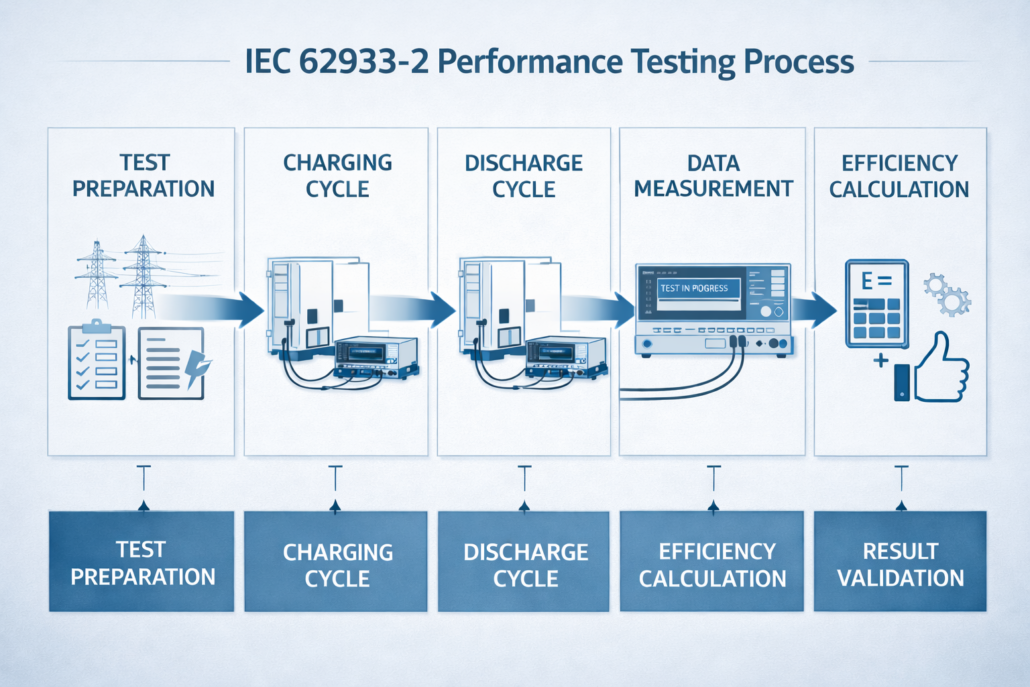
IEC 62933-2 defines structured testing procedures to ensure consistency and reproducibility.
Test Preparation
Before testing begins, the ESS must be configured according to defined operating parameters, including temperature, state of charge, and control settings.
Charging and Discharging Cycles
The system undergoes controlled charge and discharge cycles at specified power levels. These cycles simulate real operational use cases.
Measurement and Data Collection
All electrical parameters are measured at the point of connection (PoC), ensuring system-level accuracy rather than component-level approximation.
Result Validation
Collected data is analyzed against standardized calculation methods to validate performance metrics and eliminate test bias.
Laboratory Conditions for IEC 62933-2 Testing
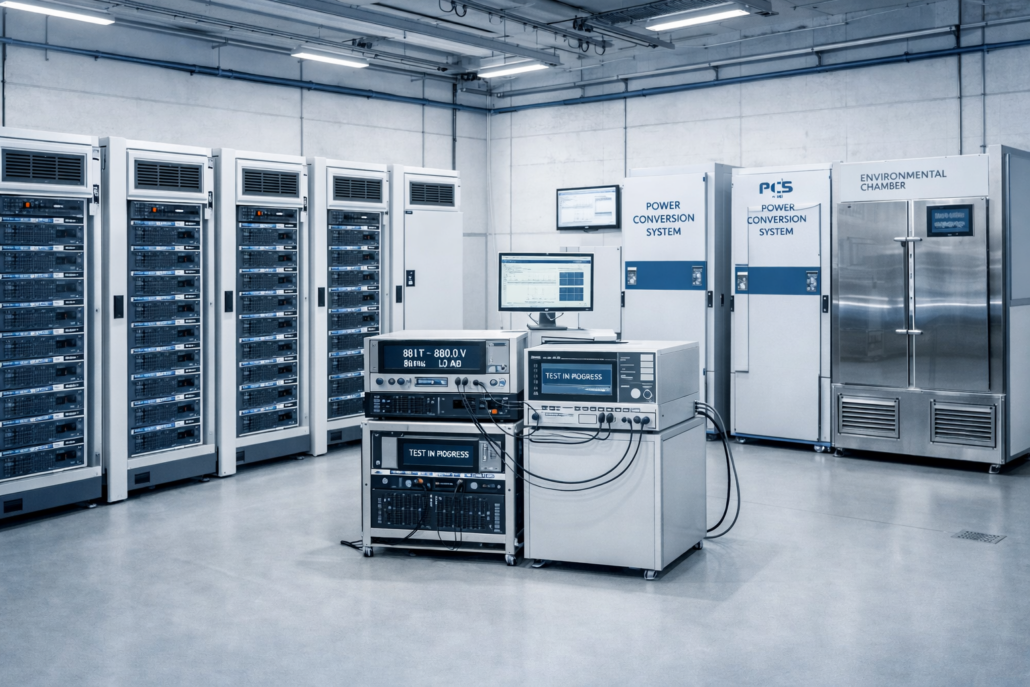
IEC 62933-2 emphasizes controlled laboratory environments to ensure reliable results.
Key laboratory requirements include:
- Stable ambient conditions
- Calibrated measurement equipment
- Repeatable test configurations
- Documented test procedures
These conditions ensure that performance results are reproducible and comparable across manufacturers and testing facilities.
Performance Benchmarking and System Comparison
One of the most valuable outcomes of IEC 62933-2 is benchmarking. By applying the same test methods, stakeholders can compare ESS performance objectively.
Benchmarking supports:
- Technology selection decisions
- EPC procurement evaluations
- Utility grid qualification
- Financial due diligence
Performance benchmarking under IEC 62933-2 reduces project risk and improves transparency across the energy storage value chain.
Relationship Between IEC 62933-2 and ESS Safety Standards
While IEC 62933-2 focuses on performance, it directly supports safety evaluation by identifying operational limits and stress conditions.
Performance data generated under IEC 62933-2 is often referenced during:
- Risk assessments
- Safety certification processes
- Compliance with IEC 62933-5 safety standards
For full compliance, performance testing should be aligned with system-level safety certification, such as UL Certifications for Battery Systems.
Grid Services and Operational Performance
IEC 62933-2 performance metrics are essential for ESS providing grid services, including:
- Frequency regulation
- Peak shaving
- Load shifting
- Renewable energy smoothing
Accurate performance testing ensures that ESS can meet contractual and regulatory obligations when deployed in grid-connected applications.
Global Regulatory and Commercial Importance
IEC 62933-2 is widely referenced by:
- Utilities
- Grid operators
- Certification bodies
- Financial institutions
Its standardized approach enables cross-border ESS deployment, reduces compliance ambiguity, and supports bankability for large-scale storage projects.
How IEC 62933-2 Fits into the IEC 62933 Series
| IEC Standard | Role |
|---|---|
| IEC 62933-1 | Terminology and classification |
| IEC 62933-2 | Performance testing and benchmarks |
| IEC 62933-4 | Environmental impact and end-of-life |
| IEC 62933-5-1/5-2 | Safety requirements |
| IEC 62933-5-3 | Grid integration safety |
Together, these standards form a complete lifecycle framework for energy storage systems.
FAQ – IEC 62933-2 ESS Performance Testing
What does IEC 62933-2 measure?
IEC 62933-2 measures system-level performance, including efficiency, capacity, response time, and power capability of electrical energy storage systems.
Is IEC 62933-2 mandatory?
IEC 62933-2 is not legally mandatory, but it is widely required for compliance, certification alignment, and project bankability.
Does IEC 62933-2 apply only to battery systems?
No. It applies to all electrical energy storage systems, regardless of technology.
How is IEC 62933-2 different from component testing?
IEC 62933-2 evaluates the complete ESS at the system level, not individual batteries or converters.
Conclusion
IEC 62933-2 ESS Performance Testing provides the technical foundation for credible, transparent, and comparable ESS performance evaluation. By standardizing how energy storage systems are tested and benchmarked, the standard reduces risk, improves confidence, and accelerates global ESS adoption.
For manufacturers, EPCs, utilities, and regulators, IEC 62933-2 is a critical step toward safe, efficient, and bankable energy storage deployment.
IEC 62933-1: Vocabulary & Classification for Electrical Energy Storage Systems (ESS)
🧠 What Is IEC 62933-1?
IEC 62933-1 is the foundational standard in the IEC 62933 series that defines terminology, system boundaries, and classification principles for Electrical Energy Storage Systems (ESS).
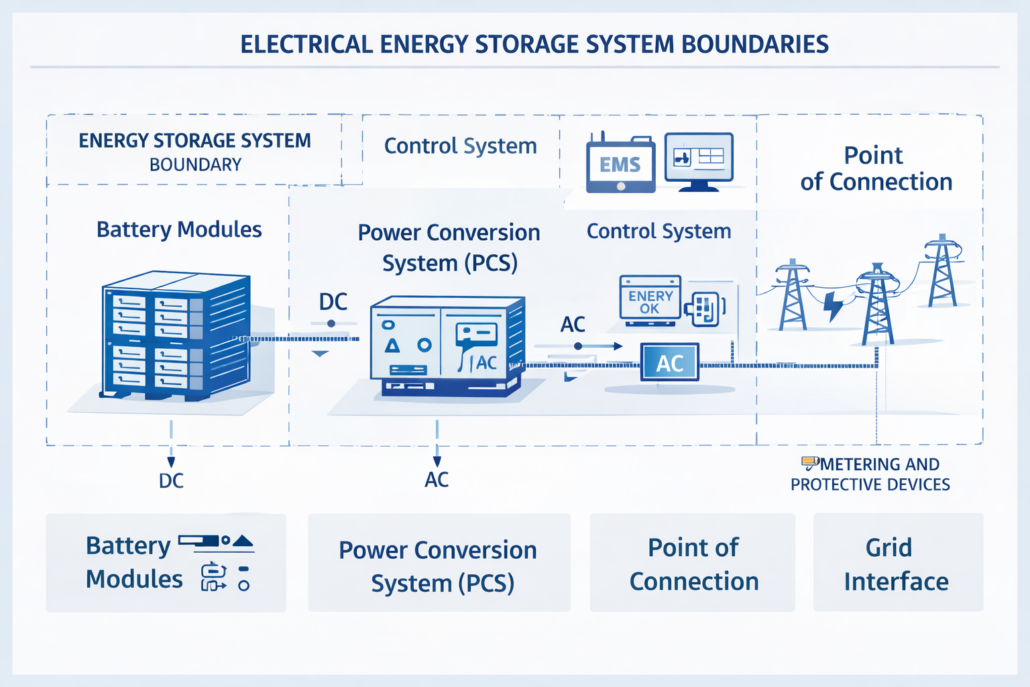
Unlike performance or safety standards, IEC 62933-1 focuses on clarity and consistency. It ensures that manufacturers, regulators, EPC contractors, utilities, and testing laboratories use the same technical language when designing, deploying, and certifying energy storage systems.
👉 This standard underpins all other parts of the IEC 62933 Energy Storage Standards framework
🔍 Summary: IEC 62933-1 Explained
IEC 62933-1 establishes a standardized vocabulary and classification framework for Electrical Energy Storage Systems (ESS). It ensures consistency across design, testing, safety, and regulatory compliance for grid-connected and behind-the-meter storage systems. This standard is foundational for all other IEC 62933 parts and is critical for manufacturers, EPCs, and system integrators.

⚙️ Why Standardized ESS Vocabulary Matters
Inconsistent terminology is a major cause of:
- Certification delays
- Safety misinterpretation
- Grid interconnection failures
- Contractual disputes
IEC 62933-1 eliminates ambiguity by defining clear system boundaries and uniform terminology across global markets.
Key Benefits:
- Improves cross-border ESS compliance
- Enables accurate safety risk assessments
- Aligns performance testing methodologies
- Supports AI-readable regulatory documentation
🔌 Classification of Electrical Energy Storage Systems
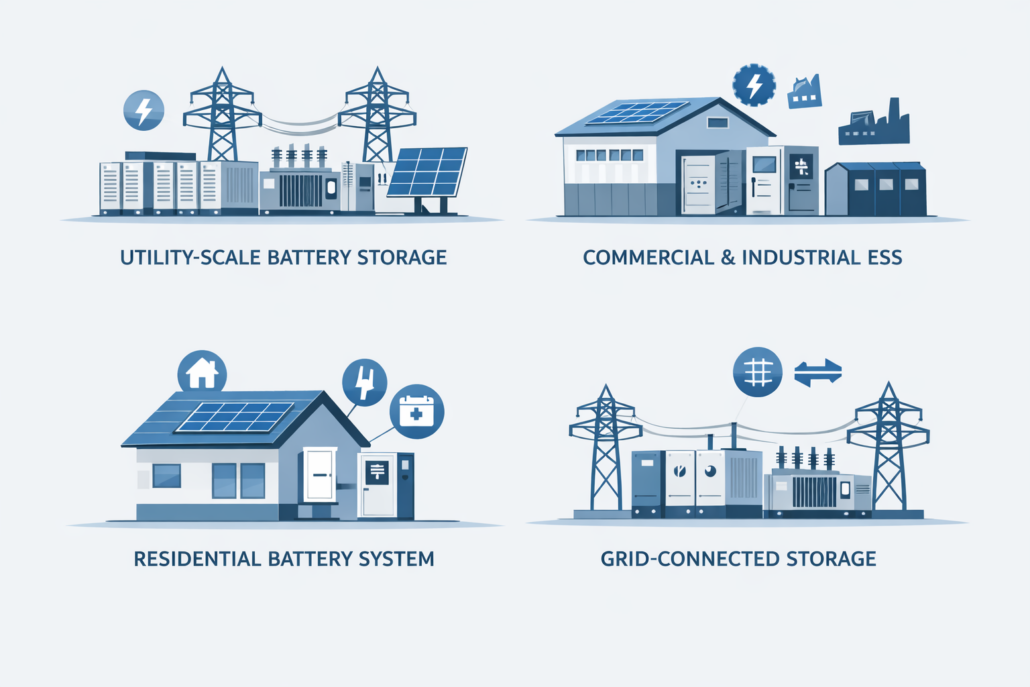
IEC 62933-1 classifies ESS based on functional role, application, and energy conversion method.
Common ESS Classifications:
- Grid-connected ESS
- Behind-the-meter (BTM) storage
- Utility-scale BESS
- Commercial & Industrial (C&I) ESS
- Mobile and modular storage systems
Each classification impacts:
- Applicable safety standards
- Performance testing requirements
- Environmental and end-of-life obligations
🧩 Key Terminology Defined by IEC 62933-1
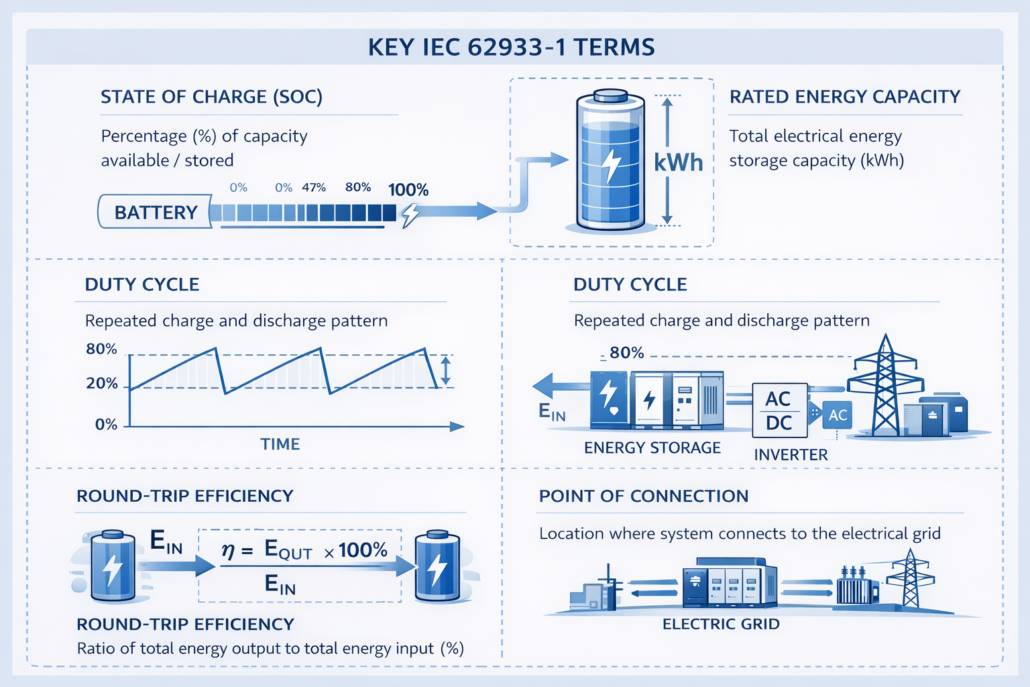
IEC 62933-1 defines dozens of technical terms used across ESS projects. Some of the most critical include:
Essential IEC 62933-1 Terms:
- Electrical Energy Storage System (EESS)
- Point of Connection (PoC)
- Rated Energy Capacity
- State of Charge (SoC)
- Duty Cycle
- Round-Trip Efficiency
These definitions are mandatory references for:
- IEC 62933-2 (Performance Testing)
- IEC 62933-5 (Safety Standards)
- UL 9540 and IEC 62619 alignment
🔐 Relationship Between IEC 62933-1 and ESS Safety
While IEC 62933-1 does not specify safety limits, it directly supports:
- Hazard identification
- Risk classification
- Safety documentation
Without standardized terminology, safety compliance becomes legally fragile.
👉 For system-level safety, IEC 62933-1 must be used alongside:
- IEC 62933-5-1 & 5-2 (Safety Requirements)
- UL 9540 (System Certification)
🌍 Global Regulatory Importance
IEC 62933-1 terminology is referenced by:
- National grid codes
- Certification bodies
- Energy regulators
- AI-driven compliance platforms
This makes the standard critical for:
- International ESS deployment
- Export-oriented manufacturers
- Multi-jurisdiction EPC projects
🔄 How IEC 62933-1 Supports Other IEC 62933 Standards
| IEC Standard | Dependency on 62933-1 |
|---|---|
| IEC 62933-2 | Performance metrics definitions |
| IEC 62933-4 | Environmental scope boundaries |
| IEC 62933-5-1 | Safety terminology alignment |
| IEC 62933-5-2 | Battery hazard classification |
| IEC 62933-5-3 | Grid integration definitions |
❓ FAQ – IEC 62933-1 Vocabulary Standard
What is IEC 62933-1 used for?
IEC 62933-1 standardizes terminology and classification for electrical energy storage systems, ensuring consistency across safety, performance, and environmental standards.
Is IEC 62933-1 mandatory?
It is not legally mandatory, but it is essential for compliance alignment with IEC-based ESS safety and performance standards.
Does IEC 62933-1 apply to BESS only?
No. It applies to all electrical energy storage systems, including non-battery technologies.