Switching to solar energy is a smart move for businesses looking to cut costs, gain energy independence, and reduce their carbon footprint. But before investing, it’s crucial to understand how to calculate the ROI of your commercial solar installation. This guide will walk you through the key factors, provide a clear framework, and offer a […]
Solar energy is no longer a futuristic concept — it’s a mainstream, cost-effective solution for homeowners worldwide. Falling panel prices, tax incentives, and financing programs make it easier than ever to install solar. But one big question remains: Should you install solar panels yourself (DIY solar panel installation), or hire a professional installer? At first […]
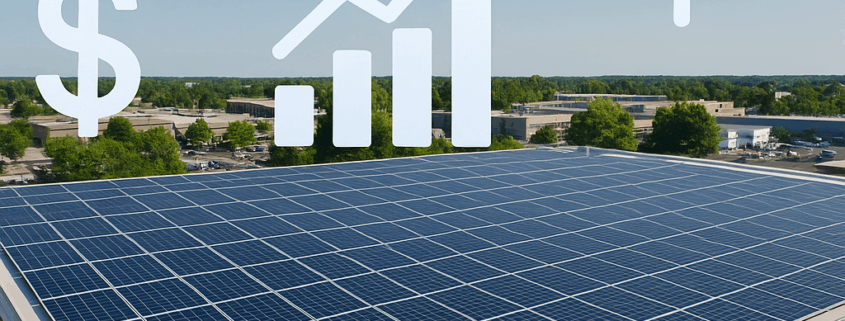
Switching to solar energy is a smart move for businesses looking to cut costs, gain energy independence, and reduce their carbon footprint. But before investing, it’s crucial to understand how to calculate the ROI of your commercial solar installation. This guide will walk you through the key factors, provide a clear framework, and offer a […]
Solar energy is no longer a futuristic concept — it’s a mainstream, cost-effective solution for homeowners worldwide. Falling panel prices, tax incentives, and financing programs make it easier than ever to install solar. But one big question remains: Should you install solar panels yourself (DIY solar panel installation), or hire a professional installer? At first […]
Return on Investment (ROI) measures how much money you’ll earn or save compared to what you spend on the system. For solar, ROI typically includes energy savings, tax incentives, rebates, and potential income from excess power sold back to the grid.
Key Factors That Influence Solar ROI
Before you crunch the numbers, be aware of the variables that affect ROI:
✅ Upfront Costs: Total system cost, including equipment, installation, permits, and maintenance contracts.
✅ Energy Usage & Rates: How much electricity your business uses and your current utility rates.
✅ Available Incentives: Federal tax credits (ITC), state rebates, accelerated depreciation (MACRS), and local incentives.
✅ System Performance: The solar system’s size, efficiency, and local sun exposure.
✅ Operations & Maintenance Costs: Annual costs for cleaning, monitoring, and upkeep.
✅ Financing Method: Cash purchase, solar loan, lease, or Power Purchase Agreement (PPA).
Simple Framework to Calculate ROI
Here’s a step-by-step outline to estimate the ROI for your business solar project:
1. Calculate Total System Cost
Include panels, inverters, mounting, installation, permits, and any other related fees.
Example:
Total cost: $200,000
2. Deduct Available Incentives
Subtract the Federal Investment Tax Credit (currently 30%) and any local incentives.
Example:
ITC savings: $200,000 x 30% = $60,000
Net cost after ITC: $140,000
3. Estimate Annual Energy Savings
Multiply your annual electricity usage (kWh) offset by solar by your current utility rate.
Example:
Annual usage offset: 100,000 kWh
Utility rate: $0.15 per kWh
Annual savings: 100,000 kWh x $0.15 = $15,000/year
4. Consider Additional Revenue Streams
If net metering is available, include income from selling excess power back to the grid.
Example:
Annual excess power income: $2,000/year
5. Factor in Operations & Maintenance Costs
Subtract annual O&M costs from savings.
Example:
Annual O&M: $1,000
Net annual savings: ($15,000 + $2,000) – $1,000 = $16,000
6. Calculate Payback Period
Divide your net system cost by net annual savings.
Example:
Payback period: $140,000 ÷ $16,000 ≈ 8.75 years
7. Calculate ROI Over System Lifetime
Most commercial systems last 25-30 years. Multiply net annual savings by expected lifespan, then divide by net cost and multiply by 100 for a percentage.
Tax Advantages: Accelerated depreciation through MACRS can boost your payback.
Green Branding: Businesses that go solar often enjoy goodwill and marketing value.
Increased Property Value: A building with solar may be worth more to future buyers or tenants.
Tips to Maximize Your Solar ROI
🔍 Get a Professional Energy Audit: Ensure your system is sized accurately. 🗂️ Explore All Incentives: Don’t leave money on the table — research local programs. 💰 Choose Quality Equipment: High-efficiency panels and reliable inverters reduce maintenance headaches. 🤝 Work with Trusted Installers: A reputable installer can design a system for optimal performance. 📈 Monitor Performance: Use monitoring tools to track output and detect issues early.
FAQs About Commercial Solar ROI
Q: How long does it take for a commercial solar system to pay for itself?
A: Most businesses see a payback period between 5 and 10 years, depending on system cost, incentives, and local energy rates.
Q: Does financing a solar system reduce ROI?
A: It can affect your upfront cash flow but may still deliver positive ROI, especially with tax advantages and rising utility costs.
Q: Is solar worth it for small businesses?
A: Yes! Small businesses often benefit from lower operating costs, increased property value, and improved sustainability credentials.
Final Thoughts
Calculating the ROI of your commercial solar installation helps you make a well-informed decision that aligns with your business goals. With proper planning, incentives, and smart system design, your investment can deliver significant long-term savings — and a strong competitive edge.
Solar energy is no longer a futuristic concept — it’s a mainstream, cost-effective solution for homeowners worldwide. Falling panel prices, tax incentives, and financing programs make it easier than ever to install solar. But one big question remains: Should you install solar panels yourself (DIY solar panel installation), or hire a professional installer?
At first glance, DIY solar panel installation seems appealing — you cut labor costs and get full control over the project. On the other hand, professional solar installation provides safety, warranty protection, and long-term performance optimization.
This article compares both options in terms of cost, safety, compliance, and return on investment — and provides resources from Sunlith Energy and trusted organizations like the Department of Energy to guide your decision.
Why Homeowners Choose DIY Solar Panel Installation
DIY solar has gained traction thanks to online tutorials, hardware kits, and the rise of DIY culture. Let’s explore why some homeowners take this route.
Cost Savings from DIY Solar Panel Installation
The biggest attraction of DIY solar is cost reduction. Professional labor can account for 10–20% of total system costs. For a $20,000 installation, that’s $2,000–$4,000 in savings.
However, it’s important to factor in potential risks. Incorrect installation can cause long-term efficiency losses, which might erase your upfront savings.
DIY installation gives you freedom to pick every component — from panels to inverters to storage systems. This level of customization is attractive for those building off-grid systems or experimenting with BESS vs ESS solutions.
The Learning Experience
If you enjoy hands-on projects, DIY solar is an opportunity to learn about electrical systems, panel orientation, and energy production. The sense of pride in generating power from a system you installed yourself is a big motivator.
Risks and Challenges of DIY Solar Panel Installation
While the benefits of DIY solar are tempting, the risks are real.
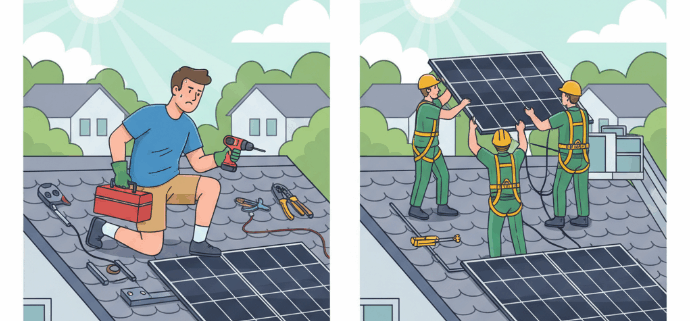
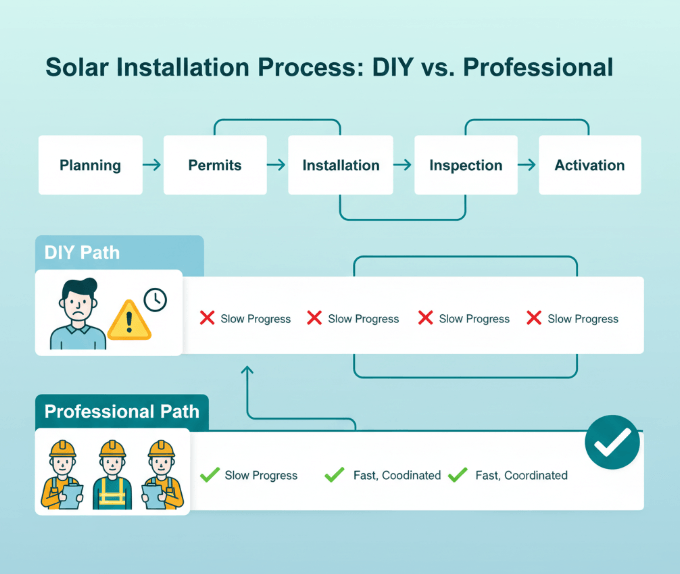
Solar installation process DIY homeowners manage every step themselves while professional installers handle permits inspections and system activation
Safety Concerns
Solar panels generate high-voltage DC electricity, which can be dangerous if mishandled. Rooftop work also introduces fall hazards. The Occupational Safety and Health Administration (OSHA) highlights the importance of proper training and safety gear when working with solar equipment.
Warranty and Insurance Issues
DIY installations often void equipment warranties. For instance, UL 1642 battery certifications stress safe handling requirements that are usually tied to certified installations.
Insurance can also be an issue — some homeowner policies won’t cover damage caused by unlicensed work.
Navigating Permits and Codes
Every solar installation must comply with building codes, zoning laws, and utility interconnection rules. If you install panels incorrectly or skip inspections, you may face penalties or be forced to redo the system.
The U.S. Department of Energy provides guidelines for permits, inspections, and interconnection to the grid — but managing them without professional support can be overwhelming.
Time and Efficiency Tradeoffs
DIY projects often stretch into weeks or months. Meanwhile, a professional team can complete installation in a few days, including permits and inspections. Delays can slow down your access to solar savings.
Benefits of Hiring a Professional Solar Installer
Professional installation remains the preferred choice for most homeowners. Here’s why.
Expert System Design
Professional installers assess your roof orientation, shading, and energy usage to design a system that maximizes efficiency. According to the National Renewable Energy Laboratory (NREL), design optimization can improve system output by up to 20%.
Safety and Compliance
Licensed contractors ensure compliance with IEC and UL certifications — key for long-term system reliability. For example, IEC certifications for BESS guide safety and performance for energy storage systems. Professionals ensure your system passes inspection and qualifies for rebates.
Warranty and After-Sales Support
Professional installations typically include workmanship warranties (5–10 years). If panels fail, the installer handles replacements. This is especially valuable when working with advanced systems like UL 2580 certified EV batteries that require strict safety compliance.
Faster Installation and Paperwork Handling
Professionals handle permitting, inspections, and utility approvals — reducing your workload. According to Energy.gov, certified installers also ensure your system qualifies for federal solar tax credits, something DIY projects may not guarantee.
DIY Solar Panel Installation vs. Hiring a Professional: Side-by-Side Comparison
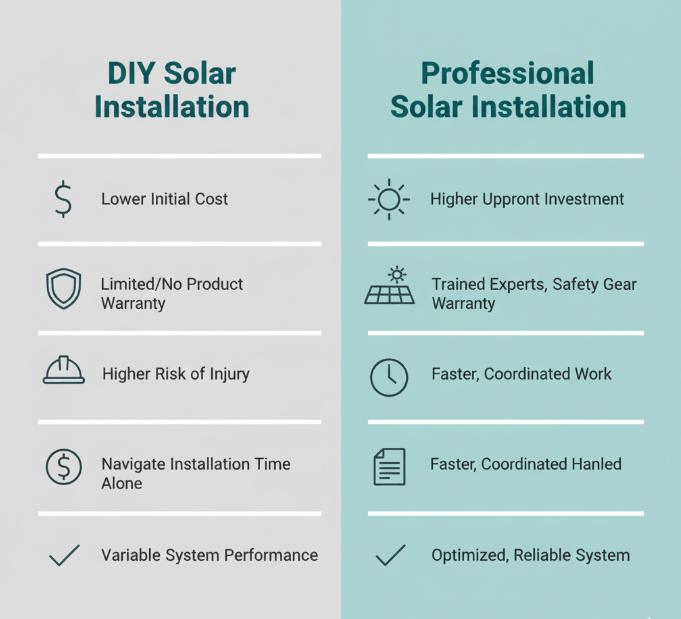
Side by side comparison of DIY solar panels versus professional installation highlighting cost safety warranties and long term reliability
Factor
DIY Installation
Professional Installation
Cost Savings
Saves ~10–20% on labor
Higher upfront, but reliable ROI
Control Over Components
Full customization
Expert recommendations
Warranty Eligibility
Often voided
Full coverage maintained
Permits & Paperwork
Homeowner manages
Installer handles
Safety & Risk
High (rooftop + electrical hazards)
Low with trained crew
Installation Time
Weeks to months
Few days
Reliability
Dependent on skill
High consistency & support
Long-Term Value
May decline if errors occur
Optimized for decades
DIY Solar Panel Installation vs. Hiring a Professional FAQ
Is DIY solar panel instalation legal?
Yes, but you must comply with local codes and permitting requirements. See DOE’s solar permitting guide for details.
How much can I save with DIY solar?
Typically 10–20% on labor. But errors, lost warranties, and insurance exclusions can erase those savings.
Do DIY systems qualify for rebates and tax credits?
Some programs require professional installation. Always check requirements before starting.
Can a DIY system perform as well as a professional one?
Yes — if designed and installed correctly. However, the risk of inefficiency is higher without professional expertise.
What’s the biggest hidden cost of DIY solar?
Lost warranties and rework if your system fails inspections or underperforms.
H
Conclusion: Which Path Should You Take?
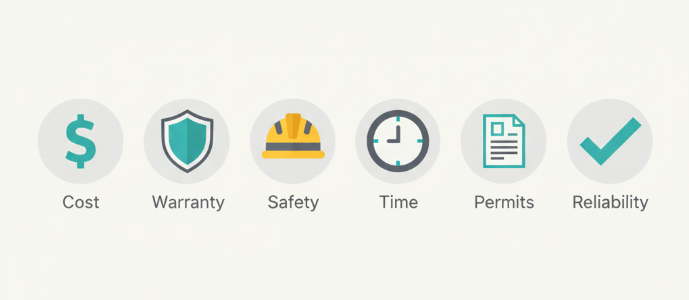
Visual highlights of key factors to consider when choosing DIY or professional solar installation
DIY solar panel installation may be right for skilled homeowners who are comfortable with electrical work, confident with permits, and eager to save on labor costs.
Professional installation is the safer, more reliable choice for those who prioritize performance, warranty protection, and eligibility for incentives.
As the International Energy Agency (IEA) reports, global adoption of solar energy continues to accelerate. Whether you go DIY or professional, you’re joining a growing movement toward renewable, sustainable power.
For most homeowners, the peace of mind, warranty coverage, and optimized system performance from professional installation far outweigh the initial savings of DIY.