
IEC 62619 Explained: The Safety Standard Behind Every Industrial Lithium Battery
IEC 62619 is the international safety standard that most industrial and commercial BESS suppliers get asked for first. Cell datasheets cite it, and procurement checklists demand it. But the standard rarely gets explained beyond a single bullet point in a longer certifications guide. So this article breaks down what it tests. It also covers what changed in the current edition, and how it fits alongside UL 1973 and IEC 63056.
| Quick Answer IEC 62619:2022 is the international safety standard for rechargeable lithium cells and batteries in industrial applications. It covers stationary uses like BESS, UPS, and telecom backup, plus motive uses like forklifts and AGVs, but excludes road vehicles and consumer devices. The current edition added mandatory thermal runaway propagation testing, a formal BMS safety analysis, EMC testing, and overcurrent protection checks. |
What Is IEC 62619?
IEC 62619 is published by the International Electrotechnical Commission’s Subcommittee 21A. Its full title is long, but in short: safety rules for lithium cells and batteries used in industry. The standard sets out the tests needed to show a lithium cell or battery is safe. This applies under both normal use and fault conditions.
The scope is industrial, not consumer. So it covers two broad groups:
- Stationary applications — telecom power, uninterruptible power supplies (UPS), electrical energy storage systems, utility switching, and emergency power
- Motive applications — forklift trucks, golf carts, automated guided vehicles (AGVs), railway vehicles, and marine vessels
Road vehicles are excluded. Where a conflict exists, standards written for automotive traction batteries take precedence instead (the IEC 62660 series). Consumer and portable devices sit under a separate standard, IEC 62133-2, rather than this one. For electrical energy storage systems, suppliers often pair IEC 62619 with a companion standard, IEC 63056. That standard adds rules built for EESS use. More on that distinction below.
The current edition is IEC 62619:2022 (Edition 2.0, published 24 May 2022). It replaced the original 2017 first edition. Europe adopts it through the EN and BS EN routes. Companies also often use the standard alongside CE marking for industrial battery systems.
What Changed Between the 2017 and 2022 Editions
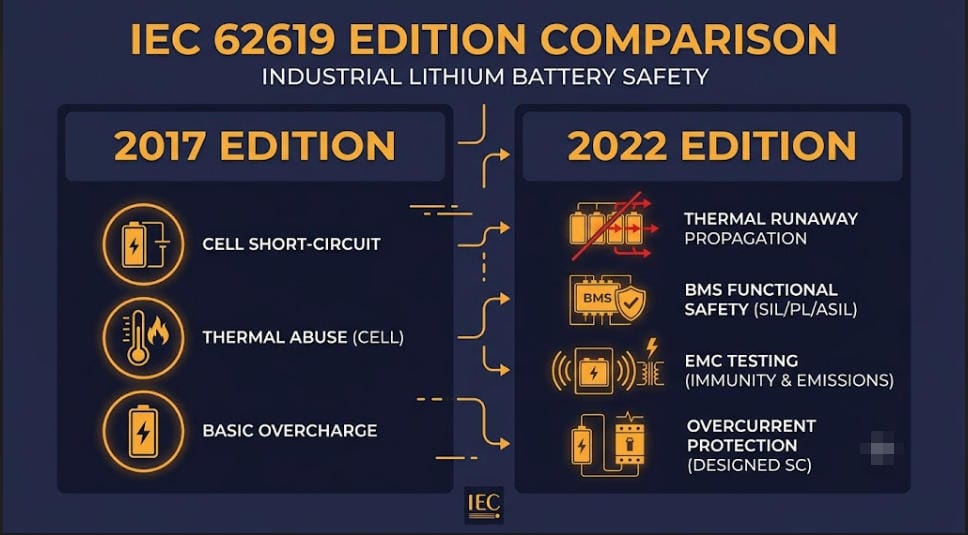
The second edition of IEC 62619 is a meaningfully stricter document. It is not a light refresh. Instead, the main additions concern system-level safety, not cell chemistry. This shift reflects how the industry moved from single-cell risk toward large multi-cell BESS deployments between 2017 and 2022.
| Area | What Changed in the 2022 Edition |
| Thermal runaway propagation | Became a mandatory test. It was present informally since 2017 but is now formalized and expanded. A new laser-ignition method was added as an alternative trigger. |
| BMS functional safety | New rule for a formal safety analysis of the BMS. This references frameworks such as IEC 61508 (targeting SIL-2) or ISO 13849. |
| Overcurrent protection | New test checking that circuit protection triggers correctly under abnormal charge or discharge current. |
| Electromagnetic compatibility (EMC) | New rule showing BMS protection functions aren’t disrupted by outside electromagnetic interference. |
| System locks / fail-safe states | Clarified rules for preventing an unsafe automatic restart after a fault. |
What the Standard Actually Tests
IEC 62619 testing runs across four categories: electrical, mechanical, environmental, and system-level. First, cell-level tests confirm the chemistry and build are safe. Then, system-level tests take over — newer and heavier in the 2022 edition. Together, they confirm the battery and its BMS respond correctly when something goes wrong.
Electrical Safety Tests
- Overcharge — the test charges the cell or battery to roughly 1.5x rated voltage for an extended hold. No fire or explosion may occur. This shows the protection circuit or BMS cuts off correctly.
- External short circuit — the test shorts the terminals through a low-resistance path. Surface temperature must stay well below thermal-runaway onset.
- Forced discharge — the test discharges the battery below its minimum voltage, then checks for safe behaviour and a minimum capacity recovery on recharge.
- Overcurrent protection (2022 addition) — shows the protection circuit activates correctly under abnormal charge or discharge current.
Mechanical and Environmental Tests
- Crush — the test applies a defined force to the battery face. No fire or explosion may occur.
- Free fall — drop testing across several orientations onto a hard surface. Checks for electrolyte leakage, fire, or explosion.
- Vibration and shock — simulates transport and in-service stress without loss of function.
- Temperature cycling — repeated cycling across a wide temperature band. A minimum capacity retention threshold applies at the end.
- Thermal abuse — external heating beyond the maximum rated temperature. Evaluates the failure response.
System-Level Safety Tests
This is where the 2022 edition diverges most from 2017. Instead of behaving like a cell-safety spec, the standard now reads more like a system-safety framework.
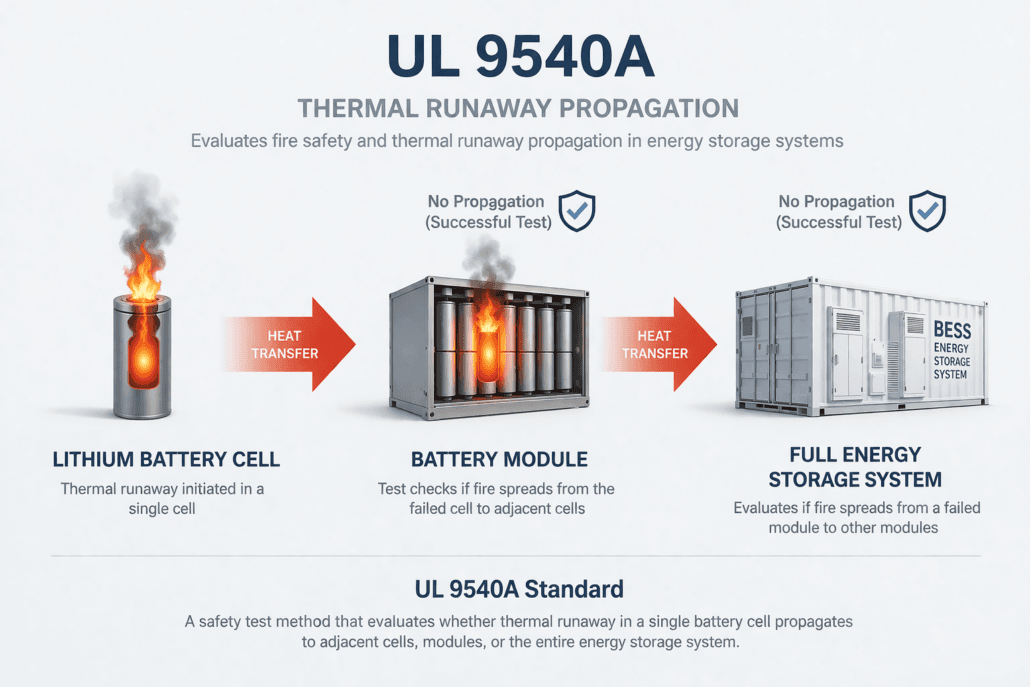
- Thermal runaway propagation — the test deliberately drives a single cell into thermal runaway, then checks the failure doesn’t spread to neighbouring cells. This test matters most for large-format BESS design, since isolated cell failures inside a multi-megawatt-hour system count as a near-certainty over a 15-20 year service life. The goal is a contained, graceful failure, not zero failures.
- BMS functional safety analysis — the test checks the BMS against a recognised safety framework. Triple monitoring of voltage, current, and temperature is typical at cell or module level, plus fast auto-disconnect on fault.
- Communication fault handling — the system must enter a safe state if it loses BMS-to-host communication.
- EMC testing — shows nearby electrical interference can’t disable or reset BMS protection functions.
IEC 62619 vs. Related Standards
IEC 62619 rarely sits alone on a certification checklist. It’s one layer in a stack. That stack spans cell chemistry, system safety, installation, and transport. Here’s how it maps against the standards it’s most often confused with. This comparison draws on the IECEE CB Scheme documentation that governs how these certificates get issued and recognised worldwide.
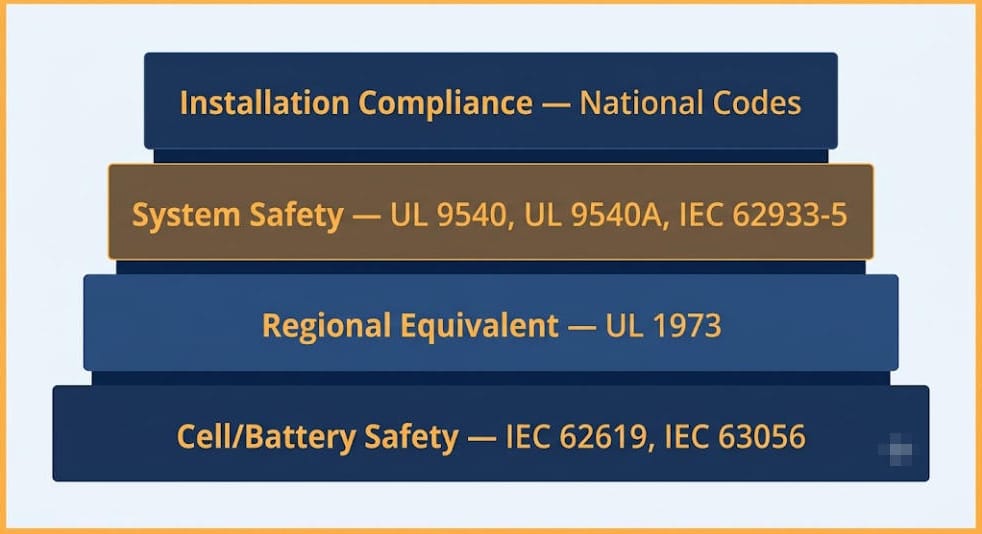
| Standard | Scope | How It Relates to IEC 62619 |
| UL 1973 | US stationary and motive auxiliary power battery safety | Regional equivalent for the US market. Most North American stationary ESS installs require UL 1973 specifically, so global suppliers often hold both UL 1973 and this standard. |
| IEC 63056 | Safety rules for secondary lithium batteries used in electrical energy storage systems | A companion standard, not a substitute. This standard sets the general industrial baseline, while IEC 63056 layers on EESS-specific rules. So ESS suppliers are often asked for both. |
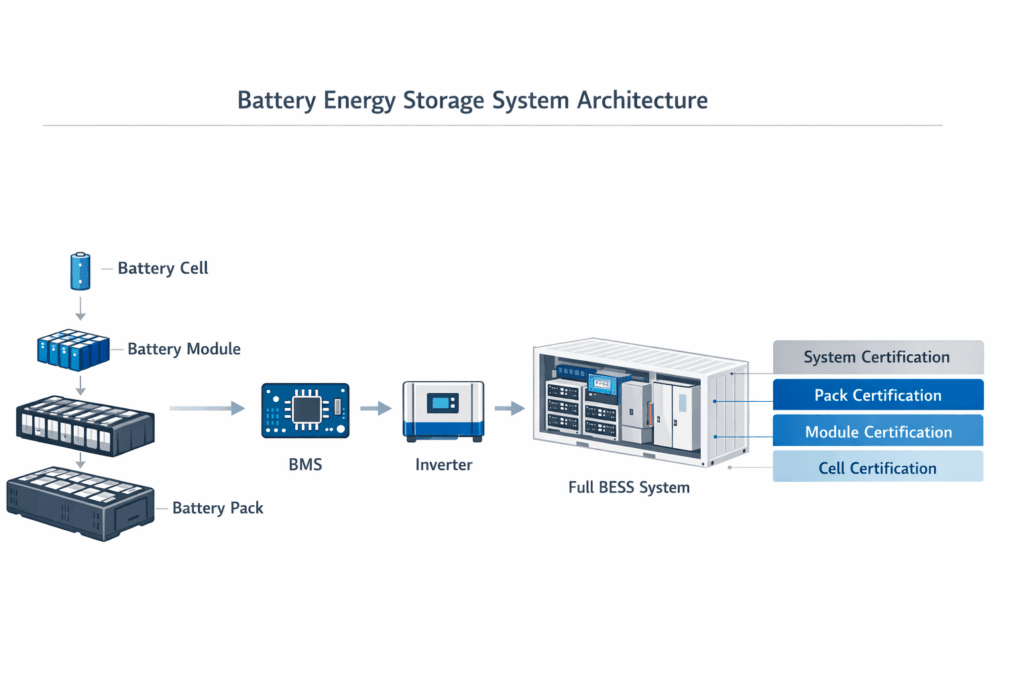
| IEC 62933-5 series | System- and grid-level safety for electrical energy storage systems | Sits above IEC 62619 in the stack. This standard certifies the cell or battery product, then IEC 62933-5 covers safety once that battery joins a full grid-connected system. |
| UL 9540 / UL 9540A | Full BESS system listing (UL 9540) and fire-propagation test method (UL 9540A) | A system-level, US-centric counterpart. So a cell can pass this standard and still need UL 9540A testing once installed in a full enclosure. |
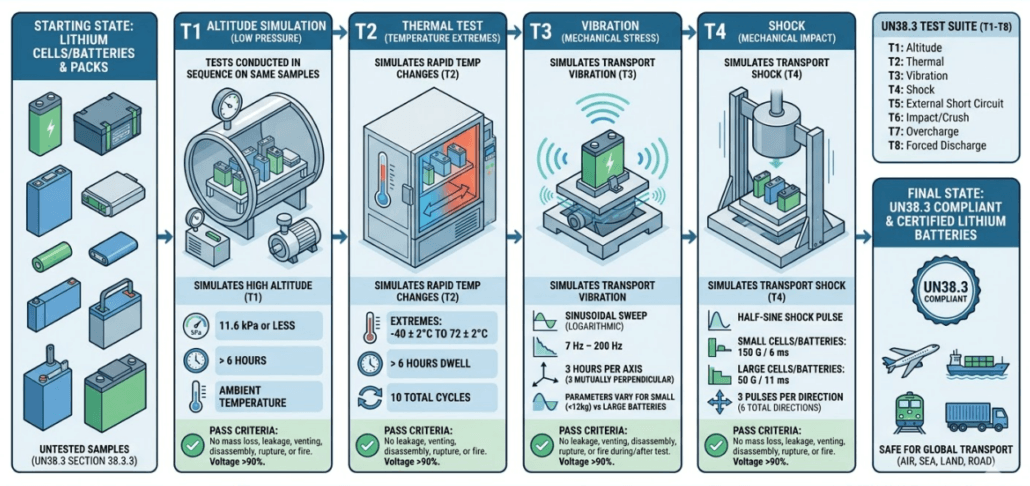
| UN 38.3 | Transport safety for lithium batteries — altitude, vibration, shock, short-circuit during shipping | A different risk entirely: safe transport, not safe operation. So a battery typically needs both UN 38.3 and this certification. |
| IEC 62109-1/2 | Safety of power converters (PCS/inverters) used in PV and ESS | Covers the inverter side, not the battery. This standard and IEC 62109 are complementary, since a full system needs certified batteries and a certified PCS. |
Certification vs. Installation Compliance
One point worth remembering: this standard tests the battery product itself. It says nothing about whether an installation is legal in a given country. In Australia, for example, a certified battery module still has to separately satisfy AS/NZS 5139 for installation safety, AS/NZS 4777.2 for inverter compliance, and AS/NZS 3008.1.1 for cable sizing. So, product certification and installation compliance are two different layers. See our full breakdown in Australia’s New Battery Rules: The 2026 Compliance Stack.
Who Needs IEC 62619 Certification
- Commercial & industrial (C&I) BESS makers and integrators
- Utility-scale energy storage suppliers
- Telecom backup power and UPS system makers
- Industrial motive power — forklifts, AGVs, and similar equipment
- Residential/home ESS suppliers — this standard is often part of the certification stack here too, though household rules sometimes point to IEC 60335 or IEC 63056 instead
Buyers should ask for cell-and-pack-level certification specifically. A component-level test report from one sub-supplier is not enough, since system integration, BMS logic, and enclosure design all affect whether certified parts stay safe once assembled.
Regional Recognition
| Region | How It Is Recognised |
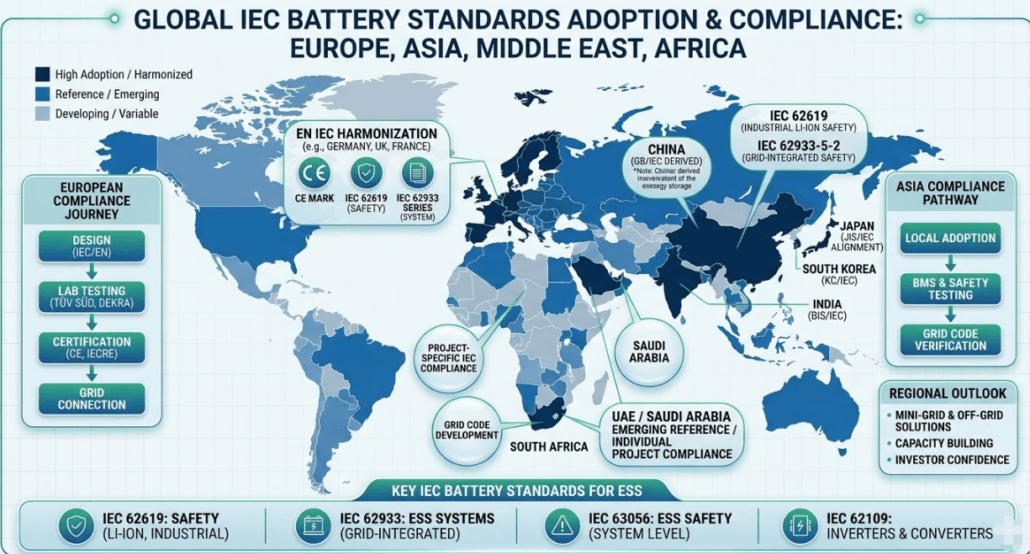
| International (CB Scheme) | 50+ member countries accept test reports and certificates issued under the IECEE CB Scheme. This avoids duplicate testing when entering multiple markets. |
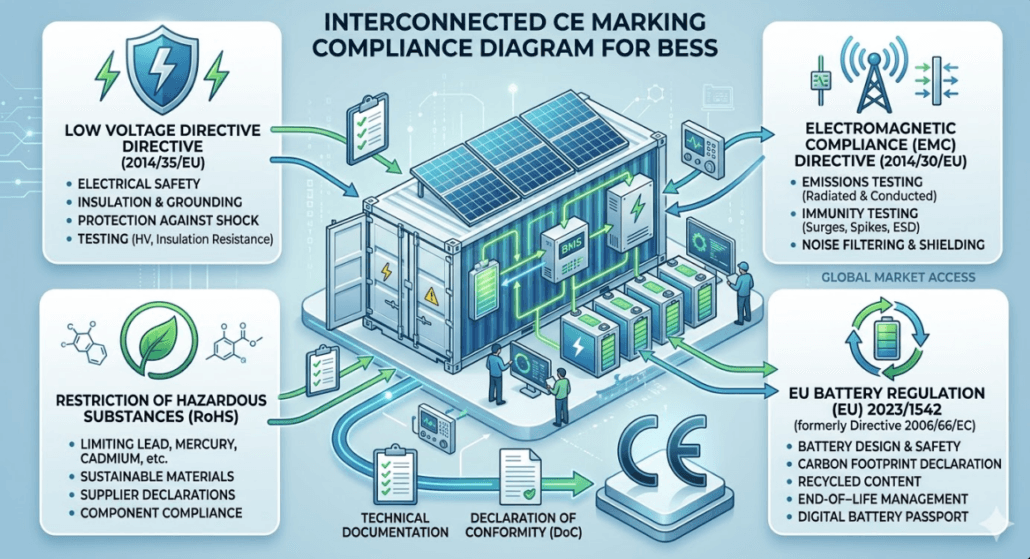
| Europe | Europe uses EN IEC 62619:2022 / BS EN IEC 62619:2022. Manufacturers commonly cite it for CE marking under the Low Voltage Directive. |
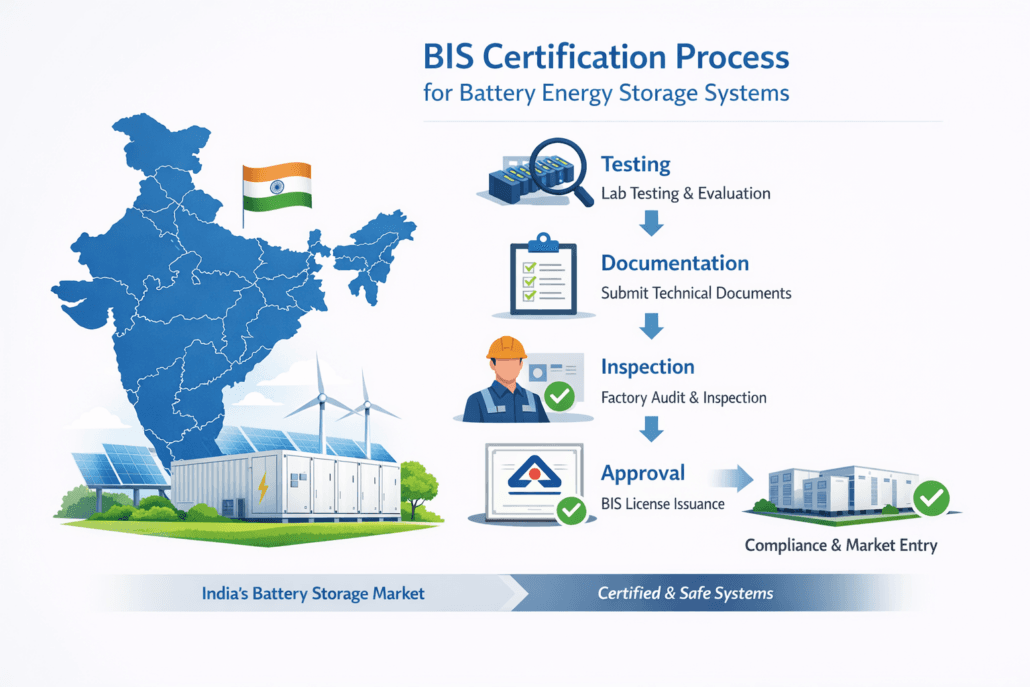
| India | IS 17855:2022 aligns closely with this standard. Large utility and industrial BESS tenders require it. Testing must happen at BIS-approved labs or accredited labs with a BIS agreement. |
| China | GB/T 36276 is the primary domestic standard for lithium-ion energy storage batteries. This standard is used as the international equivalent instead, for export-facing products. |
| Australia & New Zealand | One of the battery certifications commonly requested, alongside UL 1973 and UN 38.3. But it does not replace AS/NZS 5139 installation compliance — see our Australia battery rules hub for the full stack. |
The Certification Process, in Brief
IEC 62619 certification typically runs through the IECEE CB Scheme:
- Submit the application to an IECEE-recognised National Certification Body (NCB) with product docs, cell/battery specs, and BMS design details
- The lab tests samples at an accredited CB Test Laboratory (CBTL) against the full test matrix
- The lab issues a CB Test Report (CBTR) and CB Test Certificate (CBTC) on success
- The CB certificate then converts into national certificates (CE, KC, SAA, and others). This is usually faster than a fresh national bid, since it draws on the existing CB test report
Timelines vary by scope and lab backlog. Full testing commonly runs several weeks to a few months. This depends on sample availability and whether early testing surfaces issues that need a redesign. So, ask suppliers for the CB Test Certificate itself and the full test report. Also confirm which edition, 2017 or 2022, it references. The 2022 edition is now the one expected for new product submissions.
IEC 62619 Compliance Checklist
- Check the certificate references IEC 62619:2022, not the superseded 2017 edition
- Request the full CB Test Report, not just the summary certificate
- Verify the submission includes thermal runaway propagation results — this test matters most for multi-cell BESS safety
- Check the BMS has a functional safety analysis (IEC 61508 SIL-2 or ISO 13849) in the submission
- Check whether the application also needs IEC 63056 certification for the specific EESS use
- For the US market, confirm whether the market requires UL 1973 too
- Don’t treat this standard as a stand-in for system-level or installation rules. Check UL 9540/9540A, IEC 62933-5, or the local installation code separately
- For transport, confirm the supplier holds UN 38.3 certification separately — this standard doesn’t cover it
Frequently Asked Questions
Is IEC 62619 mandatory?
IEC 62619 is a voluntary international standard, not a law. But it’s mandatory in practice across most industrial and utility-scale BESS procurement. Buyers, insurers, and financiers routinely list it as a minimum requirement, and some national tenders, including large BESS tenders in India, name it directly as mandatory.
Does IEC 62619 cover the whole BESS system or just the battery?
It covers the cell and battery product, including its BMS. But it does not cover the full assembled system. Enclosure design, fire suppression, inverter safety (IEC 62109), and grid-level integration (IEC 62933-5) all sit outside its scope.
What’s the difference between IEC 62619 and IEC 63056?
IEC 62619 sets general industrial safety rules for lithium cells and batteries. IEC 63056, meanwhile, is a companion standard with rules specific to electrical energy storage use. So suppliers commonly hold both together, not as alternatives.
Do I need both IEC 62619 and UL 1973?
Only if the product sells into both international and US markets. UL 1973 is what US utilities, AHJs, and insurers expect for stationary ESS, while IEC 62619 is the equivalent almost everywhere else. So global suppliers commonly hold both.
What was the biggest change in the 2022 edition?
The mandatory thermal runaway propagation test, plus the new rule for a documented BMS safety analysis. Both reflect the shift from single-cell risk thinking toward large, multi-cell stationary BESS.
Further Reading
IEC Certifications for BESS: The Global Standard for Safety, Performance & Compliance
BESS Certifications: The Complete 2026 Guide (UL, IEC, CE, BIS & More)
IEC 62933: Global Standard for Grid Energy Storage Systems