
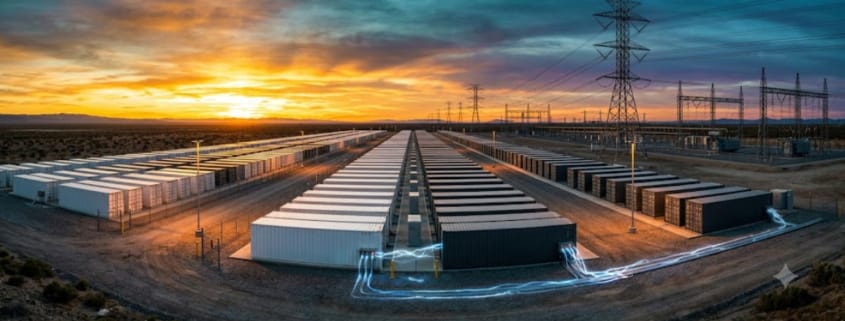

BESS Grid-Forming:The Architecture Stabilising Tomorrow’s Grid
BESS grid-forming technology is transforming how power grids stay stable. As renewable energy now accounts for more than 80% of new global capacity additions, grids are losing the mechanical inertia they once relied on. BESS grid-forming technology solves this problem directly. It lets batteries create their own voltage and frequency — rather than following the grid — so the power system stays balanced even when synchronous generators are absent. This article explains how it works, why it matters, and the $1.2 trillion market opportunity it represents.
| 1.4 TW Global grid-forming BESS capacity gap by 2034 | $1.2T BESS investment required through 2034 | 5.9 TW New wind and solar capacity expected by 2034 | 55% Projected global power demand surge by 2034 |
- 01 — The Grid Stability Problem
- 02 — What Is BESS Grid-Forming Technology?
- 03 — Grid-Forming vs. Grid-Following: Key Differences
- 04 — Core Technical Capabilities of BESS Grid-Forming Technology
- 05 — Control Strategies Behind BESS Grid-Forming Technology
- 06 — Global Market Opportunity for BESS Grid-Forming Technology
- 07 — Real-World BESS Grid-Forming Projects in 2025–2026
- 08 — Challenges and the Path Forward
- 09 — Sunlith Energy's View on BESS Grid-Forming Technology
- Key References and Further Reading
01 — The Grid Stability Problem
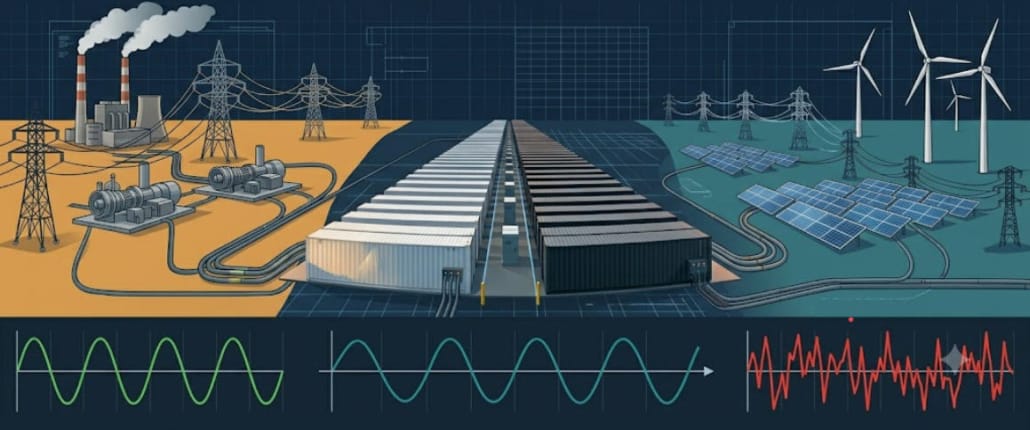
The energy transition is working. Solar costs have fallen by over 90% in a decade. Wind farms now supply power on six continents. Yet this progress creates a serious new challenge: grids are running out of inertia.
Why Inertia Matters for Grid Stability
Traditional grids relied on large spinning generators — coal plants, gas turbines, hydro dams. Their rotating mass provided mechanical inertia. Consequently, when supply and demand shifted, the grid had several seconds to respond. Frequency stayed within safe limits: 49.5–50.5 Hz in Europe, 59.95–60.05 Hz in North America.
Solar and wind farms connect through power electronics. As a result, they add no spinning mass. Therefore, as more synchronous generators retire, frequency swings become faster and more severe. The April 2025 Iberian blackout showed exactly what this means in practice — a cascading failure knocked out power across Spain, Portugal, and parts of France.
Why BESS Grid-Forming Technology Is the Answer
BESS grid-forming technology fills the inertia gap electronically. Instead of waiting for the grid to stabilise, a grid-forming battery creates its own stable voltage and frequency. In addition, it responds in milliseconds — far faster than any thermal plant. That is why grid planners worldwide are now prioritising BESS grid-forming technology as essential infrastructure, not just a backup option.
| KEY INSIGHT The April 2025 Iberian blackout reignited the global debate about grids running with too little inertia. Since then, BESS grid-forming technology has moved from ‘experimental’ to ‘strategic priority’ in market after market. |
02 — What Is BESS Grid-Forming Technology?
To understand BESS grid-forming technology, it helps to start with how batteries connect to the grid. Every battery, solar farm, and wind turbine connects through a power electronic device called an inverter. The inverter controls how electricity flows onto the AC network.
Grid-Following Inverters: The Old Standard
Until recently, almost all inverters operated in grid-following mode. A grid-following inverter reads the existing voltage waveform on the network. Then it synchronises its output current to match. This approach works well when plenty of synchronous generators are providing a stable reference. However, it fails in weak grids or during blackouts because there is no waveform left to follow.
BESS Grid-Forming Technology: The New Standard
BESS grid-forming technology works differently. A grid-forming inverter does not wait for a voltage signal. Instead, it generates its own voltage magnitude and frequency using sophisticated digital control algorithms. In other words, it behaves like a voltage source rather than a current source. Furthermore, it can hold that voltage stable even when the wider grid collapses — making black start and islanded operation possible.
“BESS grid-forming technology represents a critical breakthrough for renewable energy integration. As global power demand surges 55% by 2034, GFM BESS provides the bridge between renewable abundance and grid stability.”
— Robert Liew, Research Director, Wood Mackenzie, July 2025
In short, BESS grid-forming technology gives batteries the ability to anchor the grid — not just respond to it. For a full technical breakdown, see Wood Mackenzie: Steadying the Grid.
03 — Grid-Forming vs. Grid-Following: Key Differences
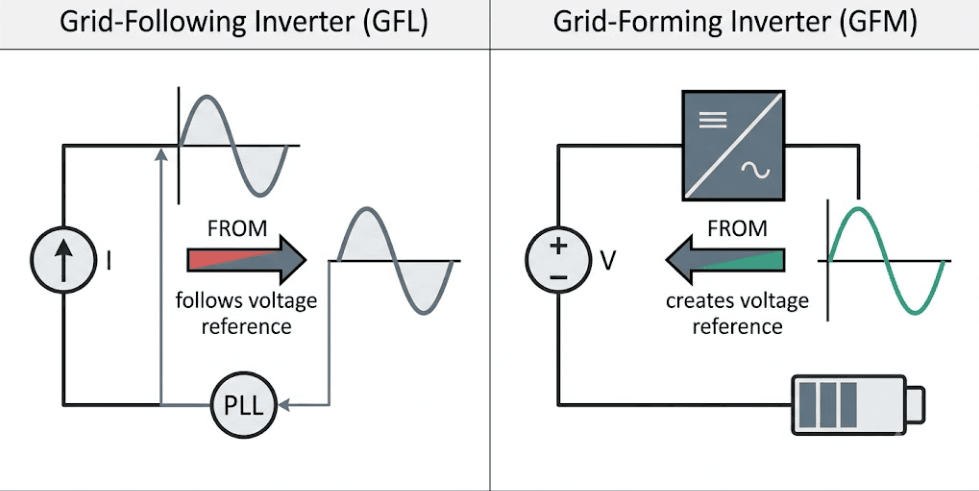
The table below compares grid-forming and grid-following BESS across the capabilities that matter most for modern power networks. Notably, BESS grid-forming technology unlocks revenue streams that grid-following systems simply cannot access.
| Capability | Grid-Following BESS | Grid-Forming BESS |
| Voltage Reference | Follows an existing grid signal | Creates its own voltage and frequency |
| Synthetic Inertia | ❌ Not available | ✅ Fully capable |
| Black Start | ❌ Needs external reference | ✅ Energises isolated networks |
| Weak Grid Support | ⚠ Performance degrades | ✅ Optimised for low short-circuit ratio |
| Islanding | ❌ Trips on isolation | ✅ Seamless island and resync |
| System Strength | ❌ Minimal | ✅ Fault current and voltage support |
| Fast Frequency Response | ⚠ No inertia component | ✅ FFR plus inertial response |
| Fault Ride-Through | ⚠ Standard only | ✅ Enhanced, phase-jump tolerant |
| Energy / FCAS Markets | ✅ Widely deployed | ✅ Same, plus premium stability revenue |
| Hardware Cost Premium | Baseline | ~15% higher (gap narrowing fast) |
The 15% Cost Premium Is Shrinking
Grid-forming hardware costs roughly 15% more than conventional BESS. This premium covers upgraded inverters, enhanced controls, and higher surge current capacity. However, battery cell prices fell 10–40% worldwide over the past year alone. Therefore, the effective cost gap is closing rapidly. Moreover, the premium stability services that BESS grid-forming technology unlocks — synthetic inertia, black start, system strength — generate significantly higher revenues. For pricing detail, see the Wood Mackenzie BESS Opportunity Report.
04 — Core Technical Capabilities of BESS Grid-Forming Technology
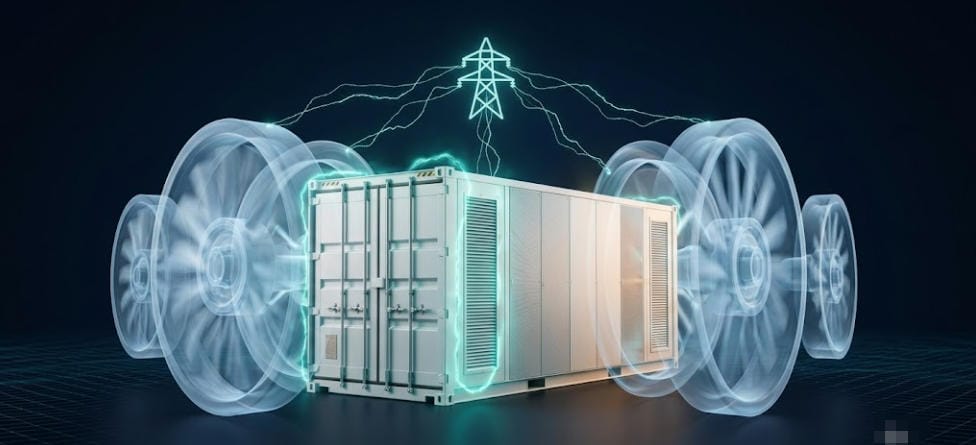
BESS grid-forming technology delivers six capabilities that conventional battery storage cannot match. Each one addresses a specific gap created by the shift to renewable generation.
| ⚡ Synthetic Inertia Electronically replicates spinning mass. When frequency shifts, stored energy is injected within milliseconds — buying time for other resources to respond. | 🔄 Black Start Restarts de-energised network segments after a blackout without needing help from thermal plants. The battery creates the initial voltage from scratch. |
| 📊 Voltage and Frequency Regulation Actively establishes and maintains both voltage magnitude and frequency — the reference signal that all other grid devices rely on. | 🏝 Islanding and Resynchronisation Keeps supply stable in an isolated grid section during faults. When the fault clears, it reconnects to the main grid autonomously and without disruption. |
| 💪 System Strength Provides short-circuit current and fault-level capacity. This is essential for connecting more renewables in areas with low grid strength. | 🛡 Oscillation Damping Detects and suppresses inter-area power oscillations — a growing risk as synchronous generators retire and natural damping disappears. |
Synthetic Inertia: How BESS Grid-Forming Technology Replaces Spinning Mass
Synthetic inertia is the most important capability of BESS grid-forming technology. Here is how it works. When grid frequency begins to fall, the control system detects the rate of change of frequency (RoCoF) in real time. Next, it discharges stored energy in proportion to that rate of change. As a result, the battery mimics the behaviour of a large spinning turbine — but responds ten times faster and remains active for hours rather than seconds.
The Blackhillock BESS in Scotland proves this in practice. Its grid-forming inverters deliver 370 megawatt-seconds of synthetic inertia and 116 MVA of short-circuit contribution directly to the GB transmission system. Furthermore, the system was the first battery in the world to provide full active and reactive power stability services at transmission level. Read the full story: Grid-Forming Tech on Centre Stage — PV Magazine. For the underlying AEMO technical methodology, see Quantifying Synthetic Inertia from GFM BESS (AEMO, 2024).
05 — Control Strategies Behind BESS Grid-Forming Technology
Three main control strategies power BESS grid-forming technology. Each offers different trade-offs between simplicity, performance, and compatibility with existing grid infrastructure.
1. Droop Control
Droop control is the most widely deployed strategy in BESS grid-forming technology today. It works by mimicking a synchronous generator’s natural response: when frequency drops, active power output increases automatically; when frequency rises, output falls. Similarly, voltage deviations trigger reactive power adjustments. Droop control is straightforward to deploy and coordinates well across multiple units. Therefore, it dominates utility-scale projects currently in operation.
2. Virtual Synchronous Generator (VSG)
VSG control takes the concept further. It mathematically models the full dynamic equations of a synchronous machine — including the swing equation, damping coefficient, and excitation system. Consequently, the battery produces inertial behaviour that closely mirrors a real generator. This approach integrates naturally with protection frameworks built around synchronous machines. However, it requires more careful tuning and greater computational power. For a detailed technical comparison, see GFM vs GFL — OPAL-RT.
3. Power Synchronisation Control (PSC)
PSC replaces the phase-locked loop (PLL) used in grid-following inverters with a direct synchronisation mechanism. As a result, it stays stable in very weak grids and close to faults where PLLs break down. PSC is well established in HVDC-VSC systems and is now being adapted for BESS in low short-circuit ratio environments. In addition, it is particularly suitable for remote or islanded microgrids where grid strength is inherently low.
| REGULATORY NOTE IEEE Standard 2800 and NERC ride-through profiles are shaping GFM compliance in North America. In Australia, AEMO’s voluntary GFM specification splits capabilities into ‘core’ (software only) and ‘additional’ (hardware upgrades). The EU’s NC RfG is being revised to add GFM-specific testing for synthetic inertia, oscillation damping, and islanding. |
06 — Global Market Opportunity for BESS Grid-Forming Technology
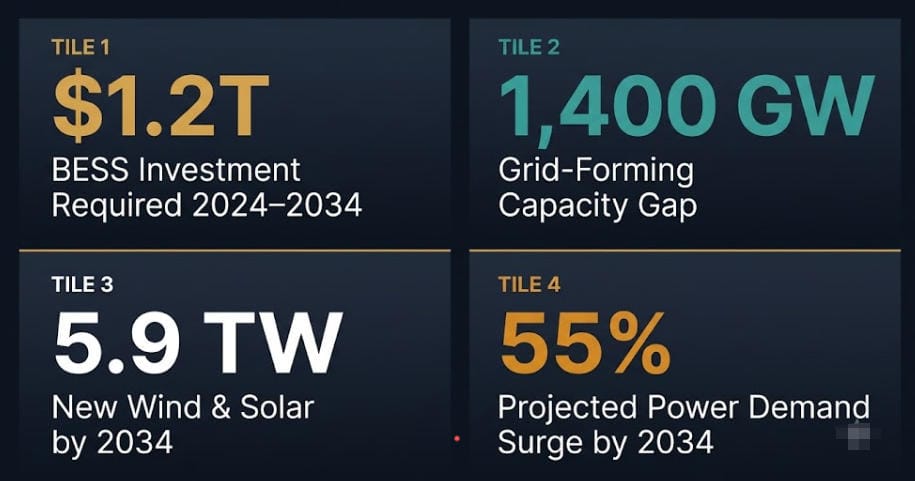
The market for BESS grid-forming technology is enormous — and largely unmet. Wood Mackenzie’s July 2025 analysis identified a 1,400 GW global capacity gap for grid-forming battery storage through 2034. To put that in context, $1.2 trillion of BESS investment is required over the decade to support more than 5,900 GW of new wind and solar capacity. Furthermore, global power demand is forecast to surge 55% by 2034, with over 80% of new capacity coming from variable renewables.
Australia Leads the World in Grid-Forming BESS Deployment
Australia’s National Electricity Market (NEM) is the most advanced market for BESS grid-forming technology globally. According to AEMO’s 2025 Transition Plan, ten grid-forming BESS sites with a combined output of 1,070 MW are already in operation. See our BESS grid-forming projects portfolio. Moreover, a further 94 projects — 78 standalone batteries and 16 hybrid installations — are in the development pipeline. AEMO has also explicitly identified BESS grid-forming technology as the dominant provider of fast FCAS (Frequency Control Ancillary Services) introduced in 2023. See: Australia’s GFM Pipeline — Energy Storage News.
The UK’s Stability Pathfinder: A Revenue Model for Grid-Forming BESS
In the United Kingdom, National Grid’s Stability Pathfinder programme has created long-term contracts for grid-forming services — specifically synthetic inertia and system strength. This gives developers the revenue certainty needed to finance large BESS grid-forming technology projects. As a result, the UK is building one of the most commercially mature markets for this technology outside Australia.
Saudi Arabia Sets a World Record
In December 2025, Saudi Arabia connected a 7.8 GWh grid-forming BESS — the largest in the world at commissioning — to its national transmission network. The project delivers black-start capability, virtual inertia, fast frequency response, and voltage support. Furthermore, it was completed in an extraordinarily compressed timeline, with over 1,500 PowerTitan 2.0 units manufactured in just 58 days. Read more: Saudi Arabia 7.8 GWh BESS — Energy Storage News.
07 — Real-World BESS Grid-Forming Projects in 2025–2026
These three projects confirm that BESS grid-forming technology has moved decisively from pilot stage to mainstream deployment.
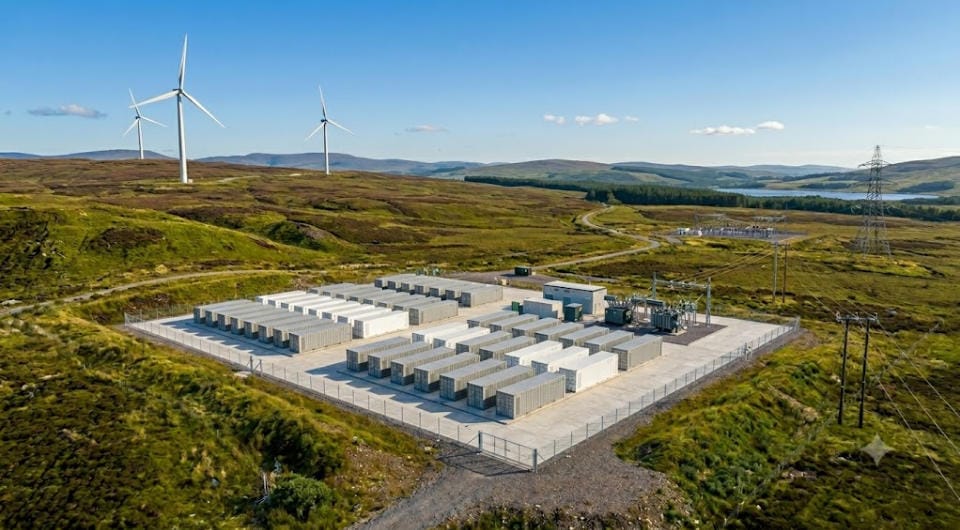
Blackhillock BESS — Great Britain (200 MW / 400 MWh)
Developed by Zenobe with Wärtsilä storage and SMA grid-forming inverters, Blackhillock became the world’s first battery to deliver full active and reactive power stability services at transmission level. It sits in northeast Scotland — a region dominated by wind generation where synchronous capacity is limited. Consequently, it provides synthetic inertia and voltage stabilisation that the local grid cannot otherwise source. The project holds 62 SMA medium-voltage stations and delivers 370 MW·s of synthetic inertia and 116 MVA of short-circuit contribution.
Saudi Arabia 7.8 GWh Grid-Forming BESS
This is currently the largest BESS grid-forming project in the world. Equipped with Sungrow PowerTitan 2.0 systems, it provides black-start capability, virtual inertia, fast frequency response, and voltage support to the Saudi transmission network. In addition, the project directly supports Saudi Arabia’s Vision 2030 clean energy programme and demonstrates that BESS grid-forming technology can scale to multi-gigawatt-hour levels within short construction windows.
Dalrymple BESS — South Australia
Dalrymple is an important proof-of-concept for islanding and resynchronisation. After the main grid fails, the battery maintains stable supply to an isolated network section. Then, when the grid recovers, it adjusts its own frequency to match before reconnecting — without any disruption. This autonomous resynchronisation capability is now a standard requirement in AEMO procurement rounds. For the underlying analysis, see Hitachi Energy: Bridging the Inertia Gap.
08 — Challenges and the Path Forward
Despite strong momentum, BESS grid-forming technology faces four genuine barriers that the industry must address to close the 1,400 GW gap.
Challenge 1: Regulatory and Standards Gaps
Most grid codes were written for synchronous machines. As a result, they do not include compliance testing procedures for capabilities unique to BESS grid-forming technology — such as synthetic inertia provision, oscillation damping, and islanding. IEEE and IEC are actively drafting updates. However, regulatory change takes time, and developers face uncertainty in the interim. See the latest review: Grid Codes for GFM Inverters — ScienceDirect.
Challenge 2: Modelling Complexity
Grid-forming inverters interact with one another in complex, non-linear ways. Consequently, electromagnetic transient (EMT) simulation tools struggle to model them accurately. This slows interconnection approvals and creates risk for developers. Nevertheless, modelling tools are improving rapidly, and several grid operators have now published accepted simulation methodologies.
Challenge 3: Mandate vs. Market Debate
A live policy question remains: should BESS grid-forming technology be mandated for all new large-scale BESS projects, or left to voluntary adoption through premium revenue streams? Australia is moving toward mandate for certain connection scenarios. By contrast, the UK is using competitive procurement. The resolution of this debate will significantly affect deployment speed through 2030.
Challenge 4: Interoperability Across Manufacturers
When multiple grid-forming units from different manufacturers operate together, their control algorithms must coordinate seamlessly. Currently, interoperability standards are still being finalised. Therefore, project developers must take extra care at the design stage when mixing equipment from different vendors.
On the positive side, battery cell prices fell 10–40% globally over the past year. Additionally, inverter manufacturers are scaling production rapidly. Therefore, the cost case for BESS grid-forming technology is strengthening every quarter. The technology is no longer experimental — it is working at scale, in live transmission networks, today.
09 — Sunlith Energy’s View on BESS Grid-Forming Technology
At Sunlith Energy, we see BESS grid-forming technology as a structural shift — not an incremental upgrade. Batteries are becoming foundational grid infrastructure. For more analysis, visit our Sunlith Energy Insights page. The old view of BESS as a behind-the-meter asset or simple frequency-response tool is giving way to something more significant: batteries as the primary source of grid stability in a renewable-dominated power system.
Our Four Core Convictions
1. The Stability Gap Is Real and Urgent
The Iberian blackout was not an anomaly. It was a warning. Markets that keep adding renewables without replacing lost inertia are accumulating systemic risk. Consequently, BESS grid-forming technology is not an optional feature — it is an engineering necessity for any grid targeting high renewable penetration.
2. Revenue Stacking Makes the Economics Compelling
A grid-forming battery can simultaneously participate in energy arbitrage, fast frequency response markets, inertia procurement, system strength contracting, and black-start services. Therefore, the total revenue potential of BESS grid-forming technology significantly exceeds that of a conventional BESS asset. Moreover, as grid codes tighten, these revenue streams will grow further.
3. Falling Costs Are Changing the Calculation
The 15% hardware premium for BESS grid-forming technology is eroding as inverter volumes scale and competition intensifies. In addition, the premium services it unlocks are worth far more than the cost difference. Within the current planning horizon, we expect grid-forming to become the default specification for utility-scale BESS in all high-renewable markets.
4. Australia and the UK Are the Proving Grounds
The procurement frameworks, grid codes, and market structures being built in these two markets today will be replicated globally. Developers who build operational experience and project references now will be strongly positioned as the $1.2 trillion opportunity unfolds. Furthermore, the lessons from Blackhillock, Dalrymple, and the Australian NEM will directly inform policy in the Middle East, Southeast Asia, and North America.

| WORK WITH SUNLITH ENERGY Our team specialises in grid-scale storage design and BESS grid-forming technology integration for utility and developer clients. Contact us to discuss your project and explore how grid-forming BESS can maximise your asset’s revenue potential. |
Key References and Further Reading
- Wood Mackenzie: $1.2T BESS Investment Required Through 2034
- Wood Mackenzie: Steadying the Grid — Why GFM BESS Is Crucial
- PV Magazine: World Needs 1.4 TW of Grid-Forming Batteries by 2034
- Energy Storage News: Australia’s GFM Pipeline Extends to 94 Projects
- Energy Storage News: Saudi Arabia Connects 7.8 GWh Grid-Forming BESS
- PV Magazine: Grid-Forming Tech on Centre Stage (May 2026)
- Hitachi Energy: Bridging the Inertia Gap (April 2026)
- OPAL-RT: Grid-Forming vs Grid-Following Real-Time Testing Guide
- AEMO: Quantifying Synthetic Inertia from GFM BESS (2024)
- CIGRE UK: Integrating GFM and GFL BESS into Power Markets
- ScienceDirect: Review of Grid Codes for GFM Inverter Compliance
- IEEE Xplore: Comparison of GFL and GFM Inverters for Frequency Stability
- Battery Design: Grid-Forming vs Grid-Following Inverters (July 2025)