
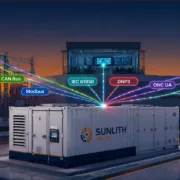
BESS Communication Protocols: The Complete 2026 Guide
What Are BESS Communication Protocols?
BESS communication protocols are the rules that let every part of a battery storage system share data.
So without them, batteries, inverters, and grid systems cannot work together.
Each device in a BESS speaks a different digital language. But a shared protocol gives them a common way to talk.
For example, the battery uses CAN Bus internally. The inverter, however, often uses Modbus. And the grid uses IEC 61850.
Choosing the right BESS communication protocols matters a lot. A bad choice leads to slow integration, poor performance, and higher costs.
Why BESS Communication Protocols Affect System Safety
Speed is critical in a BESS. A fault signal must reach the controller in milliseconds. So the protocol must be fast enough to carry it in time.
Also, the protocol must be reliable. If a message is lost, the system may not shut down safely. Therefore, engineers choose protocols based on both speed and reliability.
In addition, some protocols are secure by design. Others, however, have no built-in encryption. As a result, security must be added at the network level for older protocols.
For more background, see our guides on the Battery Management System (BMS), the Power Conversion System (PCS), and the Energy Management System (EMS).
The Five Layers of BESS Communication Protocols
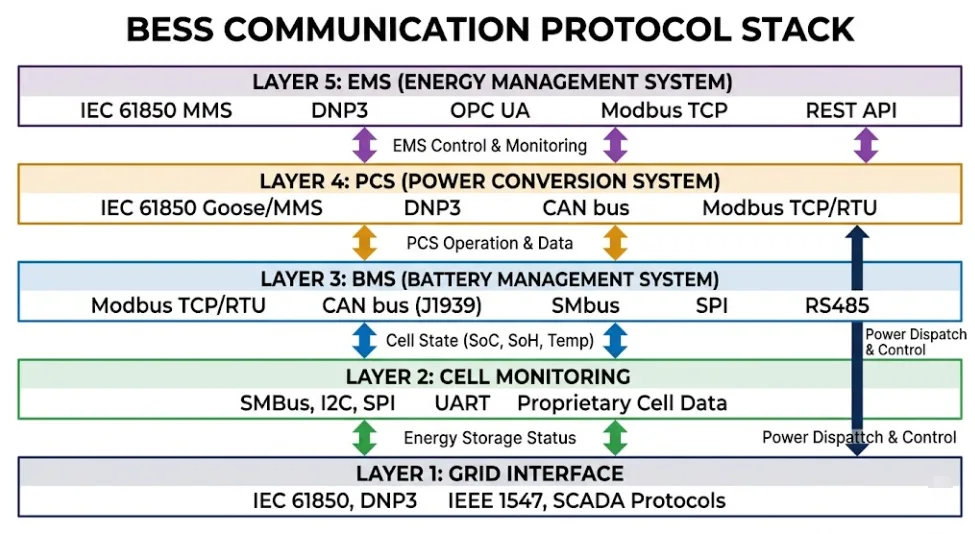
BESS communication protocols work across five system layers. Each layer has different speed needs and data types. So understanding these layers helps you pick the right protocol at each level.
| Layer | Component | Common Protocols |
|---|---|---|
| 1 — Cell | Battery cells, modules, BMUs | CAN Bus, SMBus |
| 2 — BMS | Battery Management System | Modbus RTU, CAN Bus, RS-485 |
| 3 — PCS | Power Conversion System / Inverter | Modbus TCP, CAN Bus, PROFINET, EtherNet/IP |
| 4 — EMS | Energy Management System | Modbus TCP, OPC UA, MQTT, IEC 60870-5-104 |
| 5 — Grid | Utility / SCADA / Cloud | IEC 61850, DNP3, IEEE 2030.5, MQTT, REST |
No single protocol covers all five layers. So most BESS projects use three or four protocols together.
As a result, a protocol gateway is almost always part of a real BESS design. We cover this in detail later.
1. Modbus — The Most Widely Used BESS Communication Protocol
Modbus is the most common BESS communication protocol in the world. It was developed in 1979, but it is still used in almost every BESS project today.
So why is it so popular? Because it is simple, cheap, and works with every BESS hardware vendor.
How Modbus Works as a BESS Communication Protocol
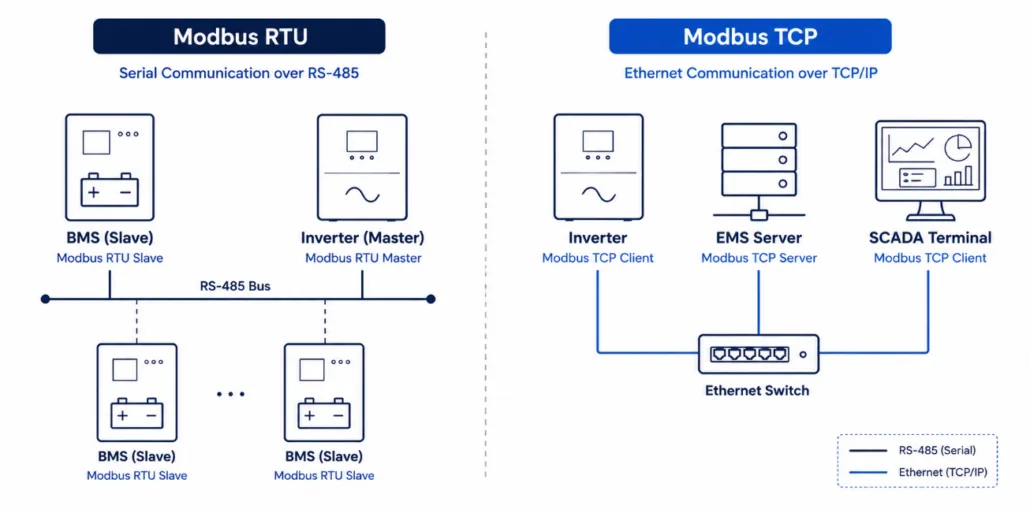
Modbus uses a master-slave model. One master — usually the EMS — sends a request to a slave device such as the BMS. The slave then replies with its data.
There are two forms. First, Modbus RTU sends binary data over an RS-485 serial cable. Then, Modbus TCP sends the same data over a standard Ethernet network. As a result, Modbus TCP works across a local area network or even the internet.
In a BESS, Modbus TCP links the BMS to the EMS and SCADA systems. So it is how most BESS assets respond to grid operator commands.
Why Modbus Has Limits as a BESS Communication Protocol
Modbus is easy to use, but it does have gaps. For example, it has no built-in security. Also, it uses polling, which adds latency.
However, these gaps are manageable. Engineers add security at the network level. And for most BESS use cases, the polling delay is acceptable.
But Modbus should not be the only protocol on an external BESS interface. For that reason, most projects combine it with a secure protocol like OPC UA or IEEE 2030.5.
| STRENGTHS ✓ Works with every BESS hardware vendor ✓ Simple to set up and easy to debug ✓ No licence cost ✓ Runs over RS-485 serial and Ethernet TCP/IP | LIMITATIONS ✗ No built-in encryption or authentication ✗ Polling model adds latency ✗ Limited data model vs IEC 61850 ✗ Not suitable alone for utility-facing use |
Used for: BMS ↔ EMS, BMS ↔ PCS, SCADA, field instruments
See also: Battery Management System (BMS) Explained | Power Conversion System (PCS) Guide
2. CAN Bus — The Internal BESS Communication Protocol
CAN Bus is the backbone of every battery rack. It was built for cars, but it also works perfectly inside BESS enclosures.
In fact, it is now found in products from BYD, CATL, Huawei, Sungrow, and Pylontech. So it has become the standard for internal BESS communication.
Why CAN Bus Suits BESS Internal Communication
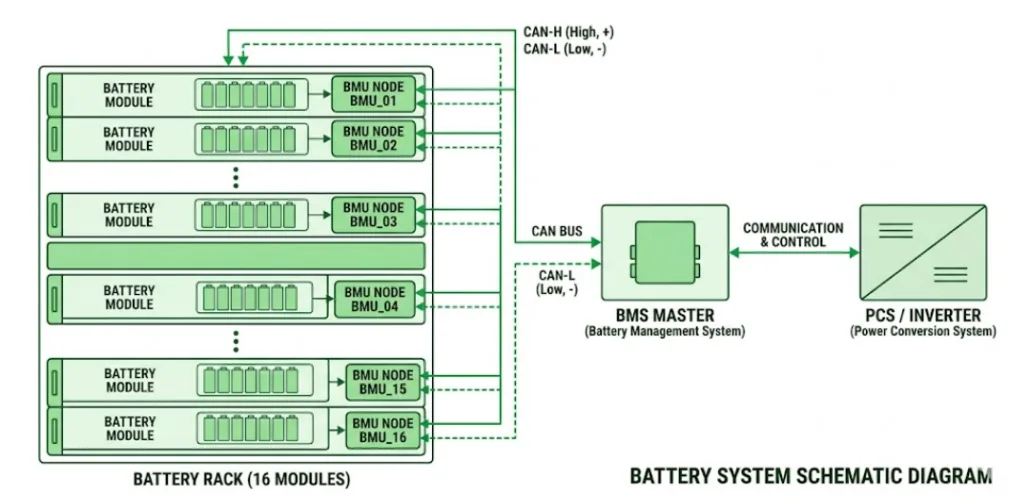
CAN Bus uses a two-wire pair — CAN-H and CAN-L. This design blocks interference from the high-current switching inside a battery cabinet.
Also, CAN Bus is a multi-master system. So every node — modules, BMUs, and the BMS controller — can send data at any time. As a result, the system gets real-time updates without waiting to be polled.
Furthermore, China’s national grid standards require CAN Bus as the BMS-to-inverter link in all utility-scale BESS projects. So it is not just popular — it is often mandatory.
CAN Bus Limits in a BESS System
CAN Bus is fast, but its range is short. At 1 Mbit/s, cables can be no longer than 40 metres. Therefore, it cannot be used beyond the battery enclosure.
However, a gateway solves this. The gateway reads CAN Bus data and then sends it upstream as Modbus TCP, MQTT, or another BESS communication protocol.
| STRENGTHS ✓ Resists EMI via differential CAN-H / CAN-L signalling ✓ Error detection and arbitration built in ✓ Real-time, event-driven — no polling needed ✓ Used by all major BESS OEMs | LIMITATIONS ✗ Short cable range — max 40 m at 1 Mbit/s ✗ Cannot reach the utility or cloud layer ✗ Vendor register maps differ between brands ✗ Needs a gateway for EMS or cloud integration |
Used for: Cell ↔ BMU, BMU ↔ BMS Master, BMS ↔ PCS (close-range)
3. IEC 61850 — The Grid-Level BESS Communication Protocol
IEC 61850 is the international standard for substation automation. It is also the leading BESS communication protocol for utility grid connections, especially in Europe and Asia-Pacific.
Unlike Modbus, it defines a full information model — not just a transport layer. So any IEC 61850 device can talk to any other, no matter the brand.
What Makes IEC 61850 Different
IEC 61850 uses logical nodes and data objects to describe every piece of equipment. As a result, there is no need for custom register mapping between vendors.
Also, IEC 61850-7-420 extends the standard to cover Distributed Energy Resources, including BESS. However, this DER extension is still developing. So some projects use custom mappings alongside the standard.
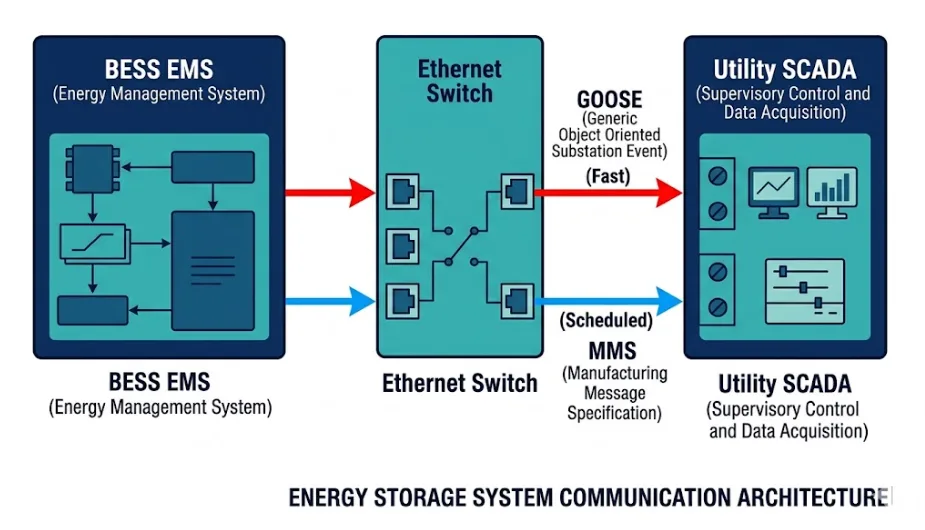
GOOSE Messaging — Speed That Other BESS Communication Protocols Cannot Match
GOOSE stands for Generic Object-Oriented Substation Event. It delivers event signals in under one millisecond. Therefore, it is used for protection — where a delayed signal could mean a fault goes uncleared.
MMS, in contrast, handles scheduled data exchange between the EMS and the utility. Together, GOOSE and MMS give IEC 61850 a range that no other BESS communication protocol can match alone.
When to Specify IEC 61850 for Your BESS
Use IEC 61850 for any utility-scale BESS in Europe, the UK, or Asia-Pacific. Many regulators now require it for all new grid-connected storage assets.
Furthermore, specifying it early avoids costly retrofits. So include it in the EMS and gateway specification from day one.
| STRENGTHS ✓ True multi-vendor interoperability — no register mapping ✓ GOOSE delivers sub-millisecond protection events ✓ Rich, self-describing data model ✓ Mandated by EU, UK, and APAC utility operators | LIMITATIONS ✗ Higher engineering cost than Modbus ✗ DER model (7-420) still maturing ✗ Not all BESS OEMs support it natively ✗ Needs SCL configuration expertise |
Used for: EMS ↔ Utility SCADA, substation automation, protection, VPP
See also: How EMS Enables Advanced Grid Services | BMS vs EMS — Control Layers
4. DNP3 — The North American Utility BESS Communication Protocol
DNP3 is the standard BESS communication protocol for utility SCADA in North America. It is formally specified under IEEE Std 1815 and has been in use since 1993.
So if your BESS connects to a North American utility, you will almost certainly need DNP3.
Why DNP3 Works Well for Remote BESS Sites
DNP3 was built for tough conditions. It works over serial radio links, low-bandwidth WAN, and cellular networks. As a result, it suits remote BESS sites where network quality is poor.
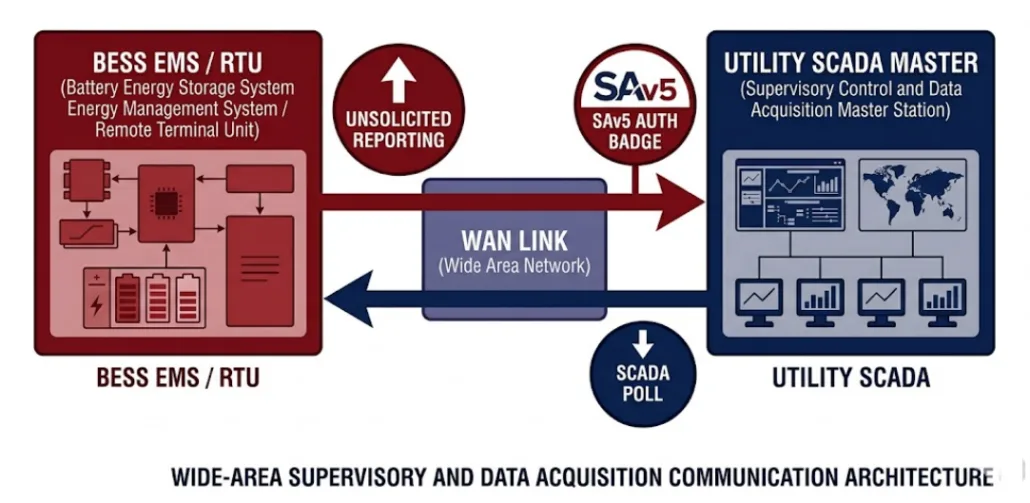
Also, DNP3 supports unsolicited reporting. This means the BESS sends data only when something changes. So it uses far less bandwidth than a polling protocol like Modbus.
Adding Security to DNP3 in BESS Projects
The base DNP3 standard has no native security. However, Secure Authentication v5 (SAv5) adds a challenge-response layer. This significantly improves protection on any BESS grid link.
NERC CIP standards require strong authentication on all utility-connected BESS assets in North America. Therefore, SAv5 is now a standard requirement in most DNP3 BESS specifications.
| STRENGTHS ✓ Reliable over poor network links — serial, radio, cellular ✓ Unsolicited reporting cuts bandwidth ✓ Leading protocol for North American utility SCADA ✓ Timestamped events support accurate fault logging | LIMITATIONS ✗ Less rich data model than IEC 61850 ✗ Security needs SAv5 as a separate add-on ✗ Rarely used outside North America ✗ Not suited to cloud or IoT use |
Used for: EMS ↔ Utility SCADA, remote BESS, North American grid connections
5. OPC UA — The Secure Cloud BESS Communication Protocol
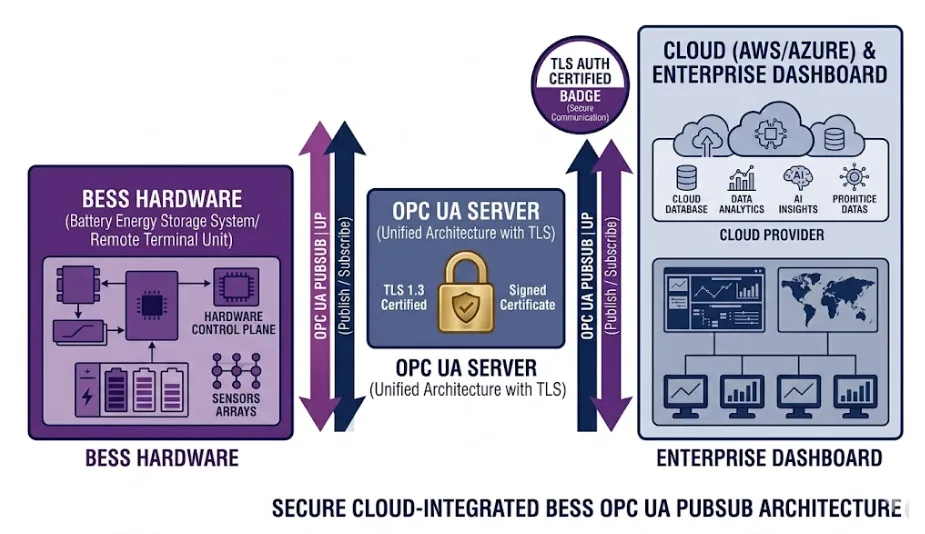
OPC UA connects BESS systems to cloud platforms and enterprise software. It is specified under IEC 62541 and is widely used in industrial IoT deployments.
Unlike older protocols, it is secure by design. So it is a strong choice for any external-facing BESS interface.
How OPC UA Improves on Legacy BESS Communication Protocols
Legacy OPC was Windows-only and had no encryption. OPC UA, however, works on any platform — Linux, Windows, or embedded controllers.
Also, OPC UA uses TLS encryption by default. So every connection is secure without any extra setup. In addition, it uses a rich object model that represents a full BESS asset in a structured, self-describing format.
As a result, cloud analytics platforms can ingest BESS data without any custom engineering. So it saves time and reduces integration risk.
Combining OPC UA and IEC 61850 in Large BESS Projects
The best approach for utility-scale BESS is to use both. IEC 61850 handles real-time grid communication. OPC UA, in contrast, carries asset data to cloud analytics and digital twin platforms.
Furthermore, AWS, Azure, and Google Cloud all support OPC UA PubSub natively. Therefore, OPC UA provides a direct, secure path from the BESS site to cloud tools.
| STRENGTHS ✓ TLS encryption built in — no add-on needed ✓ Works on any platform — Linux, Windows, embedded ✓ Rich object model for complex BESS data ✓ Native support in AWS, Azure, and Google Cloud | LIMITATIONS ✗ Heavier than MQTT for simple data streams ✗ Too complex for small C&I BESS projects ✗ Higher engineering cost than Modbus ✗ Slower to implement than simpler alternatives |
Used for: EMS ↔ Cloud, asset management, digital twins, predictive maintenance
See also: How EMS Enables Advanced Grid Services
6. MQTT — The Cloud Telemetry BESS Communication Protocol
MQTT is a lightweight protocol for cloud telemetry. It is now the most popular BESS communication protocol for real-time monitoring and remote dashboards.
So if you want to stream battery data to the cloud, MQTT is the best place to start.
How MQTT Works in a BESS
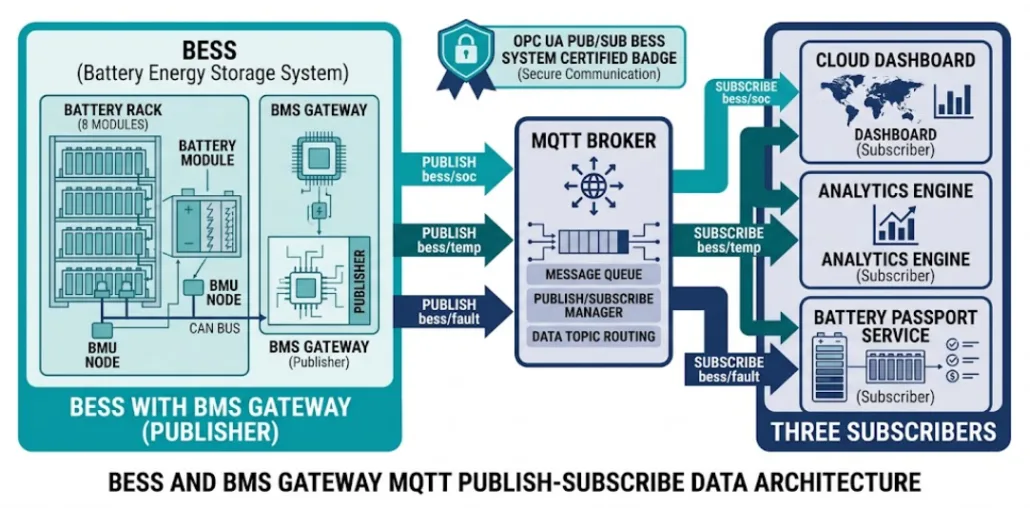
MQTT uses a broker between publishers and subscribers. The BMS gateway publishes data — such as state of charge, temperature, and fault codes — to the broker.
Then cloud dashboards subscribe and receive that data in near real time. Also, the publisher-subscriber model means you can add new cloud apps without touching any hardware.
Furthermore, IEC 61850 data models can be mapped directly to MQTT topics. So a single gateway can serve both the grid and the cloud at the same time.
MQTT and the EU Battery Passport
The EU is introducing Battery Passport rules for storage assets. MQTT is well-suited to Battery Passport data exports because of its lightweight, streaming design.
As a result, MQTT is increasingly specified alongside IEC 61850 in European BESS projects. So it is becoming a standard part of the cloud layer in most modern designs.
| STRENGTHS ✓ Very lightweight — low bandwidth and CPU use ✓ Best choice for high-frequency streaming data ✓ Native support in AWS, Azure, and Google Cloud ✓ Publisher-subscriber model is flexible and scalable | LIMITATIONS ✗ No built-in BESS data model — custom topics needed ✗ Not suitable for direct control commands ✗ QoS levels must be configured carefully ✗ TLS must be switched on manually |
Used for: Cloud telemetry, remote monitoring, Battery Passport exports, IIoT analytics
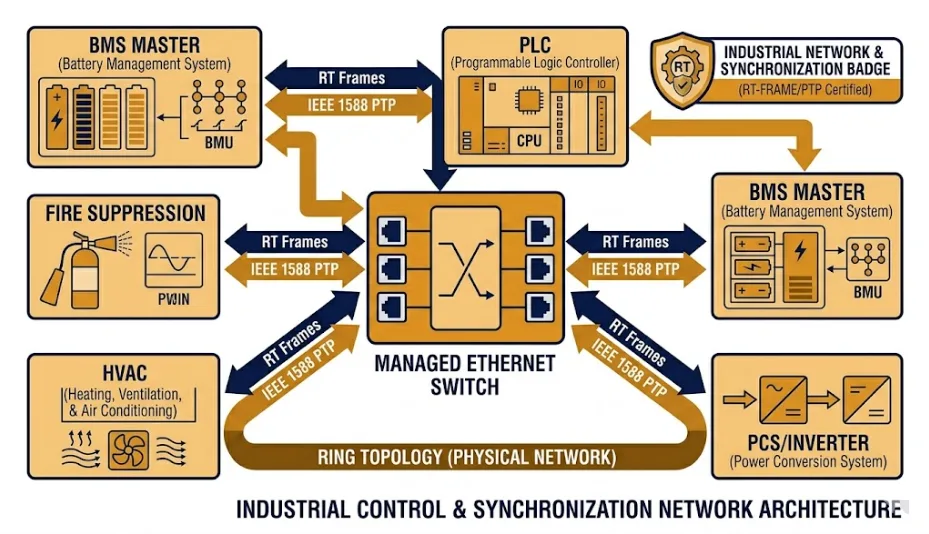
7. PROFINET and EtherNet/IP — Real-Time BESS Communication Protocols
PROFINET and EtherNet/IP are Industrial Ethernet protocols. They are used inside containerised BESS units where Modbus TCP is not fast or precise enough.
So if your BESS has a PLC controlling HVAC, fire suppression, and the inverter, these protocols are likely the right choice.
When to Use These Real-Time BESS Communication Protocols
Modbus TCP is fine for most BMS-to-EMS links. But it cannot guarantee the timing needed for fast power electronics.
PROFINET and EtherNet/IP, in contrast, are deterministic. They deliver messages within a fixed time window. As a result, charge and discharge commands arrive at exactly the right moment.
Also, both support IEEE 1588 Precision Time Protocol. This keeps all BESS components synchronised to within microseconds. Therefore, they are ideal for frequency regulation services that need sub-second response.
PROFINET vs EtherNet/IP — Which One Should You Choose?
PROFINET is the standard choice in Europe and Asia. It works best with Siemens TIA Portal and Siemens PLCs.
EtherNet/IP, however, is more common in North America. It is the native protocol for Rockwell Automation hardware. So the right choice usually depends on which PLC the project already uses.
| STRENGTHS ✓ Deterministic real-time communication ✓ Gigabit Ethernet capable — high throughput ✓ IEEE 1588 PTP for microsecond synchronisation ✓ Tight integration with Siemens (PROFINET) and Rockwell (EtherNet/IP) | LIMITATIONS ✗ Vendor lock-in — PROFINET and EtherNet/IP are not compatible ✗ Higher infrastructure cost than Modbus TCP✗ Not used for utility or cloud communication ✗ Needs managed switches with QoS and VLAN support |
Used for: BMS ↔ PCS sync, containerised BESS with PLC, auxiliary system automation
8. IEEE 2030.5 — The Compliance BESS Communication Protocol
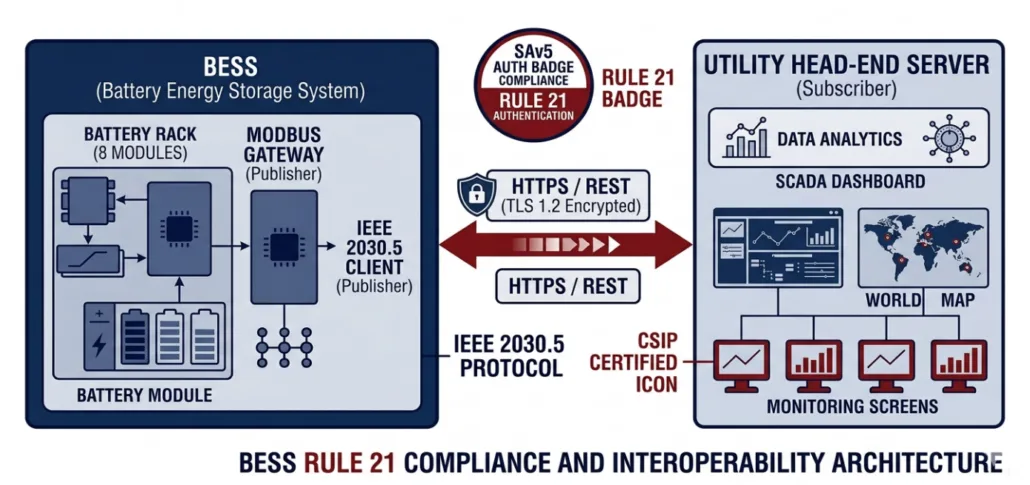
IEEE 2030.5 is a secure, RESTful protocol for connecting BESS to utility systems. It is mandatory under California Rule 21 for all grid-connected BESS in California.
So if your project is in California — or a state adopting similar rules — you will need this protocol.
Why IEEE 2030.5 Is the Most Secure BESS Communication Protocol
Unlike Modbus or DNP3, IEEE 2030.5 requires TLS 1.2 on every connection. There is no optional configuration — it is always on.
Also, it uses standard HTTPS calls. So it fits naturally into modern IT networks. As a result, integration with utility head-end systems is simpler than with legacy serial protocols.
Using IEEE 2030.5 Without Replacing Your BESS Hardware
Most existing BESS hardware does not natively support IEEE 2030.5. However, a protocol gateway solves this easily.
The gateway translates from SunSpec Modbus or DNP3 on the device side to IEEE 2030.5 on the utility side. So operators can achieve full Rule 21 compliance without any new field hardware.
In addition, more US states and international regulators are expected to adopt similar DER rules by 2030. Therefore, specifying IEEE 2030.5 gateway support today future-proofs the asset.
| STRENGTHS ✓ TLS 1.2 mandatory — security built in ✓ RESTful HTTPS fits modern networks ✓ California Rule 21 and CSIP compliant ✓ Works via gateway — no hardware replacement needed | LIMITATIONS ✗ Primarily a North American standard ✗ REST polling too slow for fast control loops ✗ Needs specialist Rule 21 / CSIP knowledge ✗ Smaller vendor ecosystem than DNP3 or Modbus |
Used for: BESS DER interconnection, California Rule 21, utility scheduling and monitoring
All BESS Communication Protocols Compared
The table below compares all eight BESS communication protocols side by side. Use it to quickly find the right protocol for each layer of your system.
| Protocol | Layer | Real-Time | Security | Utility | Cloud/IoT |
|---|---|---|---|---|---|
| Modbus RTU/TCP | BMS ↔ EMS/PCS | Polling | None | Via SCADA | No |
| CAN Bus | Cell ↔ BMS | Yes | None | No | No |
| IEC 61850 | EMS ↔ Grid | GOOSE <1ms | Opt. TLS | Yes | Via mapping |
| DNP3 | EMS ↔ Utility | Low latency | SAv5 | N. America | No |
| OPC UA | EMS ↔ Cloud | Near RT | TLS | Emerging | Yes |
| MQTT | EMS ↔ Cloud | Streaming | Opt. TLS | No | Yes |
| IEEE 2030.5 | EMS ↔ Utility | REST poll | TLS mandatory | Yes | Possible |
| PROFINET/EtherNet-IP | BMS ↔ PCS | Deterministic | Network | No | No |
Why Every BESS Needs a Protocol Gateway
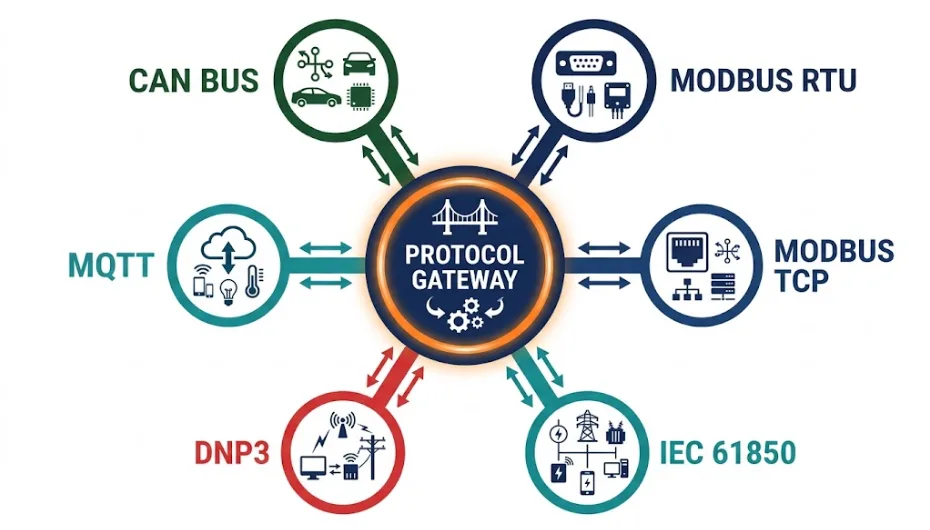
No BESS project uses just one communication protocol. CAN Bus batteries connect to Modbus inverters. Modbus inverters connect to IEC 61850 substations. DNP3 talks to SCADA. MQTT streams data to the cloud.
So a protocol gateway is what holds the whole system together. It translates data between protocols in real time.
What a BESS Protocol Gateway Does
A good gateway supports IEC 61850, DNP3, Modbus, OPC UA, and MQTT — all at the same time. As a result, the BESS can serve both the utility and the cloud from a single device.
Also, a gateway future-proofs the asset. So when utility requirements change, you update the gateway — not the hardware. This saves a lot of time and cost later in the project.
The Golden Rule for BESS Communication Protocol Design
| Design the gateway first Specify your protocol gateway before you procure any hardware. This one decision shapes every grid service, every cloud integration, and every future revenue stream. Retrofitting protocol support after commissioning is expensive and often technically very difficult. |
How to Pick the Right BESS Communication Protocols
For Commercial and Industrial BESS Projects
Most C&I projects use CAN Bus inside the battery rack. Then they use Modbus RTU between the BMS and inverter. After that, Modbus TCP connects the inverter to the EMS. Finally, MQTT pushes telemetry to the cloud.
This stack is cost-effective and easy to commission. Also, it is supported by every major BESS hardware vendor. So it is the best starting point for most behind-the-meter projects.
For C&I peak shaving, see: How C&I BESS Peak Shaving Lowers Demand Charges. For BESS with solar, see: C&I BESS with Renewable Energy.
For Utility-Scale BESS Projects
Utility-scale projects need IEC 61850 in Europe and APAC. In North America, however, DNP3 is the SCADA standard. In California, IEEE 2030.5 is also required.
As a result, the EMS must speak all three. A multi-protocol gateway or a native multi-protocol EMS platform makes this possible.
For grid-following inverter design, see: Grid-Following BESS Guide. For weak-grid environments, see: BESS Grid-Forming Technology.
Cybersecurity Rules for BESS Communication Protocols
Modbus and CAN Bus have no built-in security. So they need network-level protection — firewalls, VPNs, and strict network segmentation.
For external interfaces, use a secure protocol by design. For example, OPC UA, IEEE 2030.5, or DNP3 with SAv5 are all good choices.
- OPC UA: TLS encryption and X.509 certificates built in
- IEEE 2030.5: TLS 1.2 mandatory on every connection
- DNP3 SAv5: Challenge-response authentication add-on for existing systems
- Modbus / CAN Bus: Protect with firewalls, VPNs, and network segmentation
Also, NERC CIP standards apply to all utility-connected BESS in North America. Therefore, document all security controls for every communication interface.
Key Standards and References for BESS Communication Protocols
The sources below give primary-source detail on each BESS communication protocol. They are recommended for engineers who need full specification documents.
| Standard | Link | Protocol |
|---|---|---|
| IEC 61850 (IEC) | https://www.iec.ch/homepage | IEC 61850 |
| IEEE Std 1815 — DNP3 | https://standards.ieee.org/ieee/1815/ | DNP3 |
| IEEE 2030.5 / SEP 2.0 | https://standards.ieee.org/ieee/2030.5/ | IEEE 2030.5 |
| IEEE 2800-2022 | https://standards.ieee.org/ieee/2800/10508/ | Grid connection — IBR |
| NERC CIP Standards | https://www.nerc.com/pa/Stand/Pages/CIPStandards.aspx | Cybersecurity — all protocols |
| ENTSO-E Network Code RfG | https://www.entsoe.eu/network_codes/rfg/ | European grid requirements |
| MODBUS.org | https://modbus.org/ | Modbus RTU / TCP |
| OPC Foundation | https://opcfoundation.org/ | OPC UA |
| MQTT.org | https://mqtt.org/ | MQTT |
Conclusion — Choosing the Right BESS Communication Protocols
Choosing the right BESS communication protocols is one of the most important design decisions in any energy storage project. Get it right and the system integrates smoothly. Get it wrong and commissioning becomes painful and expensive.
So start with the basics. Use CAN Bus and Modbus for internal communication. Then add IEC 61850 or DNP3 for the utility interface. Finally, layer in OPC UA or MQTT for cloud analytics.
Above all, specify a capable protocol gateway early. It is the device that makes all the other protocols work together. And it keeps every integration option open as requirements change over the asset’s life.
Explore more from the Sunlith Energy library: BESS Technical Blog | BMS Explained | C&I BESS Economics | PCS Guide.
ESS Codes and Standards for USA Utility-Scale BESS in 2026
Battery energy storage systems are expanding rapidly across the United States. As projects grow larger, safety requirements are becoming stricter. Because of this, developers must understand modern ESS codes and standards before starting a project.
Today, battery storage compliance affects:
- System design and footprint layouts
- Fire protection and suppression mechanics
- Comprehensive thermal runaway testing
- Utility interconnection agreements
- Electrical installation workflows
- EMS and BMS hardware integration
In addition, many utilities and authorities now require proof of compliance before approving a project.
This guide explains the most important ESS codes and standards for utility-scale battery energy storage systems in 2026.
Why ESS Codes and Standards Matter
Modern lithium-ion battery systems store large amounts of energy. Therefore, safety is one of the biggest concerns in every BESS project.
ESS codes and standards help reduce risks such as:
- Fire propagation
- Thermal runaway
- Electrical faults
- Gas explosions
- Communication failures
At the same time, these standards improve system reliability and operational safety.
They also help developers:
- Speed up permitting
- Meet utility requirements
- Improve insurance approval
- Reduce project risk
Without proper compliance, projects may face delays and expensive redesigns. As a result, developers should include compliance planning during the early design stage.
Main Types of ESS Codes and Standards
Battery storage regulations are divided into several major categories.
| Category | Purpose |
|---|---|
| Electrical Codes | Safe electrical installation |
| Fire Codes | Fire prevention and protection |
| Product Standards | Equipment certification |
| Performance Standards | Thermal runaway testing |
| Interconnection Standards | Grid compatibility |
| Communication Standards | EMS and SCADA integration |
Together, these standards form the safety foundation for modern energy storage systems.
NFPA 855: The Core of ESS Codes and Standards for Installation Safety
National Fire Protection Association developed NFPA 855 for stationary energy storage systems.
Today, NFPA 855 stands as the single most critical pillar among all ESS codes and standards in the U.S. commercial market.
The standard covers:
- Installation
- Fire protection
- Ventilation
- Maintenance
- Commissioning
- Decommissioning
In addition, NFPA 855 defines safety distances between ESS units and nearby equipment.
The 2026 edition introduces stricter requirements for:
- Large-scale fire testing
- Explosion prevention
- Emergency ventilation
- Gas monitoring systems
Because of these updates, developers must carefully review NFPA 855 during the early project stage.
Many authorities having jurisdiction now use NFPA 855 as a primary safety reference for utility-scale BESS projects.
Learn more here: SunLith Energy – Ultimate NFPA 855 Guide
UL 9540 for ESS System Certification
UL Solutions created the UL 9540 standard to evaluate complete, integrated energy storage systems.
UL 9540 evaluates:
- Battery systems
- PCS integration
- Thermal management
- Safety controls
- Enclosure protection
Unlike component standards, UL 9540 focuses on the complete integrated ESS system.
As a result, most utility-scale projects require UL 9540 certification before permitting approval.
Furthermore, UL 9540 references several other standards, including:
- UL 1973
- UL 1741
- UL 991
- UL 1998
These standards work together to improve overall ESS safety.
UL 9540A Thermal Runaway Testing
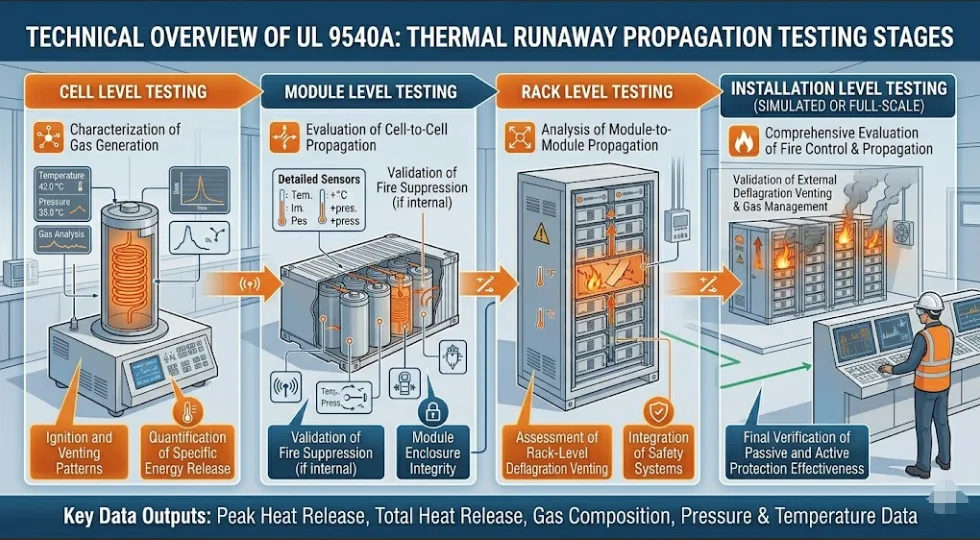
UL 9540A is one of the most important fire testing standards for lithium-ion battery systems.
Unlike UL 9540, this standard does not certify the product itself. Instead, it evaluates thermal runaway fire behavior inside the ESS.
Testing occurs at four levels:
- Cell level
- Module level
- Unit level
- Installation level
According to the ACP document, utility-scale lithium-ion systems must complete cell, module, and unit-level testing.
In addition, the latest revision introduces large-scale fire testing requirements.
Because of these updates, fire safety testing is becoming much stricter for utility-scale projects.
UL 9540A testing helps engineers study:
- Fire spread
- Heat release
- Gas generation
- Explosion risk
- Suppression system performance
Consequently, test results strongly affect enclosure design and site layout planning.
Why Thermal Runaway Testing Matters
Thermal runaway can spread rapidly between battery cells. Consequently, uncontrolled fires may occur inside ESS enclosures.
UL 9540A testing helps engineers evaluate:
- Fire propagation behavior
- Toxic gas release
- Explosion hazards
- Heat release rates
- Suppression system effectiveness
Because of this, testing results directly affect:
- Enclosure spacing
- Ventilation design
- Fire suppression systems
- Emergency response planning
As ESS projects continue growing larger, thermal runaway testing becomes even more important.
NFPA 69 Explosion Prevention Requirements
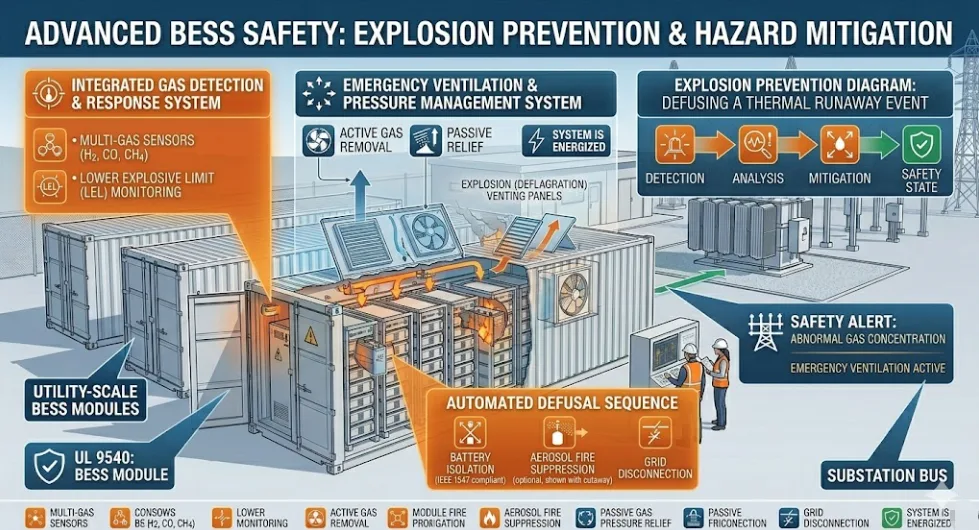
NFPA 69 focuses on explosion prevention inside ESS enclosures.
The updated 2026 NFPA 855 edition increases the importance of this standard.
Under NFPA 69, projects may require:
- Emergency ventilation systems
- Flammable gas monitoring
- Gas concentration control
In many systems, ventilation equipment must keep gas concentration below 25% of the lower flammable limit.
Previously, some projects relied mostly on deflagration venting. However, newer requirements focus more on prevention instead of pressure relief alone.
For this reason, gas detection and ventilation systems are becoming standard features in modern ESS projects.
NFPA 68 for Deflagration Venting
NFPA 68 supports explosion pressure venting and deflagration analysis.
This standard helps engineers calculate:
- Vent sizing
- Pressure relief
- Gas flow behavior
Today, many utility-scale projects combine:
- NFPA 68 studies
- NFPA 69 prevention systems
- UL 9540A testing
Together, these standards improve overall ESS fire safety.
NEC Article 706 for ESS Electrical Safety
National Fire Protection Association includes ESS requirements within the National Electrical Code.
Article 706 applies to energy storage systems larger than 1 kWh.
The article covers:
- Wiring methods
- Disconnects
- Grounding
- Overcurrent protection
- Equipment labeling
Therefore, NEC Article 706 is essential for electrical permitting and inspection approval.
In addition, proper NEC compliance helps reduce electrical hazards during operation and maintenance.
UL 1973 for Battery Certification
UL 1973 applies specifically to stationary battery systems.
The standard evaluates:
- Cell safety
- Module design
- Electrical protection
- Mechanical integrity
Most lithium-ion battery systems require UL 1973 certification before full ESS integration.
Consequently, UL 1973 has become a core requirement for utility-scale battery projects.
Without UL 1973 compliance, achieving UL 9540 system certification becomes difficult.
UL 1741 for PCS and Inverters
UL 1741 applies to power conversion systems and inverters.
This standard evaluates:
- Grid interaction
- Electrical safety
- Anti-islanding protection
- Converter performance
As grid-forming systems become more common, UL 1741 compliance is becoming increasingly important.
Learn more here:
- Sunlith Energy – Grid-Forming Inverter Technology in BESS
- Sunlith Energy – Grid-Following vs Grid-Forming Inverters
IEEE 1547 and IEEE 2800 Interconnection Standards
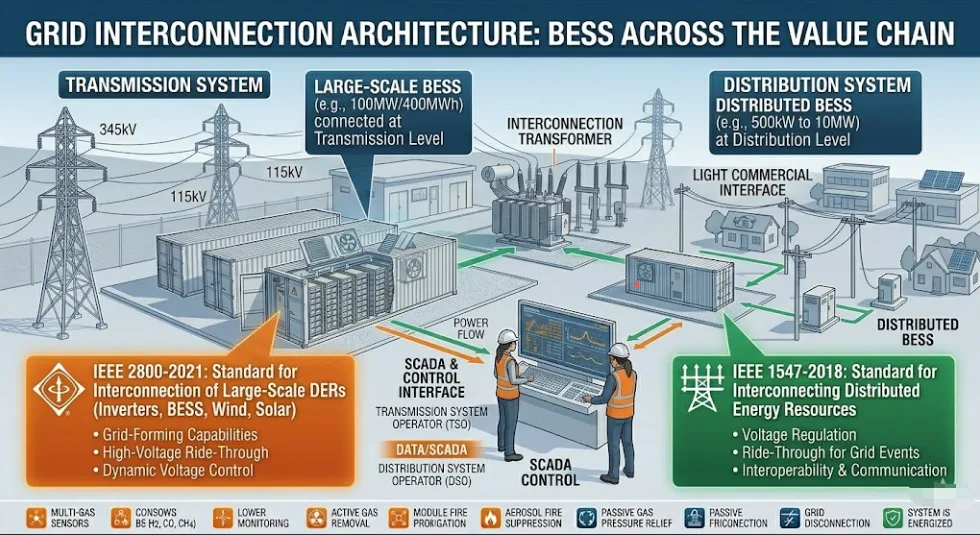
Grid interconnection standards help maintain stable operation between ESS systems and utilities.
IEEE 1547
IEEE 1547 mainly applies to distribution-connected systems.
It defines:
- Voltage response
- Frequency ride-through
- Grid synchronization
- Protection coordination
IEEE 2800
Conversely, IEEE 2800 applies explicitly to large, transmission-connected inverter-based resources.
As utility-scale projects continue growing, IEEE 2800 is becoming more relevant.
Therefore, developers should consider interconnection requirements during the early design phase.
For technical grid-interconnection rules such as voltage ride-through, frequency response, reactive-power control, protection, and country-specific requirements, see our BESS grid codes and compliance guide.
ESS Communication Standards
Modern battery storage systems depend heavily on communication networks.
These networks connect:
- EMS
- BMS
- PCS
- SCADA systems
- Utility operators
As ESS projects grow larger, communication standards become more important.
Key standards include:
- IEEE 1815.2
- IEEE 2030.5
- SunSpec Modbus models
Together, these standards improve interoperability and simplify utility integration.
In addition, they help operators monitor and control battery systems more effectively.
For more details, read:
BMS Standards for Energy Storage Systems
Battery management systems play a major role in ESS safety.
Important BMS standards include:
- UL 991
- UL 1998
- IEEE 2686
- CSA C22.2 No. 340
These standards evaluate:
- Software safety
- Fault handling
- Functional reliability
- Safety-related controls
Therefore, BMS compliance is becoming increasingly important in large utility-scale systems.
At the same time, utilities expect stronger software validation for modern ESS projects.
How AHJs Review ESS Projects
Authorities having jurisdiction review ESS projects before approval.
Typically, AHJs evaluate:
- UL certifications
- Fire safety reports
- Site layouts
- Gas mitigation systems
- Electrical compliance
- Emergency response plans
However, code adoption varies between states and cities.
Because of this, developers often face different compliance requirements across jurisdictions.
Early planning can help reduce approval delays and redesign costs.
Future Trends in ESS Codes and Standards
The ESS industry continues to evolve rapidly. Therefore, safety and compliance rules are becoming more advanced each year.
Several major trends are shaping the future of battery storage systems.
Larger Fire Testing Requirements
Large-scale fire testing is becoming standard for utility-scale BESS projects.
Stricter Gas Management Rules
Explosion prevention requirements are increasing across the industry.
Advanced Grid Support Functions
Utilities now expect smarter inverter behavior and stronger grid support capabilities.
More Software Validation
At the same time, BMS and EMS software testing requirements continue to expand.
Because of these changes, future ESS projects will require tighter coordination between:
- EMS
- BMS
- PCS
- Fire systems
- Gas detection systems
As a result, compliance-driven engineering is becoming essential for large battery storage projects.
How Sunlith Energy Simplifies ESS Codes and Standards Compliance
At Sunlith Energy, we understand that ESS codes and standards directly affect system safety, reliability, and project approval.
Our specialized engineering and integration approach focuses heavily on:
- Turnkey utility-scale BESS integration
- Advanced, compliant EMS architecture deployment
- Grid-forming inverter optimization and safety
- Proactive, code-compliant physical site design
- Scalable ESS solutions
Therefore, we help customers prepare for evolving compliance requirements across modern battery storage projects.
Conclusion
ESS codes and standards are evolving quickly as battery storage systems become larger and more advanced.
Today, standards such as:
- NFPA 855
- UL 9540
- UL 9540A
- UL 1973
- IEEE 1547
- IEEE 2800
- NFPA 69
affect nearly every part of a utility-scale BESS project.
These standards influence:
- System design
- Fire safety
- Utility interconnection
- Thermal runaway testing
- Software validation
Because of this, developers should review compliance requirements during the earliest project stages.
In the coming years, stricter safety rules and larger ESS installations will continue shaping the future of battery energy storage systems.

How to Deploy Grid-Following BESS Without Costly Failures
What Is BESS Grid-Following?
BESS grid-following is the most widely used inverter control mode in battery storage today. In simple terms, a grid-following (GFL) inverter locks its output to the existing grid voltage and frequency. Because of this, the battery system follows the grid — not the other way around.
This approach works well in most commercial and utility projects. In fact, roughly 85% of all battery storage systems deployed worldwide use grid-following control. Therefore, understanding how it works — and where it has limits — is essential for engineers, developers, and asset owners alike.
This comprehensive guide breaks down everything you need to know. We begin with a deep dive into the technical inner workings of GFL control before comparing it directly to Grid-Forming (GFM) architecture. From there, you will learn about core C&I applications, weak-grid constraints, and critical deployment mistakes to avoid.
1. How a BESS Grid-Following Inverter Works
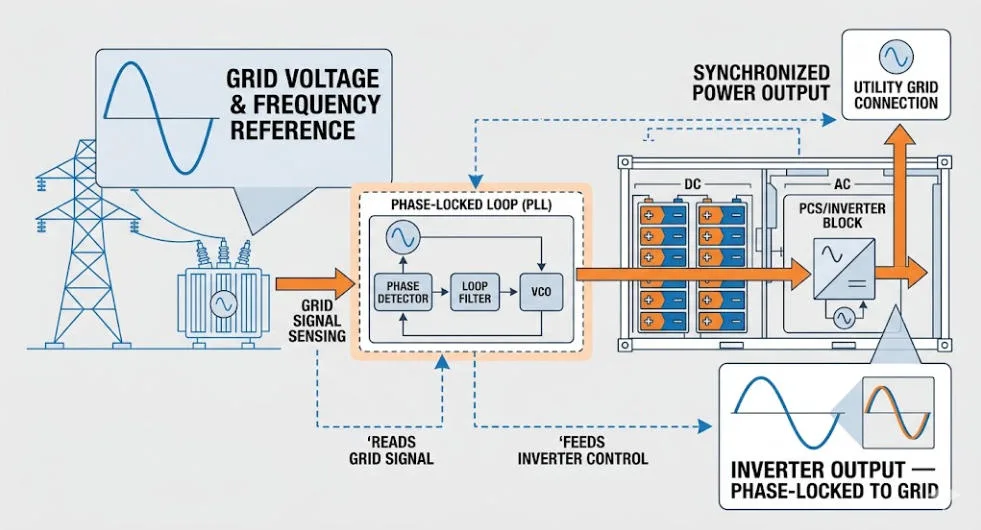
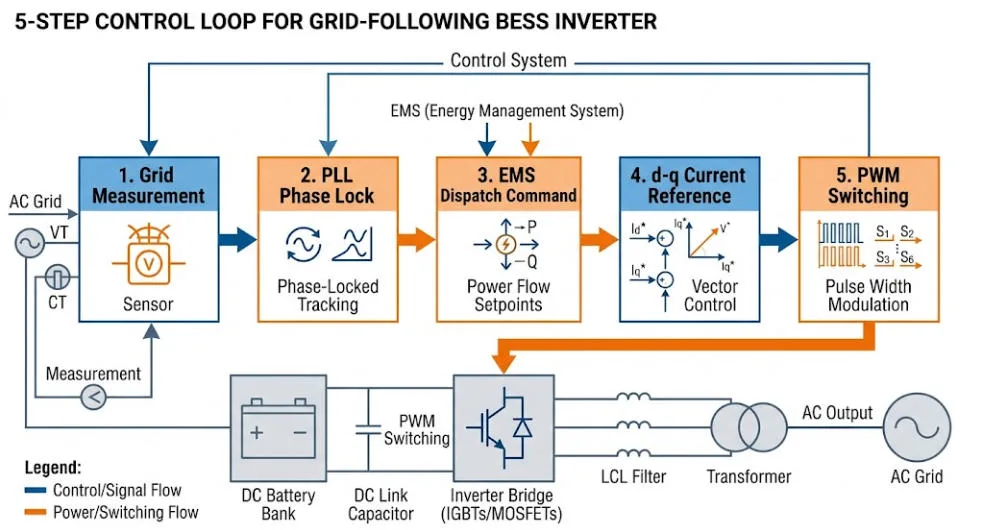
A BESS grid-following inverter acts as a controlled current source. Its job is to inject real power (watts) and reactive power (VAR) into the grid. Crucially, it does this at the exact voltage and frequency the grid is already running at.
Here is how the process works, step by step.
Step 1 — Grid Measurement
To begin, the inverter measures grid voltage, frequency, and phase angle at the Point of Common Coupling (PCC) thousands of times every second. This continuous tracking ensures the system always maintains a fresh, accurate picture of grid conditions.
Step 2 — Phase Locking via the PLL
A Phase-Locked Loop (PLL) algorithm then processes these measurements to lock the inverter’s internal reference directly to the grid’s phase angle. Consequently, the inverter stays perfectly synchronised even if the grid drifts slightly in frequency or voltage.
Step 3 — Power Dispatch from the EMS
The Energy Management System (EMS) sends a power dispatch command — for example, ‘discharge at 500 kW.’ Following this instruction, the hardware changes the target value into a current reference in the d-q rotating frame.
Step 4 — PWM Switching
High-speed IGBT transistors switch rapidly — typically at 2 to 20 kHz — using Pulse Width Modulation (PWM). As a result, the hardware generates a clean AC output that perfectly matches the reference signal.
Step 5 — Real-Time Feedback Control
Finally, a fast inner current control loop corrects any lingering errors. Running at roughly 1 to 2 kHz, this final safety loop ensures the entire BESS grid-following control cycle completes in under one millisecond.
2. The PLL: Why BESS Grid-Following Needs a Strong Grid
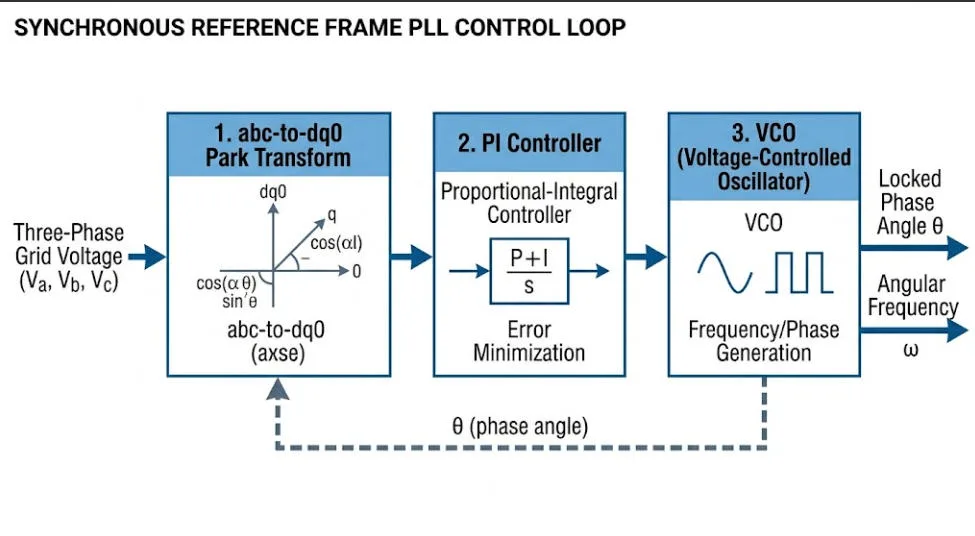
The Phase-Locked Loop (PLL) is the core of every GFL system. It is also the source of its main limitation.
The PLL works by comparing the inverter’s internal oscillator to the measured grid frequency. If these two variables drift apart, the algorithm instantly generates a correction signal. Once they match up perfectly, the loop achieves a ‘locked’ state. Modern BESS grid-following inverters use Synchronous Reference Frame PLLs (SRF-PLLs) to handle real-world imperfections — including unbalanced voltages and harmonic distortion.
Key point: The PLL needs a stable grid voltage to lock onto. If the grid voltage collapses, the PLL has no reference. As a result, the GFL inverter cannot maintain output on its own. This is the defining constraint of BESS grid-following technology.
For an alternative approach that removes this constraint, see our article on BESS Grid–Forming Technology.
3. BESS Grid-Following vs Grid-Forming: Key Differences
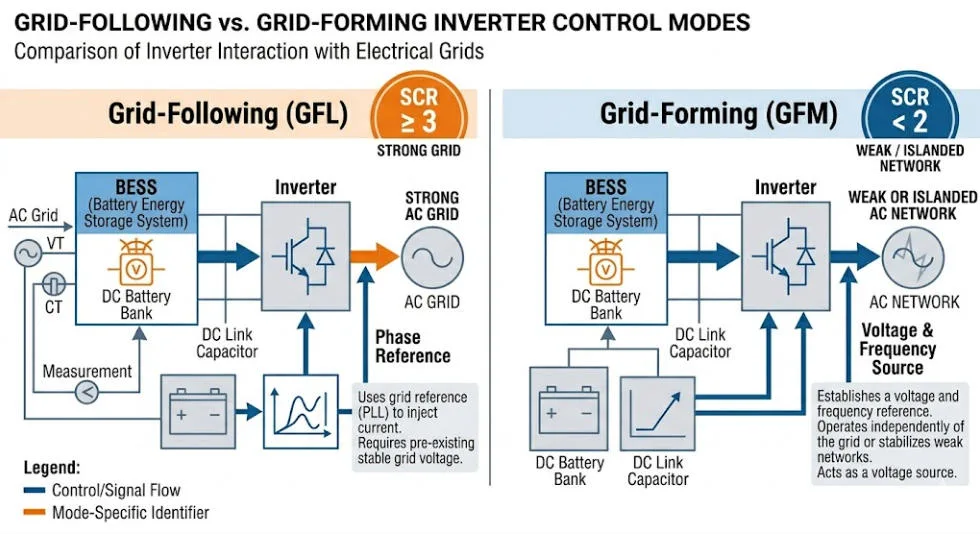
Grid-following and grid-forming are both valid technologies. However, they solve different problems. The table below shows the core differences clearly.
| Attribute | Grid-Following (GFL) | Grid-Forming (GFM) |
|---|---|---|
| Inverter type | Controlled current source | Controlled voltage source |
| Needs grid voltage? | Yes — requires reference signal | No — creates its own reference |
| Black start capable? | No | Yes |
| Islanded operation? | No (without external VSI) | Yes |
| Synthetic inertia | Limited / indirect | Native capability |
| Frequency response speed | Fast (< 500 ms), reactive | Instantaneous (< 20 ms) |
| Cost vs baseline | Baseline cost | ~10–20% premium |
| Min. SCR at PCC | SCR ≥ 3 recommended | Functions at SCR < 1.5 |
| Best for | Strong-grid C&I and utility sites | Weak grids, islands, high-IBR networks |
| Market share (2025) | ~85% of deployed systems | ~15% and growing |
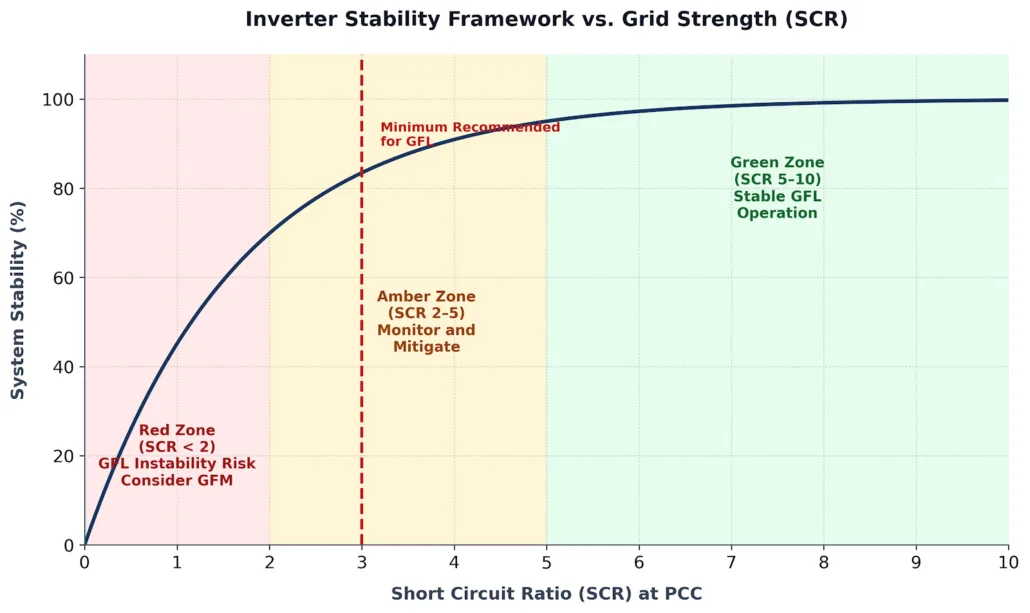
Design rule: The key question is not ‘which is better’ — it is ‘what is the Short Circuit Ratio at your Point of Common Coupling?’ If SCR is 3 or above, BESS grid-following is the right choice. If SCR falls below 2, then Grid-Forming deserves serious consideration.
Related reading: BESS Grid-Forming Technology: The Architecture Stabilising Tomorrow’s Grid
4. Where BESS Grid-Following Excels
BESS grid-following is the right choice for most projects. Below are the applications where it delivers the most value.
4.1 GFL for Peak Shaving and Demand Charge Reduction
This is the most common application for C&I BESS grid-following systems. To lower costs, the EMS monitors real-time facility demand and dispatches battery power right before a peak occurs. Because utility connections are typically stable at industrial sites, the GFL inverter easily maintains a rock-solid phase reference to execute these commands with sub-second precision.
Given that demand charges often make up 30% to 70% of a commercial electricity bill, this single strategy can completely justify the initial BESS investment.
See: How C&I BESS Peak Shaving Lowers Demand Charges
4.2 Arbitrage Opportunities via Time-of-Use Tiers
Grid-following BESS systems are ideal for energy arbitrage. In this strategy, the battery charges during off-peak hours at low tariff rates. Then it discharges during peak windows at high tariff rates. The grid itself provides the stable voltage reference needed for clean energy import and export. As a result, a well-sized GFL system can cut total energy costs by 10 to 25%.
4.3 Ancillary Services and Fast Frequency Response
Modern BESS grid-following inverters respond to frequency deviations in under 200 milliseconds. They detect frequency deviation via the PLL and adjust active power output proportionally — a method called droop-based frequency response. As a result, GFL BESS qualifies for Fast Frequency Response (FFR) and Primary Frequency Response (PFR) markets in most grid codes.
4.4 Smooth Integration for Solar and Wind Power
Renewable generation assets almost always use GFL inverters for their battery pairings. In these setups, the solar PV inverter acts as the primary grid interface while the BESS operates in parallel to absorb surplus generation. This combination fills sudden production drops to give the facility a smooth, consistent power supply.
See: How C&I BESS Enhances Solar and Wind Power Integration
4.5 Capacity Markets and Spinning Reserves
Utility-scale projects can participate directly in regional capacity markets by providing committed megawatts of fast-responding backup generation. Because a battery can earn fixed capacity payments while executing daily arbitrage, this stacked revenue structure dramatically improves project economics.
5. BESS Grid-Following Limitations to Plan For
No technology is without constraints. Failing to understand these leads to underperforming systems and costly redesigns. Here are the four main limitations of BESS grid-following systems.
5.1 GFL Performance in Weak Grids (Low SCR)
As the Short Circuit Ratio (SCR) drops below 3, GFL inverters face severe stability challenges. When operating below an SCR of 1.5, multiple parallel units can easily trigger sub-synchronous oscillations. This interaction creates a significant operational risk for remote industrial sites, isolated microgrids, and networks with heavy inverter-based resource (IBR) penetration.
The IEEE Standard 2800-2022 directly addresses these network challenges. If your target site features an SCR below 3, executing a detailed grid stability study is a mandatory step before specifying any GFL hardware.
5.2 Total Black-Start Limitations
An islanded or dead grid cannot be energised by standard GFL hardware. Because it requires an active voltage wave to lock onto, a grid-following system cannot serve as your lone backup source during a total utility outage. To achieve complete independence, you must pair the battery with a diesel generator, a fuel cell, or a Grid-Forming inverter.
For C&I sites with a critical backup requirement, the Static Transfer Switch (STS) becomes an essential design element. We explain how below.
5.3 Microgrid Constraints Without Synchronous Reference
For isolated microgrids — remote mining camps, island grids, or off-grid industrial sites — a GFL-only BESS cannot function once grid connection is lost. In that case, a Grid-Forming inverter or a synchronous generator must hold the local voltage and frequency reference.
5.4 Control Loop Vulnerabilities During System Faults
During a severe voltage disturbance, the grid voltage drops sharply. As a result, the PLL can momentarily lose synchronisation. Modern inverters have Fault Ride-Through (FRT) algorithms to prevent tripping during these events. However, poorly tuned PLLs remain a source of nuisance trips in the field.
Key standards that govern FRT requirements include ENTSO-E Network Code RfG (Europe) and IEEE 1547-2018 (USA).
6. BESS Grid-Following in C&I Projects: Value Stacking
For commercial and industrial customers, a BESS grid-following system is almost always the starting point. A well-designed system combines multiple value streams at once — a practice called value stacking. The table below shows how each stream works together.
| Value Stream | Typical Annual Impact | How GFL Enables It |
|---|---|---|
| Peak Shaving | 20–40% demand charge reduction | Discharges at demand spike with sub-second precision |
| TOU Arbitrage | 10–25% energy cost reduction | Charges off-peak, discharges at peak tariff windows |
| Backup Power (with STS) | Zero downtime for critical loads | STS transfers load to BESS in under 8 ms on fault |
| FFR / Grid Services | Additional utility revenue | PLL detects frequency deviation; responds within 200 ms |
| Solar Self-Consumption | 15–30% more PV utilisation | Absorbs surplus solar; discharges when PV output falls |
Backup Power: How GFL Works With an STS
A common misconception is that BESS grid-following cannot provide backup power. This is only partly true. When paired with a properly integrated Static Transfer Switch (STS), a GFL system can deliver seamless uninterruptible power to critical loads.
Here is why it works. The STS monitors grid voltage at millisecond resolution. When it detects a fault, it transfers the facility load from the utility to the BESS output — all within 2 to 8 milliseconds. Because this happens faster than the PLL can detect a fault event, the GFL inverter never loses its voltage reference.
As a result, critical equipment — PLCs, servers, cold chain, production lines — experiences no interruption. Furthermore, the transition is completely invisible to facility operations.
Full technical detail: The Role of Static Transfer Switch (STS) in C&I BESS
7. How the EMS Coordinates a BESS Grid-Following System
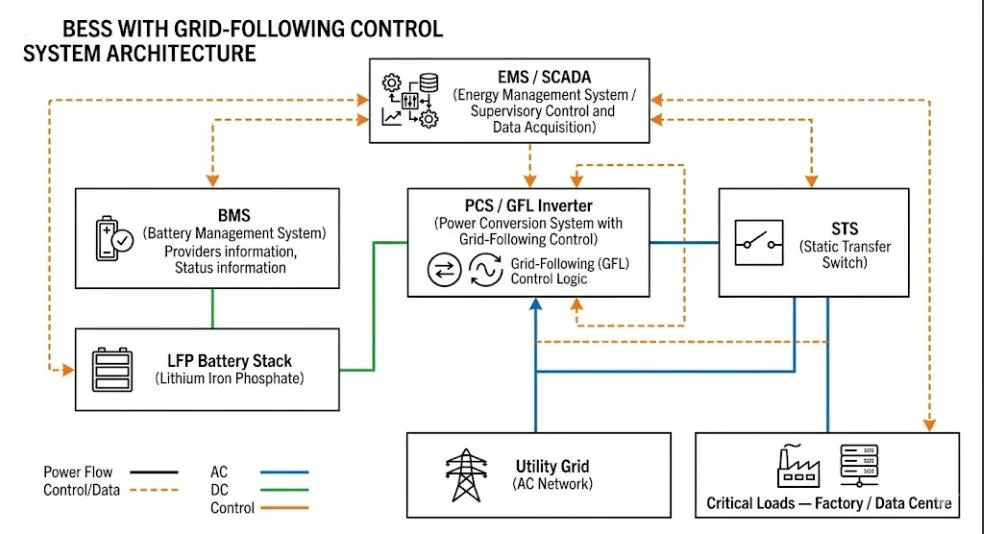
The BESS grid-following inverter is the executor. However, the Energy Management System (EMS) is the brain that tells it what to do and when. In a GFL BESS, the EMS handles four core coordination tasks:
- Smart Dispatch — Advanced algorithms run the core math to find the best times to charge or discharge. This helps you track multiple value streams at once.
- Fast Grid Response — For frequency services, the system tracks line conditions directly. It then sends speed commands to the GFL inverter in under 500 ms.
- Battery Care — Tight limits (like 15–90% SoC) protect the cells. This careful upkeep ensures you keep enough power ready for grid duties.
- Fault Management — If grid voltage drops, a safety routine starts right away. The code talks to the STS and BMS to make a quick, clean switch.
Further reading: How EMS Enables Advanced Grid Services Through BESS | BMS vs. EMS: Understanding the Control Layers in BESS
8. Grid Code Compliance for BESS Grid-Following Systems
Grid code rules are not optional. Every system must meet the rules set by the local network group. Here are the four key items:
- Frequency Limits — Inverters must work safely inside a tight frequency band. This span is 47.5 to 51.5 Hz in Europe, and 59.5 to 60.5 Hz in North America.
- Fault Ride-Through — Large voltage drops should not cause the hardware to trip off the line. Rules force units to stay online through deep sags for up to 150 ms.
- Grid Voltage Support — To keep the local grid stable, systems must feed reactive power up to $\pm0.33 \text{ pu}$ when called upon.
- Islanding Safety — Rules state that a system must quickly sense if it loses the main grid utility. The control loop must shut down the link in under 2 seconds.
| Standard / Code | Jurisdiction | Scope |
|---|---|---|
| IEEE 1547-2018 | USA | Interconnection of Distributed Energy Resources |
| ENTSO-E RfG Network Code | Europe | Generator grid connection requirements |
| AS/NZS 4777.2 | Australia / NZ | Grid connection of inverter energy systems |
| IEC 62898-3-1 | International | Microgrids — Technical requirements |
| NERC PRC-024 | North America | Generator frequency and voltage relay settings |
9. Key Components in a BESS Grid-Following System
A complete BESS grid-following system has several integrated layers. Each component has a specific role. Understanding all of them together is essential for good specifications and procurement decisions.
LFP Battery and BMS
LFP (Lithium Iron Phosphate) is the dominant cell chemistry for GFL BESS systems. It offers excellent thermal stability, a long cycle life of 3,500 to 6,000 cycles to 80% Depth of Discharge (DoD), and a competitive cost per kWh. The Battery Management System (BMS) monitors every cell for voltage, temperature, and state of charge.
See: Battery Management System (BMS) Explained
Power Conversion System (PCS) — the GFL Inverter
The PCS is the inverter. It performs DC-to-AC conversion and runs the GFL control algorithms — PLL, current control loops, and droop functions. For C&I applications, PCS units typically range from 50 kW to 2,500 kW per unit. For utility scale, 2.5 MW to 5 MW units are common.
See: Power Conversion System (PCS): The Heart of a BESS
Static Transfer Switch (STS) for GFL Backup Power
As described in Section 6, the STS is what enables a BESS grid-following system to deliver seamless uninterruptible power. It transfers load from the utility to the BESS in 2 to 8 milliseconds. This happens before the GFL inverter can lose its voltage reference.
Full guide: The Role of Static Transfer Switch (STS) in C&I BESS
Transformer and Grid Interface
Most C&I BESS grid-following systems connect at low voltage (400V or 480V). Larger systems use a step-up transformer to connect at medium voltage (11 kV or 33 kV). The transformer also affects the SCR at the PCC — so its impedance must be factored into the stability analysis.
10. Sizing a BESS Grid-Following System
Getting the size right from the start is critical for ROI. Oversizing wastes capital. Undersizing leaves value on the table. Here are the three key sizing considerations.
Power Rating (kW or MW)
For peak shaving, the power rating equals the target demand reduction. As an example, if a facility peaks at 2,000 kW and the target is 1,500 kW, the BESS needs at least 500 kW of discharge power. When it comes to FFR and frequency services, the power rating is determined by the contracted ancillary service volume.
Energy Capacity (kWh or MWh)
Energy capacity must sustain the required power for the needed duration. A peak shaving event might last 15 to 60 minutes. A backup power event may require 30 minutes to 4 hours. For most C&I peak shaving projects, a 2-hour duration — meaning energy equals power times two — is the standard starting point.
Sizing for Battery Degradation
LFP batteries degrade over time. As a result, a well-designed GFL system adds a 10 to 20% capacity buffer above Day 1 requirements. This ensures the system still meets performance targets at end of warranty — typically 10 years. Without this buffer, systems often fall short of contracted performance by Year 3 to 5.
See: C&I BESS Economics & ROI: Full Breakdown
11. Common BESS Grid-Following Deployment Mistakes
Based on Sunlith Energy’s project experience, certain mistakes appear most frequently. However, each one is entirely avoidable with good engineering practice.
- Local SCR Data — Skipping a short circuit ratio analysis creates massive system risks. Therefore, you must request this data from the network operator before choosing hardware.
- Faulty Factory Defaults — Inverters face severe control issues at sites with high harmonics. Because of this, engineers must tune the PLL settings during commissioning.
- Leaving Out the STS — Omitting a static switch is a critical system error. Projects that expect clean backup power from a GFL BESS without an STS will fail.
- Under-designed Protection Studies — Poorly coordinated anti-islanding settings cause frequent false alarms. To fix this, running a dedicated simulation study is a vital step.
- Battery Cell Degradation — Sizing a system purely for Day 1 needs will hurt your long-term ROI. Since batteries lose capacity over time, always design for your end-of-warranty targets.
- Without Rigorous Testing — Inverter firmware bugs are common in the field. Consequently, a full factory test is highly recommended to catch control errors early.
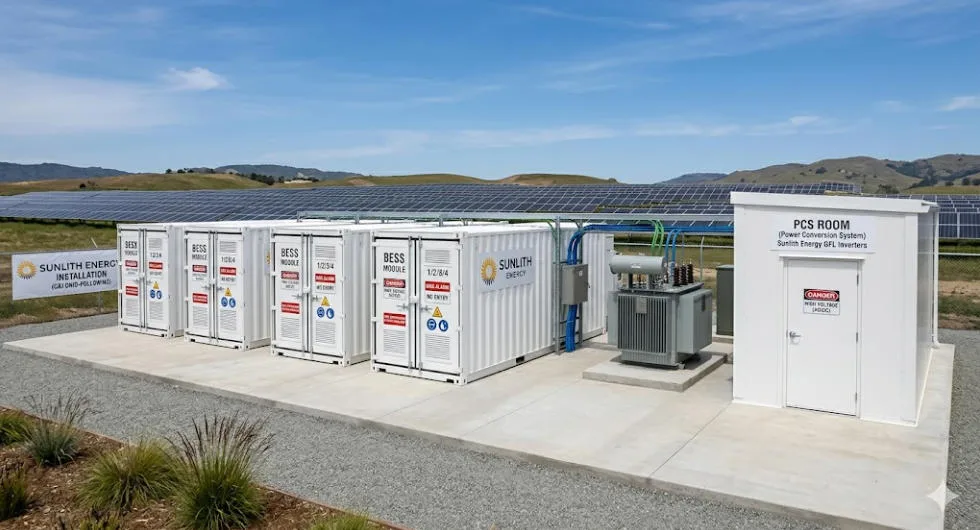
12. The Future of BESS Grid-Following: Hybrid Control Modes
The line between grid-following and grid-forming is already beginning to blur. The next generation of inverter platforms introduces hybrid modes that give GFL inverters some grid-forming capabilities under defined conditions.
Grid-Supportive GFL with Synthetic Inertia
New control algorithms allow BESS grid-following inverters to inject synthetic inertia — a power response proportional to the Rate of Change of Frequency (ROCOF). This helps fix the loss of mechanical inertia in high-renewable grids. It does not replicate full Grid-Forming capability. However, it meaningfully improves system inertia at a fraction of the cost.
Seamless GFL-to-GFM Mode Switching
Some advanced PCS platforms can switch automatically between GFL mode (when the grid is strong) and GFM mode (when the grid is weak or islanded) — without interrupting power delivery. Consequently, this is particularly valuable for microgrids that are normally grid-connected but need to island on demand.
BESS Grid-Following in Virtual Power Plants (VPPs)
Aggregators are grouping multiple GFL BESS assets across different C&I sites into Virtual Power Plants (VPPs). These VPPs then bid collectively into grid service markets. Each site uses a standard BESS grid-following system. Furthermore, the master platform provides the scale needed to enter the market. According to BloombergNEF, VPPs incorporating GFL BESS are forecast to exceed 50 GW of virtual capacity globally by 2030.
Source: BloombergNEF Energy Storage Market Outlook
13. Frequently Asked Questions About BESS Grid-Following
What does BESS grid-following mean?
BESS grid-following means the battery inverter synchronises its output to the existing grid voltage and frequency. Because of this, the battery follows the grid — it does not set the grid reference. This is the most common inverter control mode in battery storage today.
Can a GFL BESS provide backup power?
Yes — when paired with a Static Transfer Switch (STS). The STS transfers load from the utility to the BESS in 2 to 8 milliseconds, before the GFL inverter loses its voltage reference. As a result, critical loads experience no interruption. For more detail, see our guide on the STS.
Read more: The Role of STS in C&I BESS
What SCR is needed for BESS grid-following systems?
A minimum Short Circuit Ratio of 3 at the Point of Common Coupling is the standard engineering rule of thumb. Below SCR 2, a detailed stability analysis is mandatory. In addition, Grid-Forming inverters should be seriously considered for any site below SCR 2.
How fast does a BESS grid-following system respond to frequency events?
A modern GFL inverter with droop-based frequency response begins injecting power within 200 to 500 milliseconds of a frequency deviation. This qualifies for Fast Frequency Response (FFR) markets in most grid codes worldwide.
What battery chemistry does Sunlith Energy use for GFL BESS?
Sunlith Energy uses LFP (Lithium Iron Phosphate) chemistry as the primary choice for GFL BESS systems. NMC is also available for space-constrained applications. Contact our team to discuss your specific requirements.
What certifications apply to a BESS grid-following system?
Key certifications include UL 9540 (system level), UL 1973 (battery), UL 1741 (inverter), IEEE 1547 (interconnection), and IEC 62619 (safety). Grid code compliance requirements vary by jurisdiction. For a full breakdown, see our certifications guide.
See: UL 9540 & IEC Standards Compliance for BESS
14. Conclusion: Is BESS Grid-Following Right for Your Project?
BESS grid-following is not a compromise technology waiting to be replaced. Instead, it is the proven, cost-effective workhorse of the global energy storage industry. For the vast majority of C&I and utility-scale projects connected to strong grids, it remains the right choice — both technically and economically.
However, what separates a high-performing GFL system from an underperforming one is not the technology itself. Rather, it comes down to how the system is designed, integrated, and operated. Getting the PLL right. Sizing for end-of-warranty performance. Integrating an STS for backup power. Running a rigorous SCR analysis. Pairing the inverter with an EMS that stacks every available value stream.
At Sunlith Energy, we design complete BESS grid-following solutions engineered to perform — not just to specification on Day 1, but in the real world over the full project lifetime.
Talk to the Sunlith Energy Team →
Related Articles on Sunlith Energy
- BESS Grid-Forming Technology: The Architecture Stabilising Tomorrow’s Grid
- The Role of Static Transfer Switch (STS) in C&I BESS
- How C&I BESS Peak Shaving Lowers Demand Charges for Businesses
- How EMS Enables Advanced Grid Services Through BESS
- Power Conversion System (PCS): The Heart of a BESS
- C&I BESS Economics & ROI: Full Breakdown
- How C&I BESS Enhances Solar and Wind Power Integration
- Battery Management System (BMS) Explained
- UL 9540 & IEC Standards Compliance for BESS
- Benefits of C&I BESS for Manufacturing Facilities
- BMS vs. EMS: Understanding the Control Layers in BESS
External References
- NREL — Grid Integration of Battery Storage Research
- IEEE 1547-2018 — Standard for Interconnection of Distributed Energy Resources
- IEEE 2800-2022 — Interconnection Requirements for IBRs
- ENTSO-E — Network Code on Requirements for Grid Connection of Generators
- IEA — Batteries and Secure Energy Transitions Report
- BloombergNEF — Energy Storage Market Outlook
- U.S. DOE — Energy Storage Grand Challenge
- NERC — PRC-024 Frequency and Voltage Protective Relay Settings
- IEC 62898-3-1 — Microgrids: Technical Requirements
- EPRI — Inverter-Based Resource Grid Integration Studies
BESS Grid-Forming:The Architecture Stabilising Tomorrow’s Grid
BESS grid-forming technology is transforming how power grids stay stable. As renewable energy now accounts for more than 80% of new global capacity additions, grids are losing the mechanical inertia they once relied on. BESS grid-forming technology solves this problem directly. It lets batteries create their own voltage and frequency — rather than following the grid — so the power system stays balanced even when synchronous generators are absent. This article explains how it works, why it matters, and the $1.2 trillion market opportunity it represents.
| 1.4 TW Global grid-forming BESS capacity gap by 2034 | $1.2T BESS investment required through 2034 | 5.9 TW New wind and solar capacity expected by 2034 | 55% Projected global power demand surge by 2034 |
- 01 — The Grid Stability Problem
- 02 — What Is BESS Grid-Forming Technology?
- 03 — Grid-Forming vs. Grid-Following: Key Differences
- 04 — Core Technical Capabilities of BESS Grid-Forming Technology
- 05 — Control Strategies Behind BESS Grid-Forming Technology
- 06 — Global Market Opportunity for BESS Grid-Forming Technology
- 07 — Real-World BESS Grid-Forming Projects in 2025–2026
- 08 — Challenges and the Path Forward
- 09 — Sunlith Energy's View on BESS Grid-Forming Technology
- Key References and Further Reading
01 — The Grid Stability Problem
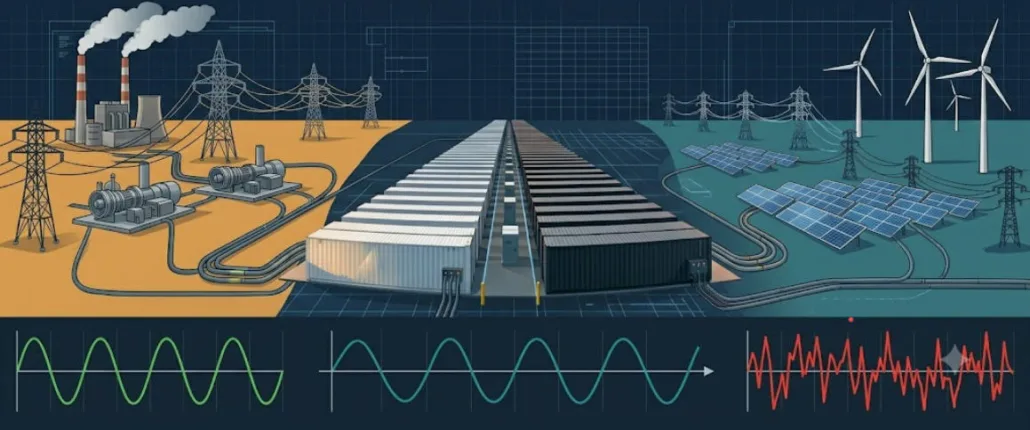
The energy transition is working. Solar costs have fallen by over 90% in a decade. Wind farms now supply power on six continents. Yet this progress creates a serious new challenge: grids are running out of inertia.
Why Inertia Matters for Grid Stability
Traditional grids relied on large spinning generators — coal plants, gas turbines, hydro dams. Their rotating mass provided mechanical inertia. Consequently, when supply and demand shifted, the grid had several seconds to respond. Frequency stayed within safe limits: 49.5–50.5 Hz in Europe, 59.95–60.05 Hz in North America.
Solar and wind farms connect through power electronics. As a result, they add no spinning mass. Therefore, as more synchronous generators retire, frequency swings become faster and more severe. The April 2025 Iberian blackout showed exactly what this means in practice — a cascading failure knocked out power across Spain, Portugal, and parts of France.
Why BESS Grid-Forming Technology Is the Answer
BESS grid-forming technology fills the inertia gap electronically. Instead of waiting for the grid to stabilise, a grid-forming battery creates its own stable voltage and frequency. In addition, it responds in milliseconds — far faster than any thermal plant. That is why grid planners worldwide are now prioritising BESS grid-forming technology as essential infrastructure, not just a backup option.
| KEY INSIGHT The April 2025 Iberian blackout reignited the global debate about grids running with too little inertia. Since then, BESS grid-forming technology has moved from ‘experimental’ to ‘strategic priority’ in market after market. |
02 — What Is BESS Grid-Forming Technology?
To understand BESS grid-forming technology, it helps to start with how batteries connect to the grid. Every battery, solar farm, and wind turbine connects through a power electronic device called an inverter. The inverter controls how electricity flows onto the AC network.
Grid-Following Inverters: The Old Standard
Until recently, almost all inverters operated in grid-following mode. A grid-following inverter reads the existing voltage waveform on the network. Then it synchronises its output current to match. This approach works well when plenty of synchronous generators are providing a stable reference. However, it fails in weak grids or during blackouts because there is no waveform left to follow.
BESS Grid-Forming Technology: The New Standard
BESS grid-forming technology works differently. A grid-forming inverter does not wait for a voltage signal. Instead, it generates its own voltage magnitude and frequency using sophisticated digital control algorithms. In other words, it behaves like a voltage source rather than a current source. Furthermore, it can hold that voltage stable even when the wider grid collapses — making black start and islanded operation possible.
“BESS grid-forming technology represents a critical breakthrough for renewable energy integration. As global power demand surges 55% by 2034, GFM BESS provides the bridge between renewable abundance and grid stability.”
— Robert Liew, Research Director, Wood Mackenzie, July 2025
In short, BESS grid-forming technology gives batteries the ability to anchor the grid — not just respond to it. For a full technical breakdown, see Wood Mackenzie: Steadying the Grid.
03 — Grid-Forming vs. Grid-Following: Key Differences
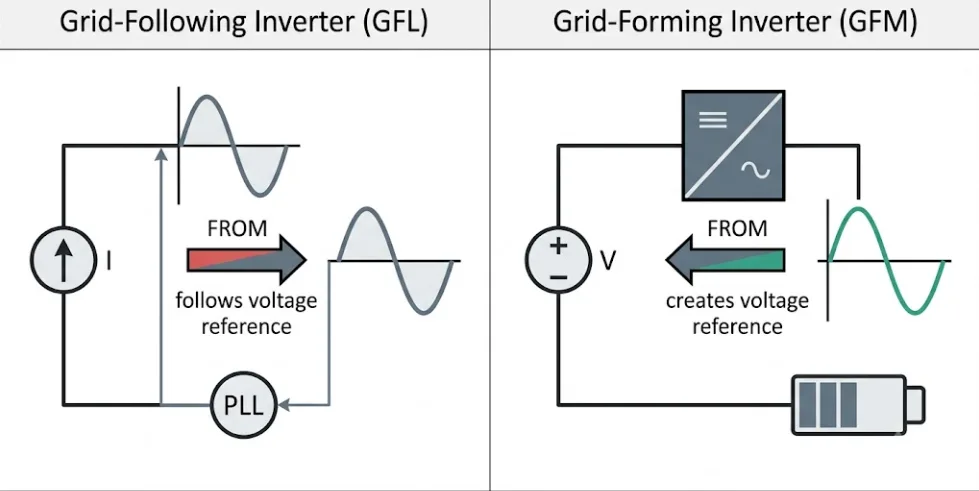
The table below compares grid-forming and grid-following BESS across the capabilities that matter most for modern power networks. Notably, BESS grid-forming technology unlocks revenue streams that grid-following systems simply cannot access.
| Capability | Grid-Following BESS | Grid-Forming BESS |
| Voltage Reference | Follows an existing grid signal | Creates its own voltage and frequency |
| Synthetic Inertia | ❌ Not available | ✅ Fully capable |
| Black Start | ❌ Needs external reference | ✅ Energises isolated networks |
| Weak Grid Support | ⚠ Performance degrades | ✅ Optimised for low short-circuit ratio |
| Islanding | ❌ Trips on isolation | ✅ Seamless island and resync |
| System Strength | ❌ Minimal | ✅ Fault current and voltage support |
| Fast Frequency Response | ⚠ No inertia component | ✅ FFR plus inertial response |
| Fault Ride-Through | ⚠ Standard only | ✅ Enhanced, phase-jump tolerant |
| Energy / FCAS Markets | ✅ Widely deployed | ✅ Same, plus premium stability revenue |
| Hardware Cost Premium | Baseline | ~15% higher (gap narrowing fast) |
The 15% Cost Premium Is Shrinking
Grid-forming hardware costs roughly 15% more than conventional BESS. This premium covers upgraded inverters, enhanced controls, and higher surge current capacity. However, battery cell prices fell 10–40% worldwide over the past year alone. Therefore, the effective cost gap is closing rapidly. Moreover, the premium stability services that BESS grid-forming technology unlocks — synthetic inertia, black start, system strength — generate significantly higher revenues. For pricing detail, see the Wood Mackenzie BESS Opportunity Report.
04 — Core Technical Capabilities of BESS Grid-Forming Technology
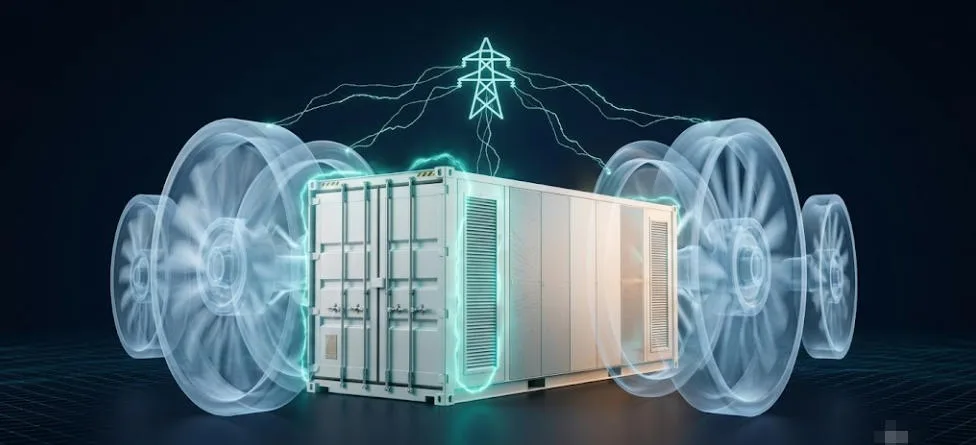
BESS grid-forming technology delivers six capabilities that conventional battery storage cannot match. Each one addresses a specific gap created by the shift to renewable generation.
| ⚡ Synthetic Inertia Electronically replicates spinning mass. When frequency shifts, stored energy is injected within milliseconds — buying time for other resources to respond. | 🔄 Black Start Restarts de-energised network segments after a blackout without needing help from thermal plants. The battery creates the initial voltage from scratch. |
| 📊 Voltage and Frequency Regulation Actively establishes and maintains both voltage magnitude and frequency — the reference signal that all other grid devices rely on. | 🏝 Islanding and Resynchronisation Keeps supply stable in an isolated grid section during faults. When the fault clears, it reconnects to the main grid autonomously and without disruption. |
| 💪 System Strength Provides short-circuit current and fault-level capacity. This is essential for connecting more renewables in areas with low grid strength. | 🛡 Oscillation Damping Detects and suppresses inter-area power oscillations — a growing risk as synchronous generators retire and natural damping disappears. |
Synthetic Inertia: How BESS Grid-Forming Technology Replaces Spinning Mass
Synthetic inertia is the most important capability of BESS grid-forming technology. Here is how it works. When grid frequency begins to fall, the control system detects the rate of change of frequency (RoCoF) in real time. Next, it discharges stored energy in proportion to that rate of change. As a result, the battery mimics the behaviour of a large spinning turbine — but responds ten times faster and remains active for hours rather than seconds.
The Blackhillock BESS in Scotland proves this in practice. Its grid-forming inverters deliver 370 megawatt-seconds of synthetic inertia and 116 MVA of short-circuit contribution directly to the GB transmission system. Furthermore, the system was the first battery in the world to provide full active and reactive power stability services at transmission level. Read the full story: Grid-Forming Tech on Centre Stage — PV Magazine. For the underlying AEMO technical methodology, see Quantifying Synthetic Inertia from GFM BESS (AEMO, 2024).
05 — Control Strategies Behind BESS Grid-Forming Technology
Three main control strategies power BESS grid-forming technology. Each offers different trade-offs between simplicity, performance, and compatibility with existing grid infrastructure.
1. Droop Control
Droop control is the most widely deployed strategy in BESS grid-forming technology today. It works by mimicking a synchronous generator’s natural response: when frequency drops, active power output increases automatically; when frequency rises, output falls. Similarly, voltage deviations trigger reactive power adjustments. Droop control is straightforward to deploy and coordinates well across multiple units. Therefore, it dominates utility-scale projects currently in operation.
2. Virtual Synchronous Generator (VSG)
VSG control takes the concept further. It mathematically models the full dynamic equations of a synchronous machine — including the swing equation, damping coefficient, and excitation system. Consequently, the battery produces inertial behaviour that closely mirrors a real generator. This approach integrates naturally with protection frameworks built around synchronous machines. However, it requires more careful tuning and greater computational power. For a detailed technical comparison, see GFM vs GFL — OPAL-RT.
3. Power Synchronisation Control (PSC)
PSC replaces the phase-locked loop (PLL) used in grid-following inverters with a direct synchronisation mechanism. As a result, it stays stable in very weak grids and close to faults where PLLs break down. PSC is well established in HVDC-VSC systems and is now being adapted for BESS in low short-circuit ratio environments. In addition, it is particularly suitable for remote or islanded microgrids where grid strength is inherently low.
| REGULATORY NOTE IEEE Standard 2800 and NERC ride-through profiles are shaping GFM compliance in North America. In Australia, AEMO’s voluntary GFM specification splits capabilities into ‘core’ (software only) and ‘additional’ (hardware upgrades). The EU’s NC RfG is being revised to add GFM-specific testing for synthetic inertia, oscillation damping, and islanding. |
06 — Global Market Opportunity for BESS Grid-Forming Technology
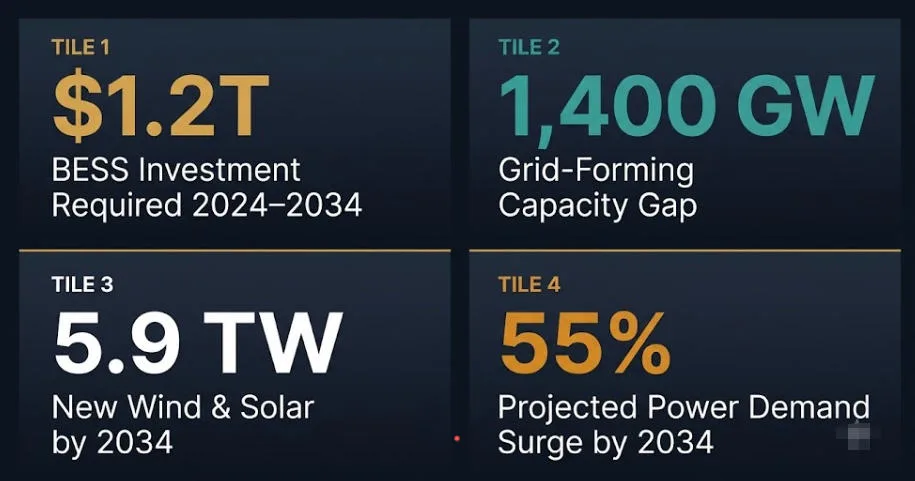
The market for BESS grid-forming technology is enormous — and largely unmet. Wood Mackenzie’s July 2025 analysis identified a 1,400 GW global capacity gap for grid-forming battery storage through 2034. To put that in context, $1.2 trillion of BESS investment is required over the decade to support more than 5,900 GW of new wind and solar capacity. Furthermore, global power demand is forecast to surge 55% by 2034, with over 80% of new capacity coming from variable renewables.
Australia Leads the World in Grid-Forming BESS Deployment
Australia’s National Electricity Market (NEM) is the most advanced market for BESS grid-forming technology globally. According to AEMO’s 2025 Transition Plan, ten grid-forming BESS sites with a combined output of 1,070 MW are already in operation. See our BESS grid-forming projects portfolio. Moreover, a further 94 projects — 78 standalone batteries and 16 hybrid installations — are in the development pipeline. AEMO has also explicitly identified BESS grid-forming technology as the dominant provider of fast FCAS (Frequency Control Ancillary Services) introduced in 2023. See: Australia’s GFM Pipeline — Energy Storage News.
The UK’s Stability Pathfinder: A Revenue Model for Grid-Forming BESS
In the United Kingdom, National Grid’s Stability Pathfinder programme has created long-term contracts for grid-forming services — specifically synthetic inertia and system strength. This gives developers the revenue certainty needed to finance large BESS grid-forming technology projects. As a result, the UK is building one of the most commercially mature markets for this technology outside Australia.
Saudi Arabia Sets a World Record
In December 2025, Saudi Arabia connected a 7.8 GWh grid-forming BESS — the largest in the world at commissioning — to its national transmission network. The project delivers black-start capability, virtual inertia, fast frequency response, and voltage support. Furthermore, it was completed in an extraordinarily compressed timeline, with over 1,500 PowerTitan 2.0 units manufactured in just 58 days. Read more: Saudi Arabia 7.8 GWh BESS — Energy Storage News.
07 — Real-World BESS Grid-Forming Projects in 2025–2026
These three projects confirm that BESS grid-forming technology has moved decisively from pilot stage to mainstream deployment.
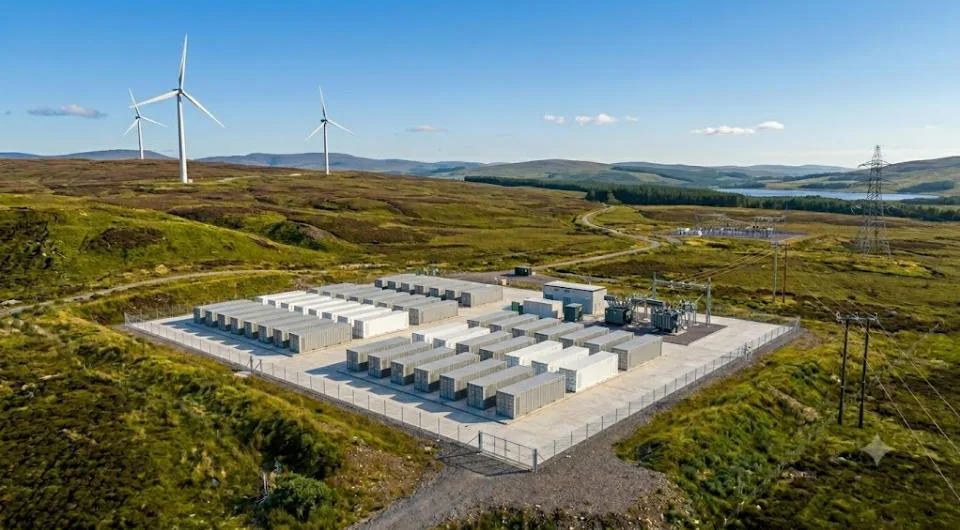
Blackhillock BESS — Great Britain (200 MW / 400 MWh)
Developed by Zenobe with Wärtsilä storage and SMA grid-forming inverters, Blackhillock became the world’s first battery to deliver full active and reactive power stability services at transmission level. It sits in northeast Scotland — a region dominated by wind generation where synchronous capacity is limited. Consequently, it provides synthetic inertia and voltage stabilisation that the local grid cannot otherwise source. The project holds 62 SMA medium-voltage stations and delivers 370 MW·s of synthetic inertia and 116 MVA of short-circuit contribution.
Saudi Arabia 7.8 GWh Grid-Forming BESS
This is currently the largest BESS grid-forming project in the world. Equipped with Sungrow PowerTitan 2.0 systems, it provides black-start capability, virtual inertia, fast frequency response, and voltage support to the Saudi transmission network. In addition, the project directly supports Saudi Arabia’s Vision 2030 clean energy programme and demonstrates that BESS grid-forming technology can scale to multi-gigawatt-hour levels within short construction windows.
Dalrymple BESS — South Australia
Dalrymple is an important proof-of-concept for islanding and resynchronisation. After the main grid fails, the battery maintains stable supply to an isolated network section. Then, when the grid recovers, it adjusts its own frequency to match before reconnecting — without any disruption. This autonomous resynchronisation capability is now a standard requirement in AEMO procurement rounds. For the underlying analysis, see Hitachi Energy: Bridging the Inertia Gap.
08 — Challenges and the Path Forward
Despite strong momentum, BESS grid-forming technology faces four genuine barriers that the industry must address to close the 1,400 GW gap.
Challenge 1: Regulatory and Standards Gaps
Most grid codes were written for synchronous machines. As a result, they do not include compliance testing procedures for capabilities unique to BESS grid-forming technology — such as synthetic inertia provision, oscillation damping, and islanding. IEEE and IEC are actively drafting updates. However, regulatory change takes time, and developers face uncertainty in the interim. See the latest review: Grid Codes for GFM Inverters — ScienceDirect.
Challenge 2: Modelling Complexity
Grid-forming inverters interact with one another in complex, non-linear ways. Consequently, electromagnetic transient (EMT) simulation tools struggle to model them accurately. This slows interconnection approvals and creates risk for developers. Nevertheless, modelling tools are improving rapidly, and several grid operators have now published accepted simulation methodologies.
Challenge 3: Mandate vs. Market Debate
A live policy question remains: should BESS grid-forming technology be mandated for all new large-scale BESS projects, or left to voluntary adoption through premium revenue streams? Australia is moving toward mandate for certain connection scenarios. By contrast, the UK is using competitive procurement. The resolution of this debate will significantly affect deployment speed through 2030.
Challenge 4: Interoperability Across Manufacturers
When multiple grid-forming units from different manufacturers operate together, their control algorithms must coordinate seamlessly. Currently, interoperability standards are still being finalised. Therefore, project developers must take extra care at the design stage when mixing equipment from different vendors.
On the positive side, battery cell prices fell 10–40% globally over the past year. Additionally, inverter manufacturers are scaling production rapidly. Therefore, the cost case for BESS grid-forming technology is strengthening every quarter. The technology is no longer experimental — it is working at scale, in live transmission networks, today.
09 — Sunlith Energy’s View on BESS Grid-Forming Technology
At Sunlith Energy, we see BESS grid-forming technology as a structural shift — not an incremental upgrade. Batteries are becoming foundational grid infrastructure. For more analysis, visit our Sunlith Energy Insights page. The old view of BESS as a behind-the-meter asset or simple frequency-response tool is giving way to something more significant: batteries as the primary source of grid stability in a renewable-dominated power system.
Our Four Core Convictions
1. The Stability Gap Is Real and Urgent
The Iberian blackout was not an anomaly. It was a warning. Markets that keep adding renewables without replacing lost inertia are accumulating systemic risk. Consequently, BESS grid-forming technology is not an optional feature — it is an engineering necessity for any grid targeting high renewable penetration.
2. Revenue Stacking Makes the Economics Compelling
A grid-forming battery can simultaneously participate in energy arbitrage, fast frequency response markets, inertia procurement, system strength contracting, and black-start services. Therefore, the total revenue potential of BESS grid-forming technology significantly exceeds that of a conventional BESS asset. Moreover, as grid codes tighten, these revenue streams will grow further.
3. Falling Costs Are Changing the Calculation
The 15% hardware premium for BESS grid-forming technology is eroding as inverter volumes scale and competition intensifies. In addition, the premium services it unlocks are worth far more than the cost difference. Within the current planning horizon, we expect grid-forming to become the default specification for utility-scale BESS in all high-renewable markets.
4. Australia and the UK Are the Proving Grounds
The procurement frameworks, grid codes, and market structures being built in these two markets today will be replicated globally. Developers who build operational experience and project references now will be strongly positioned as the $1.2 trillion opportunity unfolds. Furthermore, the lessons from Blackhillock, Dalrymple, and the Australian NEM will directly inform policy in the Middle East, Southeast Asia, and North America.

| WORK WITH SUNLITH ENERGY Our team specialises in grid-scale storage design and BESS grid-forming technology integration for utility and developer clients. Contact us to discuss your project and explore how grid-forming BESS can maximise your asset’s revenue potential. |
Key References and Further Reading
- Wood Mackenzie: $1.2T BESS Investment Required Through 2034
- Wood Mackenzie: Steadying the Grid — Why GFM BESS Is Crucial
- PV Magazine: World Needs 1.4 TW of Grid-Forming Batteries by 2034
- Energy Storage News: Australia’s GFM Pipeline Extends to 94 Projects
- Energy Storage News: Saudi Arabia Connects 7.8 GWh Grid-Forming BESS
- PV Magazine: Grid-Forming Tech on Centre Stage (May 2026)
- Hitachi Energy: Bridging the Inertia Gap (April 2026)
- OPAL-RT: Grid-Forming vs Grid-Following Real-Time Testing Guide
- AEMO: Quantifying Synthetic Inertia from GFM BESS (2024)
- CIGRE UK: Integrating GFM and GFL BESS into Power Markets
- ScienceDirect: Review of Grid Codes for GFM Inverter Compliance
- IEEE Xplore: Comparison of GFL and GFM Inverters for Frequency Stability
- Battery Design: Grid-Forming vs Grid-Following Inverters (July 2025)
The Role of Static Transfer Switch (STS) in C&I BESS
Most facility managers focus on battery capacity or inverter size when evaluating a BESS. However, one component quietly determines whether the whole system works as promised. That component is the Static Transfer Switch (STS). It is the device that makes power transitions invisible to your equipment — and your operations. In this guide, we cover how it works, where it fits, and why getting it right matters so much.
1. What Is a Static Transfer Switch (STS)?
A Static Transfer Switch is a solid-state device. It moves a facility’s electrical load from one power source to another. The key feature is speed — it completes the switch in just 2 to 8 milliseconds.
It uses Silicon-Controlled Rectifiers (SCRs), also called thyristors. These are semiconductor components with no moving parts. In fact, a standard Automatic Transfer Switch (ATS) takes 2 to 60 seconds to do the same job. As a result, the STS is the only device fast enough to protect truly sensitive industrial loads.
Furthermore, because there are no mechanical parts, the device lasts longer and needs less maintenance. For Sunlith Energy’s C&I BESS range, visit our C&I BESS blog. For technical standards, see IEC 62310: Static Transfer Systems.
How the Device Responds to a Grid Fault — Step by Step
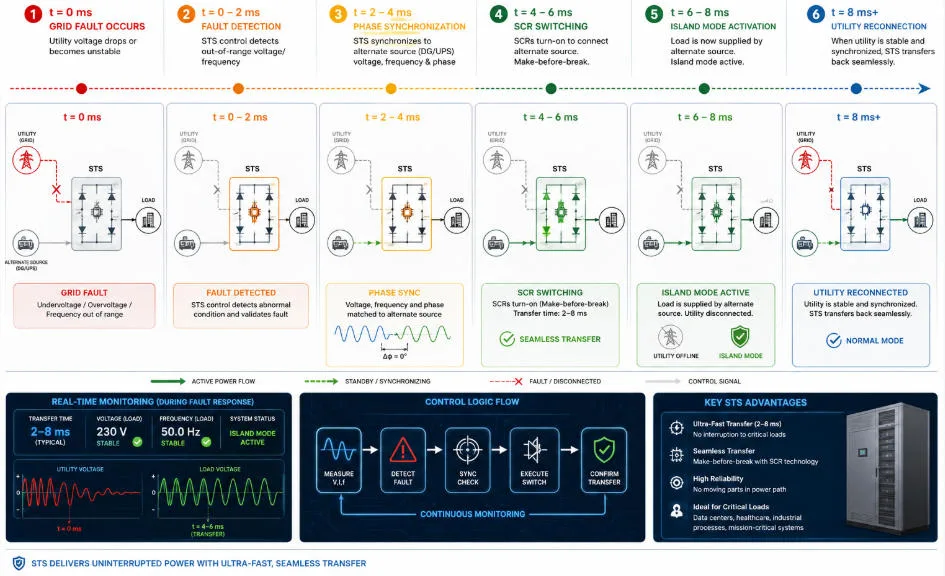
The table below shows exactly what happens when the grid fails. Notice how quickly each stage moves.
| Time | Event | What Happens |
| t = 0 ms | Grid fault starts | STS sensors detect the voltage anomaly right away. |
| t = 1–2 ms | Fault confirmed | The DSP controller validates the fault and aligns the BESS output phase. |
| t = 2–8 ms | Transfer fires | SCR thyristors switch the load to BESS. Critical loads feel nothing. |
| t = 8–20 ms | Island mode active | The facility runs as a microgrid. EMS takes over load dispatch. |
| Grid restore | Reconnection | STS checks utility stability, then reconnects smoothly and safely. |
| ⚡ Key Performance Numbers to Know STS transfer time: 2–8 ms | Full electrical cycle: < 20 msEquipment hold-up time: 15–30 ms | Seamless switching window: ≤ 20 msIn short, loads never feel the switch happen. The STS acts well within the safety margin. |
2. STS vs. ATS: Why the Speed Gap Is Decisive for C&I Sites
Many facilities already have an Automatic Transfer Switch installed. So why upgrade to an STS? The answer is speed — and what that speed means in practice.
According to NREL’s energy storage research, demand charges make up 30 to 70% of a typical C&I electricity bill. A single power interruption — even 50 ms — can reset demand charge windows. It can also trip relays and crash PLCs. Because of this, a 2-second ATS response simply is not good enough for sensitive loads.
In contrast, an STS acts in milliseconds. The equipment on the other side never registers the event. Moreover, the solid-state design means fewer service calls and a longer operational life over a 10-year BESS project.
Side-by-Side Comparison: STS vs. Standard ATS
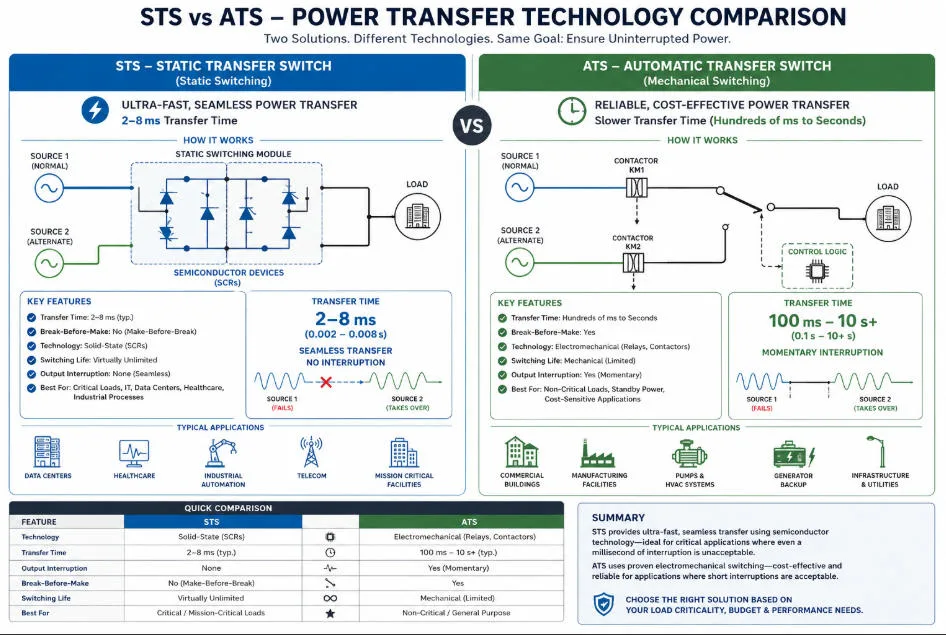
| Attribute | Static Transfer Switch (STS) | Automatic Transfer Switch (ATS) |
| Transfer Time | ✓ 2–8 ms — sub-cycle speed | ✗ 2–60 seconds — far too slow |
| Switching Technology | ✓ Solid-state SCR thyristors | ✗ Mechanical contactors / relays |
| Moving Parts | ✓ None — zero mechanical wear | ✗ Yes — needs regular servicing |
| Sensitive Load Protection | ✓ Yes — PLCs, servers, cold chain | ✗ No — causes a momentary outage |
| Microgrid Islanding | ✓ Seamless and fully synchronised | ✗ Possible but with interruption |
| Long-Term Reliability | ✓ Very high — no contact fatigue | ~ Moderate — contacts wear over time |
| Upfront Cost | ~ Higher initial investment | ✓ Lower upfront cost |
| Right for C&I BESS? | ✓ YES — for critical industrial sites | ~ Only for non-critical backup |
For further reading, see IEEE Standard 446: Emergency and Standby Power Systems. To discuss which technology suits your facility, contact the Sunlith Energy team.
3. Where the Static Transfer Switch Fits in a C&I BESS Architecture
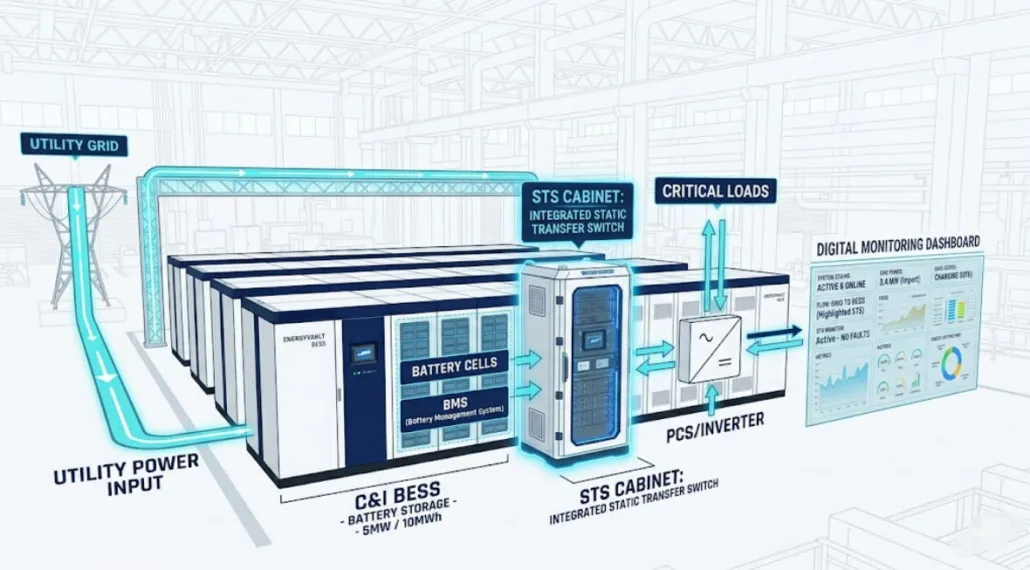
A complete C&I BESS has several layers. Each layer has a specific job. Understanding them together makes the STS role much clearer.
| Battery Cells LFP / NMC | → | BMS Safety & balancing | → | PCS / Inverter DC ↔ AC conversion | → | STS ★ Source switching | → | Critical Loads Factory / Building |
The STS sits between the Power Conversion System and the facility’s loads. It acts as the gatekeeper. In real time, it decides whether the building draws from the grid or from the battery.
Normal Day-to-Day Operation
During normal operation, the facility draws from the grid. The battery charges during off-peak hours. Meanwhile, the STS monitors voltage, frequency, and phase angle continuously. It samples these thousands of times per second. The moment something goes wrong, it acts.
What Happens During a Grid Failure
When a fault is detected, the STS disconnects the facility from the utility. At the same time, it connects the PCS output from the battery. Because the PCS pre-synchronises with the grid, the switch is seamless. Subsequently, the facility becomes an independent microgrid. For more on microgrid design, see EPRI’s Microgrid Design Guidelines.
Reconnecting to the Grid After a Fault
Reconnection is just as important as the initial switch. The STS does not reconnect immediately when the grid returns. Instead, it first checks that voltage, frequency, and phase are all stable. Then it reconnects in a controlled way. This approach prevents inrush currents and protects equipment on both sides.
| 🔁 STS and PCS: A Critical Partnership The Static Transfer Switch (STS) and the Power Conversion System (PCS) work closely together.The PCS continuously tracks the grid phase angle. As a result, there is always a ready backup source.This coordination is precisely why the transfer happens in under 8 ms — the system anticipates rather than just reacts. |
4. Six Key Applications of the Static Transfer Switch That Justify the Investment
The STS is not a single-use device. Instead, it enables several overlapping applications. Together, these stack financial and operational value. Sunlith Energy’s C&I BESS peak shaving guide explains how this stacking works in practice.
Seamless Backup via Static Transfer Switch
This is the primary use case. When the grid fails, the switch transfers load to the BESS in milliseconds. Production lines, cold rooms, and server racks stay online. There is no inrush and no restart. As a result, facilities avoid the costly downtime that slower systems cannot prevent.
Peak Shaving and Demand Charge Reduction
Demand charges often make up 30 to 70% of a C&I electricity bill. During peak demand windows, the BESS discharges through the STS. The transition is smooth and clean. In addition, combined with a smart Energy Management System, this can cut demand charges by 30 to 40%.
Microgrid Islanding for Energy Independence
Remote sites, mining operations, and campuses with resilience needs can use the STS to form a stable microgrid. The facility then operates independently when needed. For context on global adoption, see the IEA Batteries and Secure Energy Transitions Report.
Power Quality Protection Beyond Just Outages
Voltage sags and transients cause just as much damage as full outages. The STS responds to these events as well. Therefore, PLCs, variable-frequency drives, and precision equipment are all protected — not only from blackouts, but from brownouts too.
Solar and BESS Hybrid System Management
In solar and battery hybrid systems, the STS manages handoffs between solar, battery, and grid. Cloud cover and shading change output constantly. As a result, the facility always receives a clean, uninterrupted supply. See also: Commercial Solar Battery Integration Explained.
Demand Response and Grid Services Participation
Demand response programmes pay C&I sites to reduce grid load at peak times. Fast, reliable switching is what makes participation viable. Moreover, as Virtual Power Plants (VPPs) grow, the STS becomes a key asset for grid operators. Learn more at U.S. DOE Demand Response Resources.
5. How the Static Transfer Switch Multiplies BESS ROI
C&I BESS projects pay back fastest — typically in 3 to 5 years — when they capture several revenue streams at once. This is called value stacking. The Static Transfer Switch is the hardware that makes it safe to stack. Without it, transitions between sources carry risk. With it, the system manages them automatically. Read more: How C&I BESS Reduces Demand Charges.
Value Stack Enabled by STS Technology
| Value Stream | Financial Impact | How the STS Enables It |
| Peak Shaving & Demand Charges | 30–70% of C&I bill savings | STS prevents the spike that resets demand charge windows |
| Time-of-Use (TOU) Arbitrage | 10–25% energy cost reduction | Smooth charge/discharge — no power quality events mid-transition |
| Backup & Business Continuity | Eliminates production stoppages | Sub-8ms switching makes backup truly uninterruptible |
| Grid Services & Demand Response | New utility revenue streams | Fast STS response meets utility programme requirements |
| Solar + BESS Self-Consumption | Maximises renewable output | STS manages PV → BESS → Grid priority without any glitch |
“A facility with a 5 MW / 10 MWh BESS and correctly integrated STS cut demand charges by 35%. They also recovered the full investment within four years — and eliminated production stoppages caused by grid instability.”
6. Sizing and Selecting the Right Unit for Your C&I Project
Choosing the right STS is just as important as choosing the right battery. Several technical factors drive the decision. For reference, see IEC 62310-1: General Requirements for Static Transfer Systems.
Static Transfer Switch Current Rating
The unit must handle the facility’s maximum continuous load current. It also needs headroom for motor start inrush. Common C&I ratings run from 200A to 1,800A per unit. Larger systems use units in parallel.
Voltage Class and Point of Interconnection
Most C&I BESS systems run at low voltage — 400V or 480V three-phase. However, larger industrial sites may need medium-voltage units. Always match the voltage class to the point of interconnection in your single-line diagram.
4-Pole vs. 3-Pole: Neutral Switching Options
Facilities with sensitive grounding schemes may need 4-pole designs. For example, sites with TN-S grounding or medical-grade loads often require independent neutral switching. This detail is easy to overlook but important to get right.
Matching Unit Size to PCS Output
For high-power C&I systems above 40 kW, the STS is a standalone unit. It must match or exceed the PCS output capacity. For smaller systems, integrated designs within the PCS simplify installation and reduce wiring complexity.
| 📐 Sunlith Energy’s Sizing Methodology We start with a detailed load profile analysis.We then assess maximum demand, critical load share, motor inrush factors, and grounding topology.Consequently, the STS is sized to handle the worst-case scenario — not just the average.Contact us at sunlithenergy.com for a free technical consultation. |
7. Common Deployment Pitfalls — and How to Avoid Them
Even a well-specified STS can underperform if deployed incorrectly. Based on Sunlith Energy’s project experience, these are the most common mistakes.
- Pre-synchronisation is non-negotiable. The STS can only switch cleanly if both sources share phase. The PCS must run in grid-following mode at all times. If it does not, the transfer causes an inrush event instead of preventing one.
- Segregate critical loads before installation. The STS should protect only the most important loads — not the whole building. Separating critical circuits from non-critical ones (lighting, HVAC) reduces required battery capacity and extends runtime on backup.
- Coordinate with upstream protection devices. The switching event must work in harmony with upstream breakers. Without coordination, you risk nuisance tripping. Always conduct arc flash and protection studies before commissioning.
- Secure the control interface. Modern STS units are network-connected. In facilities with OT networks, this interface must be hardened against unauthorised access. See NIST SP 800-82: Guide to ICS Security for best practices.
- Always test under real load conditions. Every installation should complete a full transfer test under load before going live. Both Factory Acceptance Testing (FAT) and Site Acceptance Testing (SAT) must be documented.
8. What Is Next? Emerging Trends in Switching Technology
The STS is evolving quickly. Modern units do much more than react to faults. Instead, they are becoming intelligent grid-edge devices. Several trends are shaping this shift, as tracked by BloombergNEF Energy Storage Outlook and Wood Mackenzie BESS Forecasts.
- EMS Integration: Next-generation units communicate with the EMS via Modbus, IEC 61850, or DNP3. As a result, switching is coordinated — not merely reactive.
- Power Quality Analytics: Advanced firmware logs voltage sags, harmonics, and transients continuously. This data helps justify BESS investments to finance teams with hard evidence.
- VPP Participation: As Virtual Power Plants scale up, the STS becomes a key dispatchable endpoint. Grid operators can use it for frequency support and demand flexibility.
- Modular, Scalable Designs: Rack-mounted modular units let facilities start small and scale up. Consequently, the barrier of large upfront capital for a full-rated unit is removed.
- AI-Assisted Predictive Switching: Emerging platforms use machine-learning to anticipate grid instability. Therefore, the system pre-positions itself before a fault occurs — rather than reacting after the fact.
9. Frequently Asked Questions About the Static Transfer Switch
What is the main job of a Static Transfer Switch (STS) in a battery storage system?
Its job is to transfer the load from the grid to the battery in under 8 milliseconds. This protects critical equipment from any power interruption. Without it, the BESS cannot respond fast enough to be genuinely uninterruptible.
How does it compare to a standard ATS in speed?
A standard ATS takes 2 to 60 seconds to switch. In contrast, the STS does it in 2 to 8 milliseconds. That difference is the gap between seamless protection and a disruptive outage.
Is it necessary for every C&I battery project?
Not necessarily. For non-critical backup, an ATS can be enough. However, any site with sensitive loads — manufacturing, cold chain, data, or healthcare — needs this level of protection. In short, if downtime is expensive, you need it.
Where do I get one for my project?
Sunlith Energy designs and deploys complete C&I BESS systems with STS integration included. Contact our team to discuss your site requirements.
10. Conclusion: Why the Static Transfer Switch Makes or Breaks Your BESS
To sum up, this device is what separates a reliable C&I BESS from an unreliable one. Peak shaving, islanding, demand response, and renewable integration all depend on clean, fast source switching. Without proper switching technology, the gaps between sources carry risk. With it, transitions are invisible.
At Sunlith Energy, we treat Static Transfer Switch (STS) integration as a first-class engineering task. We size it correctly, coordinate it with upstream protection, and test it under real load conditions before handover.
The grid is becoming less predictable. Energy costs continue to rise. Facilities that invest in the right switching technology today will have a real operational advantage tomorrow. Talk to the Sunlith Energy team to get started.
Related Articles on Sunlith Energy
- How C&I BESS Reduces Demand Charges Through Peak Shaving
- C&I BESS Economics & ROI: Full Breakdown
- Power Conversion System (PCS): The Heart of a BESS
- Benefits of C&I BESS for Manufacturing Facilities
- UL 9540 & IEC Standards Compliance for BESS
- EMS: Understanding the Control Layers in BESS
- What Is a Battery Management System (BMS)?
External References & Further Reading
- IEC 62310 — Static Transfer Systems Standard
- IEEE Standard 446 — Emergency and Standby Power Systems
- NREL — Commercial & Industrial Energy Storage Research
- IEA — Batteries and Secure Energy Transitions Report
- EPRI — Microgrid Design and Implementation Guidelines
- U.S. DOE — Demand Response Resources & Programmes
- NIST SP 800-82 — Guide to Industrial Control Systems Security
- BloombergNEF — Energy Storage Market Outlook
- Wood Mackenzie — BESS Forecast & Market Reports
The EMS Architecture & The 3S Framework: The Intelligence Behind Modern BESS
EMS architecture is the control backbone of modern battery energy storage systems. It helps batteries operate safely, efficiently, and reliably. In addition, EMS architecture improves grid stability, renewable energy integration, and power management.
Today, battery storage systems support much more than backup power. They also help utilities balance electricity demand and stabilize renewable energy output. Therefore, smart control software is now essential.
At Sunlith Energy, advanced energy storage platforms use intelligent monitoring and automation to improve overall system performance.
What Is EMS Architecture?
EMS architecture refers to the structure that controls and manages a battery energy storage system. It combines software, communication systems, and hardware—such as Power Conversion Systems (PCS)—into one intelligent platform.
The system continuously collects real-time data. Then, it analyzes operating conditions and sends control commands.
For example, the EMS can:
- Manage charging cycles
- Prevent battery over-discharge
- Balance grid demand
- Improve energy efficiency
- Monitor system safety
As a result, operators can improve both performance and reliability.
EMS Architecture and the 3S Framework
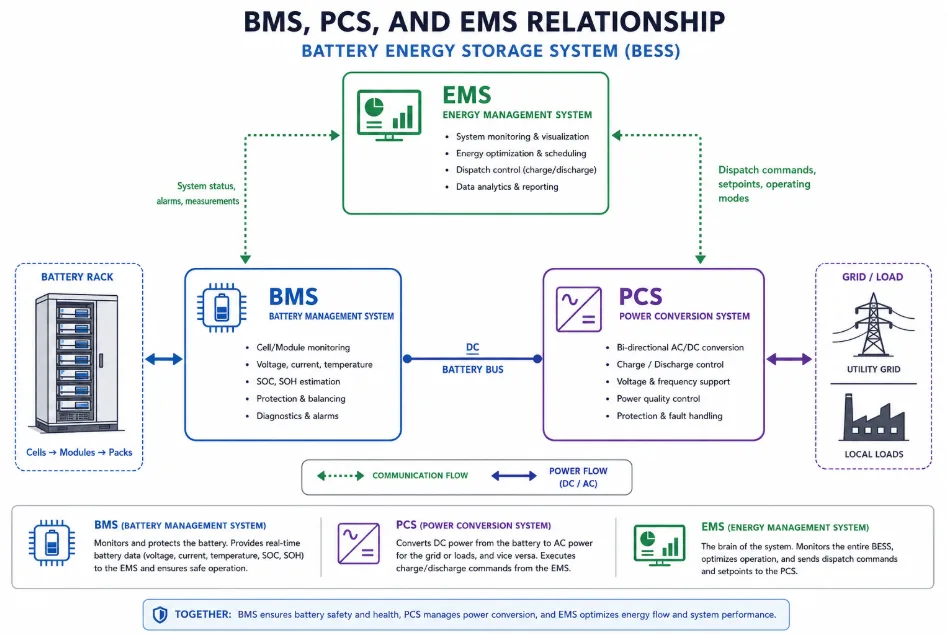
Modern battery systems use the 3S framework. This framework includes:
- Battery Management System (BMS)
- Power Conversion System (PCS)
- Energy Management System (EMS)
Each system has a different role. However, all three systems work together continuously.
Battery Safety and Monitoring
The Battery Management System protects battery cells from unsafe operating conditions.
It monitors:
- Voltage
- Current
- Temperature
- State of Charge
- State of Health
If the system detects abnormal conditions, it can stop operation immediately. Consequently, battery safety improves significantly.
You can learn more about battery storage safety at U.S. Department of Energy Energy Storage Program.
Power Conversion and Grid Support
The Power Conversion System converts DC battery power into AC electricity for the grid.
In addition, the PCS allows bidirectional power flow. Therefore, batteries can both charge and discharge when needed.
Modern PCS platforms support:
- Fast response times
- Voltage regulation
- Grid synchronization
- Frequency support
Because renewable energy output changes often, rapid response capability is very important.
EMS Architecture for Intelligent Control
The EMS acts as the intelligence layer of the storage system.
It gathers data from:
- Battery modules
- Inverters
- Sensors
- Utility dispatch systems
Next, the EMS decides how the battery should operate.
For example, the system may charge batteries during low electricity prices. Later, it may discharge energy during peak demand periods.
As a result, operators can reduce operating costs and improve efficiency.
Main Layers of EMS Architecture
Modern control platforms use several operational layers. This structure improves reliability, flexibility, and system speed.
EMS Architecture Device Layer
The device layer includes physical equipment inside the storage system.
This layer contains:
- Battery modules
- PCS inverters
- HVAC systems
- Fire suppression systems
- Smart meters
These devices continuously send operating data to the controller.
EMS Architecture Communication Layer
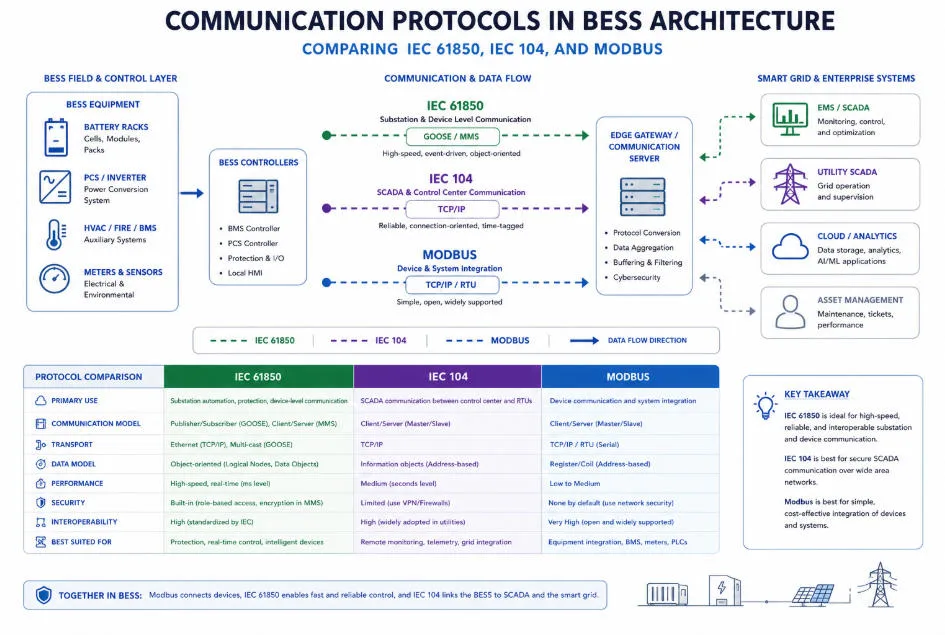
Additionally, the communication layer transfers information between devices and the EMS platform.
Specifically, fast communication is important because delays can reduce system performance.
Additionally, these protocols ensure the system can handle energy storage losses by optimizing the power path in real-time.
Common communication protocols include:
- IEC 61850
- IEC 60870-5-104
- Modbus TCP
In addition, these standards improve coordination between grid equipment and battery systems.
You can explore these industrial standards at International Electrotechnical Commission (IEC).
EMS Architecture Information Layer
The information layer stores operational history and system records.
It tracks:
- Alarm history
- Battery performance
- Operational events
- Maintenance logs
Because of this, operators can monitor long-term battery behavior more effectively.
Software and Optimization Layer
The application layer contains advanced optimization tools and control software.
This layer supports:
- Peak shaving
- Demand response
- Renewable integration
- Frequency response
- Energy optimization
Therefore, operators can improve both technical performance and financial returns.
Why EMS Architecture Matters
Solar and wind energy are variable power sources. Their output changes throughout the day.
Because of this, electrical grids require flexible storage systems.
EMS architecture helps battery systems respond quickly to changing grid conditions.
In addition, it improves:
- Grid reliability
- Battery lifespan
- Energy efficiency
- Renewable energy usage
- Power quality
Without intelligent monitoring and automation, battery systems cannot operate efficiently.
Reliability and Cybersecurity
Modern utility-scale systems require strong reliability and cybersecurity protection.
Therefore, advanced platforms include:
- Backup controllers
- Encrypted communication
- Secure access systems
- Redundant communication networks
These features reduce operational risks and improve system stability.
The National Renewable Energy Laboratory (NREL) also highlights the growing importance of cybersecurity in renewable energy infrastructure.
EMS Architecture for Real-Time Operations
The control platform operates continuously in real time.
First, it monitors grid conditions. Then, it analyzes battery data. Finally, it sends commands to the PCS and BMS systems.
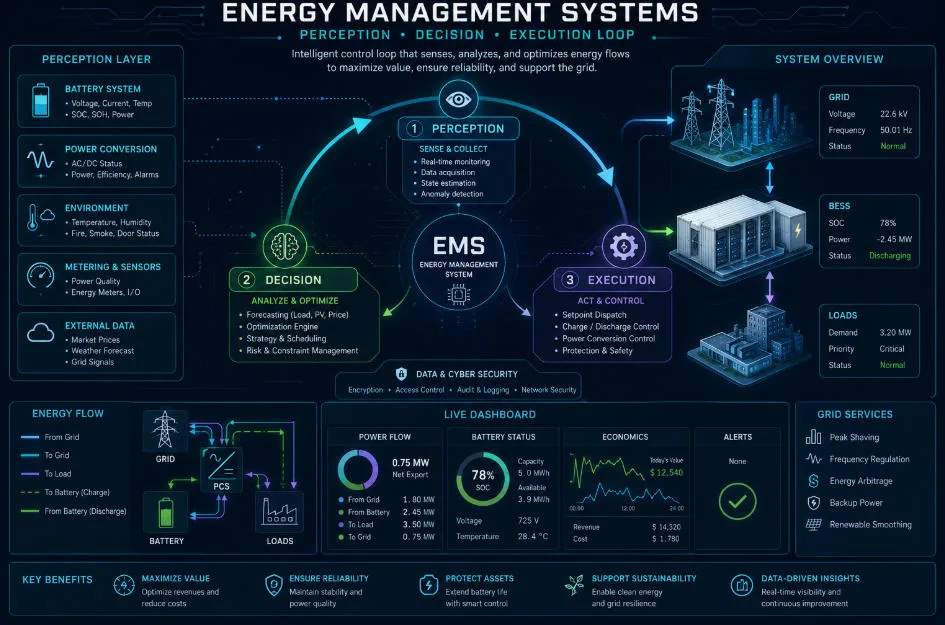
This process repeats every second.
As a result, the storage system can maintain stable and reliable operation.
Future Trends in EMS Architecture
The global energy market continues to evolve rapidly.
As renewable energy adoption increases, EMS architecture will become even more important.
Future systems may include:
- AI-based optimization
- Predictive maintenance
- Faster communication systems
- Advanced analytics
- Smart forecasting tools
Consequently, battery systems will become more efficient and intelligent.
Conclusion
EMS architecture is the operational brain of modern battery energy storage systems. It connects batteries, power electronics, and communication systems into one intelligent platform.
Through advanced monitoring and automation, operators can improve energy efficiency, grid support, and battery reliability.
At Sunlith Energy, integrated storage solutions support modern renewable energy and utility-scale applications.
FAQs
What is EMS architecture?
EMS architecture is the control structure used to manage communication, monitoring, and optimization inside battery energy storage systems.
Why is EMS architecture important?
EMS architecture improves system safety, grid stability, battery performance, and energy efficiency.
What are the three main parts of a battery storage system?
The three main components are:
Battery Management System (BMS)
Power Conversion System (PCS)
Energy Management System (EMS)
Technical Reference Guide
To better understand the individual components and metrics mentioned in this architecture, explore our deep-dive engineering guides:
- Battery Performance: Learn why DC Internal Resistance (DCIR) is the true measure of a cell’s ability to handle high-power grid demands.
- System Sizing: Use our Energy Storage Calculation Guide to determine the exact battery and solar capacity required for your architecture.
- Safety & Compliance: A detailed breakdown of UL 9540A Test Methods for thermal runaway propagation.
- BMS Evaluation: Download our checklist for Evaluating BESS Suppliers to ensure your BMS meets utility-scale standards.
- Lifespan Optimization: Check the Impact of Temperature on LiFePO4 Cycle Life to configure your HVAC setpoints correctly.