home solar power system: Have you ever looked at your monthly electricity bill and wished for a better, more sustainable, and cost-effective solution? The answer might be shining right above you. The sun, a powerhouse of clean energy, offers a remarkable opportunity for Indian homeowners to achieve energy independence, reduce their carbon footprint, and secure […]
Bi-directional inverters are becoming a game-changer in modern energy solutions, especially within Power Conversion Systems (PCS). Whether in residential solar setups or large-scale Battery Energy Storage Systems (BESS), bi-directional inverters ensure seamless power flow in both directions—charging and discharging—between sources, storage units, and the grid. This blog post explores how they work, why they matter, […]
home solar power system: Have you ever looked at your monthly electricity bill and wished for a better, more sustainable, and cost-effective solution? The answer might be shining right above you. The sun, a powerhouse of clean energy, offers a remarkable opportunity for Indian homeowners to achieve energy independence, reduce their carbon footprint, and secure […]
Bi-directional inverters are becoming a game-changer in modern energy solutions, especially within Power Conversion Systems (PCS). Whether in residential solar setups or large-scale Battery Energy Storage Systems (BESS), bi-directional inverters ensure seamless power flow in both directions—charging and discharging—between sources, storage units, and the grid. This blog post explores how they work, why they matter, […]
home solar power system: Have you ever looked at your monthly electricity bill and wished for a better, more sustainable, and cost-effective solution? The answer might be shining right above you. The sun, a powerhouse of clean energy, offers a remarkable opportunity for Indian homeowners to achieve energy independence, reduce their carbon footprint, and secure significant long-term savings.
This comprehensive guide will illuminate the path to adopting a home solar power system, breaking down the technology, the process, and the incredible benefits for you and your family.
How Does Solar Power Actually Work on Your Rooftop?
Imagine your roof transforming into a mini power plant. That’s essentially what a home solar power system does. The process is elegant and efficient, converting raw sunlight into the electricity that powers your daily life. Here’s a step-by-step breakdown:
Sunlight to DC Current: It all begins with the solar panels (or photovoltaic – PV – modules). These panels are composed of solar cells, typically made from silicon. When photons from sunlight strike these cells, they knock electrons loose from their atoms, creating a flow of electricity. This initial electricity is in the form of Direct Current (DC).
Conversion from DC to AC: Your home’s appliances, from your television to your air conditioner, run on Alternating Current (AC) electricity. This is where the inverter, the brain of your solar system, steps in. It masterfully converts the DC electricity generated by the panels into usable AC electricity.
Powering Your Home: The converted AC power flows from the inverter to your home’s main electrical panel (also known as the distribution board). From here, it’s seamlessly distributed throughout your home’s circuits, powering your lights and appliances just as grid electricity would. Your home will always prioritize using the free solar power first.
Managing Excess Energy – The Smart Choice: On a sunny afternoon, your system will likely produce more electricity than you’re consuming. This surplus energy is where the real magic of a modern solar system lies. You have two primary options for this excess power in India:
Net Metering: If you have a grid-connected system, the excess electricity is exported back to the public utility grid. A special bidirectional meter, known as a net meter, records both the electricity you draw from the grid (import) and the electricity you send back (export). At the end of the billing cycle, you are only charged for the “net” amount of electricity consumed. If you’ve exported more than you’ve imported, you can even receive credits on your future bills!
Solar Battery Storage: The ultimate step towards true energy independence is a solar battery. This allows you to store your excess solar energy for later use. You can power your home at night, during cloudy weather, or, most importantly, during the frequent power cuts that can be a part of life in India.
Decoding the Components of Your Home Solar Power System
Understanding the parts of your system will help you appreciate its value and make informed decisions.
1. Solar Panels: The Power Generators
These are the workhorses of your system. In the Indian market, you’ll primarily find two types of solar panels:
Monocrystalline Panels: Made from a single, pure silicon crystal, these panels are known for their high efficiency and sleek, uniform black appearance. They perform better in low-light conditions and have a longer lifespan, making them a premium choice for residential rooftops where space might be limited.
Polycrystalline Panels: Constructed from multiple silicon fragments melted together, these panels have a blue, speckled look. While they are slightly less efficient than monocrystalline panels, they are more budget-friendly, offering a great balance between cost and performance.
2. Inverter: The Brain of the Operation
The inverter is a critical component, and you have several options:
String Inverters: This is the most common and cost-effective type of inverter. Multiple solar panels are connected in a series (a “string”), and their combined DC output is fed into a single, central inverter.
Microinverters: A more advanced option, a microinverter is a small inverter installed on the back of each individual solar panel. This means each panel operates independently, maximizing the system’s overall performance, especially if some panels are affected by shade. They also offer panel-level monitoring.
Power Optimizers: A hybrid solution, power optimizers are also installed on each panel. They don’t convert DC to AC at the panel level but “condition” the DC electricity before sending it to a central string inverter. This also helps mitigate the impact of shading on the entire system.
3. Mounting Structure: The Foundation of Your System
This is the robust framework that securely fastens your solar panels to your roof. A well-engineered mounting structure is essential to withstand India’s diverse weather conditions, from strong monsoon winds to intense summer heat. It also ensures the panels are tilted at the optimal angle to capture maximum sunlight.
4. Solar Battery: Your Personal Power Reserve
While optional for grid-connected systems, a solar battery is becoming increasingly popular in India for its ability to provide:
Power during outages: Continue to run essential appliances when the grid goes down.
Energy at night: Use your stored solar energy after the sun has set.
Maximizing self-consumption: Use more of your own clean energy and rely less on the grid.
Common battery types include Lithium-ion and Lead-Acid, with Lithium-ion being the preferred choice due to its longer lifespan, higher efficiency, and compact size.
The Journey to Solar: Your Step-by-Step Installation Guide in India
Going solar is a well-defined process:
Site Assessment and Consultation: A solar expert will visit your home to assess your roof’s condition, orientation, and any potential shading issues. They will also analyze your electricity bills to determine the optimal system size for your needs.
System Design and Proposal: Based on the site assessment, the solar company will design a custom system for your home and provide you with a detailed proposal, including the components to be used, the total cost, and the expected savings.
Permits and Approvals: Your installer will handle the necessary paperwork for net metering and any other local permits required by your electricity distribution company (DISCOM).
Installation: Once the approvals are in place, the installation team will mount the racking, install the solar panels, connect the inverter, and wire the entire system.
Inspection and Commissioning: After the installation is complete, a representative from your DISCOM will inspect the system to ensure it meets all safety standards. Once approved, the system is commissioned, and you can start generating your own clean electricity!
The Financial Advantage: Government Subsidies and ROI in India
The Indian government is actively promoting rooftop solar through attractive subsidies, making it more affordable than ever. Under the PM Surya Ghar: Muft Bijli Yojana, homeowners can avail substantial central financial assistance, which is directly deducted from the total cost of the system. As of early 2025, the subsidy structure is as follows:
Up to 2 kW systems: ₹30,000 per kW
For the next 1 kW (up to 3 kW total): ₹18,000
Systems larger than 3 kW: A total capped subsidy of ₹78,000
With these subsidies, the payback period for a home solar power system in India can be as short as 4-6 years. Considering the 25-year lifespan of solar panels, this translates into over two decades of free electricity and a remarkable return on investment.
Are You Ready to Embrace a Brighter Future?
Switching to a home solar power system is more than just an investment in your property; it’s an investment in a sustainable future for your family and for India. With rising electricity tariffs, the financial and environmental benefits of solar energy are undeniable.
Take the first step today by contacting a reputable solar installer for a free consultation. Your journey towards energy independence and a greener tomorrow is just a sunbeam away.
Bi-directional inverters are becoming a game-changer in modern energy solutions, especially within Power Conversion Systems (PCS). Whether in residential solar setups or large-scale Battery Energy Storage Systems (BESS), bi-directional inverters ensure seamless power flow in both directions—charging and discharging—between sources, storage units, and the grid. This blog post explores how they work, why they matter, and how they power smarter energy infrastructure.
What Is a Bi-Directional Inverter?
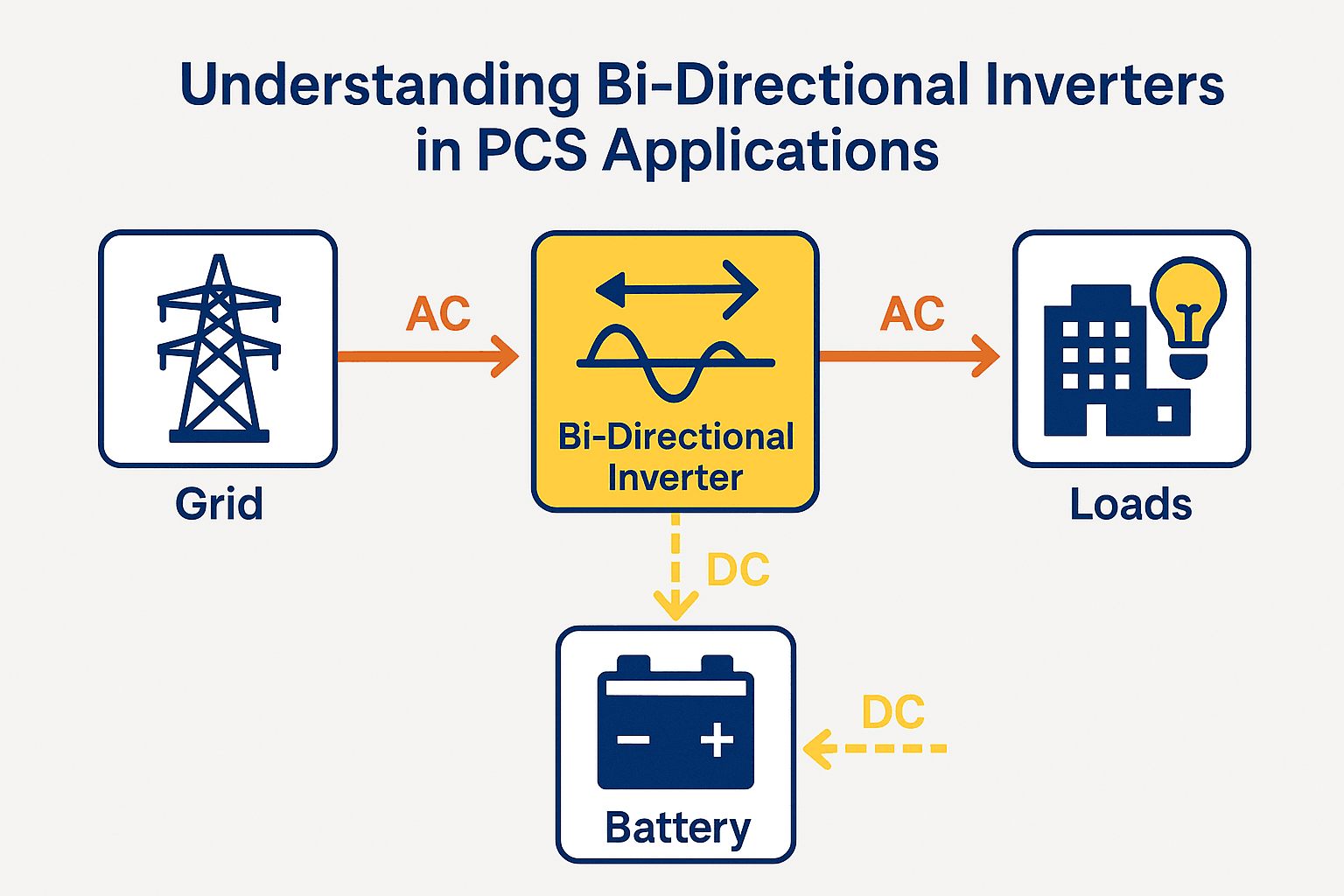
A bi-directional inverter is an advanced power electronic device that can both convert DC to AC (inverter mode) and AC to DC (rectifier mode). This dual functionality allows energy to move in two directions:
From the grid to batteries (charging)
From batteries to the grid or loads (discharging)
In PCS applications, this is crucial for load balancing, backup power, demand response, and optimizing energy costs.
Why Are Bi-Directional Inverters Important in PCS?
Power Conversion Systems (PCS) act as the interface between the energy storage system and the grid. The integration of bi-directional inverters offers several key advantages:
1. Grid Support and Frequency Regulation
They can feed power back into the grid or absorb it as required, enabling voltage/frequency stabilization, which is critical in renewable energy-heavy grids.
2. Flexible Load Management
During peak demand or outages, PCS with bi-directional inverters can redirect stored energy to critical loads.
3. Renewable Integration
They allow solar or wind energy to be stored and reused later, smoothing out the intermittency of renewables.
How Do Bi-Directional Inverters Work in PCS?
Charging Mode (Rectification)
When there’s excess power—such as from solar panels or the grid during off-peak hours—the inverter converts AC to DC and stores it in the battery system.
Discharging Mode (Inversion)
When power is needed, the stored DC energy is converted back to AC and used to power loads or sent to the grid.
This seamless switch between modes is managed by intelligent control algorithms within the PCS.
Applications of Bi-Directional Inverters in PCS
1. Battery Energy Storage Systems (BESS)
Large-scale storage units rely on bi-directional inverters for charge-discharge cycles, especially for grid-tied systems.
2. Microgrids
Enable isolated power operation and load sharing between solar, diesel generators, and batteries.
3. EV Charging Stations
Allow for vehicle-to-grid (V2G) energy transfer, where EVs serve as energy reserves.
4. Home and Commercial Energy Systems
Support self-consumption, energy arbitrage, and backup power during grid failure.
Key Technical Features of Bi-Directional Inverters
Smart Control Systems for dynamic energy flow management
Safety Mechanisms: Isolation, over-voltage, and thermal protection
These features make bi-directional inverters indispensable for smart energy ecosystems.
Benefits of Using Bi-Directional Inverters in PCS
Benefit
Explanation
Grid Interaction
Enables export/import of power to/from the grid
Energy Cost Optimization
Charge when prices are low; discharge when high
Resilience & Backup
Provide power during outages or peak load times
Renewable Maximization
Store excess solar or wind energy for future use
System Longevity
Controlled charge/discharge cycles improve battery life
Challenges and Considerations
Despite their many benefits, bi-directional inverters come with some technical and operational considerations:
Initial Cost: More complex and expensive than traditional inverters
System Complexity: Requires advanced control systems and integration
Regulatory Compliance: Must adhere to grid codes and safety standards
Thermal Management: Bidirectional use generates more heat, demanding better cooling solutions
Q&A About Bi-Directional Inverters
Q1: Can I use bi-directional inverters with solar panels?
Yes! They are ideal for solar systems combined with battery storage, allowing energy to be stored and used efficiently.
Q2: What makes them different from normal inverters?
Unlike regular inverters that only convert DC to AC, bi-directional inverters work both ways, supporting dynamic energy flows.
Q3: Are they suitable for off-grid systems?
Absolutely. In off-grid and hybrid systems, they provide enhanced energy control and backup capabilities.
Q4: Do they require special batteries?
Not necessarily, but high-efficiency systems often pair them with lithium-ion or other advanced battery chemistries for better results.
Real-World Use Case: Bi-Directional PCS in Smart Grid
In a commercial solar + storage project, a bi-directional PCS enables the facility to charge batteries during sunlight hours and discharge during peak demand, saving thousands on utility bills. The same system also provides blackout protection and participates in demand response programs, generating revenue.
Final Thoughts
Bi-directional inverters are at the heart of modern Power Conversion Systems. They’re more than just a technical upgrade—they’re a necessity for efficient, flexible, and intelligent energy management. As renewable energy and distributed generation continue to rise, so will the importance of these dual-purpose devices.
If you’re planning a BESS project, upgrading your commercial energy system, or simply aiming for smarter energy use, make sure to explore bi-directional inverters. They’re not just about converting power—they’re about empowering the future.