

BMS for LiFePO4 Batteries: Requirements, Parameters, and What to Check Before You Buy
| ⚡ Quick Answer: What Does a BMS for LiFePO4 Need? A BMS for LiFePO4 batteries must enforce a cell voltage window of 2.5V–3.65V, use Coulomb counting or Kalman filtering for accurate SOC (not OCV alone), provide at least 80–100 mA balancing current for passive systems, monitor temperature at multiple points, and halt charging below 0°C. These requirements differ significantly from NMC — a BMS designed for NMC will underperform on LFP cells. |
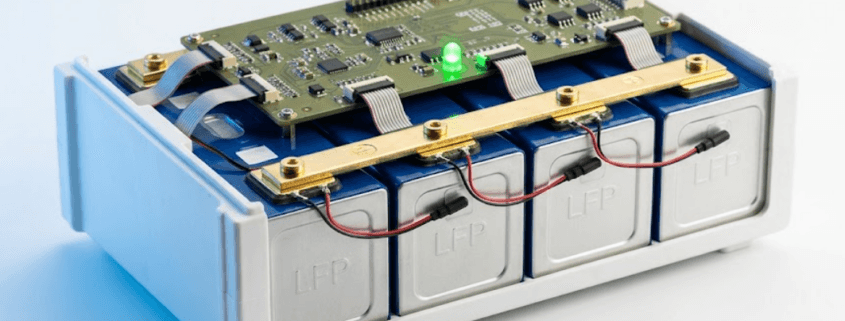
LiFePO4 (LFP) is the dominant chemistry for solar storage, commercial BESS, and off-grid systems. Its long cycle life, thermal stability, and safety advantages make it the first choice for most stationary applications. However, LFP also has specific characteristics that place unique demands on the BMS for LiFePO4.
Not every BMS is built with LFP in mind. Many suppliers use a generic platform across multiple chemistries. Consequently, an NMC-designed BMS on LFP cells shows poor SOC accuracy and slow balancing. It also lacks the specific protections LFP needs.
This guide covers the key requirements for a BMS for LiFePO4 — voltage parameters, SOC methods, balancing current, and temperature limits. It also includes the supplier questions that reveal whether a BMS is genuinely built for LFP.
New to battery management systems? Read our complete BMS explainer guide first, then return here for the LFP-specific detail.
1. Why LiFePO4 Places Unique Demands on the BMS
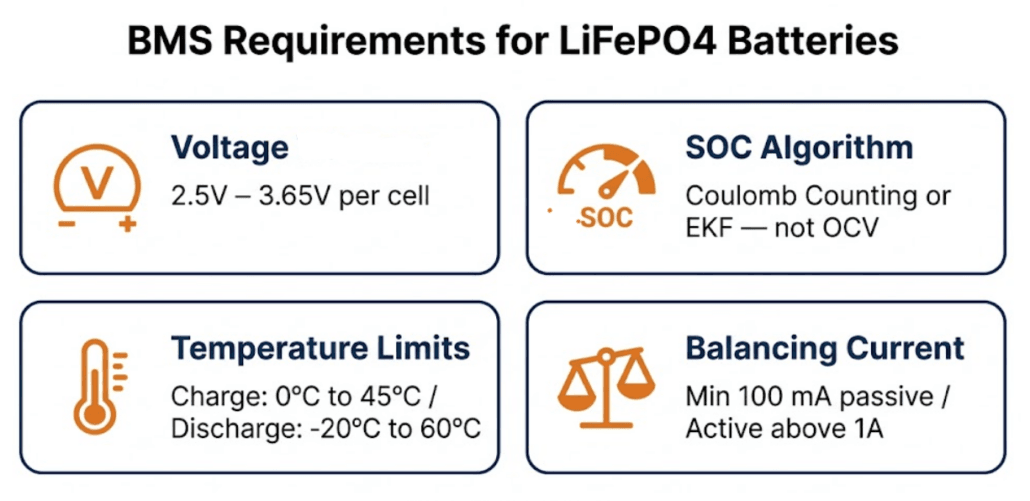
LFP’s chemistry gives it three properties that directly shape what the BMS must do. Understanding these properties is the starting point for evaluating any BMS for LiFePO4.
The Flat Voltage Curve: LiFePO4’s Biggest BMS Challenge
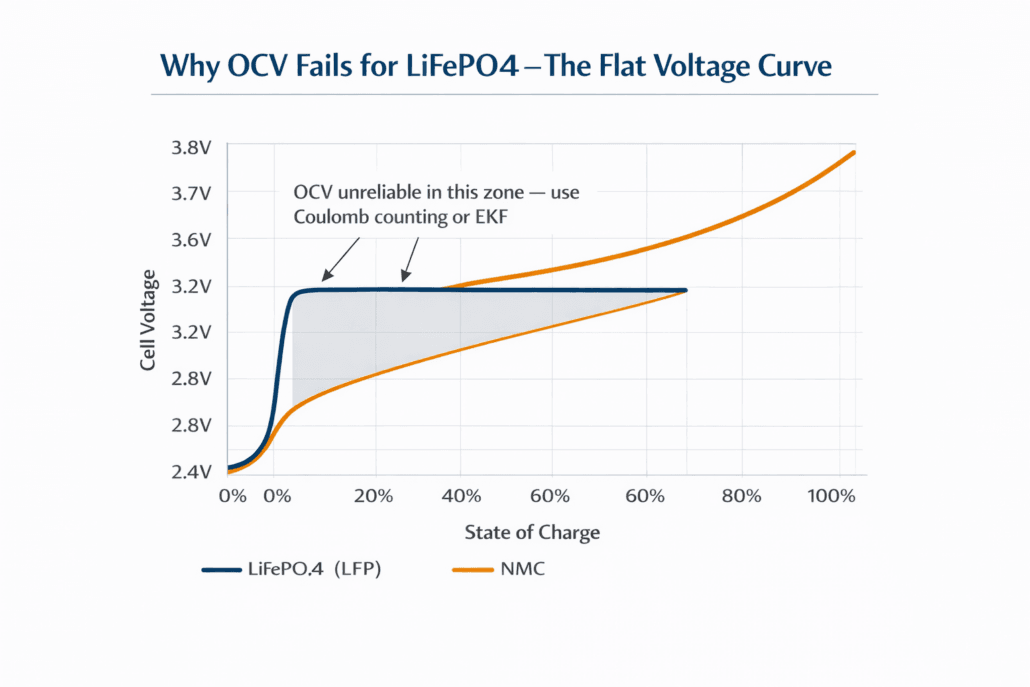
LFP cells operate near 3.2V–3.3V across most of their usable SOC range. Specifically, from 20% to 80% SOC, the voltage barely moves. This is unlike NMC, where voltage drops steadily and predictably as the cell discharges.
Consequently, the BMS cannot rely on voltage alone to estimate SOC. A cell at 50% SOC and a cell at 30% SOC look almost identical on voltage. As a result, any BMS that uses OCV as its primary SOC method will be wildly inaccurate on LFP during operation.
This is the most important LFP-specific BMS requirement. A wrong SOC estimate causes early shutdowns and surprise overcharge events. It also wastes usable energy by setting overly cautious capacity limits.
Chemical Stability: LiFePO4 Still Needs BMS Protection
LFP’s iron-phosphate cathode is chemically very stable. Its thermal runaway threshold is 270°C–300°C — far higher than NMC’s 150°C–210°C. This stability means the BMS has more time to respond to developing faults. However, it does not mean LFP needs less protection.
Over-discharge below 2.5V per cell damages the anode permanently. Overcharge above 3.65V per cell damages the cathode. Both need fast BMS action. The stability advantage of LFP reduces thermal risk — but it does not reduce voltage protection needs.
Wide Operating Temperature Range
LFP handles temperature extremes better than NMC. It operates from -20°C to 60°C on discharge and from 0°C to 45°C on charge. However, charging below 0°C causes lithium plating. This is a permanent form of anode damage that accumulates with each cold-temperature charge cycle.
The BMS must, therefore, actively halt charging when cell temperature drops below 0°C. This is a hard protection requirement, not a soft warning. For more on how temperature affects LFP lifespan, see our guide on temperature impact on LiFePO4 cycle life.
2. LiFePO4 BMS Voltage Parameters: The Exact Numbers
Voltage parameters are the foundation of any BMS for LiFePO4 configuration. These values define the safe operating window for each cell. The BMS enforces them through contactor control and charge/discharge current limiting.
| Parameter | LFP Value | What Happens If Breached |
|---|---|---|
| Nominal cell voltage | 3.2V | Reference point for system design — not a limit |
| Charge cutoff (max) | 3.65V per cell | Permanent cathode damage above this — BMS must disconnect |
| Discharge cutoff (min) | 2.5V per cell | Permanent anode damage below this — BMS must disconnect |
| Recommended operating range | 2.8V–3.4V per cell | Staying within this range extends cycle life significantly |
| Cell voltage balance tolerance | ±20mV typical | Wider spread indicates balancing failure or weak cell |
| Low voltage pre-warning | 2.7V–2.8V | BMS should alert before hard cutoff — allows graceful shutdown |
Why Cell-Level Monitoring Is Non-Negotiable
These voltage limits apply to individual cells — not to the overall pack voltage. In a 16S LFP pack (16 cells in series), the nominal pack voltage is 51.2V. However, one weak cell can hit its 2.5V discharge cutoff while the pack voltage still reads 49V — well above the apparent safe threshold.
A BMS that monitors only pack voltage will therefore miss this event entirely. The weak cell gets driven below its safe limit and suffers permanent damage. Consequently, cell-level individual voltage monitoring is the most basic non-negotiable requirement for any BMS for LiFePO4.
Voltage Tolerance in the BMS Hardware
The accuracy of the voltage measurement circuit matters. For LFP, a measurement tolerance of ±5–10mV per cell is acceptable. Some premium BMS platforms achieve ±1–2mV. Tighter tolerances mean the BMS can set closer operating limits and extract more usable capacity from the pack.
Ask your supplier: what is the cell voltage measurement accuracy of the BMS? If they cannot answer, that is a red flag.
3. SOC Estimation for LiFePO4: Why OCV Alone Fails
SOC estimation is where most generic platforms fail. It is, therefore, the most important technical question to ask any BMS for LiFePO4 supplier.
Why OCV Fails for LFP
OCV lookup works by mapping a resting cell voltage to a SOC value. It uses a table built from cell tests. This works well for NMC because NMC voltage drops steadily as the cell discharges.
LFP, however, produces an almost flat voltage curve between 20% and 80% SOC — roughly 3.2V to 3.3V across this entire range. As a result, a cell at 25% SOC and a cell at 75% SOC look nearly identical on OCV. The BMS cannot distinguish between them. Consequently, an OCV-based BMS on LFP shows SOC readings that jump erratically and fail to track the actual charge state.
OCV is only useful for LFP after the battery has rested for at least 30–60 minutes with no current flowing. It is, therefore, a valid method for setting the initial SOC estimate at startup — not for real-time tracking.
Coulomb Counting: The Minimum Standard for LFP
Coulomb counting integrates current over time to track charge entering and leaving the battery. It is the most widely used SOC method in real-time operation. It is also the minimum acceptable standard for any BMS for LiFePO4.
Coulomb counting is accurate over short periods. However, it drifts over time. Sensor errors, temperature effects, and small unmeasured currents all add up. Without regular recalibration, the SOC estimate can drift by 2–5% over several days.
Best practice: The BMS should recalibrate SOC to 100% when the battery reaches full charge voltage (3.65V per cell) and to 0% when it reaches the discharge cutoff (2.5V per cell). These are reliable anchor points that correct accumulated drift automatically.
Extended Kalman Filter: The Gold Standard for LFP
The Extended Kalman Filter (EKF) is the most accurate SOC method for LFP. It combines Coulomb counting with a cell behaviour model. Continuously, it corrects the estimate by comparing the model’s output to the actual measured voltage.
EKF handles LFP’s flat curve far better than OCV. It does not rely on voltage to estimate SOC. Instead, it uses a dynamic model that accounts for temperature, aging, and load history. Furthermore, premium BMS platforms from Texas Instruments, Analog Devices, and Orion BMS use EKF or adaptive Kalman filter variants.
The trade-off is complexity. EKF requires a well-characterised cell model that must be calibrated for the specific LFP cell chemistry in use. A generic EKF implementation calibrated for one cell type will not necessarily be accurate on another. Always ask whether the EKF model was calibrated for the specific cells in your system.
| Method | Accuracy on LFP | Key Limitation | Use Case |
|---|---|---|---|
| OCV Lookup | Poor (flat curve) | Useless during operation | Initial SOC at rest only |
| Coulomb Counting | Good short-term, drifts | Accumulates error over time | Minimum standard — all LFP systems |
| Coulomb + OCV reset | Good — self-correcting | Needs full charge/discharge cycles | Residential and C&I systems |
| Extended Kalman Filter | Excellent (±1–2%) | Needs cell-specific calibration | Utility-scale and precision BESS |
4. Temperature Requirements for a LiFePO4 BMS
LFP handles temperature better than NMC. However, this does not mean temperature management matters less — it means the safety margins are wider. The BMS must still enforce hard temperature limits and respond to thermal events.
LFP Temperature Operating Limits
| Condition | Safe Range | BMS Action Required |
|---|---|---|
| Charging temperature | 0°C to 45°C | Halt charging below 0°C — lithium plating risk |
| Discharging temperature | -20°C to 60°C | Reduce current below -10°C; cut off below -20°C |
| Optimal operating range | 15°C to 35°C | No restriction — full rated performance |
| High temp warning | 45°C–55°C | Reduce charge/discharge current; trigger cooling |
| High temp cutoff | Above 55°C–60°C | Disconnect pack — risk of accelerated degradation |
| Thermal runaway threshold | ~270°C–300°C | Emergency disconnect and alarm — well above normal ops |
Temperature Sensor Placement for LFP
The number and placement of temperature sensors directly affects BMS accuracy. For LFP packs, the minimum is one sensor per module. However, in larger systems, multiple sensors per module are standard — at the cell surface, the busbar, and inside the enclosure.
Temperature gradients across a large LFP pack can be significant. A poorly ventilated corner of a battery rack can run 10°C–15°C hotter than the rest. Without adequate sensor coverage, the BMS misses this. Consequently, the hottest cells degrade faster, creating imbalance that shortens the entire pack’s life.
Cold Weather and LFP: The Lithium Plating Risk
Charging LFP below 0°C is one of the most common field mistakes in cold-climate installations. When lithium ions cannot intercalate into the anode at low temperatures, they deposit as metallic lithium on the anode surface instead. This lithium plating is permanent and cumulative.
Specifically, repeated cold-temperature charging causes capacity loss and increases internal resistance. In severe cases, it creates dendrites that cause internal short circuits. The BMS must therefore monitor cell temperature before and during charging. It must halt charge current if any cell falls below 0°C.
5. Cell Balancing Requirements for LiFePO4 BMS
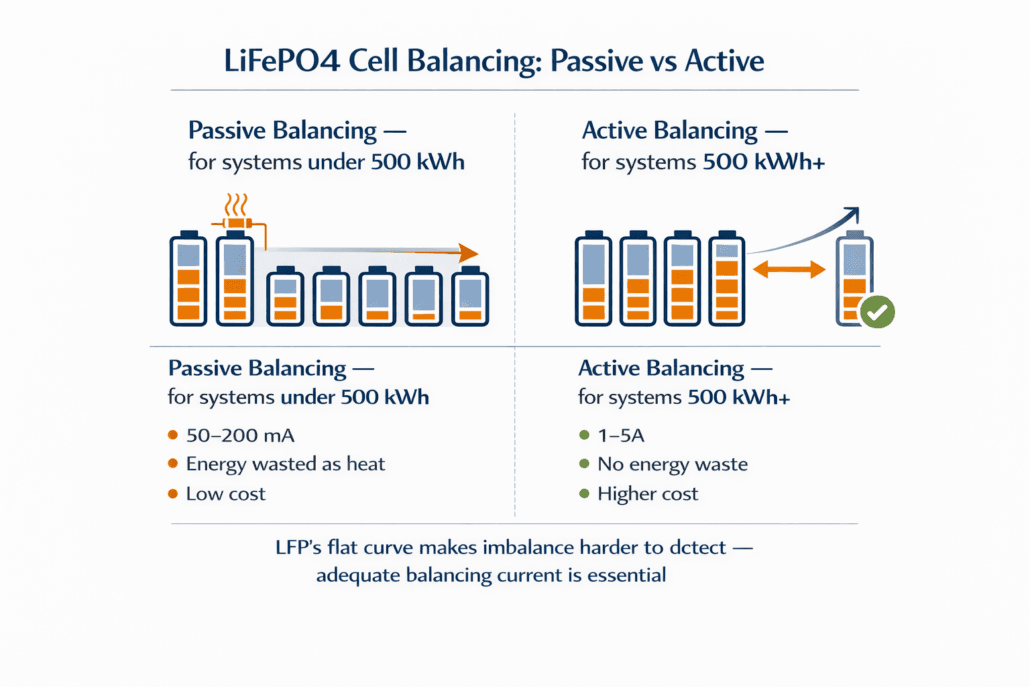
Cell balancing is especially important for LFP. The flat voltage curve makes imbalance harder to spot by voltage alone. Two cells can differ significantly in SOC while showing nearly the same voltage. As a result, the BMS must use current tracking — not just voltage — to detect and correct imbalance.
Minimum Balancing Current for LFP
Passive balancing current determines how quickly the BMS can correct cell imbalance. For LFP systems, the minimum acceptable balancing current depends on system size and cycle frequency.
| System Size | Minimum Balancing Current | Why |
|---|---|---|
| Residential (under 30 kWh) | 50–100 mA | Low cycle frequency — slow balancing keeps up |
| Small C&I (30–200 kWh) | 100–200 mA | Daily cycling creates drift — needs more current to correct |
| Large C&I (200–500 kWh) | 200–500 mA or active | Passive may not keep up — active balancing preferred |
| Utility-scale (500 kWh+) | Active balancing (1–5A) | Passive is inadequate — active required for long-term performance |
When to Specify Active Balancing for LFP
In residential systems with one cycle per day and high-grade A-cell packs, passive balancing at 100 mA is typically sufficient. The cells are well-matched from the factory and, consequently, drift slowly at moderate cycle rates.
Active balancing becomes worthwhile for LFP systems in three situations. First, systems above 500 kWh that cycle daily — imbalance builds faster than passive balancing can fix. Second, systems in variable temperature environments where thermal gradients cause uneven aging. Third, long-duration systems designed for 15+ years where small capacity gains have significant ROI impact.
For a detailed comparison of passive vs active balancing methods, see our complete BMS guide which covers both approaches in depth.
6. Protection Functions: What a LiFePO4 BMS Must Detect
Beyond voltage and temperature, a BMS for LiFePO4 must handle several protection scenarios. Each one has LFP-specific parameters that differ from other chemistries.
Overcharge Protection in a BMS for LiFePO4
The hard overcharge cutoff for LFP is 3.65V per cell. Above this, the cathode undergoes irreversible structural changes. The BMS must therefore disconnect the charge current before any cell reaches this limit. It must do so at the cell level — not the pack level.
Response time should be under 100ms from detection to contactor opening. Additionally, the BMS should implement a pre-warning at around 3.55V–3.60V that reduces charge current (CC-CV charging taper) before the hard cutoff is needed. This protects cells and reduces stress on the contactor.
Over-Discharge Protection for LiFePO4 Cells
The discharge cutoff for LFP is 2.5V per cell. However, the recommended operating minimum is 2.8V — keeping cells above 2.8V significantly extends cycle life. The BMS should therefore implement a two-stage approach: a soft limit at 2.8V that issues a warning and reduces available power, and a hard cutoff at 2.5V that disconnects the pack entirely.
In grid-connected systems, the EMS typically enforces the operational SOC limit well above the hard BMS cutoff. However, the BMS hard limit acts as the last line of defence. It activates if the EMS dispatch fails or if the system enters an unexpected deep discharge scenario.
Short Circuit and Overcurrent Protection
Short circuit response must be in microseconds. The BMS uses a hardware protection circuit — a MOSFET or contactor — that operates independently of the main processor. Software-based response is simply too slow for a hard short circuit event.
Overcurrent protection covers sustained high-current events that are not a hard short. It typically uses a time-delay threshold — for example, 2C discharge for more than 10 seconds triggers a disconnect. The exact settings depend on the cell’s C-rate rating and the load profile.
Cell Voltage Imbalance: A Key LiFePO4 BMS Alert
This is an LFP-specific protection function that many generic BMS platforms handle poorly. LFP cells look similar on voltage even when SOC values differ significantly. As a result, the BMS must monitor cell voltage spread continuously and alert when cells diverge beyond the tolerance threshold.
A spread greater than 50–100 mV across cells indicates a problem. It is typically a sign of a weak cell, a failing balancing circuit, or early degradation. The BMS should log this event and alert the monitoring platform — not simply trigger a hard cutoff.
7. BMS for LiFePO4: Communication and Data Requirements
A BMS for LiFePO4 in a modern BESS must communicate reliably with the inverter, EMS, and monitoring platform. Furthermore, from 2027, EU Battery Passport compliance adds data logging requirements. As a result, communication capability becomes a regulatory issue — not just a technical one.
Communication Protocols: What a BMS for LiFePO4 Must Support
- CAN bus 2.0A/B — standard for high-performance and EV-derived BMS platforms; fastest and most reliable
- RS485 / Modbus RTU — most common in C&I and utility BESS; compatible with most commercial inverters
- CANopen — used in some European industrial applications
- MQTT / TCP-IP — required for cloud monitoring and Battery Passport data export
Before specifying a BMS, confirm it works with your inverter’s protocol. A mismatch needs a gateway converter — adding cost, a failure point, and communication lag.
Data Logging Requirements for LiFePO4 BMS Systems
For residential and small commercial LFP systems, minimum data logging should cover SOC, cell voltages, temperatures, cycle count, and fault history. This supports warranty claims and helps diagnose degradation over time.
For systems selling into the EU market after February 2027, the BMS must also log SOH history, energy throughput, and temperature exposure. This data must be in a format compatible with the EU Digital Battery Passport. For full details, see our EU 2023/1542 compliance guide.
8. BMS for LiFePO4 Certifications: What to Check
A BMS for LiFePO4 in a commercial or grid-connected system must hold safety certifications. These confirm the BMS has been tested under fault conditions and meets minimum protection standards.
| Standard | Scope | LFP BMS Relevance |
|---|---|---|
| UL 1973 | Stationary lithium battery systems | Required for US market — covers BMS protection functions |
| IEC 62619 | Li-ion battery safety | International standard — covers voltage, temp, and BMS protection |
| IEC 62933-5 | ESS safety framework | Covers BMS communication, monitoring, and fault response |
| UN 38.3 | Transport safety | BMS must survive vibration and thermal tests for shipping |
| CE Marking | EU market access | Required for EU sales — covers electrical safety |
Always request the full test reports — not just the certificate. A reputable BMS supplier will provide complete documentation without hesitation. If they provide only a certificate image with no underlying test data, treat that as a red flag.
For a comprehensive overview of BESS certification requirements, see our BESS certifications guide.
9. How to Evaluate a LiFePO4 BMS: 7 Specific Questions
Generic BMS evaluation questions apply to all lithium chemistries. These seven questions, however, are specifically designed to reveal whether a BMS has been properly configured for LFP cells.
Questions 1–4: Technical Parameters
- What SOC algorithm does this BMS use for LFP — and can you show me the accuracy data?
If the answer is OCV lookup, walk away. Ask specifically for SOC accuracy under dynamic load conditions — not just at rest. A good answer is Coulomb counting with OCV reset, or EKF with LFP-calibrated cell model. Ask for the SOC error percentage from their test data.
- What is the cell voltage measurement accuracy, and how often does the BMS sample each cell?
For LFP, ±10mV or better is the minimum. Sampling frequency should be at least once per second under normal operation, with faster sampling during charge/discharge transitions. Slower sampling misses brief voltage spikes near the cutoff limits.
- Does the BMS halt charging below 0°C at the cell level — not just the ambient temperature?
This is a critical LFP protection requirement. Ambient temperature sensors can give false readings. A cell inside an enclosure can be warmer or colder than the ambient sensor shows. The BMS must therefore use cell-level temperature sensors for this protection. If the supplier uses only one ambient sensor, that is inadequate for LFP.
- What is the balancing current, and is it sufficient for the system’s daily cycle rate?
Use the table in Section 5 as your reference. A 50 kWh residential system cycling once daily needs at least 100 mA. A 500 kWh C&I system cycling twice daily needs at minimum 500 mA passive or active balancing. If the supplier cannot tell you the balancing current, that is a red flag.
Questions 5–7: Data and Support
- Was the BMS calibrated specifically for the LFP cells in this system — or is it a generic configuration?
SOC accuracy depends on the BMS being calibrated for the specific cell chemistry and capacity. A BMS set up for a 100 Ah CATL cell will not be accurate on a 200 Ah EVE cell. Always ask whether the cell model was calibrated for your specific cells.
- What LFP-specific fault codes does the BMS log, and how are they accessible?
Look for: cell voltage imbalance alerts, low-temperature charge inhibit events, SOC drift correction logs, and balancing records. These are essential for diagnosing field problems and supporting warranty claims. A BMS that only logs hard faults — not pre-fault warnings — will miss early signs of cell trouble.
- Does the BMS support OTA firmware updates — and is the LFP cell model updatable in the field?
LFP cells change as they age. A BMS with OTA firmware updates can recalibrate its cell model over time. This keeps SOC accuracy high as the cells degrade. It is a premium feature — but it matters a lot for systems designed to last 15+ years.
Conclusion: Match the BMS to the Chemistry
A BMS for LiFePO4 is not the same as a generic lithium BMS. LFP’s flat voltage curve needs a purpose-built SOC method. Its sensitivity to cold charging needs cell-level temperature sensors. Its long cycle life needs strong balancing to keep cells aligned over thousands of cycles.
The seven questions in Section 9 will reveal whether a supplier has genuinely designed their BMS for LiFePO4 — or simply relabelled an NMC platform. The difference matters. Over a 15-year lifespan, a purpose-built BMS for LiFePO4 delivers more usable energy, better SOC accuracy, and fewer field failures.
For a complete understanding of all BMS functions — not just the LFP-specific ones — read our complete battery management system guide. For a deeper look at how LFP compares to NMC across cycle life, safety, and total cost, see our LiFePO4 vs NMC battery comparison.
| ☀️ Need an LFP BMS Review for Your BESS Project? Sunlith Energy reviews BMS specifications for LFP projects from 50 kWh upward. We check SOC algorithm suitability, voltage parameter configuration, balancing current adequacy, and certification compliance — before you commit to a supplier. Contact us |
Frequently Asked Questions
What voltage should a LiFePO4 BMS cut off at?
The hard charge cutoff is 3.65V per cell and the hard discharge cutoff is 2.5V per cell. However, for longer cycle life, the recommended operating range is 2.8V to 3.4V. Operating consistently within this narrower range can significantly extend total cycle count over the system’s lifetime.
Can I use an NMC BMS on LiFePO4 cells?
Technically you can, but the SOC accuracy will be poor. NMC BMS platforms typically use OCV-based SOC, which fails on LFP’s flat voltage curve. The voltage window settings will also be wrong — NMC cells have higher charge cutoffs and different discharge profiles. In practice, an NMC BMS on LFP leads to inaccurate SOC readings, early shutdowns, and reduced usable capacity.
What is the minimum balancing current for a LiFePO4 BMS?
Residential systems under 30 kWh cycling once daily need 50–100 mA passive balancing. Commercial systems above 100 kWh cycling daily need 200 mA or more. Active balancing is preferred for systems above 500 kWh. Low balancing current in a large pack allows imbalance to accumulate — leading to progressive capacity loss.
Does a LiFePO4 BMS need to stop charging in cold weather?
Yes — this is a hard requirement. Charging LFP below 0°C causes lithium plating, which is permanent and cumulative. The BMS must use cell-level temperature sensors to enforce this protection. Ambient sensors alone are not sufficient — cells inside an enclosure can be warmer or colder than the surrounding air suggests.
How accurate should SOC be on a LiFePO4 BMS?
A Coulomb counting BMS with regular OCV resets should achieve ±3–5% SOC accuracy in steady-state operation. An EKF-based BMS with a properly calibrated LFP cell model should achieve ±1–2%. Poor SOC accuracy above ±10% typically indicates OCV-only estimation — or a cell model not calibrated for the specific LFP chemistry.
Sources and Further Reading
NREL Battery Field Performance Data: https://www.nrel.gov
IEC 62619 — Safety requirements for secondary lithium cells and batteries for use in industrial applications: https://www.iec.ch/
EU Batteries Regulation 2023/1542 — European Commission: https://environment.ec.europa.eu/topics/waste-and-recycling/batteries_en
Related Reading from Sunlith Energy
Battery Management System (BMS) Explained — Complete Guide
LiFePO4 vs NMC Battery: Why LFP Delivers Lower Lifetime Cost
NMC Battery vs LFP Safety: The Complete BESS Risk Breakdown
Impact of Temperature on LiFePO4 Battery Cycle Life
EU 2023/1542: Compliance Deadlines and Battery Passport Guide