
BESS Safety and Compliance: Why Fire Codes, Standards, and Certification Matter More Than Ever
Battery Energy Storage Systems (BESS) are rapidly becoming a foundation of modern power grids, enabling renewable energy integration, peak shaving, and grid resilience. As BESS installations grow in size and density, safety and regulatory compliance have emerged as top priorities for utilities, regulators, insurers, and project developers worldwide.
BESS safety and compliance ensure that battery energy storage systems operate safely across design, testing, installation, and operation. Key requirements include UL 9540 certification, UL 9540A thermal runaway testing, NFPA 855 installation compliance, IEC battery safety standards, certified battery management systems (BMS), and integrated fire detection and suppression systems.
High-energy lithium battery systems introduce unique fire, thermal, and electrical risks. Without strict adherence to international safety standards, these risks can impact public safety, project approvals, insurance coverage, and long-term asset reliability. As a result, BESS safety and compliance now determine whether a project is bankable, insurable, and scalable.
To understand the fundamentals of system design and applications, read our detailed guide on What Is BESS? Understanding Battery Energy Storage Systems.
Visual Overview: BESS Safety and Compliance
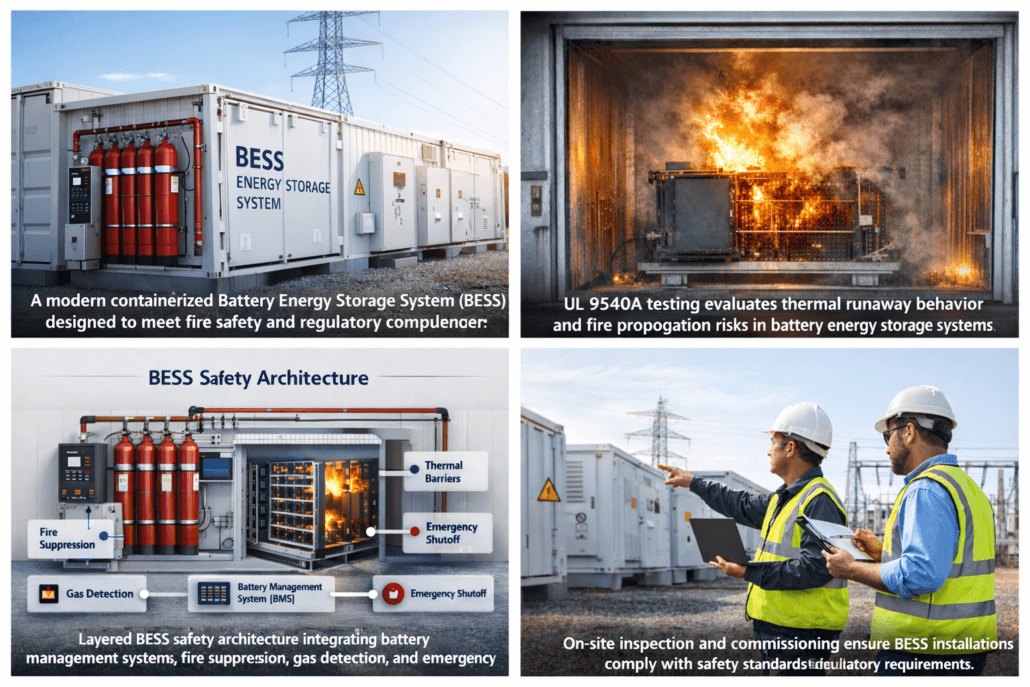
This combined visual represents the complete BESS safety lifecycle—from compliant system design and fire testing to real-world inspection and commissioning—making it ideal for Google Discover and AI answer engines.
Why BESS Safety and Compliance Matter
BESS safety directly affects people, infrastructure, and grid reliability. A single failure can result in fire incidents, forced shutdowns, regulatory penalties, or long-term reputational damage.
Compliance is essential for:
- Utility interconnection approvals
- Local Authority Having Jurisdiction (AHJ) permits
- Insurance underwriting and project financing
- Long-term operational reliability
Safety requirements also vary by system type and application. This is why understanding the difference between BESS and ESS is critical when designing systems that meet regulatory and fire-code expectations.
Why BESS Safety Is a Growing Global Concern
Battery safety incidents and tighter fire codes have prompted regulators and utilities to reassess how energy storage systems are designed, tested, and installed. Authorities now require higher levels of third-party certification, fire-risk analysis, and documented mitigation strategies.
At the same time, insurers and financiers increasingly demand proof of UL, IEC, and NFPA compliance before underwriting large-scale projects. As global energy storage capacity expands, safety compliance has become a gating factor for market growth, not just a technical requirement.
Key Safety Risks in Battery Energy Storage Systems
Thermal Runaway
Thermal runaway occurs when a battery cell overheats uncontrollably, potentially triggering fire or explosion. It remains the most significant risk in lithium-based BESS installations.
Electrical Hazards
High-voltage DC systems introduce shock and arc-flash risks during installation, operation, and maintenance.
Fire Propagation
Without proper spacing, barriers, and suppression systems, a single cell failure can spread rapidly across modules and racks.
Gas Emissions
Battery failures may release toxic or flammable gases, making gas detection and ventilation critical safety measures.
Core BESS Safety Standards and Compliance Frameworks
UL Certifications for BESS (North America)
- UL 9540 – System-level safety certification for BESS
- UL 9540A – Thermal runaway and fire propagation testing
- UL 1973 – Safety standard for stationary battery modules
UL 9540 certification is often mandatory for commercial and utility-scale BESS projects.
NFPA 855 – Installation and Fire Safety Code
NFPA 855 governs:
- System spacing and layout
- Fire detection and suppression systems
- Ventilation and exhaust requirements
- Emergency response planning
It is widely enforced by fire departments and building authorities.
IEC Standards for Global BESS Projects
- IEC 62619 – Safety requirements for industrial lithium batteries
- IEC 62933 series – Energy storage system safety and performance
IEC standards support compliance across Europe, Asia, and international markets.
Fire Protection and Risk Mitigation in BESS
Battery Management Systems (BMS)
A certified BMS monitors voltage, temperature, state of charge, and fault conditions to prevent unsafe operation.
Fire Detection and Suppression
Modern BESS designs integrate smoke and gas detection, clean-agent or aerosol suppression, and compartmentalized enclosures.
Thermal and Mechanical Design
Thermal barriers, flame-retardant materials, and seismic reinforcement help contain failures and protect surrounding assets.
Compliance Across the BESS Lifecycle
Manufacturing and Factory Testing
Incoming cell inspections, module testing, and Factory Acceptance Testing (FAT) reduce defect-related risks.
Installation and Commissioning
Grounding, fire system validation, safety signage, and Site Acceptance Testing (SAT) confirm readiness for operation.
Operation and Maintenance
Remote monitoring, routine inspections, and BMS updates maintain long-term compliance and reliability.
How Sunlith Energy Ensures BESS Safety and Compliance
Drawing on hands-on experience across commercial, industrial, and utility-scale projects, Sunlith Energy designs and supplies compliant Battery Energy Storage Systems aligned with UL, IEC, and NFPA safety frameworks.
Our approach includes:
- Compliance-driven system engineering
- Integrated fire protection design
- Multi-stage quality inspections
- Application-specific regulatory planning
Learn more about our battery energy storage solutions at Sunlith Energy.
Key Takeaways: BESS Safety and Compliance
- BESS safety addresses thermal, electrical, and fire risks
- UL 9540 and UL 9540A are core certifications
- NFPA 855 governs installation and fire protection
- IEC standards enable global compliance
- Safety spans design, testing, installation, and operation
- Early AHJ engagement accelerates approvals
Frequently Asked Questions (FAQ)
What is the most important BESS safety standard?
UL 9540 is the most widely required system-level safety standard in North America.
Is NFPA 855 mandatory?
It is often adopted by local jurisdictions, making it effectively mandatory.
How does UL 9540A improve safety?
It evaluates thermal runaway behavior and fire propagation risks.
Are IEC standards accepted globally?
Yes, they are recognized across Europe, Asia, and international markets.
Who is responsible for BESS safety compliance?
Manufacturers, EPCs, system integrators, and site owners share responsibility under AHJ oversight.
Final Thoughts
As energy storage adoption accelerates, BESS safety and compliance are no longer optional. They define project approval, insurability, and long-term success. By aligning with recognized global standards and proven safety engineering, organizations can deploy battery energy storage systems with confidence and resilience.