
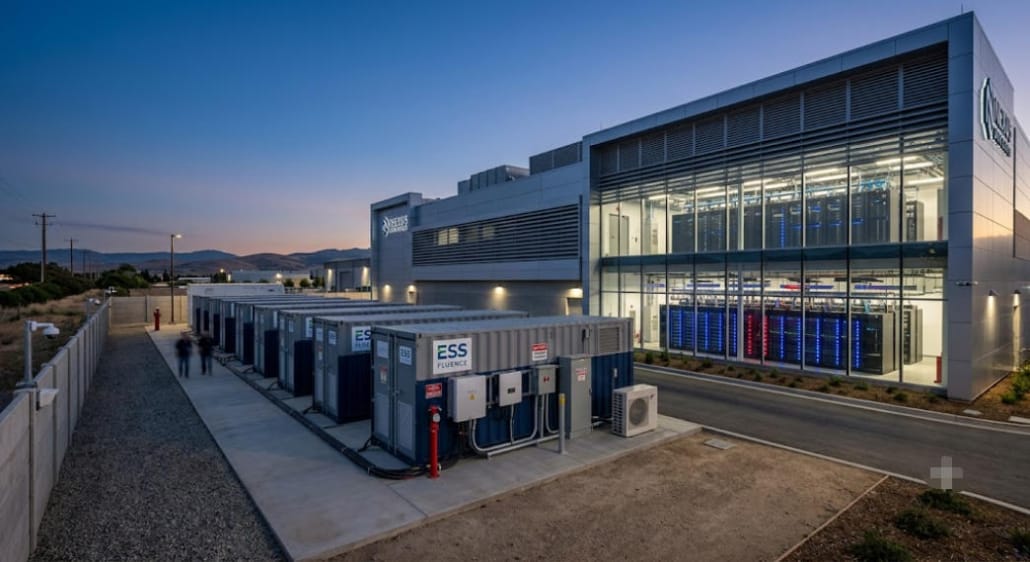
AI Data Center Energy Storage: Why BESS Is Critical
| Quick Answer AI data centers strain power grids in two ways. First, they need massive amounts of power. Second, that power swings wildly, second to second. In practice, training a large GPU cluster can shift facility power by tens or hundreds of megawatts within milliseconds. AI data center BESS, battery storage deployed on-site, solves both problems. It absorbs these swings, bridges long grid connection delays, and cuts peak demand charges. As a result, it often costs far less than building new on-site generation. |
1. The Power Problem Driving AI Data Center BESS
AI data center BESS has moved from a niche add-on to a core design requirement. Specifically, global data center electricity demand is set to top 1,000 TWh in 2026. That is roughly double the 2023 level. In the United States, data center power demand should climb by 400 TWh by 2030. That works out to about 23% growth each year. In fact, AI workloads alone could drive 30% to 40% of that new demand.
This growth has outpaced what utilities can build. Hyperscalers now sign gigawatt-scale power deals faster than new transmission lines can go up. As a result, a widening gap has formed. AI facilities need power on day one, but the grid often cannot deliver it on schedule. That is why AI data center BESS increasingly closes the gap, both on-site and in front of the meter.
2. Why Volatility Matters More Than Total Power
#image_title
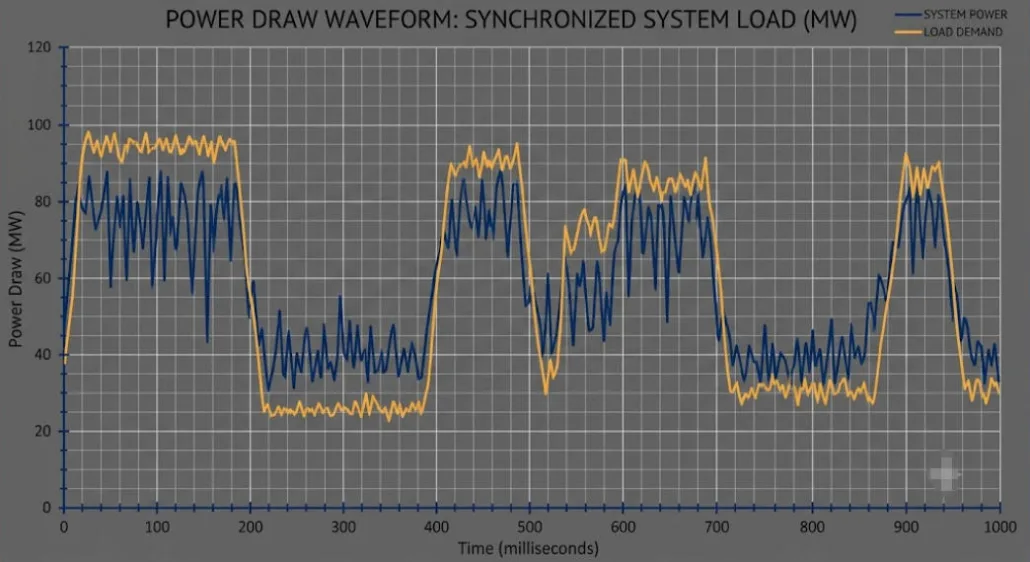
Consequently, most conversations about AI data centers focus on total megawatts. However, the harder problem is how unevenly that power arrives. For example, a traditional data center runs thousands of small, unrelated tasks. Therefore, those tasks average out into a fairly flat load. In contrast, an AI training cluster works quite differently. Specifically, tens of thousands of GPUs execute in lockstep. As a result, they synchronize computation and communication in cycles that last just milliseconds.
A large training job often pauses for a checkpoint or a data-sync step. When it does, GPU power can fall from full load to near idle in a split second. Then it snaps back just as fast. At scale, these swings can move tens or even hundreds of megawatts almost instantly. For example, Meta’s own engineers have described this exact problem on a 24,000-GPU cluster pulling roughly 30 MW. Notably, they say the problem only grows as clusters get bigger.
According to Uptime Institute, these swings can push AI compute clusters to about 150% of their normal power draw. That strains transformers, UPS units, and protection gear never built for this kind of stress. Left unmanaged, the swings can trip upstream protection or shake grid equipment through resonance. In response, fast-responding battery storage can absorb or release power within milliseconds. So, AI data center BESS is one of the few tools that can smooth these swings before they reach the utility line.
3. Interconnection Queues Are the Real Bottleneck
Even a fully funded data center still has to wait in line to connect to the grid. As of late 2025, about 2,600 GW of generation and storage capacity sat in U.S. interconnection queues. Today, the median project takes close to five years to reach commercial operation. Some PJM-area projects have waited more than eight. Meanwhile, ERCOT alone had 143.5 GW of data center load seeking connection as of October 2025. That is well above the grid operator’s all-time peak demand of 85.9 GW.
In short, only a small share of queued capacity ever gets built. In fact, Lawrence Berkeley National Laboratory found that just 13% of capacity that applied for interconnection between 2000 and 2019 had reached commercial operation by the end of 2024. For a developer who needs power within 18 to 24 months, a five-to-eight-year queue is not a delay. It is a dealbreaker. Because of this, an estimated 50 GW of behind-the-meter data center power capacity was announced in 2025 alone. Most of it pairs on-site generation with co-located battery storage. This is exactly the gap AI data center BESS is built to bridge, until the grid connection is ready.
4. Where AI Data Center BESS Fits: Four Key Roles
AI data center BESS is not a single application. Instead, it covers four distinct jobs. Often, all four stack on the same battery asset.
Sub-Second Power Smoothing
Specifically, rack-level and facility-level battery banks can absorb a sudden GPU load drop. Then they discharge just as fast when demand snaps back. This turns a millisecond-scale spike into a gradual ramp. As a result, grid equipment and on-site generators can actually keep up. Chipmakers now pair this storage with power capping and staged ramp-up controls. Together, these keep facility-wide swings within a range utilities can tolerate.
Bridge Power for AI Data Center BESS
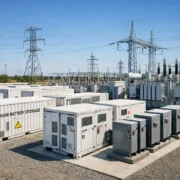
A co-located BESS can start covering peak loads the day a facility opens. This happens long before a full grid connection is approved. So, it buys time for transmission upgrades to catch up. The project does not have to sit idle for years waiting on first power.
Peak Shaving and Demand Charge Management
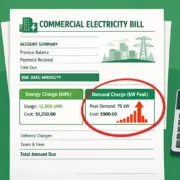
Typically, utilities bill large loads heavily for their single highest demand spike each month. By charging the battery during cheap, low-demand hours and discharging during peak windows, a facility can shave that spike. This can meaningfully cut a facility’s monthly bill. For more detail, see Sunlith’s guide to peak shaving and demand charge reduction.
Grid Services and Energy Arbitrage
Additionally, a stand-alone BESS in front of the meter can also earn revenue on its own. It charges when wholesale prices are low. Then it discharges, or provides frequency regulation, when prices spike. In turn, this transforms backup infrastructure into a second income stream, not just a cost center.
5. BESS vs. Alternative Power Strategies for AI Facilities
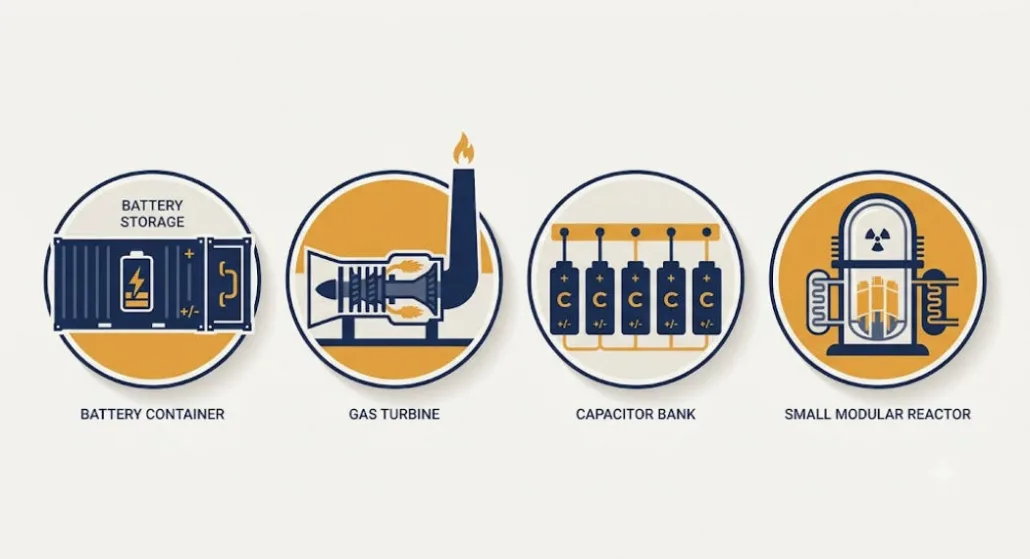
Data center developers rarely choose one power strategy alone. Instead, the table below compares how AI data center BESS stacks up against other tools developers are using in 2026.
| Strategy | Response Time | Deployment Timeline | Best For |
|---|---|---|---|
| BESS | Milliseconds to seconds | 6–18 months | Power smoothing, peak shaving, bridge power |
| On-site gas generation | Seconds to minutes | 12–24 months | Sustained bridge power at large scale |
| Grid-forming UPS / capacitor banks | Microseconds | Built into facility design | Ride-through for the shortest transients |
| Small modular reactors (SMRs) | Not applicable (baseload) | 5+ years | Long-term, always-on capacity |
6. Sizing AI Data Center BESS: What to Consider
Not every BESS deployment looks the same. Sizing one for an AI data center starts from a different set of questions than a typical grid-scale project.
Response Time and C-Rate
Smoothing millisecond-scale GPU swings needs a battery and inverter rated for very fast response. This matters more than raw capacity. It is a different design target than a system built purely for hours-long peak shaving.
Duration: Burst Smoothing vs. Bridge Power
A system built to absorb short, sharp swings needs little energy capacity but very high power. By contrast, a system meant to bridge months or years of interconnection delay needs the opposite. It needs sustained duration to cover real load, not just brief spikes.
AI Data Center BESS Placement: Rack vs. Facility
Some operators deploy smaller battery banks close to the rack to catch the fastest transients. They pair these with a larger facility-scale BESS for peak shaving and bridge power. The two serve different timescales. So, they are rarely substitutes for each other.
Battery Chemistry for AI Data Center BESS
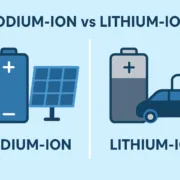
AI data center duty cycles involve frequent, partial charge-discharge events, not one clean cycle a day. Lithium iron phosphate, or LFP, tends to hold up well under that kind of irregular cycling. It also offers strong thermal stability. That matters for compliance with codes covered in Sunlith’s NFPA 855 guide for large-format stationary storage.
Key Takeaways on AI Data Center BESS
| Point | Why It Matters |
|---|---|
| AI data centers strain the grid two ways | Total demand is high, but the bigger design problem is millisecond-scale power swings during GPU training |
| Interconnection queues now stretch 5–8 years | AI data center BESS and other behind-the-meter resources bridge the gap until full grid connection |
| BESS covers four distinct jobs | Power smoothing, bridge power, peak shaving, and grid services can stack on one battery asset |
| Sizing depends on the job | Smoothing needs fast response and modest duration; bridge power needs sustained duration and real capacity |
| LFP suits AI data center duty cycles | Frequent partial cycling and thermal stability requirements favor LFP over other lithium chemistries |
Frequently Asked Questions About AI Data Center BESS
What Is AI Data Center BESS?
BESS stands for battery energy storage system. AI data center BESS refers to on-site or co-located batteries. These batteries smooth GPU power swings, bridge grid connection delays, and manage peak demand charges.
How Much Power Do AI Data Centers Actually Use?
Individual GPU racks now draw 50 to 100 kW. That is up from just 5 to 10 kW for older server racks. At the facility level, large training clusters can pull tens to hundreds of megawatts. Notably, swings of similar size can occur within milliseconds.
Can Batteries Really Respond Fast Enough for GPU Power Swings?
Yes, when purpose-built for it. Battery and inverter combinations designed for fast response can absorb and release power within milliseconds. That is exactly the timescale GPU training swings operate on.
How Long Does BESS Deployment Take?
A dedicated BESS deployment typically takes 6 to 18 months, from order to commissioning. That is far faster than the five-plus-year interconnection queues many large loads now face.
Is BESS a Permanent Fix or a Bridge to Something Else?
It can be both, depending on the role. For instance, peak-shaving and power-smoothing functions are usually permanent.
Further Reading
- C&I vs. Utility-Scale Solar and BESS
- Peak Shaving and Demand Charge Reduction
- NFPA 855 Guide for Battery Energy Storage Systems




Trackbacks & Pingbacks
[…] AI Data Center Energy Storage […]
[…] AI Data Center Energy Storage […]
Leave a Reply
Want to join the discussion?Feel free to contribute!