
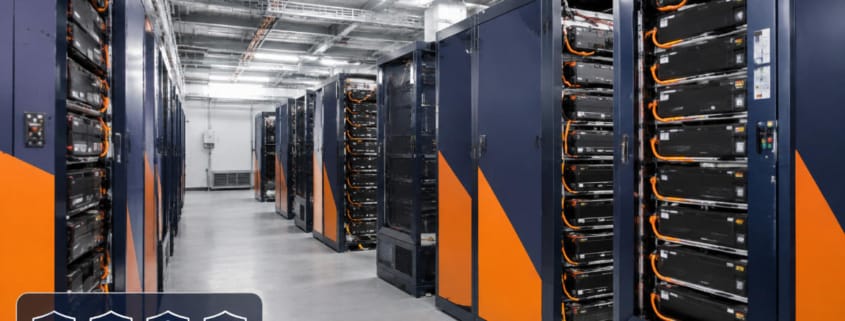
IEC 62619 Explained: The Safety Standard Behind Every Industrial Lithium Battery
IEC 62619 is the international safety standard that most industrial and commercial BESS suppliers get asked for first. Cell datasheets cite it, and procurement checklists demand it. But the standard rarely gets explained beyond a single bullet point in a longer certifications guide. So this article breaks down what it tests. It also covers what changed in the current edition, and how it fits alongside UL 1973 and IEC 63056.
| Quick Answer IEC 62619:2022 is the international safety standard for rechargeable lithium cells and batteries in industrial applications. It covers stationary uses like BESS, UPS, and telecom backup, plus motive uses like forklifts and AGVs, but excludes road vehicles and consumer devices. The current edition added mandatory thermal runaway propagation testing, a formal BMS safety analysis, EMC testing, and overcurrent protection checks. |
What Is IEC 62619?
IEC 62619 is published by the International Electrotechnical Commission’s Subcommittee 21A. Its full title is long, but in short: safety rules for lithium cells and batteries used in industry. The standard sets out the tests needed to show a lithium cell or battery is safe. This applies under both normal use and fault conditions.
The scope is industrial, not consumer. So it covers two broad groups:
- Stationary applications — telecom power, uninterruptible power supplies (UPS), electrical energy storage systems, utility switching, and emergency power
- Motive applications — forklift trucks, golf carts, automated guided vehicles (AGVs), railway vehicles, and marine vessels
Road vehicles are excluded. Where a conflict exists, standards written for automotive traction batteries take precedence instead (the IEC 62660 series). Consumer and portable devices sit under a separate standard, IEC 62133-2, rather than this one. For electrical energy storage systems, suppliers often pair IEC 62619 with a companion standard, IEC 63056. That standard adds rules built for EESS use. More on that distinction below.
The current edition is IEC 62619:2022 (Edition 2.0, published 24 May 2022). It replaced the original 2017 first edition. Europe adopts it through the EN and BS EN routes. Companies also often use the standard alongside CE marking for industrial battery systems.
What Changed Between the 2017 and 2022 Editions
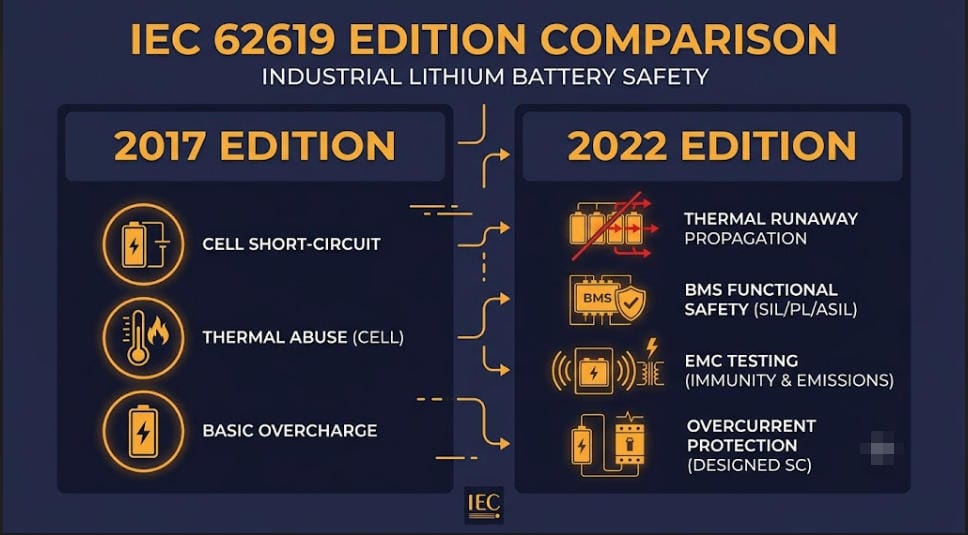
The second edition of IEC 62619 is a meaningfully stricter document. It is not a light refresh. Instead, the main additions concern system-level safety, not cell chemistry. This shift reflects how the industry moved from single-cell risk toward large multi-cell BESS deployments between 2017 and 2022.
| Area | What Changed in the 2022 Edition |
| Thermal runaway propagation | Became a mandatory test. It was present informally since 2017 but is now formalized and expanded. A new laser-ignition method was added as an alternative trigger. |
| BMS functional safety | New rule for a formal safety analysis of the BMS. This references frameworks such as IEC 61508 (targeting SIL-2) or ISO 13849. |
| Overcurrent protection | New test checking that circuit protection triggers correctly under abnormal charge or discharge current. |
| Electromagnetic compatibility (EMC) | New rule showing BMS protection functions aren’t disrupted by outside electromagnetic interference. |
| System locks / fail-safe states | Clarified rules for preventing an unsafe automatic restart after a fault. |
What the Standard Actually Tests
IEC 62619 testing runs across four categories: electrical, mechanical, environmental, and system-level. First, cell-level tests confirm the chemistry and build are safe. Then, system-level tests take over — newer and heavier in the 2022 edition. Together, they confirm the battery and its BMS respond correctly when something goes wrong.
Electrical Safety Tests
- Overcharge — the test charges the cell or battery to roughly 1.5x rated voltage for an extended hold. No fire or explosion may occur. This shows the protection circuit or BMS cuts off correctly.
- External short circuit — the test shorts the terminals through a low-resistance path. Surface temperature must stay well below thermal-runaway onset.
- Forced discharge — the test discharges the battery below its minimum voltage, then checks for safe behaviour and a minimum capacity recovery on recharge.
- Overcurrent protection (2022 addition) — shows the protection circuit activates correctly under abnormal charge or discharge current.
Mechanical and Environmental Tests
- Crush — the test applies a defined force to the battery face. No fire or explosion may occur.
- Free fall — drop testing across several orientations onto a hard surface. Checks for electrolyte leakage, fire, or explosion.
- Vibration and shock — simulates transport and in-service stress without loss of function.
- Temperature cycling — repeated cycling across a wide temperature band. A minimum capacity retention threshold applies at the end.
- Thermal abuse — external heating beyond the maximum rated temperature. Evaluates the failure response.
System-Level Safety Tests
This is where the 2022 edition diverges most from 2017. Instead of behaving like a cell-safety spec, the standard now reads more like a system-safety framework.
- Thermal runaway propagation — the test deliberately drives a single cell into thermal runaway, then checks the failure doesn’t spread to neighbouring cells. This test matters most for large-format BESS design, since isolated cell failures inside a multi-megawatt-hour system count as a near-certainty over a 15-20 year service life. The goal is a contained, graceful failure, not zero failures.
- BMS functional safety analysis — the test checks the BMS against a recognised safety framework. Triple monitoring of voltage, current, and temperature is typical at cell or module level, plus fast auto-disconnect on fault.
- Communication fault handling — the system must enter a safe state if it loses BMS-to-host communication.
- EMC testing — shows nearby electrical interference can’t disable or reset BMS protection functions.
IEC 62619 vs. Related Standards
IEC 62619 rarely sits alone on a certification checklist. It’s one layer in a stack. That stack spans cell chemistry, system safety, installation, and transport. Here’s how it maps against the standards it’s most often confused with. This comparison draws on the IECEE CB Scheme documentation that governs how these certificates get issued and recognised worldwide.
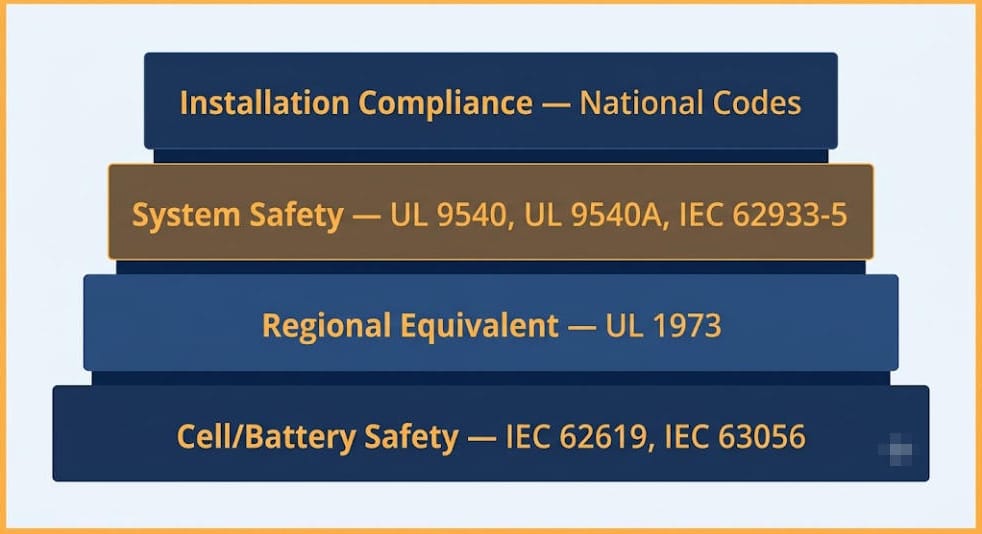
| Standard | Scope | How It Relates to IEC 62619 |
| UL 1973 | US stationary and motive auxiliary power battery safety | Regional equivalent for the US market. Most North American stationary ESS installs require UL 1973 specifically, so global suppliers often hold both UL 1973 and this standard. |
| IEC 63056 | Safety rules for secondary lithium batteries used in electrical energy storage systems | A companion standard, not a substitute. This standard sets the general industrial baseline, while IEC 63056 layers on EESS-specific rules. So ESS suppliers are often asked for both. |
| IEC 62933-5 series | System- and grid-level safety for electrical energy storage systems | Sits above IEC 62619 in the stack. This standard certifies the cell or battery product, then IEC 62933-5 covers safety once that battery joins a full grid-connected system. |
| UL 9540 / UL 9540A | Full BESS system listing (UL 9540) and fire-propagation test method (UL 9540A) | A system-level, US-centric counterpart. So a cell can pass this standard and still need UL 9540A testing once installed in a full enclosure. |
| UN 38.3 | Transport safety for lithium batteries — altitude, vibration, shock, short-circuit during shipping | A different risk entirely: safe transport, not safe operation. So a battery typically needs both UN 38.3 and this certification. |
| IEC 62109-1/2 | Safety of power converters (PCS/inverters) used in PV and ESS | Covers the inverter side, not the battery. This standard and IEC 62109 are complementary, since a full system needs certified batteries and a certified PCS. |
Certification vs. Installation Compliance
One point worth remembering: this standard tests the battery product itself. It says nothing about whether an installation is legal in a given country. In Australia, for example, a certified battery module still has to separately satisfy AS/NZS 5139 for installation safety, AS/NZS 4777.2 for inverter compliance, and AS/NZS 3008.1.1 for cable sizing. So, product certification and installation compliance are two different layers. See our full breakdown in Australia’s New Battery Rules: The 2026 Compliance Stack.
Who Needs IEC 62619 Certification
- Commercial & industrial (C&I) BESS makers and integrators
- Utility-scale energy storage suppliers
- Telecom backup power and UPS system makers
- Industrial motive power — forklifts, AGVs, and similar equipment
- Residential/home ESS suppliers — this standard is often part of the certification stack here too, though household rules sometimes point to IEC 60335 or IEC 63056 instead
Buyers should ask for cell-and-pack-level certification specifically. A component-level test report from one sub-supplier is not enough, since system integration, BMS logic, and enclosure design all affect whether certified parts stay safe once assembled.
Regional Recognition
| Region | How It Is Recognised |
| International (CB Scheme) | 50+ member countries accept test reports and certificates issued under the IECEE CB Scheme. This avoids duplicate testing when entering multiple markets. |
| Europe | Europe uses EN IEC 62619:2022 / BS EN IEC 62619:2022. Manufacturers commonly cite it for CE marking under the Low Voltage Directive. |
| India | IS 17855:2022 aligns closely with this standard. Large utility and industrial BESS tenders require it. Testing must happen at BIS-approved labs or accredited labs with a BIS agreement. |
| China | GB/T 36276 is the primary domestic standard for lithium-ion energy storage batteries. This standard is used as the international equivalent instead, for export-facing products. |
| Australia & New Zealand | One of the battery certifications commonly requested, alongside UL 1973 and UN 38.3. But it does not replace AS/NZS 5139 installation compliance — see our Australia battery rules hub for the full stack. |
The Certification Process, in Brief
IEC 62619 certification typically runs through the IECEE CB Scheme:
- Submit the application to an IECEE-recognised National Certification Body (NCB) with product docs, cell/battery specs, and BMS design details
- The lab tests samples at an accredited CB Test Laboratory (CBTL) against the full test matrix
- The lab issues a CB Test Report (CBTR) and CB Test Certificate (CBTC) on success
- The CB certificate then converts into national certificates (CE, KC, SAA, and others). This is usually faster than a fresh national bid, since it draws on the existing CB test report
Timelines vary by scope and lab backlog. Full testing commonly runs several weeks to a few months. This depends on sample availability and whether early testing surfaces issues that need a redesign. So, ask suppliers for the CB Test Certificate itself and the full test report. Also confirm which edition, 2017 or 2022, it references. The 2022 edition is now the one expected for new product submissions.
IEC 62619 Compliance Checklist
- Check the certificate references IEC 62619:2022, not the superseded 2017 edition
- Request the full CB Test Report, not just the summary certificate
- Verify the submission includes thermal runaway propagation results — this test matters most for multi-cell BESS safety
- Check the BMS has a functional safety analysis (IEC 61508 SIL-2 or ISO 13849) in the submission
- Check whether the application also needs IEC 63056 certification for the specific EESS use
- For the US market, confirm whether the market requires UL 1973 too
- Don’t treat this standard as a stand-in for system-level or installation rules. Check UL 9540/9540A, IEC 62933-5, or the local installation code separately
- For transport, confirm the supplier holds UN 38.3 certification separately — this standard doesn’t cover it
Frequently Asked Questions
Is IEC 62619 mandatory?
IEC 62619 is a voluntary international standard, not a law. But it’s mandatory in practice across most industrial and utility-scale BESS procurement. Buyers, insurers, and financiers routinely list it as a minimum requirement, and some national tenders, including large BESS tenders in India, name it directly as mandatory.
Does IEC 62619 cover the whole BESS system or just the battery?
It covers the cell and battery product, including its BMS. But it does not cover the full assembled system. Enclosure design, fire suppression, inverter safety (IEC 62109), and grid-level integration (IEC 62933-5) all sit outside its scope.
What’s the difference between IEC 62619 and IEC 63056?
IEC 62619 sets general industrial safety rules for lithium cells and batteries. IEC 63056, meanwhile, is a companion standard with rules specific to electrical energy storage use. So suppliers commonly hold both together, not as alternatives.
Do I need both IEC 62619 and UL 1973?
Only if the product sells into both international and US markets. UL 1973 is what US utilities, AHJs, and insurers expect for stationary ESS, while IEC 62619 is the equivalent almost everywhere else. So global suppliers commonly hold both.
What was the biggest change in the 2022 edition?
The mandatory thermal runaway propagation test, plus the new rule for a documented BMS safety analysis. Both reflect the shift from single-cell risk thinking toward large, multi-cell stationary BESS.
Further Reading
IEC Certifications for BESS: The Global Standard for Safety, Performance & Compliance
BESS Certifications: The Complete 2026 Guide (UL, IEC, CE, BIS & More)
IEC 62933: Global Standard for Grid Energy Storage Systems

VEU Rebate for Victoria: What the Program Actually Covers in 2026
Many Victorian homeowners search for a VEU rebate on solar batteries.
Then they find out the truth. The Victorian Energy Upgrades program does not fund home batteries directly. It covers many other energy-efficient upgrades instead.
So where does battery support actually come from? This guide explains what the VEU rebate covers, how the scheme works in 2026, and where battery buyers should look next.
| Quick Answer The VEU rebate is a Victorian Government discount for energy-efficient upgrades like heat pump hot water and insulation. It does not cover home battery storage. Victorian battery buyers instead use the federal Cheaper Home Batteries Program, while businesses claim battery value through VEU project-based activities. |
What Is the VEU Rebate?
The VEU rebate comes from the Victorian Energy Upgrades program, regulated by the Essential Services Commission. It was once called the Victorian Energy Efficiency Target scheme.
Actually, the program started back in 2009. Since then, it has helped more than 2.4 million Victorian homes.
In 2025, the state passed a bill extending the program through to 2045. So installers and homeowners now have long-term certainty.
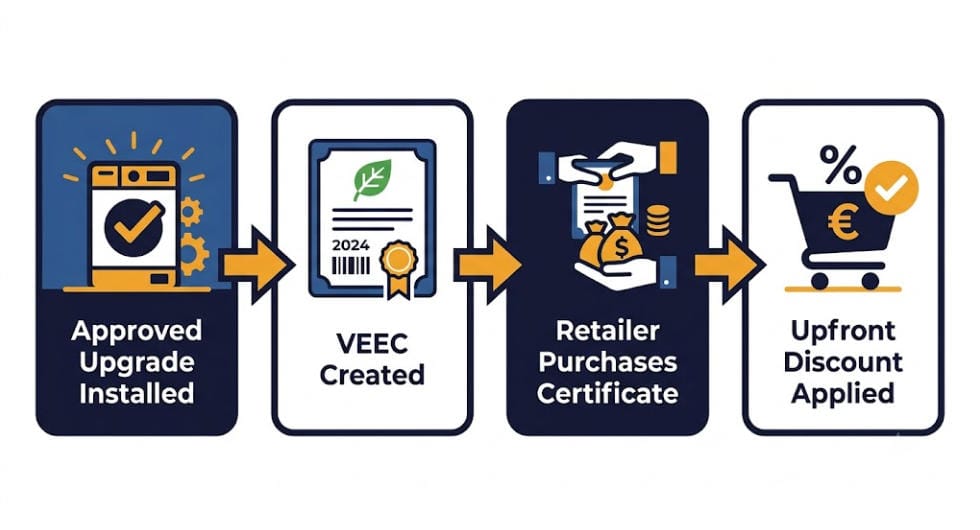
Here is how the funding works. Then energy retailers must buy and hand in credits each year.
Each credit is called a VEEC, short for a Victorian energy efficiency certificate. One VEEC equals one tonne of greenhouse gas saved.
So providers earn these credits by installing approved products. Then they turn that value into your upfront discount.
2026 and 2027 Targets
The government locked in new targets for the scheme. So the VEU rebate program now aims for 4.4 million certificates in 2026, rising to 4.6 million in 2027.
Also, regulators expect around 6 million certificates to actually be created each year. That builds a healthy surplus and keeps the market stable.
Once, retailers who fell short only faced a modest penalty. Now the shortfall rate has risen to $100 per certificate, which pushes retailers to keep buying.
How the Program Works Step by Step
The process stays simple on your end. First, you contact an accredited provider.
Next, they check your home and current system. Then your quote shows the discount already applied. You never claim anything after the fact.
From Credit to Discount
Your VEU rebate size depends on two things. One is the credit price, and the other is how much greenhouse gas your upgrade saves.
Also, prices move with the market. So the same upgrade can offer a different discount from month to month.
Credit Fees and Deadlines
Providers pay a fee for each credit they create. That fee rose from $2.33 to $4.35 from 1 January 2026, as part of a wider cost-recovery update.
Then there is also a strict deadline. So credits must be created within six months after the year ends.
So a 2025 upgrade needs its credit locked in by 30 June 2026. This same deadline covers late claims too.
Act early if you already installed an approved product but never claimed the discount.
Does the VEU Rebate Cover Home Batteries?
Not directly. Instead, the VEU program has no set activity for home battery installs, even in 2026.
That surprises many people. After all, batteries are one of the most searched clean-energy products in Victoria right now.
Victoria did run an interest-free loan scheme for home batteries through Solar Victoria, but that’s closed now. It hit its 4,500-loan target and stopped taking new applications in 2025.
Solar Victoria still offers rebates for solar panels and hot water systems, and the income cap for those drops from $210,000 to $150,000 from 1 July 2026. That cap doesn’t apply to battery support, though, since the battery loan itself no longer exists.
The Federal Cheaper Home Batteries Program
Instead, the federal Cheaper Home Batteries Program adds its own discount on top. That support runs through the Small-scale Renewable Energy Scheme, administered by the Clean Energy Regulator.
It funds around 30 percent off the upfront cost of eligible battery systems between 5kWh and 100kWh. No separate government application is needed. Your installer applies the discount directly.
This program has grown fast. In its first six months, more than 155,000 households and small businesses claimed the discount, with most installs happening outside inner-city areas.
So in December 2025, the government expanded its budget from $2.3 billion to $7.2 billion over four years. That’s expected to help over 2 million Australians install a battery by 2030.
Then, from 1 May 2026, the calculation method changed. The Small-scale Technology Certificate factor now tapers by battery size and steps down every six months through 2030.
Still, the government says the aim is to hold the discount at roughly 30 percent for most typical systems, while discouraging oversized batteries bought purely to chase a bigger rebate.
So if a provider advertises a “VEU battery rebate” for your home, ask one simple question: which scheme actually pays for it?
Often, it turns out to be a federal or state incentive, just marketed loosely under the VEU name.
What the Program Covers for Households
The scheme funds many approved products. Here are the most common home upgrades covered by the VEU rebate in 2026:
- Heat pump hot water systems, swapped in for old electric or gas units, generally earning 10 to 30 certificates per home
- Reverse-cycle air conditioning, replacing older heating and cooling
- Ceiling insulation, a brand-new 2026 activity — live now for public and community housing, opening to all Victorian homes from 1 October 2026
- Induction cooktops, recently extended to cover more eligible households
- Efficient shower roses and other water-saving fixtures
Renters can access most upgrades too. But some, like heating and cooling, need landlord sign-off first.
Always check your own eligibility with a provider before you commit to any single product, since exact certificate numbers vary by climate zone and the system being replaced.
Business Battery Storage and the VEU Rebate
Business battery projects access VEU rebate value differently. Instead, companies tap credit value through project-based activities.
So these use real measurement data, not a fixed formula. Since June 2025, the program added new measurement methods for larger sites.
So these better capture the value that business batteries deliver. As a result, they produce a stronger credit outcome than the older method did.
That single change makes battery projects easier to finance. So this especially helps sites doing heavy peak shaving.
The scheme also added a Commercial and Industrial Solar activity, which commenced on 29 September 2025. It covers systems between 30kW and 200kW, with the program guide and application forms released by late November 2025.
Pairing that solar activity with a battery lets a site make, store, and use its own power. So this cuts grid costs further over time.
The scheme has also revised its high efficiency motor activity and updated eligibility rules for several existing activities, so it’s worth checking current terms even for a project you assessed a year ago.
For help sizing these systems correctly, see our guide on C&I vs Utility-Scale BESS.
How to Claim Your VEU Rebate
Follow these steps to claim your VEU rebate with any accredited provider:
- Confirm your home and current system qualify for an approved activity
- Pick an approved product from the VEU register
- Get a quote with the discount already taken off
- Have a licensed provider complete the install
- Let the provider handle the credit paperwork
You never touch the credit process yourself. Instead, your provider manages that step from start to finish.
What’s Changing Next: The VEU Strategic Review
The program isn’t standing still. Regulators are running a wider strategic review of the whole VEU framework in 2026.
So the aim is to modernise the VEU rebate scheme and better support electrification as more households switch to efficient, electric appliances.
A bill to amend the underlying Act is planned for state Parliament later in 2026. Formal stakeholder engagement, including public webinars, ran through March and April 2026.
Instead of assuming today’s rules are fixed for years, treat this guide as a snapshot. Always confirm current activity terms with an accredited provider before signing a quote.
Comparing VEU Rebate and Other Battery Incentives
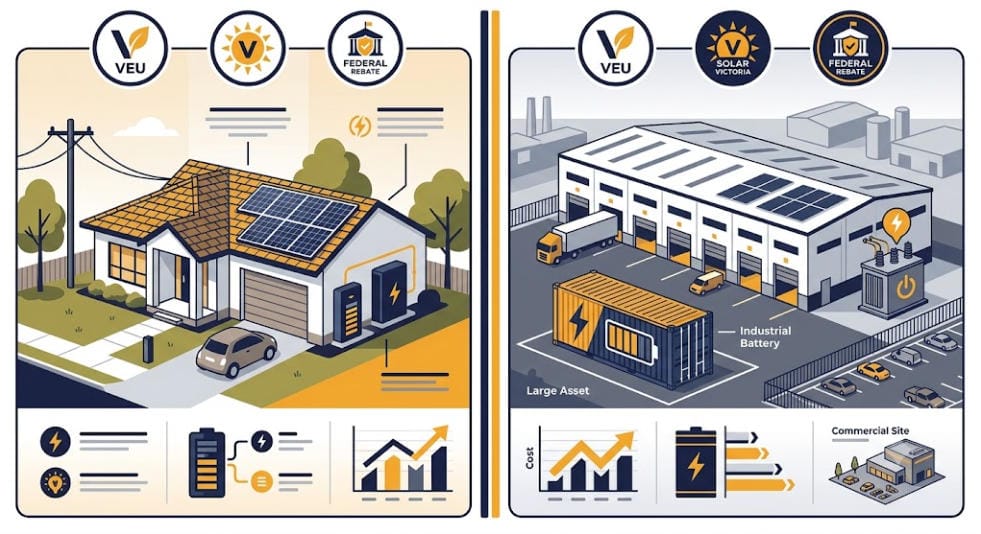
The table below compares the main schemes Victorian homes and businesses actually use.
| Scheme | What It Covers | Who It Suits |
|---|---|---|
| VEU rebate (standard activities) | Hot water, heating, cooling, insulation | Homes and small businesses |
| Solar Victoria rebates | Solar panel and hot water rebates (battery loan closed in 2025); income-capped from July 2026 | Income-eligible homeowners |
| Federal Cheaper Home Batteries Program | Around 30% off usable battery capacity | Any eligible home nationally |
| VEU project-based activities | Credit value for custom battery and solar projects | Commercial and industrial sites |
Mixing up these schemes is common. Often, providers blend the language together in their marketing.
So knowing which body actually funds your discount helps you compare quotes fairly. It also guards you against a provider who overstates what the VEU rebate alone will cover.
Why the Mix-Up Happens So Often
Most Victorian energy schemes overlap in timing and paperwork. So it is easy to see why homeowners blur them together.
Often, one accredited VEU provider is also a Solar Victoria partner. That same firm might also process federal battery credits.
So one invoice can quietly bundle three discounts into a single number. Always ask for a clear, itemised breakdown before you sign anything.
Frequently Asked Questions
Is there a VEU rebate for solar batteries at home?
No — home battery storage is not a standard VEU activity. Solar Victoria’s battery loan has closed, so look at the federal Cheaper Home Batteries Program instead.
How much is the rebate worth?
That depends on the credit price and your specific upgrade. Prices shift with the market, so your provider confirms the exact figure before work starts.
Has the federal battery discount changed in 2026?
Yes. The calculation method changed from 1 May 2026, tapering by battery size. But the government still targets around a 30 percent discount for most typical systems.
Who is eligible in Victoria?
Most Victorian homes and small businesses qualify for at least one activity. There is no income test for most VEU upgrades, though renters may still need landlord approval.
Can businesses combine incentives?
Yes. So business batteries can often stack project-based credit value with federal Small-scale Technology Certificates. This pairs well with solar and often shortens the payback period too.
Further Reading
AS/NZS 3008.1.1:2025: What Changed for Cable Selection
AS/NZS 3008.1.1:2025 changed how engineers size cables across Australia and New Zealand. It’s also the fourth edition of the standard. It replaces the 2017 edition, which ran for eight years. So a cable calculation done today needs the new tables, not the old ones. This guide covers the real changes in AS/NZS 3008.1.1:2025. It also covers the new DC provisions and the transition timeline for each country. It’s one of three standards in Australia’s new battery rules.
| Quick Answer Quick answer: Standards Australia published AS/NZS 3008.1.1:2025 on 19 December 2025. It adds dedicated DC cable rating tables for the first time, covering circuits up to 1500V. Grouping and soil derating factors also got tighter. The standard renames “derating factor” to “correction factor.” Aluminium conductor ratings now extend down to 16mm². Both editions currently remain valid. Western Australia set 19 June 2026 as its full-compliance date. New Zealand expects to withdraw the 2017 edition around November 2026. |
What Is AS/NZS 3008.1.1?
AS/NZS 3008.1.1 sets the current-carrying capacity, voltage drop, and mechanical protection rules for cables in permanent electrical installations up to 0.6/1 kV. It also works alongside AS/NZS 3000, the wiring rules. Every cable has to clear three separate checks under this framework. AS/NZS 3008.1.1:2025 sets the numbers for all three checks.
The Three Checks Every Cable Must Pass
The first check is current-carrying capacity. A cable has to carry its design current continuously, without exceeding its insulation temperature rating. First, that figure comes from the base rating tables. Then the design derates it for ambient temperature, grouping, and depth of burial. Next, the second check is voltage drop. The drop from the supply point to the furthest load can’t exceed 5 percent of nominal supply voltage under AS/NZS 3000. For 230V single-phase, that’s 11.5V. For 400V three-phase, that’s 20V. Finally, the third check is earth fault loop impedance. So the total fault loop has to stay low enough that the upstream protective device disconnects within the AS/NZS 3000 Table 5.1 time limit.
| Check | Requirement |
| Current-carrying capacity (Iz) | Cable must carry the design current continuously without exceeding its insulation temperature rating, after derating for ambient temperature, grouping, and depth of burial |
| Voltage drop (Vd) | Must not exceed 5% of nominal supply voltage under AS/NZS 3000 (11.5V for 230V single-phase; 20V for 400V three-phase) |
| Earth fault loop impedance (Zs) | Total fault loop impedance must let the protective device disconnect within the AS/NZS 3000 Table 5.1 time limit |
Everything AS/NZS 3008.1.1:2025 Changed, at a Glance
| Change | Detail |
| New DC tables | Tables 3.21 and 3.22 cover DC circuits up to 1500V directly — first time in the standard’s history |
| AC tables rebuilt | Updated IEC 60287 thermal models; some ratings up 1-3% where 2017 was overly conservative |
| Aluminium range expanded | Ratings now start at 16mm², down from 25mm² |
| Grouping factors tightened | 6-circuit unperforated tray factor: 0.73 → 0.68 |
| Soil resistivity table | New “very dry soil” row added for desert/remote mining conditions |
| Terminology | “Derating factor” renamed to “Correction Factor (CF)” throughout |
New DC Cable Tables Up to 1500V
The single biggest change in AS/NZS 3008.1.1:2025 is new DC cable tables. Tables 3.21 and 3.22 now cover DC circuits directly. So that’s a first in the standard’s history. Before this edition, engineers sizing DC cables for solar strings, battery racks, or EV charging had no dedicated national table to work from. So they either approximated DC values from the AC tables using a 1.155 conversion factor, or leaned on manufacturer data instead. Now that workaround is gone. The new tables cover DC circuits up to 1500V directly. This matches where utility-scale solar and BESS DC bus voltages have been heading for years.
DC voltage drop also gets a cleaner formula under AS/NZS 3008.1.1:2025. DC has no reactive component. So the calculation is simpler than the AC version: voltage drop equals two times current times resistance times length, divided by 1000. So the factor of two accounts for both the outgoing and the return conductor. For a bipolar system with positive, neutral, and negative rails, the designer calculates each pole separately.
AC Table Changes
AC tables changed too, not just DC. AS/NZS 3008.1.1:2025 rebuilt the 2017 current rating tables using updated IEC 60287 thermal models. Some ratings actually increased, typically by 1 to 3 percent. That happened where the old 2017 figures turned out to be overly conservative. Also, table groupings got reorganised in places. This mainly cuts the risk of picking the wrong column. Aluminium conductor coverage expanded too. So ratings now start at 16mm², down from 25mm² in the old tables. This reflects how aluminium now shows up more in smaller, cost-sensitive solar DC circuits. These new ratings sit alongside the DC provisions covered in our Understanding BESS Specifications guide.
Revised Grouping and Soil Derating Factors
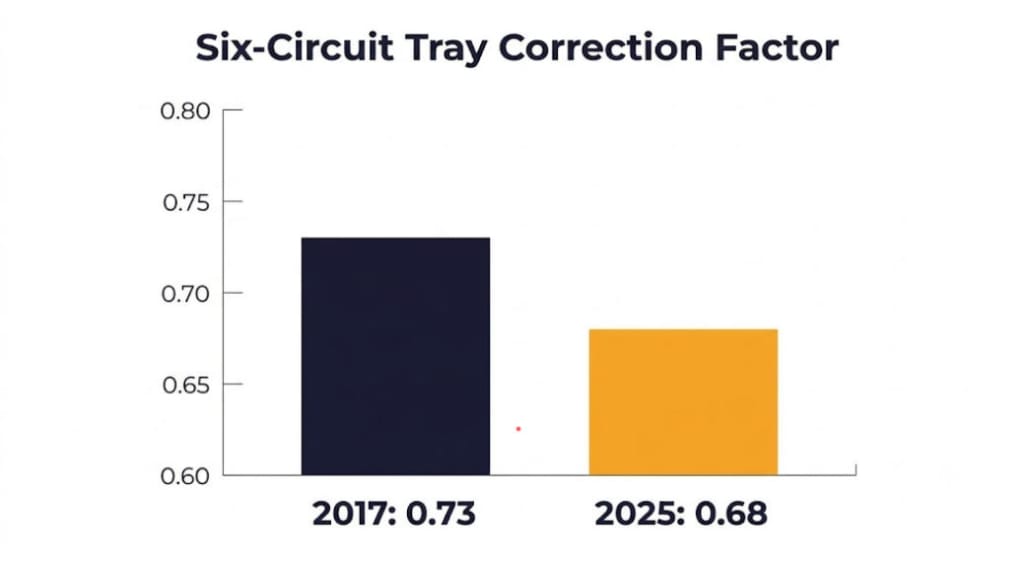
Not every change loosened requirements. Grouping and soil derating factors got tighter under AS/NZS 3008.1.1:2025, not looser. Cables on unperforated trays now carry lower correction factors than before. Take a six-circuit run on a solid tray, for example. It drops from a factor of 0.73 to 0.68. So that single change can push a cable size up a full commercial step on a real job. Field studies and thermal modelling done since 2017 found the old grouping factors weren’t conservative enough. Certain enclosed, tightly packed tray configurations were the main problem.
Soil thermal resistivity got a new addition, not just a tightened number. A “very dry soil” row now appears in the table. It also covers desert and remote mining conditions the 2017 edition never addressed. So that row matters for any underground DC run through genuinely arid ground. The old table simply had no category for it.
Terminology Change: Correction Factor Replaces Derating Factor
The term “derating factor” is gone from AS/NZS 3008.1.1:2025 entirely. It’s now called “correction factor,” abbreviated CF throughout the standard. Still, this is only a naming change, not a calculation change. Still, it matters for documentation. So design calculations and compliance paperwork using the old “derating factor” term should get updated to match.
AS/NZS 3008.1.1:2025 Transition Timeline
Timing differs by country and by state. Both the 2017 and 2025 editions currently remain valid for use. Western Australia’s Building and Energy division set 19 June 2026 as the date full compliance becomes mandatory there. That follows the same six-month transition period that applies to the AS/NZS 5139 battery safety amendment, published the same day. Meanwhile, New Zealand runs on its own clock. The Electrical Workers Registration Board expects the 2017 edition to get withdrawn around November 2026, once the standard 24-month transition period closes.
Mixing editions on one job causes real problems. Some 2017 cable sizes calculate slightly differently under the 2025 tables, even for straightforward AC circuits. So the safest approach for new design work is picking one edition. Size the entire job to AS/NZS 3008.1.1:2025, rather than checking some circuits against 2017 figures and others against 2025 figures.
Compliance Checklist for the 2025 Cable Standard
- Size all new DC circuits (solar strings, BESS DC bus, EV charging) using Tables 3.21 and 3.22, not the old AC-conversion workaround.
- Recalculate any six-or-more-circuit run on an unperforated tray against the tightened correction factors.
- Check underground DC runs in arid conditions against the new “very dry soil” resistivity row.
- Update design documentation and compliance paperwork to use “Correction Factor (CF)” instead of “derating factor.”
- Confirm your state’s specific compliance timeline before assuming both editions remain acceptable indefinitely.
- Size an entire job to one edition of the standard — don’t mix 2017 and 2025 figures on the same project.
Frequently Asked Questions
When was AS/NZS 3008.1.1:2025 published?
It was published on 19 December 2025, the same day as AS/NZS 5139 Amendment 1. Some secondary sources describe it as a late-2024 publication, but the standard’s own front matter and Western Australia’s government notice both confirm the December 2025 date.
Does AS/NZS 3008.1.1:2025 cover DC cable sizing?
Yes, for the first time. Tables 3.21 and 3.22 provide dedicated DC current rating tables for circuits up to 1500V, replacing the previous workaround of approximating DC values from AC tables.
What happened to the term “derating factor”?
AS/NZS 3008.1.1:2025 renamed it to “Correction Factor,” abbreviated CF. It’s the same calculation, just updated terminology that should be reflected in new design documentation.
Do I have to use the 2025 edition right now?
Not everywhere yet. Both editions remain valid during the transition. Western Australia requires full compliance from 19 June 2026. New Zealand expects to withdraw the 2017 edition around November 2026. Check your specific state’s position before assuming a date.
Can I mix 2017 and 2025 cable sizing on the same project?
It’s not recommended. Some cable sizes calculate slightly differently between editions, even for standard AC circuits. Size the entire job to one edition to avoid inconsistent results.
Further Reading
- Australia’s New Battery Rules: The 2026 Compliance Stack
- AS/NZS 5139 Amendment 1: What Changed for Battery System Safety
- AS/NZS 4777.2 Amendment 2: What Changed for Inverter Requirements
- Updated Electrical Installation Standards — WA Government
- AS/NZS 3008.1.1:2025 Updates for Solar Cable Design — GSES
- Understanding BESS Specifications
AS/NZS 4777.2 Amendment 2: What Changed for Inverter Requirements
AS/NZS 4777.2 Amendment 2 changed how Australia approves grid-connect inverters. Standards Australia published it on 23 August 2024. It became mandatory exactly one year later. Also, it now applies to every new grid-connect install. So any inverter installed today needs to meet it. So this guide covers every real change. It also covers the region settings you need to check, and what happened to inverters already on the approved list. It’s one of three standards in Australia’s new battery rules.
| Quick Answer Quick answer: It became mandatory on 23 August 2025, after a 12-month transition. It makes six changes. New supply terms. Fewer tests for battery-only gear. New generation limit rules. Updated Region C set points. New paperwork rules. New clauses for two-way EV charging. Older CEC inverter listings didn’t carry over automatically. So manufacturers had to submit a declaration and evidence of the updated region settings before the deadline, or their models came off the approved list. |
What Is AS/NZS 4777.2 Amendment 2?
AS/NZS 4777.2 is the standard that governs how grid-connect inverters behave once installed. It’s also Part 2 of a two-part standard. Part 1 covers general requirements. Part 2 covers the inverter-specific rules that matter most for design work. AS/NZS 4777.2 Amendment 2 is the second update to the 2020 edition. So it’s formally known as AS/NZS 4777.2:2020 Amendment 2:2024.
The Six Changes in AS/NZS 4777.2 Amendment 2
Six changes make up the bulk of AS/NZS 4777.2 Amendment 2. First, AS/NZS 4777.2 Amendment 2 updates supply type terminology, for clearer alignment with AS/NZS 4777.1. Then second, battery-only products no longer need IEC 62109 testing. That cuts duplicate certification work. Third, generation limit control parameters changed. Fourth, AS/NZS 4777.2 Amendment 2 updates Region C set points. Fifth, documentation and marking rules changed. Sixth, and most talked-about, new clauses cover electric vehicle supply equipment.
| Change | What It Means |
| Supply type terminology | Updated for clearer alignment with AS/NZS 4777.1’s supply-type definitions |
| IEC 62109 removed | Battery-only products no longer need this testing, cutting duplicate certification work |
| Generation limit parameters | Control parameters for generation limiting were updated |
| Region C set points | Updated power quality set points specifically for Region C networks (Horizon Power, TasNetworks, remote Power & Water) |
| Documentation and marking | Updated requirements for product documentation and equipment marking |
| EVSE clauses (new) | New clauses covering electric vehicle supply equipment for bidirectional charging |
When AS/NZS 4777.2 Amendment 2 Took Effect
So Standards Australia set a 12-month transition window. During that time, manufacturers could apply under the old or the new standard. After 23 August 2025, the Clean Energy Council only accepts Amendment 2 products for new listings. The Clean Energy Council runs this through its approved inverter list. Most network operators use that list directly.
What Happened to Existing CEC Inverter Listings
Existing listings didn’t need full re-testing for AS/NZS 4777.2 Amendment 2. Still, manufacturers had to prove compliance. The Clean Energy Council asked for a signed declaration. It also asked for proof of the updated region settings for every model. That proof could be a product manual, an install guide, or a screenshot from a monitoring app. Anything missing by 23 August 2025 meant the model came off the approved list. The Clean Energy Council’s standards-change page has the full manufacturer declaration template and process.
So this matters for anyone still specifying against an old product sheet. An inverter that was genuinely CEC-approved two years ago may not carry that status today. So always check the live CEC list at the point of design, not a cached copy from a previous project.
CSIP-AUS and Smart Communication
The updated standard introduced CSIP-AUS, the Common Smart Inverter Profile for Australia. Still, this is a communication protocol, not a hardware requirement. It lets network operators manage dynamic export limits, and in some cases apply remote curtailment. A compliant inverter under AS/NZS 4777.2 Amendment 2 lets the grid talk back to it, not just receive power one-way.
Region-Based Power Quality Settings
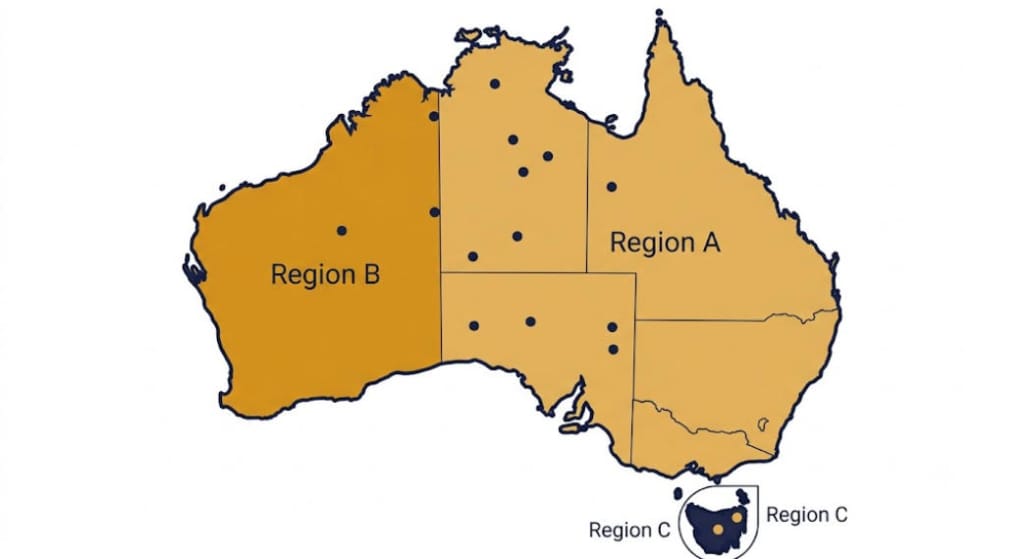
Power quality settings still follow a region-based structure: Australia A, B, or C. Most of the country falls under Region A. Western Power alone makes up Region B. Tasmania and remote areas fall under Region C, covering Horizon Power, TasNetworks, and remote parts of Power & Water. The full list is in the table below. AS/NZS 4777.2 Amendment 2 changed the Region C set points specifically. So a Tasmanian or remote WA install needs extra care here. Energy Networks Australia’s FAQ has the full DNSP contact list for each state.
| Region | Distribution Network Service Providers (DNSPs) |
| Australia A | Ausgrid, AusNet Services, Endeavour Energy, Essential Energy, Ergon Energy, Energex, Evoenergy, Jemena, CitiPower, Powercor, United Energy, SA Power Networks, Power & Water (some areas) |
| Australia B | Western Power |
| Australia C | Horizon Power, TasNetworks, Power & Water (remote networks) |
Warranty Replacement Rules
Warranty replacements get a narrow exception. Owners can still swap in an older-standard inverter under warranty, but only if three conditions hold together. The replacement has to be the same make and model. It has to genuinely be a warranty case. And the inverter has to match the existing connection agreement. Also, DNSPs still need to approve the replacement first. Outside those conditions, a warranty swap needs a current AS/NZS 4777.2 Amendment 2 compliant unit.
Bidirectional EV Charging: Mode 3 vs Mode 4
Bidirectional EV charging is where this amendment gets genuinely new. It’s not just a terminology refresh. So it splits two charging modes apart. Mode 4 charging sends power to and from the vehicle through wall-mounted gear with its own inverter. That gear now falls under AS/NZS 4777.2 Amendment 2 directly. It also sits inside the CEC’s approved inverter list. Mode 3 also sends power both ways, but the inverter lives inside the car instead. The Clean Energy Council is still working out how much of that setup falls under the same listing rules.
AS/NZS 4777.2 Amendment 2 Compliance Checklist
- Confirm the specific inverter model against the live CEC approved list, not a cached spec sheet or marketing page.
- Confirm the correct region setting (A, B, or C) for the installation’s DNSP — Region C set points changed under this amendment.
- Check whether any EV charging equipment on the job is Mode 3 or Mode 4, since that determines which listing requirements apply.
- For battery-only power conversion equipment, confirm whether the IEC 62109 exemption applies to the specific product.
- If proposing a warranty replacement with an older-standard inverter, verify all three conditions: same make and model, genuine warranty case, and matching connection agreement.
- Get DNSP approval before installing any warranty replacement inverter.
Frequently Asked Questions
When did AS/NZS 4777.2 Amendment 2 become mandatory?
Standards Australia published it on 23 August 2024. After a 12-month transition, it became mandatory for new inverter installations from 23 August 2025.
Does an old CEC inverter listing still work after Amendment 2?
Not automatically. Manufacturers had to submit a declaration and evidence of updated region settings before 23 August 2025. Any model without that evidence was removed from the approved list on that date.
What is CSIP-AUS?
CSIP-AUS is the Common Smart Inverter Profile for Australia — a communication protocol introduced with this amendment that lets network operators manage dynamic export limits and, in some cases, apply remote curtailment.
What’s the difference between Mode 3 and Mode 4 EV charging under this amendment?
Mode 4 charging uses wall-mounted Electric Vehicle Supply Equipment with its own inverter, which falls directly under AS/NZS 4777.2 and the CEC’s approved inverter list. Mode 3 charging also flows power both ways, but the inverter sits inside the vehicle instead — how that gets covered by the listing framework is still being finalised.
Can I still install an inverter that only meets the pre-Amendment 2 standard?
Only as a like-for-like warranty replacement, and only if the replacement is the same make and model, is genuinely for warranty purposes, and is set up to match the existing connection agreement. The DNSP still has to approve it first.
Further Reading
AS/NZS 5139 Amendment 1: What Changed for Battery System Safety (2025–2026)
AS/NZS 5139 Amendment 1 changed how batteries get installed across Australia and New Zealand. It arrived on 19 December 2025. So if you designed a BESS install before that date, several of your default assumptions just moved. This guide walks through every real change. New definitions. New clearance figures. A genuinely useful garage exception. A new appendix for fault current calculations. It’s one of three standards in Australia’s new battery rules.
| Quick Answer AS/NZS 5139 Amendment 1 updates 18 clauses. It also adds five new figures, plus Appendix I for calculating cell short-circuit current. It’s mandatory now in NSW. Western Australia set a specific deadline of 19 June 2026, after a six-month transition. The headline practical change is a new exception. Batteries can now sit within 600mm of a garage opening wider than 900mm, provided safe egress is preserved. |
What Is AS/NZS 5139 Amendment 1?
AS/NZS 5139:2019 is the standard that governs safety for battery energy storage systems. It covers systems connected to power conversion equipment. It replaced the older AS 4086.2 standard back in 2019. AS/NZS 5139 Amendment 1 doesn’t replace this base standard. Instead, it updates specific clauses. It adds new figures. It also adds one new appendix. The rest of the 2019 standard stays in force. The full amended text is available through the Standards Australia Store.
The full clause list is in the table below. It also touches Figures 2.11 and 2.12, and adds five entirely new figures: 4.1A, 4.1B, 4.1C, 4.1D, and 4.2A. Appendix I is new. So is a set of new Bibliography references.
Everything AS/NZS 5139 Amendment 1 Changed, at a Glance
| Type | Reference |
| Clauses updated | 1.3, 3.2.3.3, 4.2.2.1, 4.2.2.2, 4.2.4.2, 4.2.5, 5.2.2.1, 5.2.2.2, 5.2.4.2, 5.3.1.2.1, 5.3.1.3.8, 6.3.6.4, 7.2, 7.7, 7.8, 7.9, 7.10, 7.11 |
| Figures updated | 2.11, 2.12 |
| Figures added (new) | 4.1A, 4.1B, 4.1C, 4.1D, 4.2A |
| Appendix added (new) | Appendix I — calculating cell short-circuit current |
| Bibliography | New references added |
When AS/NZS 5139 Amendment 1 Takes Effect
Timing isn’t the same in every state. NSW treats the amendment as mandatory right away. Any install that misses the updated requirements no longer complies with the Standard there. WA took a different path. It set a full-compliance date of 19 June 2026, six months after publication. Until then, either the old or the new version is fine. Other states are still working out their own position. So check with your state regulator before you quote a date to a client.
| Jurisdiction | Position | Source |
| NSW | Mandatory immediately on publication (19 Dec 2025) | NSW Building Commission advisory |
| Western Australia | Full compliance required from 19 Jun 2026, after a 6-month transition where either edition is acceptable | WA Building and Energy notice |
| Queensland | Amendment issued and communicated to electricians; specific compliance date not published in the source reviewed | WorkSafe QLD eSafe newsletter |
| Other states/NZ | Not confirmed in this research pass — verify with the relevant state or NZ regulator before quoting a date | — |
New Definitions Under AS/NZS 5139 Amendment 1
Clause 1.3 covers terms and definitions, and it picked up real changes. The main addition is a new definition: a battery energy storage system room. That’s a dedicated room. It holds the battery, the power conversion equipment, and other BESS accessories. A note attached to this definition matters just as much as the definition. It says a multi-purpose room doesn’t count as “dedicated,” just because a battery sits in it. A garage or a general storage room are both good examples.
Three other definitions picked up clarifying notes too, with practical examples. So electricians should still read Clause 1.3 in full. Drawings and compliance paperwork need to use the amended wording exactly.
New Clearance Figures: 4.1A Through 4.2A
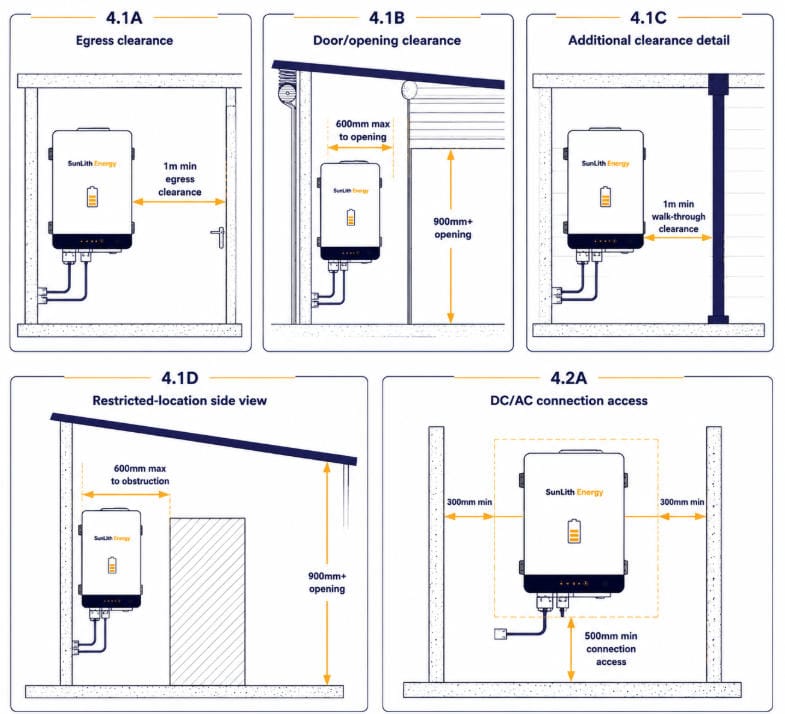
The amendment replaces the old typical BESS installation diagrams with five new figures. First, Figure 4.1A covers egress clearance in a corridor, hallway, or lobby. Then Figure 4.1B covers clearance to doors and openings. Also, Figure 4.1C adds further detail to the clearance picture. Figure 4.1D shows a side-view diagram of clearance from restricted locations, with the familiar 600mm front clearance and 900mm above-battery clearance both drawn out. Finally, Figure 4.2A covers clearances for battery connection access, split by whether the connection is DC or AC.
One structural cleanup came along with the new figures. Also, the standard used to repeat similar diagrams in Section 5. So the amendment removes that duplication. Section 5 now just refers back to the Section 4 figures instead of reprinting them.
The Garage Door Exception — Clause 4.2.2.2
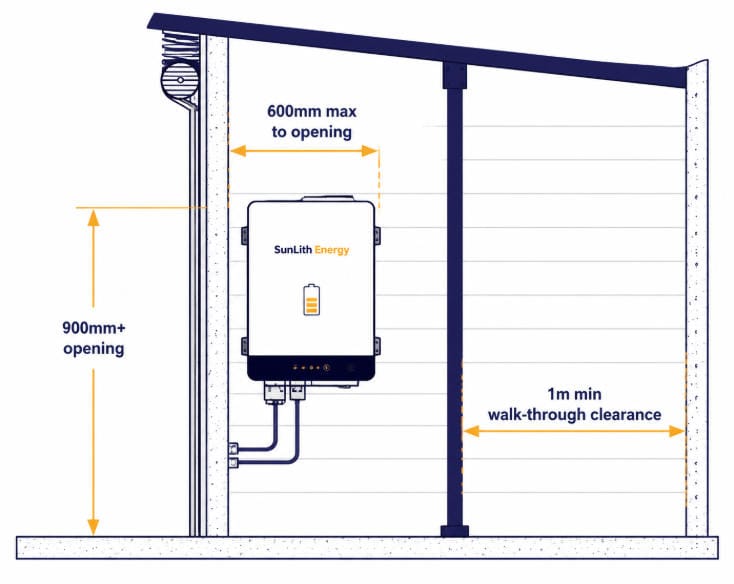
The most talked-about change is a new exception for garage installations. Under the amended Clause 4.2.2.2, a battery can now sit within 600mm of an opening wider than 900mm — a typical garage door, in other words — as long as the opening still allows sufficient clearance for safe egress, and the clearance is no less than 1m from any front or side a person might need to pass through during an exit.
This matters because garages are the preferred spot for a lot of installers. They’re usually not living spaces, they’re weather-protected, often shaded, and close to the switchboard. But the old blanket 600mm rule ruled out a lot of good garage walls, just because of a wide roller door. The amendment keeps the safety goal in place. People still need a safe way out. It just stops punishing a battery for sitting near a large opening when someone could still walk past it safely.
In practice, this means a designer needs two numbers, not one. The first is the 600mm distance to the opening itself. The second is the 1m clearance from whichever front or side edge a person would need to pass. So both conditions have to hold at the same time. A wide garage door with a wall corner narrowing the walk-through space to less than a metre still fails, even if the 600mm figure looks fine on a drawing.
Worked Example
A garage has a 2.4m-wide roller door. The nearest wall section suitable for a battery sits 500mm from the door opening. Under the amended clause, 500mm is within the 600mm allowance, and the door is well over the 900mm width threshold. So far, this passes. But the same wall has a support post 800mm from the door edge, narrowing the usable walk-through space to 800mm at that point. Since 800mm is under the 1m minimum clearance the amendment also requires, this specific layout still fails — even though the headline 600mm number looks fine. Moving the battery, or resolving the post clearance, is the fix.
Inverters as Associated Appliances
The amendment also reclassifies inverters. Power conversion equipment now counts as an associated appliance. So it can go inside a restricted location, where it couldn’t before. That’s a useful change for compact installs, where wall space near the battery is already tight.
Fire Barrier and Overcurrent Protection Changes
Fire barrier requirements moved the other way. Stricter, not looser. So exempt materials used as a barrier to a habitable room now need a minimum thickness of 6mm. Also, building materials within 1 metre of a battery system classed as a chemical hazard pick up new requirements.
Paralleled pre-assembled battery systems get a new rule for overcurrent protection. The protective device’s kA rating now has to cover the combined fault current of every paralleled unit, not just the biggest one. That’s a real change for multi-unit homes and light commercial jobs. Two or three battery modules often get paralleled to hit a target capacity.
To make that calculation possible, the amendment adds Appendix I. It sets out the method for calculating cell short-circuit current within a battery system. So that’s the number a designer needs before sizing the paralleled OCPD correctly. This connects directly to broader short-circuit protection design work on the DC side of a BESS installation. This connects directly to broader short-circuit protection design work on the DC side of a BESS installation.
Safety Data Sheet Requirements
Safety Data Sheet handling picked up a clarification too. A physical copy of the SDS must be provided on site. It also has to stay protected from damage or degradation. The standard specifically mentions storing it in a sealed, durable, clear pouch as an acceptable method. So treat SDS storage as part of the handover package, not an afterthought bolted on at final inspection.
Background: Restricted Locations Under AS/NZS 5139
It helps to know what this amendment did NOT change. The base restricted-location rules still apply. Batteries still can’t sit within 600mm of an exit, a window edge, a vent into a living room, or an appliance. They still can’t sit within 900mm below any of those. Ceiling spaces, wall cavities, roofs, stairways, walkways, escape routes, and living rooms themselves are still off-limits. The ERAC Battery Energy Storage System Guideline backs up these same rules. None of this changed. The amendment only added the wide-opening exception above, plus the inverter reclassification.
Restricted Locations — Unchanged by Amendment 1
- Within 600mm of any exit or entry
- Within 600mm of any window’s vertical side, or a ventilation opening into a habitable room
- In an evacuation or designated escape route
- Within 600mm of any appliance
- Within 900mm below any of the items above
- In ceiling spaces or wall cavities
- On roofs
- Under stairways or access walkways
- Within a habitable room itself
AS/NZS 5139 Amendment 1 Compliance Checklist
- Confirm the installation drawings use Clause 1.3’s updated terminology, including the new battery energy storage system room definition.
- Check clearance layouts against the new Figures 4.1A–4.2A, not the pre-amendment diagrams.
- If relying on the garage-door exception, verify both the 600mm opening distance AND the 1m walk-through clearance — not just one of them.
- Confirm inverter placement against the updated associated-appliance classification if it sits in a restricted location.
- Check fire-barrier materials meet the 6mm minimum thickness where used as exempt materials.
- For paralleled pre-assembled battery systems, recalculate the OCPD kA rating against the combined fault current using Appendix I.
- Confirm a physical SDS copy is on site and stored in a protective pouch before handover.
- Verify your state’s specific compliance timeline before telling a client the installation is (or isn’t) required to meet Amendment 1 yet.
Frequently Asked Questions
When did AS/NZS 5139 Amendment 1 take effect?
It was published on 19 December 2025. NSW treats it as mandatory immediately. Western Australia requires full compliance from 19 June 2026, after a six-month transition period. Confirm the position in your own state before quoting a date.
What is the garage door exception under this amendment?
Under the amended Clause 4.2.2.2, a battery can be installed within 600mm of an opening wider than 900mm — such as a garage door — provided safe egress is maintained and clearance is no less than 1m from any front or side a person might need to pass through.
Does this amendment change where inverters can be installed?
Yes. Power conversion equipment is now classified as an associated appliance, which means it can be installed inside a restricted location where it previously couldn’t.
What is Appendix I, and what does it calculate?
Appendix I is a new addition that sets out how to calculate cell short-circuit current within a battery system. It’s needed to correctly size overcurrent protection for paralleled pre-assembled battery systems under the amendment’s new kA rating requirement.
Do the pre-existing restricted-location rules still apply under Amendment 1?
Yes, unchanged. Batteries still can’t be installed within 600mm of exits, windows, ventilation openings, or appliances, within 900mm below those items, or in ceiling spaces, wall cavities, roofs, under stairways, escape routes, or habitable rooms. Amendment 1 only added the specific wide-opening exception and the inverter reclassification — it didn’t touch the base restricted-location list.
Further Reading
Australia’s New Battery Rules: The 2026 Compliance Stack
Australia has new battery rules for 2026, and they arrived from three different directions at once. Between August 2025 and December 2025, regulators updated the inverter standard, the battery safety standard, and the cable selection standard. Two of them landed on the very same day. So anyone installing, supplying, or specifying a BESS in Australia now answers to all three of these new battery rules. Miss one, and the other two won’t save the project.
| Quick Answer Australia’s new battery rules for 2026 span three standards. AS/NZS 5139:2019 Amendment 1 (published 19 Dec 2025) covers battery system safety. AS/NZS 4777.2:2020 Amendment 2 (mandatory from 23 Aug 2025) governs inverter performance and grid behaviour. AS/NZS 3008.1.1:2025 (also published 19 Dec 2025) sets cable selection and DC ratings. In Western Australia, full compliance with both the 5139 and 3008.1.1 updates is required from 19 June 2026, following a six-month transition period — other states administer their own timelines. A compliant BESS install needs all three standards, and a battery’s international product certifications (IEC 62619, UL 1973, UN38.3) do not substitute for any of them. |
What Are Australia’s New Battery Rules?
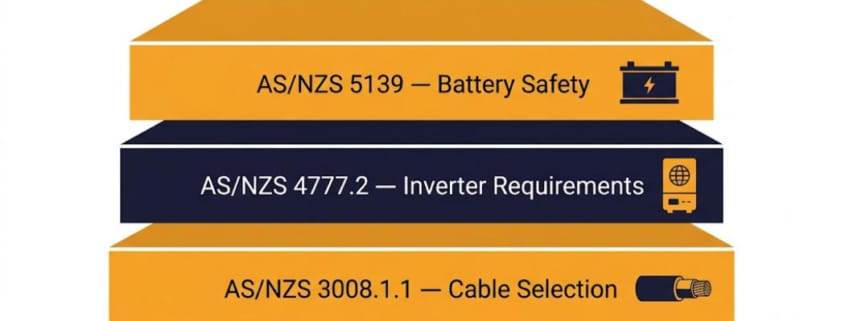
Together, Australia’s new battery rules form what’s best understood as a compliance stack, not three unrelated updates. A battery energy storage system never sits under a single rulebook. Instead, it sits at the intersection of three. AS/NZS 5139 governs how the battery gets installed, ventilated, and protected. AS/NZS 4777.2 governs how the inverter behaves once it talks to the grid. AS/NZS 3008.1.1 governs every cable that connects the two. So a design can pass one standard and still fail the job. Also, it only takes one missed layer to cause it.
It’s also worth separating two things international suppliers often conflate. So battery product certification and Australian installation compliance are not the same thing. A cell or module can carry IEC 62619, UL 1973, and UN38.3 certification and still fail an Australian project if the installation, inverter, or cable design doesn’t separately satisfy the three standards below.
This page works as a living hub, not a one-time post, since Australia’s new battery rules will keep changing. Also, each standard below links out to its own detailed guide as those go live. As amendments publish, this hub updates first, then the change log at the bottom records exactly what moved and when. Bookmark this page, not a single standard’s guide — the compliance stack shifts as a set, not one piece at a time.
Australia’s New Battery Rules: Compliance Stack Overview
The table below summarises where each standard sits today. Full detail on each one follows in its own section, and a dedicated guide for each standard is in progress.
| Standard | Governs | Published | Mandatory From | Administered By |
| AS/NZS 5139:2019 | Battery system and BESS installation safety | Amendment 1: 19 Dec 2025 | Immediate in NSW; full compliance from 19 Jun 2026 in WA (6-month transition) — confirm with your state regulator | Standards Australia / Standards NZ; state electrical safety regulators |
| AS/NZS 4777.2:2020 | Grid-connect inverter performance | Amendment 2: Aug 2024 | 23 Aug 2025 | Standards Australia / Standards NZ; Clean Energy Council; DNSPs |
| AS/NZS 3008.1.1 | Cable selection, current-carrying capacity, DC ratings to 1500V | 2025 edition: 19 Dec 2025 | Full compliance from 19 Jun 2026 in WA (6-month transition); NZ 2017 edition withdrawal ~Nov 2026 | Standards Australia / Standards NZ |
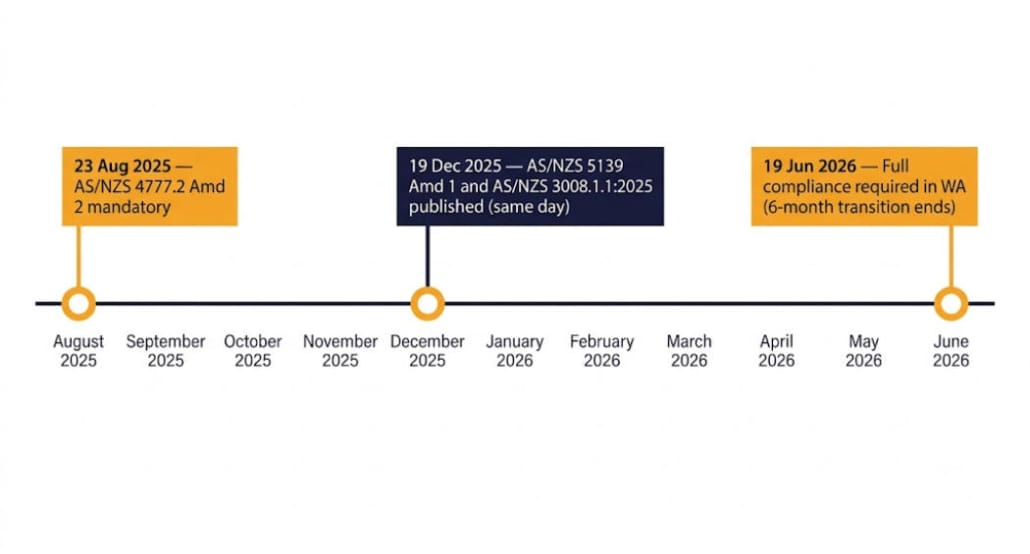
Note on dates: AS/NZS 5139 Amendment 1 and AS/NZS 3008.1.1:2025 were both published on 19 December 2025, not on separate dates. Mandatory compliance timing varies by state; Western Australia’s Building and Energy division has published the clearest specific deadline (19 June 2026, after a six-month dual-acceptance period), while NSW guidance describes the 5139 update as mandatory immediately on publication. Confirm the position in your specific state before quoting a date to a client.
Australia’s New Battery Rules, Part 1: AS/NZS 5139:2019 Amendment 1 — Battery System Safety
Amendment 1 to AS/NZS 5139:2019 was published on 19 December 2025. The NSW Building Commission confirms that a battery installation failing to meet the updated requirements no longer complies with the Standard in NSW.
Western Australia’s Building and Energy division has set a specific full-compliance date: 19 June 2026. That follows a six-month transition period, during which both the 2019 base standard and the amended version are acceptable.
So the amendment touches definitions, installation diagrams, clearances, overcurrent protection, and safety documentation.
What Changed in Amendment 1
Several changes matter for day-to-day design work. First, Clause 1.3 introduces new and updated definitions. So terminology used on drawings needs a fresh check. Also, the typical BESS installation diagrams were revised — new figures 4.1A through 4.2A cover egress clearance, door and opening clearance, and unimpeded access to a pre-assembled integrated BESS.
Location, Fire Barriers, and Overcurrent Protection
Still, location rules loosened in one specific way. A battery system may now sit within 600mm of an opening, provided that opening is wider than 900mm, such as a garage door. Inverters are also now treated as an associated appliance, and are permitted inside a restricted location, which they previously were not.
Fire-barrier requirements got stricter instead. So exempt materials used as a barrier to a habitable room must now be at least 6mm thick. Building materials within 1 metre of a battery system classed as a chemical hazard also face new requirements.
Also, overcurrent protection for paralleled pre-assembled battery systems changed. The protection device’s kA rating must now match or exceed the combined fault current of every paralleled battery system, not just one. So a new Appendix I sets out how to calculate that cell short-circuit current. This pairs directly with existing short-circuit protection design work on the DC side of the system.
Safety Data Sheets
Safety Data Sheet handling was clarified too. A physical copy must stay on site, protected from damage — for example inside a sealed, durable, clear pouch. Installers should treat SDS storage as part of the handover package, not an afterthought.
AS/NZS 5139 Compliance Checklist for BESS Suppliers and Installers
- Battery enclosure design meets updated location and clearance rules
- Installation clearances reflect revised figures 4.1A–4.2A
- Fire protection strategy accounts for the 6mm minimum barrier thickness
- Overcurrent protection kA rating is calculated against combined paralleled fault current (Appendix I)
- Safety Data Sheets are on-site in a protective pouch
- Installation manuals and terminology match Clause 1.3 definitions
- Maintenance and emergency access procedures documented
Full guide: AS/NZS 5139 Battery Safety Standard — Amendment 1 Explained
Australia’s New Battery Rules, Part 2: AS/NZS 4777.2:2020 Amendment 2 — Inverter Requirements
AS/NZS 4777.2:2020 Amendment 2 governs how grid-connect inverters behave once installed. It is the second of the three new rules. Standards Australia released it in August 2024, then set a 12-month transition period. Full compliance became mandatory from 23 August 2025. So it now applies to every new low-voltage grid-connect inverter installation. That makes it the second pillar of the battery compliance stack.
CSIP-AUS and Smart Communication
First, the headline addition is CSIP-AUS, the Common Smart Inverter Profile for Australia. This communication protocol lets network operators manage dynamic export limits. In some cases, it also allows remote curtailment. A modern compliant inverter is built to be talked to by the grid, not just to push power onto it. The Clean Energy Council’s approved inverter list now reflects Amendment 2 as the current benchmark. Clean Energy Council’s approved inverter list now reflects Amendment 2 as the current benchmark.
What Installers Must Check
Older CEC listings did not carry over automatically. So manufacturers had to submit a declaration plus supporting evidence that their products met Amendment 2 before their listings kept standing. Installers should verify the exact model against the current CEC list — never trust a listing checked before August 2025.
Power quality settings still follow a region-based profile — Australia A, B, or C — set by the local distribution network service provider. This includes the ride-through behaviour covered in our LVRT and HVRT guide. This includes the ride-through behaviour covered in our LVRT and HVRT guide.
EV and V2G Provisions
Next, the amendment adds requirements supporting vehicle-to-grid and vehicle-to-building inverters. So bidirectional EV charging now shares the same grid-connect framework as solar and battery inverters. See our PCS overvoltage protection guide for how these settings interact with anti-islanding and ride-through coordination.
AS/NZS 4777.2 Compliance Checklist
- CEC approval status confirmed against the current list, not a pre-Aug-2025 listing
- Correct firmware version installed
- Grid protection settings match the DNSP’s region profile (A, B, or C)
- Anti-islanding function verified
- Export control compatibility confirmed
- CSIP-AUS capability documented
- LVRT/HVRT settings verified against ride-through requirements
Full guide: AS/NZS 4777.2 Amendment 2: What Changed for Inverter Requirements
Australia’s New Battery Rules, Part 3: AS/NZS 3008.1.1:2025 — Cable Selection
AS/NZS 3008.1.1:2025 is the third of Australia’s new battery rules. It replaces the 2017 edition that governed cable selection for eight years. Standards Australia published the new edition on 19 December 2025. That’s the same day as AS/NZS 5139 Amendment 1, not late 2024 as some secondary sources report. Both editions currently remain valid during the transition. In Western Australia, full compliance with the 2025 edition is required from 19 June 2026. This is the third and final pillar of the battery compliance stack.
New 1500V DC Cable Ratings
So the most significant scope change is new DC cable rating provisions up to 1500 volts. The 2017 edition barely covered DC circuits above 1000 volts. That left utility-scale solar strings and BESS rack-to-inverter cabling without a proper rating table. So the 2025 edition adds explicit current-rating tables for single-core DC cables, plus new provisions for DC fast-charger cabling. These new tables are already referenced alongside the DC specifications in our Understanding BESS Specifications guide.
Revised Grouping and Soil Derating Factors
Also, grouping and soil derating factors tightened. Cables on unperforated trays now carry lower derating factors than before. A six-circuit run on a solid tray, for instance, drops from a factor of 0.73 to 0.68. So that can push a cable size up a full commercial step. A new “very dry soil” row now covers desert and remote mining conditions the 2017 tables never addressed.
Transition Timeline
New Zealand runs its own transition clock. Still, the 2025 edition became available there at the same time as in Australia. But the 2017 edition is expected to be formally withdrawn around November 2026, once the standard 24-month transition period closes. Western Australia’s Building and Energy division confirms that both AS/NZS 5139 Amd 1:2025 and AS/NZS 3008.1.1:2025 were published 19 December 2025, with full compliance required from 19 June 2026 following a six-month period in which either edition is acceptable.
AS/NZS 3008.1.1 Compliance Checklist
- Cable voltage rating confirmed for the full DC operating window (up to 1500V where applicable)
- Maximum operating current calculated against the 2025 tables
- Short-circuit withstand capability checked against combined fault current
- Grouping and derating factors recalculated for unperforated trays with six or more circuits
- Soil thermal resistivity checked for underground runs, including the new “very dry soil” category
- Voltage drop calculation completed for the full cable run
Full guide: AS/NZS 3008.1.1:2025: What Changed for Cable Selection
Battery Product Certification vs. Australian Installation Compliance
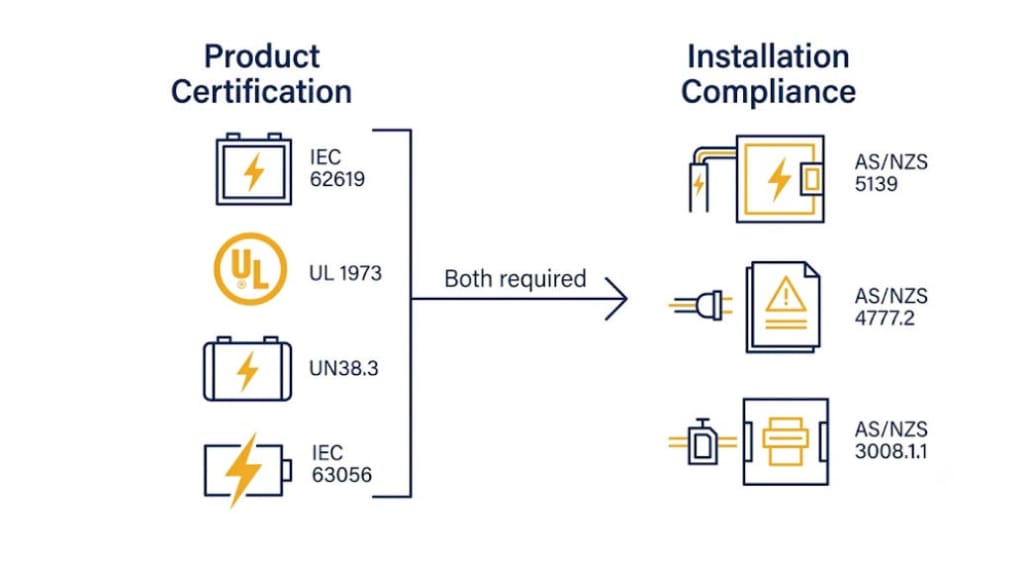
One misunderstanding shows up often among international BESS suppliers. Often, they assume battery product certification alone satisfies Australia’s new battery rules and allows market entry. It doesn’t. A battery module can pass every relevant international safety test and still fail an Australian project. That happens whenever the installation, inverter, or cable design doesn’t separately satisfy AS/NZS 5139, AS/NZS 4777.2, and AS/NZS 3008.1.1. So product certification and installation compliance are different regulatory layers, and both are required.
Common Battery Product Certifications Referenced in Australian BESS Projects
| Certification | What It Covers | Typical Use |
| IEC 62619 | Industrial lithium-ion battery safety: electrical abuse protection, thermal safety, operational reliability | Commercial and industrial BESS, telecom energy storage |
| UL 1973 | Stationary battery safety at module, rack, and system level | Utility-scale and North American-influenced BESS specifications |
| UN38.3 | Transport safety: altitude, temperature, vibration, shock, short-circuit, and overcharge testing | Required before any international lithium battery shipment |
| IEC 63056 | Secondary lithium battery safety for stationary energy storage applications | Residential and commercial ESS, increasingly requested alongside IEC 62619 |
For a full breakdown of these certifications — what each one tests, who issues it, and typical cost and timeline — see our complete BESS Certifications Guide.
So none of these substitute for AS/NZS 5139 installation compliance, AS/NZS 4777.2 inverter or CEC approval, or AS/NZS 3008.1.1 cable design. For suppliers planning an Australian entry, compliance needs to be considered during BESS design. Enclosure layout, protection settings, and documentation format all belong at the design stage. None of it works well retrofitted after manufacturing is locked in.
How Australia’s New Battery Rules Work Together on One Job
These three standards do not operate in isolation on a real job. Take a paralleled battery system as an example, since it shows how Australia’s new battery rules stack on top of one another. First, AS/NZS 5139 Amendment 1 sets the required kA rating for its overcurrent protection device, based on the combined fault current. Then that same fault current drives the short-circuit withstand check on the DC cable under AS/NZS 3008.1.1. Meanwhile, the inverter tying it all to the grid still needs a valid CEC listing under AS/NZS 4777.2 Amendment 2. Miss any one layer, and the other two will not save the design.
So treat the battery compliance stack as one system, not three separate checklists. A designer who only checks the inverter datasheet will eventually hit a cable run that neither standard alone was built to catch. The same goes for a designer who only checks enclosure clearances. Check all three, every time — and check that the underlying battery product certification is in place before any of it matters.
Change Log — Australia’s New Battery Rules Hub
| Date | Version | Update |
|---|---|---|
| 26 Jul 2026 | v1.0 | Initial publication covering AS/NZS 5139 Amendment 1, AS/NZS 4777.2 Amendment 2, and AS/NZS 3008.1.1:2025. |
| 26 Jul 2026 | v2.0 | Corrected the AS/NZS 3008.1.1:2025 publication date to 19 December 2025. Added Western Australia’s specific 19 June 2026 compliance date. Added a new section comparing battery product certification (IEC 62619, UL 1973, UN38.3) with Australian installation compliance. |
| 26 Jul 2026 | v3.0 | Updated the page framing to lead with “Australia’s new battery rules” for clarity. |
| 26 Jul 2026 | v3.1 | Finalised page details ahead of publishing. |
| 28 Jul 2026 | v3.2 | Published all three detailed guides — AS/NZS 5139 Amendment 1, AS/NZS 4777.2 Amendment 2, and AS/NZS 3008.1.1:2025 — and linked them from their respective sections above. |
Australia’s New Battery Rules Checklist for 2026
- Confirm every new BESS design references AS/NZS 5139:2019 including Amendment 1, and check your state’s specific enforcement timeline.
- Check the inverter model against the current CEC approved list for AS/NZS 4777.2:2020 Amendment 2 compliance — a pre-amendment listing did not carry over automatically.
- Specify cable sizing to AS/NZS 3008.1.1:2025 for new designs, even during the transition period.
- Recalculate DC cable sizes on unperforated trays with six or more circuits — the 2025 grouping factors are more conservative.
- Confirm battery product certifications (IEC 62619, UL 1973, UN38.3, IEC 63056 as applicable) are current, and don’t treat them as a substitute for the three installation standards above.
- Revisit this hub whenever an amendment publishes — the battery compliance stack changes faster than most single-standard guides track.
Frequently Asked Questions
What are Australia’s new battery rules?
It’s the combination of standards required for a compliant BESS installation in Australia: AS/NZS 5139 for battery system safety, AS/NZS 4777.2 for inverter/grid-connect performance, and AS/NZS 3008.1.1 for cable selection. A project needs all three — passing one doesn’t clear the others.
When did AS/NZS 5139 Amendment 1 and AS/NZS 3008.1.1:2025 take effect?
Both were published on 19 December 2025. NSW guidance treats the 5139 update as mandatory immediately on publication. Western Australia’s Building and Energy division has set 19 June 2026 as the date full compliance is required for both standards, following a six-month transition period. Confirm the position with your specific state regulator, since implementation timing is not uniform nationally.
Does every battery inverter need CEC approval in Australia?
Grid-connected inverters used in eligible Australian installations generally require approval through the Clean Energy Council’s approved inverter list, and that listing must reflect AS/NZS 4777.2 Amendment 2 compliance specifically — pre-August-2025 listings did not carry over automatically.
Are IEC 62619 or UL 1973-certified batteries automatically approved for use in Australia?
No. These certifications demonstrate battery product safety, but the complete BESS system still needs to separately satisfy AS/NZS 5139 installation compliance, AS/NZS 4777.2 inverter compliance, and AS/NZS 3008.1.1 cable design compliance.
What standard covers BESS cable sizing in Australia?
AS/NZS 3008.1.1:2025 provides current-carrying capacity, voltage drop, and derating guidance for AC and DC cables, including the new tables for DC systems up to 1500V introduced in the 2025 edition.
Further Reading
- Changes to the Battery Standard — NSW Government
- Updated Electrical Installation Standards for Battery Systems and Cable Selection — WA Government (Building and Energy)
- AS/NZS 4777.2 Inverter Standards Change — Clean Energy Council
- AS/NZS 3008.1.1:2025 Updates for Solar Cable Design — GSES
- AS/NZS 5139:2019 (incorporating Amendment 1) — Standards Australia Store
- BESS Short Circuit Protection
- PCS Overvoltage Protection
- LVRT and HVRT Ride-Through
- Understanding BESS Specifications
- VEU Rebate for Victoria: What the Program Actually Covers in 2026