Battery Energy Storage Systems (BESS) are rapidly becoming a foundation of modern power grids, enabling renewable energy integration, peak shaving, and grid resilience. As BESS installations grow in size and density, safety and regulatory compliance have emerged as top priorities for utilities, regulators, insurers, and project developers worldwide.
BESS safety and compliance ensure that battery energy storage systems operate safely across design, testing, installation, and operation. Key requirements include UL 9540 certification, UL 9540A thermal runaway testing, NFPA 855 installation compliance, IEC battery safety standards, certified battery management systems (BMS), and integrated fire detection and suppression systems.
High-energy lithium battery systems introduce unique fire, thermal, and electrical risks. Without strict adherence to international safety standards, these risks can impact public safety, project approvals, insurance coverage, and long-term asset reliability. As a result, BESS safety and compliance now determine whether a project is bankable, insurable, and scalable.
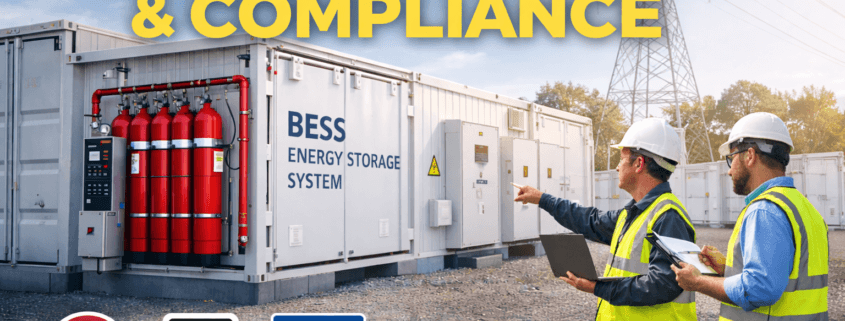
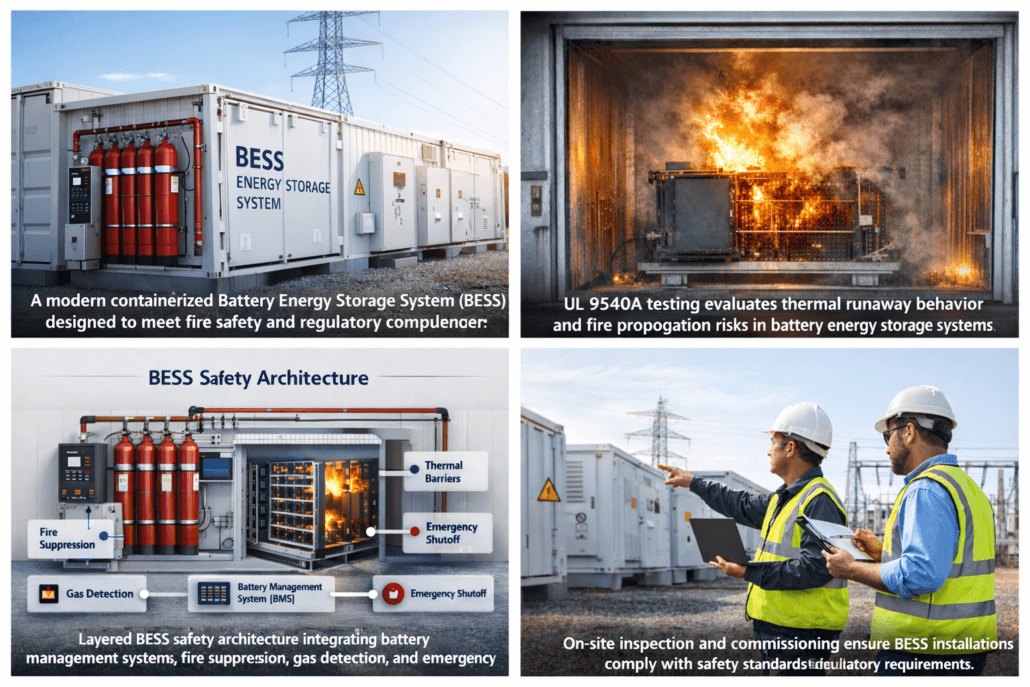
A visual overview of BESS safety and compliance, including containerized energy storage with fire suppression, UL 9540A thermal runaway testing, layered safety architecture, and on-site inspection and commissioning.
This combined visual represents the complete BESS safety lifecycle—from compliant system design and fire testing to real-world inspection and commissioning—making it ideal for Google Discover and AI answer engines.
Why BESS Safety and Compliance Matter
BESS safety directly affects people, infrastructure, and grid reliability. A single failure can result in fire incidents, forced shutdowns, regulatory penalties, or long-term reputational damage.
Compliance is essential for:
Utility interconnection approvals
Local Authority Having Jurisdiction (AHJ) permits
Insurance underwriting and project financing
Long-term operational reliability
Safety requirements also vary by system type and application. This is why understanding the difference between BESS and ESS is critical when designing systems that meet regulatory and fire-code expectations.
Why BESS Safety Is a Growing Global Concern
Battery safety incidents and tighter fire codes have prompted regulators and utilities to reassess how energy storage systems are designed, tested, and installed. Authorities now require higher levels of third-party certification, fire-risk analysis, and documented mitigation strategies.
At the same time, insurers and financiers increasingly demand proof of UL, IEC, and NFPA compliance before underwriting large-scale projects. As global energy storage capacity expands, safety compliance has become a gating factor for market growth, not just a technical requirement.
Key Safety Risks in Battery Energy Storage Systems
Thermal Runaway
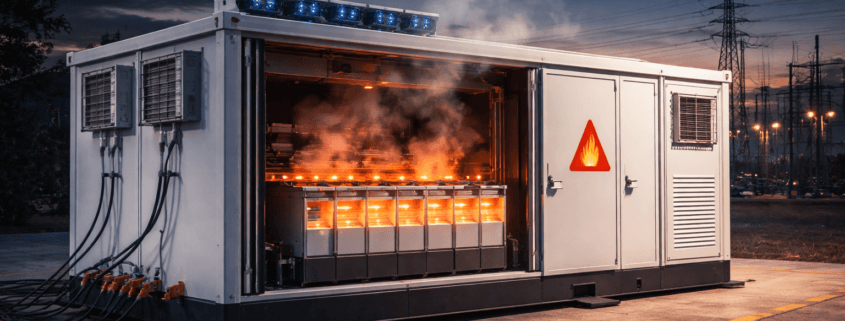
Thermal runaway occurs when a battery cell overheats uncontrollably, potentially triggering fire or explosion. It remains the most significant risk in lithium-based BESS installations.
Electrical Hazards
High-voltage DC systems introduce shock and arc-flash risks during installation, operation, and maintenance.
Fire Propagation
Without proper spacing, barriers, and suppression systems, a single cell failure can spread rapidly across modules and racks.
Gas Emissions
Battery failures may release toxic or flammable gases, making gas detection and ventilation critical safety measures.
Core BESS Safety Standards and Compliance Frameworks
UL Certifications for BESS (North America)
UL 9540 – System-level safety certification for BESS
UL 9540A – Thermal runaway and fire propagation testing
UL 1973 – Safety standard for stationary battery modules
UL 9540 certification is often mandatory for commercial and utility-scale BESS projects.
NFPA 855 – Installation and Fire Safety Code
NFPA 855 governs:
System spacing and layout
Fire detection and suppression systems
Ventilation and exhaust requirements
Emergency response planning
It is widely enforced by fire departments and building authorities.
IEC Standards for Global BESS Projects
IEC 62619 – Safety requirements for industrial lithium batteries
IEC 62933 series – Energy storage system safety and performance
IEC standards support compliance across Europe, Asia, and international markets.
Fire Protection and Risk Mitigation in BESS
Battery Management Systems (BMS)
A certified BMS monitors voltage, temperature, state of charge, and fault conditions to prevent unsafe operation.
Fire Detection and Suppression
Modern BESS designs integrate smoke and gas detection, clean-agent or aerosol suppression, and compartmentalized enclosures.
Thermal and Mechanical Design
Thermal barriers, flame-retardant materials, and seismic reinforcement help contain failures and protect surrounding assets.
Grounding, fire system validation, safety signage, and Site Acceptance Testing (SAT) confirm readiness for operation.
Operation and Maintenance
Remote monitoring, routine inspections, and BMS updates maintain long-term compliance and reliability.
How Sunlith Energy Ensures BESS Safety and Compliance
Drawing on hands-on experience across commercial, industrial, and utility-scale projects, Sunlith Energy designs and supplies compliant Battery Energy Storage Systems aligned with UL, IEC, and NFPA safety frameworks.
Our approach includes:
Compliance-driven system engineering
Integrated fire protection design
Multi-stage quality inspections
Application-specific regulatory planning
Learn more about our battery energy storage solutions at Sunlith Energy.
Key Takeaways: BESS Safety and Compliance
BESS safety addresses thermal, electrical, and fire risks
Safety spans design, testing, installation, and operation
Early AHJ engagement accelerates approvals
Frequently Asked Questions (FAQ)
What is the most important BESS safety standard?
UL 9540 is the most widely required system-level safety standard in North America.
Is NFPA 855 mandatory?
It is often adopted by local jurisdictions, making it effectively mandatory.
How does UL 9540A improve safety?
It evaluates thermal runaway behavior and fire propagation risks.
Are IEC standards accepted globally?
Yes, they are recognized across Europe, Asia, and international markets.
Who is responsible for BESS safety compliance?
Manufacturers, EPCs, system integrators, and site owners share responsibility under AHJ oversight.
Final Thoughts
As energy storage adoption accelerates, BESS safety and compliance are no longer optional. They define project approval, insurability, and long-term success. By aligning with recognized global standards and proven safety engineering, organizations can deploy battery energy storage systems with confidence and resilience.
The UL 9540A Test Method is the only national standard that measures how thermal runaway fire spreads inside a battery energy storage system. It covers everything from a single cell all the way to a full real-world installation.
Most U.S. states require this test. Both NFPA 855 and the International Fire Code reference it directly. Without UL 9540A test data, large BESS projects simply cannot receive AHJ approval.
This guide covers everything you need:
What UL 9540A tests and why it matters
All 4 test levels with pass/fail criteria
Real costs, timelines, and lab selection tips
Every change in the 2025 Fifth Edition
How UL 9540A connects to UL 9540 certification
Who needs it and exactly when
WWhat is the UL 9540A Test Method?
The UL 9540A Test Method — formally titled “Standard for Evaluating Thermal Runaway Fire Propagation in Battery Energy Storage Systems” — measures specifically how a battery fire behaves once it starts.
Most safety certifications cover general equipment performance. This standard, however, focuses purely on fire propagation. In other words, it answers one critical question: will a failure in one cell, module, or unit spread to the rest of the system?
That narrow focus makes it the go-to reference for engineers, installers, and Authorities Having Jurisdiction (AHJs) across the United States. According to UL Solutions, the standard is widely adopted because it provides reproducible, science-based data that fire authorities can consistently apply across different projects and jurisdictions.
The standard answers three specific safety questions:
Cell propagation — whether thermal runaway in a single cell spreads to adjacent cells or the full module
Fire behaviour — how a battery module or full ESS unit reacts during a fire, including flame height, gas release, and heat output
Suppression effectiveness — whether built-in or external fire suppression systems can prevent explosion, deflagration, or reignition
No other national standard addresses all three at once.
BESS installations — whether residential, commercial, or utility-scale — fall under NFPA 855 and the International Fire Code in most U.S. states. Both codes reference the UL 9540A Test Method directly as the required fire safety test for stationary energy storage systems. Moreover, the National Fire Protection Association updates NFPA 855 regularly to reflect new battery technologies and installation environments.
This standard ensures three important things for the industry:
Manufacturers can prove their systems are safe using science-based, reproducible test data
Installers receive clear installation parameters — separation distances, suppression specifications, and ventilation requirements — all derived directly from test results
Authorities Having Jurisdiction gain a reliable, nationally recognised safety benchmark for permit reviews
Without UL 9540A test data, a BESS product cannot be permitted in most U.S. commercial, industrial, or utility-scale projects. Therefore, it is not simply a competitive advantage — it is the entry ticket to the market.
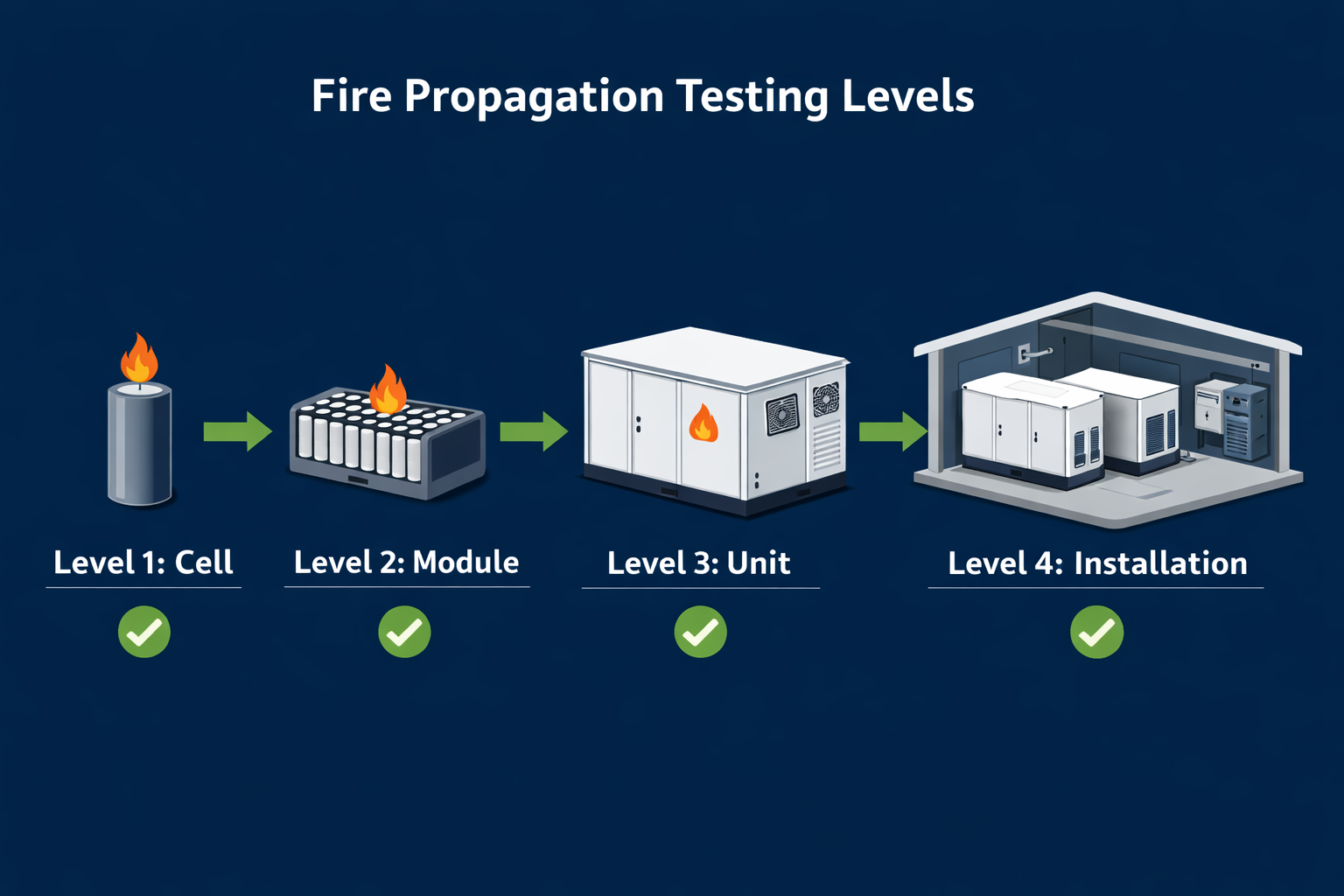
UL 9540A four-level test hierarchy cell module unit and installation level
The UL 9540A Test Method uses a hierarchical four-level structure. Testing stops at the earliest level where no fire propagation is detected. As a result, not every product needs all four levels. This can significantly reduce cost and time for manufacturers whose chemistry performs well at cell or module level.
Level 1: Cell-Level Testing
Cell-level testing is where every UL 9540A program begins. A heater strip or nail penetration forces thermal runaway in a single cell while sensors record what happens next.
What gets measured:
Gas volume and composition, including hydrogen, CO, and CO₂
Peak heat release rate in kilowatts and total heat energy
Flame height, duration, and whether flames self-extinguish
Surface temperature of adjacent cells
Whether neighbouring cells ignite
Pass condition: Adjacent cells do not reach thermal runaway. When no propagation is detected, the test program stops here. Consequently, the manufacturer receives cell-level data and can move toward UL 9540 certification without module or unit testing.
What triggers escalation: If heat or gas from the first cell causes a second cell to enter thermal runaway, testing moves to Level 2.
Chemistry guidance: Most modern LiFePO₄ (LFP) cells pass at this stage because of their inherently stable chemistry and lower heat release. NMC and NCA chemistries, on the other hand, release significantly more heat and gas. Therefore, they are more likely to escalate to Level 2.
When cell-level testing shows propagation risk, the UL 9540A program moves to the module — a group of cells assembled exactly as they appear in a real BESS product. The same thermal runaway trigger applies to a single cell inside the fully assembled module.
What gets measured:
Whether thermal runaway spreads from the triggered cell to all other cells
Gas volume and composition vented from the full module
Flame spread across the module casing
Peak and sustained temperature of the module exterior
Whether the module casing ignites or deforms
Pass condition: Thermal runaway does not spread beyond the module boundary. Furthermore, the casing contains the event without external flaming or structural failure. When this condition is met, the manufacturer holds module-level data and can define safe installation spacing without moving to unit-level testing.
What triggers escalation: Flames, heat, or gas that could ignite an adjacent module in a real installation will push testing to Level 3.
Design insight: Module-level testing frequently reveals weaknesses in cell spacing, busbar design, and casing vent placement. For this reason, many manufacturers make design changes after Level 2 results before spending money on unit and installation tests.
At Level 3, the complete battery system — exactly as it would ship to a customer — undergoes testing. This includes battery modules, BMS, thermal management components, enclosure, and all internal wiring. Importantly, suppression systems are typically disabled at this level unless they are permanently integrated and cannot be removed.
What gets measured:
Whether thermal runaway spreads from the triggered module to other modules
Total gas volume vented from the enclosure
Explosion and deflagration risk from accumulated vented gases
Flame spread across the enclosure exterior
Peak temperatures on all external surfaces
Structural integrity of the enclosure after the event
Pass condition: No sustained external flaming occurs. Additionally, there is no detonation or deflagration of vented gases, and the enclosure does not fail in a way that exposes people or adjacent equipment to flames or hot gas.
What triggers escalation: If the unit vents enough flammable gas to create an explosion risk, or if external surfaces reach temperatures that could ignite surrounding materials, testing proceeds to Level 4.
Why AHJs focus here: Most Authorities Having Jurisdiction review unit-level data first when evaluating a BESS permit. The unit-level report defines minimum separation distances, ventilation requirements, and suppression specifications — all of which feed directly into the installation design.
Level 4 is the most comprehensive stage of the UL 9540A Test Method. Here, the system undergoes testing exactly as it would be installed — including active fire suppression, ventilation systems, and surrounding structural elements like walls and floors. Unlike Level 3, suppression systems are fully enabled.
What gets measured:
Whether active suppression successfully controls the fire event
Explosion and deflagration of vented gases in the confined installation space
Flame spread to surrounding structural elements
Reignition within 24 hours after suppression
Gas concentration levels during and after the event
Structural integrity of the installation environment post-event
Pass condition: No detonation or deflagration occurs. The suppression system controls the event. No sustained flaming spreads to surrounding structures. Furthermore, no reignition appears during the 24-hour post-test monitoring window.
What a pass unlocks: Installation-level data is the gold standard for AHJ approvals at commercial and utility scale. In addition, it defines the exact suppression system specification — type, activation threshold, and flow rate — that must be replicated in every real-world installation.
The UL 9540A Test Method uses four sequential levels. Cell-level testing checks whether a single cell’s thermal runaway spreads. Module-level testing then examines propagation across a full battery module. Next, unit-level testing evaluates the complete ESS with suppression disabled. Finally, installation-level testing runs the complete real-world scenario with suppression fully active. Because testing stops at the earliest clean level, many manufacturers never need to reach Level 4.
UL 9540A Pass/Fail Criteria: What Does the Test Actually Measure?
A BESS system passes the UL 9540A Test Method when all of the following conditions are met during and after the induced thermal runaway event:
Criteria
Pass Condition
Fire propagation
No spread beyond the unit boundary
Detonation / deflagration
Not observed at any point
Sustained flaming
Ceases within the post-test observation window
Suppression effectiveness
Active system controls the event
Reignition
None observed 24 hours post-test
What happens on a failure? A single failed criterion requires a design modification and re-testing from that specific level — not from the beginning. Most manufacturers use the results to improve cell spacing, separator design, or suppression placement before committing to the more expensive installation-level test.
UL 9540A Test Method Costs, Timelines, and Accredited Labs
One of the first questions manufacturers ask about the UL 9540A Test Method is simple: how much does it cost and how long will it take?
Test Level
Typical Duration
Estimated Cost (USD)
Cell level
2–4 weeks
$8,000–$20,000
Module level
3–6 weeks
$15,000–$40,000
Unit level
4–8 weeks
$25,000–$60,000
Installation level
6–12 weeks
$40,000–$100,000+
Full 4-level program
3–6 months
$80,000–$200,000+
Costs vary based on system size, chemistry, and lab availability. Retesting adds time and cost at the specific level that failed.
How to Choose a UL 9540A Accredited Test Lab
Not every lab can run all four test levels. Before booking, verify these four things:
IAS or A2LA accreditation specifically covering UL 9540A scope
Physical capacity for your unit or installation test size
Experience with your battery chemistry — LFP, NMC, or sodium-ion
Hydrogen detection capability, which the Fifth Edition now requires for relevant chemistries
Well-known accredited labs include UL Solutions, Intertek, TÜV SÜD, and SGS. Importantly, the best labs book out 3–6 months in advance. Start conversations before you are ready to test, not after.
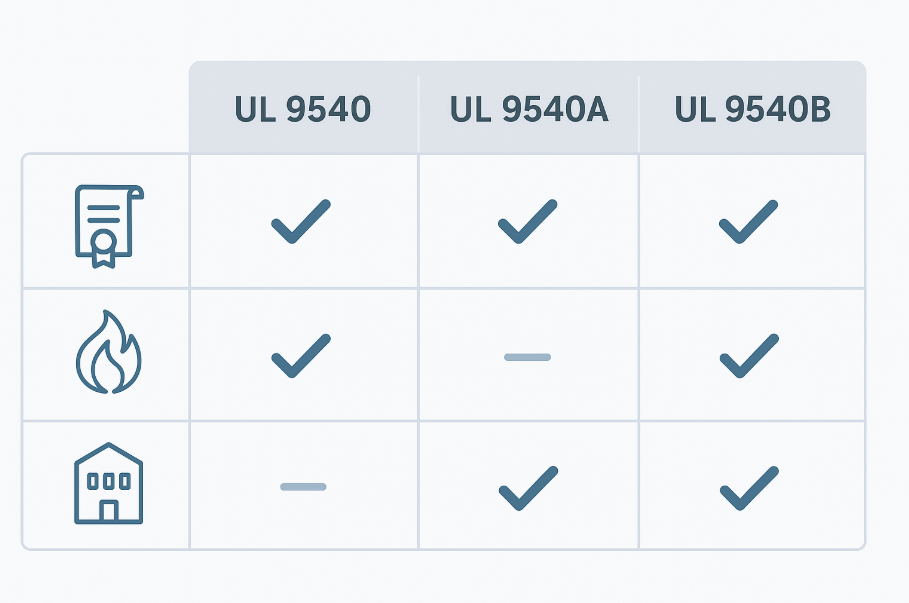
UL 9540A vs UL 9540 vs UL 9540B: Key Differences
These three standards are closely related, yet they serve very different purposes. Confusing them is one of the most common and expensive mistakes in BESS certification.
Standard
Type
Scope
Who It Applies To
UL 9540
Certification
Full ESS system safety
Manufacturers seeking UL listing
UL 9540A
Test Method
Thermal runaway fire propagation
Anyone needing AHJ / NFPA 855 compliance
UL 9540B
Test Method
Residential vent gas ignition
Home BESS installers
The critical distinction: The UL 9540A Test Method produces a test report, not a certificate. That report feeds into UL 9540 certification and satisfies NFPA 855 and IFC requirements. In practice, you can hold UL 9540A data without being UL 9540 certified. However, you cannot achieve UL 9540 certification without it.
Together, these three standards form a complete safety framework — covering fire propagation at every scale from a single residential battery to a 100 MWh grid-scale installation.
Fifth Edition (2025): What Changed and What It Means for You
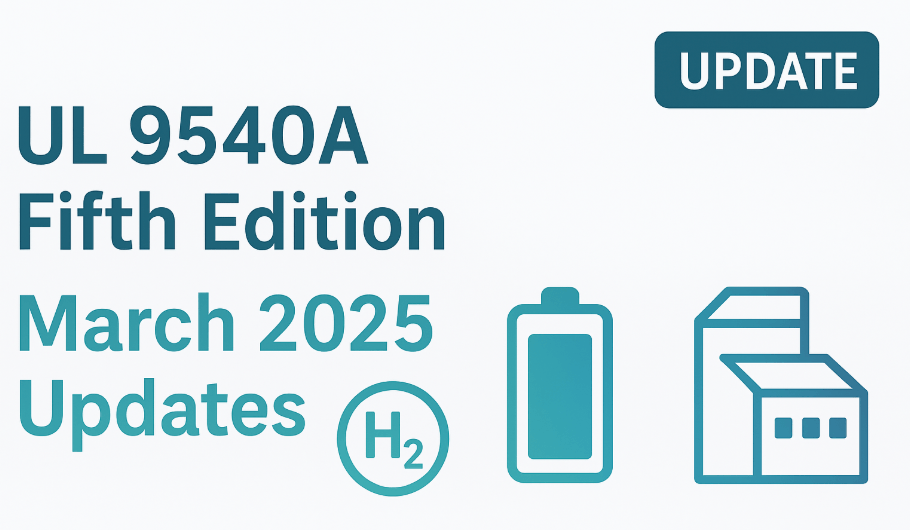
UL Solutions released the UL 9540A Test Method Fifth Edition on March 12, 2025. This update is the most significant revision since the standard’s introduction. Three forces drove the changes: rapid adoption of new battery chemistries, a surge in rooftop and residential BESS deployments, and real-world fire incidents that exposed gaps in the previous edition.
Below is every major change — and specifically what each one means in practice.
Change 1: Hydrogen Detection Protocols Now Explicitly Addressed
What changed: The Fifth Edition formally adds hydrogen sensor protocols to the test setup. Previously, hydrogen monitoring was optional and inconsistently applied across different labs.
What it means for you: If your BESS uses any chemistry that off-gasses hydrogen during thermal runaway — including lead-acid, certain NMC variants, and some older lithium chemistries — your chosen lab must now have hydrogen-rated enclosures and calibrated sensors. However, not all accredited labs have upgraded their facilities yet.
Action required: Before booking, specifically ask: “Are you equipped for hydrogen detection under the UL 9540A Fifth Edition?” Discovering this gap after scheduling typically adds several weeks to your timeline.
Change 2: Rooftop and Open Garage Installations Have Dedicated Criteria
What changed: The Fifth Edition adds specific test scenarios and pass/fail criteria for rooftop-mounted BESS and open garage installations — two of the fastest-growing deployment environments in commercial solar-plus-storage.
What it means for you: Before this update, AHJs evaluating rooftop BESS had to interpret indoor criteria and apply them to rooftop conditions, which led to inconsistent approvals. Now, if your product targets commercial rooftop projects, your UL 9540A test report must explicitly cover the rooftop installation scenario. A report based only on indoor unit-level testing will therefore not satisfy AHJ requirements for rooftop deployments.
Action required: Tell your test lab upfront that you need rooftop installation scenario data in the final report. This change affects test setup, not just documentation.
Change 3: Rest Times After Conditioning and Charging Are Clarified
What changed: The Fifth Edition specifies exact rest periods between cell conditioning, charging, and the thermal runaway trigger. Previously, labs interpreted these intervals differently, which produced inconsistent results across facilities.
What it means for you: Standardised rest times make results more reproducible and comparable across labs. If you have older UL 9540A data from before March 2025, some AHJs may request updated data under the Fifth Edition protocols. Consequently, you should confirm with your certification body whether existing reports are still accepted for new project applications.
Change 4: Thermocouple Placement Is More Precisely Defined
What changed: The Fifth Edition introduces tighter specifications for sensor placement during cell-level testing, including continuous temperature ramping rather than the stepped increments some labs previously used.
What it means for you: More precise thermocouple placement captures temperature gradients more accurately — particularly at cell edges where propagation typically begins. As a result, cell-level tests may take slightly longer to set up correctly under the new specifications.
Change 5: Module Casing Temperature Limits Are Now Specified
What changed: Previously, the standard measured casing temperature but did not define a clear pass/fail threshold. The Fifth Edition now introduces specific maximum temperature limits for module casings during Level 2 testing.
What it means for you: This change directly affects module enclosure design. If your module casing reaches the new temperature threshold, the test escalates to Level 3 regardless of whether flame propagation was observed. Manufacturers using thin-wall aluminium enclosures are most likely to be affected by this change.
Action required: Review your module casing material and wall thickness against the new thresholds before testing. Adding a ceramic fibre layer or increasing casing thickness can prevent an unexpected escalation to Level 3 — and save $25,000–$60,000 in additional testing costs.
Change 6: New Chemistries — Lead-Acid, NiCd, and Flow Batteries Now Covered
What changed: The original standard focused almost entirely on lithium-ion chemistry. In contrast, the Fifth Edition adds dedicated test protocols for lead-acid, nickel-cadmium, and flow battery systems.
What it means for you: If you manufacture or integrate non-lithium BESS technology, the Fifth Edition finally gives you a clear test roadmap. Previously, testing these chemistries required significant negotiation with both the lab and the AHJ to agree on appropriate protocols. For flow battery manufacturers in particular, this is a major development — vanadium flow and zinc-bromine systems behave fundamentally differently from lithium thermal runaway, and the Fifth Edition addresses this directly.
What changed: The Fourth Edition used an NFPA 286 fire room for residential installation-level testing. The Fifth Edition replaces this with an instrumented wall assembly, which better represents how home batteries are actually mounted — on a garage or utility room wall.
What it means for you: If you sell residential BESS products, your installation-level test setup looks different now. The instrumented wall assembly is generally less expensive to construct than a full NFPA 286 fire room. Nevertheless, if you have existing residential installation-level data from before March 2025, confirm with your certification body whether the new wall assembly requirement affects your report’s validity.
Fifth Edition Changes at a Glance
Change
Who Is Affected Most
Action Required
Hydrogen detection protocols
Lead-acid, NMC, NCA chemistries
Confirm lab has H₂-rated enclosures
Rooftop & garage criteria
Commercial rooftop solar-plus-storage
Add rooftop scenario to test scope
Clarified rest times
All manufacturers with pre-2025 data
Verify older reports still accepted
Thermocouple placement
All cell-level tests
Allow extra lab setup time
Module casing temp limits
Thin-wall aluminium enclosures
Review casing design before testing
New chemistry protocols
Lead-acid, NiCd, flow batteries
Follow chemistry-specific protocols
Residential wall assembly
Home / residential BESS products
Update installation test setup
The March 2025 UL 9540A Fifth Edition introduced seven significant changes. The most impactful changes for manufacturers are the new hydrogen detection protocols — which affect lab selection for chemistries that off-gas hydrogen — and the dedicated rooftop installation criteria, which now require a separate test scenario for any product targeting commercial rooftop solar-plus-storage. Furthermore, manufacturers with test reports issued before March 12, 2025 should confirm with their AHJ and certification body whether existing data is still accepted for new project applications.
Do You Need to Retest Under the Fifth Edition?
The answer depends on three factors.
First, check when your existing report was issued. Reports from before March 12, 2025 were conducted under the Fourth Edition. Most AHJs still accept these for projects already in the permitting pipeline. However, new applications submitted after mid-2025 increasingly require Fifth Edition data.
Second, check whether your product design has changed. Any change to cell chemistry, module configuration, casing material, or suppression system after your original test date requires a new UL 9540A test — regardless of which edition is current.
Third, confirm what your AHJ specifically requires. California, New York, and Massachusetts fire authorities have been quickest to adopt the Fifth Edition. Always verify the edition requirement directly with your AHJ before scheduling any testing.
Who Is Required to Complete UL 9540A Testing?
The UL 9540A Test Method is not optional for most BESS projects in the United States. Here is a breakdown of exactly who needs it, why, and when.
1. Battery Manufacturers
Manufacturers are the first and most critical party in the UL 9540A chain. Without cell or module level test data, no downstream party can use the product in a code-compliant installation.
Specifically, manufacturers need UL 9540A data before submitting for UL 9540 system certification, before launching any product commercially in the U.S. or Canadian markets, and whenever a significant design change occurs — whether to cell chemistry, module configuration, or enclosure design.
Real example: A South Korean LFP cell manufacturer entering the U.S. market completes cell-level testing and passes with no propagation at Level 1. Because they include the test report in their product datasheet, every integrator using their cells can reference it in permit applications — significantly shortening approval timelines for everyone downstream.
2. BESS Integrators and System Builders
Integrators who assemble cells or modules into complete ESS units need UL 9540A data at the unit level. Even when the cells inside already carry cell-level data from the manufacturer, the assembled unit must still be tested separately — because different enclosures, cell spacing, and thermal management all change how the system behaves.
The most common mistake integrators make: Many assume that their cell supplier’s cell-level data covers their assembled system. It does not. AHJs want unit-level or installation-level data for the specific product being installed — not just the cells inside it.
Real example: A U.S.-based integrator builds a 500 kWh containerised system using LFP cells with existing cell-level test data. Despite this, they still need unit-level testing on the complete container. The reason is straightforward — cell-level data does not account for how heat and gas behave inside that specific enclosure design.
3. Project Developers and EPCs
Developers and EPC firms typically do not conduct UL 9540A testing themselves. Instead, they rely on the manufacturer or integrator to provide the report. However, they remain responsible for ensuring the correct report exists and covers the specific installation scenario before permit submission.
The financial risk of missing documentation: Permit delays on utility-scale projects can cost $50,000–$500,000 or more per month in carrying costs, grid connection fees, and contractor standby charges. Getting UL 9540A documentation right at the permit stage is therefore one of the most cost-effective risk management steps a developer can take.
Real example: A California solar-plus-storage developer submits a permit for a 2 MWh commercial BESS. The AHJ requests installation-level data. Unfortunately, the integrator only holds unit-level data. As a result, the permit is held for 11 weeks while the integrator arranges additional testing — delaying commercial operation and triggering a penalty clause in the PPA.
4. Commercial and Industrial Installers
C&I installers are responsible for ensuring the physical installation meets all fire code requirements. Although they do not conduct UL 9540A testing themselves, they need to understand what the test data means — because it determines the installation parameters they must follow on site.
Specifically, test data defines minimum separation distances, required suppression system type and specifications, ventilation requirements, and whether the system can be installed in occupied spaces.
Real example: A C&I installer receives a BESS unit with a UL 9540A report covering indoor ground-level installation. The customer, however, wants the unit in a rooftop plant room. After reviewing the report, the installer identifies that rooftop installation is not covered. Because this is now a separate test scenario under the Fifth Edition, the installer flags the issue to the developer before installation — successfully avoiding a failed inspection and costly remediation.
5. Residential Installers
Residential installers need to verify that the products they install carry UL 9540A data specifically covering residential installation scenarios. Under the Fifth Edition, residential installation-level testing now uses an instrumented wall assembly rather than the previous NFPA 286 fire room.
In California, New York, Massachusetts, and several other leading states, residential BESS installations above a certain capacity also require a fire marshal review. During that review, the fire marshal will specifically examine the UL 9540A report. An outdated Fourth Edition report covering only indoor ground-level scenarios may not pass that review.
6. Authorities Having Jurisdiction (AHJs)
Understanding how AHJs use UL 9540A data helps manufacturers, integrators, and developers prepare the right documentation on the first submission.
When reviewing a permit application, AHJs check four specific things. First, they confirm the test covers the specific installation type — indoor, outdoor, rooftop, or residential. Second, they verify the report is under the current edition. Third, they ensure the suppression system in the report matches what is being installed. Fourth, they check that the separation distances in the design match the test data requirements.
The most common reason AHJs reject a BESS permit: The UL 9540A report covers a different installation configuration than what is being proposed. In almost every case, this is avoidable with proper planning.
Quick Reference: Who Needs What
Party
Needs UL 9540A?
At What Level
When
Battery manufacturer
Yes
Cell + Module
Before product launch
BESS integrator
Yes
Unit level minimum
Before UL 9540 certification
Project developer / EPC
Must obtain from supplier
Unit or Installation
Before permit application
C&I installer
Must verify it exists
Unit or Installation
Before accepting product
Residential installer
Must verify it exists
Installation — residential wall
Before installation
AHJ
Reviews it
Installation level preferred
At permit application stage
How Passing UL 9540A Accelerates Project Approvals
For manufacturers and integrators new to the UL 9540A Test Method, testing can feel like a cost centre. In reality, the test data is one of the most commercially valuable documents a BESS company can hold. Here is exactly what it delivers.
1. Unlocks the U.S. and Canadian Markets
Without UL 9540A test data, a BESS product cannot receive permits for most U.S. commercial, industrial, or utility-scale installations. According to Wood Mackenzie, the U.S. utility-scale BESS market is projected to exceed 100 GWh of annual deployments by 2027. Every gigawatt-hour of that capacity requires UL 9540A documentation before installation can begin.
2. Speeds Up AHJ Approvals Dramatically
When a permit application arrives with a complete, current UL 9540A report covering the correct installation scenario, AHJ reviews move quickly. Without one — or with a report covering the wrong configuration — projects stall.
Documentation Status
Typical AHJ Review Time
Full report — correct edition and scenario
2–6 weeks
Partial report — unit level only
6–14 weeks
No UL 9540A report
3–6 months or permit denied
Wrong installation scenario
8–16 weeks while retesting is arranged
For a utility-scale developer carrying $500,000 per month in project costs, the difference between a 4-week and a 16-week AHJ review represents $6 million in carrying costs alone.
The test report tells installers and engineers exactly how to install a system safely. Specifically, it provides minimum separation distances, suppression system type and specifications, ventilation requirements, and occupancy separation rules. Without test data, engineers must apply conservative worst-case assumptions to every parameter — resulting in larger equipment rooms and more expensive suppression systems than the product actually requires.
Real example: A 1 MWh commercial BESS without test data is conservatively specced with 3-metre separations and a full FM-200 suppression system. After unit-level UL 9540A testing shows minimal gas release and no external flaming, the AHJ approves 1.5-metre separations and a standard sprinkler system instead — saving the developer $180,000 in installation costs on a single project.
4. Strengthens Credibility With Buyers and Investors
Most utility and large C&I tenders now include UL 9540A documentation as a mandatory submission requirement. Beyond procurement, project finance lenders review it during technical due diligence. BESS project insurers also base premiums and coverage terms partly on test results — systems with complete data typically receive 10–25% lower annual premiums. In competitive RFP processes where two products are technically similar, the one with more complete and current documentation consistently wins.
5. Delivers Valuable Design Feedback
The UL 9540A Test Method is not simply a pass/fail gate. Rather, it is the most rigorous thermal event simulation most BESS products will ever undergo. Manufacturers routinely learn which cells in a module are most vulnerable to propagation, whether casing vent design adequately directs hot gas away from adjacent modules, how the BMS responds when thermal runaway begins, and whether suppression activates early enough. Each test cycle generates specific, quantified data about failure modes that competitors without that test history simply do not possess.
6. Reduces Insurance Costs and Liability Exposure
Systems with complete installation-level UL 9540A data typically receive 10–25% lower annual premiums than systems with partial or no documentation. Furthermore, in the event of a fire incident, a manufacturer with complete test data has documented evidence that their product was tested to the applicable national standard. Without that documentation, liability exposure in litigation increases significantly.
7. Supports International Market Access
Beyond North America, several international markets reference or accept UL 9540A data as part of their BESS approval processes. Australia’s Clean Energy Council accepts UL 9540A reports as supporting documentation. Similarly, Japan’s Fire and Disaster Management Agency references the standard in guidance for large-scale BESS. In addition, South Korea has incorporated UL 9540A style propagation testing following high-profile fire incidents, and several Gulf states including the UAE and Saudi Arabia reference it in their developing BESS procurement standards.
The True Cost of Skipping UL 9540A Testing
Consequence
Typical Cost Impact
Permit application rejected or delayed
$50K–$500K+ per month
AHJ requires retesting mid-project
$80K–$200K + 3–6 month delay
Insurance coverage limited
15–30% higher annual premiums
Excluded from mandatory RFP requirement
Full contract value lost
Fire incident without test documentation
Unlimited liability in litigation
Project finance delayed pending documentation
Higher borrowing costs or lost financing window
A full four-level UL 9540A program costs $80,000–$200,000 and takes 3–6 months. Against any single item in the table above, that investment pays for itself many times over.
Conclusion: Is Your BESS Ready for UL 9540A Testing?
The UL 9540A Test Method is not a box to check — it is the technical foundation that determines whether your BESS project gets built or stalls at the permit stage. With the 2025 Fifth Edition now in effect, manufacturers and integrators working with newer chemistries or rooftop installations need to revisit their test plans immediately.
Here is a quick recap of everything covered in this guide:
The UL 9540A Test Method measures thermal runaway fire propagation at four levels — cell, module, unit, and installation
Testing stops at the earliest clean level, so not every product needs all four
A full four-level program costs $80,000–$200,000 and takes 3–6 months — yet the cost of not having it is far higher
The 2025 Fifth Edition introduced seven significant changes — verify your existing data is still accepted for new applications
Every party in the BESS value chain interacts with UL 9540A data at a different stage of the project lifecycle
The Three Most Expensive UL 9540A Mistakes
Mistake 1: Assuming cell-level data covers the assembled system Cell-level data from your supplier does not cover your assembled unit. AHJs require unit-level or installation-level data for the specific product being installed.
Mistake 2: Testing the wrong installation scenario An indoor ground-level report does not satisfy AHJ requirements for rooftop deployment. Under the Fifth Edition, rooftop and open garage installations are separate test scenarios entirely. Always match your test scope to your target installation environment before testing begins.
Mistake 3: Using Fourth Edition data for new Fifth Edition projects Reports issued before March 12, 2025 were conducted under the Fourth Edition. Verify the edition requirement with your AHJ before submitting any new applications.
Three Steps to Take Right Now
Step 1 — Confirm your installation scenario Indoor or outdoor? Ground-level, rooftop, or garage? Residential or commercial? The answers determine which UL 9540A test levels and scenarios your report must cover. Getting this wrong wastes months and significant budget.
Step 2 — Verify your existing test data Check the edition under which it was issued, the installation scenarios it covers, and whether any product design changes have occurred since the test date. When in doubt, confirm directly with your certification body.
Step 3 — Select an accredited lab early The best labs book out 3–6 months in advance. Start conversations before you are ready to test. Confirm hydrogen detection capability if your chemistry requires it under the Fifth Edition.
Related Guides on SunLith Energy
Before you go, these articles will help you build a complete picture of the UL certification landscape:
SunLith Energy works with BESS manufacturers and integrators at every stage of the UL 9540A process:
✅ Test scope planning — confirming which levels and scenarios your program needs to cover ✅ Lab selection and scheduling — matching your chemistry, system size, and timeline to the right accredited facility ✅ Documentation preparation — building the test report package that gets AHJ approvals on first submission ✅ Fifth Edition gap assessment — identifying what, if anything, needs updating in your existing test data
The best time to start planning your UL 9540A program is before your next project enters the pipeline — not after the permit application is submitted.
The UL 9540A Test Method is the only national standard that evaluates whether thermal runaway fire in a battery cell will spread to adjacent cells, modules, or a full BESS installation. It is required by NFPA 855 and the International Fire Code for most commercial and utility-scale energy storage projects in the United States.
Q2. Is UL 9540A a certification?
No. UL 9540A is a test method, not a certification. It produces a test report that manufacturers use to achieve UL 9540 system certification and satisfy local fire code requirements. A BESS product can hold UL 9540A test data without being UL 9540 certified, but cannot achieve UL 9540 certification without it.
Q3. What are the four levels of UL 9540A testing?
The UL 9540A Test Method uses four levels: (1) cell-level, (2) module-level, (3) unit-level, and (4) installation-level with suppression active. Testing stops at the earliest level where no fire propagation is detected, reducing cost and time for manufacturers.
Q4. How much does UL 9540A testing cost and how long does it take?
A full four-level UL 9540A test program typically costs $80,000–$200,000 and takes 3–6 months. Individual levels range from $8,000–$20,000 for cell-level testing to $40,000–$100,000+ for installation-level testing. Costs vary based on system size, battery chemistry, and whether retesting is required.
Q5. What changed in the UL 9540A Fifth Edition released in 2025?
The March 2025 Fifth Edition added hydrogen detection protocols, rooftop BESS installation criteria, new chemistry coverage for flow batteries and lead-acid, module casing temperature limits, and clarified rest times between test stages.