
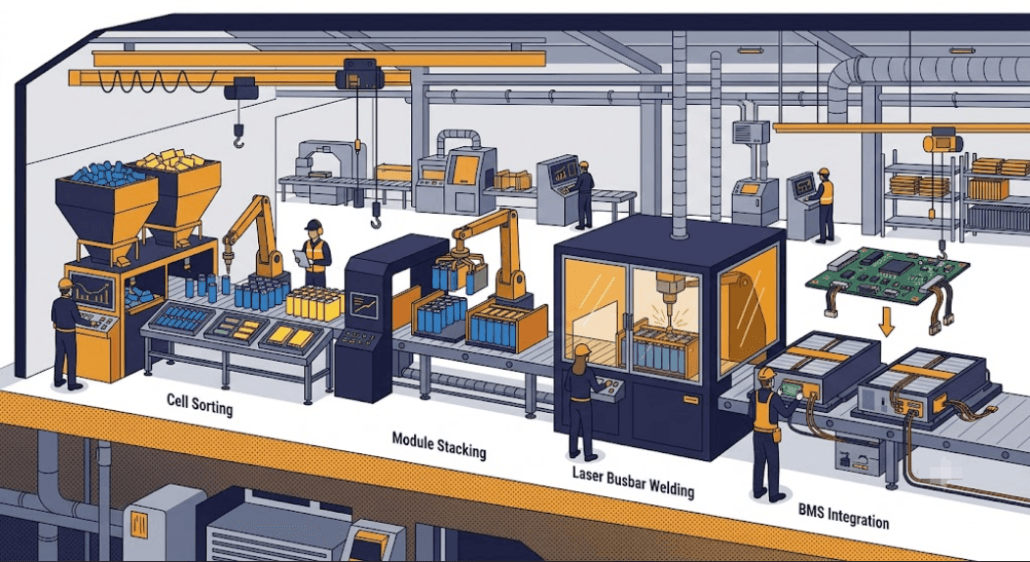
Battery Pack Assembly Process: From Cell Sorting to Finished BESS Pack
| ⚡ Quick Answer: What Is the Battery Pack Assembly Process? The battery pack assembly process turns screened cells into a finished, protected energy storage unit. It moves through six stages: cell sorting and matching, module stacking and compression, busbar welding, BMS integration, enclosure sealing, and aging or burn-in testing. Each stage sets a ceiling that later stages can’t fully recover from. A pack that skips or rushes an early stage rarely fails outright. Instead, it simply delivers less capacity and a shorter cycle life than its datasheet promised. |
1. Why the Battery Pack Assembly Process Is a Manufacturing Discipline, Not a Wiring Job
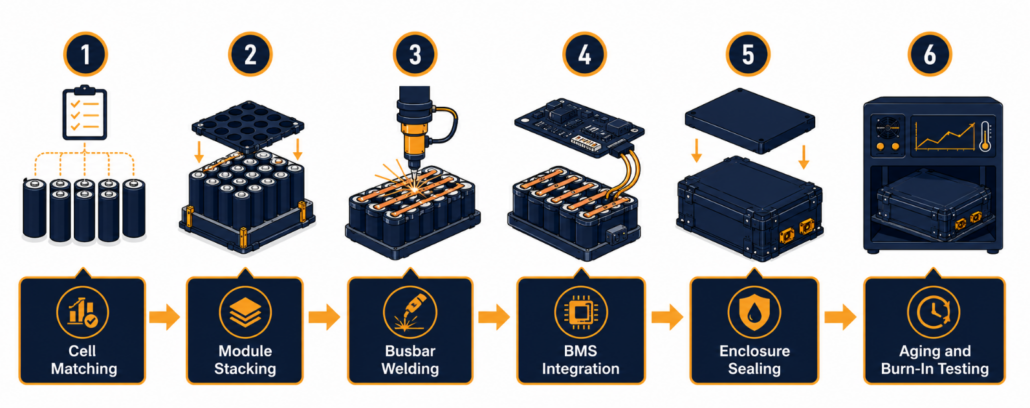
Building a battery pack looks simple from the outside. You connect a group of cells, add a control board, and close the case. In practice, however, the battery pack assembly process works more like precision manufacturing than basic wiring. Small tolerances stack up at every stage. A cold weld here and an uneven compression force there can add up fast. As a result, the finished pack can fall short of the capacity and cycle life its datasheet promised.
This gap matters more for a BESS than for a small consumer device. That’s because a stationary pack runs thousands of cycles over 10 to 20 years. In fact, international safety standards such as IEC 62619 exist precisely because assembly quality drives real-world safety, not just performance. For a broader view of how pack assembly fits within a complete system, read our guide to key components in a BESS architecture. Below, the sections walk through each stage in the order it happens on a production line.
2. Stage 1 of the Battery Pack Assembly Process: Cell Sorting and Matching
Before a single cell reaches the assembly line, workers sort it by voltage, capacity, and internal resistance. Even cells from the same production batch vary slightly. Therefore, grouping similar cells together reduces how much correcting the BMS has to do later. Typically, manufacturers run a fast ACIR screen first, then confirm with DCIR pulse testing before final grouping.
For a full breakdown of this step, read our complete cell matching before pack assembly guide. It covers how internal resistance affects series versus parallel groups. In short, this is the foundation stage of the entire battery pack assembly process. Every later stage inherits whatever variation this one leaves behind.
3. Stage 2: Module Stacking and Mechanical Compression
Once cells are sorted, they move into module stacking. End plates and pressure plates apply a controlled compression force across the stack. This keeps prismatic and pouch cells in steady contact. It also leaves room for the swelling that naturally happens over a cell’s charge cycle. Before this step locks in, a CCD vision system checks tab and terminal alignment. A misaligned cell here creates a welding problem two stages later.
Adhesives also enter the process at this stage, and they do two separate jobs. On one hand, a compliant thermal interface material carries heat away from the cells. On the other, a smaller, targeted structural adhesive bead helps hold the stack together, without resisting the swelling that compression plates already accommodate. Our guide to gluing cells in a battery pack covers which adhesive chemistry fits which job. It also explains why a rigid, full-face bond causes many long-term pack failures.
Afterward, steel straps or plastic-steel banding secure the stack for transport to the welding station. Bottom flatness matters here too, since an uneven module base creates gaps against thermal pads or cooling plates further downstream. Eventually, that gap shows up as an uneven temperature distribution, a problem we cover in our guide to cell temperature gradients in BESS.
4. Stage 3: Busbar Welding and Electrical Interconnection
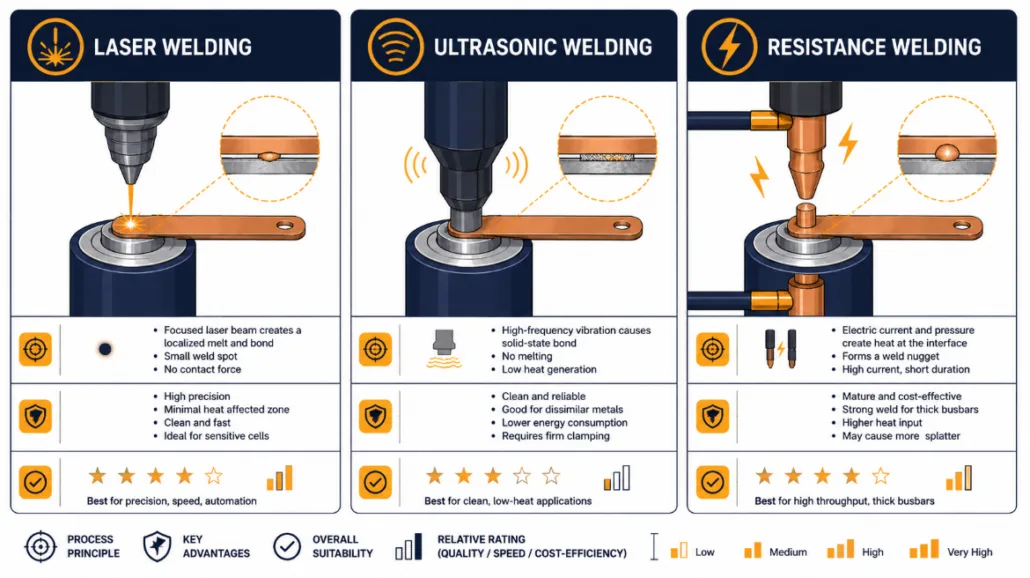
Busbar welding turns individual cells into an electrically connected string. Three welding methods dominate this stage of the battery pack assembly process. First, laser welding offers high precision and low thermal impact. Meanwhile, ultrasonic welding works fast and handles dissimilar metals without melting either surface. By contrast, resistance welding is the simplest method, but it tolerates dissimilar, highly conductive materials less well at scale.
Right after welding, technicians verify weld quality with a pull-force test, since a joint that looks fine can still carry excessive resistance. For instance, a cold weld or particulate spatter left uncleaned can pierce a cell casing. It can also create a resistance hotspot, which then ages that section of the pack faster than the rest. Because this stage feeds directly into DCIR verification, any resistance mismatch becomes measurable before the pack moves forward.
5. Stage 4: BMS Integration and Wiring Harness
With the electrical interconnections complete, the battery management system goes in next. Technicians install cell supervision circuit (CSC) boards and connect sensor and communication wiring harnesses. In larger packs, they also wire multiple slave boards to a central master BMS. Because the busbars still sit at low voltage at this point, manufacturers deliberately install the BMS before final busbars bring the pack to full voltage. Consequently, this keeps the line safer for technicians.
For a full explanation of how the BMS monitors and protects the pack once assembly finishes, see our guide to how a battery management system works. Similarly, our comparison of centralised, modular, and wireless BMS architecture explains how this stage differs across pack sizes.
6. Stage 5 of the Battery Pack Assembly Process: Enclosure Sealing and IP Rating
Once the BMS and wiring harness are in place, workers close the pack into its enclosure. They apply sealant, torque the lid to specification, and then run a leak-rate test to confirm the rated IP class. Generally, indoor commercial installs target IP65, while outdoor and utility-scale deployments exposed to rain, dust, or coastal humidity typically need IP66 or IP67.
At this stage, fire code compliance also starts to matter directly. Specifically, enclosure integrity, safety distances, and installation clearances feed into requirements covered under NFPA 855. Even so, a leak-tested but poorly torqued enclosure can pass an initial inspection and still fail years later, once gasket materials age and compress.
7. Stage 6: Aging, Burn-In, and Factory Acceptance Testing
The final stage of the battery pack assembly process is checking the work. First, the sealed pack goes through insulation resistance and withstand voltage testing. It then runs charge and discharge cycling that mirrors real operating conditions. Notably, this aging or burn-in period surfaces problems that earlier QC checks can miss. For example, a weak cell or a marginal weld connection can look fine under static testing. It may only reveal itself once the pack cycles under load.
For BESS-scale packs, this step overlaps with formal factory acceptance testing, which also verifies alarm thresholds, protection logic, and communication protocols before the pack ships. Our guide to BESS safety and compliance explains how factory-level testing connects to the certification requirements a finished system needs.
8. Cell-to-Pack vs Module-Based Assembly: A Quick Note on Architecture
Most of the stages above describe a module-based process: cells become modules, and modules become a pack. Alternatively, cell-to-pack (CTP) design skips the module step entirely and bonds cells directly to the pack structure and cooling plate instead. Because this removes an entire layer of module casings and interconnections, it can reduce weight, part count, and cost.
Still, the tradeoff is real. CTP removes the module-level buffer between a single bad cell and the whole pack. This places even more weight on the cell sorting and matching stage covered above. As a result, buyers evaluating a CTP-based product should ask harder questions about incoming cell grading. A module-based pack has more structural redundancy if a cell underperforms.
9. Quality Control Checkpoints in the Battery Pack Assembly Process
Overall, a well-run battery pack assembly process builds in a verification step after every major stage, not just at the very end. The table below summarizes what each checkpoint is designed to catch.
| Stage | QC Checkpoint | What It Catches |
|---|---|---|
| Cell sorting | Voltage, capacity, DCIR/ACIR grading report | Mismatched cells before they ever reach a module |
| Module stacking | CCD alignment check, compression force verification | Misaligned tabs, uneven pressure, weld gap errors |
| Busbar welding | Pull-force test, weld seam inspection, DCIR retest | Cold welds, spatter contamination, high-resistance joints |
| BMS integration | Insulation resistance, withstand voltage test | Wiring faults, sensor placement errors |
| Enclosure sealing | IP-rated leak test, torque verification | Seal failures that let in moisture or dust |
| Aging & burn-in | Charge/discharge cycling, capacity verification | Weak cells or joints that only surface under load |
10. Questions to Ask a Manufacturer About Their Battery Pack Assembly Process
- Do you test and match cells by voltage, capacity, and internal resistance before assembly?
- Which busbar welding method do you use, and what pull-force standard do welds have to meet?
- What IP rating does the sealed enclosure achieve, and is it leak-tested on every unit or by sample?
- Do you run aging or burn-in cycles before shipment, and can you provide that data for our batch?
- Is this a module-based or cell-to-pack design, and how does that affect your cell grading tolerance?
Conclusion: The Battery Pack Assembly Process Sets What the Finished Pack Can Deliver
Ultimately, no single stage of this process works in isolation. Cell matching sets the ceiling the BMS has to work within. Meanwhile, module compression and busbar welding determine how evenly that ceiling holds up over years of cycling. Finally, enclosure sealing and burn-in testing confirm, before the pack ships, whether earlier stages were done properly.
Therefore, when you evaluate a cell or pack supplier, ask about each stage specifically. Don’t just accept a general assurance that “the BMS handles it.” Instead, look for a manufacturer who can walk through their process stage by stage, with documentation at each checkpoint. That is what a genuinely controlled battery pack assembly process looks like, not a finished product with an unverifiable history.
| ☀️ Need Help Evaluating a Pack Manufacturer’s Assembly Process? Sunlith Energy reviews cell sorting data, weld QC records, enclosure test reports, and burn-in results for BESS projects from 50 kWh upward. Contact us before you finalize a cell or pack supplier. |
Key Takeaways
| Stage | What Happens |
|---|---|
| 1. Cell Sorting & Matching | Workers grade cells by voltage, capacity, and internal resistance before assembly. |
| 2. Module Stacking & Compression | Machines stack, compress, and mechanically retain cells to control swelling and vibration. |
| 3. Busbar Welding | Laser, ultrasonic, or resistance welding connects cells in series and parallel. |
| 4. BMS Integration | Technicians install and connect sensor wiring, CSC boards, and the master BMS. |
| 5. Enclosure Sealing | Workers seal the pack to its rated IP class and leak-test it. |
| 6. Aging & Burn-In Testing | Charge and discharge cycling, plus insulation tests, confirm the pack before shipment. |
Frequently Asked Questions About the Battery Pack Assembly Process
What are the main stages of the battery pack assembly process?
Six stages make up the battery pack assembly process: cell sorting and matching, module stacking and compression, busbar welding, BMS integration, enclosure sealing, and aging or burn-in testing. Each stage builds on the one before it, so a defect introduced early is much harder to catch later.
Is battery pack assembly the same as cell manufacturing?
No. Cell manufacturing produces the individual lithium cells, tested and graded before they reach a pack line. By contrast, battery pack assembly starts once those finished cells arrive, and it covers sorting, stacking, welding, BMS integration, sealing, and testing. For the step that happens first, see our cell matching guide.
Why does battery pack assembly quality matter more for BESS than for a small consumer battery?
A stationary BESS pack runs thousands of cycles over 10 to 20 years, often at higher currents than a consumer device. Because of this, small defects that would go unnoticed in a phone battery compound over years of daily cycling. For example, a slightly cold weld or a poorly matched cell can turn into measurable capacity loss, or in the worst case, a safety event.
What is the difference between cell-to-pack and module-based assembly?
Module-based assembly groups cells into modules first, then combines modules into a pack. Cell-to-pack assembly, on the other hand, skips the module step and bonds cells directly to the pack structure. This can reduce weight and cost, but it also removes the module-level buffer between a bad cell and the full pack.
How long does battery pack assembly typically take?
For a utility-scale BESS pack, sorting, stacking, welding, and BMS integration can finish in hours on an automated line. However, aging and burn-in testing often adds one to several days, since full charge and discharge cycles take time but properly verify the pack before shipment.
What should I ask a manufacturer about their battery pack assembly process?
Ask which welding method they use for busbars, and whether they match cells before assembly. Also, find out what IP rating the enclosure achieves, and request burn-in test data for your specific batch. Overall, a manufacturer who answers all three with documentation is running a genuinely controlled battery pack assembly process.
Further Reading
- Cell Matching Before Pack Assembly
- Cell Internal Resistance: What It Is and How to Measure It
- Battery Pack Busbar Welding: Laser vs Ultrasonic vs Resistance
- Cell Temperature Gradients in BESS
- Gluing Cells in a Battery Pack: Heat, Swelling, and Long-Term Reliability
- Battery Management System (BMS) Explained
- BMS Architecture: Centralised vs Modular vs Wireless
- How to Evaluate a BESS Supplier’s BMS
- NFPA 855 Guide
- BESS Safety and Compliance
- Understanding BESS Specifications
- BESS Certifications Explained





Trackbacks & Pingbacks
[…] Battery Pack Assembly Process: The Complete Guide […]
Leave a Reply
Want to join the discussion?Feel free to contribute!