
BESS Power Factor Explained: Complete Guide
What Is BESS Power Factor?
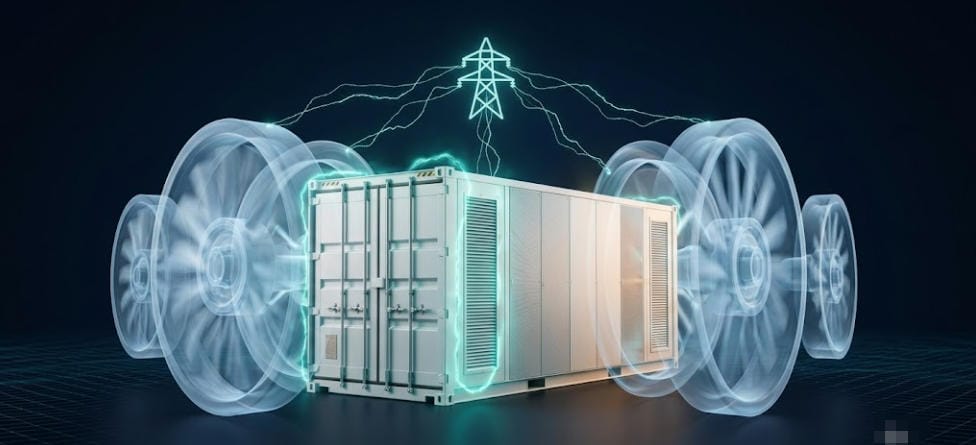
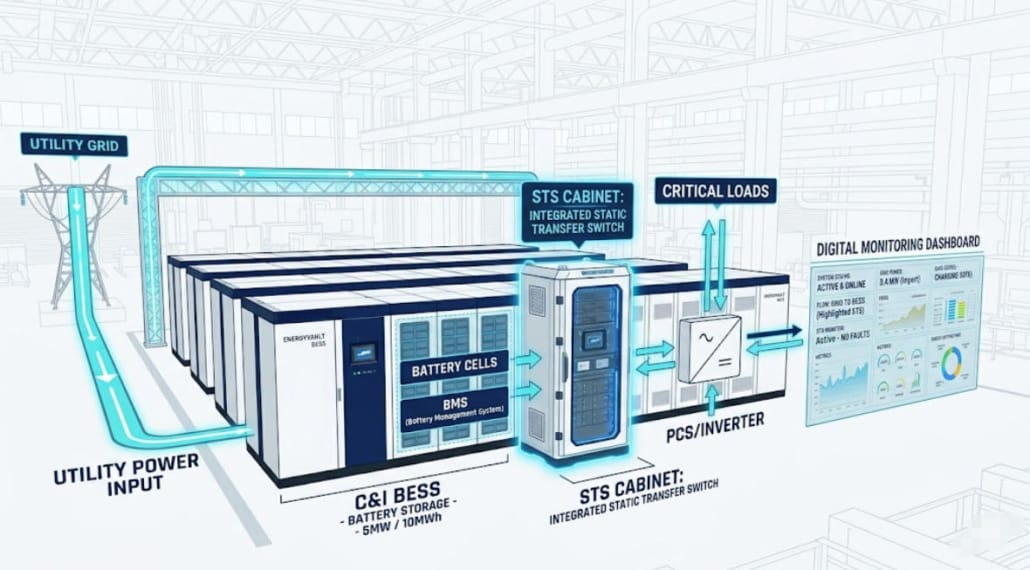
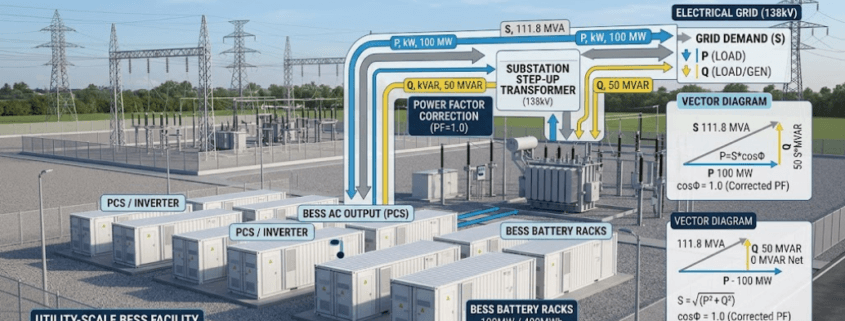
BESS Power Factor is one of the most important design parameters in a Battery Energy Storage System (BESS). It affects inverter sizing, reactive power capability, voltage regulation, grid compliance, and project economics. As utilities require more grid support from energy storage systems, understanding BESS Power Factor has become essential for developers, EPC contractors, utilities, and industrial energy users.
A modern Battery Energy Storage System does much more than store energy, as it can also provide vital voltage support, reactive power compensation, and grid stabilization. Consequently, managing the BESS Power Factor has become a foundational requirement in utility-scale and commercial energy storage projects worldwide.
To understand how a BESS supports the grid, it is important to understand active power, reactive power, and apparent power.
For a complete overview of how these configurations work, see our comprehensive guide to battery energy storage systems (BESS).
- What Is BESS Power Factor?
- Why BESS Power Factor Matters
- What Is Power Factor?
- Understanding Active Power, Reactive Power, and Apparent Power
- How BESS Power Factor Works
- BESS Power Factor Modes
- BESS Power Factor and PCS Sizing
- BESS Power Factor Calculation Example
- Leading vs Lagging BESS Power Factor
- Utility Requirements for BESS Power Factor
- IEEE 1547 and BESS Power Factor
- Can a BESS Provide Reactive Power Without Discharging?
- BESS Power Factor Correction vs Capacitor Banks
- BESS Power Factor in Commercial and Industrial Projects
- Power Factor Challenges in Renewable Energy Projects
- Future Trends in BESS Power Factor Management
- Frequently Asked Questions About BESS Power Factor
- Conclusion
Why BESS Power Factor Matters
A system’s power factor directly dictates how efficiently an inverter utilizes its total capacity, while simultaneously determining the volume of active and reactive power it can deliver. Because modern utilities increasingly mandate that energy storage installations actively support grid voltage, developers must carefully account for these power factor constraints during the early stages of system design.
Furthermore, a properly designed BESS can successfully achieve the following:
A properly designed BESS can:
- Improve voltage stability
- Reduce transmission losses
- Support renewable energy integration
- Meet utility interconnection requirements
- Provide ancillary services
- Improve power quality
Consequently, BESS Power Factor plays a major role in project performance and profitability.
What Is Power Factor?
Power factor measures how effectively electrical power is converted into useful work.
The formula is:
Power Factor = kW ÷ kVA
A power factor of 1.0 indicates ideal operation. However, most electrical systems operate below unity power factor because they require reactive power.
Generally:
- 1.0 PF = Excellent
- 0.95 PF = Very Good
- 0.90 PF = Acceptable
- Below 0.90 PF = Often penalized by utilities
Understanding Active Power, Reactive Power, and Apparent Power
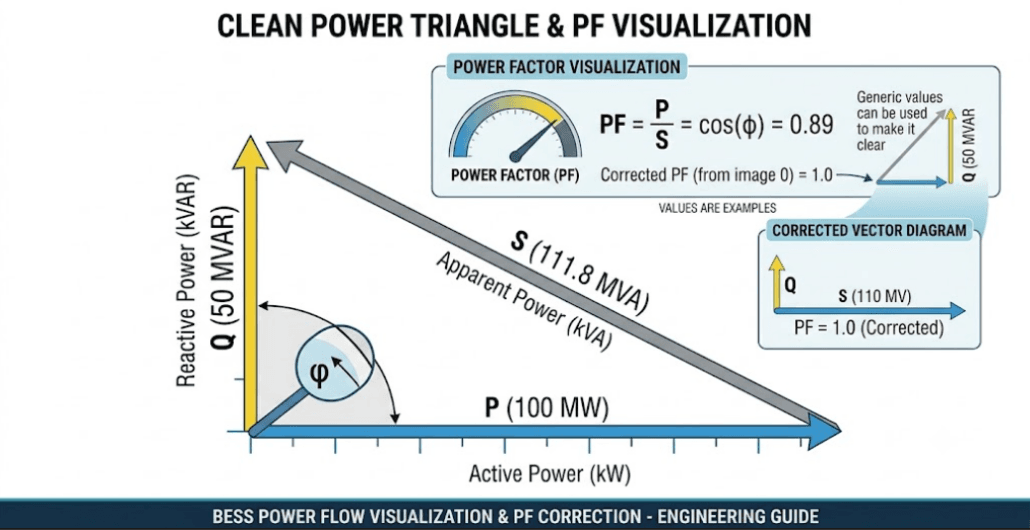
Before discussing BESS Power Factor in detail, it is important to understand the three types of power found in AC systems.
Active Power (kW)
Active power performs useful work.
Examples include:
- Running motors
- Powering equipment
- Charging batteries
- Operating lighting systems
This is the power customers actually consume.
Reactive Power (kVAR)
Reactive power supports magnetic and electric fields.
For example, motors, transformers, and inductive loads require reactive power to operate correctly.
Although reactive power does not perform useful work directly, it remains essential for grid stability.
Apparent Power (kVA)
Apparent power combines active power and reactive power.
PCS inverters are usually rated in kVA because they must handle both types of power simultaneously.
To learn more about how inverter technology manages these loads, read about the role of the power conversion system (PCS).
How BESS Power Factor Works
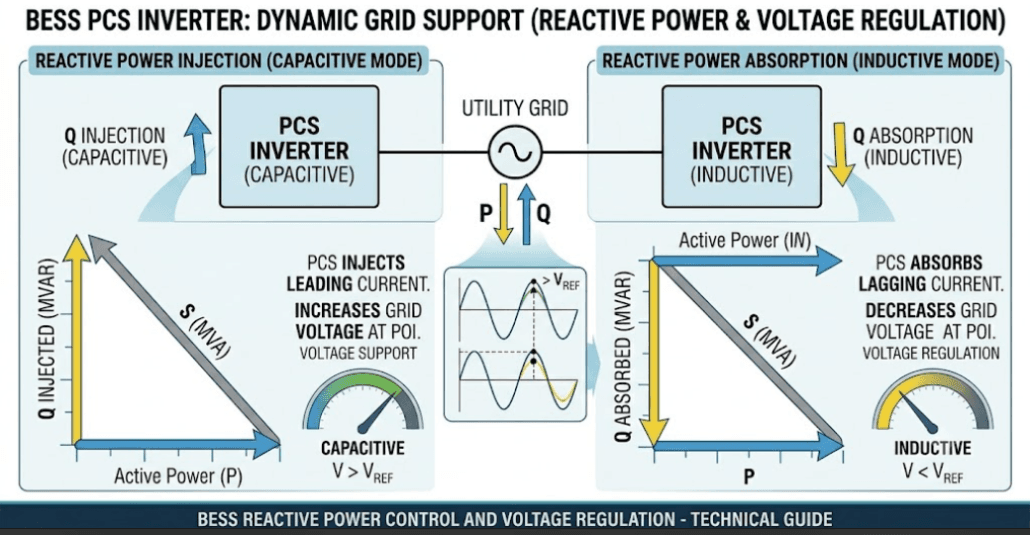
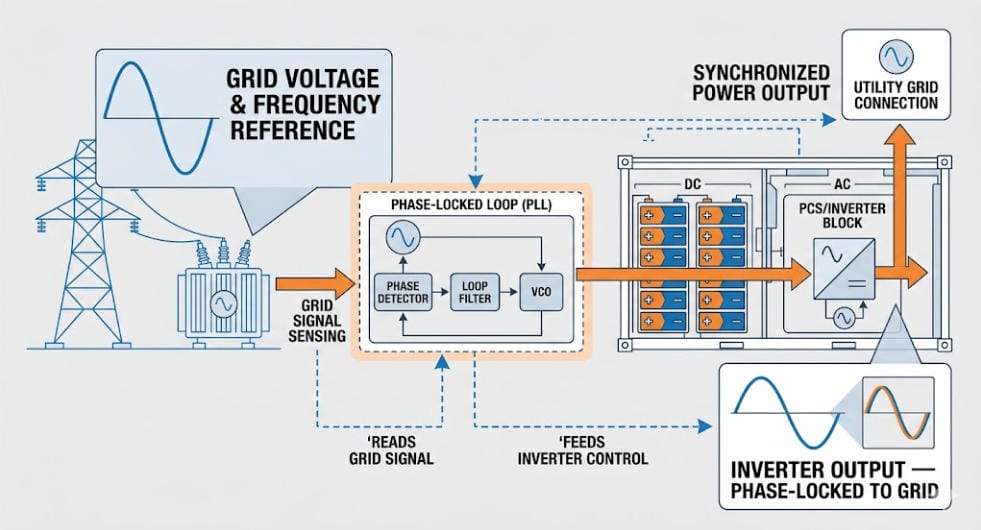
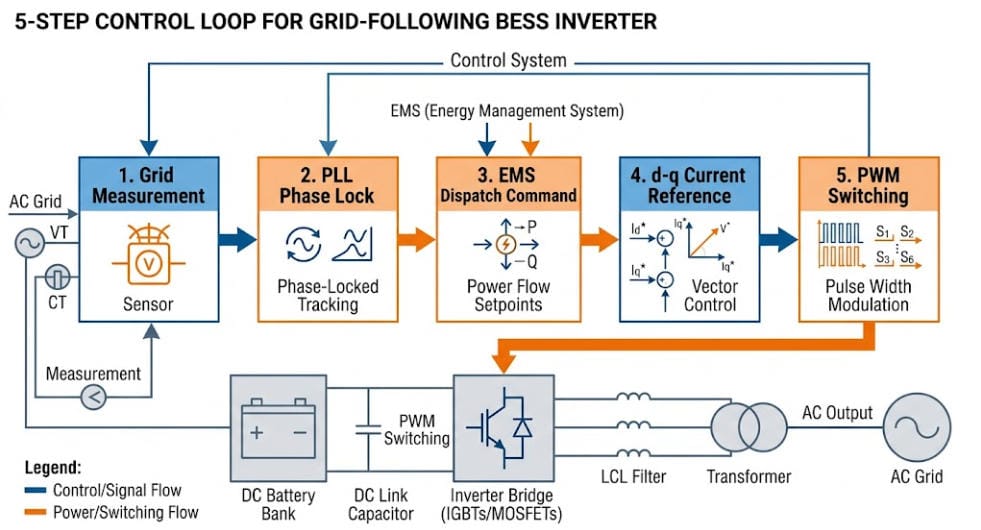
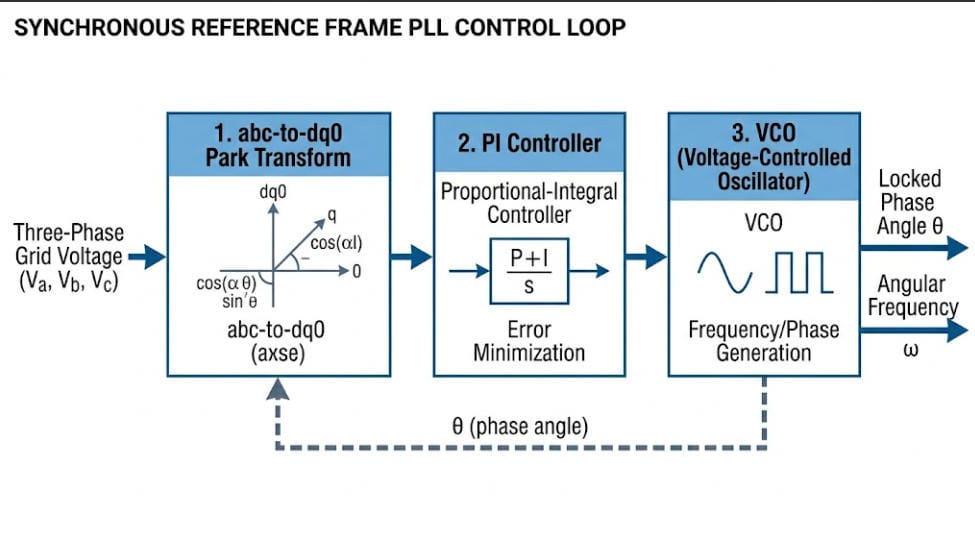
Modern Battery Energy Storage Systems utilize advanced PCS platforms to seamlessly manage both active and reactive power. Unlike traditional static capacitor banks, these intelligent inverters respond dynamically to real-time grid fluctuations, allowing them to inject or absorb reactive power within milliseconds. As a result, the PCS automatically modulates its output as grid conditions shift, which ultimately helps maintain long-term voltage stability and superior power quality across the network.
Consequently, the BESS helps maintain voltage stability and power quality.
Reactive Power Injection
When grid voltage falls, the inverter can inject reactive power.
This mode:
- Supports voltage recovery
- Helps weak grids
- Supports inductive loads
Reactive Power Absorption
When grid voltage rises, the inverter can absorb reactive power.
This mode:
- Reduces overvoltage conditions
- Supports solar-rich networks
- Improves voltage regulation
Unity Power Factor Operation
At unity power factor, the inverter delivers only active power.
In this case:
PF = 1.0
No reactive power support is provided.
BESS Power Factor Modes
Modern PCS platforms support several control modes.
Constant BESS Power Factor Mode
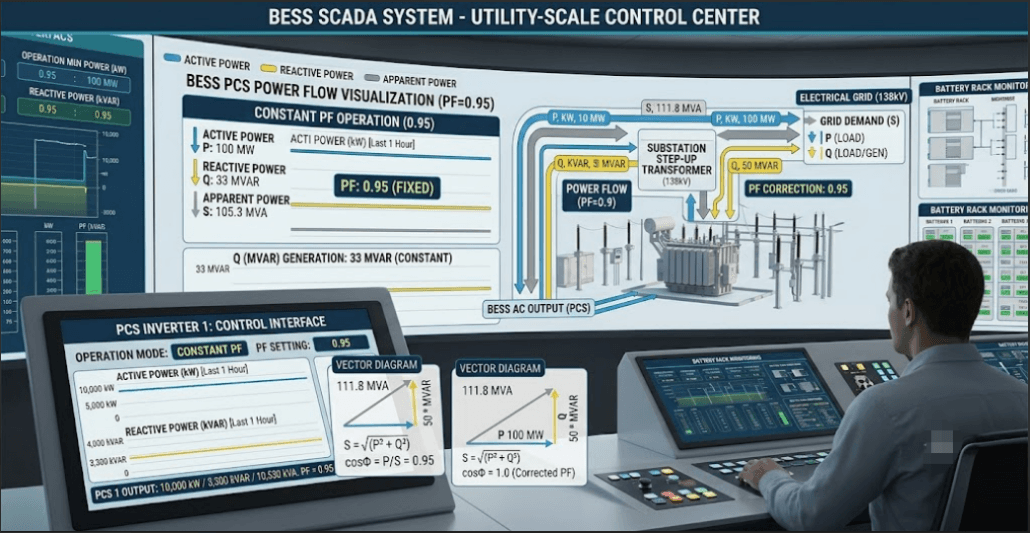
In this mode, the inverter maintains a fixed power factor.
Common settings include:
- 1.0 PF
- 0.98 PF
- 0.95 PF
- 0.90 PF
As active power changes across the system, the reactive power automatically adjusts to maintain this target. Therefore, utilities often mandate this specific mode for strict grid compliance purposes.
Volt-VAR Control Mode
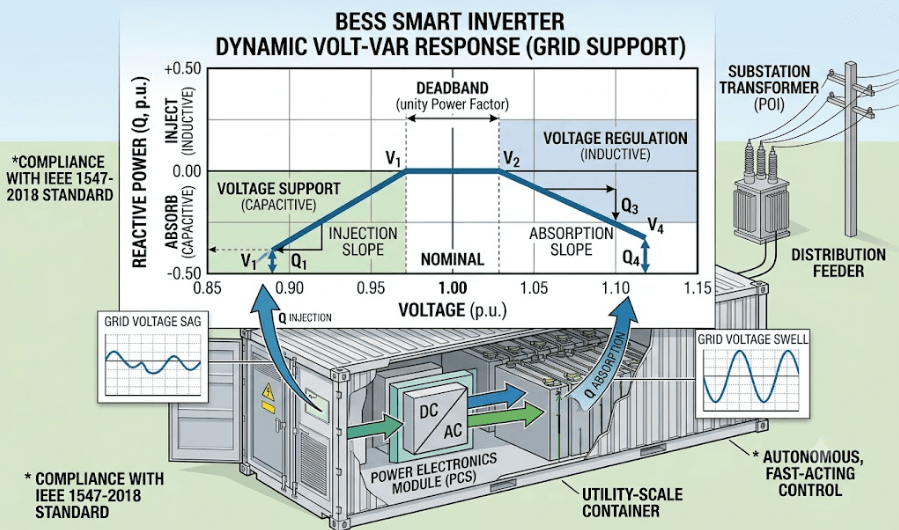
Volt-VAR control adjusts reactive power according to voltage levels.
When voltage falls:
- Reactive power increases
When voltage rises:
- Reactive power decreases
As a result, the system dynamically maintains a highly stable voltage profile across the distribution network.
Reactive Power Setpoint Mode
In this mode, operators directly specify reactive power output.
Examples include:
- +500 kVAR
- -1000 kVAR
This approach is common in transmission applications.
Dynamic Grid Support Mode
Advanced systems continuously adjust reactive power based on grid conditions.
These systems support:
- Frequency regulation
- Voltage control
- Black start capability
- Fault ride-through
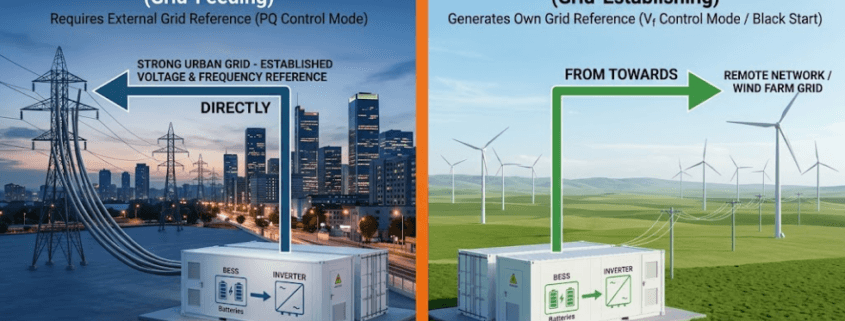
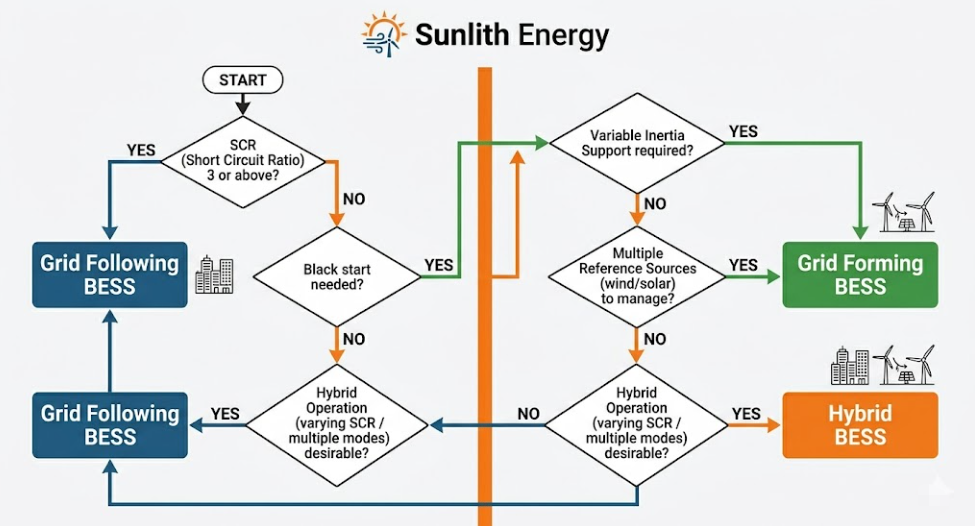
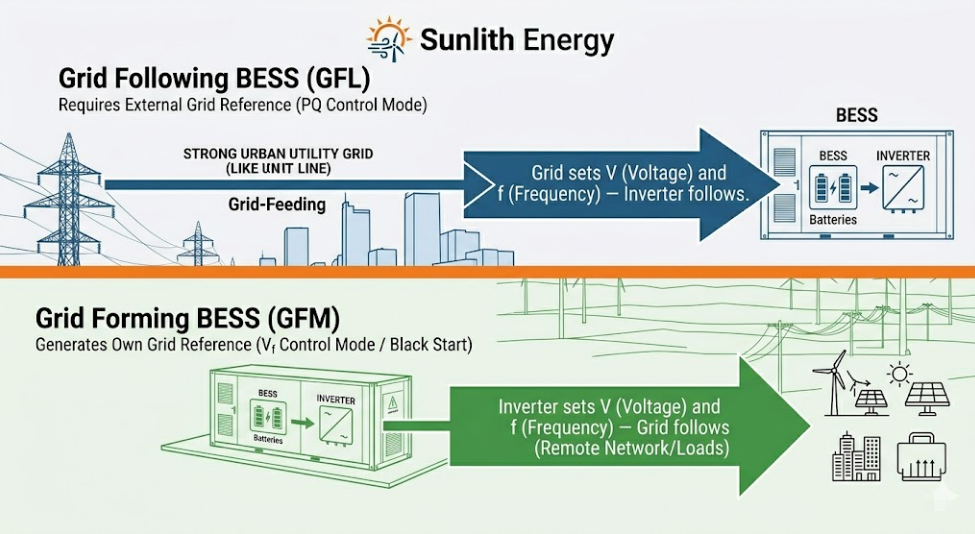
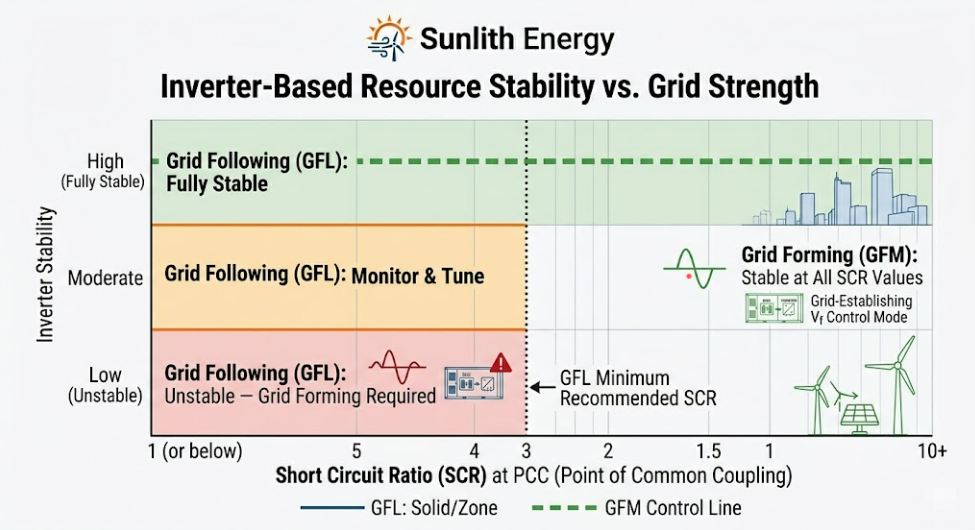
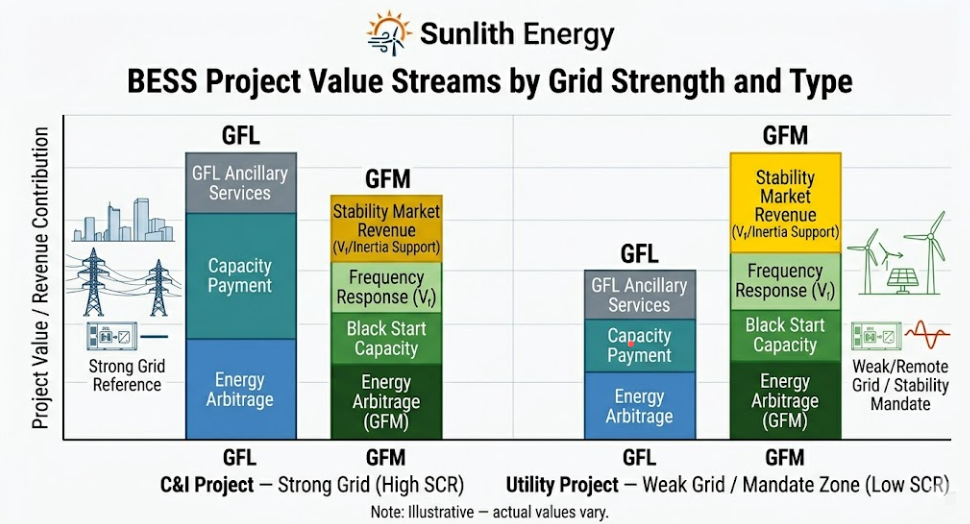
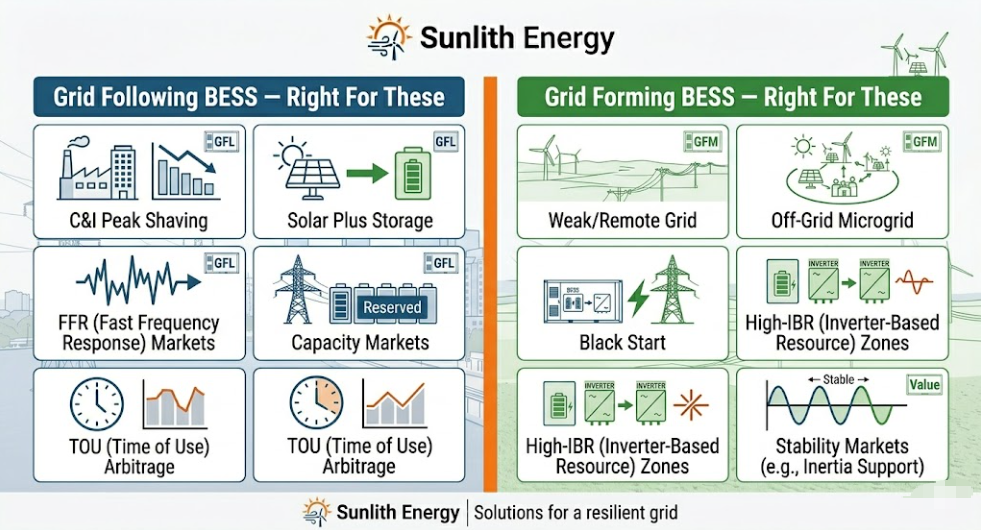
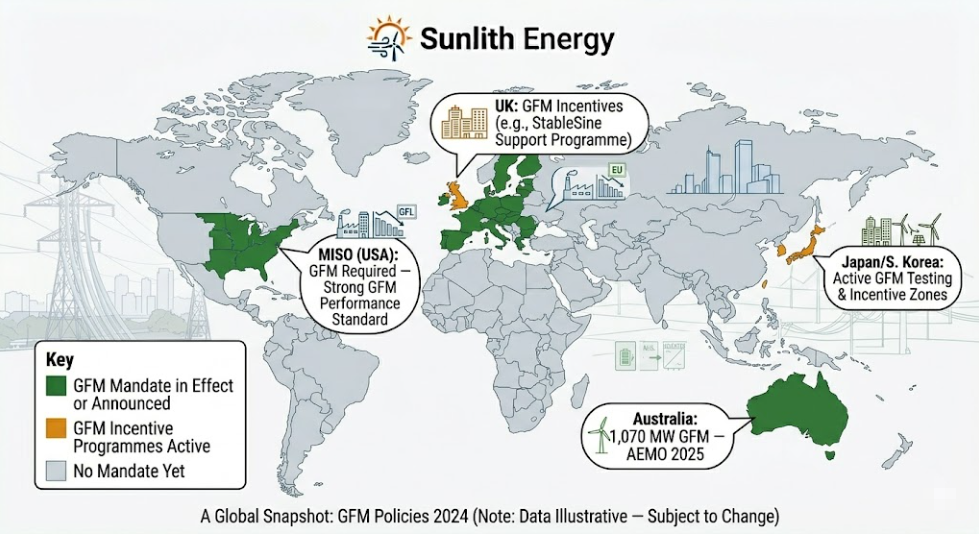
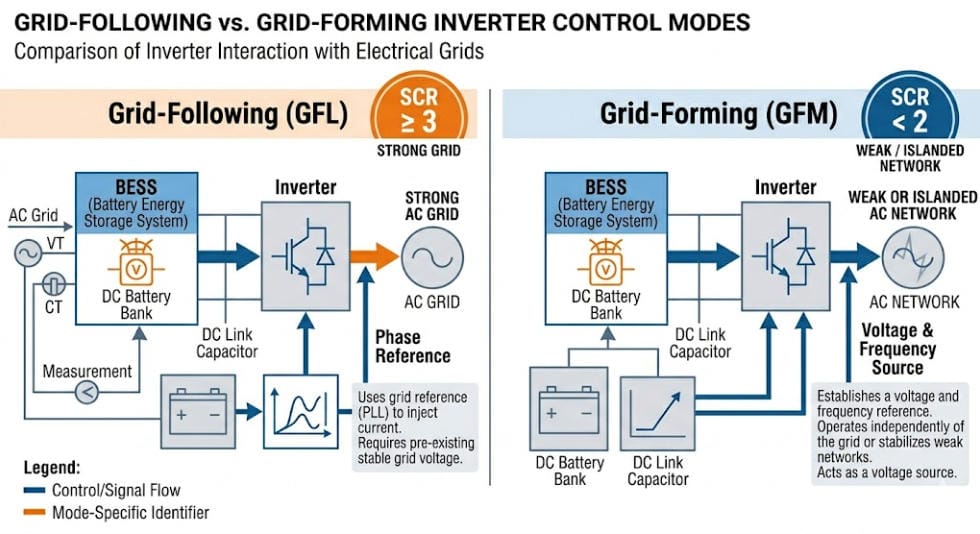
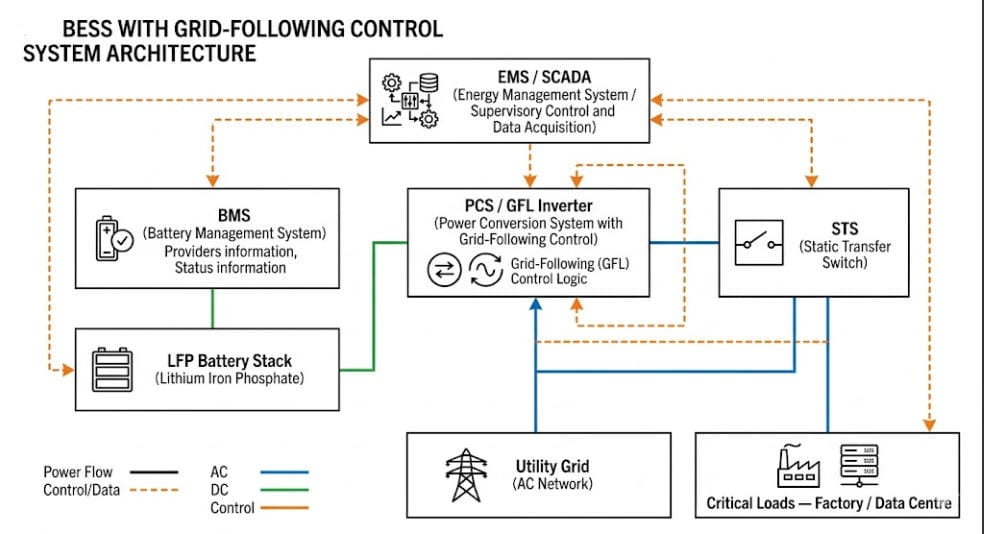
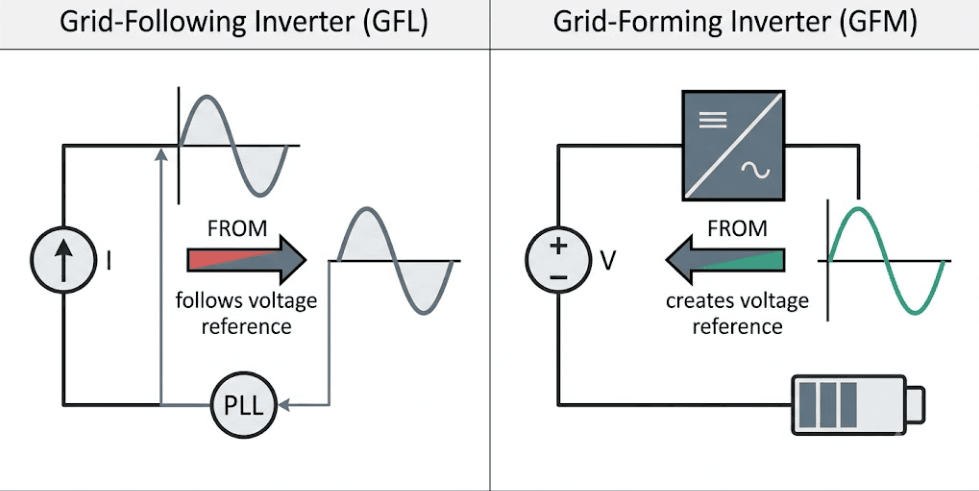
For advanced inverter operation, explore the differences between BESS grid-forming technology
and standard BESS grid-following (GFL) configurations.
BESS Power Factor and PCS Sizing
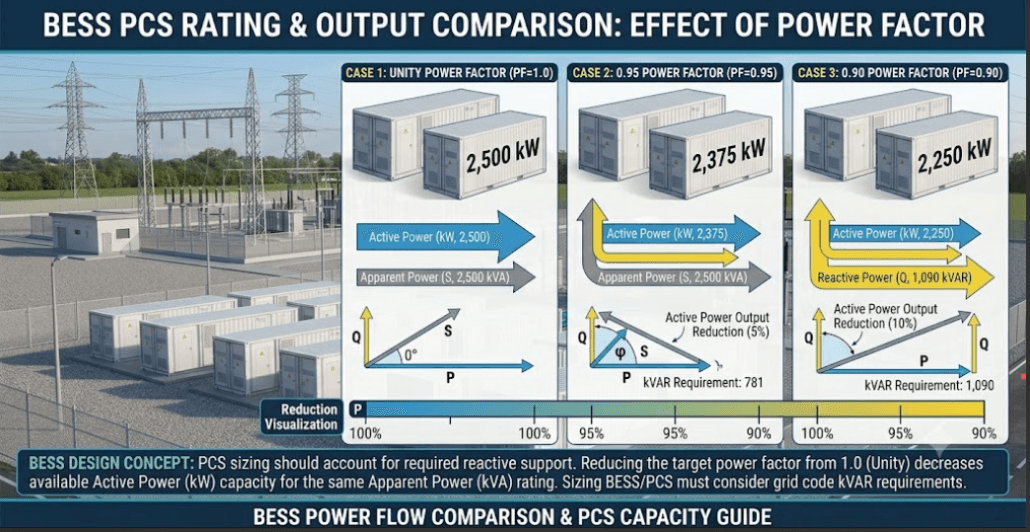
PCS sizing is one of the most important considerations in BESS design.
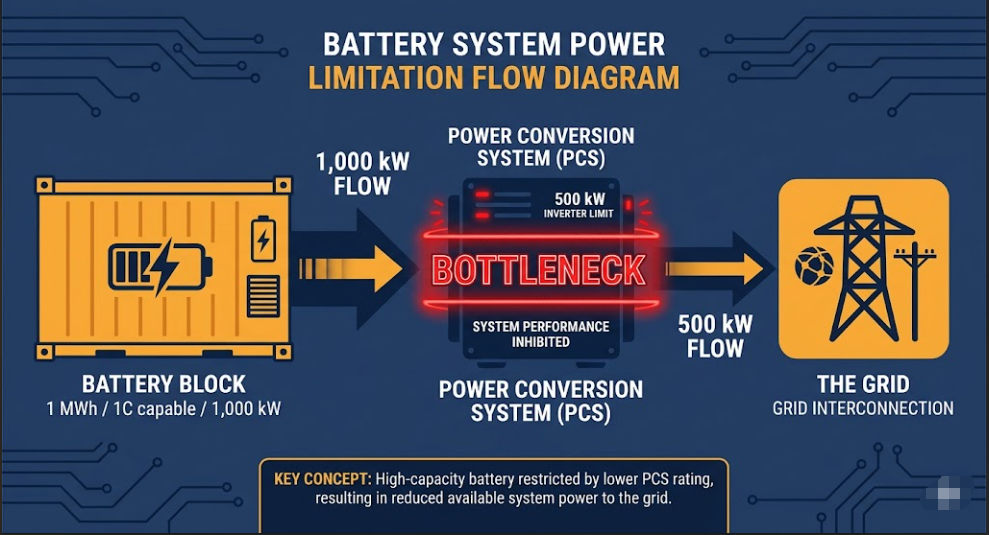
Many developers assume a 1 MW PCS can always deliver 1 MW. However, that is only true at unity power factor.
Consider this example:
PCS Rating = 1 MVA
Required PF = 0.90
Maximum Active Power:
1 MVA × 0.90 = 900 kW
This calculation reveals that 100 kVA of capacity must remain strictly reserved for reactive grid support. Consequently, these stringent utility requirements frequently force engineering teams into oversizing their PCS hardware to avoid bottlenecking active power delivery.
BESS Power Factor Calculation Example
Assume:
- Active Power = 1000 kW
- Reactive Power = 484 kVAR
Apparent Power:
S = √(1000² + 484²)
S = 1111 kVA
Power Factor:
PF = 1000 ÷ 1111
PF = 0.90
Therefore, the Battery Energy Storage System operates at a 0.90 power factor.
Leading vs Lagging BESS Power Factor
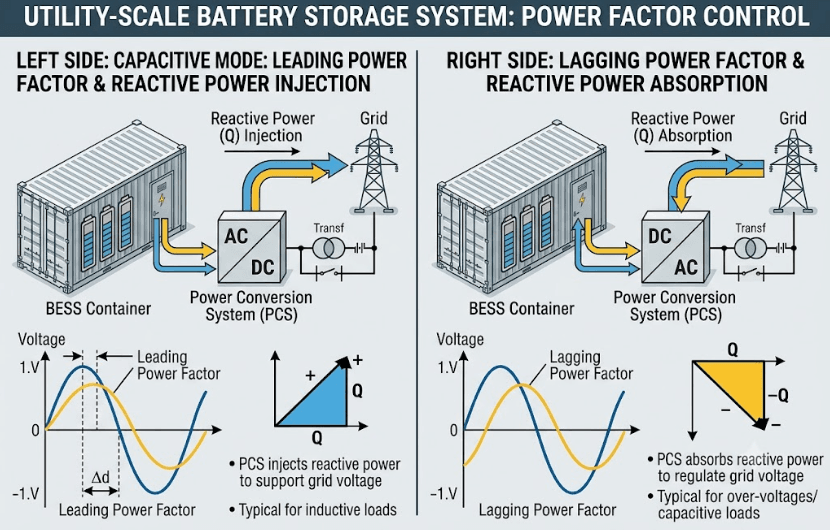
Leading BESS Power Factor
A leading power factor occurs when the inverter injects reactive power.
Characteristics include:
- Capacitive behavior
- Voltage support
- Improved weak-grid performance
Lagging BESS Power Factor
A lagging power factor occurs when the inverter absorbs reactive power.
Characteristics include:
- Inductive behavior
- Overvoltage mitigation
- Renewable energy integration support
Because modern electrical grids face highly volatile load profiles, utilizing both of these operating modes dynamically is absolutely essential for stabilizing modern distribution networks.
Utility Requirements for BESS Power Factor
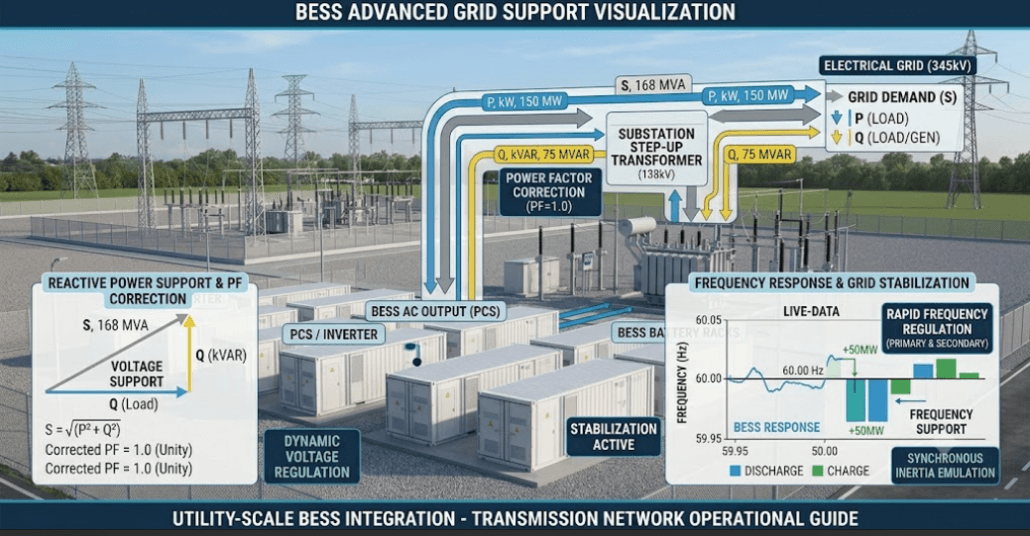
Most utilities require energy storage projects to operate within specific power factor limits.
Common requirements include:
- 0.95 Leading
- 0.95 Lagging
Some transmission operators require:
- 0.90 Leading
- 0.90 Lagging
Therefore, developers must understand local interconnection requirements before selecting PCS equipment.
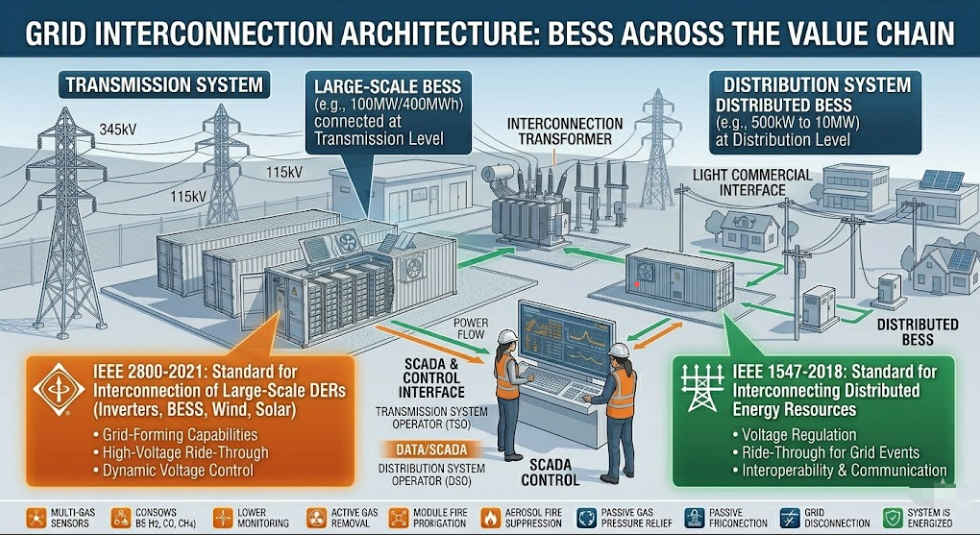
IEEE 1547 and BESS Power Factor
IEEE 1547 established new requirements for inverter-based resources.
Today, Battery Energy Storage Systems must provide:
- Voltage regulation
- Reactive power support
- Power factor control
- Grid support functions
As renewable penetration grows, these capabilities become increasingly important.You can review the official compliance mandates in the IEEE 1547 standard for interconnection.
Can a BESS Provide Reactive Power Without Discharging?
Yes.
Modern PCS technology can provide reactive power even when the battery is idle.
This is because reactive power primarily uses inverter capacity rather than stored battery energy.
As a result, BESS projects can provide grid services without significant battery cycling.
BESS Power Factor Correction vs Capacitor Banks
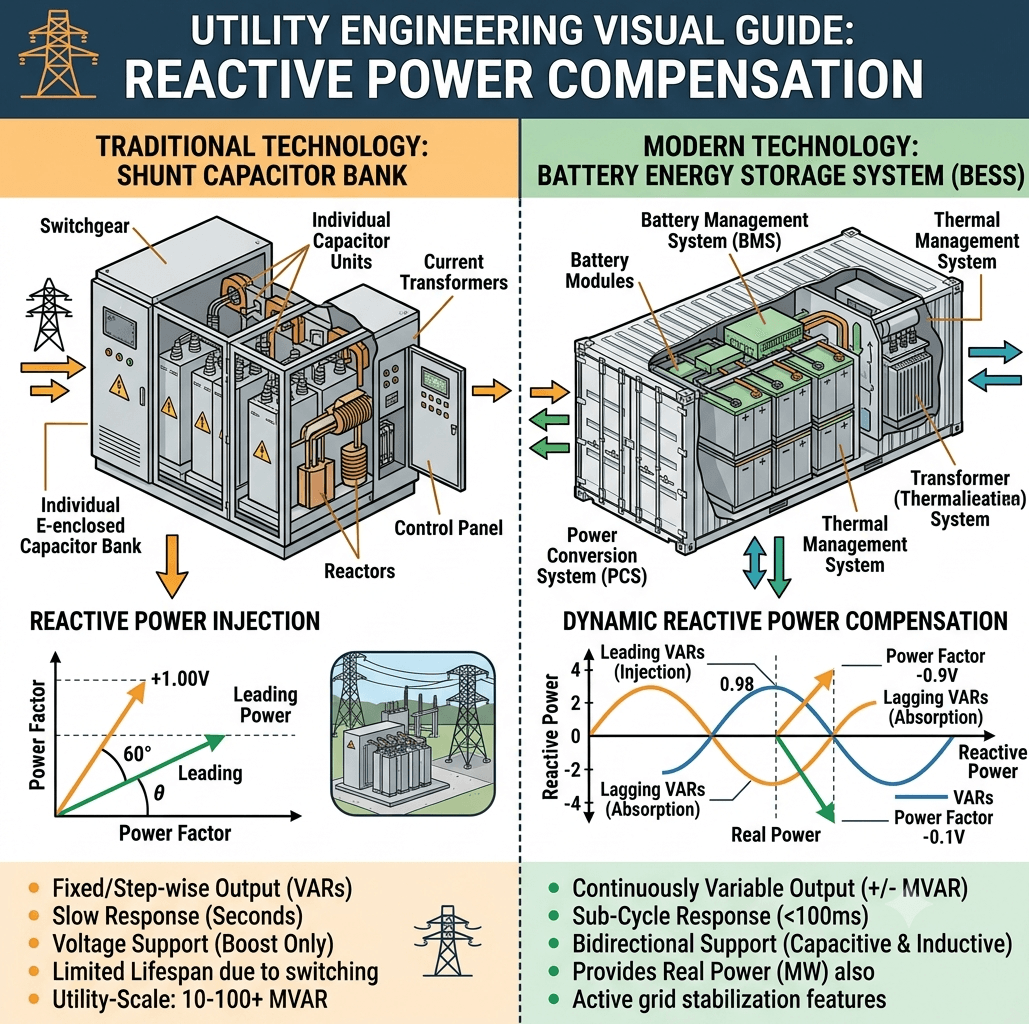
Traditional capacitor banks have been used for decades. However, Battery Energy Storage Systems provide greater flexibility.
Benefits of BESS include:
- Fast response times
- Dynamic voltage support
- Energy storage capability
- Frequency regulation
- Multiple revenue streams
Because of these operational advantages, many modern utilities now heavily prefer flexible BESS-based reactive power solutions over static equipment.
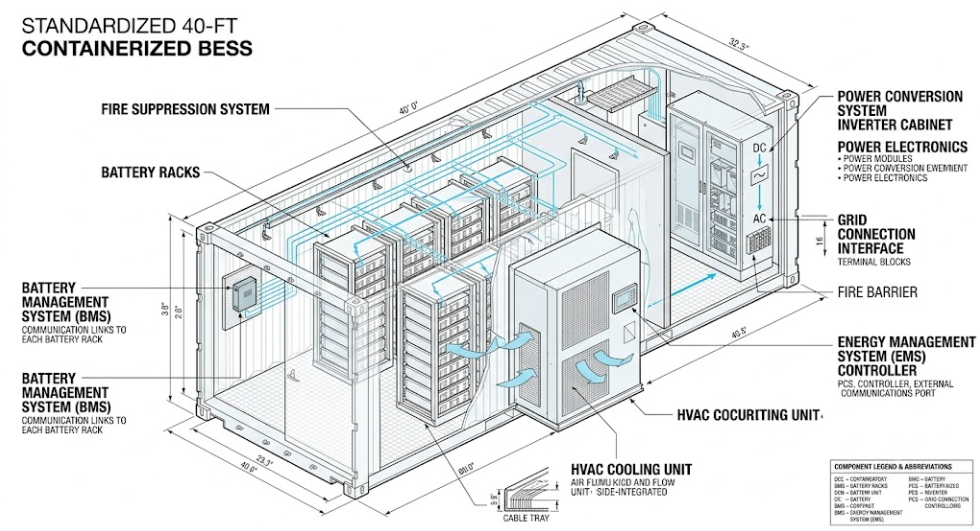
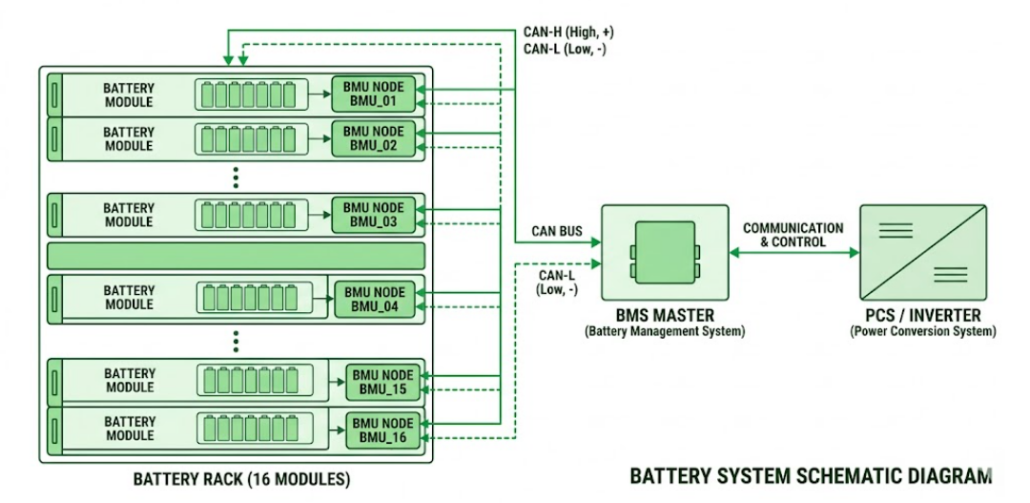
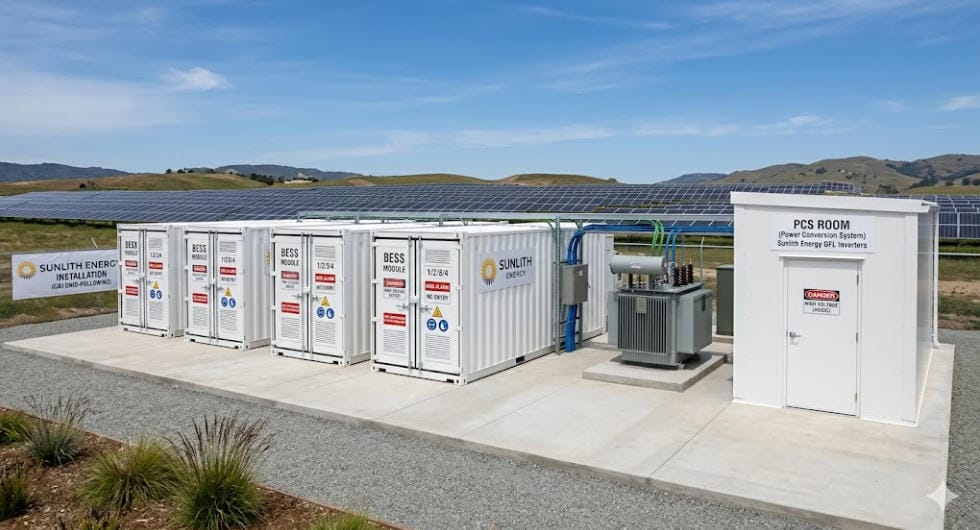
To understand how these components integrate into the overall system design, see our breakdown of BESS architecture.
BESS Power Factor in Commercial and Industrial Projects
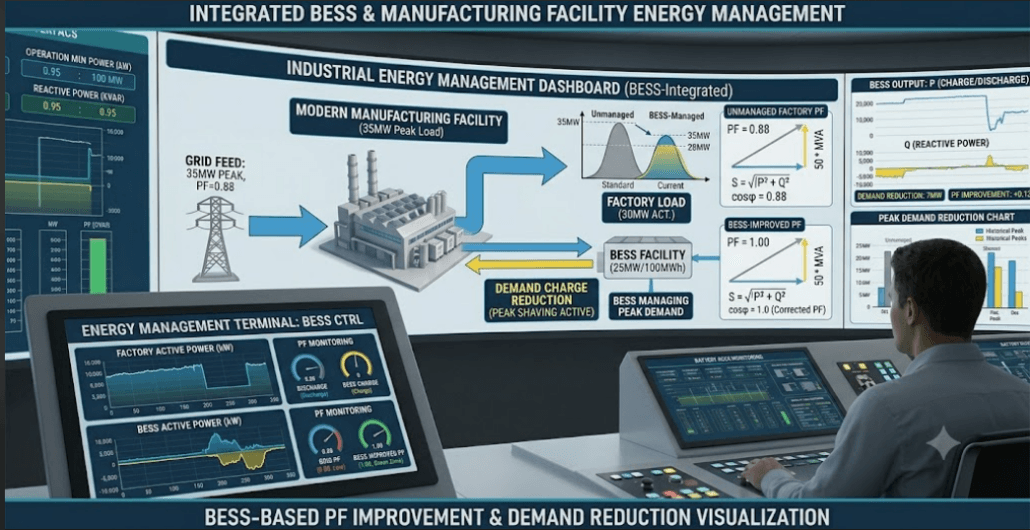
Commercial facilities often face utility penalties for poor power factor.
A Battery Energy Storage System can help:
- Reduce utility penalties
- Improve power quality
- Support motor starting
- Stabilize voltage
- Reduce demand charges
Consequently, BESS installations often provide value beyond energy storage alone.
Power Factor Challenges in Renewable Energy Projects
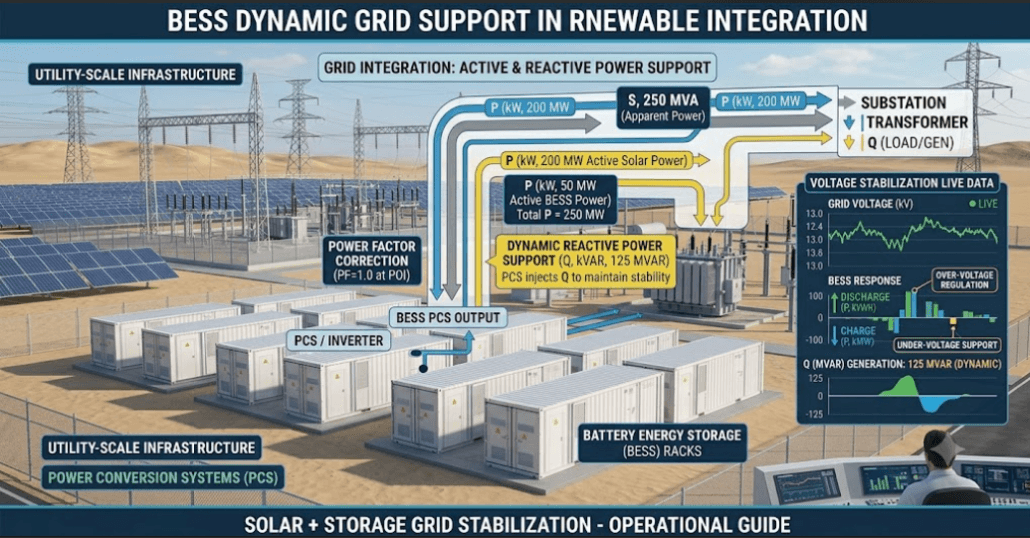
Renewable energy projects introduce unique complexities for BESS power factor control, primarily stemming from highly variable generation profiles and weak grid conditions. Because solar and wind plants do not produce static power, local voltage levels frequently fluctuate throughout the day, which can cause the overall power factor to become highly unstable if it is not proactively managed.
Key Challenges in Renewable Energy Systems
1. Voltage Fluctuations
Solar output changes rapidly with moving cloud cover, causing grid voltage to rise and fall frequently throughout the day.
2. Reverse Power Flow
When localized solar generation exceeds immediate demand, power flows backward into the distribution system and creates severe voltage spikes.
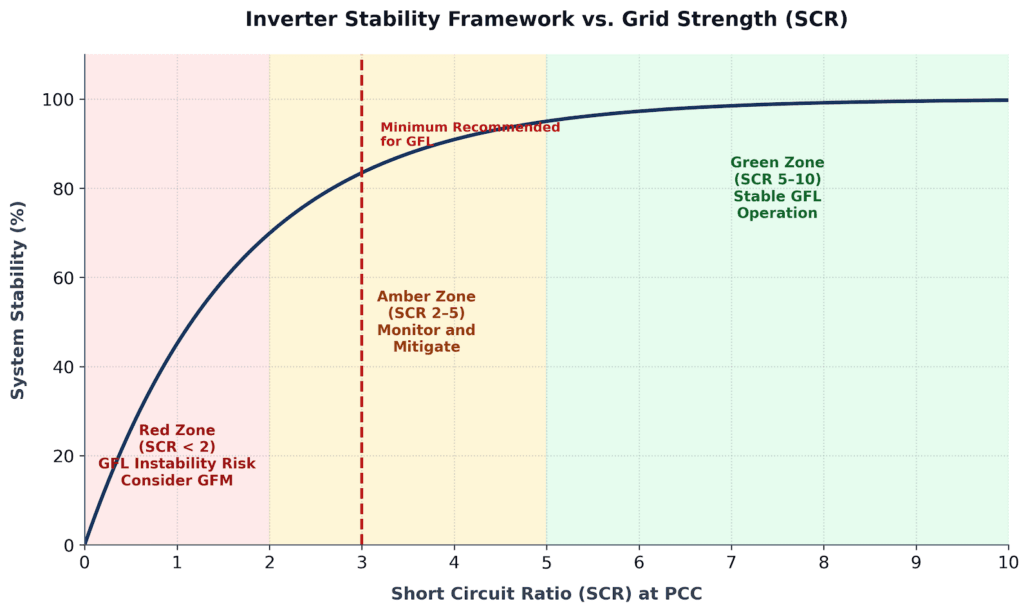
3. Weak Grid Conditions
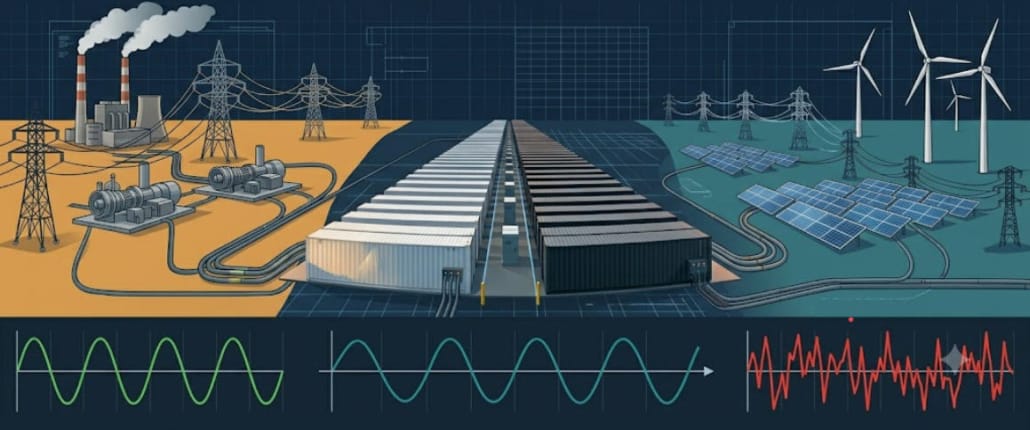
High concentrations of inverter-based resources inherently reduce natural grid inertia, which ultimately degrades overall frequency and voltage stability.
4. Low System Inertia
Inverter-based systems reduce natural grid inertia. As a result, frequency and voltage stability decrease.
Future Trends in BESS Power Factor Management
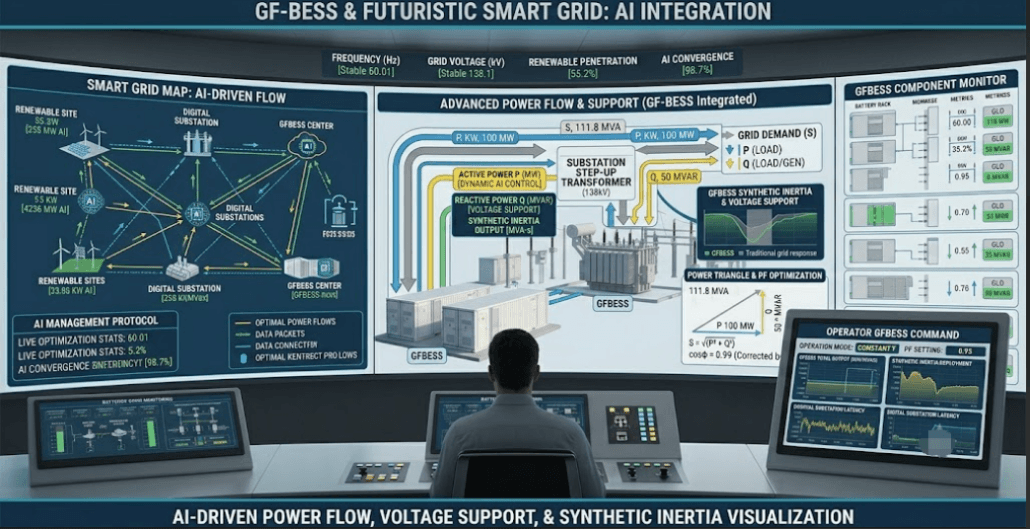
The future of BESS Power Factor management is moving beyond simple correction.
Emerging technologies include:
- Grid-forming inverters
- Synthetic inertia
- AI-driven optimization
- Dynamic VAR compensation
- Virtual synchronous machines
As grids become more renewable, these technologies will become increasingly important.
Furthermore, future Battery Energy Storage Systems will provide even greater grid support capabilities.
Frequently Asked Questions About BESS Power Factor
What is BESS Power Factor?
BESS Power Factor is the ratio between active power and apparent power delivered by a Battery Energy Storage System.
Why is BESS Power Factor important?
It affects PCS sizing, grid compliance, voltage regulation, and system performance.
Can a BESS improve power factor?
Yes. Modern PCS inverters can inject or absorb reactive power to improve power factor.
Does reactive power consume battery energy?
Reactive power primarily uses inverter capacity. Therefore, it typically causes minimal battery energy consumption.
What power factor is required for utility-scale BESS?
Most utilities require operation between 0.95 leading and 0.95 lagging. However, requirements vary by region.
Conclusion
BESS Power Factor is no longer a secondary design consideration. Instead, it has become a critical requirement for modern Battery Energy Storage Systems.
A properly designed BESS can provide voltage support, reactive power compensation, and grid stabilization. In addition, it can improve renewable energy integration and create new revenue opportunities.
As utility requirements continue to evolve, understanding BESS Power Factor will remain essential for developers, EPC contractors, and energy asset owners.
For this reason, power factor analysis should be included in every Battery Energy Storage System design process.