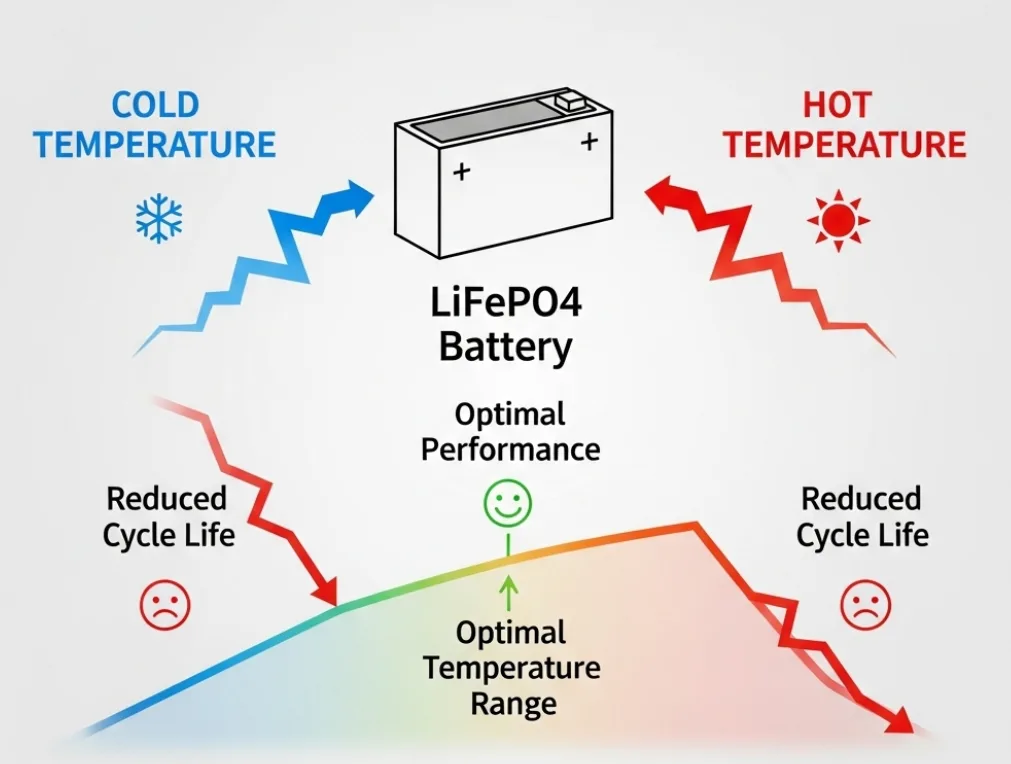
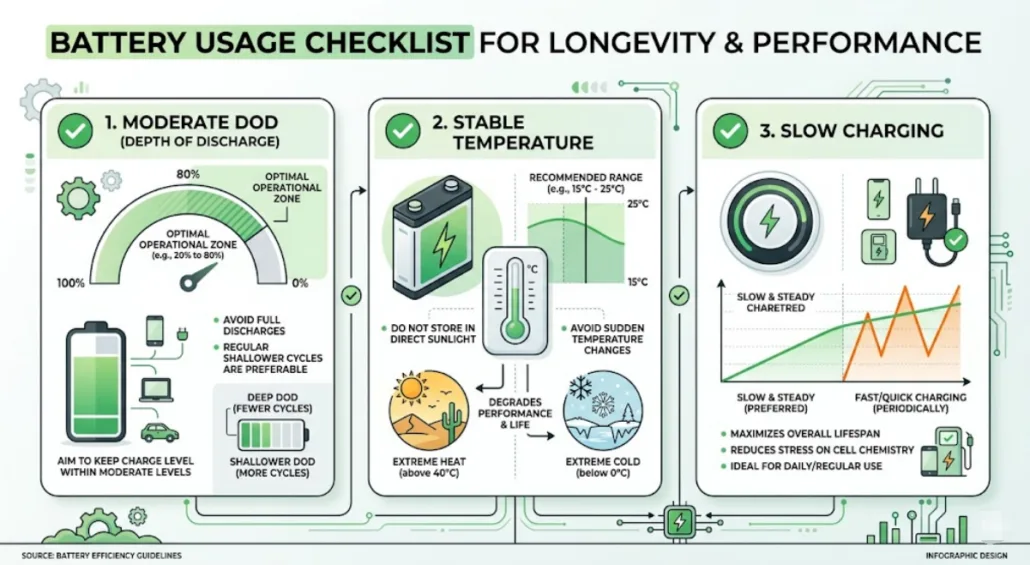
LiFePO₄ batteries are known for their long lifespan, stable chemistry, and safety. However, like all lithium-based chemistries, their cycle life is highly influenced by operating temperature.
If you want your LiFePO₄ battery to last thousands of cycles, understanding the impact of temperature is critical.
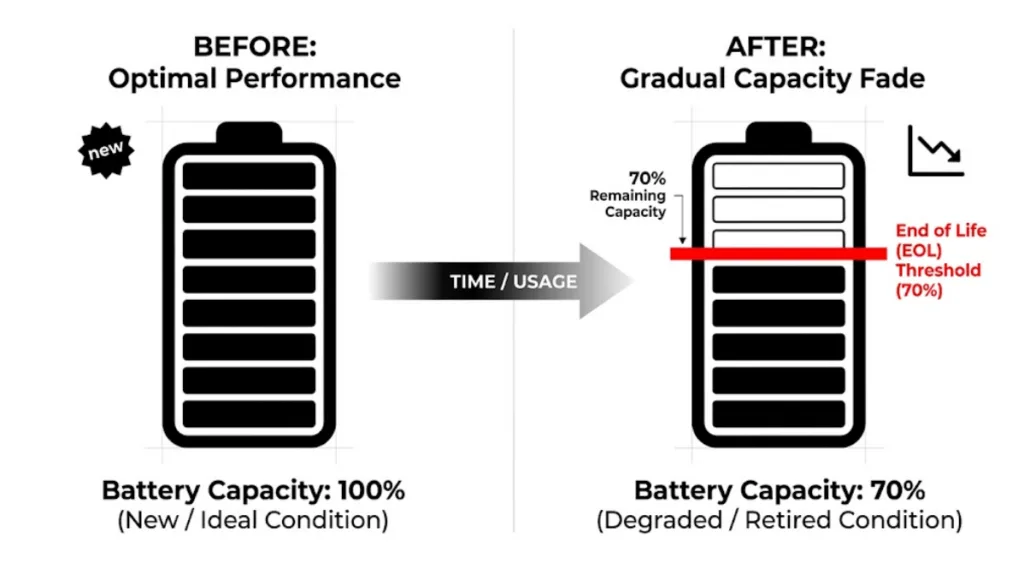
Example: If a LiFePO₄ battery starts at 100 Ah capacity and is considered “end-of-life” at 80 Ah, the number of cycles to reach this point is its cycle life.
Why Temperature Matters
Temperature affects the electrochemical reactions, internal resistance, and degradation rate of LiFePO₄ cells:
High Temperatures (>40 °C)
Speeds up electrolyte decomposition.
Causes lithium plating and faster SEI (Solid Electrolyte Interface) growth.
Shortens cycle life drastically.
Low Temperatures (<0 °C)
Reduces ionic mobility.
Increases internal resistance.
May cause lithium plating during charging.
Optimal Range (15 °C – 30 °C)
Best balance between performance and longevity.
Minimal degradation rate.
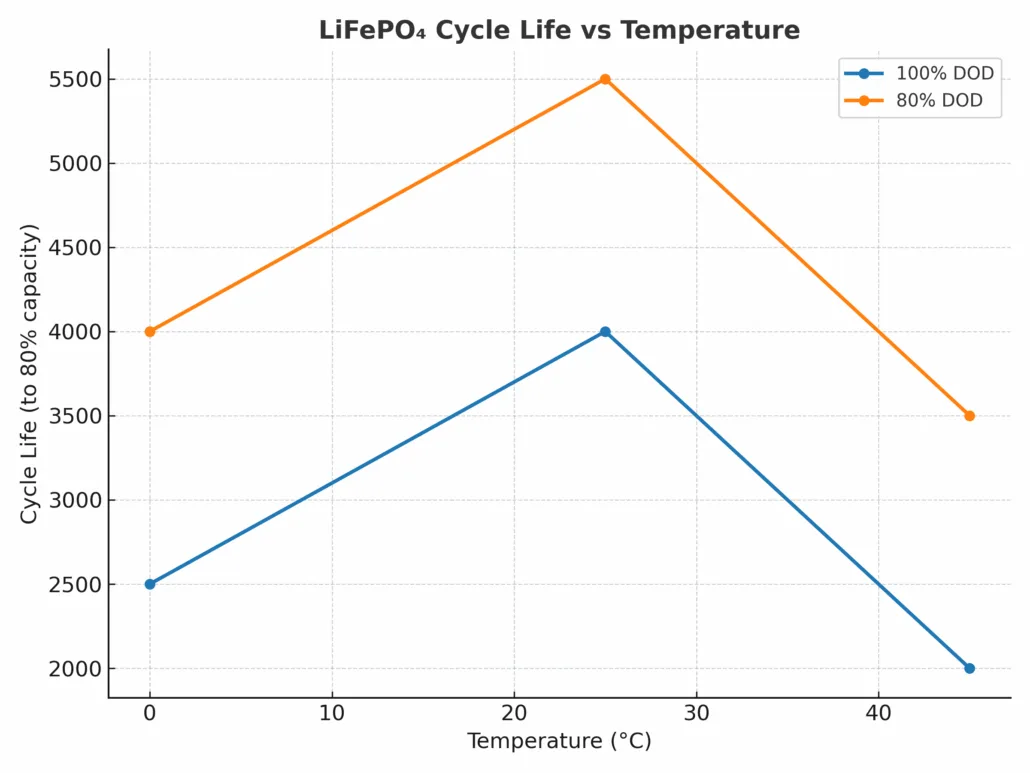
Cycle Life at Different Temperatures – Datasheet Example
Let’s take an example from a typical LiFePO₄ cell datasheet (values are representative of many commercial cells):
Temperature
Depth of Discharge (DOD)
Cycle Life (to 80% capacity)
25 °C
100% DOD
3,500 – 4,000 cycles
25 °C
80% DOD
5,000 – 6,000 cycles
45 °C
100% DOD
~2,000 cycles
45 °C
80% DOD
~3,500 cycles
0 °C
100% DOD
~2,500 cycles
0 °C
80% DOD
~4,000 cycles
Key Takeaways from the Table:
Going from 25 °C to 45 °C can cut cycle life almost in half.
Shallower depth of discharge (DOD) greatly extends life at any temperature.
Low temperatures reduce cycle life but not as severely as high heat.
Formula – Estimating Temperature Impact on Cycle Life
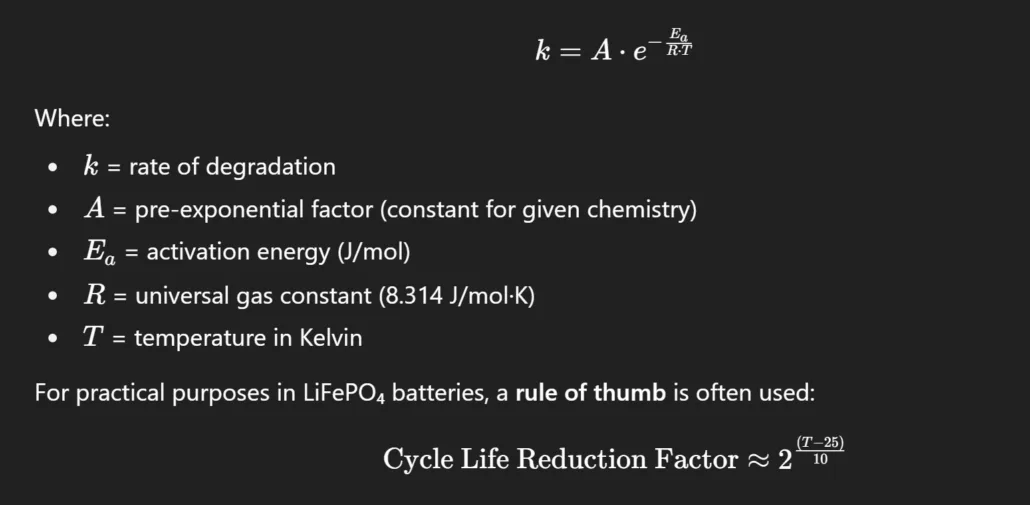
Many battery engineers use a simplified Arrhenius equation to estimate how temperature affects degradation:
Meaning:
Every 10 °C increase above 25 °C halves the cycle life.
Every 10 °C decrease below 25 °C increases life slightly, but at the cost of lower performance.
Ensures cells are operated within safe voltage and temperature limits.
Final Thoughts
Temperature has a direct, measurable impact on LiFePO₄ cycle life. While the chemistry is far more temperature-tolerant than other lithium-ion types, excessive heat is still the fastest way to kill a battery.
By keeping your batteries in the optimal range, using a good BMS, and managing DOD, you can achieve 5,000+ cycles and over 10 years of reliable performance.
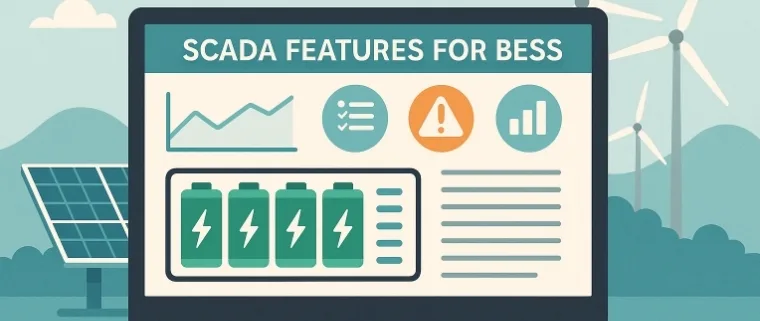
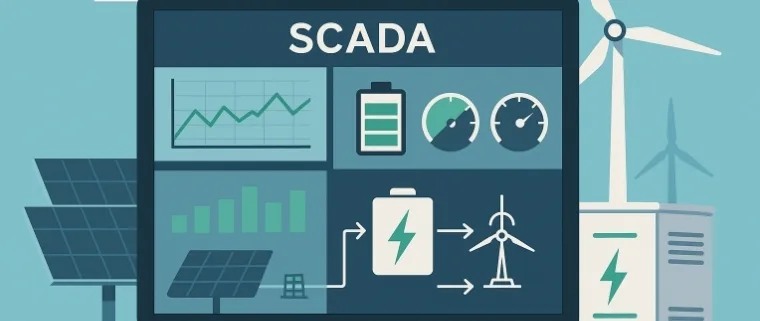
As Battery Energy Storage Systems (BESS) continue to evolve, the need for intelligent monitoring and control becomes essential. One system that stands out in delivering this capability is SCADA. In this post, we explore the most powerful SCADA features that make energy storage smarter, safer, and more efficient.
This ensures balanced energy dispatch and helps optimize cost savings across renewable and storage assets.
Final Thoughts: SCADA Features Drive Smarter Energy Storage
In today’s fast-moving energy landscape, SCADA features are the digital foundation of effective BESS management. From remote control to predictive insights, each feature plays a critical role in keeping storage systems smart, responsive, and secure.
As energy demands grow and decentralized systems become the norm, investing in advanced SCADA features isn’t just a good idea—it’s a necessity.
In today’s rapidly evolving energy sector, Battery Energy Storage Systems (BESS) play a vital role in grid stability, renewable energy integration, and peak load management. But what ensures their efficient, safe, and reliable operation? The answer lies in a powerful control system known as SCADA.
This enables smart decision-making across the energy ecosystem.
Conclusion: SCADA Enables Smart, Safe, and Scalable BESS
The use of SCADA in BESS is not just a technical convenience—it is a necessity for scaling clean energy systems. With advanced monitoring, remote control, data analytics, and real-time fault detection, SCADA ensures that battery storage systems operate at peak efficiency, safely and reliably.
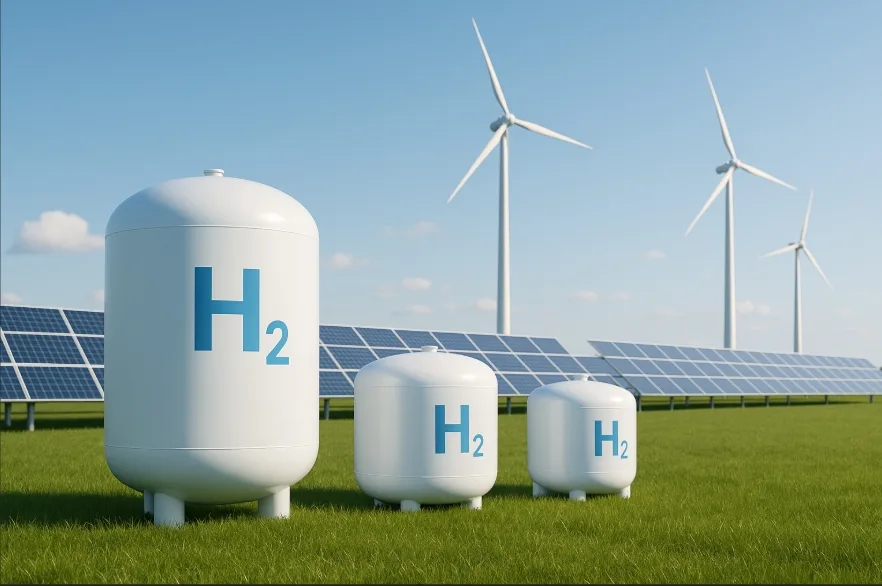
Long Duration Energy Storage (LDES) refers to energy storage systems that can discharge energy continuously for more than 10 hours, unlike traditional short-term batteries. LDES solutions are designed to store excess electricity—often from renewable sources like solar or wind—and release it during periods of high demand, outages, or when generation drops.
These systems are not just battery backups—they’re enablers of round-the-clock clean power, grid stability, and energy transition. With longer durations, they serve both daily and seasonal energy balancing needs.
⚡ Why is Long Duration Energy Storage Important?
Long Duration Energy Storage plays a critical role in modern energy systems. Its importance can be broken down into the following key points:
🌞 Enabling Renewable Energy Integration
One of the biggest challenges with renewable energy is its intermittent nature. Solar panels don’t generate power at night, and wind turbines are at the mercy of wind patterns.
How LDES Helps:
Stores excess daytime solar energy for nighttime use.
Balances supply and demand mismatches caused by variable renewables.
Helps reach 100% renewable energy targets.
Without LDES, we are limited in how much solar and wind energy we can effectively use.
🔌 Grid Reliability and Resilience
The grid must constantly balance generation and consumption. Outages, sudden surges, and extreme weather events challenge this balance.
LDES Improves Reliability By:
Providing backup power during outages and blackouts.
Acting as a buffer during grid instability or peak demand.
Supporting islanded microgrids and off-grid applications.
A resilient grid supported by LDES can bounce back quickly during disasters.
🛢️ Reducing Reliance on Fossil Fuels
Fossil fuel plants have traditionally handled peak loads and filled the gaps left by renewables. But this comes at an environmental and economic cost.
LDES Enables Clean Alternatives:
Replaces peaker plants with zero-emission storage systems.
Reduces carbon emissions and air pollution.
Cuts fuel dependency for countries aiming at energy independence.
💡 Why We Need Long Duration Energy Storage Now
Here’s a quick list of why LDES is no longer optional:
Renewables are growing fast, but they need storage to be reliable.
Climate change requires urgent reduction in emissions.
Blackouts and energy crises are increasing globally.
Energy equity—delivering clean power to remote regions—is now a priority.
Policy mandates and carbon neutrality goals demand storage integration.
🔬 LDES Technologies: Explained in Detail
Let’s explore the major Long Duration Energy Storage technologies powering the future:
1. 💧 Pumped Hydro Storage
How it works: Water is pumped to a higher elevation during low demand periods and released through turbines during high demand to generate electricity.
Key Benefits:
Proven, mature technology
Can deliver GW-scale storage
Low operating cost over decades
Limitations:
Requires specific geography (elevation and water availability)
High initial capital cost
2. 🌬️ Compressed Air Energy Storage (CAES)
How it works: Air is compressed using electricity and stored in underground caverns. When needed, the air is heated and expanded through turbines to generate power.
Key Benefits:
Long operational lifespan
Can be scaled up easily
Low cost per kWh at scale
Limitations:
Requires underground storage space
Efficiency is lower than some alternatives (~50-70%)
3. 🔥 Thermal Energy Storage (TES)
How it works: Excess energy is stored as heat (or cold), often in molten salts or phase change materials, and later used for power generation or industrial heating/cooling.
Key Benefits:
Excellent for concentrated solar power (CSP)
Useful for both electric and thermal applications
Scalable and cost-effective
Limitations:
Energy-to-electricity conversion can involve losses
Best suited for hybrid systems
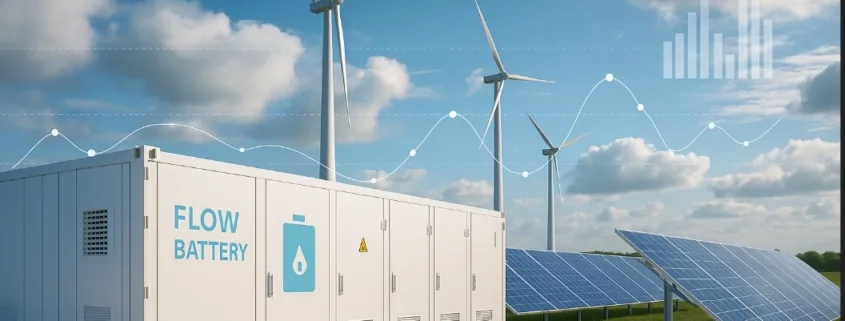
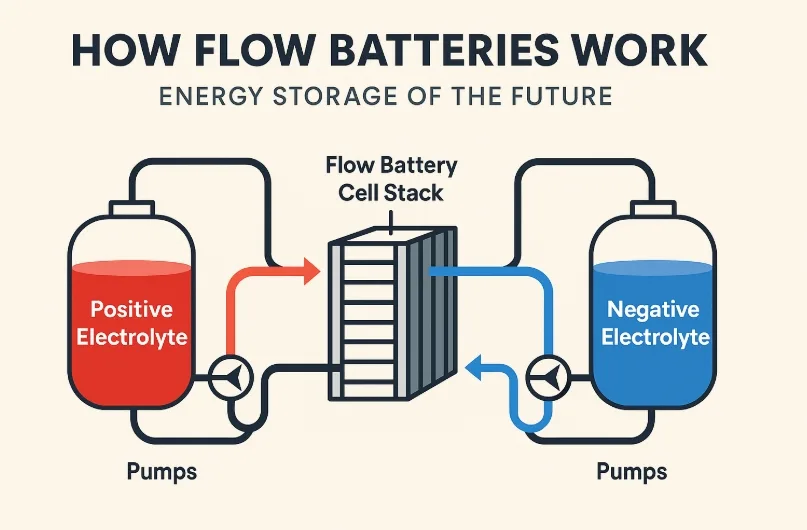
4. ⚗️ Flow Batteries
How it works: Electrolytes are stored in external tanks and pumped through a cell stack where chemical energy is converted into electrical energy.
Seasonal Storage: Especially in northern climates where solar dips in winter.
❓ FAQ: Long Duration Energy Storage
Q1: What is the difference between short and long duration energy storage?
A1: Short duration systems (e.g., lithium-ion) store energy for 1–4 hours. Long duration systems store energy for 10 hours or more, addressing broader grid needs.
Q2: Is LDES only for renewable energy?
A2: While LDES is crucial for integrating renewables, it can also support fossil-free baseload power, emergency backup, and industrial loads.
Q3: Is LDES commercially viable today?
A3: Yes, many LDES technologies are already in pilot or commercial use, especially in Europe, China, and the U.S., with rapid cost reductions underway.
Q4: Which LDES technology is best?
A4: It depends on the application:
Hydrogen for seasonal shifts
Hydro and CAES for bulk storage
Flow batteries for daily cycling
Thermal for hybrid systems
F
✅ Final Thoughts
The future of clean energy doesn’t stop at installing solar panels or wind turbines—it lies in our ability to store energy affordably, reliably, and sustainably. That’s where Long Duration Energy Storage (LDES) becomes indispensable.
LDES isn’t just an energy solution; it’s an economic enabler, an environmental protector, and a key pillar of global decarbonization.
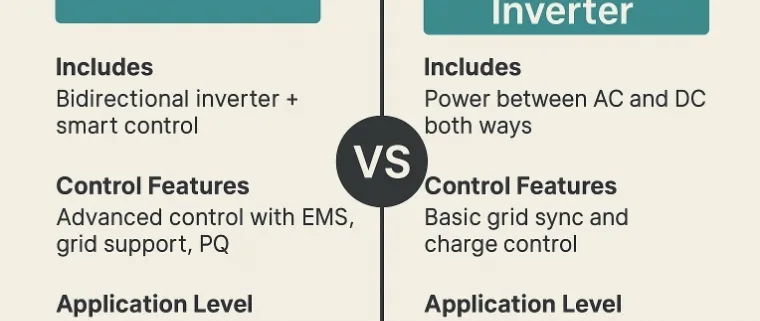
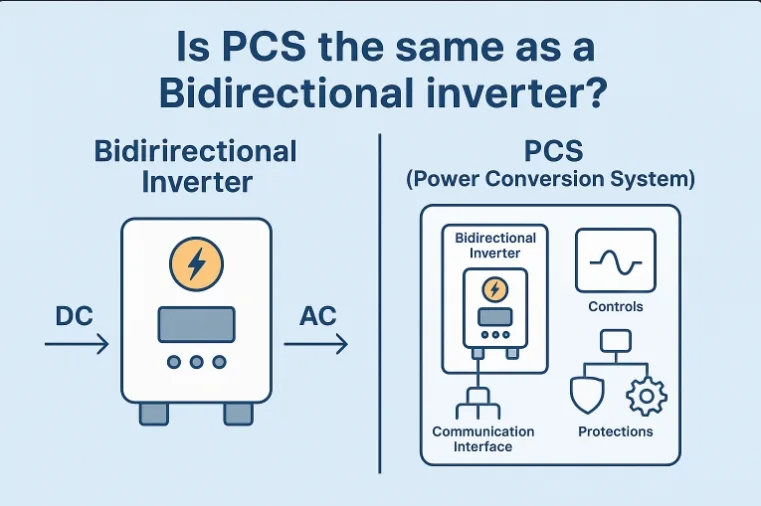
Bidirectional Inverter vs PCS: In the evolving world of energy systems, both Bidirectional Inverters and Power Conversion Systems (PCS) play a critical role—especially in energy storage systems (ESS), microgrids, and renewable power integration. While they appear similar in functionality, they are not interchangeable. In this blog, we break down every point of comparison, explain how each works, and where they are best used.
AC to DC Conversion: Converts grid AC to DC to charge batteries.
DC to AC Conversion: Converts stored DC back to AC to supply the load or feed the grid.
Grid Synchronization: Ensures power output is matched in voltage, frequency, and phase with the grid.
Battery Management Communication: Works with BMS to control charging/discharging safely.
⚙️ Usage Areas:
Home and commercial solar + battery systems
Microgrids
EV charging stations with V2G (Vehicle to Grid)
UPS systems with grid-tie capability
⚡ What Is a PCS (Power Conversion System)?
A PCS, or Power Conversion System, is a more comprehensive solution. It usually includes bidirectional inverter functionality, plus additional components such as:
Grid-interfacing controller
Communication interfaces
Safety protections
Advanced energy management algorithms
✅ Functions of PCS:
Bidirectional Power Flow: Handles charging and discharging like a bidirectional inverter.
Energy Management: Integrates with EMS (Energy Management System) for dynamic power flow.
Power Quality Control: Manages frequency, reactive power, and voltage.
Multi-port Control: Can connect multiple DC sources (PV, battery, etc.).
Islanding and Black Start: Supports off-grid operation and black start capability.
You need basic backup power and solar integration.
Budget is limited and advanced control isn’t a priority.
Choose PCS if:
You’re deploying a grid-scale battery system.
You need integration with grid operations or islanding capabilities.
You require smart control, power quality management, or multiple energy inputs.
📌 Bidirectional Inverter vs PCS: Real-World Example
Home System with Bidirectional Inverter: A solar home with a 10 kWh lithium battery uses a bidirectional inverter to charge the battery during the day and power the home at night. It synchronizes with the grid and works with a BMS.
Utility-Scale PCS Example: A 2 MW/4 MWh battery system at a wind farm uses PCS to manage energy injection into the grid during peak demand, support frequency regulation, and provide backup during outages.
🧠 Bidirectional Inverter vs PCS: Final Thoughts
Both Bidirectional Inverters and PCS are essential in the shift toward smarter, more resilient power systems. However, understanding their differences in function, scale, and intelligence is crucial before choosing the right solution.
In summary:
Use Bidirectional Inverter for basic energy conversion and storage in smaller systems.
Use PCS for smart, scalable, and grid-integrated power management in large or complex setups.
In the age of electric vehicles, solar energy storage, and portable power, batteries are everywhere. However, they don’t work efficiently—or safely—on their own. That’s where the Battery Management System (BMS) steps in.
A BMS monitors, protects, and optimizes battery operation. In this guide, we’ll break down how a BMS works, what makes it essential, and how it improves battery safety and performance.
Let’s begin with the basics.
🔍 What Is a BMS (Battery Management System)?
A Battery Management System (BMS) is an electronic controller found in nearly every advanced battery pack. Whether in electric scooters or solar home systems, the BMS performs several important tasks:
It monitors battery health and performance.
It protects the battery from unsafe conditions.
It balances cells to maintain consistency.
It calculates key values like State of Charge (SOC) and State of Health (SOH).
It communicates with other devices and controllers.
In short, it acts as the brain behind the battery.
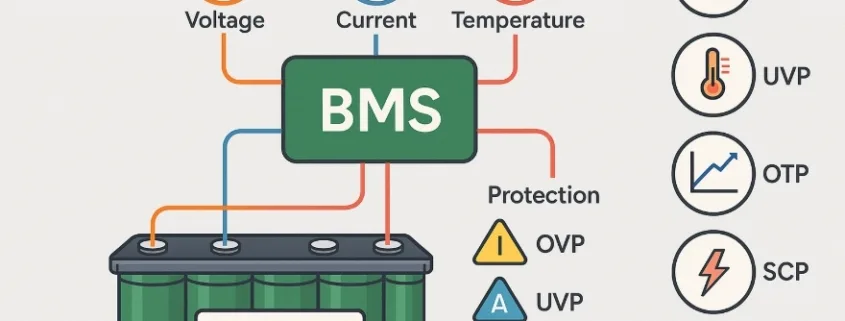
Each battery cell has a safe voltage range. The BMS monitors individual cell voltages and the total pack voltage. Even a small voltage imbalance can reduce performance or cause damage.
➡️ Why it matters: It helps avoid overcharging or over-discharging, which can permanently damage cells.
⚡ Current Monitoring
By measuring the charging and discharging current, the BMS keeps track of how much energy is moving in or out of the battery.
➡️ Why it matters: It prevents dangerous current spikes and helps calculate the battery’s remaining energy.
🌡️ Temperature Monitoring
Battery temperature is closely watched using thermal sensors. Too much heat or cold can cause big problems.
➡️ Why it matters: If a battery gets too hot, it can overheat or even catch fire. Monitoring temperature helps avoid this.
🛡️ BMS Protection Features: Preventing Damage Before It Happens
Real-time monitoring is helpful, but monitoring alone isn’t enough. The BMS also responds when things go wrong. It includes four core protection mechanisms, each with a specific safety role.
1. ✅ Over Voltage Protection (OVP)
If a battery is charged beyond its safe limit, chemical reactions inside the cells can become unstable.
➡️ Why it matters: OVP prevents this by stopping charging when voltage gets too high. This protects the cells and keeps them from overheating.
2. ❌ Under Voltage Protection (UVP)
If voltage drops too low during discharge, cells can be permanently damaged.
➡️ Why it matters: UVP shuts down the battery before damage occurs. It helps protect capacity and extends battery life.
3. 🌡️ Over Temperature Protection (OTP)
Charging or discharging at extreme temperatures can harm the battery.
➡️ Why it matters: OTP stops activity when the battery is too hot or cold. This ensures safe operation in every condition.
4. ⚠️ Short Circuit Protection (SCP)
If a short circuit occurs, current can spike instantly. This can lead to fire or explosion.
➡️ Why it matters: SCP reacts in microseconds to cut off power, preventing serious accidents.
⛽️ State of Charge (SOC): How Much Energy Is Left?
Think of SOC as the battery’s fuel gauge. It tells you how much usable energy remains, usually shown as a percentage (like 75% or 50%).
How SOC is calculated:
Coulomb counting: Tracks how much current flows in and out.
Voltage-based estimation: Uses resting voltage as an indicator.
Temperature-corrected models: Account for heat effects on performance.
➡️ Why it matters: Knowing SOC helps you avoid running out of battery unexpectedly. It also prevents overcharging, which protects the battery.
➡️ Why it matters: A battery may charge fully but still not perform like new. SOH lets users know when a battery is aging or needs replacement. It’s also useful for warranties and service checks.
⚖️ Cell Balancing: Keeping Every Cell in Sync
While monitoring and protection are essential, a truly effective Battery Management System also performs cell balancing. This function ensures that all individual cells within the battery pack maintain equal voltage levels.
Over time, slight differences in cell chemistry, resistance, or temperature cause some cells to charge faster or slower than others. Left unchecked, this leads to performance drops and early aging.
📌 What Is Cell Balancing?
Cell balancing equalizes the voltage of each cell, improving pack efficiency and lifespan.
There are two main types:
1. 🔋 Passive Balancing
In passive balancing, extra energy from higher-voltage cells is burned off as heat using resistors.
✅ Simple and low-cost
✅ Common in consumer electronics
❌ Less efficient due to energy loss
2. ⚡ Active Balancing
Active balancing redistributes charge from more charged cells to less charged ones, using inductors, capacitors, or switch networks.
✅ Higher efficiency
✅ Extends battery life
✅ Suitable for EVs, BESS, drones
❌ More complex and expensive
🧠 Why Balancing Matters
Balancing is critical because even small voltage mismatches between cells can lead to:
Uneven charging
Reduced usable capacity
Early triggering of safety cutoffs
Accelerated aging in weaker cells
By balancing cells, the BMS ensures every cell contributes equally—maximizing safety, performance, and battery lifespan.
⚙️ Where BMS Is Used
You’ll find BMS systems in many places, including:
…a BMS ensures that the battery stays safe, efficient, and long-lasting.
If you’re using or building battery-powered systems, never ignore the importance of a well-designed BMS. It’s the hidden engine behind every reliable energy solution.
🤛 BMS Frequently Asked Questions
Q1: Can I use batteries without a BMS?
➡️ Technically yes, but it’s risky. A BMS prevents overheating, damage, and accidents.
Q2: What type of batteries use a BMS?
➡️ Mostly lithium-based batteries (like Li-ion or LiFePO4), but other chemistries can also benefit.
Q3: Can a BMS extend battery life?
➡️ Absolutely. By balancing cells, protecting from damage, and avoiding extreme conditions, a BMS helps batteries last longer.
Q4: How accurate is the SOC reading?
➡️ Accuracy depends on the BMS algorithm, temperature conditions, and battery type. Premium systems can be highly precise.
LiFePO4 datasheet metrics: When buying LiFePO4 (Lithium Iron Phosphate) battery cells, many people only look at the price. But just going for the cheapest option can lead to problems later — like poor performance, short battery life, or safety risks.
If you want a battery that’s reliable, lasts long, and suits your needs, you must check the datasheet carefully. The datasheet is like a report card — it tells you what the battery can really do.
In this blog, we’ll explain how to read a LiFePO4 battery datasheet in simple words and how to use that information to find the best value — not just the lowest price.
✅ What Is a Battery Datasheet?
A battery datasheet is a technical document provided by the manufacturer. It includes important numbers and details that tell you how the battery works — like how much power it gives, how long it lasts, how hot it can get, and how safe it is.
If you can read these details, you can avoid low-quality or fake cells and choose the right one for your project.
🔍 Important LiFePO4 Datasheet Metrics (Explained in Simple Words)
Here are the main things to look for in a datasheet and what they really mean:
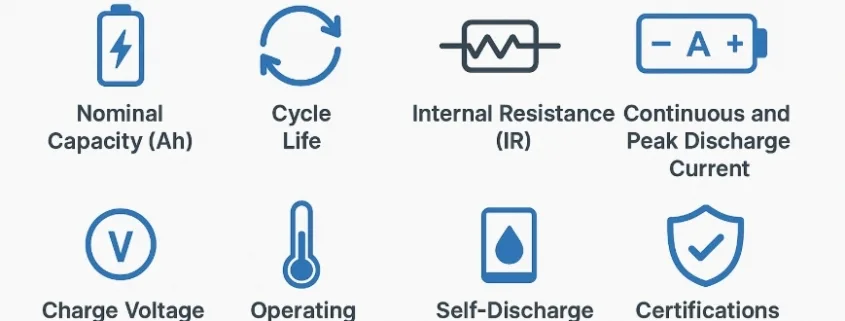
⚡ 1. Nominal Capacity (Ah)
What It Means: This tells you how much energy the battery can store.
Measured In: Ampere-hours (Ah)
Why It Matters: The higher the number, the more energy the cell can provide before it needs charging again.
Tip: Make sure it matches what you need. For example, a 100Ah battery gives more backup than a 50Ah battery.
Why It Matters: Certified batteries are safer to use and often required for shipping or installing in regulated systems.
💡 Real-World Example: Why Price Isn’t Everything
Let’s say you are comparing two cells:
Feature
Cell A
Cell B
Price per Cell
$85
$65
Capacity
100Ah
100Ah
Cycle Life
4,000 cycles
2,000 cycles
Usable Energy
100Ah × 3.2V × 80% × 4,000 = 1,024 kWh
512 kWh
Cost per kWh
$0.083
$0.127
📌 Conclusion: Even though Cell B is cheaper at first, Cell A gives twice the energy over its life and ends up costing you much less in the long run.
🚨 Warning Signs in a Bad LiFePO4 datasheet metrics
❌ Missing test conditions (e.g., no info on how cycle life was tested)
❌ Unrealistic claims like “10,000 cycles” with no proof
❌ No certifications or safety reports
❌ Different values shown for the same model on different documents
💬 FAQs about LiFePO4 datasheet metrics
Q1: What if the LiFePO4 datasheet has no cycle life info?
A: That’s a red flag. Reliable suppliers always share cycle life test results.
Q2: Can I test internal resistance myself?
A: Yes. Use a battery IR tester. You can compare it with the datasheet to check if it matches.
Q3: Why does the same capacity battery have different prices?
A: Because of quality, grade (A or B), certifications, and performance specs. Price doesn’t tell the full story.
🏁 Final Thoughts
When buying LiFePO4 batteries, don’t just ask, “How much does it cost?”
Instead, ask:
How long will it last?
Is it safe?
Will it work well in my system?
Does the datasheet match the performance I need?
📘 The LiFePO4, battery datasheet, battery safety, battery grading, energy storage, EV batteries, cycle life, internal resistancet gives you the answers. Learn how to read it — and you’ll make better, safer, and more cost-effective decisions.
LiFePO4 battery testing: LiFePO4 batteries have become the backbone of energy storage systems, from solar power banks to electric vehicles. But did you know that behind every “Grade A” label is an extensive, complex process of testing, sorting, and grading? This blog post takes you inside the factory to reveal how manufacturers test LiFePO4 cells, what parameters matter most, and why standardized grading remains a challenge.
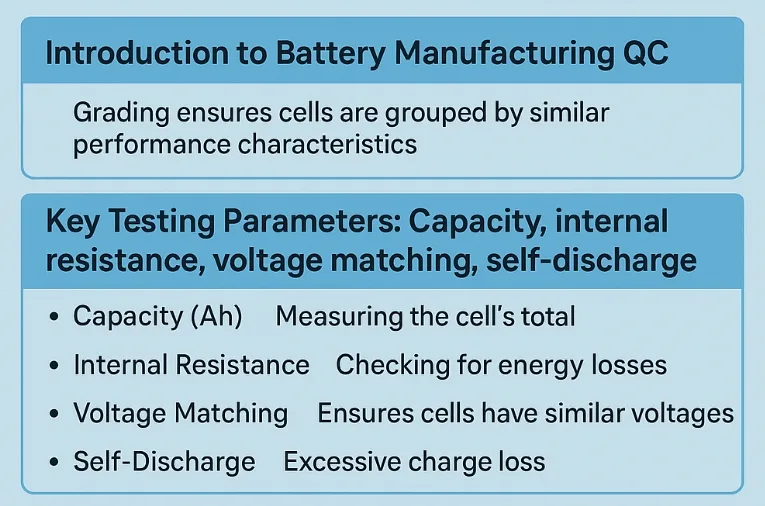
Introduction to Battery Manufacturing QC for LiFePO4 Battery Testing
In any reputable LiFePO4 cell factory, Quality Control (QC) is the beating heart of the operation. The manufacturing process includes multiple checkpoints — from raw material inspection to final cell testing. Even the best production lines produce cells with slight variations. These variations affect performance, safety, and lifespan, which is why proper grading is essential.
Grading helps ensure that cells with similar performance characteristics are grouped together. This is vital for applications like energy storage systems (ESS), where mismatched cells can cause premature failure or reduced efficiency.
LiFePO4 Battery Testing Parameters: What Gets Checked?
Let’s break down the most critical parameters manufacturers measure when grading LiFePO4 cells.
1. Capacity (Ah)
Capacity is the total amount of charge a cell can store, typically measured in ampere-hours (Ah). Manufacturers run charge-discharge cycles to verify that the cell meets or exceeds its rated capacity — usually within ±2% for Grade A cells. Cells that fall slightly below the spec can get downgraded to Grade B or C.
2. Internal Resistance (IR)
Internal resistance affects how well a battery can deliver current. High IR means greater energy losses and more heat during use. Cells with lower IR are preferred for applications requiring high power output. Manufacturers test IR at different temperatures to ensure stability. For a full breakdown of what drives IR and how it’s measured, see our guide on Cell Internal Resistance.
3. Voltage Matching
Cells are sorted based on their open-circuit voltage (OCV) to ensure that packs built from multiple cells stay balanced. Cells with mismatched voltages can lead to uneven charge/discharge cycles and reduce overall pack life.
4. Self-Discharge Rate
A cell’s self-discharge rate determines how quickly it loses charge when not in use. Excessive self-discharge indicates internal defects or impurities, which can compromise performance and safety.
Cycle Life Testing Protocols: How Long Will It Last?
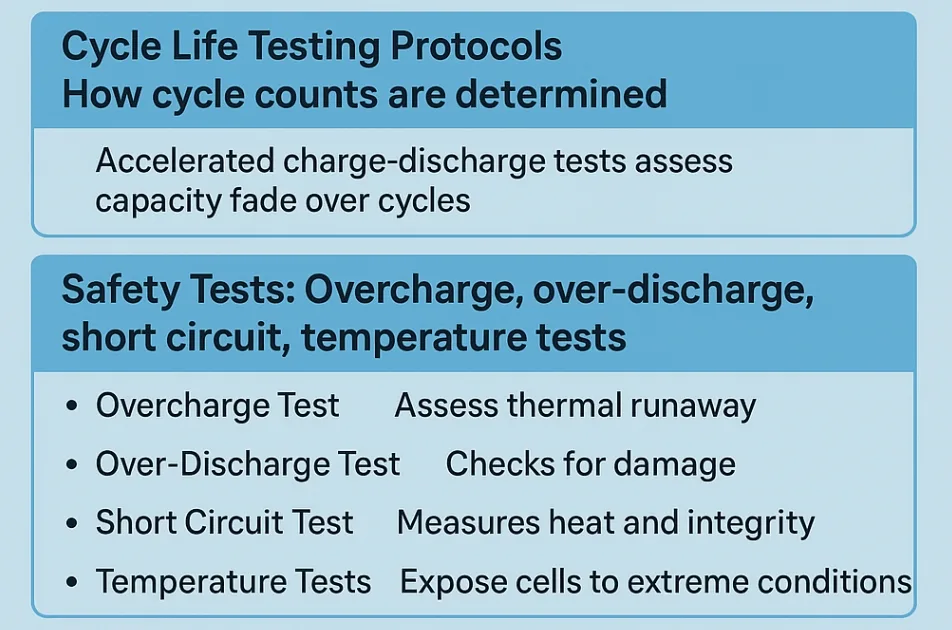
One of the biggest selling points of LiFePO4 is its long cycle life — often 2,000–6,000 cycles. But how is this tested?
Due to time constraints, manufacturers often rely on statistical sampling and predictive modeling rather than testing every cell for thousands of cycles.
Safety Tests: Beyond Performance
LiFePO4 is one of the safest lithium-ion chemistries, but that doesn’t mean safety tests are skipped.
Common safety tests include:
Overcharge Test: The cell is charged beyond its maximum voltage to check for thermal runaway or swelling.
Over-Discharge Test: The cell is deeply discharged to see if it can recover without damage.
Short Circuit Test: The terminals are shorted under controlled conditions to check heat generation and structural integrity.
Cells that fail safety tests are immediately rejected or downgraded for less demanding applications.
The “Defect Rate” and How Grade B/C Cells Are Created
No production line is perfect. Even leading manufacturers have a defect rate — usually 3–5% — where cells fall outside the ideal performance window.
Grade B cells: Slightly lower capacity or higher IR than Grade A, but still usable for less critical applications like budget power banks or backup systems.
Grade C cells: Significant deviations or borderline defects. Often sold at a deep discount for non-critical uses or recycling. These should never be used in high-demand or mission-critical projects.
Some unscrupulous sellers remarket Grade B or C cells as Grade A, so it’s crucial to buy from trusted suppliers with traceable testing data.
LiFePO4 Battery Testing: Why Standardized Grading is a Challenge
One frustrating reality in the LiFePO4 market is the lack of a global standard for grading. Different factories may use slightly different thresholds for what they call Grade A, B, or C.
Factors like:
Local production tolerances
Variations in test equipment
Sampling size
Batch-specific conditions
…all mean that “Grade A” from one supplier might be closer to “Grade B” by another’s standards.
For buyers, this makes third-party testing and working with reputable suppliers essential. A cell’s data sheet should always come with original test reports showing capacity, IR, and other key parameters.
Final Thoughts: Stay Informed, Source Smart
Demystifying LiFePO4 cell grading is about understanding the science behind your battery pack. When you know what goes into the tests — capacity, IR, voltage, cycle life, and safety — you can better evaluate what you’re buying.
✅ Always ask for factory test reports. ✅ Buy from suppliers who are transparent about their QC processes. ✅ Match your project’s needs with the right cell grade.
A few extra dollars spent on verified Grade A cells can save you massive headaches, costly replacements, or even safety risks down the line.
LiFePO4 Battery Testing FAQs
Q: How do I know if a LiFePO4 cell is really Grade A?
A: Always request factory test reports showing capacity, internal resistance, voltage, and cycle life data.
The growing popularity of LiFePO4 (Lithium Iron Phosphate) batteries in solar energy storage, RVs, and off-grid setups has brought a flood of suppliers into the market. It’s tempting, especially for DIYers and budget-conscious buyers, to grab the cheapest deal. But beware — that bargain pack of cells labeled “Grade A” at suspiciously low prices might actually be low-grade or even rejected cells. The short-term savings could cost you big in the long run. how to protect from Battery Scam?
The Trap: Why Cheap Batteries Can Cost You More
There’s a reason reputable suppliers and certified manufacturers charge more for Grade A LiFePO4 cells. High-quality cells are rigorously tested for consistency in capacity, internal resistance, cycle life, and safety. Low-grade or Grade C cells often fail these tests — they’re the factory rejects, excess stock, or even refurbished cells passed off as new.
Unscrupulous sellers know that most buyers can’t test cells themselves. They slap a “Grade A” sticker on low-quality cells and move inventory fast. Once the battery pack fails or causes problems, it’s too late.
Performance Issues: The Hidden Cost of Low-Grade Cells
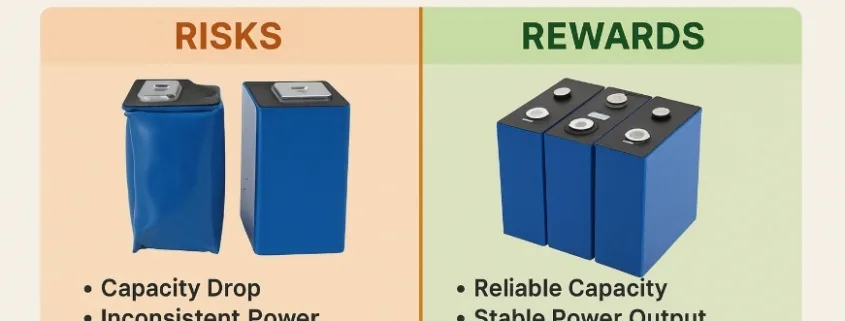
1. Unexpected Capacity Drops: Low-grade cells often have inconsistent capacity ratings. You might think you’re getting 100Ah, but in real-world use, you may only get 70–80% of the advertised capacity — if that.
2. Inconsistent Power Output: Cells with mismatched internal resistance or degraded chemistry can’t deliver stable power. You’ll notice fluctuations, poor performance under load, or even sudden shutoffs — not ideal if you rely on your batteries for critical energy needs.
Overheating & Swelling: Poor-quality cells are more prone to swelling due to gas buildup. They can overheat during charging or discharging, increasing the risk of thermal runaway.
Imagine spending hundreds or thousands of dollars to build or buy a battery bank, only to have cells fail after a few months. Low-grade cells can lose capacity rapidly, dropping below usable levels in a fraction of the cycles you’d get from genuine Grade A cells.
What’s worse, a single bad cell can drag down an entire battery pack — meaning you may have to replace the whole thing. So, that “cheap” deal can turn into double or triple the cost over time.
How to Protect Yourself: Smart Buying Steps
Don’t get scammed — here’s how to safeguard your project and your wallet:
✅ Do Your Due Diligence: Research suppliers thoroughly. Check reviews, forums, and independent test reports.
✅ Verify Supplier Claims: Reputable sellers will share the factory test reports, including capacity, internal resistance, and cycle life data. Don’t hesitate to ask.
✅ Look for Certifications: Ensure the cells meet international safety standards like UN38.3, IEC, or UL certifications.
✅ Inspect on Arrival: Check the physical condition of cells. Look for dents, swelling, corrosion, or mismatched labels.
✅ Run Your Own Tests: If you have the tools, test cells for capacity and internal resistance before building your pack.
✅ Work with Trusted Partners: Sometimes it’s worth paying a local representative or battery expert to vet suppliers and inspect shipments, especially for bulk orders.
Real-World Examples: When Cheap Batteries Go Bad
🔍 Case in Point: A small off-grid community bought a pallet of “Grade A” LiFePO4 cells from an unknown online supplier. Within six months, over 40% of the cells were swollen and underperforming. When they tried to claim a warranty, the seller disappeared. They ended up paying twice — once for the junk cells, and again for new, certified replacements.
🔍 Another Example: A DIYer on a popular solar forum shared photos of cells they’d bought at a discount. They discovered old weld marks under the heat shrink — the cells were clearly recycled from old packs. This can pose both performance and safety issues.
Final Thoughts: Spend Smart, Not Cheap
LiFePO4 batteries are a great investment — but only if you buy quality. When it comes to energy storage, you truly get what you pay for. A cheap battery today can become a costly, even dangerous headache tomorrow.
So, be cautious. Ask questions. Demand data. And when in doubt, remember: a trusted supplier might cost more upfront, but they’ll save you thousands in headaches down the road.
A: Without testing, it’s hard. That’s why factory test reports, supplier transparency, and independent verification matter so much.
Q: Is buying refurbished or used cells ever worth it?
A: For non-critical applications, maybe. But always expect lower performance and a shorter lifespan — and never use them for applications where reliability is crucial.
Battery Cycle Standards explain how battery life is measured; however, many datasheets are not clear. As a result, users often misunderstand real-world performance.
In reality, battery life is not a fixed number. Instead, it fluctuates based on usage and environmental conditions. Therefore, Understanding how DOD, SOH, and EOL work together is vital. Therefore, knowing these basics helps you pick the right battery for your needs
💡 Quick Summary: DOD vs SOH vs EOL
For those comparing battery specs, here is the essential relationship:
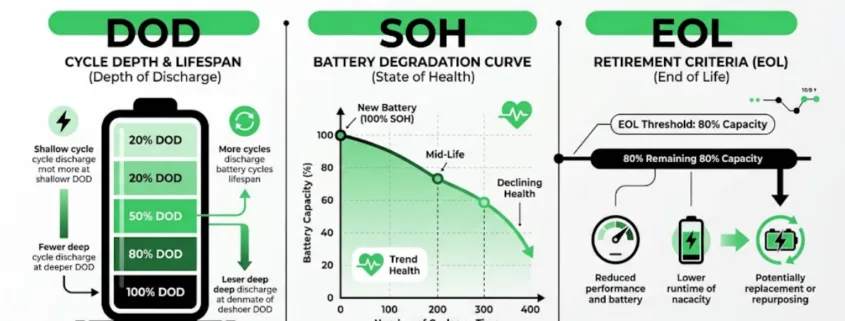
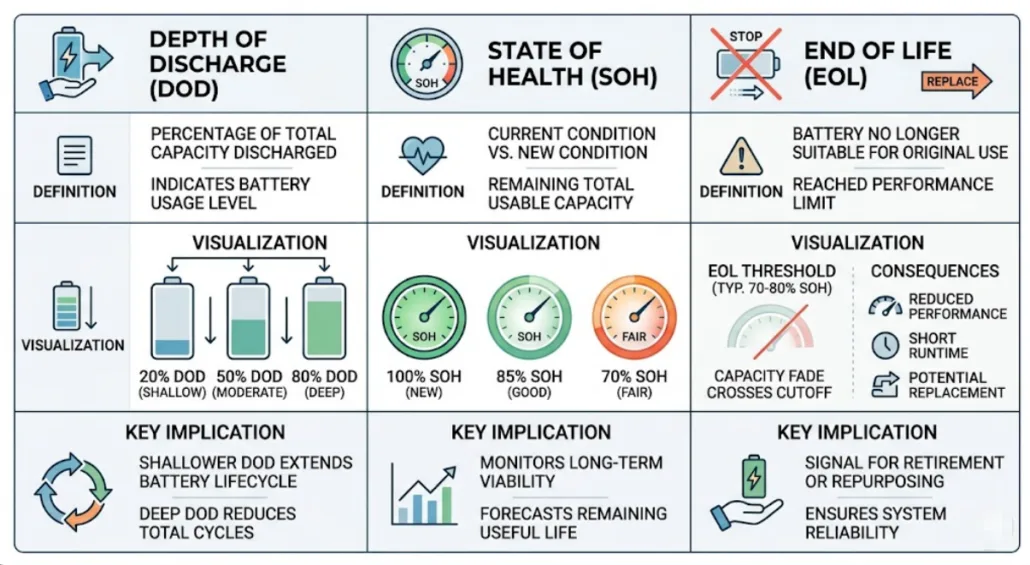
DOD (Depth of Discharge): How much energy you take out per cycle (e.g., 80%).
SOH (State of Health): How much total capacity the battery has left compared to when it was new.
EOL (End of Life): The “failure point” (usually 80% SOH) where the battery should be replaced.
The Standard: A battery rated for 6,000 cycles at 80% DOD means it can be used 6,000 times before its SOH hits the EOL limit.
What Are Battery Cycle Standards in Batteries?
Battery Cycle Standards measure how many charge and discharge cycles a battery can complete before its capacity drops to 70%–80%.
A battery cycle is formally defined as one full charge and discharge; nevertheless, real-world results depend on several critical factors. Specifically, variables such as temperature, charge rate, and Depth of Discharge (DOD) determine the actual longevity. Consequently, two batteries with identical ratings can perform very differently in different environments
For example:
Temperature
Charge rate
Depth of Discharge
What Is DOD in Battery Cycle Standards?
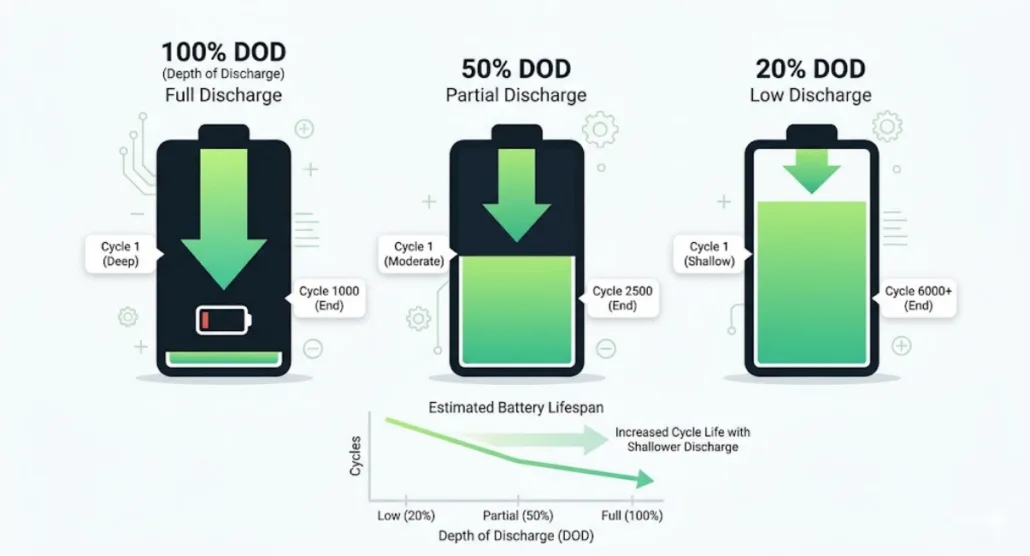
Depth of Discharge (DOD) indicates how much energy is cycled out of the battery; for instance, a 100% DOD means a full discharge, whereas a 50% DOD represents a half discharge.
For example:
100% DOD = full discharge
50% DOD = half discharge
While a higher DOD significantly increases internal stress and causes battery life to drop, utilizing a lower DOD conversely reduces wear on the cells and extends their longevity.
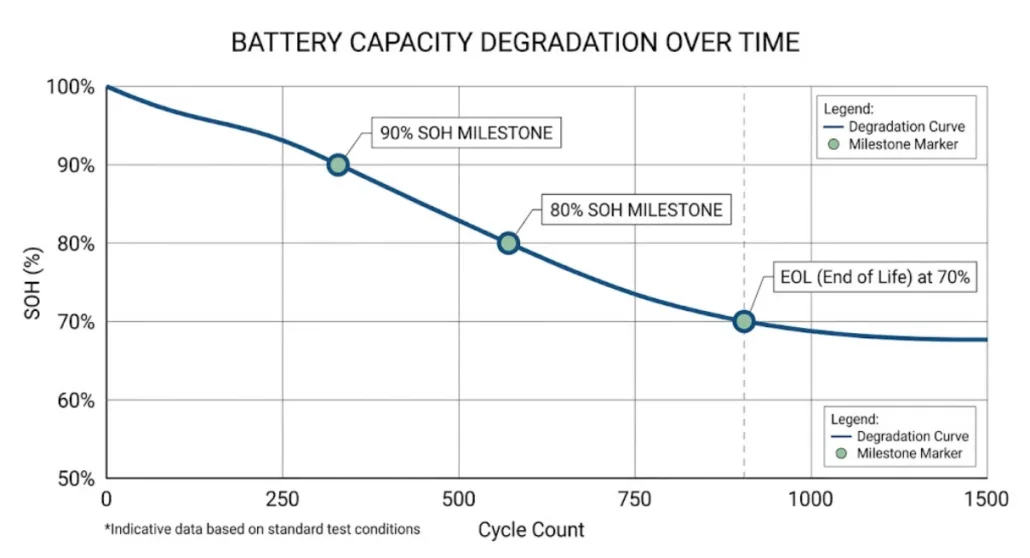
State of Health (SOH) shows remaining battery capacity.
For example:
100% SOH = new battery
80% SOH = reduced capacity
Over time, the SOH naturally decreases as the internal chemistry of the cells degrades. In addition to tracking wear, SOH serves as a vital indicator for warranty claims, since most manufacturers guarantee a specific capacity percentage over a set number of years.
When SOH drops to 80% or 70%, that’s usually considered End of Life (EOL).
What Is EOL in Battery Cycle Standards?
End of Life (EOL) identifies the point when a battery is no longer considered reliable for its primary application.
In most cases, EOL is reached when the SOH drops to 70%–80%. Although the battery still works, its power is much lower. Consequently, you should replace it to keep your system safe and steady.
EOL = 70%–80% SOH
The battery still works. However, performance is lower. Therefore, it must be replaced.
Each metric is different. Therefore, you must use all three.
Why Battery Cycle Standards Are Different
Battery cycle standards differ because testing conditions and methods are not the same.
Different Testing Goals in Battery Cycle Standards
ome companies prioritize showing higher cycle numbers for marketing purposes, whereas others focus on providing realistic life expectations for heavy-duty use. Because of this variation in goals, the results across different brands can vary wildly. Therefore, it is crucial to verify if the cycles are rated at high or low temperatures.
Battery Cycle Life Depends on Conditions
Battery life depends on real conditions.
For example:
High temperature increases wear
High load adds stress
Fast charging speeds degradation
Therefore, results change.
Marketing vs Engineering in Cycle Standards
Some data is for marketing. Other data is for engineers.
Marketing materials often highlight the highest possible cycle numbers achieved under perfect lab conditions. In contrast, engineers focus on ‘usable’ life under heavy loads. Because of this discrepancy, it is important to look past the headline numbers and examine the testing parameters instead.”
Because of this, numbers may differ.
Same Battery, Different Ratings
It is common for a single battery to show multiple cycle values depending on the criteria used. Specifically, a manufacturer might list 6,000 cycles at 80% DOD while simultaneously claiming 8,000 cycles if the EOL is set to 70% SOH. Because both ratings are technically correct, you must compare the testing methods instead of just the final numbers.
Application-Based Battery Cycle Standards
Different industries use different metrics.
For example:
Solar uses EOL
EV uses SOH
Backup uses DOD
Therefore, standards change by use case.
Which Battery Cycle Standard Should You Trust?
EOL-based cycle life is the most reliable when tested under real conditions.
However, you must check:
DOD
Temperature
Charge rate
Without this, numbers can mislead.
Simple Rule for Battery Cycle Standards
Always check:
EOL at your real DOD
This gives the most accurate result.
How DOD Affects Battery Cycle Life
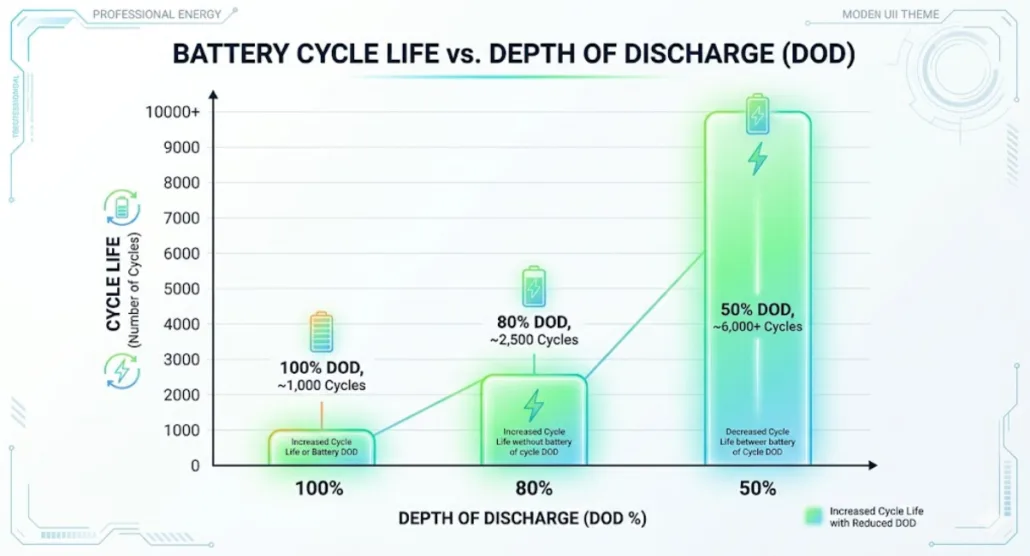
Higher DOD reduces battery life. Lower DOD increases it.
DOD
Cycle Life
100%
2,000–3,000
80%
3,000–5,000
50%
5,000–7,000
📊 Datasheet Cycle Life Calibration Tool
Input your battery’s specific datasheet baseline specs to simulate real-world environmental degradation.
📋 Step 1: Enter Datasheet Base Claims
⚙️ Step 2: Adjust Your Project Conditions
Your Operational DOD:80%
Ambient Cell Temperature:25°C
Calibrated Real-World Longevity Output
6,000 Cycles
~16.4 Years of Daily Use
⚠️ High ambient heat ($>35$°C) accelerates secondary SEI layer growth, heavily reducing chemical cycle ceilings.
*Calculated dynamically via Arrhenius rate parameters for cell aging and exponential Co-efficient models matching LFP structural chemistry metrics.
Therefore, lower DOD improves life.
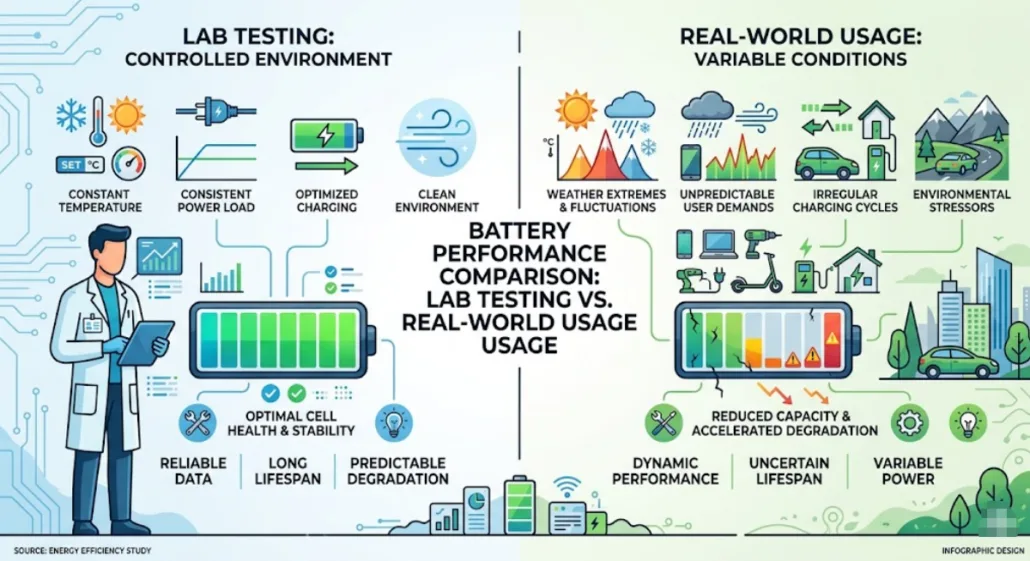
Lab vs Real Battery Cycle Performance
Lab tests typically use ideal conditions to establish a baseline; however, real-life performance is often quite different. For instance, ambient temperature fluctuations and varying discharge loads can add significant stress to the cells. As a result, the actual performance is usually lower than the theoretical ratings found on the datasheet. Consequently, users should plan for a margin of error when sizing their systems
Always compare DOD, SOH, EOL, and test conditions.
Start with your use case. Then check DOD. Next, review degradation.
Therefore, do not trust cycle numbers alone.
Battery Cycle Standards and Certifications
Battery standards are guided by:
International Electrotechnical Commission
Underwriters Laboratories
These groups define safety and testing rules.
Role of BMS in Battery Life
A Battery Management System (BMS) acts as the brain of the energy storage unit by controlling critical environmental and electrical factors.
Specifically, it manages the Depth of Discharge (DOD) and monitors internal temperatures to prevent thermal runaway. Furthermore, by regulating the charging current, the BMS ensures that the cells do not undergo excessive stress.
As a result, the overall battery life improves significantly, allowing the system to reach its full rated cycle potential.
Common Mistakes in Battery Cycle Standards
Many users make mistakes.
Many users make the mistake of trusting cycle numbers without investigating the underlying test conditions. For example, ignoring the DOD or missing the effects of high ambient temperatures can lead to premature system failure. Because of this lack of context, many buyers end up with the wrong battery for their specific climate or load requirements. Therefore, it is essential to review the full datasheet before making a final purchase
How to Improve Battery Life
While battery degradation is inevitable, you can extend your system’s lifespan easily by following a few best practices.
For instance, limiting your daily usage to a 70–80% DOD reduces the chemical strain on the Lithium-ion cells. In addition to managing discharge levels, keeping the ambient temperature stable and avoiding frequent fast charging will further preserve the SOH. Consequently, the battery will last much longer than a system that is constantly pushed to its operational limits
A battery cycle is one complete discharge and recharge of a battery’s rated capacity. It does not have to happen in a single sitting; for example, using 50% of your battery today and 50% tomorrow counts as exactly one full cycle.
How does DOD affect total battery life?
DOD (Depth of Discharge) has an inverse relationship with lifespan. Lowering your daily DOD significantly increases the total number of cycles a battery can perform. For instance, a Lithium (LFP) battery might achieve 3,000 cycles at 100% DOD but over 6,000 cycles if limited to 80% DOD.
What is the difference between SOH and SOC?
SOC (State of Charge): Tells you how much “fuel” is in the tank right now (0% to 100%).
SOH (State of Health): Tells you how much the “tank” has shrunk over time due to aging (e.g., 90% SOH means the battery can now only hold 90% of its original design capacity).
When should I replace my battery (EOL)?
The industry standard for End of Life (EOL) is 80% SOH. While the battery will still function below this point, it will drain faster and may struggle to power high-surge appliances. In solar storage, 80% is the typical threshold for warranty claims and reliable performance.
Final Takeaway
Battery Cycle Standards are not simple numbers. Instead, they depend on use and conditions.
Therefore, always check:
DOD
SOH
EOL
Always review full test conditions before comparing batteries.