
BESS OPEX and Operating Cost Model: What Really Drives Annual Expenses
A BESS OPEX and operating cost model lists every recurring cost to run a battery storage system. It covers O&M, charging electricity, degradation, insurance, taxes, and software.
So these costs sit on top of CAPEX. They also feed straight into LCOS and project-ROI models.
| Quick Answer: BESS OPEX covers every recurring cost to run a battery storage system: fixed costs like site lease, insurance, and base O&M, plus variable costs like charging electricity and performance-based fees. A BESS operating cost model sums these by year and feeds the total into LCOS and cash-flow calculations. |
Why BESS OPEX Matters as Much as CAPEX
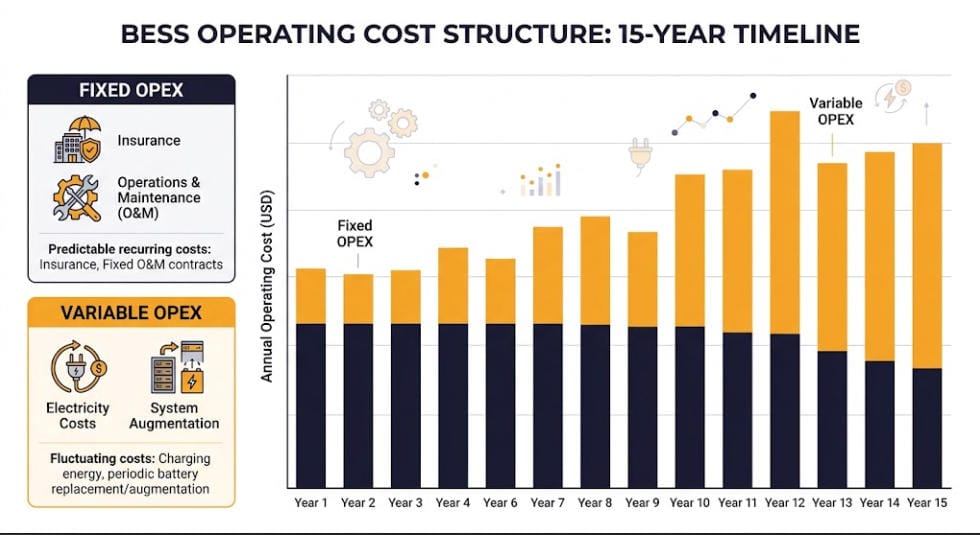
BESS OPEX splits into fixed costs and variable costs. Fixed costs include site lease, insurance, base O&M, and software.
Variable costs include charging electricity and performance-based O&M. An operating-cost model sums these items by year and feeds them into LCOS and cash-flow calculations.
CAPEX tells you what a system costs to build. OPEX tells you what it costs to run.
Two projects with similar CAPEX can still have very different LCOS, because O&M strategy or electricity price differs.
In a basic LCOS model, lifetime cost starts with initial CAPEX. Then add annual OPEX over the project life, plus charging cost, minus any residual value at the end.
Since BESS OPEX recurs every year, small fee changes can shift LCOS by tens of dollars per MWh. For deeper background, see our CAPEX vs LCOS guide and our BESS CAPEX calculation guide.
Fixed vs Variable BESS OPEX
Most BESS operating cost models split expenses into two buckets: fixed and variable.
Fixed OPEX
Fixed costs occur every year. This holds no matter how much the battery cycles.
Typical items include site lease and property taxes. For example, insurance and a base O&M contract count, along with a software subscription.
Security and site-management overhead round out fixed OPEX. This bucket often appears as dollars per kW-year, or as a flat sum per site per year.
Variable OPEX
Variable costs change with how the system runs. They include charging electricity, performance-based O&M fees, and degradation-related costs like augmentation.
Depending on the market and tariff structure, network charges, taxes, or other fees may also vary with imported energy, exported energy, throughput, or revenue. Variable OPEX usually appears as dollars per MWh charged or discharged.
A robust BESS OPEX model tracks fixed and variable costs separately. That way, you can test operating strategies without rebuilding the base cost structure each time.
Key BESS OPEX Components to Track
Use this checklist when you build an annual BESS OPEX model.
Operations and Maintenance (O&M)
O&M covers preventive maintenance, corrective repairs, remote monitoring, spare parts, and labor.
O&M contracts commonly take one of three forms: a fixed annual fee; a base fee plus a throughput-based charge; or a performance-linked arrangement with availability guarantees, incentives, and/or penalties.
Before signing, check what the contract covers. Monitoring, firmware updates, and cybersecurity patches usually make the list.
Major component replacement and grid-compliance upgrades usually don’t.
Charging Electricity Cost
Charging electricity is often the largest variable OPEX line. It depends on annual energy charged and round-trip efficiency.
Local tariffs matter too. Time-of-use pricing and solar co-location both move this number.
Include auxiliary consumption where possible. HVAC, pumps, controls, fire-safety systems, and standby loads can reduce net delivered energy or increase the energy purchased to support the system.
A simple estimate multiplies annual energy charged by average price. More advanced BESS OPEX models split charging by time block or market product, such as arbitrage or ancillary services.
Degradation, Augmentation, and Replacement
Degradation is another central consideration. Battery capacity fades over time, which cuts available energy, contracted performance, and lifetime throughput.
Since lower throughput drives LCOS up, projects manage this in a few ways: oversizing the battery upfront, adding augmentation later, or replacing parts of the system mid-life.
Once usable capacity drops below a threshold, augmentation usually kicks in. Projects usually model augmentation and major mid-life replacements as scheduled future CAPEX or replacement-CAPEX events.
For a simplified operating-cost budget, some teams show them alongside annual OPEX. But they should remain separate from routine O&M, and clearly appear in the year the expenditure occurs.
Insurance, Taxes, and Site Costs
Insurance and site costs matter too, especially for commercial and industrial projects. Typical items include property insurance, liability cover, and site security.
Some of these costs scale with CAPEX value. Others stay fixed per site.
Software, Data, and Compliance
Modern BESS also run on software. Energy management, market bidding, compliance reporting, and cybersecurity monitoring all count here.
Costs include license fees, per-site charges, and optional optimization modules. Some markets also require compliance audits, which adds a further OPEX line, as the U.S. Department of Energy’s storage program materials note.
A Simple BESS OPEX Model Structure
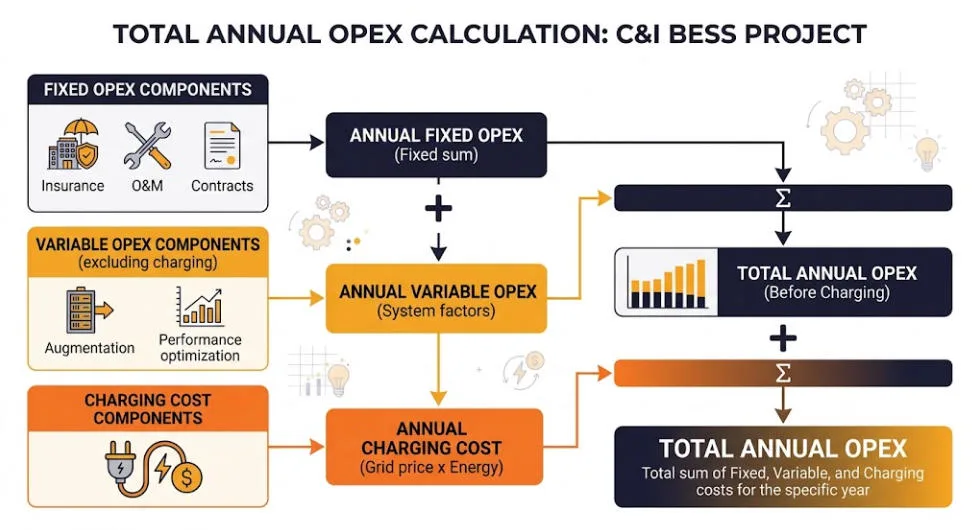
A basic annual operating-cost model sums three recurring lines: fixed OPEX, variable OPEX, and charging cost. The model tracks augmentation or replacement CAPEX separately, in the year it occurs.
Operating Costt = Fixed OPEXt + Variable OPEXt + Charging Costt
Lifecycle Spendt = Operating Costt + Augmentation/Replacement CAPEXt
Here, t is the operating year. Fixed OPEX covers recurring site, insurance, software, and contracted O&M costs. Variable OPEX changes with throughput or performance. Charging cost reflects the energy purchased to charge the system. Augmentation or replacement CAPEX appears only in years when the project needs it.
For LCOS or NPV work, discount each year’s total to present value at your chosen rate.
Worked Example: Annual BESS OPEX for a 2 MWh C&I System
For example, take a 2 MWh, 1 MW commercial and industrial system. Assume 250 equivalent full cycles per year and 90% round-trip efficiency.
Annual discharged energy: 2 MWh × 250 × 0.90 = 450 MWh/year
Annual charging energy: 450 MWh ÷ 0.90 = 500 MWh/year
At $2 per MWh discharged, throughput-based O&M is 450 × $2 = $900 per year. At $40 per MWh charged, annual charging electricity cost is 500 × $40 = $20,000.
Fixed OPEX is $18,000/year. Adding $900/year of throughput-based O&M and $20,000/year of charging electricity produces recurring operating cost of $38,900/year.
In year eight, the plan adds a $60,000 augmentation allowance as a separate capital expenditure, bringing that year’s total lifecycle spend to $98,900.
| Cost Line | Basis | Cost |
| Fixed OPEX | Lease, insurance, base O&M, software | $18,000/year |
| Variable O&M | 450 MWh discharged × $2/MWh | $900/year |
| Charging electricity | 500 MWh charged × $40/MWh | $20,000/year |
| Recurring operating cost | Years 1–7, excluding augmentation | $38,900/year |
| Augmentation/replacement CAPEX | Year 8 planning allowance | $60,000 |
| Lifecycle spend in Year 8 | Recurring operating cost + augmentation | $98,900 |
In a financial model, the $38,900 is recurring annual operating cost. However, you should normally model the $60,000 augmentation allowance as a separate future capital expenditure in Year 8.
This is a simplified example. Real models add escalation rates, more granular operating profiles, and often a revenue-side view too.
How BESS OPEX Feeds into LCOS and Project Decisions
BESS OPEX shapes LCOS two ways. First, it adds directly to lifetime cost: higher fees, pricier contracts, or costlier charging all push LCOS up.
Second, it shapes strategy indirectly. Expensive charging can push a project to cycle less, which then trims revenue too.
Before you commit to a BESS design, ask a few questions: what does fixed OPEX run per kW or per site, and how do contracts price variable O&M?
What charging strategy does the LCOS model assume, and how is degradation handled? Are software and compliance costs included?
Our Cost of Storing Energy guide walks through how these pieces combine into a full LCOS figure.
Frequently Aske d Questions
What Is a Typical BESS OPEX Range?
OPEX ranges vary by project type, region, and contract structure. Early-stage models sometimes use a provisional fixed O&M allowance of roughly one to three percent of initial CAPEX per year.
This is only a screening assumption, not a universal BESS benchmark. However, actual costs depend on system size, service scope, warranty coverage, cycling duty, labor rates, insurance, cybersecurity, site access, and whether the budget separates out major replacements.
Is Charging Electricity Cost Part of OPEX or LCOS Only?
Charging cost sits in both buckets. It is a recurring operating expense in cash-flow models, and a core input to LCOS.
However, in behind-the-meter projects, demand-charge savings can partly offset it. Self-consumed solar helps too.
How Do You Model Battery Degradation in OPEX?
Degradation itself is not a cash cost, but its effects are. Models capture it through lower available energy over time.
Also, augmentation or replacement spend in specific years counts, along with possible penalties when a project misses performance guarantees.
Together, these effects raise LCOS, because lower throughput and occasional large mid-life spending both add real cost over time.
Further Reading
- BESS CAPEX Calculation: How to Build the Total Investment Cost
- CAPEX vs LCOS: What BESS Cost per kWh Really Means
- Cost of Storing Energy: BESS LCOS Calculator Guide
- The Economics of BESS: Calculate ROI for Your Energy Storage
- Understanding BESS Specifications: The Complete 2026 Guide
- U.S. Department of Energy, Office of Electricity: energy storage program overview



Leave a Reply
Want to join the discussion?Feel free to contribute!