

BESS CAPEX Calculation: How to Build the Total Investment Cost
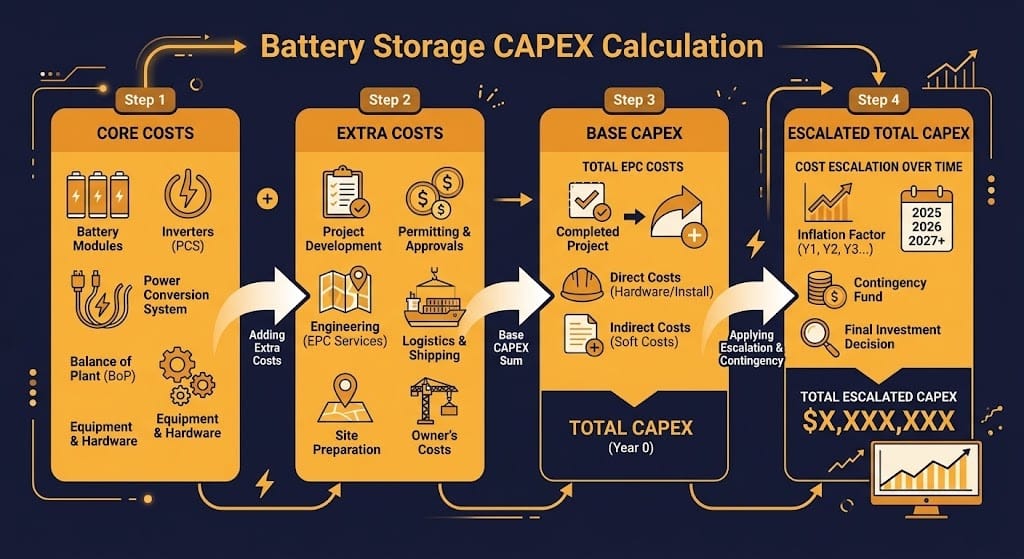
A BESS CAPEX calculation estimates the total investment to develop, procure, install, connect, and commission a battery storage system. Some costs scale with energy capacity, some scale with power capacity, and others are fixed or site-specific. Vendors often quote one dollar-per-kWh price. But that price hides several cost layers. Knowing those layers helps you check a quote. It also helps you build your own model or compare bids fairly.
| Quick Answer A BESS CAPEX calculation adds core costs, like battery, power conversion, and HVAC gear, to project costs, like installation, grid connection, and permits. It multiplies that combined per-kWh figure by system size. An escalation factor then adjusts the result for timing, giving total CAPEX. |
What Is a BESS CAPEX Calculation?
A BESS CAPEX calculation builds one investment figure for a battery project. Models use this figure as the Year-0 cost, the initial investment entered at the start of a project cash-flow, ROI, or LCOS model. In practice, getting the cost layers right beats chasing one flashy headline number.
Core System Costs
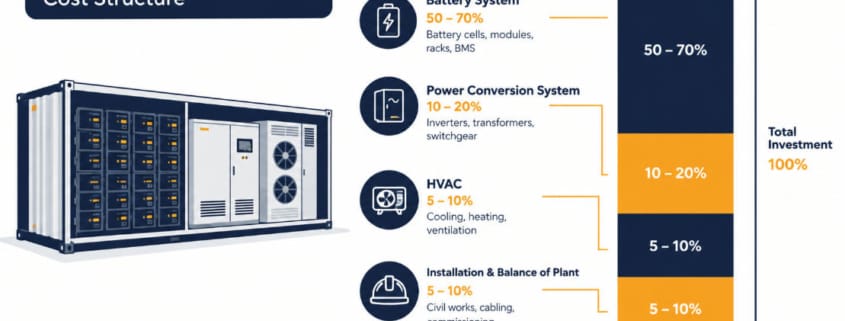
Core costs cover the technical parts of a BESS. These include the battery cells, the power conversion system, and the energy management system. They also include HVAC and fire safety gear, plus labor to put it all together. Together, these form one base cost per kWh, and they usually make up the largest share of a BESS CAPEX calculation.
- Battery cells and modules
- Power conversion system
- Energy management system
- HVAC and fire safety systems
- System integration labor and parts
Extra Project Costs That Add to CAPEX
A BESS needs more than hardware to become a real project. For example, install labor turns equipment into a working system, and grid connection work links the site to the utility. Project work also covers permits, site studies, and design, while a backup budget covers cost overruns. Skipping these costs is a common way a BESS CAPEX calculation ends up too low.
- Installation and EPC labor
- Grid connection work
- Project development work
- Contingency allowance
CAPEX Scope Checklist
Before comparing quotes, define what the CAPEX figure includes, since a BESS CAPEX calculation is only as accurate as its scope. A BESS proposal may be equipment-only, supply-and-install, EPC turnkey, or fully operational at the point of interconnection. A complete project scope may include:
- Battery cells, modules, racks, containers, and battery management systems (BMS)
- Power conversion system (PCS), transformer, switchgear, protection, SCADA, and communications
- Thermal management, fire detection, fire suppression or mitigation equipment where required, and auxiliary power
- Civil works, foundations, drainage, access roads, fencing, and site security
- Freight, commissioning, performance testing, and spare parts
- Engineering, procurement, construction, development, permitting, and studies
- Grid interconnection, network studies, metering, and utility upgrades
- Contingency, insurance during construction, and financing-related costs
Always state whether a quote is equipment-only, ex-works, delivered-duty-paid, supply-and-install, or turnkey EPC. A low per-kWh quote can leave out interconnection, civil works, commissioning, warranty extensions, or augmentation.
| Scope note Always compare quotes on the same delivery basis. An equipment-only price cannot be compared directly with a turnkey EPC price unless you add the omitted engineering, logistics, civil works, installation, commissioning, interconnection, contingency, and owner’s-cost items. |
The BESS CAPEX Calculation Formula
Once you know both cost layers, a basic BESS CAPEX calculation stays simple. First, add core costs to extra costs. Then multiply that combined per-kWh figure by system size.
| Base CAPEX = (Core Costs + Extra Costs) × Size (kWh) |
Separate Power and Energy Costs for a Realistic Model
A single dollar-per-kWh figure works for an early estimate. But real BESS cost depends on both energy size and power size, because PCS, transformers, and switchgear scale with power, not just energy. As a result, this version of a BESS CAPEX calculation gives a more realistic figure for larger or longer-duration systems.
| Base CAPEX = (Cₑ × E) + (Cₚ × P) + Fixed Costs + Site Costs |
- Cₑ = energy cost, in $/kWh
- E = usable or installed energy, in kWh
- Cₚ = power cost, in $/kW
- P = rated AC power, in kW
- Fixed costs = items that don’t scale with size
- Site costs = civil works and grid connection
For example, this split matters most when you compare a 2-hour system and a 4-hour system at the same power rating. Battery cost changes a lot between them, while PCS and grid connection cost often do not.
Account for Escalation and Timing
A cost estimate ties to a base date. But a project often gets built later, and prices for gear, labor, and site work can shift in that gap. Because of this, a complete BESS CAPEX calculation has to account for timing, not just today’s prices.
| Escalation Amount = Base CAPEX × Escalation Rate Total CAPEX = Base CAPEX × (1 + Escalation Rate) |
Here, the escalation rate is the expected cost shift from the estimate date to the build date. For example, if base CAPEX runs $540,000 and the escalation rate runs 4 percent, total CAPEX comes to $561,600.
For a multi-year build, model escalation by cost category and year instead of one flat rate.
| Total CAPEX (Year t) = Base CAPEX × (1 + Escalation Rate)^t |
Round the final figure to whole dollars for reporting.
| Escalation vs. Contingency Escalation reflects expected future price changes between the cost-estimate date and the purchase or construction date. Contingency covers uncertainty and execution risk in the defined scope. A robust BESS CAPEX model may include both, but they should be tracked as separate line items. |
Worked Example: BESS CAPEX Calculation for a 2 MWh System
The steps below walk through a full BESS CAPEX calculation from start to finish. First, though, in a real estimate, state whether the energy figure means nominal battery energy, usable energy at the start of life, or AC-deliverable energy at the connection point. Otherwise, the definition changes the per-kWh result and the fairness of any quote comparison.
Assume a 2 MWh battery project with these numbers. Size runs 2,000 kWh. Core cost runs $210 per kWh. Extra cost runs $60 per kWh. Escalation rate runs 4 percent, for a one-year build.
Step 1: Base cost per kWh. Add $210 and $60. That gives $270 per kWh.
Step 2: Base CAPEX. Multiply $270 by 2,000 kWh. That gives $540,000.
Step 3: Escalation amount. Multiply $540,000 by 4 percent. That gives $21,600.
Step 4: Total CAPEX. Multiply $540,000 by 1.04. That gives $561,600.
| Input | Value |
| Nominal system energy | 2,000 kWh |
| Core system cost | $210/kWh |
| Project/site cost | $60/kWh |
| Base CAPEX | $540,000 |
| Escalation allowance | 4% |
| Escalation amount | $21,600 |
| Total CAPEX | $561,600 |
| Implied total CAPEX | $280.80/kWh |
This is an early-stage estimate only. It does not set a market price for a specific system or site.
This method is best for screening and early-stage budgeting. As the project advances, replace generic per-kWh assumptions with supplier quotes, site-specific civil estimates, interconnection studies, construction schedules, and a defined EPC scope.
What This CAPEX Number Doesn’t Tell You
A BESS CAPEX calculation is only the first half of the cost picture. It shows the cost to develop, procure, and build a system within a defined scope, but it does not show the cost of owning and operating the system or the value it creates.
For the recurring costs that sit outside Year-0 CAPEX — including O&M, charging electricity, insurance, software, and degradation-related spending — see our BESS OPEX and operating cost model.
Instead, financing costs, O&M, charging energy, degradation, augmentation, revenue, and demand-charge savings belong in an LCOS, operating-cost, or project-ROI model.
Depending on project scope, land, permitting, development, and interconnection expenses may be included in CAPEX or tracked separately.
CAPEX shows the cost to build the asset, not the value it can create through arbitrage, demand-charge savings, capacity payments, or grid services. Explore these opportunities in our BESS revenue streams and value-stacking guide.
For the full cost picture, pair this figure with an LCOS model. Our CAPEX vs LCOS guide explains why these two numbers differ. It also covers 2025-2026 price benchmarks. Our LCOS Calculator Guide walks through the full cost formula step by step.
The U.S. Department of Energy tracks storage cost trends through its energy program. Its guidance uses a similar cost-layer approach to the one here.
Frequently Asked Questions
How Accurate Is a BESS CAPEX Calculation Without a Vendor Quote?
A calculation built from industry ranges gives a fair early estimate. But a vendor quote reflects real gear prices and site conditions. Use the calculation for early planning. Then refine it once quotes come in.
Does BESS CAPEX Include Land and Permitting Costs?
It depends on the project scope and the delivery basis used in the quote. Some models include land, permitting, development, owner’s engineering, and interconnection in CAPEX. Others track some or all of these costs separately. So, before comparing figures, confirm exactly which items are included, excluded, or treated as allowances in your BESS CAPEX calculation.
How Often Should You Re-Run a BESS CAPEX Calculation?
Re-run the BESS CAPEX calculation any time a big input changes. New vendor prices, a new timeline, or a new escalation rate can all shift total CAPEX. As a result, many teams re-check CAPEX at each project milestone.
Further Reading
CAPEX vs LCOS: What BESS Cost per kWh Really Means
Cost of Storing Energy: BESS LCOS Calculator Guide
The Economics of BESS: Calculate ROI for Your Energy Storage
Understanding BESS Specifications: The Complete 2026 Guide
U.S. Department of Energy, Office of Electricity: energy storage program overview