
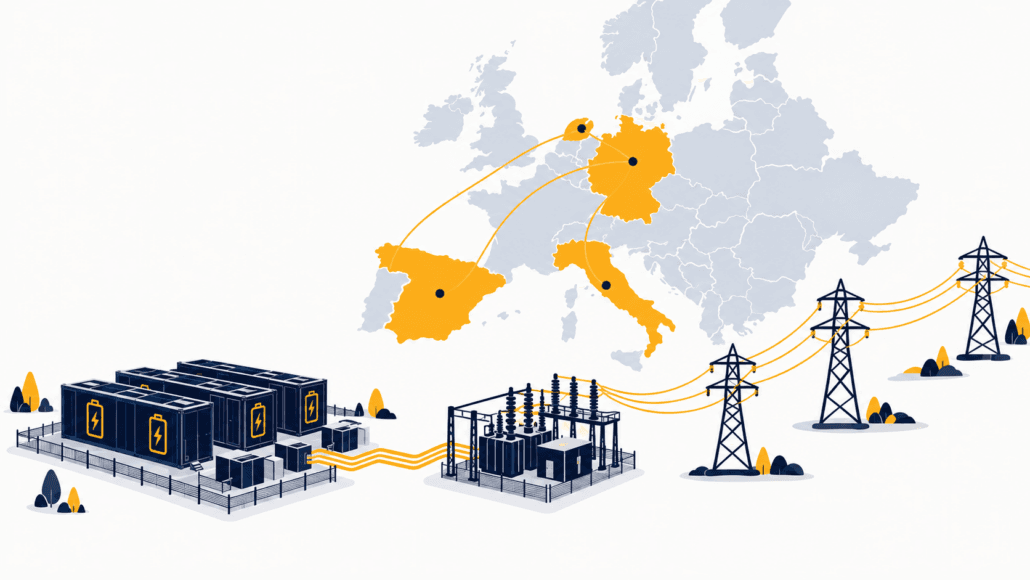
Europe BESS Grid Connection: EU RfG and Country Guide
A Europe BESS grid connection depends on the country where the project is located within the European Union, not just its size or voltage. The EU-wide Requirements for Generators (RfG) regulation provides a common technical baseline. But each country runs its own transmission system operator, its own national grid code, and its own connection process. So the practical route, and the risk of delay, can differ sharply between markets that share the same underlying EU rules.
Scope note: This guide covers the EU-wide RfG framework, then spotlights four of Europe’s largest BESS markets: Germany, Spain, Italy, and the Netherlands. The United Kingdom sits outside the EU and follows its own framework, covered in a separate guide. Norway and Switzerland connect into the same ENTSO-E system but sit outside the EU too, and are not covered in detail here.
Quick answer: A BESS grid connection in the EU starts with the Requirements for Generators (RfG) framework, but the real route is decided nationally. The relevant TSO or DSO applies its own country-specific grid code, connection process, capacity-allocation rules, studies, and compliance tests. Germany, Spain, Italy, and the Netherlands each face significant connection pressure right now, so confirm current queue, congestion, and permitting requirements with the relevant network operator before fixing a schedule or equipment specification.
So, this guide walks through:
- How the EU-wide RfG framework sets a common technical baseline across member states
- Who governs a Europe BESS grid connection at the EU level and the national level
- How the connection process generally works, stage by stage
- Country spotlights on Germany, Spain, Italy, and the Netherlands
- The common thread across these markets, and how to reduce connection risk
Europe BESS Grid Connection Checklist
- Confirm the country, connection voltage, network level, and applicable synchronous area, because RfG thresholds and national requirements vary.
- Identify the likely RfG Power Generating Module Type (A, B, C, or D) for the project’s capacity and voltage.
- Confirm whether the project connects to the national TSO or a regional DSO, and what that changes.
- Check the national grid code’s specific requirements, since these can go well beyond the EU baseline.
- Screen the country’s current connection-queue status, since several markets have overhauled their rules recently.
- Ask the PCS supplier and system integrator for validated models in the format the network operator requires.
- Allow schedule contingency for studies, national permitting, and grid-code compliance testing.
Who Governs a Europe BESS Grid Connection?
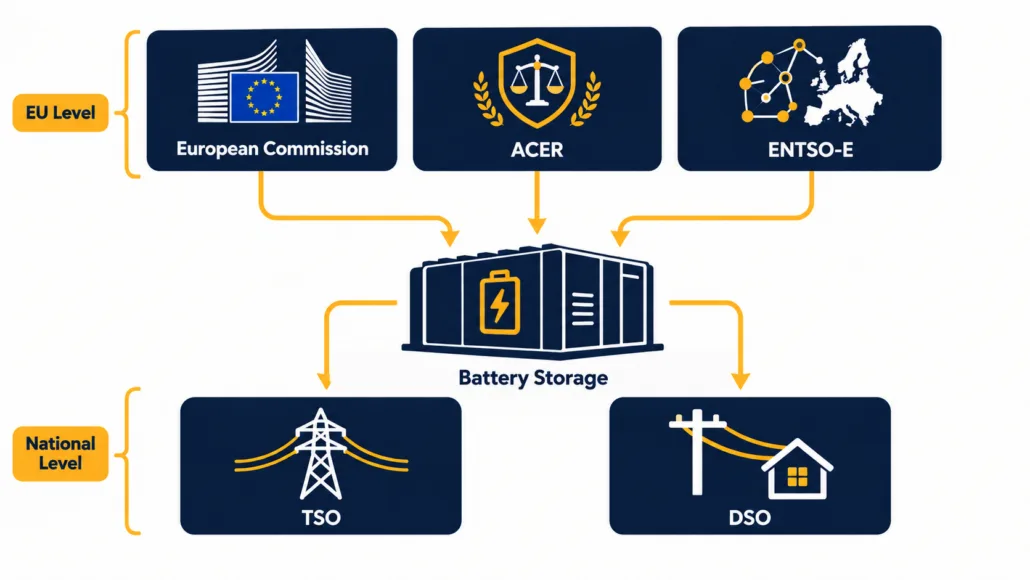
No single body runs a Europe BESS grid connection from end to end. Instead, EU-level bodies set the common framework, while national bodies run the actual connection process.
| Organisation | Main role for BESS projects |
| European Commission | Adopts EU network codes, including RfG, as binding regulations across member states. |
| ACER | The EU Agency for the Cooperation of Energy Regulators. Recommends network codes and coordinates national regulators. |
| ENTSO-E | The European Network of Transmission System Operators. Coordinates technical implementation of RfG and related codes across national TSOs. |
| National TSO | Operates the transmission grid and connects larger or transmission-voltage projects. The number and structure of TSOs vary by country; Germany, for example, has four. |
| National DSO(s) | Operate regional or local distribution networks and connect most smaller and medium-sized projects. Often several per country. |
| National regulator | Approves connection rules and technical codes at the national level. Examples include Germany’s Bundesnetzagentur, Spain’s CNMC, Italy’s ARERA, and the Netherlands’ ACM. |
So don’t assume ENTSO-E or the European Commission reviews individual projects. Instead, they set the common framework. In practice, the project deals mainly with the relevant TSO or DSO and, where applicable, the energy regulator.
Current detail from EU-level bodies: ENTSO-E’s RfG overview, ACER.
The EU-Wide Framework Behind a Europe BESS Grid Connection
RfG classifies Power-Generating Modules (PGMs) into Types A to D. For BESS projects in EU member states, this is the shared technical baseline behind most connection requirements.
| Type | General basis | What it means in practice |
| Type A | Smallest capacity, lowest voltage | Fewest technical requirements, often a simplified process |
| Type B | Small to medium capacity | More technical requirements than Type A, thresholds vary by country |
| Type C | Medium to large capacity | Detailed technical and testing requirements |
| Type D | Largest capacity, or connects at high voltage | Most extensive requirements, including full system studies |
The exact MW thresholds between types are not identical across the EU, though. RfG sets upper limits for each synchronous area, but leaves the precise threshold within that band to the national level. So a project sitting near a threshold in one country may fall into a different type in another. Confirm the applicable type with the connecting TSO or DSO rather than assuming a single EU-wide number.
Battery storage adds a further wrinkle, and this is worth reading carefully. RfG was drafted around generation, and storage can be treated differently depending on the national implementation, the BESS’s operating mode, and its connection arrangement. In many member states, storage that exports to the grid is assessed using requirements aligned with the relevant PGM category, but developers should confirm the exact national treatment with the connecting TSO or DSO rather than assume it works identically to a conventional generator. National implementation of RfG can also add significant detail beyond the EU baseline, as our global BESS grid codes comparison shows.
How the Europe BESS Grid Connection Process Works, Stage by Stage
Treat the connection journey as a set of stages, not one checklist. The framework stays similar across countries, but the pace and detail vary a great deal, as the country spotlights below show.
Stage 1: Site Screening and Capacity Assessment
First, confirm the country, the likely point of connection, and whether that point sits on the transmission or distribution network. Then estimate the project’s likely RfG type, since this shapes both the technical requirements and the study scope ahead. Also screen the national connection queue early. As the country spotlights below show, several major markets are running queues many times larger than their planning assumptions. So realistic timing matters more than nameplate capacity alone.
Stage 2: Connection Application
Next, submit a connection application to the relevant network operator. That means the relevant TSO for transmission-network connections or larger projects, or the relevant DSO for many distribution-network connections. The application should identify the proposed site, capacity, connection voltage, and intended operating modes. Requirements for what to include vary by country, so check the specific network operator’s current application format rather than assuming one EU-wide template.
Stage 3: Studies and Compliance Verification
The network operator then sets the study scope. Larger or higher-type projects generally need load-flow, short-circuit, and dynamic-performance studies against the applicable national grid code. Many countries also require compliance documentation, certificates, or witnessed test evidence before energisation, where the national framework calls for it, confirming the installed plant meets the agreed technical requirements.
Treat model submission as real engineering, not paperwork. Ask the PCS supplier and system integrator for validated models in the format the network operator requires, together with controller logic and operating-mode assumptions, before finalising procurement.
See our guide on fault ride-through and LVRT/HVRT capability for more on the dynamic-performance side of this testing.
Stage 4: Connection Offer and Permitting
Both the network operator’s response and the surrounding permitting process vary significantly by country. In some markets, access and connection authorisations are processed through linked or coordinated procedures. In others, they are separate stages with their own timelines. Environmental and planning permits often run in parallel, and can end up the longer critical path on a large project. Confirm the current sequence with the relevant network operator and permitting authority early.
Stage 5: Construction and Commissioning
Commissioning confirms the installed plant matches the approved design. Expect to provide as-built documentation and protection settings, plus any certification or compliance evidence required by the national framework and network operator before energisation. Testing typically covers protection behaviour and, for larger or higher-type projects, dynamic performance against the applicable grid code.
Stage 6: Ongoing Compliance
Compliance does not stop once operation begins. Instead, changes to inverter firmware, protection settings, plant-controller logic, or other declared technical parameters can trigger a reassessment. So treat compliance documentation as an ongoing operational task, not a one-off commissioning step.
Realistic timelines vary enormously by country and by where a project sits in that country’s connection queue, application pipeline, or capacity-allocation process. A small, distribution-connected project can sometimes progress in months. A large, transmission-connected project in a congested market can take years, and several major markets are actively reworking their queue rules as this guide is written. Build schedule contingency around studies and queue position specifically, since both are the hardest parts to forecast right now.
For the general, country-agnostic version of this workflow, see our BESS interconnection process guide.
Country Spotlight: Germany
Germany runs four regional TSOs: 50Hertz, Amprion, TenneT Germany, and TransnetBW. Their number and structure are specific to Germany, not a Europe-wide pattern. Distribution-level projects instead connect through one of many regional DSOs. The national regulator is the Bundesnetzagentur.
Technical requirements come from the VDE-AR-N series: 4105 for low voltage, 4110 for medium voltage, and 4120 for high voltage, each implementing RfG in German-specific detail. Battery projects also typically need to meet VDE-AR-E 2510-50 for battery safety, alongside the relevant grid-connection code.
The connection process itself is changing. By the end of Q3 2025, Germany’s four TSOs had received 545 applications for large battery-storage systems representing 211 GW of requested capacity. That figure describes application volume, not contracted or construction-ready capacity, and it compares to a Grid Development Plan forecast of just 41 to 94 GW of large-scale storage by 2037.
In response, the TSOs jointly proposed a new maturity assessment procedure, the Reifegradverfahren, to move away from allocation based solely on application date, toward an evaluation based on land control, permitting status, technical readiness, and financial or commercial readiness. The procedure began its application phase on 1 April 2026. As of that announcement, the TSOs themselves noted that confirmation of the procedure’s legal basis by the Bundesnetzagentur was still advisable. So treat this as a live, TSO-led process still being formalised, rather than a settled legal framework, and confirm current requirements directly with the relevant TSO.
See: the four German TSOs’ joint press release on the maturity assessment procedure.
Country Spotlight: Spain
Spain has one national TSO, Red Eléctrica de España (REE), plus regional DSOs for distribution-level connections. Meanwhile, the national regulator is the Comisión Nacional de los Mercados y la Competencia (CNMC).
Since 2020, Spain has processed access and connection permits together. Developers submit a single joint application to REE or the relevant DSO, rather than two separate steps. During 2025, Spain’s storage-access framework underwent several changes. Royal Decree-Law 7/2025 included proposed measures relevant to storage access, but Congress rejected it on 22 July 2025, so it never took permanent legal effect. Related provisions were later introduced through Royal Decree 997/2025, approved on 5 November 2025, which also addressed how installed capacity is calculated for hybrid and standalone storage projects. Given this history, confirm the currently applicable rule directly with REE or CNMC rather than citing either decree from memory.
The scale of pent-up demand is striking. Published Spanish grid data has indicated a large pipeline of storage projects at different access, connection, and pre-commissioning stages, while commissioned battery capacity remains much lower, on the order of a few hundred MW. Check REE’s latest dataset before using any specific pipeline figure in a schedule or investment decision.
See: Royal Decree 997/2025 (BOE-A-2025-22434).
Country Spotlight: Italy
In Italy, Terna manages transmission-network connections, while regional distribution operators manage most distribution-network connections. In some circumstances, projects of 10 MW or more may be handled by Terna, but the responsible operator depends on the point of connection, voltage level, network configuration, and the applicable TICA provisions. ARERA, the national energy regulator, sets the technical and economic conditions for both, through the Testo Integrato delle Connessioni Attive (TICA). Confirm the route with the prospective network operator rather than relying on capacity alone.
Like Germany and the Netherlands, Italy is managing far more connection requests than its network was planned for. As of 31 May 2026, Terna’s Econnextion platform recorded roughly 294 GW of storage connection requests alone, well beyond national 2030 targets. In response, Decreto MASE 291/2026, signed 8 September 2026 and in force from 9 September 2026, requires Terna to divide the national transmission grid into microzone (microzones) and calculate available capacity for renewables and storage within each. The decree sets out a phased rollout: Terna must submit its microzone methodology to the ministry within 30 days of the decree taking effect, with the finalised microzones published within a further 15 days after approval. So treat the underlying capacity-allocation reform as legally in force, but the actual microzone boundaries and published capacity figures as still being rolled out through late 2026.
See: Decreto MASE 291/2026 (Italy’s Ministry of Environment and Energy Security).
Country Spotlight: Netherlands
The Netherlands has one national TSO, TenneT, plus regional DSOs for distribution-level connections. The Authority for Consumers and Markets (ACM) is the national regulator.
Grid congestion, known locally as netcongestie, is the defining issue for new connections in much of the country. TenneT’s own reporting has described a connection queue including tens of gigawatts of battery storage requests against a national peak load a fraction of that size.
In response, ACM authorised flexible capacity arrangements, including what TenneT calls the time-bound transmission right (TDTR) and the capacity control contract (CSC), under which a project may accept reduced or conditional access in exchange for network capacity or congestion-management value. A battery that can act as a controllable congestion mitigator, reducing strain on the grid at TenneT’s request under this framework, may receive preferential treatment under the applicable congestion-management or capacity-allocation framework. Confirm the exact contract type, availability, and eligibility conditions directly with TenneT or the relevant DSO, since this framework is still being extended to new regions and projects.
See: TenneT’s own account of its first congestion-mitigator contract.
Comparing Europe BESS Grid Connection Markets: Germany, Spain, Italy, and the Netherlands
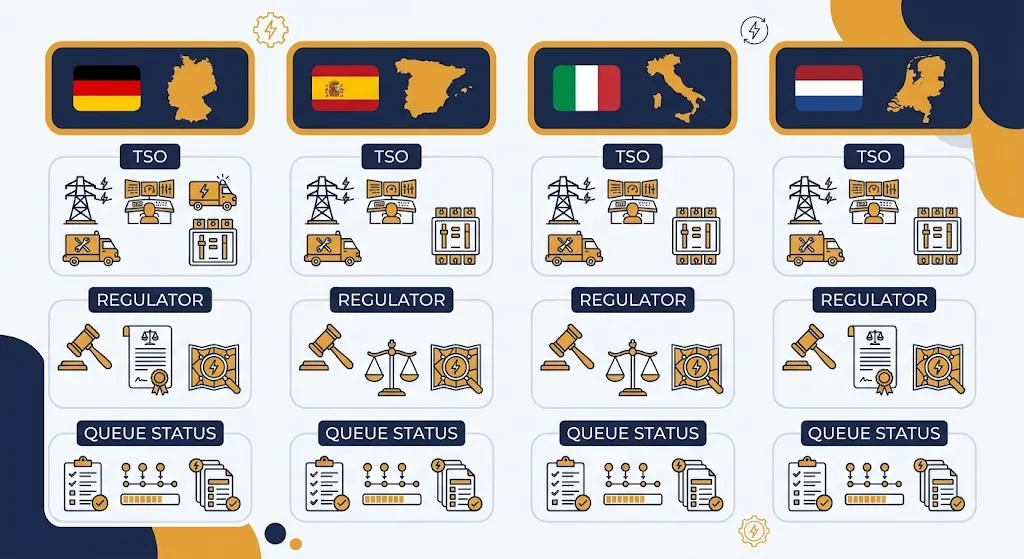
| Country | Transmission operator | Main connection issue | Check first |
| Germany | 4 regional TSOs | High application volume, new maturity-based allocation | Applicable TSO’s current process and connection point |
| Spain | REE | Unsettled storage-access rules, large pending pipeline | REE/DSO access capacity and current permit route |
| Italy | Terna + regional DSOs | Capacity allocation via new microzone system | Connection voltage and responsible operator |
| Netherlands | TenneT + regional DSOs | Widespread congestion (netcongestie) | Firm versus flexible capacity options |
The Common Thread Across These Europe BESS Grid Connection Markets
Germany, Spain, Italy, and the Netherlands look different on the surface. Each has its own TSO structure, its own national code, and its own institutions. But they share a pattern worth noticing. Across all four, high volumes of storage and hybrid-project applications have increased pressure on connection processes. Network operators are increasingly using readiness evidence, technical feasibility, conditional-access arrangements, or other prioritisation tools, rather than relying solely on application date. The details differ materially by country and operator, and some of these changes are still being finalised as this guide is written.
For developers, that means two things. First, don’t plan a European BESS project around queue rules you read about even a year ago; they may already be out of date. Second, a project’s evidence of real readiness, land control, permits, financing, and validated technical models, increasingly matters as much as when it first applied.
Common Risks in a Europe BESS Grid Connection
Most delays in a Europe BESS grid connection trace back to a small set of repeat mistakes. So here is how to catch them early.
| Risk | Consequence | Mitigation |
| Assuming one EU-wide threshold or process applies | Wrong compliance pathway assumed early | Confirm the national RfG type and process with the specific TSO or DSO |
| Relying on outdated queue-rule guidance | Schedule built on a process that no longer applies | Check current queue and prioritisation rules directly with the network operator |
| Selecting a site before checking congestion status | Non-firm terms or multi-year delay | Screen the country’s current congestion and queue data early |
| Incomplete or unvalidated dynamic models | Delayed studies and commissioning rework | Require validated models from the PCS vendor and integrator |
| Treating national code compliance as an afterthought | Design changes late in development | Confirm the applicable national grid code early in concept design |
| Assuming permitting and connection run on the same timeline | Land, environmental, or planning delays block an otherwise-ready connection | Run permitting and connection work in parallel from the start |
Planning a BESS project in Europe? Start with a country-specific connection-readiness assessment. Cover the applicable RfG type, national grid code, current queue status, and permitting timeline, before you finalise equipment specifications.
Frequently Asked Questions About a Europe BESS Grid Connection
Common questions developers ask before choosing a European market or signing a connection agreement.
Does one EU grid code cover every country?
No. RfG sets a common EU-wide baseline, classifying projects into Types A to D. But each country implements it through its own national grid code, which can add significant detail, as Germany’s VDE-AR-N series shows. Confirm the national code alongside RfG, not instead of it.
Is the UK covered by this Europe BESS grid connection guide?
No. The UK sits outside the EU and follows its own framework, built around NESO, the Grid Code, and Engineering Recommendations G98/G99/G100. See our dedicated UK guide for that detail.
Which European countries have the longest BESS connection queues right now?
Germany, Italy, Spain, and the Netherlands have all reported connection queues many times larger than their official capacity targets. Each has introduced new prioritisation rules within the past two years to manage this, so treat queue length as a moving target, not a fixed number.
Does battery storage get classified the same way as solar or wind under RfG?
Often, but not automatically. Many national frameworks apply Type A-D-style requirements to BESS when it exports to the grid, but the applicable classification can depend on the country, operating mode, hybrid configuration, and connection arrangement. Confirm the route with the connecting TSO or DSO.
Why do Germany, Italy, and the Netherlands all have such large storage queues?
Developers in each market applied for far more grid capacity than the underlying network was planned to carry. Partly, that happened because reserving a queue position cost little relative to a project’s potential value. All three countries have since introduced readiness or maturity-based rules to filter for projects genuinely likely to proceed.
Can a battery help resolve grid congestion instead of just adding to it?
In some markets, yes. The Netherlands’ congestion-mitigator framework, for example, lets a battery accept flexible or conditional access in exchange for helping manage congestion at the network operator’s request. Similar flexible-connection concepts are emerging elsewhere in Europe too.
How long does a Europe BESS grid connection take?
It varies enormously by country and by position in the relevant queue or pipeline. A small distribution-connected project can sometimes progress in months. A large, transmission-connected project in a congested market can take years, particularly in markets still working through a legacy backlog.
Do I need compliance certification before energising?
In many European countries, yes, particularly for larger or higher-type projects. Requirements vary by country and by RfG type, so the specific certification and testing route is best set early, with the connecting network operator.
Glossary of Terms for This Europe BESS Grid Connection Guide
Because this guide spans several countries, here are the key terms and institutions, defined in plain terms.
EU-Level Terms and Institutions
RfG — Requirements for Generators — Regulation (EU) 2016/631, the EU network code establishing baseline requirements for connecting Power-Generating Modules. National frameworks may apply related requirements to battery storage depending on the project’s operating mode and connection arrangement.
ENTSO-E — European Network of Transmission System Operators for Electricity — coordinates technical implementation of RfG and related codes across national TSOs.
ACER — EU Agency for the Cooperation of Energy Regulators — recommends network codes and coordinates national energy regulators.
PGM — Power-Generating Module — a generating unit or group of generating units covered by the applicable connection requirements. Under RfG, PGMs are assigned Type A, B, C, or D requirements according to the applicable capacity, voltage, and national criteria.
Synchronous area — A group of interconnected power systems operating in synchronism at the same nominal frequency. RfG thresholds may differ by synchronous area.
National Institutions Referenced in This Guide
TSO — Transmission System Operator — the national (or, in Germany, regional) body that owns and operates the high-voltage transmission grid.
DSO — Distribution System Operator — the regional or local body that owns and operates the lower-voltage distribution network.
Bundesnetzagentur — Germany’s national energy regulator, which oversees grid connection rules and the country’s four TSOs.
CNMC — Spain’s national markets and competition regulator, which approves technical criteria for grid access alongside REE.
ARERA — Italy’s national regulator for energy, networks, and the environment, which sets connection rules through the TICA.
ACM — The Netherlands’ Authority for Consumers and Markets, which regulates grid congestion and connection-priority rules.
Important: This guide is general information, so treat it that way, not as legal, engineering, or connection advice. Grid-compliance requirements vary by country, network operator, project design, and the applicable rules at the time of assessment. Several of the markets covered here are actively reforming their connection processes. Confirm requirements with the relevant national TSO or DSO, national regulator, and qualified electrical, grid-connection, and legal advisers.
Further Reading on Europe BESS Grid Connection
More Sunlith Energy guides on battery storage connection, interconnection, and compliance.
- BESS interconnection process (BESS Interconnection Process: From Application to Commercial Operation)
- Global BESS grid-code requirements (BESS Grid Codes and Compliance)
- UK BESS grid connection process (UK BESS Grid Connection: G98, G99, NESO and Grid Code Guide)
- Australia BESS grid connection process (Australia BESS Grid Connection: AEMO, TNSP and DNSP Requirements)
- PCS fault ride-through and LVRT/HVRT capability (Fault Ride-Through Features: The PCS Hardware and Control Functions Behind LVRT/HVRT Compliance)
Source
The EU-wide framework detail in this guide is grounded in the EU’s RfG regulation text.



Leave a Reply
Want to join the discussion?Feel free to contribute!