
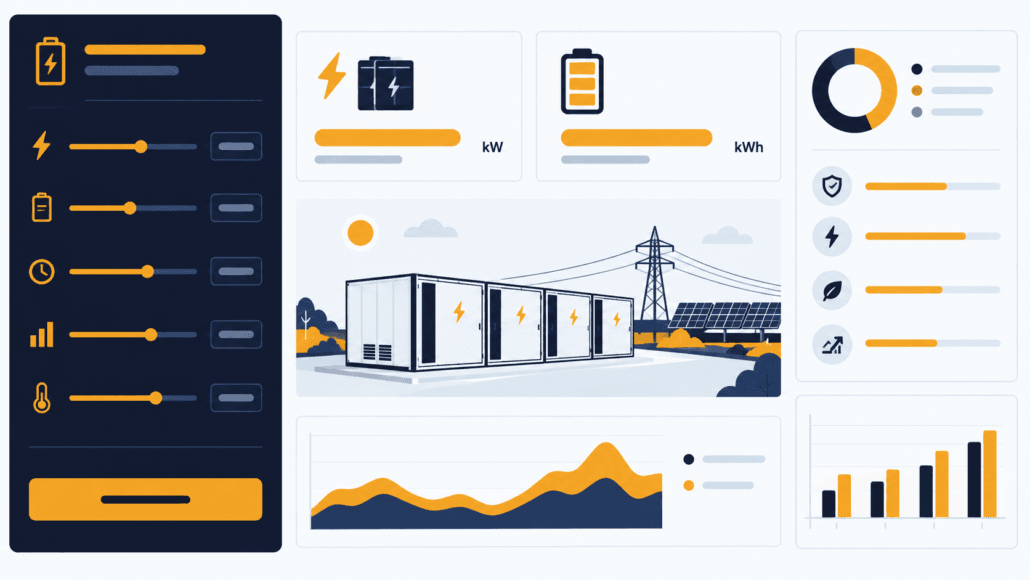
C&I BESS Sizing Calculator: Formulas, Free Tool, and a Worked Example
A C&I BESS sizing calculator answers one question fast. How big should the battery and inverter be?
It turns your critical load and backup hours into two numbers. First, installed battery energy in kWh. Second, PCS power in kW.
Use the free calculator below for a preliminary estimate. Then review the formulas, assumptions, and worked example before making project decisions.
Quick Answer: A C&I BESS sizing calculator turns your critical load and backup hours into two numbers. Installed battery energy in kWh factors in depth of discharge and round-trip efficiency. PCS power in kW adds a safety margin to your critical load. Still, this is a preliminary size, not a final design.
Try the C&I BESS Sizing Calculator
This calculator runs instantly in your browser. Once you enter a few numbers, it returns a preliminary size.
Enter your peak site load, critical load, and backup duration below. Then adjust depth of discharge, round-trip efficiency, and reserve margin if you have better numbers than the defaults.
C&I BESS Sizing Calculator
Estimate preliminary BESS power (kW/MW), installed battery energy (kWh/MWh), usable capacity, and backup duration.
Advanced assumptions
The results show recommended PCS power and installed battery energy. They also show usable capacity, minimum apparent power, and the required C-rate.
It works on desktop and mobile browsers alike, with no signup and no limit on how many times you recalculate.
Preliminary sizing only. This calculator estimates battery energy and PCS power from the inputs you provide. It is not a final design, quotation, or performance guarantee. It also does not replace an interconnection study, fire-safety review, or full interval-load analysis.
Why C&I BESS Sizing Matters for Commercial and Industrial Sites
Demand charges and outage risk both push sites toward battery storage. So a C&I BESS sizing calculator earns its place from the first estimate.
But get the size wrong, and the cost shows up either way.
Demand charges can be steep. In fact, research from the National Renewable Energy Laboratory (NREL), cited in this NYSERDA research summary, puts them at 30 to 70 percent of a typical commercial bill.
For example, an undersized battery cannot cover the critical load for the full outage. An oversized one, meanwhile, ties up capital that could fund other work.
A sizing calculator will not replace formal engineering design. But it still gives you a fast, defensible starting point.
Many C&I storage decisions, in turn, weigh demand-charge savings alongside backup value, though actual payback varies widely by project, utility rate structure, and site load profile.
What This C&I BESS Sizing Calculator Estimates
This calculator has one job: outage backup. Enter a critical load and a backup duration. Then it returns a preliminary size.
It is not a peak-shaving calculator. Instead, peak shaving needs interval load data and your utility’s demand-charge structure, not just a critical load.
Cutting demand charges is a different goal. See our guide to C&I BESS peak shaving instead.
Facility managers, EPCs, and asset owners typically use this stage of sizing before requesting formal quotes from vendors.
How to Find Your C&I BESS Sizing Calculator Inputs
Most sizing mistakes start with the inputs, not the formulas. Get these right first, and the C&I BESS sizing calculator results are far more reliable. Rough numbers are fine at this stage; precise numbers can wait for the engineering phase.
Critical load: list every circuit that must run through an outage. Think life-safety systems, refrigeration, servers, security, and any process equipment that cannot tolerate downtime. Then sum their running kW, not nameplate or inrush kW.
Peak site load: pull this from 12 months of utility interval data if you have it. Otherwise, use your utility bill’s peak demand figure as a starting point.
Backup duration: match this to your actual outage risk, not a round number. A site with frequent short outages needs a different duration than one preparing for extended grid events, so review recent outage history if it exists.
Site documentation, meanwhile, helps too. Single-line diagrams, panel schedules, and recent utility bills all help validate your critical-load list before you finalise it.
Power factor and reserve margin, by contrast, are usually starting assumptions rather than measured figures. Adjust them once your battery vendor or EPC confirms real numbers.
The Sizing Formulas Behind the Calculator
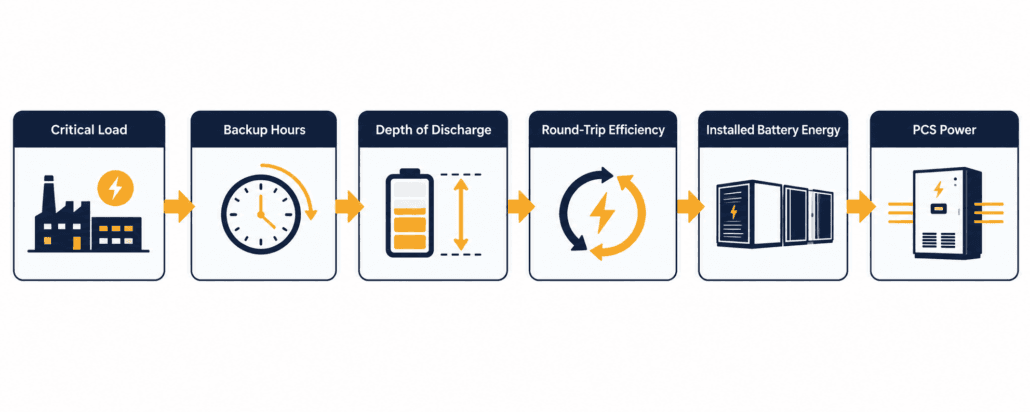
Every result from this C&I BESS sizing calculator comes from one of the formulas below. Here is what each one does, and why it matters.
Delivered Backup Energy
Delivered backup energy is critical load multiplied by backup hours. A 300 kW critical load for four hours, for example, needs 1,200 kWh delivered.
In short, this is the energy your equipment actually uses. It is not yet the battery size, since no battery discharges every stored kWh.
A facility with several critical circuits should sum them before running this figure.
Installed Battery Energy
Installed battery energy has three steps. First, divide delivered energy by depth of discharge. Then divide again by round-trip efficiency. Finally, add a reserve margin.
Together, DoD and RTE shrink how much nameplate capacity you can actually use. The reserve margin, meanwhile, covers degradation, temperature, and load uncertainty.
Most C&I LFP batteries run 85 to 95 percent depth of discharge. Round-trip efficiency usually sits between 90 and 95 percent at the system level. Always confirm this with your manufacturer’s datasheet.
Round-trip efficiency is a simplified, conservative assumption for a preliminary calculator. Final backup sizing should instead use discharge-path efficiency. That includes PCS, transformer, cable, battery, and auxiliary-load losses at the actual operating condition.
A wider site temperature range usually pushes real-world RTE toward the lower end of that band.
Recommended PCS Power and Apparent Power
Similarly, recommended PCS power is critical load times one plus a power margin. A 10 percent margin is a preliminary allowance only, and motor starting or other transient loads still need separate review.
Minimum apparent power in kVA, meanwhile, divides that PCS power by your system power factor. This is the screening figure for PCS and transformer ratings.
A lower power factor raises the apparent-power requirement, which can affect transformer selection.
C-Rate and Nominal E/P Duration
Finally, required C-rate is PCS power divided by installed battery energy. It shows how hard you are asking the battery to discharge.
Nominal E/P duration, by contrast, is installed battery energy divided by PCS power. Watch this figure closely. It often differs from your target backup hours, since DoD, RTE, and reserve margin all pull it away from a clean match.
A lower target C-rate generally means a larger, more conservative battery for the same PCS power.
| Calculation | Formula | Meaning |
| Delivered backup energy (kWh) | Critical load (kW) × backup duration (hours) | Energy the critical load needs during the outage. |
| Installed battery energy (kWh) | (Delivered ÷ (DoD × RTE)) × (1 + reserve margin) | Nominal capacity required after DoD, system efficiency, and reserve margin. |
| Usable battery capacity (kWh) | Installed battery energy × DoD | Energy within the chosen discharge window. |
| Recommended PCS power (kW) | Critical load × (1 + power margin) | Suggested continuous PCS output rating. |
| Minimum apparent power (kVA) | Recommended PCS power ÷ power factor | Screening value for PCS and transformer rating. |
| Required C-rate | Recommended PCS power ÷ installed battery energy | Power-to-energy relationship indicator. |
| Nominal E/P duration (hours) | Installed battery energy ÷ recommended PCS power | Configuration indicator, not a runtime guarantee. |
A C&I BESS Sizing Calculator Worked Example: 300 kW Critical Load
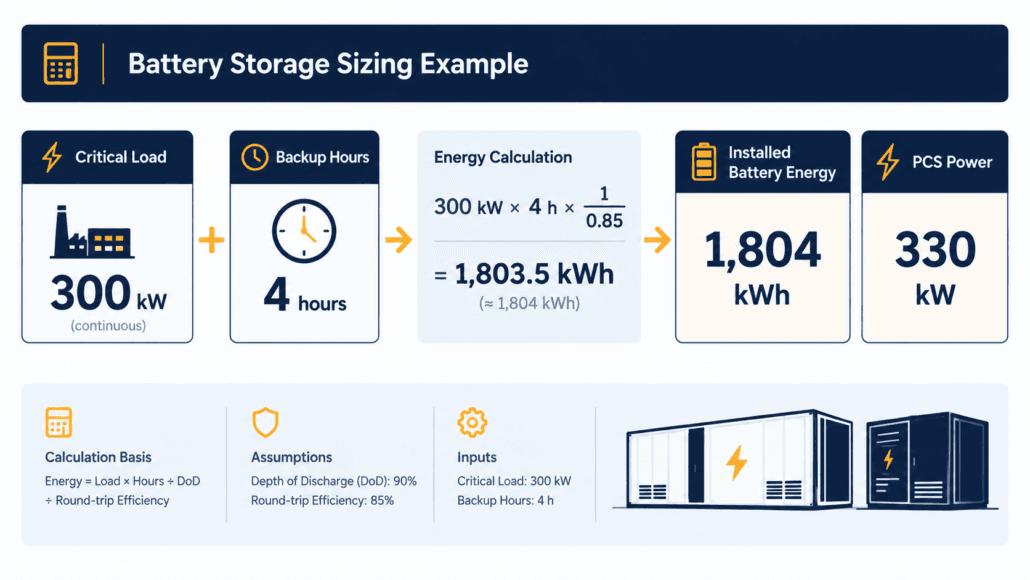
This worked example uses an 800 kW peak load and a 300 kW critical load. Backup duration is four hours.
Assumptions: 85% depth of discharge, 90% round-trip efficiency, 15% reserve margin. Also: 10% power margin, 0.90 power factor.
- Delivered backup energy: 300 kW × 4 hours = 1,200 kWh.
- Installed battery energy: (1,200 ÷ (0.85 × 0.90)) × 1.15 = 1,804 kWh, roughly 1.80 MWh.
- Usable battery capacity: 1,804 × 0.85 = 1,533 kWh.
- Recommended PCS power: 300 × 1.10 = 330 kW, or 0.33 MW.
- Minimum apparent power: 330 ÷ 0.90 = 367 kVA, or 0.37 MVA.
- Required C-rate: 330 ÷ 1,804 = 0.18C.
- Nominal E/P duration: 1,804 ÷ 330 = 5.5 hours. That’s longer than the 4-hour target. DoD, RTE, and reserve margin together explain the gap.
- This C&I BESS sizing calculator worked example uses one input combination. Change the backup duration to 2 hours, and installed battery energy roughly halves.
- Push reserve margin to 20 percent instead, and it grows a little further. Run a few combinations of your own before settling on a target range.
Common C&I BESS Sizing Calculator Mistakes
These mistakes show up again and again in early estimates. But each one is easy to avoid once you know to check for it, and most take only a few extra minutes to correct before you share a number with anyone.
- Ignoring DoD and RTE. In practice, sizing straight off delivered energy leaves a battery that cannot actually deliver the promised backup.
- Skipping the reserve margin. Batteries lose usable capacity over time. A 10 to 15 percent margin, therefore, buys headroom for later years, not just day one.
- Confusing power and energy. In short, a 330 kW PCS and a 1,804 kWh battery answer two different questions. Size both instead of just one.
- Ignoring the required C-rate. For instance, a high C-rate can raise thermal stress and cut usable capacity under load. It can also affect cycle life and fall outside warranty limits. Confirm your chosen battery and PCS support the required rate.
- Skipping fire code and siting review. NFPA 855, local fire and building codes, the authority having jurisdiction, and UL 9540A test evidence can all affect separation distances and layout. A preliminary estimate still needs a compliant site review. See our NFPA 855 guide for more detail.
- Using nameplate load instead of running load. Nameplate and measured running load serve different purposes. Size the C&I BESS sizing calculator energy inputs off measured running kW, but review starting and transient loads separately for PCS sizing.
- Skipping a sensitivity check. Run the calculator twice: once with conservative assumptions, once with optimistic ones. The gap between the two shows how much margin your estimate really has.
When You Need More Than a C&I BESS Sizing Calculator
Peak shaving, tariff optimisation, solar shifting, and generator integration all need more than one critical-load input. So do data centres and microgrids.
Peak shaving needs interval load data and your target demand level. Our demand charge guide covers why that line item is often 30 to 70 percent of a commercial bill.
Treat this calculator’s output as a starting point instead. Overall, bring it to an engineer, not to a procurement order.
Solar-plus-storage sizing is another case this C&I BESS sizing calculator does not cover. A hybrid system needs production profiles, self-consumption targets, and export limits alongside backup requirements.
Multi-building campuses work differently too. Size each building’s critical load separately, then combine the installed-energy totals rather than averaging duration targets across buildings.
Frequently Asked Questions
Quick answers to the most common C&I BESS sizing calculator questions, covering inputs, assumptions, and accuracy.
What inputs does a C&I BESS sizing calculator need?
At minimum: peak site load, critical load, and backup duration. Depth of discharge, round-trip efficiency, reserve margin, power margin, and power factor refine the estimate further.
What depth of discharge and round-trip efficiency should I use for LFP?
Most C&I LFP systems run 85 to 95 percent usable depth of discharge. Round-trip efficiency is usually 90 to 95 percent at the system level. Still, confirm exact figures with your manufacturer’s datasheet.
How much reserve margin should I add?
10 to 15 percent is a common starting point. It covers degradation, temperature swings, and load uncertainty. Still, longer contracts or harsher climates justify a larger margin.
Is a C&I BESS sizing calculator accurate enough for procurement?
No. Treat it as a preliminary estimate instead. Final sizing needs interval-load analysis, electrical design, site conditions, grid requirements, and product-specific warranty terms.
What’s the difference between installed and usable battery capacity?
Specifically, installed capacity is the nominal or nameplate energy capacity selected for the system. It is sized above the delivered-load requirement to account for DoD, system efficiency, and reserve margin. Usable capacity, by contrast, is the portion available within the selected DoD window.
Can this calculator size a multi-building campus?
Not directly in one pass. Run it once per building using each building’s own critical load and backup duration, then combine the installed-energy results before selecting a shared BESS.
How often should I re-run the calculator during a project?
Re-run it whenever a key input changes, such as an updated critical-load list, a revised backup target, or new DoD and RTE figures from a vendor quote. Treat early results as a starting range, not a fixed number.
Does this calculator account for battery degradation over time?
The calculator does not explicitly model year-by-year degradation. Its reserve margin is a user-selected allowance, not a validated end-of-life guarantee. Actual fade depends on chemistry, duty cycle, temperature, and your warranty terms.
Further Reading
More Sunlith guides pair well with this C&I BESS sizing calculator, covering fire code compliance, demand charges, and cost planning for C&I storage projects generally.
- NFPA 855 Guide
- C&I BESS Peak Shaving and Demand Charges
- What Is a Demand Charge and Why Is It So Expensive
- BESS CAPEX Calculation
- BESS Short Circuit Protection
Disclaimer: This calculator and article provide preliminary estimates only. Final BESS sizing requires interval-load analysis, electrical engineering design, site assessment, applicable grid and fire codes, and manufacturer-specific validation.









Leave a Reply
Want to join the discussion?Feel free to contribute!