
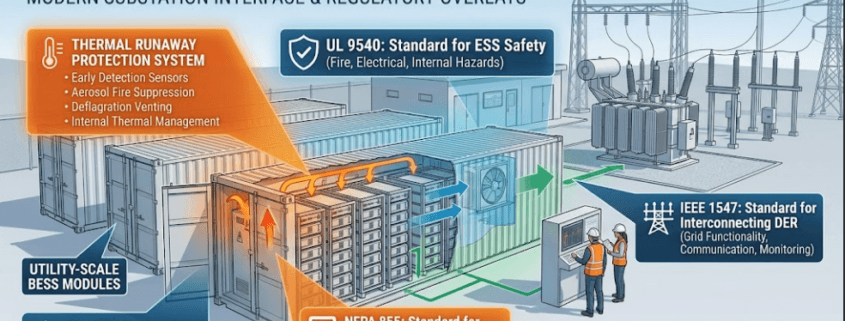

ESS Codes and Standards for USA Utility-Scale BESS in 2026
Battery energy storage systems are expanding rapidly across the United States. As projects grow larger, safety requirements are becoming stricter. Because of this, developers must understand modern ESS codes and standards before starting a project.
Today, battery storage compliance affects:
- System design and footprint layouts
- Fire protection and suppression mechanics
- Comprehensive thermal runaway testing
- Utility interconnection agreements
- Electrical installation workflows
- EMS and BMS hardware integration
In addition, many utilities and authorities now require proof of compliance before approving a project.
This guide explains the most important ESS codes and standards for utility-scale battery energy storage systems in 2026.
Why ESS Codes and Standards Matter
Modern lithium-ion battery systems store large amounts of energy. Therefore, safety is one of the biggest concerns in every BESS project.
ESS codes and standards help reduce risks such as:
- Fire propagation
- Thermal runaway
- Electrical faults
- Gas explosions
- Communication failures
At the same time, these standards improve system reliability and operational safety.
They also help developers:
- Speed up permitting
- Meet utility requirements
- Improve insurance approval
- Reduce project risk
Without proper compliance, projects may face delays and expensive redesigns. As a result, developers should include compliance planning during the early design stage.
Main Types of ESS Codes and Standards
Battery storage regulations are divided into several major categories.
| Category | Purpose |
|---|---|
| Electrical Codes | Safe electrical installation |
| Fire Codes | Fire prevention and protection |
| Product Standards | Equipment certification |
| Performance Standards | Thermal runaway testing |
| Interconnection Standards | Grid compatibility |
| Communication Standards | EMS and SCADA integration |
Together, these standards form the safety foundation for modern energy storage systems.
NFPA 855: The Core of ESS Codes and Standards for Installation Safety
National Fire Protection Association developed NFPA 855 for stationary energy storage systems.
Today, NFPA 855 stands as the single most critical pillar among all ESS codes and standards in the U.S. commercial market.
The standard covers:
- Installation
- Fire protection
- Ventilation
- Maintenance
- Commissioning
- Decommissioning
In addition, NFPA 855 defines safety distances between ESS units and nearby equipment.
The 2026 edition introduces stricter requirements for:
- Large-scale fire testing
- Explosion prevention
- Emergency ventilation
- Gas monitoring systems
Because of these updates, developers must carefully review NFPA 855 during the early project stage.
Many authorities having jurisdiction now use NFPA 855 as a primary safety reference for utility-scale BESS projects.
Learn more here: SunLith Energy – Ultimate NFPA 855 Guide
UL 9540 for ESS System Certification
UL Solutions created the UL 9540 standard to evaluate complete, integrated energy storage systems.
UL 9540 evaluates:
- Battery systems
- PCS integration
- Thermal management
- Safety controls
- Enclosure protection
Unlike component standards, UL 9540 focuses on the complete integrated ESS system.
As a result, most utility-scale projects require UL 9540 certification before permitting approval.
Furthermore, UL 9540 references several other standards, including:
- UL 1973
- UL 1741
- UL 991
- UL 1998
These standards work together to improve overall ESS safety.
UL 9540A Thermal Runaway Testing
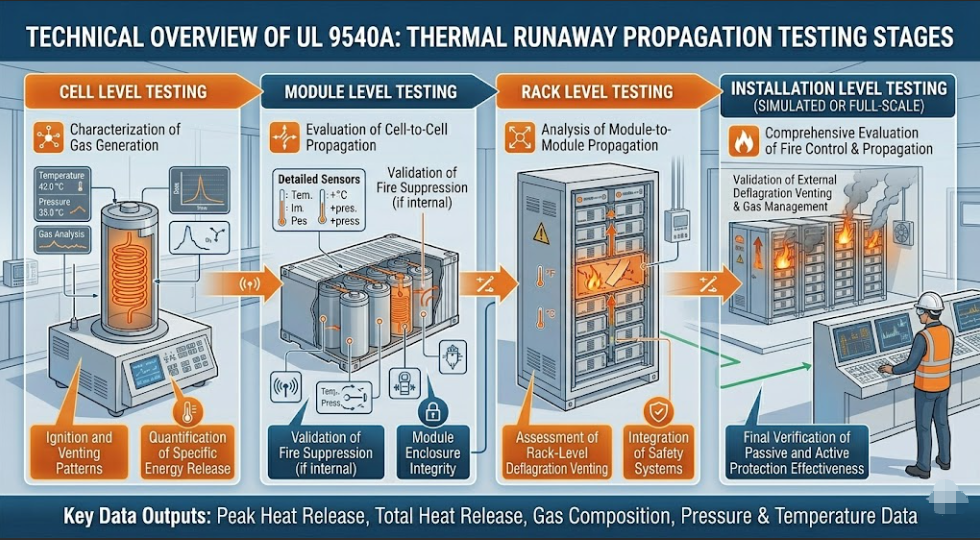
UL 9540A is one of the most important fire testing standards for lithium-ion battery systems.
Unlike UL 9540, this standard does not certify the product itself. Instead, it evaluates thermal runaway fire behavior inside the ESS.
Testing occurs at four levels:
- Cell level
- Module level
- Unit level
- Installation level
According to the ACP document, utility-scale lithium-ion systems must complete cell, module, and unit-level testing.
In addition, the latest revision introduces large-scale fire testing requirements.
Because of these updates, fire safety testing is becoming much stricter for utility-scale projects.
UL 9540A testing helps engineers study:
- Fire spread
- Heat release
- Gas generation
- Explosion risk
- Suppression system performance
Consequently, test results strongly affect enclosure design and site layout planning.
Why Thermal Runaway Testing Matters
Thermal runaway can spread rapidly between battery cells. Consequently, uncontrolled fires may occur inside ESS enclosures.
UL 9540A testing helps engineers evaluate:
- Fire propagation behavior
- Toxic gas release
- Explosion hazards
- Heat release rates
- Suppression system effectiveness
Because of this, testing results directly affect:
- Enclosure spacing
- Ventilation design
- Fire suppression systems
- Emergency response planning
As ESS projects continue growing larger, thermal runaway testing becomes even more important.
NFPA 69 Explosion Prevention Requirements
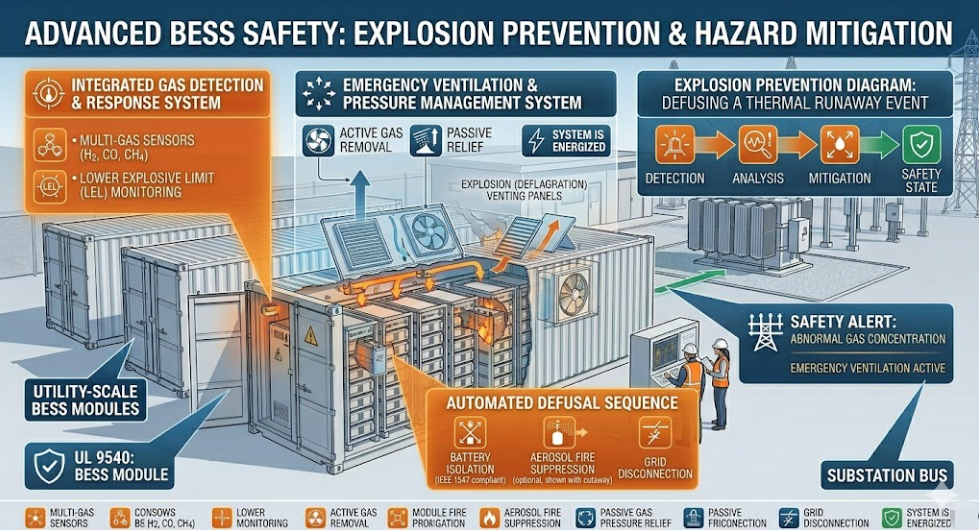
NFPA 69 focuses on explosion prevention inside ESS enclosures.
The updated 2026 NFPA 855 edition increases the importance of this standard.
Under NFPA 69, projects may require:
- Emergency ventilation systems
- Flammable gas monitoring
- Gas concentration control
In many systems, ventilation equipment must keep gas concentration below 25% of the lower flammable limit.
Previously, some projects relied mostly on deflagration venting. However, newer requirements focus more on prevention instead of pressure relief alone.
For this reason, gas detection and ventilation systems are becoming standard features in modern ESS projects.
NFPA 68 for Deflagration Venting
NFPA 68 supports explosion pressure venting and deflagration analysis.
This standard helps engineers calculate:
- Vent sizing
- Pressure relief
- Gas flow behavior
Today, many utility-scale projects combine:
- NFPA 68 studies
- NFPA 69 prevention systems
- UL 9540A testing
Together, these standards improve overall ESS fire safety.
NEC Article 706 for ESS Electrical Safety
National Fire Protection Association includes ESS requirements within the National Electrical Code.
Article 706 applies to energy storage systems larger than 1 kWh.
The article covers:
- Wiring methods
- Disconnects
- Grounding
- Overcurrent protection
- Equipment labeling
Therefore, NEC Article 706 is essential for electrical permitting and inspection approval.
In addition, proper NEC compliance helps reduce electrical hazards during operation and maintenance.
UL 1973 for Battery Certification
UL 1973 applies specifically to stationary battery systems.
The standard evaluates:
- Cell safety
- Module design
- Electrical protection
- Mechanical integrity
Most lithium-ion battery systems require UL 1973 certification before full ESS integration.
Consequently, UL 1973 has become a core requirement for utility-scale battery projects.
Without UL 1973 compliance, achieving UL 9540 system certification becomes difficult.
UL 1741 for PCS and Inverters
UL 1741 applies to power conversion systems and inverters.
This standard evaluates:
- Grid interaction
- Electrical safety
- Anti-islanding protection
- Converter performance
As grid-forming systems become more common, UL 1741 compliance is becoming increasingly important.
Learn more here:
- Sunlith Energy – Grid-Forming Inverter Technology in BESS
- Sunlith Energy – Grid-Following vs Grid-Forming Inverters
IEEE 1547 and IEEE 2800 Interconnection Standards
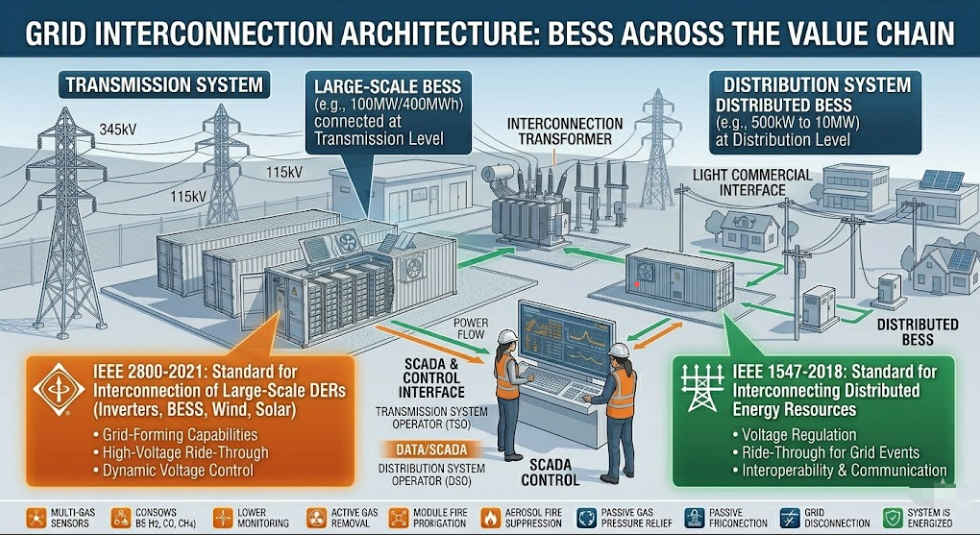
Grid interconnection standards help maintain stable operation between ESS systems and utilities.
IEEE 1547
IEEE 1547 mainly applies to distribution-connected systems.
It defines:
- Voltage response
- Frequency ride-through
- Grid synchronization
- Protection coordination
IEEE 2800
Conversely, IEEE 2800 applies explicitly to large, transmission-connected inverter-based resources.
As utility-scale projects continue growing, IEEE 2800 is becoming more relevant.
Therefore, developers should consider interconnection requirements during the early design phase.
For technical grid-interconnection rules such as voltage ride-through, frequency response, reactive-power control, protection, and country-specific requirements, see our BESS grid codes and compliance guide.
ESS Communication Standards
Modern battery storage systems depend heavily on communication networks.
These networks connect:
- EMS
- BMS
- PCS
- SCADA systems
- Utility operators
As ESS projects grow larger, communication standards become more important.
Key standards include:
- IEEE 1815.2
- IEEE 2030.5
- SunSpec Modbus models
Together, these standards improve interoperability and simplify utility integration.
In addition, they help operators monitor and control battery systems more effectively.
For more details, read:
BMS Standards for Energy Storage Systems
Battery management systems play a major role in ESS safety.
Important BMS standards include:
- UL 991
- UL 1998
- IEEE 2686
- CSA C22.2 No. 340
These standards evaluate:
- Software safety
- Fault handling
- Functional reliability
- Safety-related controls
Therefore, BMS compliance is becoming increasingly important in large utility-scale systems.
At the same time, utilities expect stronger software validation for modern ESS projects.
How AHJs Review ESS Projects
Authorities having jurisdiction review ESS projects before approval.
Typically, AHJs evaluate:
- UL certifications
- Fire safety reports
- Site layouts
- Gas mitigation systems
- Electrical compliance
- Emergency response plans
However, code adoption varies between states and cities.
Because of this, developers often face different compliance requirements across jurisdictions.
Early planning can help reduce approval delays and redesign costs.
Future Trends in ESS Codes and Standards
The ESS industry continues to evolve rapidly. Therefore, safety and compliance rules are becoming more advanced each year.
Several major trends are shaping the future of battery storage systems.
Larger Fire Testing Requirements
Large-scale fire testing is becoming standard for utility-scale BESS projects.
Stricter Gas Management Rules
Explosion prevention requirements are increasing across the industry.
Advanced Grid Support Functions
Utilities now expect smarter inverter behavior and stronger grid support capabilities.
More Software Validation
At the same time, BMS and EMS software testing requirements continue to expand.
Because of these changes, future ESS projects will require tighter coordination between:
- EMS
- BMS
- PCS
- Fire systems
- Gas detection systems
As a result, compliance-driven engineering is becoming essential for large battery storage projects.
How Sunlith Energy Simplifies ESS Codes and Standards Compliance
At Sunlith Energy, we understand that ESS codes and standards directly affect system safety, reliability, and project approval.
Our specialized engineering and integration approach focuses heavily on:
- Turnkey utility-scale BESS integration
- Advanced, compliant EMS architecture deployment
- Grid-forming inverter optimization and safety
- Proactive, code-compliant physical site design
- Scalable ESS solutions
Therefore, we help customers prepare for evolving compliance requirements across modern battery storage projects.
Conclusion
ESS codes and standards are evolving quickly as battery storage systems become larger and more advanced.
Today, standards such as:
- NFPA 855
- UL 9540
- UL 9540A
- UL 1973
- IEEE 1547
- IEEE 2800
- NFPA 69
affect nearly every part of a utility-scale BESS project.
These standards influence:
- System design
- Fire safety
- Utility interconnection
- Thermal runaway testing
- Software validation
Because of this, developers should review compliance requirements during the earliest project stages.
In the coming years, stricter safety rules and larger ESS installations will continue shaping the future of battery energy storage systems.