

Solar Panel Tilt Angle by Location: The Complete World Guide to Maximum Output
Why the Tilt Angle Decision Matters Before You Buy a Single Panel
Most solar buyers spend hours comparing panel brands and inverter models. However, one of the most powerful performance variables costs nothing to optimise. In fact, it is decided before the first bolt is tightened: the solar panel tilt angle. Therefore, setting it correctly for your location means you capture every kilowatt-hour the Sun is offering. If you set it wrong, you permanently leave 20–40% of your system’s lifetime yield on the table — for the entire life of the installation.
This guide is the definitive reference for solar panel tilt angle by location. First, it explains the physics behind the tilt angle rule. Furthermore, it breaks down the optimal values by latitude zone. In addition, it provides a comprehensive 130+ city world database covering every country, all US state capitals, Canadian provinces, and major capitals across every continent. As a result, every value is cross-referenced against NREL and Global Solar Atlas irradiance data so you can act on it with confidence.
Whether you are designing a residential rooftop system, a commercial ground-mount, or a utility-scale solar-plus-storage plant, this guide is therefore your complete reference. Used alongside Sunlith’s Peak Sun Hours by Location guide and the Energy Storage Calculation guide, it gives you the complete input data you need to size a system correctly from the ground up.
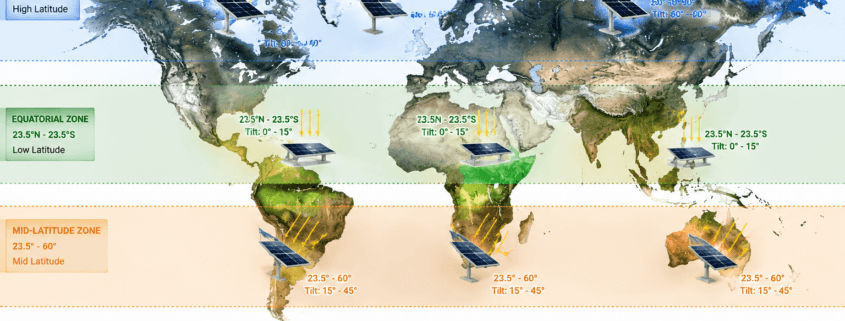
Solar panel tilt angle rule: Set your tilt angle equal to your site latitude for maximum annual yield.
• Northern Hemisphere → Face TRUE SOUTH.
• Southern Hemisphere → Face TRUE NORTH.
• Equatorial zone (0°–15°) → Minimum 10–15° tilt for drainage.
• High latitudes → Steepen tilt toward 60–70°.
Single-axis trackers recover 15–25% more energy at any tilt angle setting.
1. The Physics Behind Solar Panel Tilt Angle
1.1 Why Tilt Angle Exists: Solar Declination and the Ecliptic Plane
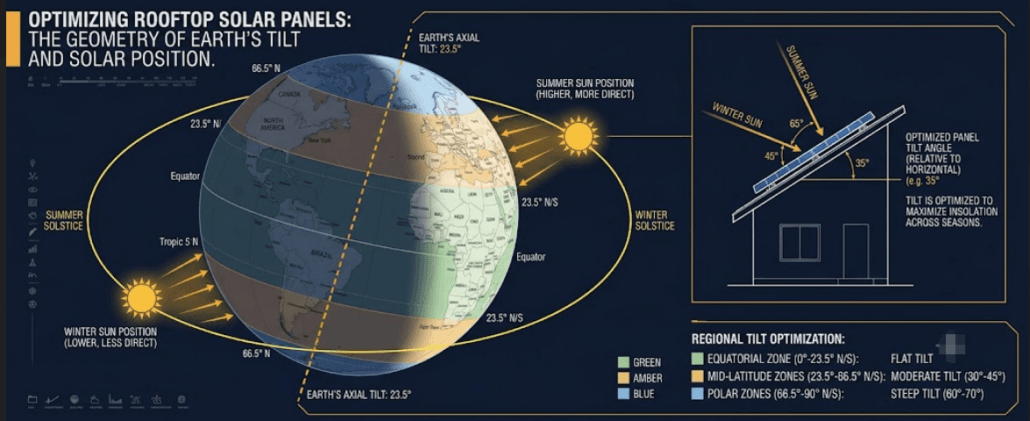
The Earth orbits the Sun on a tilted axis — 23.5° relative to the ecliptic plane. As a result, the Sun’s path across the sky varies by season and latitude. In summer, the Sun arcs high; in winter, it tracks low and short. Consequently, a fixed solar panel set at the wrong tilt angle misses the bulk of available irradiance for large parts of the year. Setting the correct solar panel tilt angle therefore compensates for this by orienting the panel face as close to perpendicular to the Sun’s average annual path as possible.
Two angles fully define a solar panel’s orientation relative to the Sun. In addition, both must be set correctly for maximum output:
- Azimuth angle: the compass direction the panel face points toward (e.g., 180° = true south in the Northern Hemisphere).
- Tilt angle (inclination angle): how steeply the panel is inclined from horizontal — 0° is perfectly flat, 90° is vertical. This is therefore the primary focus of this guide.
1.2 Azimuth Direction: The Companion Setting to Tilt Angle
Tilt angle and azimuth direction must therefore be set together — each amplifies or undermines the other. The Sun transits across the sky from east to west. In the Northern Hemisphere, the Sun’s arc peaks in the southern sky. In the Southern Hemisphere, it consequently peaks in the northern sky. A panel tilted at the correct solar panel tilt angle but facing the wrong direction consequently captures far less irradiance than its theoretical potential.
- Northern Hemisphere (latitudes > 0°): pair any tilt angle with azimuth 180° — TRUE SOUTH.
- Southern Hemisphere (latitudes < 0°): pair any tilt angle with azimuth 0° — TRUE NORTH.
- Near the Equator (±5°): tilt angle is the dominant variable; azimuth east-west deviation has minimal impact.
Important: compass south and TRUE geographic south can differ by several degrees depending on magnetic declination at your site. Therefore, always calibrate to true south using GPS coordinates or solar simulation tools such as PVGIS or the Global Solar Atlas — do not rely on a standard magnetic compass alone.
1.3 The Latitude Rule: How to Calculate Your Optimal Solar Panel Tilt Angle
Quick Summary: How to Orient Solar Panels by Location
- Northern Hemisphere: Face panels true south (180° azimuth) at a tilt angle equal to the site latitude.
- Southern Hemisphere: Face panels true north (0° azimuth) at a tilt angle equal to the site latitude.
- Equatorial Regions (0°–15°): Set a minimum tilt angle of 10° to 15° to ensure proper rain drainage and self-cleaning.
- High Latitudes (Above 55°): Steepen the tilt angle toward 60°–70° to capture the low-tracking winter sun.
The optimal solar panel tilt angle for a fixed-mount system is generally equal to the geographic latitude of your location. Setting the tilt angle to match your latitude balances seasonal solar changes, positioning the panels perpendicular to the sun’s average annual path to maximize total yearly energy yield.
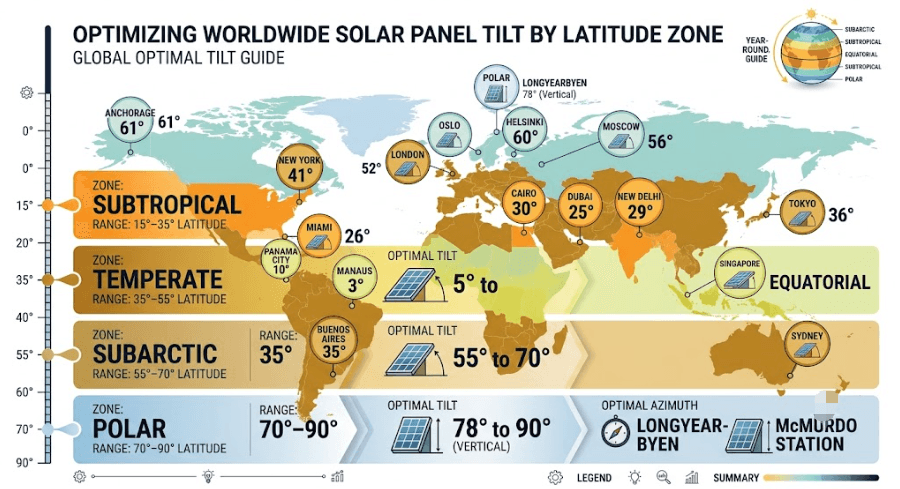
- London (51.5°N) → solar panel tilt angle ≈ 51°
- New York (40.7°N) → solar panel tilt angle ≈ 41°
- Dubai (25.2°N) → solar panel tilt angle ≈ 25°
- Sydney (33.9°S) → solar panel tilt angle ≈ 34°, facing true north
- Singapore (1.3°N) → solar panel tilt angle ≈ 10–15° (equatorial minimum for drainage)
Seasonal tilt adjustments can furthermore improve output by 5–10% for systems with adjustable racking. For example, increasing the tilt angle by 10–15° in winter compensates for the lower Sun; conversely, decreasing it by 10–15° in summer maximises longer daylight hours. As a result, fixed systems should use the annual average tilt angle equal to latitude as the default. The world city database in Section 4 applies this rule to 130+ locations globally so you have a ready reference for any site.
2. Solar Panel Tilt Angle by Latitude Zone: Five Regional Guides
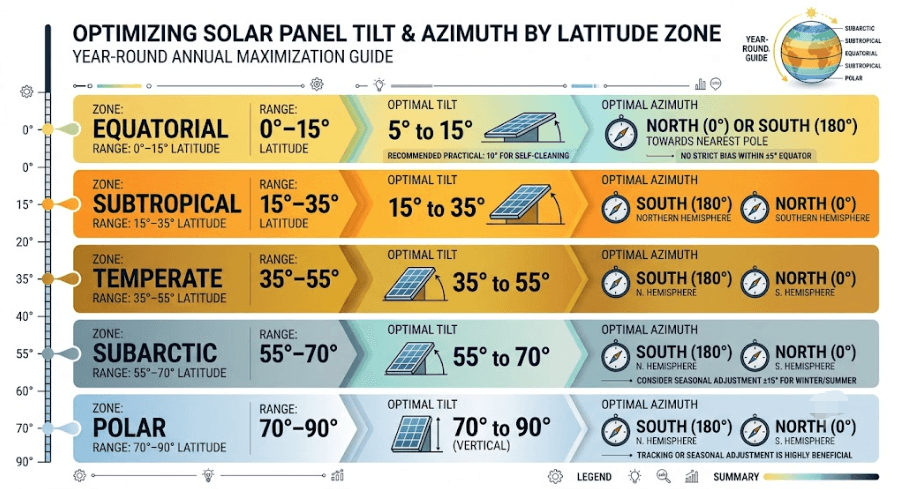
Zone 1: Equatorial Region — Solar Panel Tilt Angle 10°–15° (0° – 15° Latitude)
Countries: Indonesia, Malaysia, Singapore, Kenya, Ecuador, Colombia, Nigeria, Ghana, Uganda, Sri Lanka
- Optimal solar panel tilt angle: 10–15° minimum. Do not go lower — near-flat panels accumulate dust and water pools, accelerating soiling losses and potential corrosion.
- Optimal direction: Can face either north or south — the Sun’s noon altitude is very high year-round (75°–90°), so azimuth deviation has minimal impact at these latitudes.
- Key consideration: diffuse irradiance from overcast tropical skies contributes significantly to total annual yield. Bifacial panels recover 5–12% additional energy from sky-diffuse and ground-reflected radiation.
- Seasonal variation: minimal — no major adjustment required.
In equatorial climates, the biggest output losses are soiling and high cell temperatures — not tilt angle errors. Once you clear the 10–15° minimum tilt angle required for natural rain self-cleaning, shift your focus to establishing a regular panel washing routine and choosing modules featuring a low temperature coefficient (ideally below –0.35%/°C).
Zone 2: Subtropical Region — Solar Panel Tilt Angle 15°–35° (15° – 35° Latitude)
Countries/regions: India (south), Australia (north), Saudi Arabia, UAE, Mexico, Texas (USA), Egypt, South Africa (north), Morocco
- Optimal solar panel tilt angle: 15°–35° — apply the latitude rule directly.
- Optimal direction: True south (Northern Hemisphere) or true north (Southern Hemisphere) is important here, because the Sun arc is not as overhead as in the equatorial zone.
- Desert sites in this zone carry the world’s highest Direct Normal Irradiance (DNI). However, soiling losses from fine dust can reach 15–25% without monthly panel cleaning — soiling management is therefore as critical as tilt angle optimisation.
- Temperature coefficient loss: At a cell temperature of 70°C — common on black rooftop panels in subtropical summer — a standard monocrystalline panel consequently loses approximately 16% of its STC-rated output. This is separate from, and additive to, any tilt angle loss.
Zone 3: Temperate Region — Solar Panel Tilt Angle 35°–55° (35° – 55° Latitude)
Countries/regions: Most of Europe, northern USA, northern China, Japan, South Korea, New Zealand (South Island), southern Australia
- Optimal solar panel tilt angle: 35°–55° matching latitude. This range consequently sees the greatest absolute yield difference between a correct and incorrect tilt angle — much more so than in tropical zones.
- Optimal direction: True south (Northern Hemisphere) or true north (Southern Hemisphere). At these latitudes, a 45° azimuth deviation (e.g., facing SE instead of S) therefore costs 5–8% of annual yield — far more than in lower latitudes.
- Winter considerations: Increasing the solar panel tilt angle by 10–15° above latitude (e.g., 55° instead of 45° in London) trades a small summer yield reduction for meaningfully better winter output — often the right trade-off where winter heating or storage demand is highest.
- Bifacial panels on snowy ground: Reflected light from snow cover can increase bifacial yield by 10–25% in northern Europe, Canada, and the northern USA — an often-overlooked benefit of a steeper tilt angle in these climates.
Zone 4: Subarctic Region — Solar Panel Tilt Angle 55°–70° (55° – 70° Latitude)
Countries/regions: Scandinavia (Norway, Sweden, Finland), Alaska, Iceland, northern Russia, northern Canada
- Optimal solar panel tilt angle: 55°–70°. At these latitudes the winter Sun barely clears the horizon, so a steep tilt angle is therefore essential to face the panel more directly toward the low solar disc.
- Optimal direction: True south is non-negotiable. Any significant eastward or westward deviation consequently sharply reduces the already-limited winter irradiance.
- System design consideration: Annual yield is dominated by the long summer days. As a result, the BESS must be sized to time-shift summer surplus and bridge the extended winter shortfall. Sizing decisions therefore begin with the correct tilt angle, then apply the minimum winter peak sun hours to determine storage requirements.
- Trackers: dual-axis trackers can boost summer harvest by 30–40%, substantially improving the seasonal energy balance for subarctic sites.
Zone 5: Polar Region — Solar Panel Tilt Angle 70°–90° (70° – 90° Latitude)
Countries/regions: Northern Greenland, Svalbard, Arctic research stations, Antarctica
- Optimal solar panel tilt angle: 70°–90° (near-vertical). The Sun never rises high in polar skies — a near-vertical panel therefore faces the low solar disc most directly during the brief productive hours.
- Optimal direction: True south (Northern Hemisphere). During polar summer, when the Sun circles the sky for 24 hours, east-west orientation splits may consequently be considered to distribute capture around the clock.
- Key consideration: Systems must be massively oversized relative to winter demand, or paired with complementary generation (wind, diesel) to survive multi-month polar night. As a result, the tilt angle decision at these latitudes is secondary to the fundamental seasonal energy gap.
3. Panel Facing Direction vs. Tilt Angle: The Combined Impact Table
3.1 How Direction Deviations Reduce Annual Yield
The solar panel tilt angle and azimuth direction interact closely. Therefore, the table below shows annual yield relative to a perfectly south-facing, latitude-matched tilt angle installation in the Northern Hemisphere. Use it to evaluate what you lose when roof orientation or planning constraints force a compromise on either variable.
| Panel Facing Direction | Azimuth | Yield vs. True South | Best Use Case |
|---|---|---|---|
| True South | 180° | 100% (Reference) | Maximum annual yield |
| South-Southeast | 157° | 98–99% | Negligible loss — acceptable |
| South-Southwest | 202° | 98–99% | Slight afternoon bias — acceptable |
| Southeast | 135° | 92–95% | Morning production emphasis |
| Southwest | 225° | 92–95% | Afternoon / evening bias — better for TOU pricing |
| East | 90° | 78–82% | Morning-heavy; good for morning demand sites |
| West | 270° | 78–82% | Afternoon peak; matches evening demand; grid peak shaving |
| North | 0° | 55–65% | Worst — avoid in Northern Hemisphere |
3.2 When West-Facing Makes Commercial Sense
West-facing panels paired with a steeper tilt angle have gained significant commercial interest under Time-of-Use (TOU) tariff structures—a trend reflecting the shifting grid dynamics noted in the IEA World Energy Outlook 2024. The reason is that they shift generation toward peak afternoon grid pricing periods. As a result, even though west-facing arrays produce 18–22% less annual energy than true-south arrays, the higher value of that afternoon energy can consequently close the revenue gap. Furthermore, a Battery Energy Storage System (BESS) can maximise revenue from any panel orientation by decoupling solar generation time from dispatch time — making optimal tilt angle therefore the most important fixed parameter when the direction is constrained.
4. Solar Panel Tilt Angle Database: 130+ World Cities by Country, State & Capital
4.0 How to Use This Database
The following database provides the recommended solar panel tilt angle and optimal facing direction for 130+ world cities. Values are derived from geographic latitude and, furthermore, cross-referenced against PVGIS and Global Solar Atlas irradiance data. These are therefore authoritative starting values. However, always run a site-specific simulation using PVGIS or PVWatts to account for local shading, horizon obstructions, and microclimate before finalising your installation design.
4.1 USA State Capitals & Major Cities — Southern & Central States (A–N)
All US states in the Northern Hemisphere use true south (180°) as the optimal azimuth. Therefore, the tilt angle is the only variable that changes by location — set it equal to your state capital’s latitude for maximum annual output.
| City / State | Latitude | Optimal Direction | Tilt Angle | Annual PSH (avg) |
|---|---|---|---|---|
| Phoenix, AZ | 33.4°N | True South (180°) | 33° | 5.5–6.5 hrs |
| Los Angeles, CA | 34.1°N | True South (180°) | 34° | 5.0–6.0 hrs |
| Sacramento, CA | 38.6°N | True South (180°) | 39° | 4.8–5.6 hrs |
| Denver, CO | 39.7°N | True South (180°) | 40° | 5.0–5.8 hrs |
| Hartford, CT | 41.8°N | True South (180°) | 42° | 4.2–4.8 hrs |
| Tallahassee, FL | 30.4°N | True South (180°) | 30° | 4.8–5.5 hrs |
| Atlanta, GA | 33.7°N | True South (180°) | 34° | 4.5–5.2 hrs |
| Honolulu, HI | 21.3°N | True South (180°) | 21° | 5.5–6.3 hrs |
| Boise, ID | 43.6°N | True South (180°) | 44° | 4.5–5.3 hrs |
| Springfield, IL | 39.8°N | True South (180°) | 40° | 4.2–5.0 hrs |
| Indianapolis, IN | 39.8°N | True South (180°) | 40° | 4.0–4.8 hrs |
| Des Moines, IA | 41.6°N | True South (180°) | 42° | 4.2–5.0 hrs |
| Topeka, KS | 39.0°N | True South (180°) | 39° | 4.5–5.3 hrs |
| Frankfort, KY | 38.2°N | True South (180°) | 38° | 4.0–4.8 hrs |
| Baton Rouge, LA | 30.5°N | True South (180°) | 31° | 4.5–5.2 hrs |
| Augusta, ME | 44.3°N | True South (180°) | 44° | 3.8–4.5 hrs |
| Annapolis, MD | 38.9°N | True South (180°) | 39° | 4.0–4.8 hrs |
| Boston, MA | 42.4°N | True South (180°) | 42° | 4.0–4.7 hrs |
| Lansing, MI | 42.7°N | True South (180°) | 43° | 3.8–4.5 hrs |
| St. Paul, MN | 44.9°N | True South (180°) | 45° | 3.8–4.5 hrs |
| Jackson, MS | 32.3°N | True South (180°) | 32° | 4.5–5.2 hrs |
| Jefferson City, MO | 38.6°N | True South (180°) | 39° | 4.2–5.0 hrs |
| Helena, MT | 46.6°N | True South (180°) | 47° | 4.0–5.0 hrs |
| Lincoln, NE | 40.8°N | True South (180°) | 41° | 4.5–5.3 hrs |
| Carson City, NV | 39.2°N | True South (180°) | 39° | 5.5–6.5 hrs |
4.1b USA State Capitals — Northern & Western States (N–W) + DC & Territories
As a result of increasing latitude, northern states consistently require steeper tilt angles. For example, Juneau, Alaska (58.3°N) uses a 58° tilt angle — nearly twice that of Honolulu, Hawaii (21°). Furthermore, northern states also see lower peak sun hours, which makes setting the correct tilt angle even more critical to capturing every available hour of irradiance.
| City / State | Latitude | Optimal Direction | Tilt Angle | Annual PSH (avg) |
|---|---|---|---|---|
| Concord, NH | 43.2°N | True South (180°) | 43° | 3.9–4.6 hrs |
| Trenton, NJ | 40.2°N | True South (180°) | 40° | 4.0–4.8 hrs |
| Santa Fe, NM | 35.7°N | True South (180°) | 36° | 5.5–6.5 hrs |
| Albany, NY | 42.7°N | True South (180°) | 43° | 3.9–4.6 hrs |
| New York City, NY | 40.7°N | True South (180°) | 41° | 4.0–4.8 hrs |
| Raleigh, NC | 35.8°N | True South (180°) | 36° | 4.5–5.2 hrs |
| Bismarck, ND | 46.8°N | True South (180°) | 47° | 4.2–5.0 hrs |
| Columbus, OH | 40.0°N | True South (180°) | 40° | 3.9–4.7 hrs |
| Oklahoma City, OK | 35.5°N | True South (180°) | 36° | 4.8–5.5 hrs |
| Salem, OR | 44.9°N | True South (180°) | 45° | 3.5–4.5 hrs |
| Harrisburg, PA | 40.3°N | True South (180°) | 40° | 4.0–4.8 hrs |
| Providence, RI | 41.8°N | True South (180°) | 42° | 4.0–4.7 hrs |
| Columbia, SC | 34.0°N | True South (180°) | 34° | 4.5–5.2 hrs |
| Pierre, SD | 44.4°N | True South (180°) | 44° | 4.5–5.2 hrs |
| Nashville, TN | 36.2°N | True South (180°) | 36° | 4.5–5.0 hrs |
| Austin, TX | 30.3°N | True South (180°) | 30° | 5.0–5.8 hrs |
| Salt Lake City, UT | 40.8°N | True South (180°) | 41° | 5.0–5.8 hrs |
| Montpelier, VT | 44.3°N | True South (180°) | 44° | 3.8–4.5 hrs |
| Richmond, VA | 37.5°N | True South (180°) | 38° | 4.2–5.0 hrs |
| Olympia, WA | 47.0°N | True South (180°) | 47° | 3.2–4.0 hrs |
| Charleston, WV | 38.4°N | True South (180°) | 38° | 3.8–4.5 hrs |
| Madison, WI | 43.1°N | True South (180°) | 43° | 3.8–4.5 hrs |
| Cheyenne, WY | 41.1°N | True South (180°) | 41° | 5.0–5.8 hrs |
| Juneau, AK | 58.3°N | True South (180°) | 58° | 2.5–3.5 hrs |
| Washington, DC | 38.9°N | True South (180°) | 39° | 4.0–4.8 hrs |
4.2 Canada — Provincial & Territorial Capitals
| City / Province | Latitude | Optimal Direction | Tilt Angle | Annual PSH (avg) |
|---|---|---|---|---|
| Victoria, BC | 48.4°N | True South (180°) | 48° | 3.5–4.5 hrs |
| Edmonton, AB | 53.5°N | True South (180°) | 54° | 3.5–4.5 hrs |
| Regina, SK | 50.5°N | True South (180°) | 51° | 4.0–5.0 hrs |
| Winnipeg, MB | 49.9°N | True South (180°) | 50° | 4.0–5.0 hrs |
| Toronto, ON | 43.7°N | True South (180°) | 44° | 3.8–4.5 hrs |
| Quebec City, QC | 46.8°N | True South (180°) | 47° | 3.8–4.5 hrs |
| Fredericton, NB | 45.9°N | True South (180°) | 46° | 3.7–4.4 hrs |
| Halifax, NS | 44.6°N | True South (180°) | 45° | 3.7–4.4 hrs |
| Charlottetown, PEI | 46.2°N | True South (180°) | 46° | 3.6–4.3 hrs |
| St. John’s, NL | 47.6°N | True South (180°) | 48° | 3.5–4.2 hrs |
| Whitehorse, YT | 60.7°N | True South (180°) | 61° | 3.0–4.0 hrs |
| Yellowknife, NT | 62.5°N | True South (180°) | 63° | 3.0–4.0 hrs |
| Iqaluit, NU | 63.7°N | True South (180°) | 64° | 2.5–3.5 hrs |
4.3 Europe — Country Capitals & Major Cities
| City / Country | Latitude | Hemisphere | Optimal Direction | Tilt Angle | PSH (avg) |
|---|---|---|---|---|---|
| Reykjavik, Iceland | 64.1°N | Northern | True South (180°) | 64° | 2.5–3.5 hrs |
| Helsinki, Finland | 60.2°N | Northern | True South (180°) | 60° | 2.8–3.8 hrs |
| Oslo, Norway | 59.9°N | Northern | True South (180°) | 60° | 2.8–3.8 hrs |
| Stockholm, Sweden | 59.3°N | Northern | True South (180°) | 59° | 3.0–4.0 hrs |
| Tallinn, Estonia | 59.4°N | Northern | True South (180°) | 59° | 2.9–3.8 hrs |
| Riga, Latvia | 56.9°N | Northern | True South (180°) | 57° | 3.0–3.9 hrs |
| Vilnius, Lithuania | 54.7°N | Northern | True South (180°) | 55° | 3.1–4.0 hrs |
| Moscow, Russia | 55.8°N | Northern | True South (180°) | 56° | 3.0–4.0 hrs |
| Copenhagen, Denmark | 55.7°N | Northern | True South (180°) | 56° | 3.0–4.0 hrs |
| Edinburgh, Scotland | 55.9°N | Northern | True South (180°) | 56° | 2.8–3.8 hrs |
| Amsterdam, Netherlands | 52.4°N | Northern | True South (180°) | 52° | 3.0–4.0 hrs |
| Brussels, Belgium | 50.9°N | Northern | True South (180°) | 51° | 3.0–4.0 hrs |
| Warsaw, Poland | 52.2°N | Northern | True South (180°) | 52° | 3.2–4.2 hrs |
| Prague, Czech Rep. | 50.1°N | Northern | True South (180°) | 50° | 3.3–4.2 hrs |
| Berlin, Germany | 52.5°N | Northern | True South (180°) | 53° | 3.2–4.2 hrs |
| Vienna, Austria | 48.2°N | Northern | True South (180°) | 48° | 3.5–4.5 hrs |
| Bern, Switzerland | 46.9°N | Northern | True South (180°) | 47° | 3.5–4.8 hrs |
| Paris, France | 48.9°N | Northern | True South (180°) | 49° | 3.2–4.2 hrs |
| London, UK | 51.5°N | Northern | True South (180°) | 52° | 2.7–3.7 hrs |
| Dublin, Ireland | 53.3°N | Northern | True South (180°) | 53° | 2.6–3.5 hrs |
| Lisbon, Portugal | 38.7°N | Northern | True South (180°) | 39° | 4.5–5.5 hrs |
| Madrid, Spain | 40.4°N | Northern | True South (180°) | 40° | 4.5–5.5 hrs |
| Rome, Italy | 41.9°N | Northern | True South (180°) | 42° | 4.2–5.2 hrs |
| Athens, Greece | 37.9°N | Northern | True South (180°) | 38° | 4.5–5.5 hrs |
| Nicosia, Cyprus | 35.2°N | Northern | True South (180°) | 35° | 5.0–6.0 hrs |
| Valletta, Malta | 35.9°N | Northern | True South (180°) | 36° | 5.0–6.0 hrs |
| Zagreb, Croatia | 45.8°N | Northern | True South (180°) | 46° | 3.8–4.8 hrs |
| Sarajevo, Bosnia | 43.9°N | Northern | True South (180°) | 44° | 3.8–4.8 hrs |
| Belgrade, Serbia | 44.8°N | Northern | True South (180°) | 45° | 3.8–4.8 hrs |
| Bucharest, Romania | 44.4°N | Northern | True South (180°) | 44° | 4.0–5.0 hrs |
| Sofia, Bulgaria | 42.7°N | Northern | True South (180°) | 43° | 4.0–5.0 hrs |
| Budapest, Hungary | 47.5°N | Northern | True South (180°) | 48° | 3.7–4.7 hrs |
| Bratislava, Slovakia | 48.2°N | Northern | True South (180°) | 48° | 3.6–4.6 hrs |
| Ljubljana, Slovenia | 46.1°N | Northern | True South (180°) | 46° | 3.7–4.7 hrs |
| Kyiv, Ukraine | 50.5°N | Northern | True South (180°) | 51° | 3.5–4.5 hrs |
| Minsk, Belarus | 53.9°N | Northern | True South (180°) | 54° | 3.2–4.2 hrs |
| Chisinau, Moldova | 47.0°N | Northern | True South (180°) | 47° | 3.8–4.8 hrs |
| Tirana, Albania | 41.3°N | Northern | True South (180°) | 41° | 4.2–5.2 hrs |
| Skopje, N. Macedonia | 42.0°N | Northern | True South (180°) | 42° | 4.2–5.2 hrs |
| Podgorica, Montenegro | 42.4°N | Northern | True South (180°) | 42° | 4.2–5.2 hrs |
| Pristina, Kosovo | 42.7°N | Northern | True South (180°) | 43° | 4.0–5.0 hrs |
| Andorra la Vella | 42.5°N | Northern | True South (180°) | 43° | 4.5–5.5 hrs |
| Luxembourg City | 49.6°N | Northern | True South (180°) | 50° | 3.2–4.2 hrs |
| Valletta, Malta | 35.9°N | Northern | True South (180°) | 36° | 5.0–6.0 hrs |
4.4 Asia — Country Capitals & Major Cities
| City / Country | Latitude | Hemisphere | Optimal Direction | Tilt Angle | PSH (avg) |
|---|---|---|---|---|---|
| Tokyo, Japan | 35.7°N | Northern | True South (180°) | 36° | 3.8–4.8 hrs |
| Beijing, China | 39.9°N | Northern | True South (180°) | 40° | 4.5–5.5 hrs |
| Shanghai, China | 31.2°N | Northern | True South (180°) | 31° | 3.8–4.8 hrs |
| Seoul, South Korea | 37.6°N | Northern | True South (180°) | 38° | 3.8–4.8 hrs |
| Pyongyang, N. Korea | 39.0°N | Northern | True South (180°) | 39° | 4.0–5.0 hrs |
| Ulaanbaatar, Mongolia | 47.9°N | Northern | True South (180°) | 48° | 4.5–5.8 hrs |
| New Delhi, India | 28.6°N | Northern | True South (180°) | 29° | 4.5–5.5 hrs |
| Mumbai, India | 19.1°N | Northern | True South (180°) | 19° | 5.0–6.0 hrs |
| Chennai, India | 13.1°N | Northern | True South (180°) | 13° | 5.0–6.0 hrs |
| Islamabad, Pakistan | 33.7°N | Northern | True South (180°) | 34° | 5.0–6.0 hrs |
| Dhaka, Bangladesh | 23.7°N | Northern | True South (180°) | 24° | 4.5–5.5 hrs |
| Kathmandu, Nepal | 27.7°N | Northern | True South (180°) | 28° | 4.5–5.5 hrs |
| Colombo, Sri Lanka | 6.9°N | Northern | True South/Flat | 10–15° | 5.0–6.0 hrs |
| Male, Maldives | 4.2°N | Equatorial | True South/Flat | 10–15° | 5.5–6.5 hrs |
| Kabul, Afghanistan | 34.5°N | Northern | True South (180°) | 35° | 5.5–6.5 hrs |
| Tehran, Iran | 35.7°N | Northern | True South (180°) | 36° | 5.0–6.0 hrs |
| Baghdad, Iraq | 33.3°N | Northern | True South (180°) | 33° | 5.5–6.5 hrs |
| Riyadh, Saudi Arabia | 24.7°N | Northern | True South (180°) | 25° | 5.5–6.5 hrs |
| Dubai, UAE | 25.2°N | Northern | True South (180°) | 25° | 5.5–6.5 hrs |
| Doha, Qatar | 25.3°N | Northern | True South (180°) | 25° | 5.5–6.5 hrs |
| Kuwait City, Kuwait | 29.4°N | Northern | True South (180°) | 29° | 5.5–6.5 hrs |
| Muscat, Oman | 23.6°N | Northern | True South (180°) | 24° | 5.5–6.5 hrs |
| Sana’a, Yemen | 15.4°N | Northern | True South (180°) | 15° | 5.5–6.5 hrs |
| Amman, Jordan | 31.9°N | Northern | True South (180°) | 32° | 5.0–6.0 hrs |
| Beirut, Lebanon | 33.9°N | Northern | True South (180°) | 34° | 5.0–6.0 hrs |
| Jerusalem, Israel | 31.8°N | Northern | True South (180°) | 32° | 5.0–6.0 hrs |
| Ankara, Turkey | 39.9°N | Northern | True South (180°) | 40° | 4.5–5.5 hrs |
| Tashkent, Uzbekistan | 41.3°N | Northern | True South (180°) | 41° | 4.8–5.8 hrs |
| Almaty, Kazakhstan | 43.3°N | Northern | True South (180°) | 43° | 4.5–5.5 hrs |
| Bishkek, Kyrgyzstan | 42.9°N | Northern | True South (180°) | 43° | 4.5–5.5 hrs |
| Dushanbe, Tajikistan | 38.6°N | Northern | True South (180°) | 39° | 4.8–5.8 hrs |
| Ashgabat, Turkmenistan | 37.9°N | Northern | True South (180°) | 38° | 5.0–6.0 hrs |
| Baku, Azerbaijan | 40.4°N | Northern | True South (180°) | 40° | 4.5–5.5 hrs |
| Tbilisi, Georgia | 41.7°N | Northern | True South (180°) | 42° | 4.3–5.3 hrs |
| Yerevan, Armenia | 40.2°N | Northern | True South (180°) | 40° | 4.5–5.5 hrs |
| Kuala Lumpur, Malaysia | 3.1°N | Equatorial | South/Flat | 10–15° | 4.5–5.5 hrs |
| Singapore | 1.3°N | Equatorial | South/Flat | 10–15° | 4.3–5.3 hrs |
| Bangkok, Thailand | 13.8°N | Northern | True South (180°) | 14° | 4.8–5.8 hrs |
| Hanoi, Vietnam | 21.0°N | Northern | True South (180°) | 21° | 4.5–5.5 hrs |
| Manila, Philippines | 14.6°N | Northern | True South (180°) | 15° | 4.8–5.8 hrs |
| Jakarta, Indonesia | 6.2°S | Southern | True North (0°) | 10–15° | 4.5–5.5 hrs |
| Phnom Penh, Cambodia | 11.6°N | Northern | True South (180°) | 12° | 5.0–6.0 hrs |
| Vientiane, Laos | 17.9°N | Northern | True South (180°) | 18° | 5.0–6.0 hrs |
| Naypyidaw, Myanmar | 19.7°N | Northern | True South (180°) | 20° | 4.8–5.8 hrs |
| Kathmandu, Nepal | 27.7°N | Northern | True South (180°) | 28° | 4.8–5.8 hrs |
| Thimphu, Bhutan | 27.5°N | Northern | True South (180°) | 28° | 4.5–5.5 hrs |
4.5 Africa — Country Capitals & Major Cities
| City / Country | Latitude | Hemisphere | Optimal Direction | Tilt Angle | PSH (avg) |
|---|---|---|---|---|---|
| Cairo, Egypt | 30.1°N | Northern | True South (180°) | 30° | 5.5–6.5 hrs |
| Tunis, Tunisia | 36.8°N | Northern | True South (180°) | 37° | 5.0–6.0 hrs |
| Algiers, Algeria | 36.7°N | Northern | True South (180°) | 37° | 5.0–6.0 hrs |
| Rabat, Morocco | 34.0°N | Northern | True South (180°) | 34° | 5.0–6.0 hrs |
| Tripoli, Libya | 32.9°N | Northern | True South (180°) | 33° | 5.5–6.5 hrs |
| Khartoum, Sudan | 15.6°N | Northern | True South (180°) | 16° | 6.0–7.0 hrs |
| Addis Ababa, Ethiopia | 9.0°N | Northern | True South (180°) | 9° | 5.5–6.5 hrs |
| Nairobi, Kenya | 1.3°S | Southern | True North (0°) | 10–15° | 5.5–6.5 hrs |
| Kampala, Uganda | 0.3°N | Equatorial | South/Flat | 10–15° | 5.0–6.0 hrs |
| Dar es Salaam, Tanzania | 6.8°S | Southern | True North (0°) | 7–15° | 5.5–6.5 hrs |
| Kigali, Rwanda | 1.9°S | Southern | True North (0°) | 10–15° | 5.5–6.5 hrs |
| Bujumbura, Burundi | 3.4°S | Southern | True North (0°) | 10–15° | 5.5–6.5 hrs |
| Lusaka, Zambia | 15.4°S | Southern | True North (0°) | 15° | 5.5–6.5 hrs |
| Harare, Zimbabwe | 17.8°S | Southern | True North (0°) | 18° | 5.5–6.5 hrs |
| Maputo, Mozambique | 25.9°S | Southern | True North (0°) | 26° | 5.5–6.5 hrs |
| Lilongwe, Malawi | 14.0°S | Southern | True North (0°) | 14° | 5.5–6.5 hrs |
| Gaborone, Botswana | 24.7°S | Southern | True North (0°) | 25° | 5.5–6.5 hrs |
| Windhoek, Namibia | 22.6°S | Southern | True North (0°) | 23° | 5.8–6.8 hrs |
| Pretoria, South Africa | 25.7°S | Southern | True North (0°) | 26° | 5.5–6.5 hrs |
| Cape Town, S. Africa | 33.9°S | Southern | True North (0°) | 34° | 5.0–6.0 hrs |
| Johannesburg, S. Africa | 26.2°S | Southern | True North (0°) | 26° | 5.5–6.5 hrs |
| Lagos, Nigeria | 6.5°N | Northern | True South (180°) | 10–15° | 4.5–5.5 hrs |
| Abuja, Nigeria | 9.1°N | Northern | True South (180°) | 9° | 5.0–6.0 hrs |
| Accra, Ghana | 5.6°N | Northern | True South (180°) | 10–15° | 5.0–6.0 hrs |
| Dakar, Senegal | 14.7°N | Northern | True South (180°) | 15° | 5.5–6.5 hrs |
| Bamako, Mali | 12.6°N | Northern | True South (180°) | 13° | 5.5–6.5 hrs |
| Niamey, Niger | 13.5°N | Northern | True South (180°) | 14° | 6.0–7.0 hrs |
| Ouagadougou, Burkina | 12.4°N | Northern | True South (180°) | 12° | 6.0–7.0 hrs |
| Ndjamena, Chad | 12.1°N | Northern | True South (180°) | 12° | 6.0–7.0 hrs |
| Kinshasa, DRC | 4.3°S | Southern | True North (0°) | 10–15° | 4.5–5.5 hrs |
| Brazzaville, Congo | 4.3°S | Southern | True North (0°) | 10–15° | 4.5–5.5 hrs |
| Libreville, Gabon | 0.4°N | Equatorial | South/Flat | 10–15° | 4.5–5.5 hrs |
| Yaounde, Cameroon | 3.8°N | Equatorial | South/Flat | 10–15° | 4.5–5.5 hrs |
| Malabo, Eq. Guinea | 3.8°N | Equatorial | South/Flat | 10–15° | 4.5–5.5 hrs |
| Mogadishu, Somalia | 2.0°N | Equatorial | South/Flat | 10–15° | 5.5–6.5 hrs |
| Djibouti City | 11.6°N | Northern | True South (180°) | 12° | 6.0–7.0 hrs |
| Asmara, Eritrea | 15.3°N | Northern | True South (180°) | 15° | 6.0–7.0 hrs |
| Antananarivo, Madagascar | 18.9°S | Southern | True North (0°) | 19° | 5.0–6.0 hrs |
4.6 South America — Country Capitals & Major Cities
| City / Country | Latitude | Hemisphere | Optimal Direction | Tilt Angle | PSH (avg) |
|---|---|---|---|---|---|
| Bogota, Colombia | 4.7°N | Equatorial | South/Flat | 10–15° | 4.5–5.5 hrs |
| Caracas, Venezuela | 10.5°N | Northern | True South (180°) | 11° | 5.0–6.0 hrs |
| Georgetown, Guyana | 6.8°N | Equatorial | South/Flat | 10–15° | 5.0–6.0 hrs |
| Paramaribo, Suriname | 5.9°N | Equatorial | South/Flat | 10–15° | 4.5–5.5 hrs |
| Cayenne, French Guiana | 5.0°N | Equatorial | South/Flat | 10–15° | 4.5–5.5 hrs |
| Quito, Ecuador | 0.2°S | Equatorial | South/Flat | 10–15° | 4.8–5.8 hrs |
| Lima, Peru | 12.0°S | Southern | True North (0°) | 12° | 4.5–5.5 hrs |
| La Paz, Bolivia | 16.5°S | Southern | True North (0°) | 17° | 5.5–6.5 hrs |
| Brasilia, Brazil | 15.8°S | Southern | True North (0°) | 16° | 5.0–6.0 hrs |
| Sao Paulo, Brazil | 23.5°S | Southern | True North (0°) | 24° | 4.5–5.5 hrs |
| Rio de Janeiro, Brazil | 22.9°S | Southern | True North (0°) | 23° | 4.8–5.8 hrs |
| Asuncion, Paraguay | 25.3°S | Southern | True North (0°) | 25° | 5.0–6.0 hrs |
| Montevideo, Uruguay | 34.9°S | Southern | True North (0°) | 35° | 4.5–5.5 hrs |
| Buenos Aires, Argentina | 34.6°S | Southern | True North (0°) | 35° | 4.5–5.5 hrs |
| Santiago, Chile | 33.5°S | Southern | True North (0°) | 34° | 4.8–5.8 hrs |
| Punta Arenas, Chile | 53.1°S | Southern | True North (0°) | 53° | 3.0–4.0 hrs |
4.7 Oceania — Capitals & Major Cities
| City / Country | Latitude | Hemisphere | Optimal Direction | Tilt Angle | PSH (avg) |
|---|---|---|---|---|---|
| Canberra, Australia | 35.3°S | Southern | True North (0°) | 35° | 4.8–5.8 hrs |
| Sydney, Australia | 33.9°S | Southern | True North (0°) | 34° | 4.8–5.8 hrs |
| Melbourne, Australia | 37.8°S | Southern | True North (0°) | 38° | 4.3–5.3 hrs |
| Brisbane, Australia | 27.5°S | Southern | True North (0°) | 28° | 5.0–6.0 hrs |
| Perth, Australia | 31.9°S | Southern | True North (0°) | 32° | 5.5–6.5 hrs |
| Adelaide, Australia | 34.9°S | Southern | True North (0°) | 35° | 5.0–6.0 hrs |
| Darwin, Australia | 12.5°S | Southern | True North (0°) | 13° | 5.5–6.5 hrs |
| Wellington, New Zealand | 41.3°S | Southern | True North (0°) | 41° | 4.0–5.0 hrs |
| Auckland, New Zealand | 36.9°S | Southern | True North (0°) | 37° | 4.3–5.3 hrs |
| Port Moresby, PNG | 9.4°S | Southern | True North (0°) | 10–15° | 4.8–5.8 hrs |
| Suva, Fiji | 18.1°S | Southern | True North (0°) | 18° | 5.0–6.0 hrs |
| Nuku’alofa, Tonga | 21.1°S | Southern | True North (0°) | 21° | 5.0–6.0 hrs |
| Honiara, Solomon Is. | 9.4°S | Southern | True North (0°) | 10–15° | 4.8–5.8 hrs |
| Apia, Samoa | 13.8°S | Southern | True North (0°) | 14° | 5.0–6.0 hrs |
| Port Vila, Vanuatu | 17.7°S | Southern | True North (0°) | 18° | 5.0–6.0 hrs |
| Tarawa, Kiribati | 1.3°N | Equatorial | South/Flat | 10–15° | 5.5–6.5 hrs |
| Funafuti, Tuvalu | 8.5°S | Southern | True North (0°) | 10–15° | 5.5–6.5 hrs |
| Palikir, Micronesia | 7.0°N | Northern | True South (180°) | 10–15° | 5.5–6.5 hrs |
| Majuro, Marshall Is. | 7.1°N | Northern | True South (180°) | 10–15° | 5.5–6.5 hrs |
| Ngerulmud, Palau | 7.5°N | Northern | True South (180°) | 10–15° | 5.5–6.5 hrs |
5. Fixed Tilt Angle vs. Solar Trackers: Yield Gain vs. Cost Trade-Off
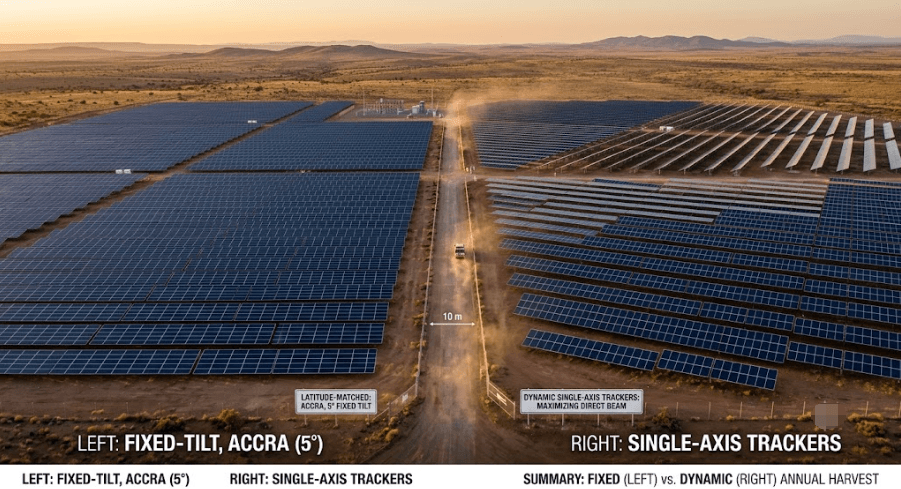
Solar trackers dynamically adjust the solar panel tilt angle and/or azimuth throughout the day to follow the Sun’s path. The yield benefit is consequently well-established. However, trackers add cost, moving parts, and maintenance requirements. Therefore, here is a clear framework for when each approach makes engineering and financial sense:
| System Type | Yield Gain vs. Fixed | Best For | Key Trade-Off |
|---|---|---|---|
| Fixed Tilt Angle (Latitude-Matched) | Reference (0%) | Rooftops, constrained sites, low CAPEX priority | Lowest cost, lowest maintenance |
| Single-Axis Tracker (adjusts azimuth E-W) | +15–25% yield vs. fixed tilt angle | Ground-mount utility & C&I projects, flat terrain | Higher CAPEX, maintenance, moving parts |
| Dual-Axis Tracker (full tilt angle + azimuth follow) | +30–40% yield vs. fixed tilt angle | High-latitude sites, CPV, research stations | Highest cost and complexity — specialist use only |
For residential and commercial rooftop systems, a fixed tilt angle at latitude therefore remains the dominant choice for its simplicity and zero maintenance. For ground-mount projects on flat terrain, single-axis trackers consequently deliver the best LCOE improvement. When paired with a Battery Energy Storage System, even a fixed tilt angle installation can furthermore be optimised for revenue through intelligent charge and dispatch scheduling — the BESS compensates for suboptimal solar timing rather than suboptimal panel geometry.
6. Real-World Constraints: When You Cannot Set the Ideal Tilt Angle
6.1 Fixed Roof Pitch — Working With What You Have
Most residential rooftops have a fixed pitch that may not match the ideal solar panel tilt angle for the site latitude. Therefore, here is a practical decision hierarchy for constrained installations:
- Measure the existing roof pitch angle. A 4/12 pitch = approximately 18°; a 6/12 pitch = approximately 27°. This is consequently your actual tilt angle before any additional racking.
- Compare the existing pitch to your target solar panel tilt angle (= your latitude). Calculate the deficit.
- Evaluate tilt-up racking mounts that can add 5–15° of additional tilt angle without significant structural impact. In addition, check manufacturer wind load ratings for your region.
- Check for shading from chimneys, neighboring buildings, and trees using winter solstice Sun angles — shading loss often exceeds the yield gain from correcting tilt angle on a partially shaded plane.
- If multiple roof planes exist, compare yield across orientations. Sometimes the secondary roof plane at a better tilt angle and azimuth consequently outperforms the primary plane, even at a smaller usable area.
6.2 Flat Roof Installations — Full Tilt Angle Freedom
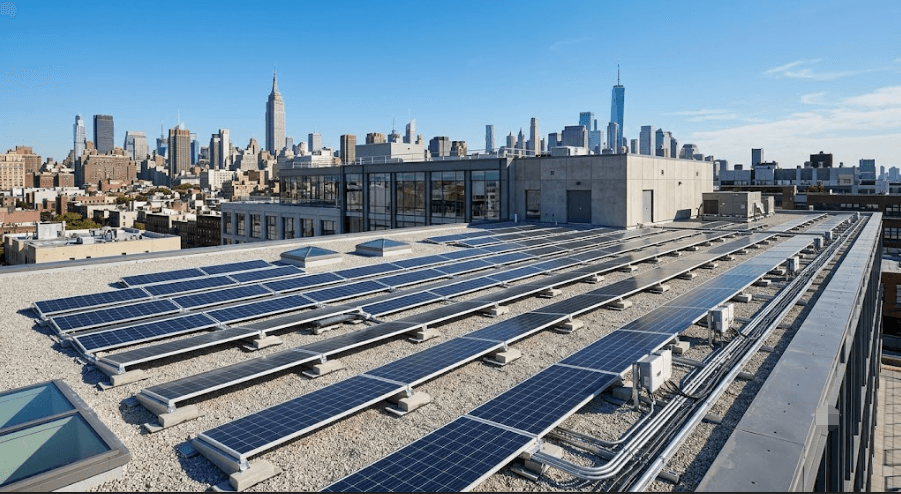
Flat-roof commercial buildings have complete freedom to set any solar panel tilt angle and azimuth direction. Best practices for flat roof systems:
- Use ballasted racking to achieve the optimal tilt angle (= site latitude) without roof penetrations. Ballasted systems are reversible and avoid waterproofing risk.
- Orient all rows in the true south direction (Northern Hemisphere) or true north (Southern Hemisphere) before setting the tilt angle — direction lock-in is permanent once installed.
- Apply correct inter-row spacing to prevent self-shading. The minimum row gap = panel height × sin(tilt angle) / tan(winter solstice solar altitude angle at the site latitude).
- In very hot climates, a tilt angle of 10–15° rather than the full latitude value reduces wind uplift loads and soiling accumulation at the cost of a 2–5% yield reduction — often acceptable in exchange for lower structural requirements.
7. Tools to Calculate Your Site-Specific Solar Panel Tilt Angle
7.1 Free Online Tilt Angle Calculators
The tilt angle values in this guide are reliable starting points derived from the latitude rule. However, every site has unique shading, horizon obstructions, albedo, and microclimate factors that therefore affect the optimal tilt angle. As a result, always use one of these authoritative free tools to confirm your site-specific solar panel tilt angle before installation:
- PVGIS (European Commission JRC): — The gold standard for tilt angle optimisation in Europe, Africa, and Asia. Enter GPS coordinates; the tool consequently returns the optimal tilt angle, azimuth, and monthly energy yield for any fixed or tracking configuration.
- PVWatts (NREL):— The primary tool for US sites, with global coverage. Input your tilt angle and azimuth to get annual and monthly energy output. In addition, it calculates financial payback estimates.
- Global Solar Atlas (World Bank):— Provides irradiance maps and explicitly states the optimal tilt angle for any location worldwide. Furthermore, it is completely free with no registration required.
7.2 On-Site Verification Tools
After calculating your solar panel tilt angle using the tools above, verify it on-site before committing to a racking layout. The following tools help you confirm true south direction and check shading:
- Solargis:— High-resolution irradiance data with tilt angle optimisation tools. Free prospecting tier available for initial screening.
- Sun Surveyor / SunCalc: mobile and web tools for visualising the Sun’s path and checking horizon shading at your exact tilt angle and azimuth before installation day.
Once you have confirmed your solar panel tilt angle and direction, the next step is full system sizing. Use Sunlith’s Energy Storage Calculation Guide and Peak Sun Hours by Location together — both tools use your tilt-angle-corrected peak sun hours as the key input for battery and solar capacity calculations.
8. Solar Panel Tilt Angle and BESS Integration: How They Interact
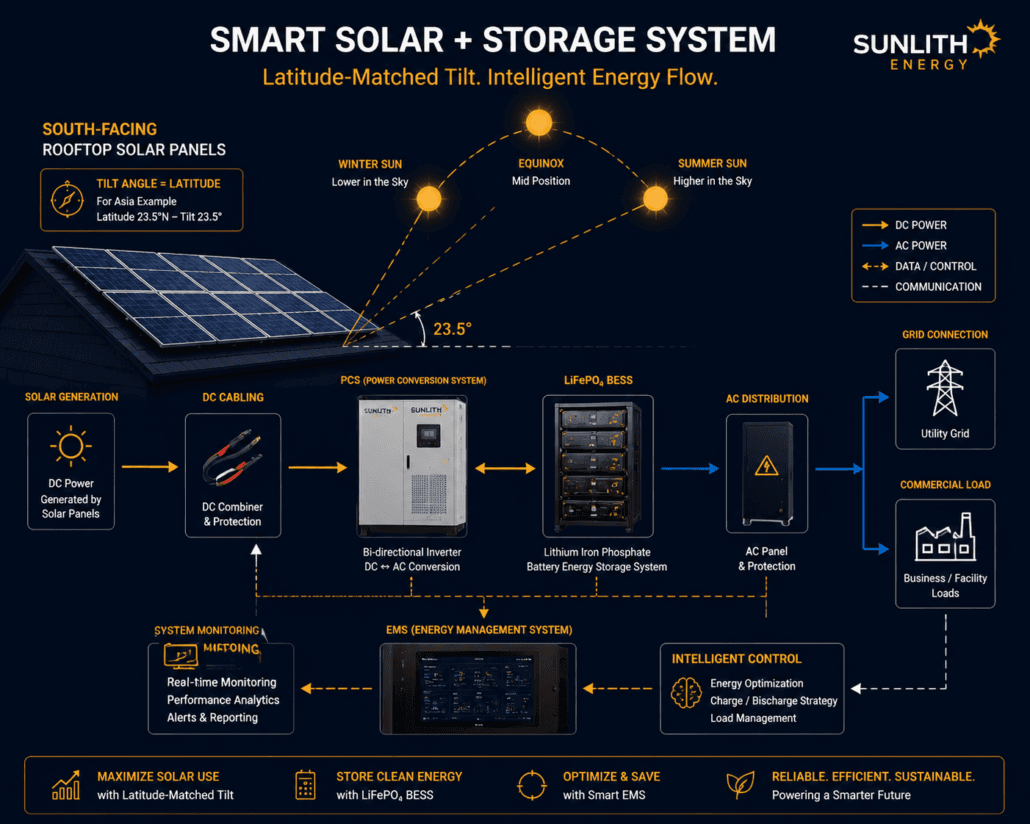
The solar panel tilt angle is not an isolated parameter — it directly shapes how your BESS must be sized and controlled. Understanding this interaction prevents the common mistake of under-sizing storage to compensate for a suboptimal panel setup, or over-building solar capacity to make up for an incorrect tilt angle.
8.1 How Tilt Angle Shapes the BESS Charge Profile
A south-facing array at the correct solar panel tilt angle (= site latitude) produces a symmetrical bell-curve output peaking at solar noon. This predictable profile makes BESS scheduling highly efficient: the charge controller begins ramping up in the early irradiance rise, reaches full state of charge before midday peak, and begins discharging as afternoon irradiance declines. The Power Conversion System (PCS) manages this charge-to-discharge transition bidirectionally, responding to real-time irradiance readings and grid price signals. An incorrect tilt angle that flattens or shifts the generation curve forces the PCS to operate across a wider, less predictable range — reducing dispatch efficiency.
8.2 East-West Split Arrays and Tilt Angle with BESS
When a ridge-line roof forces an east-west split, the tilt angle on each plane becomes even more important. A steeper tilt angle on the west plane (closer to site latitude) captures more afternoon irradiance and complements a BESS discharging into the evening peak. East-facing panels at a shallower tilt produce a morning surge ideal for charging the BESS before the midday load period. Matching tilt angles to each plane’s orientation and season is the most cost-effective optimisation step before adding storage.
8.3 Tilt Angle Errors Increase Required BESS Capacity
Every degree of tilt angle error that reduces annual solar yield must be compensated by either more panel capacity or more battery storage — both add cost. A correctly set solar panel tilt angle is the cheapest system optimisation available. For complete sizing methodology using tilt-angle-corrected peak sun hours, see the Sunlith How to Choose Solar Panels and Batteries guide and the kWp vs kWh Solar Guide.
9. Frequently Asked Questions on Solar Panel Tilt Angle
What is the correct solar panel tilt angle for my location?
The correct solar panel tilt angle for a fixed system is equal to your site’s geographic latitude. For example: New York (41°N) → tilt angle 41°; London (51.5°N) → tilt angle 52°; Dubai (25.2°N) → tilt angle 25°; Sydney (33.9°S) → tilt angle 34°. In equatorial regions below 15° latitude, use a minimum tilt angle of 10–15° for panel self-cleaning regardless of latitude. See the full city database in Section 4 for your specific location.
What direction should the solar panel face at the correct tilt angle?
In the Northern Hemisphere, set the tilt angle facing TRUE SOUTH (azimuth 180°). In the Southern Hemisphere, set the tilt angle facing TRUE NORTH (azimuth 0°). At equatorial latitudes (within 5° of the equator), the tilt angle is the primary variable and the facing direction matters far less. Always calibrate to true geographic south, not magnetic compass south, as magnetic declination can introduce several degrees of error.
Does changing the solar panel tilt angle by season improve output?
Yes. Adjusting the tilt angle seasonally can improve annual yield by 5–10% compared to a fixed tilt angle at latitude. In winter, increase the tilt angle by 10–15° above latitude to compensate for the lower Sun. In summer, reduce the tilt angle by 10–15° below latitude. Adjustable racking systems or dual-axis trackers automate this optimization. For fixed systems, the latitude-matched tilt angle remains the best single setting for maximum annual energy.
What solar panel tilt angle should I use on a flat roof?
On a flat roof, you have complete freedom to set any tilt angle. Use your site latitude as the target tilt angle. In very hot or dusty climates, a tilt angle of 10–15° is often used to reduce wind load and racking cost, with only a 2–5% yield reduction. For latitudes above 35°, always use the full latitude-matched tilt angle for maximum winter performance.
Does a wrong solar panel tilt angle really make a significant difference?
Yes — significantly. A tilt angle that is 20° too shallow or too steep can reduce annual yield by 8–15% in temperate climates and by 15–25% at high latitudes above 50°. Over a 25-year system life, that compounds into a very large energy and revenue loss. Correcting the tilt angle at installation costs nothing — correcting it post-installation on a racked rooftop system can require new mounting hardware.
What solar panel tilt angle should I use in Australia?
In Australia, face panels TRUE NORTH and set the tilt angle equal to your site latitude. Sydney (34°S) → tilt angle 34°, Melbourne (38°S) → 38°, Brisbane (27.5°S) → 28°, Perth (32°S) → 32°, Darwin (12.5°S) → 13°, Adelaide (35°S) → 35°, Canberra (35.3°S) → 35°. Use PVGIS or PVWatts for site-specific validation, especially if your roof pitch differs significantly from your latitude value.
Conclusion: Get the Solar Panel Tilt Angle Right First — Everything Else Follows
The Universal Tilt Angle Rules
The solar panel tilt angle is the most underrated variable in solar system design. It costs nothing to set correctly at installation. However, a wrong tilt angle silently drains 10–40% of your system’s lifetime output depending on your latitude. As a result, getting it right before installation is the single highest-ROI decision in solar system design. The rules are simple and consistent everywhere on Earth:
- Set solar panel tilt angle = your site latitude for maximum annual yield.
- Northern Hemisphere: combine that tilt angle with true south facing (azimuth 180°).
- Southern Hemisphere: combine that tilt angle with true north facing (azimuth 0°).
- Equatorial zone: use a minimum tilt angle of 10–15° regardless of latitude — never install flat.
- High latitudes (above 55°): steepen the tilt angle toward 60–70° to capture the low winter Sun.
Your Next Steps
First, use the world city database in Section 4 to find your city’s recommended tilt angle. Then validate it with PVGIS or PVWatts using your exact GPS coordinates and horizon data. As a result, you will have a site-specific confirmed tilt angle rather than a generic approximation. Finally, size your complete system — panels, inverter, and BESS — using tilt-angle-corrected peak sun hours as the foundational input for all capacity calculations.
The solar panel tilt angle is therefore where correct solar design begins. In addition, use Sunlith’s Energy Storage Calculation Guide and Peak Sun Hours by Location to complete your system sizing with the same engineering rigour.