
Supplier Payment Scams in China Sourcing: Offshore Accounts, Virtual Banks, and Fake Agents
Supplier payment scams rarely start with a fake website. Instead, they start after weeks of honest technical talks, right when the Proforma Invoice (PI) lands in your inbox.
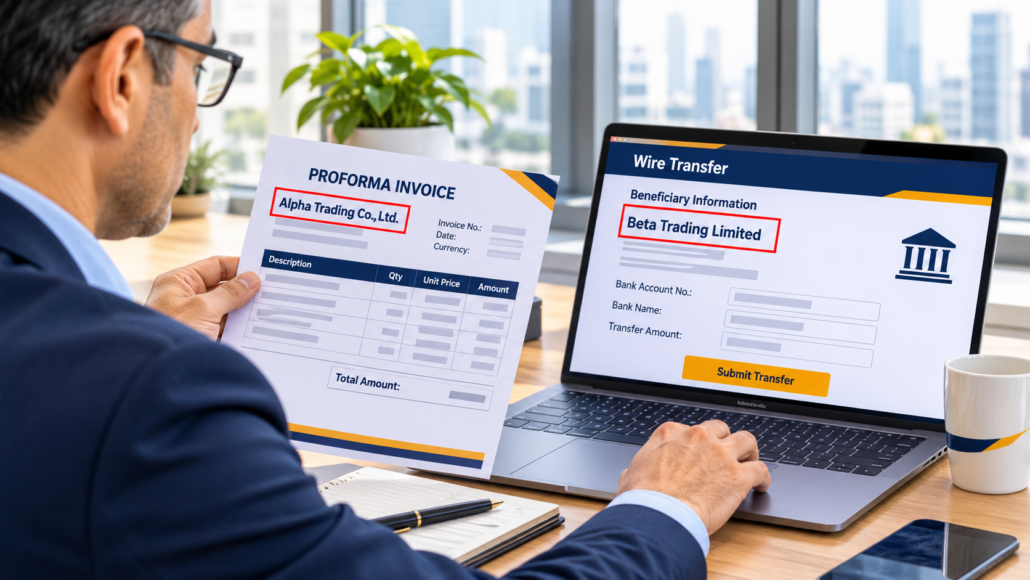
The PI names a mainland Chinese manufacturer as the seller. But the bank details ask for a 30% deposit to a company you do not know. It sits in Hong Kong or Singapore, or it is a virtual receiving account.
In other cases, a trading company claims to be the “exclusive export agent” for a famous Tier-1 brand. It asks you to wire the deposit to its own offshore account.
Payment mismatches cause the largest losses in B2B sourcing. For example, in 2025, the FBI logged 24,768 business email compromise complaints. Reported losses reached about $3.05 billion (IC3 2025 Internet Crime Report).
Quick answer: Never send a deposit to an offshore account, virtual account, or self-declared exclusive agent until you verify the corporate link in writing. First, match the seller’s business license, proforma invoice, contract, and bank beneficiary. Then lock the exact payee details into a signed, stamped contract before paying.
Why Supplier Payment Scams Happen Right Before the Deposit
Supplier payment scams peak just before the deposit. Fraudsters and sly middlemen rarely push payment tricks during early inquiries.
Instead, they wait until the technical talks end. By then, you are eager to lock in a price or a production slot.
At that stage, many buyers treat the PI as routine paperwork. That gap creates two separate threats.
- Outright fraud: business email compromise, spoofed invoices, and shell companies built to take your deposit and vanish.
- Legal exposure: paying an offshore firm, virtual ledger, or middleman. None of them has a duty to deliver, honor the warranty, or refund a bad batch.
Hardware is costly. With lithium cells, BESS containers, and solar inverters, one misdirected 30% deposit can reach hundreds of thousands of dollars.
What Happens When an International Wire Cannot Be Recalled
Speed decides whether you ever recover money lost to supplier payment scams. Once funds reach a foreign account, recovery is slow, costly, and never certain.
FinCEN, a US Treasury bureau, is most likely to recover funds when you report a fraudulent international wire within 72 hours (FinCEN Rapid Response Program).
The FBI’s Financial Fraud Kill Chain follows the same clock. It usually covers only international wires of $50,000 or more, once a SWIFT recall has started (FBI IC3 guidance).
Many deposits fall below those limits. So prevention matters far more than recovery.
7 Common Supplier Payment Scams Buyers Face
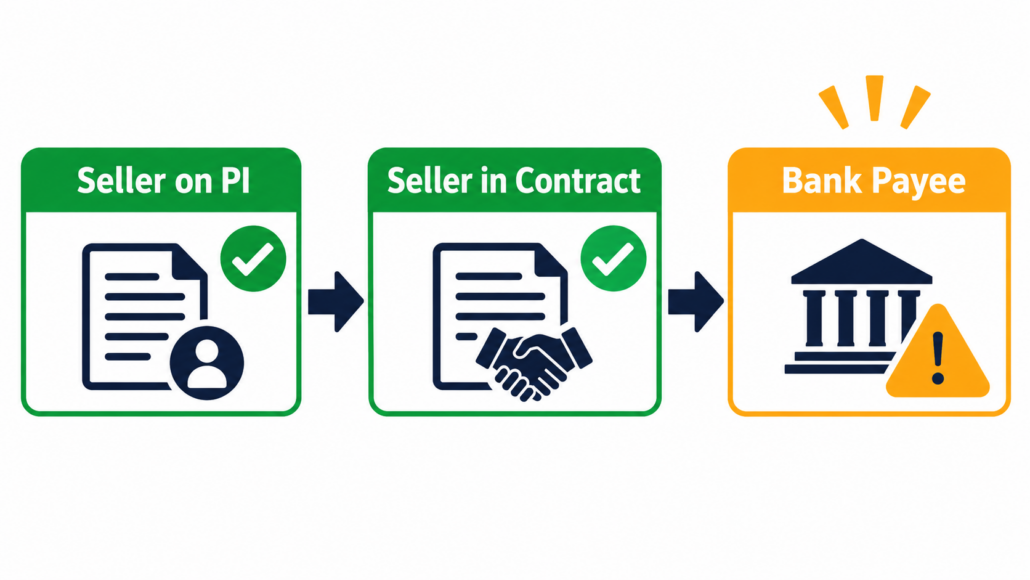
Each of these supplier payment scams follows the same basic pattern. The party that gets your money did not promise to deliver.
1. The Mainland PI With an Offshore Account
First, a supplier sends a PI with a mainland factory’s name and stamp. But the bank beneficiary is a different company in Hong Kong, Singapore, or another offshore hub.
Some real manufacturers do use offshore subsidiaries for billing, foreign exchange, or group treasury. Even so, a real supplier can prove the link at once.
Vague or evasive explanations are a warning sign. Examples are “tax convenience” or “our mainland account is full.”
Suppose the factory then fails to deliver. The offshore payee can say it is a separate company with no duty to build your goods.
2. Virtual Accounts With Mismatched Beneficiary Names
Many Chinese exporters use regulated cross-border payment platforms. These platforms give sellers local receiving accounts in the US, UK, EU, Hong Kong, or Singapore.
Legitimate factories and traders may use them to collect faster and pay lower fees. Still, virtual accounts create three blind spots for buyers.
- Name confusion: some accounts show the partner bank or a pooled platform name, not the seller’s legal name. Your bank may not see who owns the account.
- Fast setup: online sign-up can be quicker than opening a bank account. That may suit new traders and shell companies.
- Harder tracing: following funds through a platform ledger takes longer. A wire to a mainland bank account in the factory’s name is easier to trace.
Also, some platforms let sellers pass collected funds to a third party. A virtual account alone does not prove who the real seller is.
So pay a virtual account only when the name matches your verified seller. The platform must also confirm ownership in writing.
3. The “Famous Brand” and “Exclusive Agent” Trap
Some traders win trust by naming famous Tier-1 makers. They send datasheets, show line photos, and claim to be an authorized export partner.
Then they issue a PI under their own name, or an offshore account, and ask for the deposit.
Even if the trader really buys from that factory, your contract is with the trader. If it swaps in B-grade parts, delays shipment, or vanishes, the brand owes you nothing. You never signed with it or paid it.
Some traders also show expired, edited, or region-restricted authorization letters. They use them to collect deposits for goods they cannot legally export.
4. Business Email Compromise and Last-Minute Bank Changes
Criminals watch supplier email threads. They strike just before a payment is due. You get a message from a lookalike domain, or a hacked supplier inbox. It says the usual account is “under audit.”
The money often moves out within hours. The UK National Crime Agency says to confirm any bank change by phone. Use a number you called before (NCA invoice fraud guidance).
Legitimate suppliers should expect and accommodate verification of any bank-detail change. Criminals can also impersonate real suppliers, so never skip the check.
5. Fake Urgency and “Price Rises Tomorrow” Pressure
Next, some sellers push for an instant transfer. They say raw material prices jump tomorrow, offer a one-day discount, or warn that your slot will vanish.
Rushed payments skip registry checks, live factory video, and contract review. But a credible supplier should welcome clean documentation before it takes your money.
6. Personal Accounts and Unrelated Companies
Sometimes a salesperson may ask you to send a sample fee or small deposit to a personal account. Or the request may name an unrelated local company.
A personal account removes corporate accountability. If a dispute follows, you paid a person, not a registered manufacturer.
7. Bait-and-Switch Proforma Invoices
The first quotation shows the verified factory. But the final stamped PI quietly changes the seller name, registered address, or bank account.
Busy teams approve a PI for price and quantity only. Instead, check the seller header and the bank block line by line, every time.
How Payment Account Types Compare in China Sourcing
Not every non-mainland account points to supplier payment scams. But each structure needs different proof before you release funds.
| Attribute | Mainland commercial bank | Offshore subsidiary (HK or SG) | Cross-border virtual account |
|---|---|---|---|
| Beneficiary name | Matches the mainland business license | A Hong Kong or Singapore sister or parent entity | The exporter's name, or a platform sub-account name |
| Why suppliers use it | Direct export settlement and domestic tax processes | Multi-currency treasury, overseas billing, flexible FX | Fast local USD or EUR collection and lower FX fees |
| Main buyer risk | Low, if the account name matches the verified factory | Legal separation between the payee and the mainland factory | Mismatched beneficiary names or newly formed shell traders |
| Proof to request | Business license, stamped PI, and contract | Ownership records and a payment authorization letter from the factory | Platform ownership certificate and a stamped contract |
Direct Factory, Verified Agent, or High-Risk Trader?
Unclear counterparties sit at the center of many supplier payment scams. So before you wire money, confirm who really stands behind the invoice.
| Attribute | Direct factory | Verified export agent | Unverified trader |
|---|---|---|---|
| Contracting entity | Verified mainland manufacturer on the GSXT registry | Registered export entity with valid written authorization | Unverified middleman or unrelated offshore shell |
| Bank beneficiary | Matches the license name or a documented subsidiary | Matches the agent's registered legal name | Differs from the PI seller, or sits in an unexplained account |
| Manufacturer check | Registry, business scope, and live line video | Confirmed directly with the brand through official channels | Refuses direct factory contact or sends unverifiable PDFs |
| Warranty and liability | Bound by the factory's signed sales contract | Written manufacturer warranty confirmation for your order | Trader alone is liable; the brand owes you nothing |
| Payment risk | Low, once license, factory, and bank match | Moderate, with strict contract terms | High: spec substitution, non-delivery, or lost deposit |
A 5-Step Protocol to Stop Supplier Payment Scams Before You Wire
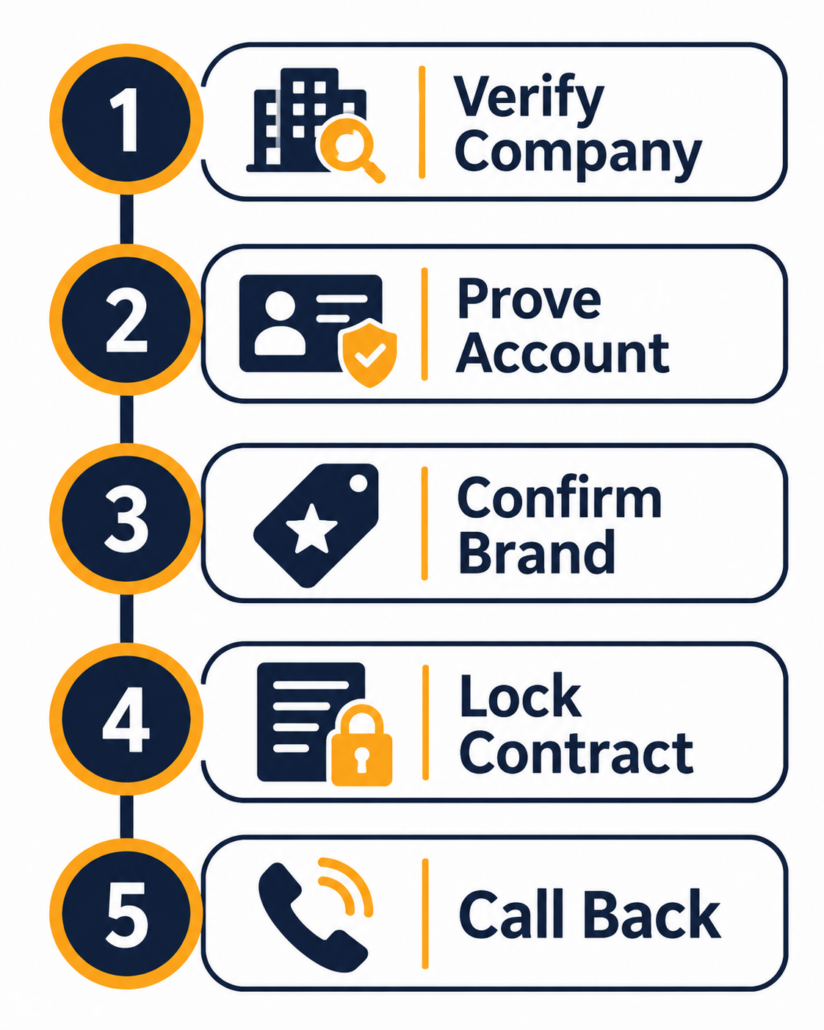
Run this sequence before every deposit and every balance payment. It blocks most supplier payment scams.
Step 1: Verify the Contracting Company
First, confirm that the PI seller is an active business that may make or export your goods. Our Chinese supplier verification guide shows how to check the 18-character Unified Social Credit Code on GSXT.
Next, match the Chinese registered name, not only the English one. English names have no legal standing, so a supplier can later deny that an English-named account is its own (China Justice Observer).
Step 2: Demand Proof for Any Offshore or Virtual Account
If the seller asks you to pay an offshore entity or a virtual account, pause. Then request documents.
- Offshore accounts: registration certificates for both firms and records that link them. Add a letter with the red official company seal saying the offshore payment settles your contract.
- Virtual accounts: an official ownership letter from the platform. It must show the account belongs to your seller, not a third party.
For a Hong Kong payee, use the public Companies Registry search. It shows whether the company exists, its status, and its directors (Hong Kong Companies Registry). Registered documents on file may help show ownership links.
If the supplier cannot give clear proof, pay a mainland bank account in the factory’s legal name. Otherwise, walk away.
Check the Company Seal on the Payment Letter
A payment letter is only as strong as its stamp. The official company seal (公章) is round and red, with a star in the middle.
It shows the full registered Chinese name. Many also show a registration number. Official chops are registered with the Public Security Bureau (China Briefing chop guide).
Be careful with other stamps. A blue stamp or an English-only stamp is a red flag. A contract-only chop may not cover a payment instruction.
Next, match the Chinese name on the seal to the business license. A mismatch means the letter may be worthless.
Rules vary by city, so you cannot judge a chop by sight alone. For large payments, ask a China lawyer to confirm it. Blue ink for a handwritten signature is normal, so check the stamp, not the pen.
Step 3: Verify “Exclusive Agent” Claims With the Brand
If a supplier says it exports for a famous brand, take three actions.
- First, find the brand’s official website and contacts yourself. Never use numbers or emails from the agent’s brochure.
- Then ask the manufacturer in writing whether the agent may export its products to your country.
- Finally, ask whether the manufacturer will honor the warranty and serial-number tracing if you buy through that agent.
For more warning signs during talks, read our guide to 30 supplier red flags.
Step 4: Lock Beneficiary Details Into the Signed Contract
Never rely on bank details pasted into a chat app or loose email. Put the exact seller name, address, bank name, account number, and SWIFT/BIC code inside the stamped contract.
If an offshore entity collects payment, the contract should name who handles delivery, quality, warranty, refunds, and disputes. It should state whether the mainland factory guarantees performance.
Add that paying an account not named in the contract does not settle your payment duty.
Have qualified counsel review the wording for your jurisdiction. Since warranty terms matter here too, see our C&I BESS warranty guide for what to lock in.
Step 5: Confirm Out of Band and Stage Your Payments
First, call a phone number you verified before the PI was issued. Then ask a second person on your team to approve the beneficiary name and account digits.
For a new payee, consider a small test transfer. Wait for written and phone confirmation of receipt before you send the main deposit.
Also, avoid paying 100% upfront. Use milestones. Pay a modest deposit, and tie the balance to an independent pre-shipment inspection or a Factory Acceptance Test.
What to Do If You Already Wired a Deposit to the Wrong Account
If you already wired a deposit to an unverified account, act within hours. Since every hour counts, follow these steps to limit losses from supplier payment scams.
- First, call your bank and ask for an immediate recall of the wire.
- Next, ask your bank to contact the receiving bank and request a freeze.
- Then report the fraud to law enforcement. In the US, file at ic3.gov; elsewhere, use your national cybercrime or police unit.
- Also save the PI, contract, emails, headers, and chat logs as evidence.
- Reporting rules differ by country, so follow your bank’s fraud-reporting procedure.
- Last, treat anyone who offers paid “fund recovery” with caution. Recovery offers are a common second scam.
Supplier Payment Scams FAQ
These answers cover the questions buyers ask most about supplier payment scams.
Is it normal for a Chinese supplier to ask for payment in Hong Kong or Singapore?
Some real manufacturers use offshore subsidiaries for billing. But it is safe only when the supplier proves the ownership link and writes the arrangement into your stamped contract.
Is a virtual bank account safe, or a sign of supplier payment scams?
Many real exporters use regulated virtual accounts. Still, it is safe only if the name matches your verified seller. The platform must confirm ownership, and the details must appear in your contract.
A trader says it is the exclusive agent for a famous brand. Can I pay it?
Only after you verify the claim with the brand through official contacts. Then confirm the authorization is active, covers your country and model, and includes warranty support.
Are last-minute bank changes a sign of supplier payment scams?
Stop the transfer. Treat the change as business email compromise until you confirm it by phone. Use a number you verified earlier, and never reply to the email that asked for the change.
How can I avoid supplier payment scams when buying BESS or lithium batteries?
First, match the license, contract, and bank account. Then verify certificates at the source and keep deposits modest. Tie the final payment to an independent inspection and serial-number checks.
Pay the Entity You Verified: Your Best Defense Against Supplier Payment Scams
Supplier payment scams work because they look like routine paperwork. But the fix is routine too: one verified seller, one matching bank account, and one signed contract.
Also, a cheaper quote is not a bargain if the payee cannot be held to the deal. Our guide on why a lower price is not a business case explains how to weigh price against counterparty risk.
So verify first, then pay. A legitimate supplier should welcome reasonable verification.
Disclaimer: This article is general guidance, not legal or financial advice. Verification rules and payment practices differ by country, so confirm details with your bank and counsel.
Further Reading on Supplier Payment Scams and China Sourcing
These guides help you avoid supplier payment scams and other sourcing risks.
- Chinese Supplier Verification: Why You Must Check the Company and Factory Before Ordering
- Supplier Red Flags: 30 Warning Signs Buyers Should Know
- “We Can Offer a Lower Price” Is Not a Business Case
- C&I BESS Warranty Guide





Leave a Reply
Want to join the discussion?Feel free to contribute!