
Hithium 6.25 MWh BESS Container: 2h vs 4h Compared
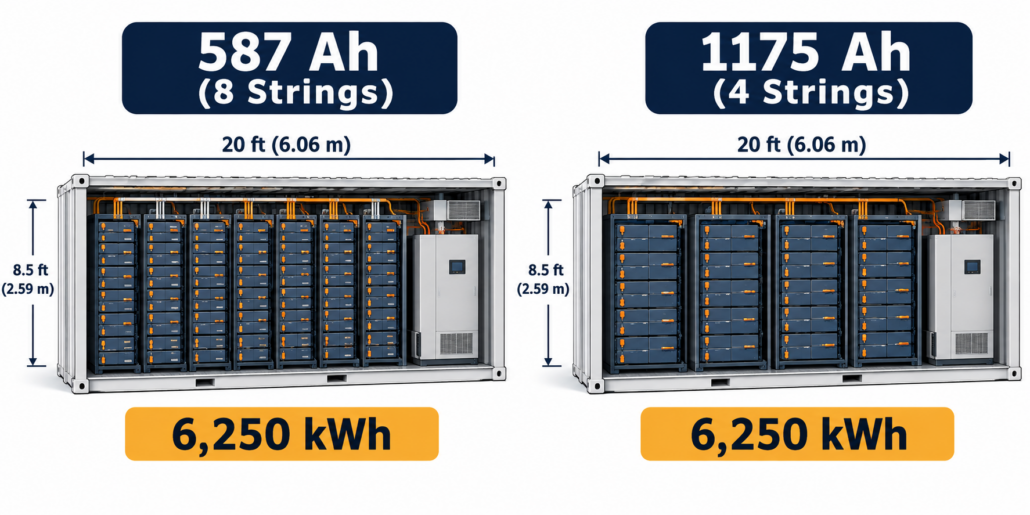
The 6.25 MWh BESS container from Hithium comes in two versions. One is a 2-hour system, and the other is a 4-hour system.
We reviewed six datasheets covering the US, Australia, and Europe. This guide compares the specs, the certification lists, and the small gaps between regions.
Quick Answer
The 6.25 MWh BESS container uses one liquid-cooled 20-foot enclosure for both versions. The 2h model runs 587 Ah cells at 0.5P, and the 4h model runs 1175 Ah cells at 0.25P. Certification lists differ by region, and the datasheets mark them as still in progress.
What the Six Datasheets Say About the 6.25 MWh BESS Container
Each file covers one duration and one region. Together, they describe one 6.25 MWh BESS container platform in two configurations.
| Datasheet | Duration | Region | Date code and version | Cell | Office listed |
|---|---|---|---|---|---|
| 1 | 2h | US | 2026-07-16, V1.1 | 587 Ah | Fremont, California |
| 2 | 2h | Australia | 2026-06-15, V1.1 | 587 Ah | Queensland, Australia |
| 3 | 2h | Europe | 2026-07-16, V1.3 | 587 Ah | Munich, Germany |
| 4 | 4h | US | 2026-05-07, V2.1 | 1175 Ah | Fremont, California |
| 5 | 4h | Australia | 2026-05-07, V2.1 | 1175 Ah | Fremont, California |
| 6 | 4h | Europe/MEA | 2026-05-07, V2.1 | 1175 Ah | Munich, Germany |
Dates come from the file names. Each sheet warns that it receives regular updates, so confirm you hold the latest version on the Hithium system products page.
All six sheets list the same 6,250 kWh nominal energy. Most differences sit in the details.
6.25 MWh BESS Container Specs: 2h vs 4h
The two versions share one box but differ inside. This section compares the core specs of the 6.25 MWh BESS container.
| Item | 2h version | 4h version |
|---|---|---|
| Cell capacity | 587 Ah prismatic LFP | 1175 Ah prismatic LFP |
| String layout | 8 x 1P416S | 4 x 1P416S |
| Cells per container (derived) | 3,328 | 1,664 |
| Nominal rate | 0.5P | 0.25P |
| Rated DC power (derived) | About 3.125 MW | About 1.56 MW |
| DC current at 1,331.2 V (derived) | About 2,347 A | About 1,174 A |
| Round-trip efficiency | 94% or higher | 95% or higher |
| Gravimetric density | 135 Wh/kg or higher (130 in EU sheet) | About 142 Wh/kg |
| Volumetric density | 145 Wh/L or higher | About 146 Wh/L |
| Weight | 45 ± 1 t (48 t in EU sheet) | 44.5 t maximum |
Shared Platform of the 6.25 MWh BESS Container
Both versions use a liquid-cooled enclosure measuring 6,058 x 2,438 x 2,896 mm. That equals 238 x 96 x 114 in, and the protection level is IP55.
Nominal voltage is 1,331.2 V, and the operating range is 1,100 to 1,500 V. Nominal energy is 6,250 kWh, and delivery state of charge is 27%.
Operating ambient temperature runs from -30 to 55 °C. Recommended storage is -20 to 35 °C, and altitude can reach 4,000 m.
The BMS talks over CAN, RS485, and Ethernet. Also, the container works with string or central PCS and allows back-to-back or side-by-side installs.
Cells and String Layout
The 2h model uses 587 Ah cells in an 8 x 1P416S layout. In contrast, the 4h model uses 1175 Ah cells in a 4 x 1P416S layout.
That means 3,328 cells in the 2h container and 1,664 in the 4h container. Each cell holds about 1.88 kWh in the 2h version and 3.76 kWh in the 4h version.
Since the 4h version has fewer cells, it has fewer joints and sensing points. But that is our engineering reading, not a datasheet claim.
Power and Efficiency of the 6.25 MWh BESS Container
The 2h model is rated 0.5P, so it delivers about 3.125 MW DC. The 4h model is rated 0.25P, or about 1.56 MW DC.
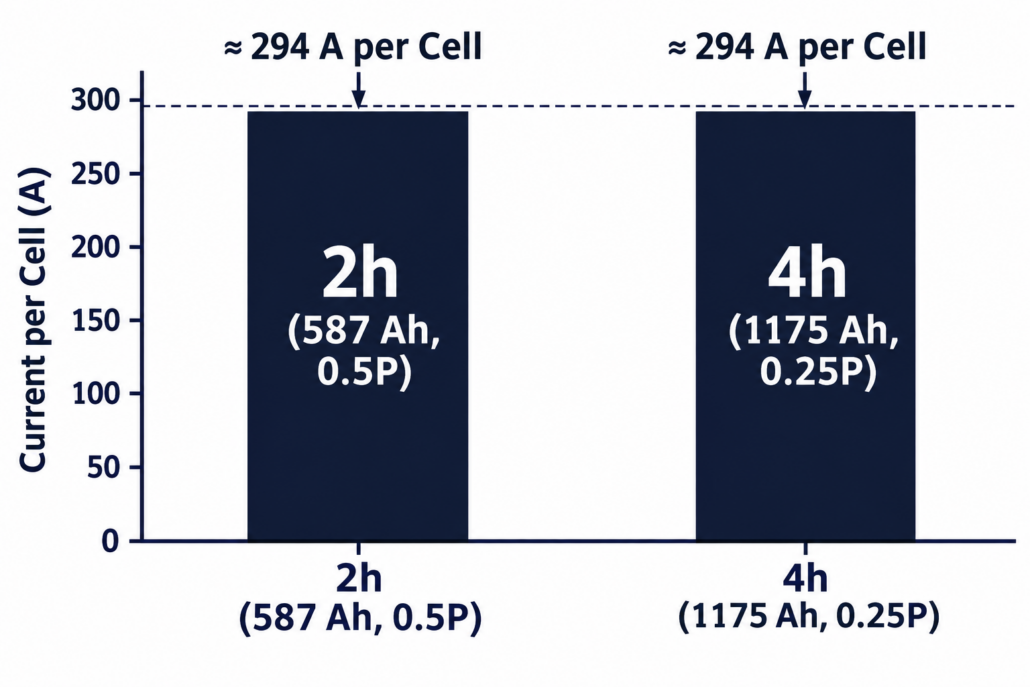
At nominal voltage, that equals about 2,347 A for the 2h model and 1,174 A for the 4h model. Each cell carries about 294 A in both cases.
This is why the sheets pair 0.5P with 587 Ah and 0.25P with 1175 Ah. As a result, cell current at rated power is nearly identical. For cycle-life data at 0.5C, see 0.5C vs 1C Cycle Life in Liquid-Cooled BESS.
Round-trip efficiency is 94% or higher for the 2h model and 95% or higher for the 4h model. Both figures apply at 25 ± 2 °C and at the rated 0.5P or 0.25P.
But the sheets do not say whether the efficiency boundary is DC or AC. Ask the supplier before you compare it with other quotes.
Weight and Energy Density
The 4h container weighs at most 44.5 t. The 2h container weighs 45 ± 1 t in US and Australian sheets, but 48 t in the European one.
Weight drives the density claims. For instance, at 45 t, 6,250 kWh gives about 139 Wh/kg, which fits the 135 Wh/kg claim.
At 48 t, the same energy gives about 130 Wh/kg. That matches the lower figure on the European sheet.
Volumetric density is nearly the same everywhere: 145 Wh/L or higher on the 2h sheets and about 146 on the 4h sheets. The enclosure volume is about 42.8 m³, which gives about 146 Wh/L.
The 4h sheets give 44.5 t as a maximum, which works out to about 140 Wh/kg. Their quoted 142 Wh/kg implies a typical weight near 44 t.
How We Derived the Numbers
We calculated every value marked derived from datasheet figures. We assumed a 3.2 V nominal cell, which matches 416 cells at 1,331.2 V.
Ncells = strings × 416
PDC (MW) = P-rate × 6.25
IDC (A) = PDC (W) ÷ 1,331.2 V
Where strings = 8 (2h) or 4 (4h), P-rate = 0.5 or 0.25 (1/h), and 6.25 is nominal energy in MWh.
Datasheet Differences by Region
The six sheets describe the same 6.25 MWh BESS container, yet each region tailors the text. The changes involve standards, units, wording, and a few numbers.
United States Datasheets
The US spec pages list UL 1973, UL 9540A, and NFPA 855. Also, the 4h sheet lists UL 9540 in both places.
But the 2h sheet shows UL 9540 only on its cover. Both US sheets add imperial units beside metric ones.
Australia Datasheets
The Australian sheets add AS 62477, AS 61000, and AS 3000 (3008). The 2h sheet adds AS 1170.
Both keep the US standards and add three IEC standards: 62933, 63056, and 62619. Also, the 2h sheet names the Queensland office, but the 4h sheet names the US office.
Europe and MEA Datasheets
The European sheets drop the AS standards and lead with five IEC standards. They keep UL 1973, UL 9540A, and NFPA 855.
Both use decimal commas. For example, 6.250 kWh means 6,250 kWh, not 6.25 kWh.
Since the 4h file name says EU/MEA but the 2h says only EU, confirm MEA coverage for the 2h version.
The European 2h sheet differs most. It lists 130 Wh/kg or higher and a 48 t maximum weight.
It adds an altitude note: above 2,000 m, consult the technical team. It also marks NFPA 855 and Regulation (EU) 2023/1542 as in progress.
Its certificate line carries a typo, EC 62477, instead of IEC 62477. It also drops the flame-retardant top cover bullet.
Certifications in the 6.25 MWh BESS Container Datasheets
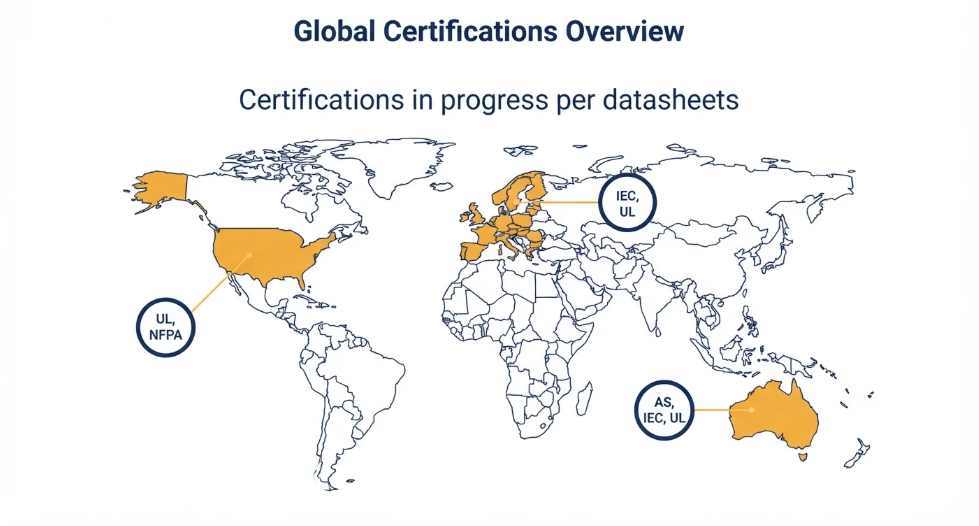
Certification lists matter most to buyers, because permits and insurers rely on them.
Important: All six datasheet covers mark the certification list as in progress. Treat it as a target until the supplier shows certificates and test reports.
Certification Matrix for the 6.25 MWh BESS Container
Y means listed on the cover and the spec page. C means cover only, and S means spec page only. A star means the sheet marks it in progress.
| Standard | US 2h | US 4h | AU 2h | AU 4h | EU 2h | EU 4h |
|---|---|---|---|---|---|---|
| UL 1973 | Y | Y | Y | Y | Y | Y |
| UL 9540A | Y | Y | Y | Y | Y | Y |
| UL 9540 | C | Y | – | S | – | Y |
| NFPA 855 | Y | Y | Y | Y | Y* | Y |
| UN 38.3 | Y | Y | Y | Y | Y | Y |
| IEC 62619 | – | – | Y | Y | Y | Y |
| IEC 62933 | – | – | Y | Y | Y | Y |
| IEC 63056 | – | – | Y | Y | Y | Y |
| IEC 62477 | – | – | – | – | Y** | Y |
| IEC 61000 | – | – | – | – | Y | Y |
| AS 62477 | – | – | Y | Y | – | – |
| AS 61000 | – | – | Y | Y | – | – |
| AS 3000 (3008) | – | – | Y | Y | – | – |
| AS 1170 | – | – | Y | – | – | – |
| EU 2023/1542 | Y | Y | Y | Y | Y* | Y |
Two stars mark the typo EC 62477 on the EU 2h spec page. All six sheets also list RoHS, REACH, and cobalt-free status.
What Each Standard Covers
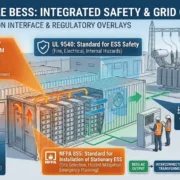
Several listed items are tests or codes, not product labels. For instance, the UL 9540A test method evaluates thermal runaway fire propagation.
- UL 1973: batteries for stationary and motive auxiliary power.
- UL 9540: safety of energy storage systems and equipment.
- UL 9540A: a test method, so it yields data rather than a pass-fail label.
- NFPA 855: an installation code for stationary storage, applied at the site.
- UN 38.3: transport tests for lithium cells and batteries.
- IEC 62619 and IEC 63056: safety of lithium cells and batteries in industrial and storage use.
- IEC 62933: the standards series for electrical energy storage systems.
- IEC 62477: safety of power electronic converter systems.
- IEC 61000: electromagnetic compatibility.
- AS 62477 and AS 61000: the Australian versions of those two IEC series.
- AS 3000 (3008): wiring rules and cable selection.
- AS 1170: structural design actions, such as wind and seismic loads.
- EU 2023/1542: the EU battery regulation.
Under the EU rule, industrial batteries will need a battery passport from 18 February 2027, says the European Commission.
Gaps to Query With the Supplier
- Ask which certificates exist today, with report numbers and dates.
- Ask why UL 9540 appears on some 2h sheets but not others.
- Since the container has no built-in PCS, ask what IEC 62477 covers.
- Also check whether the Australian 4h sheet should list the Australian office.
- Finally, request a corrected EU 2h sheet without the EC 62477 typo.
Safety, Cooling, and Environmental Claims
Safety claims on the 6.25 MWh BESS container sheets are mostly shared. But a few wording gaps separate the versions.
- All sheets describe liquid cooling, a three-level BMS, and multi-stage active fire detection and protection.
- The flame-retardant module top cover appears on all 4h sheets and the US 2h sheet. It is missing from the Australian and European 2h sheets.
- Only the 4h sheets mention low noise. The 2h photos show six large fans on the end wall, while the 4h photos show louvered panels.
- Every sheet cites a new, eco-friendly refrigerant but names no product.
- No sheet names the fire suppression agent.
The fan difference likely reflects a higher thermal load in the 2h version. That is our inference, and the photos are marked as illustrations.
Choosing a 6.25 MWh BESS Container: 2h or 4h
Match the version to your revenue model and site limits. Since energy per container is identical, power and cell count decide the choice.
For 100 MWh, you need 16 containers either way. That gives about 50 MW DC with the 2h version and about 25 MW DC with the 4h version.
When the 2h Version Fits
Pick the 2h version when you sell power-heavy services or need short, frequent cycles. It delivers twice the power per container, but then it needs more PCS capacity per MWh.
When the 4h Version Fits
Pick the 4h version when you shift energy over long windows, such as solar or capacity contracts. Also, it quotes higher efficiency and uses half as many cells.
Our guide on BESS CAPEX vs LCOS shows how duration changes cost per kWh.
Questions to Ask Before Ordering a 6.25 MWh BESS Container
But the sheets omit several items you need for a bankable quote. Request these in writing:
- Cycle life, degradation curve, and warranty terms.
- Auxiliary power use at rated load and in hot weather.
- Noise level in dB for the 4h low-noise claim.
- Weight allowance for foundations and transport, especially 48 t versus 45 t.
- Altitude limits above 2,000 m.
- DC current limits and the PCS interface.
Our C&I BESS Warranty Guide explains how to read those terms. The BESS grid codes guide covers compliance at the grid side.
Frequently Asked Questions About the 6.25 MWh BESS Container
These answers summarize the six datasheets on the 6.25 MWh BESS container.
What differs between the 2h and 4h 6.25 MWh BESS container versions?
Both store 6,250 kWh in one enclosure. The 2h version uses 587 Ah cells at 0.5P, while the 4h version uses 1175 Ah cells at 0.25P.
Are the 6.25 MWh BESS container certifications final?
No. All six covers mark the list as in progress, so ask for certificates and test reports before you buy.
Which version is more efficient?
The 4h version quotes 95% or higher round-trip efficiency. In contrast, the 2h version quotes 94% or higher, both at 25 ± 2 °C.
How heavy is the container?
The 4h version weighs up to 44.5 t. In contrast, the 2h version weighs 45 ± 1 t, or 48 t on the European sheet.
Does the container include a PCS?
The sheets list no PCS specs. Instead, they describe the container as compatible with string or central PCS.
Further Reading
These SunLith guides help you evaluate a 6.25 MWh BESS container purchase.
- BESS CAPEX vs LCOS
- BESS CAPEX Calculation
- C&I BESS Warranty Guide
- BESS Grid Codes and Compliance
- C&I BESS Sizing Calculator



Leave a Reply
Want to join the discussion?Feel free to contribute!