
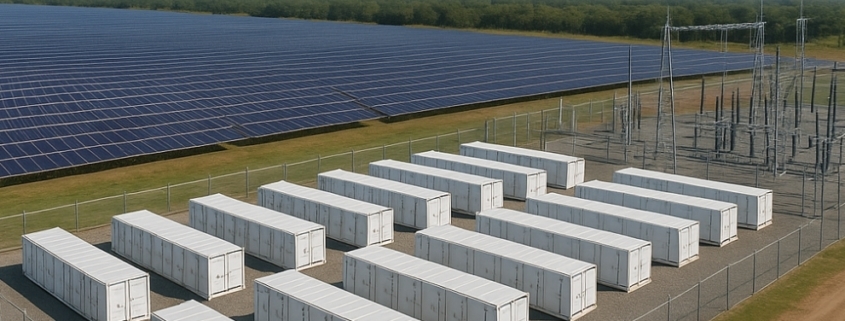

Comprehensive Guide to Setting Up a 100MW/250MWh Battery Energy Storage System (BESS) with Solar Energy Integration and Grid Connection
The global transition toward renewable energy hinges on the ability to store and manage intermittent power sources like solar. One of the most promising solutions is deploying utility-scale Battery Energy Storage Systems (BESS) in combination with large solar PV installations. In this blog, we dive deep into the components, engineering, design, and financial planning required to establish a 100MW / 250MWh BESS connected with a solar PV plant and integrated into the electrical grid.
🔋 1. Understanding the 100MW / 250MWh BESS
💡What Does 100MW / 250MWh BESS Mean?
- 100 MW is the maximum power output (or input) the battery can deliver (or accept) at a given time.
- 250 MWh is the energy capacity—meaning the battery can supply 100 MW continuously for 2.5 hours.
⚙️System Design Breakdown:
- Power Conversion System (PCS): Converts DC (battery) to AC (grid) and vice versa.
- Battery Cells & Racks: Store energy chemically, usually in lithium-ion (LiFePO4 or NMC).
- Battery Management System (BMS): Monitors cell health, temperature, and charging cycles.
- Thermal Management: Prevents overheating, typically using liquid or air cooling.
- Fire Suppression: NFPA 855 compliant fire safety systems.
- Enclosures: Often 20 or 40 ft containers with integrated HVAC and safety systems.
☀️ 2. Sizing the Solar Power Plant for 100MW / 250MWh BESS
To effectively charge the battery and export surplus power to the grid, we need a well-sized solar plant.
⚖️Solar System Sizing for 100MW / 250MWh BESS
Let’s assume we want the solar plant to:
- Fully charge the 250 MWh BESS during the day (approx. 5 sunlight hours)
- Supply power to the grid during peak hours
🧮 Calculation: 100MW / 250MWh BESS
To charge a 250 MWh BESS in 5 hours:
Required Solar Energy = 250 MWh ÷ 5 hours = 50 MW net power
Accounting for inverter & battery charging losses (~15%):
Required DC Power = 50 MW / 0.85 ≈ 58.8 MW
Also, considering extra power for grid export and cloudy conditions, oversizing is common:
Recommended Solar Plant Size = 120 MWp – 150 MWp
🔧Key Components of the Solar Plant:
- PV Panels: Monocrystalline preferred for high efficiency; each ~550W.
- Inverters: Central inverters (1–5 MW) or string inverters (~100 kW).
- Mounting Structures: Fixed tilt (low cost) or single-axis trackers (higher yield).
- Combiner Boxes & Cabling: Safely aggregate string outputs.
- Monitoring System (SCADA): Tracks performance in real-time.
⚡ 3. Grid Interconnection Infrastructure
Grid integration is crucial for exporting surplus energy and enabling load shifting. This involves multiple electrical and regulatory components.
🏗️ Major Components:
- Step-Up Transformer: Converts low voltage from PCS (~800V) to grid voltage (33–132 kV).
- Switchgear & Protection Relays: Ensure safe grid disconnection during faults.
- Substation: Includes transformers, busbars, circuit breakers, and metering.
- High Voltage Transmission Line: Transmits power to grid access point.
- Harmonic Filters & Voltage Support: Ensure power quality and grid compliance.
🧾 4. Permits, Regulations, and Approvals
Grid-connected BESS and solar projects are heavily regulated.
📜 Required Permits:
- Generation License
- Interconnection Agreement with the utility or ISO
- Power System Impact Study (PSIS)
- Environmental Impact Assessment (EIA)
- Fire and Safety Compliance (NFPA 855, IEC 62933)
🧱 5. Land and Civil Infrastructure Requirements for 100MW / 250MWh BESS
Large-scale solar and BESS facilities need extensive land and robust civil infrastructure.
🌍 Land Requirements:
- Solar Plant: ~5 acres per MW → 120 MWp ≈ 600 acres
- BESS Facility: ~2–5 acres depending on layout and containerization
🛠️ Other Infrastructure:
- Internal Roads & Drainage
- Security Systems & Fencing
- Control Room / O&M Buildings
- Water Supply (for cleaning panels)
- Telecom Lines for Remote Monitoring
🔄 6. Energy Management and SCADA System
🔌Energy Management System (EMS):
Manages:
- Battery charging/discharging
- Solar curtailment during grid constraints
- Frequency and voltage support
- Demand-response and peak shaving
📡 SCADA:
- Real-time monitoring
- Alerts and diagnostics
- Performance analytics
- Grid and weather forecasting integration
🔍 7. System Studies & Engineering Design
To ensure safe and optimized operation, various simulations are essential.
🧮 Required Engineering Studies:
- Load Flow Analysis
- Short-Circuit Study
- Power Quality (Harmonics)
- Transient Stability Study
- Protection Coordination
- PVsyst Simulation for solar yield
- Battery Degradation Modeling (cycling profile)
💰 8. Detailed Cost Breakdown (Estimates) for 100MW / 250MWh BESS
| Component | Cost Range (USD) |
|---|---|
| 250 MWh BESS (Li-ion) | $125M – $180M |
| 120–150 MWp Solar Plant | $90M – $130M |
| Substation & Interconnection | $10M – $25M |
| Civil Works & Land Prep | $5M – $15M |
| EMS/SCADA Systems | $3M – $5M |
| Permits, Consultants, Legal | $1M – $3M |
| Total Project Estimate | $240M – $360M |
These numbers vary by region, labor costs, and market conditions.
📈 9. Operational Use Cases of Solar + BESS
- Time-Shifted Solar: Store midday solar to discharge in the evening.
- Frequency Regulation: Respond to short-term grid imbalances.
- Capacity Firming: Ensure stable solar output despite weather.
- Peak Shaving: Reduce peak load charges.
- Black Start Support: Restart the grid after an outage.
🧑🔧 10. Operation & Maintenance (O&M)
BESS O&M:
- 24/7 remote monitoring
- Monthly inspections
- Battery health checks
- Air filters, coolant, fan servicing
Solar O&M:
- Module cleaning (weekly/monthly)
- Inverter maintenance
- Vegetation control
- Performance ratio monitoring
⚠️ 11. Safety and Compliance
Safety Measures:
- Fire Suppression System inside containers
- HVAC/thermal management for temperature control
- Emergency Shutdown Systems
- Remote isolation and fault management
- NFPA 855 and UL9540A Testing compliance
🌐 12. Conclusion
Establishing a 100MW / 250MWh BESS integrated with a solar plant and connected to the grid is a technically complex yet financially and environmentally rewarding initiative. This setup not only enhances grid reliability and renewable penetration but also allows investors and utilities to participate in lucrative services like frequency regulation, capacity markets, and arbitrage.
With global emphasis on decarbonization, the synergy of solar and battery storage represents a powerful step toward a sustainable energy future.
Bidirectional Inverter vs PCS: Understanding the Differences, Functions & Usage
Bidirectional Inverter vs PCS: In the evolving world of energy systems, both Bidirectional Inverters and Power Conversion Systems (PCS) play a critical role—especially in energy storage systems (ESS), microgrids, and renewable power integration. While they appear similar in functionality, they are not interchangeable. In this blog, we break down every point of comparison, explain how each works, and where they are best used.
🔌 What Is a Bidirectional Inverter?
✅ Functions of Bidirectional Inverter:
- AC to DC Conversion: Converts grid AC to DC to charge batteries.
- DC to AC Conversion: Converts stored DC back to AC to supply the load or feed the grid.
- Grid Synchronization: Ensures power output is matched in voltage, frequency, and phase with the grid.
- Battery Management Communication: Works with BMS to control charging/discharging safely.
⚙️ Usage Areas:
- Home and commercial solar + battery systems
- Microgrids
- EV charging stations with V2G (Vehicle to Grid)
- UPS systems with grid-tie capability
⚡ What Is a PCS (Power Conversion System)?
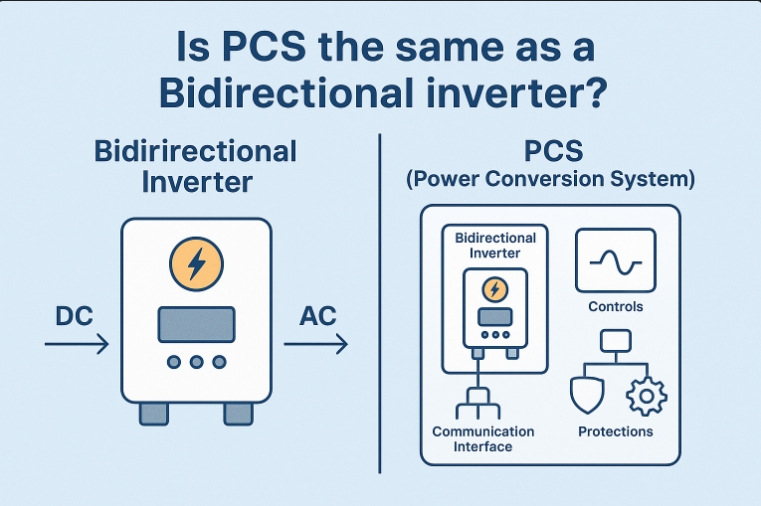
A PCS, or Power Conversion System, is a more comprehensive solution. It usually includes bidirectional inverter functionality, plus additional components such as:
- Grid-interfacing controller
- Communication interfaces
- Safety protections
- Advanced energy management algorithms
✅ Functions of PCS:
- Bidirectional Power Flow: Handles charging and discharging like a bidirectional inverter.
- Energy Management: Integrates with EMS (Energy Management System) for dynamic power flow.
- Power Quality Control: Manages frequency, reactive power, and voltage.
- Multi-port Control: Can connect multiple DC sources (PV, battery, etc.).
- Islanding and Black Start: Supports off-grid operation and black start capability.
⚙️ Usage Areas:
- Grid-scale Battery Energy Storage Systems (BESS)
- Utility and Industrial Microgrids
- Renewable Power Plants with storage
- Critical infrastructure backup systems
🆚 Key Differences Between Bidirectional Inverter and PCS
| Feature | Bidirectional Inverter | PCS (Power Conversion System) |
|---|---|---|
| Basic Function | Converts power between AC and DC both ways | Includes bidirectional inverter + smart control |
| Control Features | Basic grid sync and charge control | Advanced control with EMS, grid support, PQ |
| Application Level | Residential / Small Commercial | Utility / Industrial / Large BESS |
| Grid Services Support | Limited | Yes – can provide FFR, voltage regulation |
| Communication Protocols | Basic – BMS, inverter | Advanced – EMS, SCADA, Modbus, CAN, etc. |
| Expandability | Limited | Scalable for multi-MW systems |
| Cost | Lower | Higher due to additional features |
🎯 Which One Should You Use?
Choose Bidirectional Inverter if:
- You’re setting up a home or small commercial ESS.
- You need basic backup power and solar integration.
- Budget is limited and advanced control isn’t a priority.
Choose PCS if:
- You’re deploying a grid-scale battery system.
- You need integration with grid operations or islanding capabilities.
- You require smart control, power quality management, or multiple energy inputs.
📌 Bidirectional Inverter vs PCS: Real-World Example
Home System with Bidirectional Inverter:
A solar home with a 10 kWh lithium battery uses a bidirectional inverter to charge the battery during the day and power the home at night. It synchronizes with the grid and works with a BMS.
Utility-Scale PCS Example:
A 2 MW/4 MWh battery system at a wind farm uses PCS to manage energy injection into the grid during peak demand, support frequency regulation, and provide backup during outages.
🧠 Bidirectional Inverter vs PCS: Final Thoughts
Both Bidirectional Inverters and PCS are essential in the shift toward smarter, more resilient power systems. However, understanding their differences in function, scale, and intelligence is crucial before choosing the right solution.
In summary:
- Use Bidirectional Inverter for basic energy conversion and storage in smaller systems.
- Use PCS for smart, scalable, and grid-integrated power management in large or complex setups.
Bidirectional Inverter vs PCS FAQ
Q1: Is PCS the same as a bidirectional inverter?
Q2: Can I use PCS for residential use?
A: Technically yes, but it’s usually overkill in terms of cost and capability. A bidirectional inverter is more suitable.
Q3: What is the advantage of PCS in utility-scale projects?
A: PCS enables grid-forming functions, power quality control, and integrates with SCADA/EMS systems, which are essential for large energy operations.
Fuel Cells: The Complete Guide — Types, Working Principles, Applications & Comparisons
In the quest for a sustainable and decarbonized world, fuel cells have emerged as one of the most promising clean energy solutions. Unlike traditional combustion engines or fossil-fuel power plants, fuel cells generate electricity through an electrochemical reaction — producing only water and heat as by-products. This means zero local emissions and higher efficiency.
But did you know there are multiple types of fuel cells? Each type has unique working principles, temperature ranges, fuel requirements, and real-world applications — from powering laptops to buses, buildings, and even large-scale power plants.
In this comprehensive guide, we’ll explain how fuel cells work, break down the different types, show where they’re used, and compare them so you can see which is best for what purpose.
How Does a Fuel Cell Work?
At its core, a fuel cell converts chemical energy directly into electrical energy through an electrochemical reaction — similar to a battery, but it doesn’t run down or need recharging as long as fuel is supplied.
Basic working principle:
- Fuel (like hydrogen, methanol, or natural gas) is supplied to the anode side.
- Oxygen (from air) is supplied to the cathode side.
- At the anode, the fuel splits into electrons and protons.
- The electrolyte allows only the protons to pass through; the electrons flow through an external circuit, generating electricity.
- At the cathode, the protons, electrons, and oxygen combine to form water and release heat.
Each fuel cell type uses different fuels, electrolytes, and operating temperatures, which impact performance, cost, and application.
Types of Fuel Cells Explained in Detail
1. Proton Exchange Membrane Fuel Cell (PEMFC)
✅ How it Works:
Uses a solid polymer membrane as the electrolyte. Hydrogen fuel splits at the anode into protons and electrons; the membrane allows only protons through while electrons generate electricity via an external circuit. Operates at relatively low temperatures (~60–80°C).
✅ Typical Uses:
- Automobiles: hydrogen fuel cell cars (like Toyota Mirai, Hyundai NEXO)
- Buses & trucks
- Backup power for data centers and telecom towers
- Portable power packs
✅ Advantages:
- Fast start-up and shut-down
- Lightweight and compact
- Ideal for transportation
✅ Challenges:
- Requires pure hydrogen (sensitive to impurities)
- Expensive platinum catalyst needed
2. Solid Oxide Fuel Cell (SOFC)
✅ How it Works:
Uses a solid ceramic electrolyte that conducts oxygen ions. Operates at very high temperatures (600–1,000°C). Oxygen ions travel through the electrolyte to react with fuel (hydrogen or hydrocarbons) at the anode.
✅ Typical Uses:
- Large-scale stationary power generation
- Industrial combined heat and power (CHP)
- Distributed generation for commercial buildings
- Auxiliary power units for heavy-duty vehicles
✅ Advantages:
- High electrical efficiency (up to 60%)
- Can use various fuels: hydrogen, natural gas, biogas, syngas
- Waste heat can be used for CHP, increasing total system efficiency to ~80–90%
✅ Challenges:
- High operating temperature means long start-up times
- Expensive ceramic materials and sealing technologies needed
3. Phosphoric Acid Fuel Cell (PAFC)
✅ How it Works:
Uses liquid phosphoric acid as the electrolyte. Operates at moderate temperatures (~150–220°C). Oxygen is supplied to the cathode, while hydrogen-rich fuel reacts at the anode.
✅ Typical Uses:
- Commercial & industrial CHP
- Hospitals, hotels, and office buildings
- Distributed power generation where heat recovery is needed
✅ Advantages:
- Proven technology with commercial installations worldwide
- Good tolerance for fuel impurities
- Efficient cogeneration of heat and power (overall efficiency ~70–80%)
✅ Challenges:
- Lower electrical efficiency (~40–50%) than SOFC or PEMFC
- Bulky and heavy compared to newer fuel cell technologies
4. Molten Carbonate Fuel Cell (MCFC)
✅ How it Works:
Uses a molten carbonate salt mixture as the electrolyte, operating at around 600–700°C. Carbon dioxide and oxygen are fed to the cathode where carbonate ions are formed, migrating through the electrolyte to react with hydrogen at the anode.
✅ Typical Uses:
- Utility-scale power generation
- Large industrial facilities
- Industrial CHP systems
✅ Advantages:
- Can use carbon-based fuels like natural gas or biogas directly
- High electrical efficiency (~45–55%)
- Waste heat usable for industrial processes
✅ Challenges:
- High temperature requires durable materials and corrosion control
- Complex CO₂ management and system design
5. Alkaline Fuel Cell (AFC)
✅ How it Works:
Uses an alkaline electrolyte (potassium hydroxide solution) and operates at low to medium temperatures (~60–90°C). Very efficient at splitting hydrogen and oxygen.
✅ Typical Uses:
- Space missions (NASA’s Apollo and Space Shuttle used AFCs)
- Military applications
- Some portable or backup power solutions
✅ Advantages:
- High efficiency (up to 70% in some cases)
- Well-suited to pure hydrogen and oxygen environments
✅ Challenges:
- Sensitive to CO₂ contamination — needs purified hydrogen and air
- Limited commercial use outside niche applications
6. Direct Methanol Fuel Cell (DMFC)
✅ How it Works:
Uses a polymer electrolyte but runs directly on liquid methanol, eliminating the need for a fuel reformer. Methanol is oxidized at the anode to produce protons, electrons, and CO₂.
✅ Typical Uses:
- Small portable electronics (laptops, military field equipment)
- Backup power for telecoms
- Remote monitoring stations
✅ Advantages:
- Easy fuel storage and handling (liquid methanol)
- Simpler system design compared to hydrogen-based fuel cells
✅ Challenges:
- Lower efficiency than hydrogen fuel cells
- Methanol is toxic and flammable — needs careful handling
7. Reversible Fuel Cell (RFC)
✅ How it Works:
Also known as regenerative fuel cells, these operate as both electrolyzers and fuel cells. In electrolyzer mode, they use surplus renewable electricity to split water into hydrogen and oxygen for storage. When electricity is needed, they operate as a fuel cell to convert stored hydrogen back into power.
✅ Typical Uses:
- Renewable energy storage in microgrids
- Off-grid or remote systems with variable energy supply
- Long-duration storage solutions for excess solar/wind energy
✅ Advantages:
- Combines hydrogen production and power generation in one unit
- Ideal for integrating intermittent renewables
✅ Challenges:
- Still emerging — efficiencies, cost, and durability need improvement
- Complex system management to switch between modes
Comparison of Fuel Cell Types
| Fuel Cell Type | Operating Temp | Electrolyte | Typical Fuel | Best For | Electrical Efficiency |
|---|---|---|---|---|---|
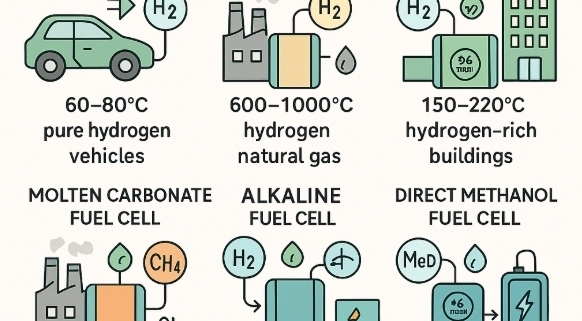
| PEMFC | 60–80°C | Polymer membrane | Pure hydrogen | Cars, buses, backup power | 40–60% |
| SOFC | 600–1,000°C | Solid ceramic | Hydrogen, natural gas | Large CHP, industrial | 50–60% |
| PAFC | 150–220°C | Phosphoric acid | Hydrogen-rich | Buildings, CHP | 40–50% |
| MCFC | 600–700°C | Molten carbonate salt | Natural gas, biogas | Utility power, CHP | 45–55% |
| AFC | 60–90°C | Alkaline solution | Pure hydrogen | Space, niche portable | 50–70% |
| DMFC | 20–90°C | Polymer membrane | Liquid methanol | Portable power | 20–30% |
| RFC | Varies | Various | Water & hydrogen | Renewable storage | ~40–50% (emerging) |
Benefits and Challenges: A Quick Recap
✅ Benefits:
- Zero local emissions (only water, heat, and some CO₂ for carbon-based fuels)
- High fuel-to-electricity efficiency
- Quiet operation
- Scalable from milliwatts to megawatts
- Compatible with renewable hydrogen production
⚡ Challenges:
- Hydrogen infrastructure gaps (production, transport, storage)
- Catalyst costs (especially platinum for PEMFC)
- Durability and materials for high-temp systems
- System complexity for reversible and hybrid applications
Final Thoughts
From zero-emission vehicles to backup power for hospitals and large industrial plants, fuel cells offer versatile, reliable, and scalable clean energy solutions. As green hydrogen production and fuel cell technologies advance, we can expect to see these systems powering more of our daily lives.
🌍 Fuel cells aren’t just the future — they’re here now, transforming transportation, industry, and our energy grids.
🧾 BIS Certification for Lithium-Ion Batteries in India: Complete Guide for 2025
⚡ Introduction: Why BIS Certification Matters for Lithium-Ion Batteries
The demand for lithium-ion batteries in India is growing rapidly, driven by the electric vehicle (EV) boom and the expansion of energy storage systems (ESS). To ensure safety, reliability, and quality, the Bureau of Indian Standards (BIS) mandates BIS Certification under the Compulsory Registration Scheme (CRS).
BIS certification validates that batteries meet India’s strict safety and performance standards — protecting consumers and ensuring market trust.
In short: No lithium-ion battery can be legally sold in India without BIS registration.
🔍 What Is BIS Certification?
The Bureau of Indian Standards (BIS) operates under the Ministry of Consumer Affairs, Government of India, and oversees product safety across multiple categories, including electrical, electronics, and battery systems.
For lithium-ion batteries, the BIS certification is issued under IS 16046 (Part 1 and Part 2) standards, which align closely with IEC 62133-1 and IEC 62133-2.
These ensure:
- Safe design and cell structure
- Protection against thermal runaway
- Reliable charging and discharging
- Prevention of short-circuit or overvoltage damage
🔗 BIS Official Website Link: Official BIS Portal – Compulsory Registration Scheme
🧩 Why BIS Certification Is Important
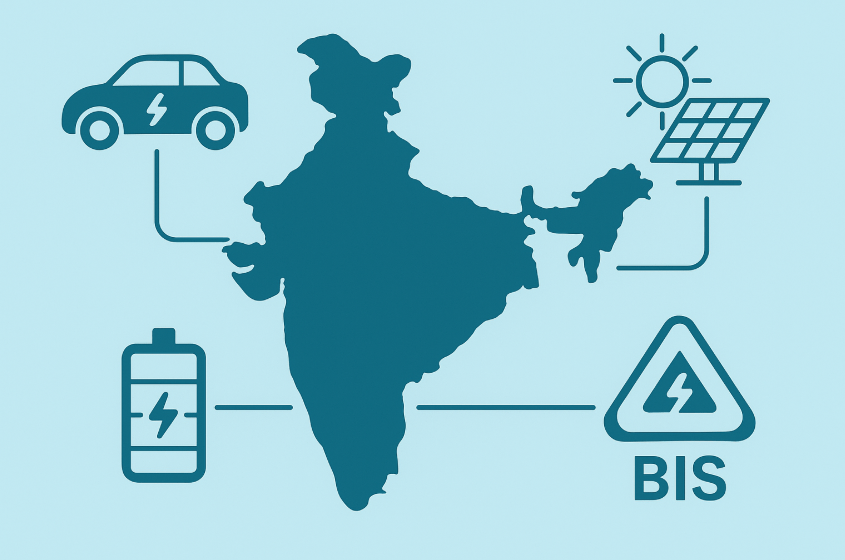
- Legal Compliance: Mandatory under the Electronics and IT Goods (Requirements for Compulsory Registration) Order.
- Safety Assurance: Prevents risks such as overheating, leakage, or fire.
- Market Access: Allows legal sales and distribution in India.
- Consumer Trust: Enhances brand credibility and acceptance.
- Export Advantage: Shows global buyers that Indian-made batteries meet rigorous standards.
🔗 Read More about UL Certifications for BESS: Learn more about UL Certifications for Battery Systems →
⚙️ Types of Batteries That Require BIS Certification
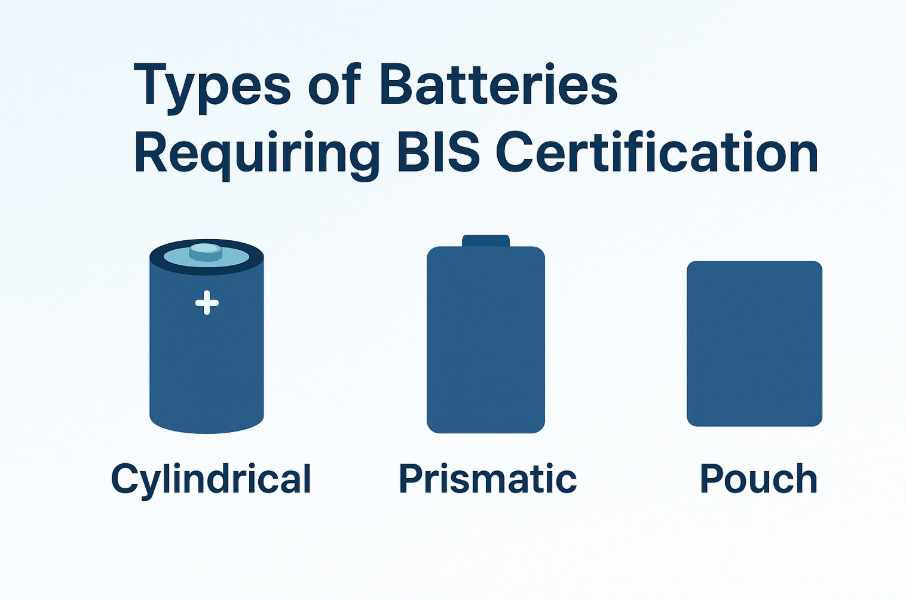
BIS certification applies to all lithium-ion batteries, including:
- Cylindrical cells
- Prismatic cells
- Pouch cells
- Battery packs used in EVs, solar storage, and portable electronics
Each type must undergo independent testing in a BIS-recognized laboratory.
🧾 BIS Certification Process for Lithium-Ion Batteries
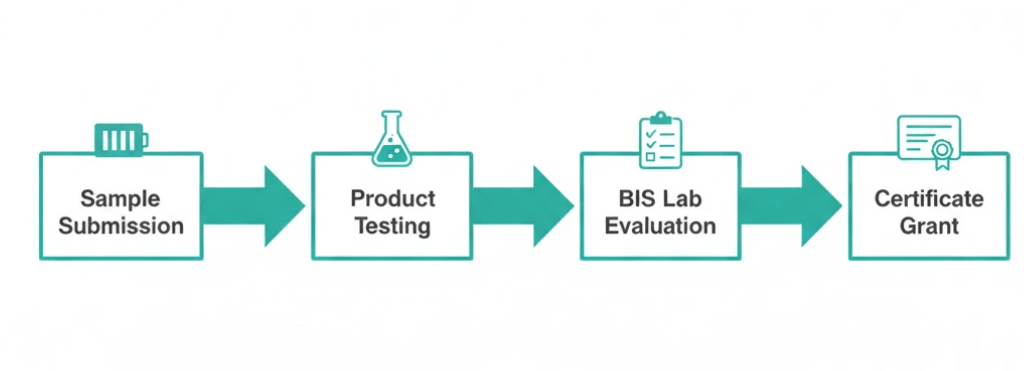
The process follows a clear and structured workflow:
- Product Testing: Submit battery samples to a BIS-recognized laboratory.
- Documentation: Provide technical specifications, test reports, and company details.
- Evaluation: BIS officers review compliance with IS 16046 and CRS requirements.
- Grant of License: Once approved, BIS issues a unique CRS number for your product.
- Ongoing Compliance: Regular audits and periodic sample re-testing ensure continued conformity.
🔗 BIS Official Website Link: BIS Laboratory Recognition Scheme
Who Needs BIS Certification in India?
BIS registration applies to:
- Indian manufacturers of lithium-ion cells or packs.
- Foreign manufacturers exporting batteries to India.
- Importers or brand owners selling products that include lithium cells (like e-bikes, ESS, or power banks).
Foreign manufacturers must appoint an Authorized Indian Representative (AIR) to manage their application.
You can learn about AIR responsibilities in the BIS Certification Process page.
Step-by-Step Process for BIS Registration
1. Identify the correct product category
Confirm your cell or pack falls under IS 16046 (Part 2): 2018.
2. Appoint an AIR (for foreign brands)
The AIR acts as the legal point of contact in India.
3. Send samples to a BIS-approved lab
Testing includes mechanical, electrical, and thermal safety tests.
4. Receive valid test reports
Reports older than the allowed period (commonly 90 days) are not accepted.
5. Submit the BIS online application
Upload your documents, test reports, and undertakings via the BIS Smart Registration portal.
6. BIS review and certification
The Bureau reviews, queries if necessary, and grants registration once approved.
The average BIS certification timeline ranges from 6 to 12 weeks, depending on test readiness and documentation accuracy.
Testing Requirements under IS 16046 (Part 2)
BIS mandates several tests to ensure safety and reliability:
- Overcharge and overdischarge tests
- Short-circuit and thermal abuse tests
- Vibration and mechanical shock tests
- Drop, crush, and impact evaluations
- Forced discharge and temperature cycling
Testing must be done at BIS-recognized Indian laboratories only.
See the CRSBIS recognized labs list for current approvals.
Validity, Renewal, and Modifications
A BIS registration typically remains valid for two years and can be renewed before expiry.
If your battery design, chemistry, or form factor changes, you may need inclusion or re-certification.
Always inform BIS of any updates to avoid suspension.
For guidance, consult BIS’s Product Certification FAQs.
Cost and Time Estimates
| Activity | Typical Duration | Cost Factors |
|---|---|---|
| Lab testing | 2–8 weeks | Sample complexity, lab backlog |
| Application & review | 2–6 weeks | Queries or re-submission |
| Renewal | Within 2 years | Administrative and testing fees |
Costs vary by product, testing scope, and chosen lab.
Budget for re-testing, document translation, and AIR service fees if applicable.
Quick BIS Application Checklist
- Verify your product under IS 16046 (Part 2): 2018
- Appoint an Authorized Indian Representative (if foreign)
- Prepare technical documents (schematics, BOM, manual)
- Send samples to a BIS-recognized lab
- Receive a valid test report (within validity window)
- Submit the online application via BIS portal
- Maintain labeling and traceability records
- Plan renewal at least 2 months before expiry
Benefits of BIS Certification
- Legal entry to the Indian market
- Enhanced brand reputation and safety credibility
- Easier access to EV, solar, and energy storage tenders
- Compliance with “Make in India” and safety mandates
- Consumer trust through verified performance
If your goal is to supply battery energy storage systems (BESS) or EV packs in India, BIS certification ensures your design meets national standards.
🔋 BIS vs UL Certification: What’s the Difference?
| Criteria | BIS (India) | UL (Global) |
|---|---|---|
| Authority | Bureau of Indian Standards | Underwriters Laboratories |
| Scope | Indian domestic market | International / export markets |
| Standard | IS 16046 (IEC 62133) | UL 2054, UL 2271, UL 2580 |
| Focus | Safety & legal compliance | Performance & export safety |
| Certification Need | Mandatory in India | Mandatory for exports & EVs |
🔗 Read more here: Compare UL 2054, UL 2271, and UL 2580 Certifications →
🧰 Common Challenges in BIS Certification
- Testing Delays: Due to limited BIS-recognized labs.
- Complex Documentation: Requires technical accuracy.
- Component Traceability: Imported cells must show source compliance.
- Frequent Standard Updates: IS 16046 revisions can impact timelines.
💡 Tip: Partnering with a certified integrator like SunLith Energy helps streamline compliance and ensure up-to-date certification.
⚡ BIS for EV, Solar, and Energy Storage Systems
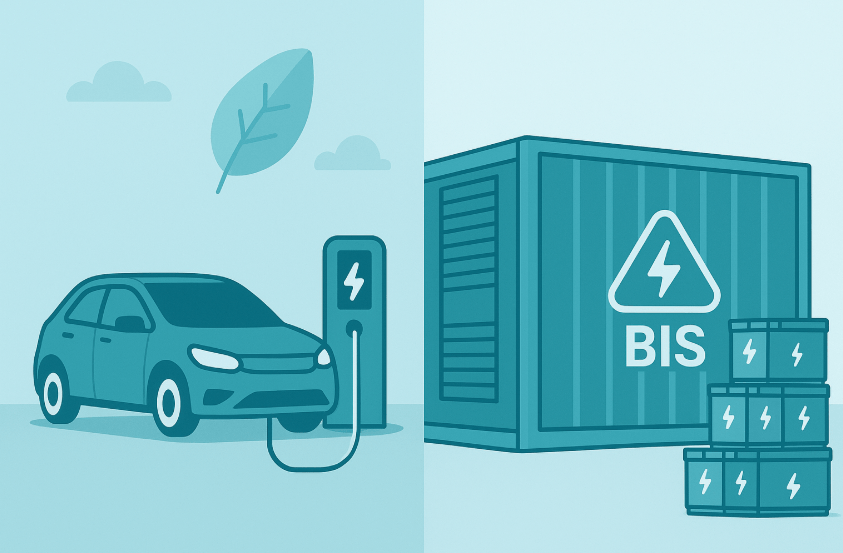
BIS certification isn’t limited to small devices — it’s equally crucial for EV batteries, solar storage units, and industrial battery systems.
SunLith Energy’s advanced BESS solutions comply with BIS and other global standards, ensuring safe and efficient operation across commercial and industrial applications.
🔗 Read more here: Explore SunLith Energy’s C&I Battery Energy Storage Systems →
🧠 Future of BIS Certification in India
The Government of India continues strengthening its battery standardization policies, aligning with global frameworks like UN 38.3 and ISO 9001:2015.
In coming years, expect:
- Expansion to cover solid-state and semi-solid lithium technologies.
- Integration with Battery Passport regulations for traceability.
- Stronger testing oversight for EV safety and fire resistance.
❓ FAQ: BIS Certification for Lithium-Ion Batteries
Q1. Is BIS certification mandatory for lithium-ion batteries?
✅ Yes. All lithium-ion cells and packs must be BIS-certified before sale in India.
Q2. How long does the BIS certification process take?
⏱️ Typically 1–4 months, depending on testing queue and document accuracy.
Q3. Can imported batteries be sold without BIS?
❌ No. Even imported batteries must register under CRS before being marketed in India.
Q4. Does BIS certification cover EV batteries?
✅ Yes. All electric vehicle battery packs must comply with BIS standards.
Q5. Can I use a foreign lab test report?
❌ No. BIS accepts test reports only from BIS-recognized labs in India.
Q6. What happens if my battery design changes?
Major design or chemistry changes require re-certification or inclusion.
Q6. Do I need BIS if my battery already has UL or IEC certification?
✅ Yes. Indian BIS registration is mandatory, even if you hold foreign safety marks.
Q7. How often must BIS be renewed?
Renew every two years or as defined in your certificate terms.
📈 Conclusion: Ensuring Battery Safety Through BIS
BIS certification is the foundation of battery safety in India. It not only ensures compliance but also builds trust among consumers, EV manufacturers, and energy solution providers.
At SunLith Energy, we support clients from design to compliance — including UL, BIS, and IEC certifications — to accelerate product launch with confidence.
By staying ahead with SunLith Energy’s BIS-compliant battery systems, your products remain reliable, future-ready, and globally competitive.
🔗 Visit: SunLith Energy – Advanced Battery Solutions for India →
🛠️ BMS Explained: Real-Time Monitoring, Key Protections, and SOC/SOH Algorithms
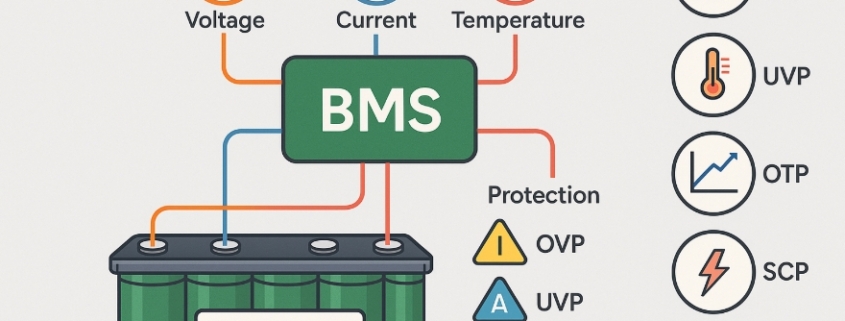
In the age of electric vehicles, solar energy storage, and portable power, batteries are everywhere. However, they don’t work efficiently—or safely—on their own. That’s where the Battery Management System (BMS) steps in.
A BMS monitors, protects, and optimizes battery operation. In this guide, we’ll break down how a BMS works, what makes it essential, and how it improves battery safety and performance.
Let’s begin with the basics.
🔍 What Is a BMS (Battery Management System)?
A Battery Management System (BMS) is an electronic controller found in nearly every advanced battery pack. Whether in electric scooters or solar home systems, the BMS performs several important tasks:
- It monitors battery health and performance.
- It protects the battery from unsafe conditions.
- It balances cells to maintain consistency.
- It calculates key values like State of Charge (SOC) and State of Health (SOH).
- It communicates with other devices and controllers.
In short, it acts as the brain behind the battery.
📈 BMS Real-Time Monitoring: Constant Awareness, Constant Safety
At the heart of every BMS is real-time monitoring. This feature continuously checks the condition of the battery, ensuring it remains within safe and efficient operating limits.
Here’s what it tracks:
🔋 Voltage Monitoring
Each battery cell has a safe voltage range. The BMS monitors individual cell voltages and the total pack voltage. Even a small voltage imbalance can reduce performance or cause damage.
➡️ Why it matters: It helps avoid overcharging or over-discharging, which can permanently damage cells.
⚡ Current Monitoring
By measuring the charging and discharging current, the BMS keeps track of how much energy is moving in or out of the battery.
➡️ Why it matters: It prevents dangerous current spikes and helps calculate the battery’s remaining energy.
🌡️ Temperature Monitoring
Battery temperature is closely watched using thermal sensors. Too much heat or cold can cause big problems.
➡️ Why it matters: If a battery gets too hot, it can overheat or even catch fire. Monitoring temperature helps avoid this.
🛡️ BMS Protection Features: Preventing Damage Before It Happens
Real-time monitoring is helpful, but monitoring alone isn’t enough. The BMS also responds when things go wrong. It includes four core protection mechanisms, each with a specific safety role.
1. ✅ Over Voltage Protection (OVP)
If a battery is charged beyond its safe limit, chemical reactions inside the cells can become unstable.
➡️ Why it matters: OVP prevents this by stopping charging when voltage gets too high. This protects the cells and keeps them from overheating.
2. ❌ Under Voltage Protection (UVP)
If voltage drops too low during discharge, cells can be permanently damaged.
➡️ Why it matters: UVP shuts down the battery before damage occurs. It helps protect capacity and extends battery life.
3. 🌡️ Over Temperature Protection (OTP)
Charging or discharging at extreme temperatures can harm the battery.
➡️ Why it matters: OTP stops activity when the battery is too hot or cold. This ensures safe operation in every condition.
4. ⚠️ Short Circuit Protection (SCP)
If a short circuit occurs, current can spike instantly. This can lead to fire or explosion.
➡️ Why it matters: SCP reacts in microseconds to cut off power, preventing serious accidents.
⛽️ State of Charge (SOC): How Much Energy Is Left?
Think of SOC as the battery’s fuel gauge. It tells you how much usable energy remains, usually shown as a percentage (like 75% or 50%).
How SOC is calculated:
- Coulomb counting: Tracks how much current flows in and out.
- Voltage-based estimation: Uses resting voltage as an indicator.
- Temperature-corrected models: Account for heat effects on performance.
➡️ Why it matters: Knowing SOC helps you avoid running out of battery unexpectedly. It also prevents overcharging, which protects the battery.
🧬 State of Health (SOH): Is the Battery Aging?
While SOC tells you the current charge, SOH tells you how healthy the battery is overall. It measures how much the battery has degraded over time.
SOH is based on:
- Charge capacity fade
- Internal resistance increase
- Temperature behavior over time
- Number of charging cycles
➡️ Why it matters: A battery may charge fully but still not perform like new. SOH lets users know when a battery is aging or needs replacement. It’s also useful for warranties and service checks.
⚖️ Cell Balancing: Keeping Every Cell in Sync
While monitoring and protection are essential, a truly effective Battery Management System also performs cell balancing. This function ensures that all individual cells within the battery pack maintain equal voltage levels.
Over time, slight differences in cell chemistry, resistance, or temperature cause some cells to charge faster or slower than others. Left unchecked, this leads to performance drops and early aging.
📌 What Is Cell Balancing?
Cell balancing equalizes the voltage of each cell, improving pack efficiency and lifespan.
There are two main types:
1. 🔋 Passive Balancing
In passive balancing, extra energy from higher-voltage cells is burned off as heat using resistors.
- ✅ Simple and low-cost
- ✅ Common in consumer electronics
- ❌ Less efficient due to energy loss
2. ⚡ Active Balancing
Active balancing redistributes charge from more charged cells to less charged ones, using inductors, capacitors, or switch networks.
- ✅ Higher efficiency
- ✅ Extends battery life
- ✅ Suitable for EVs, BESS, drones
- ❌ More complex and expensive
🧠 Why Balancing Matters
Balancing is critical because even small voltage mismatches between cells can lead to:
- Uneven charging
- Reduced usable capacity
- Early triggering of safety cutoffs
- Accelerated aging in weaker cells
By balancing cells, the BMS ensures every cell contributes equally—maximizing safety, performance, and battery lifespan.
⚙️ Where BMS Is Used
You’ll find BMS systems in many places, including:
🚗 Electric Vehicles
- Manages high-voltage battery packs
- Ensures safe fast charging
- Controls thermal systems for safety and performance
☀️ Solar Energy Storage
- Regulates battery banks for homes and businesses
- Prevents overcharging from solar input
- Ensures reliable power at night or during outages
📱 Portable Devices
- Protects battery in phones and laptops
- Extends device life and charge cycles
- Ensures safety during fast charging
🧠 Final Thoughts: Why Every Battery Needs a BMS
Batteries are powerful, but they are also sensitive. Without a Battery Management System, they would fail faster—and sometimes dangerously. With features like:
- Real-time monitoring
- Over-voltage, under-voltage, temperature, and short-circuit protections
- SOC and SOH calculations
- Cell balancing for efficiency and safety
…a BMS ensures that the battery stays safe, efficient, and long-lasting.
If you’re using or building battery-powered systems, never ignore the importance of a well-designed BMS. It’s the hidden engine behind every reliable energy solution.
🤛 BMS Frequently Asked Questions
Q1: Can I use batteries without a BMS?
➡️ Technically yes, but it’s risky. A BMS prevents overheating, damage, and accidents.
Q2: What type of batteries use a BMS?
➡️ Mostly lithium-based batteries (like Li-ion or LiFePO4), but other chemistries can also benefit.
Q3: Can a BMS extend battery life?
➡️ Absolutely. By balancing cells, protecting from damage, and avoiding extreme conditions, a BMS helps batteries last longer.
Q4: How accurate is the SOC reading?
➡️ Accuracy depends on the BMS algorithm, temperature conditions, and battery type. Premium systems can be highly precise.
Beyond Price: How to Evaluate cells Value by LiFePO4 Datasheet Metrics
LiFePO4 datasheet metrics: When buying LiFePO4 (Lithium Iron Phosphate) battery cells, many people only look at the price. But just going for the cheapest option can lead to problems later — like poor performance, short battery life, or safety risks.
If you want a battery that’s reliable, lasts long, and suits your needs, you must check the datasheet carefully. The datasheet is like a report card — it tells you what the battery can really do.
In this blog, we’ll explain how to read a LiFePO4 battery datasheet in simple words and how to use that information to find the best value — not just the lowest price.
✅ What Is a Battery Datasheet?
A battery datasheet is a technical document provided by the manufacturer. It includes important numbers and details that tell you how the battery works — like how much power it gives, how long it lasts, how hot it can get, and how safe it is.
If you can read these details, you can avoid low-quality or fake cells and choose the right one for your project.
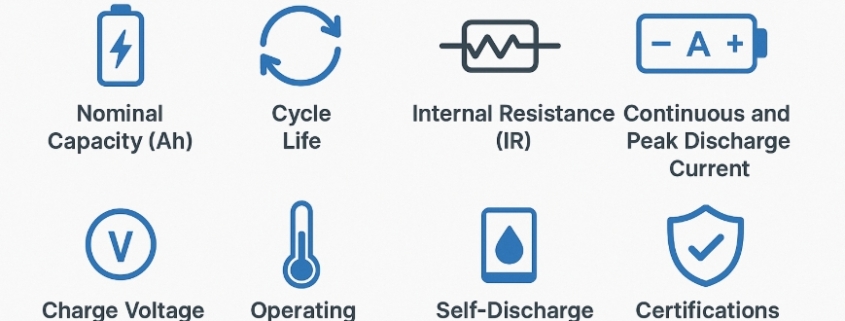
🔍 Important LiFePO4 Datasheet Metrics (Explained in Simple Words)
Here are the main things to look for in a datasheet and what they really mean:
⚡ 1. Nominal Capacity (Ah)
- What It Means: This tells you how much energy the battery can store.
- Measured In: Ampere-hours (Ah)
- Why It Matters: The higher the number, the more energy the cell can provide before it needs charging again.
- Tip: Make sure it matches what you need. For example, a 100Ah battery gives more backup than a 50Ah battery.
🔁 2. Cycle Life
- What It Means: How many times the battery can be charged and discharged before it loses most of its capacity.
- Measured As: Number of full cycles until the battery drops to 80% of its original capacity.
- Why It Matters: More cycles = longer life. A battery with 4,000 cycles will last much longer than one with 1,000 cycles.
📝 Always check the conditions under which the cycle life was tested — at what temperature, at what depth of discharge (DOD), and at what current rate?
🔌 3. Internal Resistance (IR)
- What It Means: How hard it is for electricity to move inside the battery.
- Measured In: Milliohms (mΩ)
- Why It Matters: Lower resistance is better. It means the battery can deliver power more easily and stays cooler.
- Tip: Batteries with high internal resistance waste energy and get hot during use.
🔋 4. Discharge Current (Continuous & Peak)
- What It Means:
- Continuous discharge is the amount of current the battery can give steadily.
- Peak discharge is the highest current it can give for a short time.
- Why It Matters: If you need the battery to run high-power devices (like motors or inverters), it must handle high discharge currents without damage.
🔺 Choosing a battery with low discharge ratings for high-load projects can lead to overheating and failure.
🔍 5. Charge Voltage and Cutoff Voltage
- What It Means: These are the highest and lowest voltages at which the battery should operate.
- Why It Matters: If the voltage goes outside this range, the battery can get damaged or unsafe.
- Tip: Make sure your charger and BMS (Battery Management System) follow these limits.
🌡️ 6. Operating Temperature Range
- What It Means: The safe temperature range for charging and discharging the battery.
- Why It Matters: If the battery is used in very hot or cold conditions outside the range, it might stop working or get damaged.
- Typical Range:
- Charging: 0°C to 45°C
- Discharging: -20°C to 60°C
❄️ Never charge LiFePO4 cells below 0°C — it can cause lithium plating, which damages the cell permanently.
🔋 7. Self-Discharge Rate
- What It Means: How quickly the battery loses charge when it’s not being used.
- Why It Matters: A good-quality LiFePO4 battery should hold charge for months. If it discharges quickly, it may be old or low quality.
✅ 8. Certifications
- What It Means: These are official approvals showing the battery has passed safety and quality tests.
- Common Certifications:
- UN38.3 – Safety for transport
- UL – General safety
- CE – European safety compliance
- IEC 62619 – Safety for battery systems
- Why It Matters: Certified batteries are safer to use and often required for shipping or installing in regulated systems.
💡 Real-World Example: Why Price Isn’t Everything
Let’s say you are comparing two cells:
| Feature | Cell A | Cell B |
|---|---|---|
| Price per Cell | $85 | $65 |
| Capacity | 100Ah | 100Ah |
| Cycle Life | 4,000 cycles | 2,000 cycles |
| Usable Energy | 100Ah × 3.2V × 80% × 4,000 = 1,024 kWh | 512 kWh |
| Cost per kWh | $0.083 | $0.127 |
📌 Conclusion: Even though Cell B is cheaper at first, Cell A gives twice the energy over its life and ends up costing you much less in the long run.
🚨 Warning Signs in a Bad LiFePO4 datasheet metrics
- ❌ Missing test conditions (e.g., no info on how cycle life was tested)
- ❌ Unrealistic claims like “10,000 cycles” with no proof
- ❌ No certifications or safety reports
- ❌ Different values shown for the same model on different documents
💬 FAQs about LiFePO4 datasheet metrics
Q1: What if the LiFePO4 datasheet has no cycle life info?
A: That’s a red flag. Reliable suppliers always share cycle life test results.
Q2: Can I test internal resistance myself?
A: Yes. Use a battery IR tester. You can compare it with the datasheet to check if it matches.
Q3: Why does the same capacity battery have different prices?
A: Because of quality, grade (A or B), certifications, and performance specs. Price doesn’t tell the full story.
🏁 Final Thoughts
When buying LiFePO4 batteries, don’t just ask, “How much does it cost?”
Instead, ask:
- How long will it last?
- Is it safe?
- Will it work well in my system?
- Does the datasheet match the performance I need?
📘 The LiFePO4, battery datasheet, battery safety, battery grading, energy storage, EV batteries, cycle life, internal resistancet gives you the answers. Learn how to read it — and you’ll make better, safer, and more cost-effective decisions.