

Zinc-Ion vs Zinc-Air Batteries: Two Different Technologies, One Energy Revolution
Zinc-ion vs zinc-air batteries sounds like a simple either-or choice. But the two technologies work differently and solve different storage problems.
Both use zinc, which is cheap and safe in water-based cells. A 2026 journal perspective by Oak Ridge National Laboratory researchers compares four zinc chemistries for grid storage.
Last updated: November 18, 2026.
Quick Answer: Zinc-Ion vs Zinc-Air Batteries
Quick answer: Zinc-ion vs zinc-air batteries differ in cell design. Zinc-ion cells are sealed and move zinc ions through a water-based electrolyte. Zinc-air cells pull in oxygen from outside air and are much harder to recharge. Zinc-ion suits stationary storage first, but zinc-air remains mostly at pilot scale today.
Key Takeaways
Here are five quick points on the two chemistries.
- Zinc-ion cells are sealed, but zinc-air cells breathe air and need a catalyst to recharge.
- Lab zinc-ion cells reach about 50 to 135 Wh/kg. But stack-level figures fall near 35 to 60 Wh/kg.
- Zinc-air has a theoretical 1,086 to 1,218 Wh/kg, depending on the basis. Yet rechargeable grid units are still at pilot scale.
- Zinc-ion round-trip efficiency is about 70 to 80%. Rechargeable zinc-air results range from about 40% to 70%.
- Neither has yet shown LFP-level, field-proven cycle life at commercial scale.
Why Zinc-Ion vs Zinc-Air Batteries Matter for Storage
Interest in zinc-ion vs zinc-air batteries starts with supply and safety. Zinc is far more abundant than lithium, and a 2025 review in ACS Applied Energy Materials puts the gap near 300 times.
That review prices zinc metal near $3.5 per kg, while lithium costs about $19 per kg. Also, aqueous electrolytes do not burn.
A DOE-funded Sandia program frames grid needs clearly. It lists a cost target under $100/kWh and storage lasting 2 to more than 10 hours.
But the same program adds a warning. Zinc chemistries still must prove more than 5,000 cycles, or about 10 to 15 years of life.
How Zinc-Ion Batteries Work
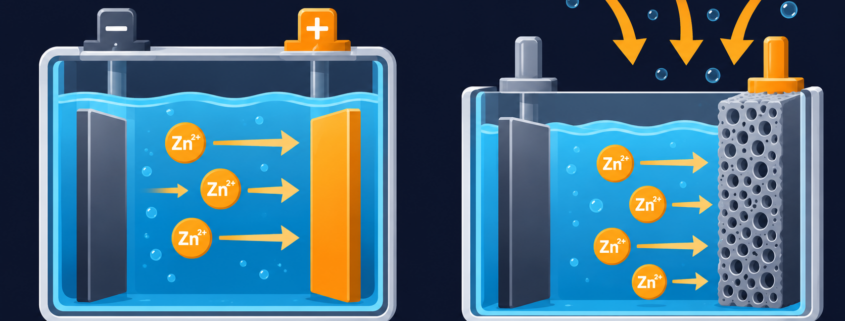
Among zinc-ion vs zinc-air batteries, zinc-ion uses the more conventional sealed-cell design. They resemble lithium-ion cells, but they use zinc and water.
Zinc-Ion Chemistry and Cell Design
A zinc-ion cell pairs a zinc metal anode with a host cathode. Manganese oxide and vanadium oxide are the most common hosts.
The electrolyte is a mild, water-based zinc salt, such as zinc sulfate. During charge and discharge, zinc ions then move between the electrodes.
Manganese oxide cathodes also take in protons alongside zinc ions. This adds capacity, but it can reduce stability.
Working voltage sits near 1.2 to 1.6 V, while lithium-ion cells run near 3.2 to 3.8 V.
Water also limits the voltage because it splits near 1.23 V. That narrows the electrolyte’s stable window.
Low voltage forces a trade-off, since the cell must hold more charge per area.
Sandia says a zinc/manganese dioxide cell needs about 15 mAh/cm² of loading. A lithium cobalt oxide cell needs only 1 to 5 mAh/cm² for similar energy.
Where Zinc-Ion Batteries Struggle
Zinc anodes face three linked problems. They are dendrite growth, hydrogen evolution and corrosion.
Cathodes add their own limits. Manganese and vanadium can dissolve, and zinc ions also move slowly through many hosts.
Lab numbers can also flatter the cells, since coin cells use extra electrolyte and thin electrodes.
A manganese oxide cathode may run thousands of cycles in a coin cell. Yet it can drop below 1,000 cycles in a pouch cell.
Energy density is modest, too. The 2025 review lists 50 to 135 Wh/kg for lab cells and 35 to 60 Wh/kg at practical stack level.
How Zinc-Air Batteries Work
In the zinc-ion vs zinc-air batteries comparison, zinc-air is the open system. It uses outside air as part of the cell.
Our zinc-air battery guide covers the chemistry in more depth.
Zinc-Air Chemistry and Cell Design
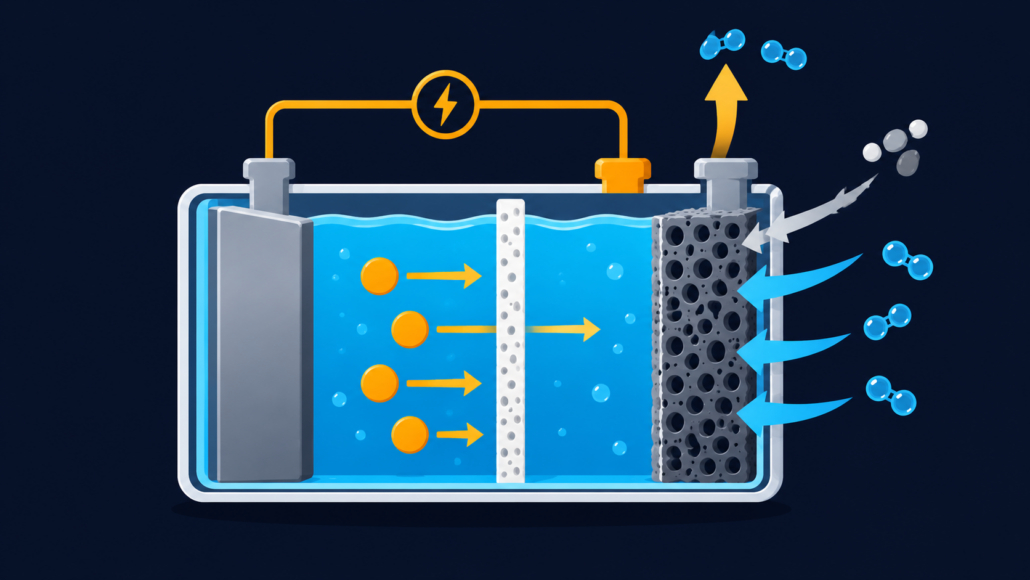
A zinc-air cell pairs a zinc anode with a porous air electrode. The electrolyte is a strong alkaline solution, usually potassium hydroxide.
On discharge, oxygen reacts at the air electrode while zinc turns into zinc oxide. Sandia lists an open-circuit voltage of 1.65 V and an operating range of 0.9 to 1.4 V.
The theoretical energy density is 1,086 Wh/kg, counting oxygen. A Chemical Society Reviews article puts that near five times lithium-ion.
Our zinc-air guide cites about 1,218 Wh/kg from a 2024 review, so the figure depends on the basis.
Practical figures sit well below theory. Sandia lists about 100 to 400 Wh/kg for zinc-air in general.
That is a broad reference range, not a verified range for rechargeable grid-scale systems.
But Sandia adds that oxygen catalysis in both directions is still hard.
Primary zinc-air cells have been commercial since the 1930s. Rechargeable versions are still the hard part.
Electrical vs Mechanical Recharging
Electrical recharging needs one air electrode that works both ways. It must reduce oxygen on discharge, then evolve oxygen on charge.
Few catalysts do both well. That gap is the main reason rechargeable zinc-air lags.
Mechanical recharging takes another path. Operators swap in fresh zinc and process the spent zinc elsewhere.
Where Zinc-Air Batteries Struggle
Carbon dioxide in air reacts with the alkaline electrolyte. The carbonate can then block active sites on the air electrode.
A 2023 failure study traced limited cycle life to this carbonation. Catalyst wear and zinc shape change also add loss.
An arXiv study ties lost reversibility to the zinc anode, the electrolyte and the air electrode. Oak Ridge also names electrolyte evaporation.
A recent laboratory result shows progress, but it does not show grid readiness. Trade press dated October 28, 2026 covers a new catalyst from a German university. The study itself appeared on September 27, 2026.
It cycled for over 300 hours, or about 100 cycles. But the cells were small, and they ran at low current and partial depth of discharge.
So this is a catalyst advance, not a proven battery.
Zinc-Ion vs Zinc-Air Batteries: Side-by-Side Comparison
This table compares zinc-ion vs zinc-air batteries on the points that matter for storage projects.
| Feature | Zinc-ion | Zinc-air |
| Electrolyte | Mild, water-based zinc salt | Strong alkaline solution (potassium hydroxide) |
| Cathode reactant | Host material, such as manganese or vanadium oxide | Oxygen from outside air |
| Cell design | Sealed | Open to air through a porous electrode |
| Voltage | About 1.2 to 1.6 V working | About 0.9 to 1.4 V operating |
| Energy density | 50 to 135 Wh/kg lab cell; 35 to 60 Wh/kg practical stack | 1,086 to 1,218 Wh/kg theoretical, basis varies; about 100 to 400 Wh/kg general reference, not verified for rechargeable grid systems |
| Round-trip efficiency | About 70 to 80% | About 40% (older flow-type pilot) to 70% (low-current lab cell) |
| Lab cycle evidence | 1,000 to 6,000 cycles in lab cells | Hundreds of hours (about 100 cycles) in small lab cells |
| Project or projected evidence | DOE 2030 baseline projection: about 6,500 cycles (not demonstrated) | 2,000 cycles reported for one older flow-type pilot |
| Main failure modes | Dendrites, hydrogen evolution, cathode dissolution | Carbonation, air-electrode wear, zinc shape change |
| Safety profile | Nonflammable electrolyte | Nonflammable electrolyte, but strongly alkaline |
| Maturity | TRL 5 to 7 (2025 review) | Primary: mature. Rechargeable grid: pilot scale |
| Likely fit | Stationary storage lasting hours | Multi-day storage targets, not yet proven |
Table sources: the 2025 review, Sandia and a 2019 flow battery study. The 70% zinc-air figure comes from a low-current lab cell. Figures mix lab cells, stack-level data, projections and general references, as labeled. Cost figures vary by study and assumptions.
What the Numbers Mean for Zinc-Ion vs Zinc-Air Batteries
Comparing zinc-ion and zinc-air performance takes care, because lab and system numbers differ.
Lab claims often use thin electrodes, excess electrolyte and shallow cycles. Those choices flatter cycle life.
Many lab zinc anodes also use thick foil, so depth of discharge stays below about 5%. Real systems cannot waste zinc that way.
So ask for pouch-cell or system data at a stated depth of discharge. Also ask for round-trip efficiency at rated power.
The 2025 review also summarizes a DOE 2030 baseline for zinc batteries. It lists about 6,500 cycles, 17 years of calendar life and 74% round-trip efficiency.
That baseline is a target or modeled benchmark, not demonstrated field performance.
The baseline cost is about $0.15 per kWh, excluding energy cost. But the DOE target is $0.05 per kWh.
To see how levelized cost works, read our BESS CAPEX vs LCOS guide.
Safety, Cost and Sustainability
Safety and materials are the strongest arguments for zinc-ion vs zinc-air batteries.
Both chemistries use nonflammable, water-based electrolytes. That removes the flammable organic solvents used in lithium-ion cells.
Zinc is also easy to recycle. The 2025 review reports zinc recovery above 99% in early studies.
A cradle-to-gate study of six lab-scale zinc-ion designs averaged 45.1 kg CO2-equivalent per kWh. The review calls that competitive with lithium-ion.
But safety is not a free pass. Dendrites can still short zinc-ion cells, and zinc-air electrolyte is strongly alkaline.
Where Zinc-Ion vs Zinc-Air Batteries Stand in 2026
Commercial status differs a lot between the two chemistries.
Zinc-Ion Batteries: Between Lab and Market
The 2025 review rates aqueous zinc-ion at technology readiness levels 5 to 7, while lithium-ion sits at level 9.
Not every zinc project is zinc-ion. Sandia lists zinc-manganese dioxide, zinc-nickel, zinc-air, zinc-bromine and zinc-ion as separate chemistries.
Labels also blur. A 2024 grant for a 6 MW/48 MWh California base carries a zinc-ion headline.
Yet the article describes zinc hybrid cathode aqueous batteries. So check the exact chemistry before you compare any two zinc projects.
Zinc-Air Batteries: Pilot Scale
Primary cells are mature, but rechargeable grid units are still in demonstration.
A Canadian government project page reports a 1 kW/24 kWh proof of concept. It carried a house load for about 24 hours.
As of 2022, developers had targeted 24 to 48 hours of duration in planned pilots, according to trade coverage from that year. Check for newer results before relying on that.
Oak Ridge’s 2026 perspective gives rechargeable zinc-air the closest look. Then it lists three open barriers.
Those are anode dendrites and corrosion, electrolyte carbonation and evaporation, and slow oxygen catalysis.
Choosing Between Zinc-Ion and Zinc-Air Batteries
The right technology depends on duration, cycling and risk tolerance. Choosing among zinc-ion vs zinc-air batteries starts there.
Zinc-ion fits sealed stationary systems where fire risk matters more than footprint.
But expect bulkier systems. Lab zinc-ion cells top out near 135 Wh/kg, while lithium-ion cells reach 160 to 250.
Zinc-air fits best where multi-day duration matters and pilot risk is acceptable. Otherwise, wait for field data.
Ask for field-cycle data, not catalyst papers. Also ask how the design controls carbon dioxide and electrolyte loss.
LFP remains the more mature option for daily cycling. The 2025 review lists lithium-ion at 3,000 to 8,000 cycles and 85 to 95% round-trip efficiency.
It also lists zinc-ion levelized cost at about $0.15 to $0.25 per kWh. Utility-scale lithium-ion sits near $0.13 to $0.18.
Buyer Questions for Zinc-Ion vs Zinc-Air Batteries
Use these questions before you accept any zinc battery quote.
- Which chemistry is it: zinc-ion, zinc hybrid cathode, zinc-bromine or zinc-air?
- Is the cycle data from pouch cells or full systems?
- Which depth of discharge and current density did the tests use?
- What is round-trip efficiency at rated power, with auxiliary loads?
- What does the warranty cover, and who carries degradation risk?
Frequently Asked Questions
These answers cover common questions about zinc-ion vs zinc-air batteries.
What is the main difference between zinc-ion vs zinc-air batteries?
Zinc-ion cells are sealed and move zinc ions between electrodes. But zinc-air cells draw oxygen from outside air and use an alkaline electrolyte.
Are zinc-ion batteries better than lithium-ion?
Not yet for most projects. They are safer and cheaper in materials, but lithium-ion leads on energy density, efficiency and proven cycle life.
Can zinc-air batteries be recharged?
Yes, but it is hard because the air electrode must work both ways. Carbonation also shortens life, so some designs swap in fresh zinc.
Which is closer to market, zinc-ion or zinc-air?
Rechargeable grid zinc-air is at pilot scale. A 2025 review rates zinc-ion at TRL 5 to 7, but both still lag LFP.
Further Reading on Zinc-Ion vs Zinc-Air Batteries and Storage Costs
These SunLith guides add cost and procurement context to the zinc-ion vs zinc-air batteries comparison.
- Zinc-Air Battery: How It Works and What Is New in 2026: the full guide to zinc-air chemistry, recharging limits and 2026 research.
- Long-Duration Energy Storage (LDES): Importance and Technologies: where multi-day storage options fit.
- What Is an Iron-Air Battery?: another multi-day option to compare with zinc-air.
- BESS CAPEX vs LCOS: how to compare upfront cost with the cost of storing energy.
- BESS CAPEX Calculation: how battery storage cost structure works.
- C&I BESS Warranty Guide: how to read degradation and warranty terms before you buy.