

Indoor Battery Installation Regulations by Country and Code
Indoor battery installation regulations differ by country, and often by state, province, or city within that same country. Because of this, a lithium battery system approved for sale in one market isn’t automatically approved for indoor installation there.
Two separate questions decide compliance. First, does the hardware meet a recognized safety standard? Second, is it sited, separated, and protected correctly for that room, under the code edition the local area has actually adopted?
This guide is for ESS manufacturers, distributors, installers, developers, and facility owners, and covers residential, commercial, and light-industrial indoor installations. Even so, it is not a substitute for project-specific engineering, code review, or sign-off from the authority having jurisdiction (AHJ).
Quick Answer
Indoor lithium-ion battery storage must meet the electrical, building, and fire-safety rules where the project sits. It must also meet the certification terms tied to that product. System certification and fire-test data support compliance. Neither replaces project-specific design review or sign-off from the authority having jurisdiction (AHJ).
Important
This article gives a high-level regulatory overview. It is not engineering, legal, fire-safety, or permitting advice. Rules depend on the locally adopted code edition. They also depend on ESS chemistry and capacity, building occupancy, manufacturer instructions, product listing, and the local authority’s judgment. Confirm project rules with qualified local professionals before installation.
Why Indoor Battery Installation Regulations Vary by Country
Every framework below regulates the same failure mode: a lithium cell in thermal runaway releases heat, flammable off-gas, and, in a confined space, pressure.
What differs is how each system of codes assigns responsibility for that risk. Some lean on cell-level certification. While others lean on system-level test data, installation separation rules, building and fire code, or a mix of all four. For example, the U.S. National Fire Protection Association publishes the installation standard most American areas reference. Its scope shows how differently one country can frame the same physics problem.
Quick Reference: Indoor Battery Installation Regulations by Region

The table below summarizes each market’s main framework, plus the key product evidence and the practical sign-off authority.
| Region | Main installation framework | Key product/system evidence | Practical approval authority |
|---|---|---|---|
| United States | NFPA 855 (where adopted), IFC/IBC rules, NEC Article 706 | UL 9540 listing; UL 9540A test data where required | Local AHJ |
| Canada | Canadian Electrical Code (CSA C22.1), provincial/territorial codes | ANSI/CAN/UL 9540; ANSI/CAN/UL 1973 where applicable | Provincial or municipal authority |
| European Union | National electrical, building, and fire rules | IEC 62619 and related EN standards; CE conformity | National or local regulator |
| Germany | National rules plus VDE practice | IEC standards and VDE-AR-E 2510-50 where specified or expected | Installer, insurer, local authority |
| United Kingdom | PAS 63100, BS 7671 Chapter 57, relevant building/fire rules | Relevant product standards and installer paperwork | Installer, building control, MCS scheme rules |
| Australia / NZ | AS/NZS 5139 plus electrical/grid standards | Relevant battery and inverter certifications | Licensed installer and local regulator |
| China | GB 51048, GB/T 42288 — mainly station-scale | Certification path varies by product category; verify locally | Local fire and regulatory authorities |
| Japan | Fire Service Act, Electrical Appliances and Materials Safety Act | Product-specific METI/PSE/JIS/IEC review | Local fire authority and relevant regulator |
Treat the China and Japan rows as directional starting points, not final answers, because those sections below explain why.
United States: NFPA 855, UL 9540A, and NEC Article 706
UL 9540A Is a Test Method, Not a Certification
UL 9540A evaluates thermal-runaway fire propagation through escalating test levels: cell, module, unit, and, where needed, installation-level testing.
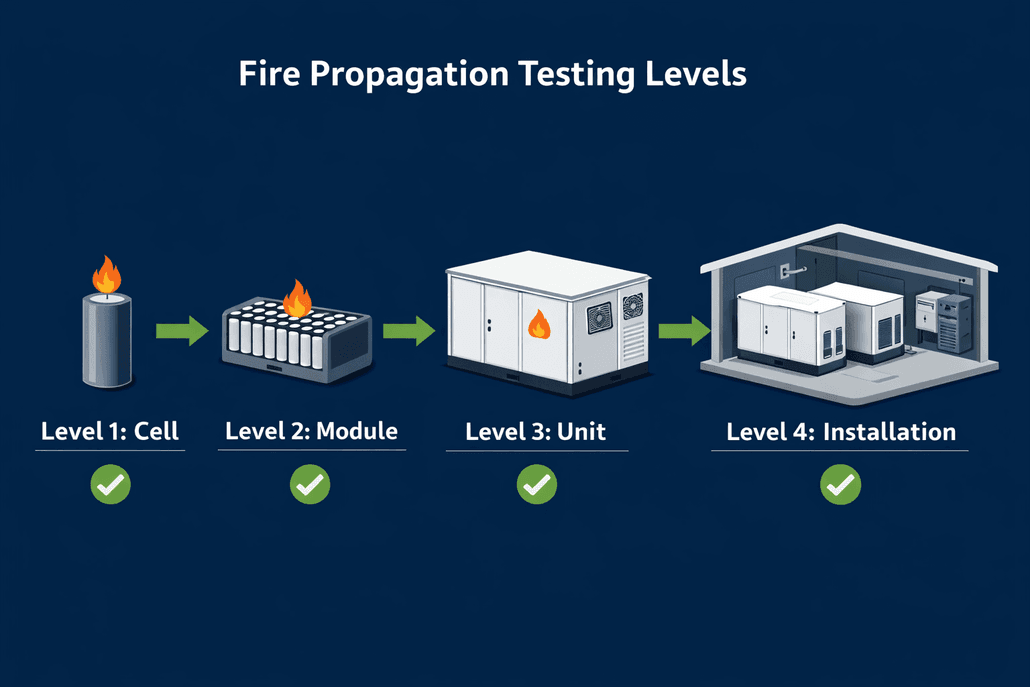
Its reports give product-specific fire and gas-release data. For example, engineers and the AHJ may use it to check spacing, aggregation, explosion control, ventilation, and fire-protection measures. That data informs the design and the AHJ’s decision. But it doesn’t replace the installation code or substitute for AHJ sign-off.
NFPA 855 Sets the Installation Rules
NFPA 855, Standard for the Installation of Stationary Energy Storage Systems, is the installation-level standard most U.S. areas reference for separation and fire-protection rules.
The 2026 edition, where adopted, significantly expands the default requirement for a documented Hazard Mitigation Analysis (HMA). “Where adopted” matters here, since code adoption is local and areas can lag the current edition by a cycle or more. So design to whichever edition the specific AHJ has actually put into force, not the newest one published.
NEC 706 Governs the Electrical Side
NEC Article 706, within NFPA 70, governs disconnects, labeling, and interconnection, no matter indoor or outdoor placement.
The International Fire Code and International Building Code incorporate NFPA 855 by reference in most adopting areas. But the AHJ still has final say. As a result, rulings vary between otherwise-similar properties depending on room construction and proximity to occupants.
Canada’s Indoor Battery Installation Regulations: Electrical Code and UL/CSA Marks
Canadian installation rules come from the Canadian Electrical Code (CSA C22.1), together with provincial or territorial electrical and fire codes, local authority rules, and the product’s certification and listing terms.
Recent editions of CSA C22.1 address energy storage systems in Section 64. Updates add a dedicated subsection for homes and raise the permitted capacity for a single residential ESS compared with earlier editions.
NFPA 855 may serve as a project, insurer, or engineering benchmark in some circumstances. But Canada’s code-adoption system is provincial and territorial, so don’t present NFPA 855 as a universally adopted Canadian installation standard. Instead, confirm the relevant provincial fire code for any specific project.
Product Certification: ANSI/CAN/UL 9540 and 1973
Product-level safety runs through the shared ANSI/CAN/UL 9540 (system) and ANSI/CAN/UL 1973 (battery) standards. A single test program can support evaluation for both the U.S. and Canadian markets.
Certification still has to come from an accredited body and be accepted by the relevant local authority. So don’t assume a U.S. listing alone is sufficient for a Canadian installation; confirm the Canadian mark or equivalent acceptance first.
European Union: IEC 62619 as the Base, Plus National Overlays
At the EU level, IEC 62619 anchors product safety for stationary lithium battery systems as the cell- and battery-level safety standard. Meanwhile, shared standards cover the power conversion and control gear, commonly cited alongside EN 62477 (power electronics) and EN 62109 (PV inverter safety, for hybrid systems).
CE marking demonstrates compliance with the relevant EU directives, but it is not itself an installation permit. Instead, siting, separation, and fire protection get set at the national or municipal level. This is where the EU differs most from the U.S. model of one widely referenced installation standard.
Germany’s Indoor Battery Installation Regulations: The VDE-AR-E 2510-50 Overlay
Germany is the clearest example of a national overlay with real market weight: VDE-AR-E 2510-50 sets safety rules for stationary lithium battery storage across its full lifecycle, from storage and transport through installation, operation, and end-of-life.
It’s commonly requested or expected in parts of the German residential and light commercial market. There, installers and some insurers treat it as a practical benchmark alongside the underlying IEC standards.
A product tested to VDE-AR-E 2510-50 may satisfy some expectations in other EU member states. But that doesn’t establish compliance with another country’s installation rules. Each national or local framework still needs its own check.
United Kingdom’s Indoor Battery Installation Regulations: PAS 63100, BS 7671, and MCS
The UK’s domestic battery framework combines fire-siting guidance, electrical-installation rules, product standards, and installer-scheme rules, built up in stages rather than as one document.
PAS 63100 and BS 7671 Chapter 57
PAS 63100:2024 provides domestic battery fire-safety guidance covering siting, fire separation, and detection, and is understood to treat bedrooms and unprotected escape routes as unsuitable locations.
A 2026 amendment to BS 7671 introduced Chapter 57, covering stationary secondary battery installations, and references PAS 63100 for domestic siting. Even so, installers should verify the exact current wording of that cross-reference against the licensed standard rather than relying on a summary.
MCS and the IET Code of Practice
MCS, the scheme relevant to specific UK incentive and export-payment programs, sets its own battery storage installation standard (MIS 3012). This points installers to the current edition of the IET Code of Practice for Electrical Energy Storage Systems.
The Code of Practice is the document that recommends following PAS 63100 for domestic siting. Because amendment and scheme language can change between code cycles, confirm the exact current rules against the licensed BS 7671 text and current MCS paperwork.
Australia and New Zealand: AS/NZS 5139
AS/NZS 5139 is Australia and New Zealand’s dedicated installation and safety standard for battery energy storage, covering siting, separation, ventilation, and protection rules in one document. By contrast, the UK and Canada use a multi-document approach.
It works alongside the broader inverter and grid-connection standards that already govern solar-plus-storage installs in the region. For the full detail on Australia’s compliance stack, including AS/NZS 4777.2 and AS/NZS 3008.1.1, see our dedicated Australian compliance hub.
China: Verify Scope and Certification Pathway Before Relying on a Summary
China’s framework for electrochemical energy-storage stations includes GB 51048 for design and GB/T 42288 for safety. Though both are principally relevant to station-scale projects rather than ordinary residential installations.
Rules for smaller indoor systems also depend on low-voltage electrical rules, product certification paths (CQC or CCC, depending on category), local fire-authority practice, and provincial rollout.
This is an area where a general summary is genuinely risky. So confirm the current edition, effective date, and scope threshold of GB 51048 with a qualified China-market compliance adviser. Also confirm whether your product category requires CCC, CQC, or another pathway before market entry. Always work from current Chinese-language official standards before any market-entry decision.
Japan: Fire Service Act Classification and Product-Specific Certification
Japan’s regulatory starting point differs from the markets above. Under the Fire Service Act, lithium-ion battery electrolyte can classify as a hazardous flammable liquid. The specific regulatory treatment depends on electrolyte composition, quantity, and the relevant hazardous-materials classification. So it isn’t a single blanket rule applied identically to every product.
METI, PSE, and IEC 62133-2
At the product level, certification runs through Japan’s METI framework. PSE marking under the Electrical Appliances and Materials Safety Act also applies. Both are product-specific rather than a blanket ESS-system certification comparable to UL 9540.
IEC 62133-2 may apply to certain portable or small stationary battery products. But don’t treat it as a general ESS system-level compliance pathway without confirming its applicability to the specific product and category under Japan’s rules.
Japan has no single dedicated residential-BESS installation standard like NFPA 855 or PAS 63100. Instead, it leans on the Fire Service Act’s hazardous-materials framework and local fire-authority discretion. This makes early talk with the local fire department a central part of Japanese project planning. Because of this, manufacturers should get Japan-specific regulatory review rather than treat PSE or IEC 62133-2 as a universal sign-off route.
What’s Consistent Across Every Country’s Indoor Battery Installation Regulations
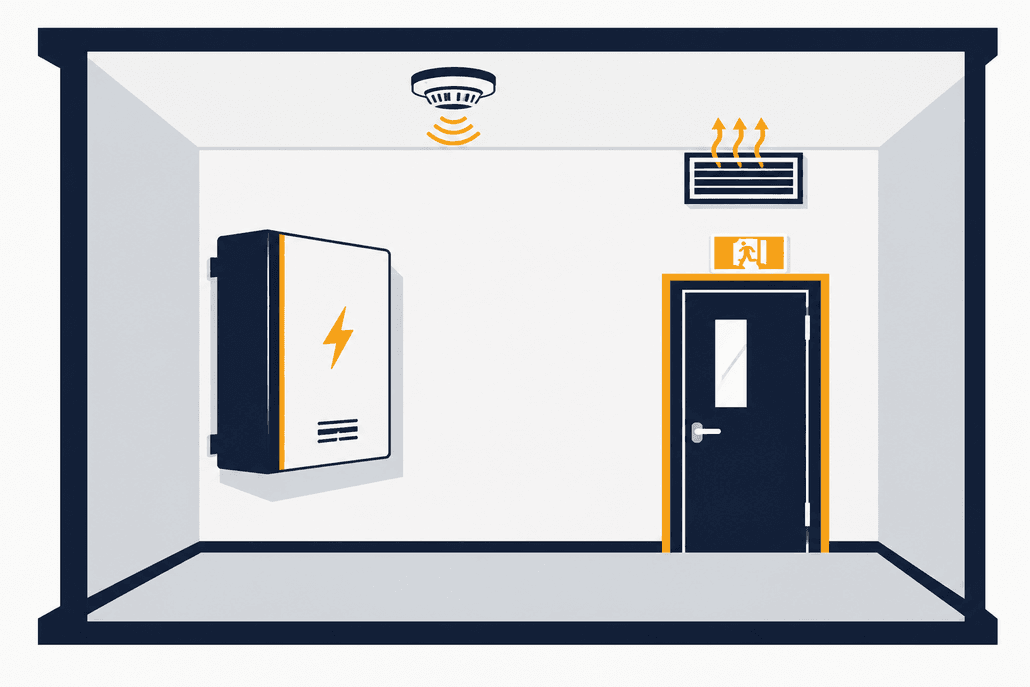
Underneath the different document names, every framework above answers the same five questions. So it’s worth designing to all five no matter which area’s paperwork sits on top.
Where Can the Unit Go?
Many frameworks impose tighter restrictions around bedrooms, escape routes, and high-occupancy areas. While garages, plant rooms, and detached structures usually face fewer limits. Because the exact restriction, and how it’s enforced, varies, check it against the locally adopted rules rather than assuming.
How Much Aggregate Capacity Is in the Room?
Several frameworks cap the sum of every unit present, not the rating of a single unit. That’s why systems added in stages sometimes fall out of compliance without anyone re-checking.
How Will an Early Fault Get Detected?
Depending on the system, occupancy, room layout, and local code, this may involve smoke detection, heat detection, battery-management-system alarms, off-gas detection, or a mix. Off-gas detection is increasingly considered for enclosed lithium-ion systems. But it isn’t a universal requirement across every area and product category.
What Fire Protection Fits This Specific Product?
This is where system-level test data, such as UL 9540A results or VDE-AR-E 2510-50 test reports, earns its keep: it can support a project-specific risk review and design choice. Instead, this avoids defaulting to the most conservative, most expensive option automatically.
Who Signs Off, and What Do They Need to See?
Whether it’s a U.S. AHJ, a UK MCS-certified installer working to PAS 63100, or a fire department talk under Japan’s Fire Service Act, every market ends the same way: the responsible authority or a qualified professional confirms project-specific compliance. No rulebook applies itself automatically.
A Practical Workflow for Meeting Indoor Battery Installation Regulations
Follow these six steps below for any indoor battery project, no matter the market.
- Identify the exact installation country, state or province, municipality, and building occupancy type. Rules can differ between neighboring areas in the same country.
- Confirm the locally adopted edition of the relevant electrical, building, and fire codes. Publication of a new standard edition doesn’t mean every area has adopted it yet.
- Confirm the product has the required system-level listing and component certifications for that specific market, not just the market where it was originally developed or tested.
- Review the manufacturer’s installation instructions, listing conditions, and any relevant UL 9540A (or equivalent) fire-test evidence referenced in the product’s certification.
- Assess aggregate installed energy, room configuration, egress proximity, ventilation, and fire-protection rules against the locally adopted rules.
- Engage the AHJ, fire authority, qualified installer, engineer, insurer, or local compliance adviser before finalizing the layout, ideally before the room gets built out, not after.
Frequently Asked Questions
A few questions about indoor battery installation regulations come up on almost every cross-border project.
Does a UL 9540-Certified Product Meet Other Countries’ Indoor Battery Installation Regulations?
No. UL 9540 shows the product meets U.S. and Canadian system-safety rules evaluated under that specific standard. But it says nothing about IEC 62619, VDE-AR-E 2510-50, PAS 63100, or GB 51048 compliance.
Cross-market projects generally need separate certification, or a documented equivalence assessment, for each target market.
Is There a Single Global Set of Indoor Battery Installation Regulations?
No, and there isn’t likely to be one soon, though IEC 62619 functions as a widely referenced cell-level standard.
Installation siting, separation, and fire-protection rules stay set nationally or sub-nationally. Each country’s own building and fire code tradition, and its adoption timeline, shapes them.
Which Country’s Indoor Battery Installation Regulations Are Strictest?
It depends on what’s being measured. Germany’s VDE-AR-E 2510-50 is often described as a very strict product-level lifecycle standard. While the UK’s PAS 63100 is unusually explicit about treating specific rooms as unsuitable. The U.S. 2026 NFPA 855 edition, where adopted, stands out too. Since it broadly expands the requirement for a documented Hazard Mitigation Analysis.
None is uniformly stricter than the others across every category. That’s because enforcement in practice depends heavily on local adoption and the responsible authority.
Further Reading
See our guide on IEC 62619 Explained for the cell-level standard several frameworks above build on. To read a manufacturer’s system-level specification sheet against these rules, see our guide on Understanding BESS Specifications. And for Australia’s full compliance stack, see our Australian battery compliance hub.