

0.25C Battery Storage vs 0.5C: Why Some Markets Favor Four Hours
0.25C battery storage usually means four hours of discharge at system level, against two hours for 0.5C. Developers increasingly choose it where revenue depends on shifting solar into the evening or meeting sustained capacity obligations.
The trend is significant but not universal. The commercial case is clearer than the safety claim. Evidence reviewed here does not show that a 0.25C rating alone makes a site safer.
This guide covers grid-scale stationary storage. It draws on the U.S. Energy Information Administration survey, California data, and Chinese tenders. Research runs through November 4, 2026.
Quick answer: Moving to 0.25C battery storage mostly means moving from two-hour to four-hour systems. Energy shifting, capacity rules, and cheaper energy-heavy designs drive it. Documented fires point to site design, controls, and emergency response. The evidence reviewed does not show that 0.25C alone lowers risk.
What Is 0.25C Battery Storage?
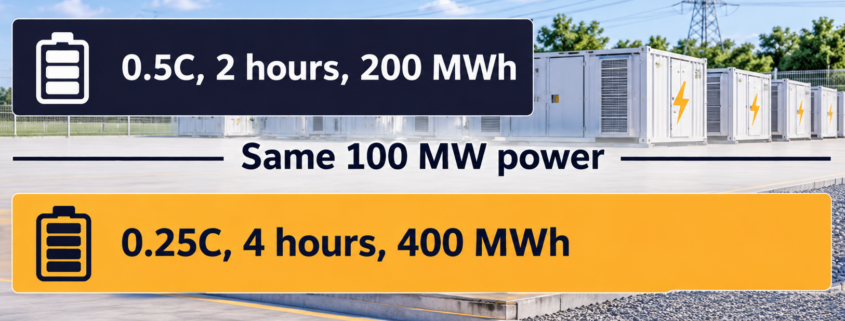
At system level, the power-to-energy ratio gives an approximate duration: 0.5C corresponds to two hours, and 0.25C to four. Our C-rate guide covers the cell-level definition.
Approximate duration (hours) = Energy capacity (MWh) ÷ Power (MW)
System-level C-rate = Power (MW) ÷ Energy capacity (MWh)
Where energy capacity is usable MWh and power is rated MW.
Energy and power ratings must use a consistent measurement basis. Cell-level C-rate and guaranteed AC delivery duration are not interchangeable.
Doubling duration creates no free energy. You must add energy capacity or cut power.
| Configuration | Rated power | Energy capacity | Duration | What changed |
| 0.5C baseline | 100 MW | 200 MWh | 2 hours | Reference case |
| 0.25C, bigger battery | 100 MW | 400 MWh | 4 hours | Twice the energy, same power |
| 0.25C, lower power | 50 MW | 200 MWh | 4 hours | Same energy, half the power |
The first path adds cost and revenue potential. The second keeps the battery but halves the MW you can sell.
Why Energy Shifting Favors Four-Hour Systems
Energy shifting drives most 0.25C battery storage decisions. Buyers want to move cheap midday energy into the evening peak.
Arbitrage Overtook Frequency Regulation
The EIA survey found that 66% of U.S. utility-scale battery capacity listed arbitrage among its uses in 2024. For 41% of capacity, arbitrage was the primary use.
Frequency regulation was primary for 24%. Before that, surveys had named it the most common use.
One caution applies: the primary-use split was similar in the 2023 survey, so the shift began before 2024.
IEA analysis shows a strong shift toward energy-shifting applications. It also shows average duration of new utility-scale batteries rising from about two hours in 2023 to three in 2025.
Why 0.25C Battery Storage Suits Evening Peaks
California shows the pattern. The market monitor’s 2025 annual report counts about 25,700 MW of batteries at the end of 2025. That covers the CAISO and Western Energy Imbalance Market footprint.
The report puts average evening discharge at a peak near 9,100 MW, up from about 5,700 MW in 2024.
Most batteries in the CAISO market have about four hours of duration. They charge when solar is abundant and discharge once solar fades.
A two-hour unit covers the steepest part of that window, while a four-hour unit covers more of it.
But extra hours pay only if prices in those hours justify them. That is a market question, not a technology rule.
Regulation Revenue Is a Thin Slice
Regulation markets are small next to battery fleets. In the CAISO balancing area, batteries with a full year of operation earned about $35/kW-year from energy in 2025. They earned $9/kW-year from regulation, per the same report.
In 2024 the split was nearly $43 and $7. Because of that, new projects have a thin base to rely on.
How Capacity Rules Shape Battery Duration
Rules, not physics, often settle 0.25C battery storage choices. Since capacity programs pay for power a battery can sustain, duration follows the rule.
How Four-Hour Accreditation Shaped California Projects
California has rated batteries by testing sustained output over four hours. The market monitor’s 2023 report said longer batteries received no extra credit.
The IEA also links California’s four-hour concentration to its resource adequacy rules.
Two Hours Earns Less Under a Four-Hour Rule
NREL describes a four-hour accreditation framework. A battery that sustains its rated power for four hours can receive full capacity credit. Extra duration does not necessarily raise that credit.
NREL also found that about 40% of new U.S. storage capacity in 2021 and 2022 was exactly four hours.
Now test a 100 MW/200 MWh battery under a four-hour rule. It can sustain only 50 MW for four hours, while a 100 MW/400 MWh battery sustains all 100 MW.
Texas shows the opposite case. SEIA reports that typical duration there is two hours, versus four in California.
The Economics of 0.25C Battery Storage
In 0.25C battery storage, four hours costs less per kWh but more per project. Both facts matter for the investment case.
Cost per kWh Falls as Duration Rises
Power-related equipment spreads over more stored energy. That equipment includes inverters, transformers, and grid-connection hardware.
Chinese data show the effect. In early 2026, CNESA put average winning bids at CNY 599.3/kWh for two-hour systems and CNY 541.3/kWh for four-hour systems.
TrendForce data for August 2026 point the same way. Two-hour awards averaged about CNY 0.75/Wh, and four-hour awards about CNY 0.60/Wh.
Lower Cost per kWh Does Not Mean Lower Project Cost
Apply the first-half 2026 averages to a 100 MW project. The table shows the result.
| Duration | Energy | Average bid | Illustrative procurement value | Cost per MW |
| 2 hours (0.5C) | 200 MWh | CNY 599.3/kWh | CNY 120 million | CNY 1.20 million |
| 4 hours (0.25C) | 400 MWh | CNY 541.3/kWh | CNY 217 million | CNY 2.17 million |
Illustration using separate reported procurement averages, not matched quotations. Differences may reflect scope, supplier mix, technical requirements, and timing as well as duration.
In this illustration, twice the energy carries about 81% more procurement value. Whether the extra hours earn that back is the key question.
For a deeper look at cost metrics, see CAPEX vs LCOS.
Chinese Tenders Buy 0.25C Battery Storage and 0.5C
Tenders show coexistence, not replacement. A 2025 framework tender from a state-owned oil and gas buyer had four sections: 0.25C, 0.5C, grid-forming 0.5C, and 1C.
In 2026, a state-owned power group’s 12 GWh tender covered both 0.5C and 0.25C systems. It also required cells of at least 314 Ah.
Another buyer’s 6 GWh procurement was 83% four-hour and 17% two-hour. Demand also varies by region.
Reports on a 2026 industry conference say that four-hour-plus projects exceed 90% in Inner Mongolia and Xinjiang. But East and Central China mainly use two-hour systems.
Policy adds a push. Since early 2026, China has had Document No. 114. It is the first national capacity-pricing rule for standalone storage.
CNESA reports that new projects averaged 2.69 hours in the first half of 2026. The IEA says the cumulative average rose from about 2.1 hours in 2021 to about 2.6 hours in 2025.
What Operating Results Show About Four-Hour Batteries
Operating fleets give better evidence on 0.25C battery storage than product launches do. California has the deepest record.
Fleet Output Rose While Revenue per kW Fell
California’s market monitor tracks annual net market revenue for batteries in the CAISO balancing area. Its battery reports show a steady decline.
| Operating year | CAISO balancing area net market revenue ($/kW-year) |
| 2022 | About 103 |
| 2023 | About 78 |
| 2024 | About 53 |
| 2025 | About 45 |
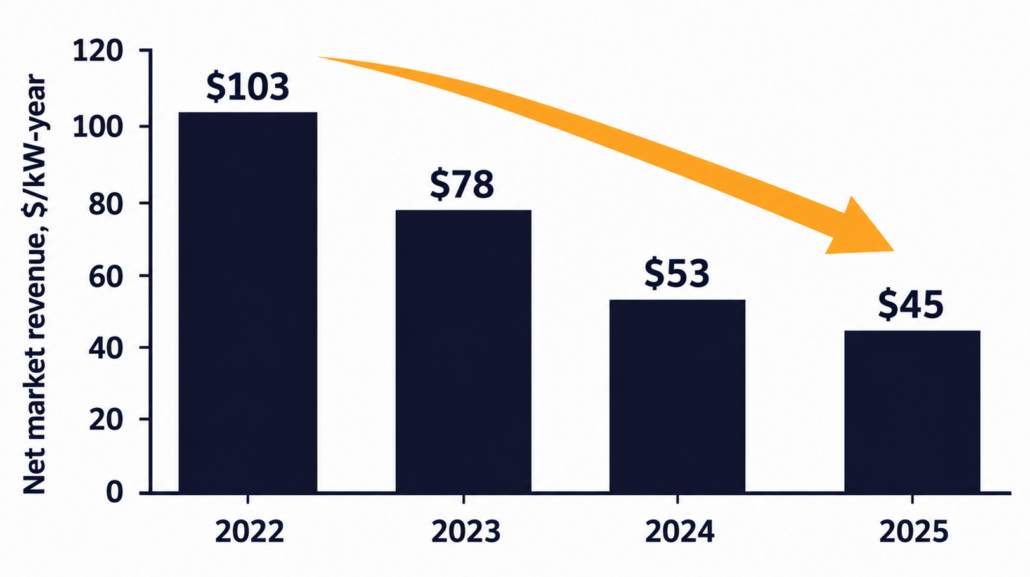
Net market revenue is not total project profit. It leaves out contracted capacity income.
The monitor tied the 2023 and 2024 drops largely to lower loads and lower peak energy prices.
Together, these results show a paradox. A growing four-hour fleet can serve the grid well, yet wholesale returns shrink.
More duration is no shield against narrower price spreads.
A Four-Hour Label Is Not Four Deliverable Hours
The 2025 annual report says batteries providing resource adequacy often lack enough charge for three or four straight peak hours.
It adds that, still, current rules give operators little reason to ensure a full charge when peak hours start.
So duration on paper is not duration in the market. Dispatch strategy matters as much as C-rate.
What Failures Reveal About 0.25C Battery Storage Safety
Fire data do not support a simple C-rate story for 0.25C battery storage. The best recent evidence is EPRI’s October 2026 failure study.
Failure Rates Have Fallen Sharply
EPRI found that failures per deployed GWh fell 98% from 2018 to 2025. In 2025 it logged 24 incidents across 634 GWh of global capacity.
EPRI rates the failure rate as comparable to large oil-filled transformers. In EPRI’s dataset, about 93% of recorded incidents involved no injuries. In the incidents captured, no member of the public experienced acute injury from a BESS arc flash, fire, or explosion.
This is a recorded thermal-incident metric, not a project-level failure probability. The dataset is not a complete census, reporting is incomplete, and each incident counts equally regardless of the damage.
The study examines site architecture, age, and chemistry. But it does not examine C-rate or duration as risk factors.
Architecture Influenced How Far Incidents Spread
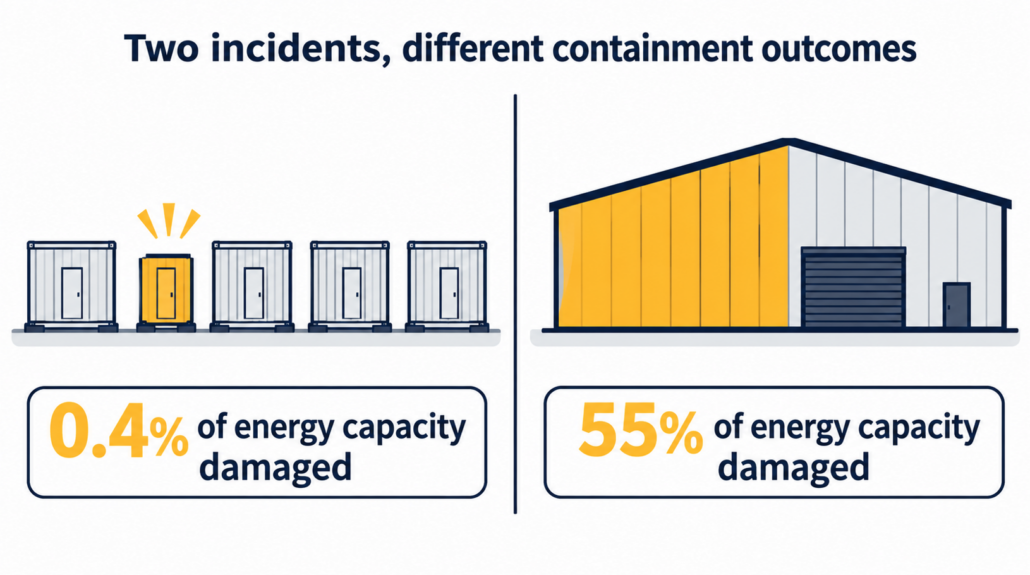
EPRI found that indoor facilities are overrepresented in failures. They also lose more capacity once an incident starts.
Compare two four-hour sites. Elkhorn (182.5 MW/730 MWh) used outdoor containers. Its 2022 fire damaged one container, about 0.4%.
Moss Landing Phase I (300 MW/1,200 MWh) sat in one indoor building. Its 2025 fire damaged about 55%.
EPRI attributes the difference in loss extent largely to architecture. These are two incidents, not a controlled comparison.
Control Failures and Accumulated Gases Created Different Hazards
The September 2021 Moss Landing event began with smoke from a failed air-handling bearing. An apparent programming error let the water-based heat suppression arm below its design smoke level.
Failed hose couplings then sprayed water onto racks. Cell temperatures were normal when the water began, but about 7% of modules suffered damage. Here a control fault, not cell overheating, started the chain.
A different hazard arose at McMicken, near Surprise, Arizona, in 2019. Flammable gas built up during thermal runaway, and four firefighters were critically injured.
EPRI notes that explosions there and in a 2024 German incident followed the opening of enclosures during response.
The 2025 Moss Landing Cause Is Unconfirmed
As of April 2026, the operator said the cause was still unknown. A California regulator says an independent investigation continues.
A further fire on September 18, 2026 prompted a shelter-in-place order, later lifted, CalMatters reports.
Until a verified cause appears, no one should blame C-rate.
Does 0.25C Battery Storage Last Longer?
Cell life is the claim most often attached to 0.25C battery storage. Yet no independent study reviewed here isolates 0.5C from 0.25C in large LFP cells.
What Cell-Aging Studies Tell Us About 0.25C Battery Storage
A Sandia study for the U.S. Department of Energy cycled LFP, NCA, and NMC 18650 cells under varied temperature, depth of discharge, and discharge rate.
LFP lifetimes ran from roughly 2,500 to 9,000 equivalent full cycles, with some values extrapolated. Within the LFP data, fade rose with temperature between 15°C and 35°C.
Discharge rate showed little clear effect from 0.5C to 2C. But 3C looked worse.
Round-trip efficiency fell as discharge rate rose. Since the cells were small 1.1 Ah cylinders, treat the result as a caution.
Manufacturer datasheets may list different cycle counts at different rates. But those figures are not a controlled comparison.
Lower Current Cuts Resistive Heat
Resistive heat in a cell scales with current squared. Take a simplified case: identical cells, the same DC voltage, twice the parallel strings, and constant total power.
Current per cell halves, so instantaneous resistive loss falls by about half. Because the discharge lasts twice as long, total loss energy is approximately unchanged.
As a share of delivered energy, however, loss falls by about half. This is not a prediction of whole-system efficiency or lifetime.
Heat still needs managing. See liquid-cooled BESS 0.5C vs 1C cycle life and C&I thermal management. For the aging effect, see temperature and degradation.
When Two-Hour Systems Still Win
The shift toward 0.25C battery storage does not make two-hour systems obsolete. Four hours is also not the final answer.
Where Two Hours Fits
In Australia’s National Electricity Market, 95% of post-2024 capacity is designed for two hours or more. Even so, average duration should rise from 1.5 hours in 2024 to 2.5 hours in 2027.
U.S. average project duration slipped to 3.08 hours in 2025 from 3.15 in 2024, per SEIA. That happened because California’s share of new builds fell.
When a discharge obligation is short, four hours is not needed. Buy the duration the contract pays for.
Where Four Hours Is Not Enough
NREL notes that summer peaks are narrow, while winter peaks can last eight hours or more.
It also expects the capacity credit of short-duration storage to decline as storage grows. That favors longer durations over time.
Moving to 0.25C extends daily shifting, but it does not solve multi-day shortfalls.
How to Choose Between 0.5C and 0.25C
Start with the revenue stack, not the C-rate. Use these five checks for 0.25C battery storage.
- Contract rules: Does the capacity program test two, four, or more hours?
- Price spreads: Do hours three and four earn enough extra revenue?
- Cost split: How much of the quote is power equipment versus cells?
- Availability: Can the dispatch plan hold a full charge before peak hours?
- Safety design: Does the site pass large-scale fire testing, and does the layout limit propagation?
For sizing logic, see peak shaving battery sizing and BESS oversizing.
Bottom Line: Choose Duration for the Revenue Stack
Evidence supports a move to 0.25C battery storage where evening energy and capacity contracts reward four hours. But the shift is not universal.
Operating data show value and limits. CAISO-area batteries now deliver large evening output, yet net market revenue fell from about $103/kW-year to $45 in three years.
Documented incidents show that architecture, propagation control, commissioning, and emergency response are important safety factors. The evidence reviewed here does not establish that a 0.25C rating independently reduces incident risk.
The right question is not whether 0.25C beats 0.5C. Instead, ask whether extra energy earns enough, stays deliverable, and justifies its cost and risk.
Frequently Asked Questions About 0.25C Battery Storage
These answers cover common questions about 0.25C battery storage.
Is 0.25C always better than 0.5C?
No. It suits four-hour duties, but two-hour duties can still favor 0.5C.
Is 0.25C battery storage safer?
The evidence does not show that. Two four-hour California sites had very different outcomes.
Does 0.25C battery storage extend cell life?
A lifetime advantage cannot be quantified from C-rate alone. The sources reviewed here do not establish a controlled 0.25C-versus-0.5C comparison for large-format stationary LFP cells.
How do I convert C-rate to duration?
Divide 1 by the C-rate. That gives 2 hours for 0.5C and 4 hours for 0.25C.
Can a 0.5C system become 0.25C?
Yes, by adding energy or cutting power. Adding cells lowers the C-rate, but cutting power cuts sellable MW. See mixed-age string design for augmentation.
Further Reading on 0.25C Battery Storage and C-Rate
These SunLith guides expand on 0.25C battery storage and C-rate choices.