

How to Prepare for a C&I BESS Quote
A C&I BESS quote is only as useful as the information behind it. In fact, a one-line request rarely supports reliable sizing or a comparable installed-price estimate.
Send your load data, tariff details, site facts, and main goal up front. Then every bidder answers the same question.
This guide covers the data, documents, and questions to prepare. Finally, it offers a request email you can copy and send.
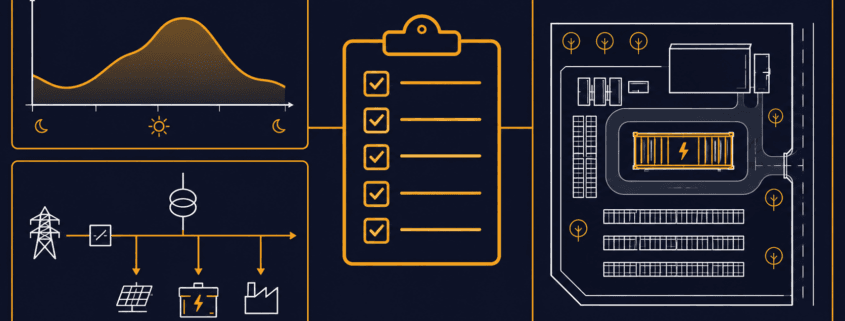
Quick Answer: To request a C&I BESS quote, state your application, site location, target operating date, and available electrical and space details. Next, add interval load data and the tariff for savings-based projects, or critical loads and backup duration for resilience. Finally, share a single-line diagram if you have one.
Why a Generic C&I BESS Quote Is Not Enough
Asking what a 1 MWh system costs does not produce a project-ready C&I BESS quote. That is because installed cost depends on far more than battery size.
- Energy duration and power rating
- The application the battery must serve
- Interconnection and controls
- Site civil work and safety systems
- Commissioning and warranty requirements
Each item changes the price. So a bare price request tells a supplier very little.
Similarly, the U.S. Department of Energy’s BESS procurement checklist shows the same idea. It gives federal agencies early-stage tasks, questions, and reference points, not just a price request.
To see how these cost drivers add up, read SunLith’s BESS CAPEX vs LCOS guide. Meanwhile, the BESS OPEX and operating cost model and Cost of Storing Energy: BESS guides cover the rest.
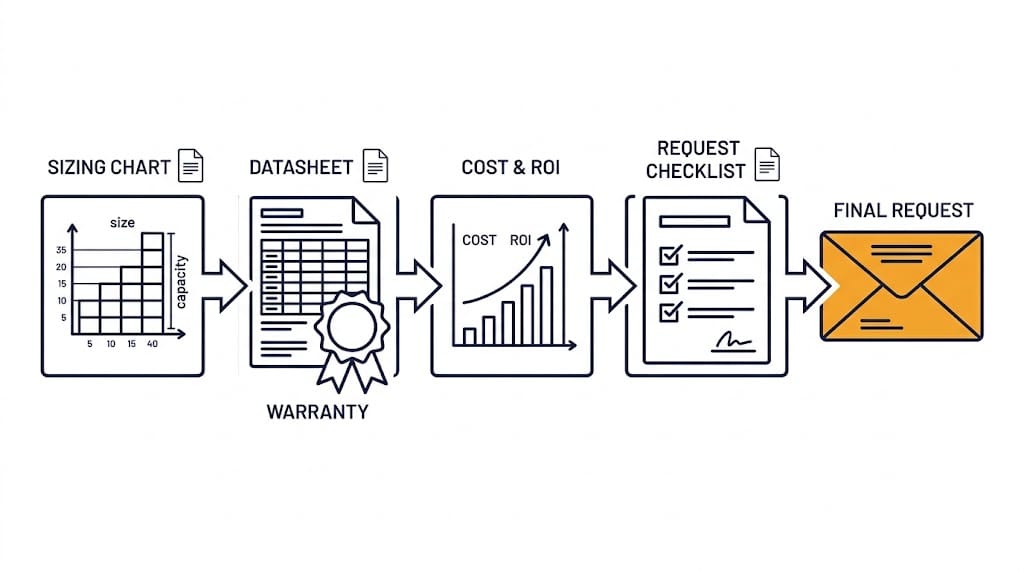
Quote preparation brings together the application, preliminary sizing, specifications, warranty requirements, and economic assumptions. However, you can refine these inputs with the supplier as the project develops.
Start Your C&I BESS Quote With the Application
Every C&I BESS quote starts with the job the battery must do. Because each job needs different data, the table below separates them.
| Primary application | Essential information |
| Peak shaving | Interval load data, tariff, target grid-import limit, demand-charge structure |
| Backup / resilience | Critical-load list, required backup duration, transfer scheme, outage history, generator interface |
| Solar self-consumption | PV system size, production data, export rules, load profile, curtailment information |
| EV charging | Charger count, charger power, utilization, transformer capacity, future expansion plan |
| Microgrid / generator replacement | Generator ratings, fuel use, load steps, operating schedule, islanding requirements |

First, pick the row that fits your main goal. Then gather everything listed beside it.
For peak shaving, follow the steps in SunLith’s peak shaving battery sizing guide. For backup, try the backup-power battery sizing calculator instead.
If you have more than one goal, rank them. Otherwise, a system tuned for one job may perform poorly at another.
Prepare the Data Behind Your C&I BESS Quote
Three groups of information shape every C&I BESS quote request. Since each group answers a different supplier question, gather all three.
Energy and Tariff Information
For peak shaving and tariff-based savings analysis, aim for at least 12 consecutive months of interval data where available.
Use the utility’s demand-measurement interval, or finer data that can be aggregated to it. Also state the timestamps, time zone, units, and whether each reading is average kW or interval kWh.
- Current utility bills
- The full tariff or rate schedule
- Demand charges, time-of-use windows, ratchets, and export compensation rules
- Existing and planned solar generation data
Electrical and Site Information
- Facility location and utility
- Main-service voltage, transformer rating, and available capacity
- Single-line diagram, where available
- Existing switchgear, protection equipment, generator, and solar-inverter details
- Proposed point of interconnection
- Site plan, access route, usable footprint, setbacks, and fire-access constraints
Operational and Commercial Information
- Main BESS use case and priority order
- Target kW reduction, backup duration, or EV-charging demand
- Typical operating schedule and seasonal changes
- Expansion plans
- Desired commercial-operation date
- Budget range, procurement route, and financing preference, if you are willing to share them
Missing a document? Send what you have. Then the supplier can list the gaps and request the rest later.
What Suppliers Should Include in Their Reply
A budgetary estimate may give an indicative configuration, price range, scope, and assumptions without detailed engineering. In contrast, a developed proposal should add a more defined layout, electrical interface, commissioning scope, and itemized exclusions.
State which stage you are requesting. Also ask suppliers to flag anything that still depends on site investigation or engineering.
A strong C&I BESS quote does more than state a price. Next, ask each bidder to cover these items.
- Proposed AC power rating, usable energy, and nominal energy
- Stated duration at rated power
- Assumed measurement boundary for capacity and efficiency
- Scope of PCS, battery, BMS, EMS, HVAC, fire-safety, enclosure, and balance-of-system equipment
- Interconnection and site-work assumptions
- Conceptual layout and electrical-interface information, where available; more detailed drawings at the developed-proposal stage
- Performance assumptions and dispatch limitations
- Warranty scope, capacity retention, throughput limit, exclusions, and remedies
- CAPEX breakdown, exclusions, O&M scope, and optional services
- Schedule, commissioning plan, and commercial assumptions
- Quote validity, currency, delivery basis, taxes or duties, payment milestones, and major price-adjustment conditions
Once bids arrive, use SunLith’s C&I BESS warranty checklist to review each warranty offer.
Because unclear terms make bids hard to compare, read SunLith’s guide to understanding BESS specifications. It explains how vendors define capacity, power, and efficiency.
Also ask how the supplier plans for capacity loss over time. Our guide to BESS augmentation planning covers that topic.
Questions to Compare Across Every C&I BESS Quote
Use these questions to put every C&I BESS quote on the same footing. Ask for written answers as well, and have important assumptions, inclusions, and exclusions written into the proposal.
Capacity and Performance Questions
- Is the energy rating nominal, usable DC, AC delivered, or measured at the point of interconnection?
- What duration does the system provide at rated power?
- Does the proposal assume one application or stacked value streams?
- How are HVAC and auxiliary loads counted in efficiency and available-energy assumptions?
Scope and Ownership Questions
- Which site upgrades, civil works, interconnection studies, permits, or fire-protection measures are excluded?
- Who owns the EMS controls, performance monitoring, and data access?
- What do commissioning, acceptance testing, training, remote monitoring, and maintenance include?
Warranty and Lifecycle Questions
- Which warranty limits apply to DoD, throughput, C-rate, SOC, temperature, and dispatch?
- What annual O&M and replacement costs are assumed?
- What must happen for capacity augmentation, and who pays for it?
Because C-rate limits often sit inside warranty terms, see BESS C-rate explained for how those limits work.
Common Mistakes When Requesting a Quote
These errors often weaken a C&I BESS quote request. If you avoid them, your bids will be easier to compare.
- Requesting price without an application: As a result, the supplier must make assumptions about the required kW, kWh, and controls.
- Sharing one monthly utility bill: Because it hides peak shape, duration, and seasonal change, sizing stays uncertain.
- Comparing nominal kWh with usable AC energy: Since the two numbers measure different things, the bids will not match.
- Ignoring tariff and demand-charge rules: When you miss them, the value of every kW you cut is unclear.
- Assuming extras are included: Unless stated, PCS, HVAC, fire protection, controls, and civil work may sit outside the price.
- Comparing warranty years alone: Instead, check throughput and operating limits as well as the term.
- Asking for a system sized for savings: Without sufficient load, tariff, and site information, savings-based sizing remains speculative.
Copy-and-Paste RFQ Email Template
Use this template to start your C&I BESS quote request. Replace each bracketed item with your own details before sending.
Subject: Request for preliminary C&I BESS assessment and budgetary quote
We are evaluating a battery energy storage system for [facility type] at [location]. Our primary objective is [peak shaving / backup / solar self-consumption / EV charging / other].
Attached are [interval load data / utility bills / tariff / single-line diagram / site plan].
Please provide a preliminary recommendation. Include proposed AC power, usable energy, expected duration, and key assumptions.
Also include required site or interconnection work, budgetary CAPEX, warranty summary, delivery schedule, and information needed for a detailed proposal.
Our target decision date is [date], and our target commercial-operation date is [date].
Send it to more than one supplier. Also use the same attachments each time.
Frequently Asked Questions About a C&I BESS Quote
When buyers prepare a C&I BESS quote request, the same questions come up often.
What data do I need for a C&I BESS quote?
Start with your application, site location, available electrical information, and target operating date. For peak shaving or tariff-based savings, include interval load data and the utility tariff.
For backup, provide critical-load requirements and the required backup duration. In addition, a single-line diagram and site plan help refine the proposal where available.
Can I get a C&I BESS quote with only one utility bill?
You may receive a budgetary estimate, but its sizing and savings assumptions will be limited. That is because one bill hides peak shape and seasonal change. Instead, interval data gives a far better basis.
Why do C&I BESS quotes differ so much?
Bids often use different definitions and scope. For example, one may quote nominal energy and another usable AC energy. Therefore, ask every bidder to state its assumptions.
Do I need a single-line diagram before I ask?
It helps, but it is not always required. If you lack one, send equipment nameplate details and photos of the main switchgear. As a result, the supplier can request more later.
Is a preliminary assessment the same as a final proposal?
No. A preliminary assessment gives budgetary figures and stated assumptions. However, a detailed proposal needs site-specific electrical, tariff, interconnection, and safety review.
Ready to Request a Preliminary Assessment?
Contact SunLith for a C&I BESS quote with your project objective, site location, and available load, tariff, and electrical information. If documents are missing, explain what you have so we can identify the next steps.
Request a Preliminary C&I BESS Assessment
SunLith can provide a preliminary assessment; final system design requires site-specific electrical, tariff, interconnection, and safety review.
Related BESS Procurement Guides
While you prepare a C&I BESS quote request, these SunLith guides support each step.
- Peak Shaving Battery Sizing — the kW and kWh method behind a peak-shaving request
- C&I BESS Sizing Calculator — preliminary outage-backup sizing, not peak shaving
- Understanding BESS Specifications — how vendors define capacity, power, and efficiency
- BESS CAPEX vs LCOS — why upfront cost and lifetime cost differ
- BESS OPEX and Operating Cost Model — the recurring costs behind every proposal
- Cost of Storing Energy: BESS LCOS Calculator Guide — how lifetime cost per kWh is calculated
- C&I BESS Warranty Guide — how to read warranty terms before you sign
- BESS Augmentation — planning for capacity loss over time