
BESS Short Circuit Protection: A Layered Approach to Preventing Fires in Grid-Scale Battery Storage
Grid-scale batteries rarely fail from one single problem. A small fault grows step by step until it becomes a fire — that is the real story behind BESS short circuit protection.
It is not one part. It is not one sensor.
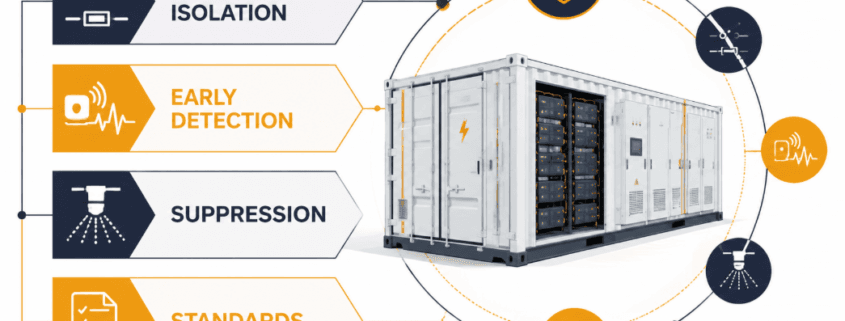
Good BESS short circuit protection is four layers working together: electrical isolation, early detection, suppression, and design standards. Miss one layer, and the rest have to work much harder to catch the fault in time.
For more on how the power conversion system contributes to fault behavior, see our guide on BESS PCS functions and features.
Quick Answer: What Is BESS Short Circuit Protection?
| Quick Answer BESS short circuit protection combines four layers. First, fast electrical isolation (fuses, contactors, gate drivers) stops a fault at the source.Second, early detection (off-gas sensors, thermal imaging, cell-level BMS) catches trouble minutes before flames appear.Third, suppression systems (venting, clean-agent, water-mist) contain what detection could not prevent.Fourth, design standards (NFPA 855, UL 9540/9540A) govern how the first three layers get specified, tested, and installed. |
Key Takeaways
| Layer | What It Does | Example Components |
|---|---|---|
| Electrical isolation | Stops the fault before it makes enough heat to ignite anything | Fuses, rack disconnects, IGBT gate drivers, propagation barriers |
| Early detection | Flags a developing problem minutes before ignition | Off-gas sensors, thermal cameras, cell-level BMS |
| Suppression | Contains what detection could not prevent | Deflagration vents, clean-agent systems, water-mist |
| Standards | Governs how every other layer is tested and installed | NFPA 855, UL 9540, UL 9540A |
Why “Short Circuit” Isn’t the Whole Story in BESS Short Circuit Protection
Most large battery fires get called short-circuit fires. But that label is a bit misleading.
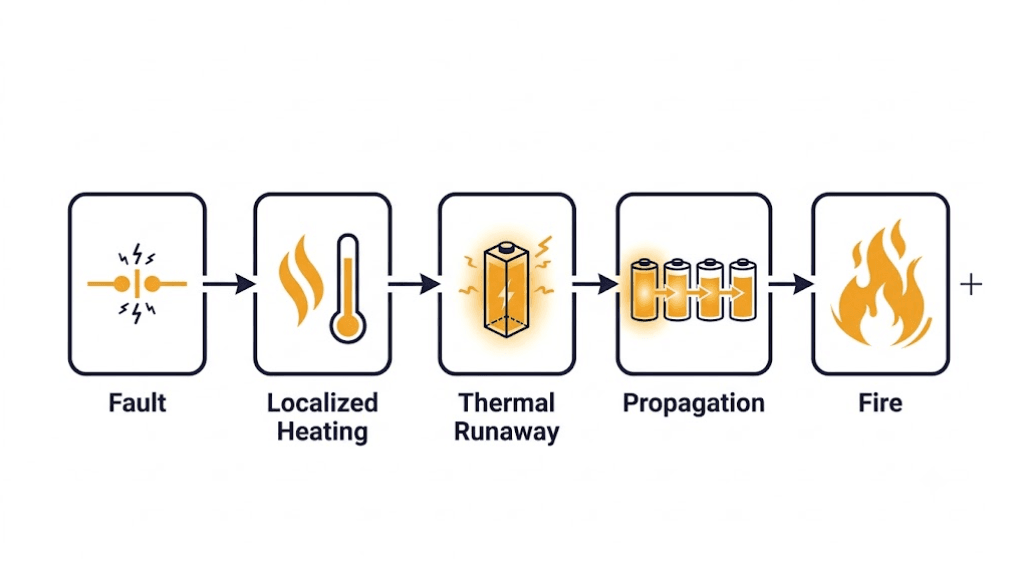
What actually happens is thermal runaway that spreads from cell to cell, like dominoes falling.
A short circuit is often the trigger, whether it comes from an internal cell defect, an external fault, or a loose connection.
Still, the real danger comes later, once heat from that one cell starts moving outward. Good BESS short circuit protection has to account for both stages, not just the initial fault.
This distinction shapes how each protective layer gets designed. For example, off-gas detection is not really a short-circuit sensor.
It is a thermal-runaway precursor sensor instead. It picks up gases vented during early cell decomposition.
Often, this happens before a short circuit or flame shows up on any other instrument.
Once you see the full chain — fault, then localized heating, then thermal runaway, then propagation, then fire — it becomes clear where each layer of BESS short circuit protection actually steps in.
Layer 1: Electrical Isolation for BESS Short Circuit Protection
The first job of electrical isolation is simple: keep a fault from ever reaching the point of ignition.
Fast-Acting Fuses and Rack-Level Disconnects
High-speed fuses at the string and pack level interrupt overcurrent fast. They act before it builds up enough localized heat to start thermal runaway.
Also, many newer systems add rack-level contactors and disconnects. As a result, a single faulted rack can be isolated without shutting down the whole container.
This cuts both fire risk and downtime at the same time.
IGBT Protection and Physical Separation
Active gate drivers watch the IGBTs (insulated-gate bipolar transistors) in the power conversion system. If overcurrent shows up, they shut the IGBTs down fast and safely.
This protects both the PCS and the battery side of the connection.
Keeping power conversion gear apart from the battery blocks matters too. A PCS-side fault tends to carry more energy, so keeping it separate makes it less likely to ignite the battery enclosure.
Cell-to-Cell Propagation Barriers
Thermally insulating materials sit between cells and modules. Mica sheets, aerogel layers, and phase-change barriers are common choices.
Even so, if one cell enters thermal runaway, these barriers slow the heat transfer. That extra time often lets detection and suppression systems do their job.
Layer 2: Early Detection Catches the Fault Before It Spreads
A detection layer only matters if it catches trouble minutes, not seconds, before ignition. This is where BESS short circuit protection depends most on speed.
Off-Gas Detection
Specialized sensors pick up gases released during early battery decomposition. Carbon monoxide, hydrogen, and various volatile organic compounds are the usual signs.
Often, this happens minutes before any smoke or measurable temperature rise. So most safety engineers treat off-gas detection as the earliest reliable warning inside a BESS enclosure.
Thermal Imaging and Smart BMS
Continuous infrared monitoring flags hot spots on busbars, connections, and power electronics. These are common origin points for electrical faults.
At the same time, a smart Battery Management System watches voltage and temperature at the individual cell level. It does not stop at the module or rack level.
That granularity lets a developing imbalance get caught and isolated before it touches neighboring cells.
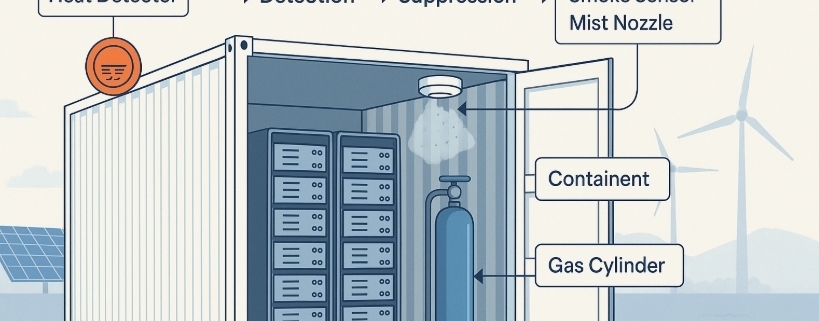
Layer 3: Fire Suppression Contains What Detection Could Not Prevent
Even strong prevention and detection will not stop every event. Suppression systems act as the last line of defense.
Also, code increasingly treats them as mandatory rather than optional.
Deflagration Venting
Explosion venting panels direct overpressure from vented battery gases safely upward. This keeps pressure away from people and nearby equipment.
As a result, pressure cannot build up inside the enclosure in the first place.
Clean-Agent Suppression Within BESS Short Circuit Protection
Clean-agent systems flood the compartment and interrupt the fire’s chemical reaction. Unlike sprinklers, they avoid water damage and electrical risk.
But not all agents work the same way. Novec 1230 is a clean gaseous agent that displaces oxygen and absorbs heat.
Stat-X, on the other hand, is a condensed aerosol that suppresses fire through a different chemical mechanism.
So the right choice depends on compartment size, ventilation design, and re-entry time requirements.
Water-Mist and Deluge Cooling
External water-mist or deluge systems usually do not stop the fire that started the event. Instead, their job is cooling adjacent containers.
This keeps the fire from jumping to the next unit. Since container-to-container spread is where the largest-scale incidents tend to originate, cooling matters as much as suppression.
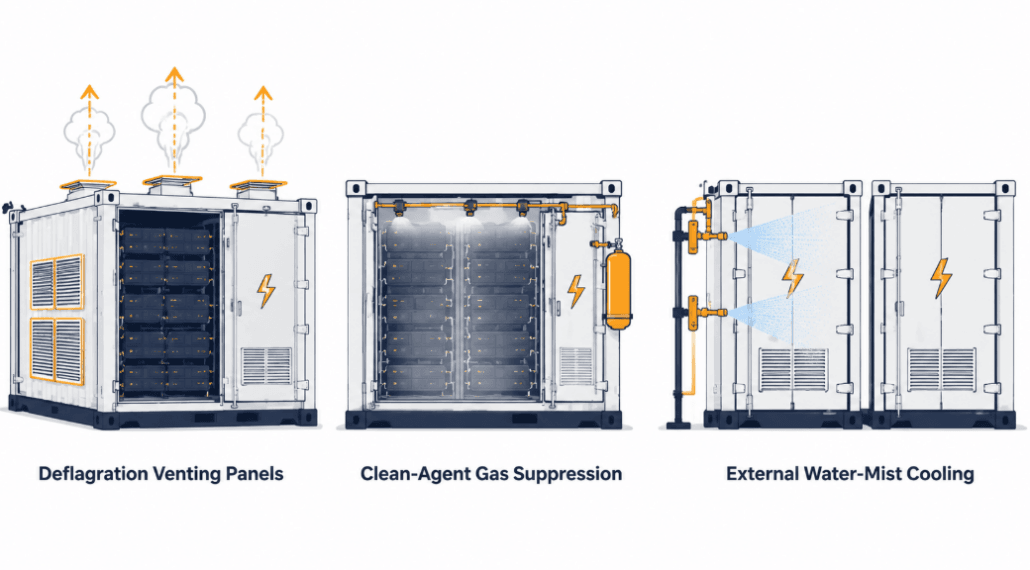
| Suppression Type | Primary Function | Best Suited For |
|---|---|---|
| Deflagration venting panels | Relieve gas overpressure safely | Preventing explosion or enclosure rupture |
| Clean-agent (Novec 1230, Stat-X) | Interrupt fire chemistry, no residue | In-compartment suppression, electronics-safe |
| Water-mist / deluge | External cooling | Preventing container-to-container propagation |
Layer 4: NFPA 855 and UL 9540A Set the Rules for BESS Short Circuit Protection
Each safety part only works as a system if it follows a recognized standard. That is where NFPA 855 and UL 9540/UL 9540A come in for BESS short circuit protection.
What NFPA 855 Covers
NFPA 855 covers siting, spacing, detection, and suppression. It also covers ventilation and emergency response planning.
One common example is the minimum 3-foot (914 mm) gap required between ESS units. This can shrink if large-scale fire testing shows a closer gap is safe.
Also, the 2023 edition made fire suppression mandatory for nearly all ESS installations.
The 2026 edition goes further still. It expands formal Hazard Mitigation Analysis to most BESS sites, not just large ones.
For the full breakdown of scope, thresholds, and the 2026 changes, see our NFPA 855 guide.
UL 9540 vs. UL 9540A in BESS Short Circuit Protection
These two standards sound alike but do different jobs. UL 9540 is a system-level product certification.
A large-scale fire test method, UL 9540A generates the propagation data regulators use to set spacing, suppression, and ventilation rules under NFPA 855. It is not a certification by itself.
For the full breakdown of how these two standards interact, and why the distinction affects permitting timelines, see our dedicated guide: UL 9540 vs UL 9540A: Understanding the Key Differences.
Emergency Response Plans
NFPA 855 also requires written emergency plans. These cover safe shutdown steps and coordination with local fire crews.
It is easy to treat this requirement as an afterthought. But it gets flagged often during AHJ review and insurance underwriting.
FAQ: BESS Short Circuit Protection
What is BESS short circuit protection?
BESS short circuit protection combines electrical isolation, early detection, and suppression. Together, they stop a short circuit fault from turning into thermal runaway and fire.
Is a short circuit the same thing as thermal runaway?
No, they are different things. A short circuit is one possible trigger for thermal runaway.
But thermal runaway itself is the underlying cascading failure. So the real fire risk in BESS short circuit protection comes from propagation between cells, not the short circuit event alone.
Is UL 9540A certification required for every BESS project?
Not exactly. UL 9540A is a test method, not a certification. So there is no such thing as being “UL 9540A listed.”
Even so, most commercial and utility-scale projects in the U.S. need UL 9540A test data. Then this data satisfies NFPA 855 and local fire code requirements for permitting.
What is the minimum spacing required between BESS units under NFPA 855?
The commonly cited baseline is 3 feet (914 mm) between individual units.
Even so, this can shrink if large-scale fire testing under UL 9540A documents that a smaller separation is safe for that specific system. Spacing is one of the simplest parts of BESS short circuit protection to verify during a site walk.
Does off-gas detection replace the need for a BMS?
No, the two serve different roles. Off-gas detection is an early warning system inside the enclosure.
It watches for thermal-runaway gases before flames show up.
A cell-level BMS, by contrast, watches voltage and temperature. So it catches a developing fault before it produces measurable off-gas at all. Together, they cover both ends of BESS short circuit protection.
Further Reading
UL 9540 vs UL 9540A: Understanding the Key Differences
UL 9540A Test Method: Complete Guide for BESS Manufacturers
Battery Management System (BMS) Explained
BESS PCS Functions and Features
Fast Frequency Response (FFR): How BESS Stabilizes Grid Frequency