
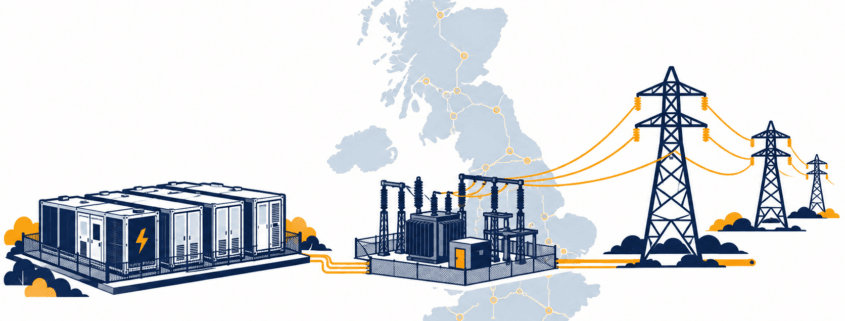

UK BESS Grid Connection: G98, G99, NESO and Grid Code Guide
A UK BESS grid connection depends on the connection voltage, export capacity, site location, network operator, and the project’s status in the connections queue. Smaller distribution-connected systems commonly follow a DNO-led Engineering Recommendation G98 or G99 process. Larger embedded and transmission-connected projects, by contrast, may need more extensive system studies, Grid Code compliance, CUSC arrangements, and a place in the reformed connections process. So a battery is never approved just because its inverter rating matches the site.
Scope note: This guide covers BESS projects connecting in Great Britain (England, Scotland, and Wales), regulated by Ofgem and coordinated by NESO. Northern Ireland operates under a separate regulatory system, as part of the Single Electricity Market with Ireland, which this guide does not cover in detail.
Quick answer: A UK BESS grid connection depends on connection voltage, export capacity, location, and where the project sits in the connections queue. Smaller, distribution-connected batteries typically go through an Engineering Recommendation G98 or G99 application with the local DNO. Larger or transmission-connected projects usually need a Bilateral Connection Agreement, Grid Code compliance, and a place in NESO’s reformed connections pipeline.
So, this guide walks through:
- How NESO, Ofgem, DNOs and Transmission Owners each fit into a BESS interconnection
- The difference between distribution-connected (G98/G99/G100) and transmission-connected pathways
- The stage-by-stage connection process, including NESO’s 2025 Connections Reform
- Grid Code requirements for Electricity Storage Modules
- UK-specific technical challenges and common project risks
UK BESS Connection Checklist
- Identify the likely point of connection and confirm distribution versus transmission voltage.
- Check whether the proposed installation falls within the applicable G98 current limit and notification conditions.
- Confirm the project’s status and expected offer window under NESO’s Connections Reform pipeline.
- Screen local network constraint and curtailment risk for the specific region.
- Confirm the applicable Grid Code Power Generating Module Type and its technical requirements.
- Ask the PCS supplier and system integrator for the model format the network operator requires, such as RMS or EMT, together with validated parameters, controller logic, and operating-mode assumptions, before finalising procurement.
- Allow schedule contingency for studies, Bilateral Connection Agreement negotiation, and commissioning.
Who Governs a UK BESS Grid Connection?
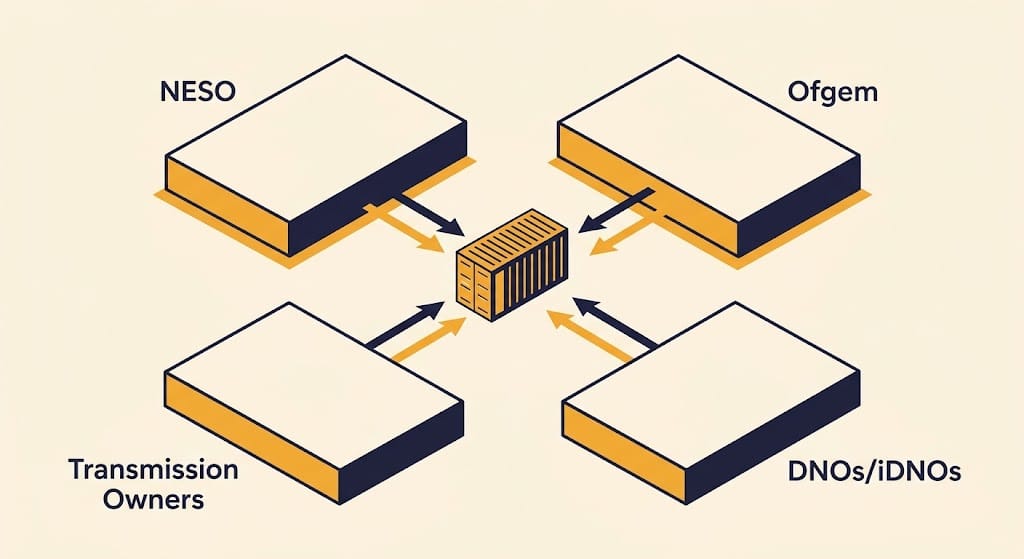
No single body runs UK BESS approval from start to finish. Instead, several organisations share the job, and the reformed connections process has changed how a few of them work together.
| Organisation | Main role for BESS projects |
| NESO | Great Britain’s electricity system operator. Coordinates the reformed transmission-connection process and works with Transmission Owners and DNOs on queue reform and connection offers. For many distribution-connected projects, the relevant DNO remains the main counterparty, not NESO directly. |
| Ofgem | Independent regulator for Great Britain. Approves code changes such as the Connections Reform modifications and regulates network company price controls. |
| Transmission Owners | Build and maintain the transmission network. Examples include National Grid Electricity Transmission (England and Wales), SP Transmission and Scottish Hydro Electric Transmission (Scotland). |
| DNOs and iDNOs | Assess and connect distribution-level projects. They process G98 and G99 applications, set local protection and export-limit conditions, and increasingly act as Distribution System Operators managing local network capacity. |
So don’t assume NESO reviews every battery project directly, and don’t assume it runs a single unified pipeline on its own. Smaller, distribution-connected batteries mostly deal with their DNO, so keep that relationship central throughout.
Current detail on each body’s role: NESO, Ofgem.
Distribution vs. Transmission: Two Paths for a UK BESS Grid Connection
One factor shapes grid approval more than any other: where the asset physically connects, and at what voltage. Distribution and transmission pathways lead to very different applications and timelines.
| Factor | Distribution-connected BESS | Transmission-connected BESS |
| Typical use case | C&I storage, community batteries, smaller grid-scale projects | Utility-scale storage, large co-located projects |
| Main counterparty | DNO or iDNO | NESO and the relevant Transmission Owner |
| Governing framework | EREC G98, G99, and G100 | Grid Code, CUSC, and a Bilateral Connection Agreement |
| Technical focus | Export limits, protection, voltage rise, anti-islanding | Power Generating Module Type, dynamic performance, system studies |
| Key risk | Local network constraint, DNO queue position | Connections Reform pipeline position, study timelines |
Project size alone doesn’t decide the pathway, though. A regional quirk matters here. In parts of Scotland, an embedded project as small as 30 MW can need a Bilateral Connection Agreement and CUSC party status. A similarly sized project in England or Wales, by contrast, may fall under the Licence Exempt Embedded Medium Power Stations arrangement instead. So confirm the specific threshold with the relevant network operator, rather than assuming a single GB-wide MW cut-off. More broadly, the categories in the table above are general planning distinctions, not universal legal classifications. A distribution-connected project can still carry Grid Code, CUSC, or transmission-system obligations depending on its configuration. So confirm the applicable route with the DNO, NESO, and the relevant Transmission Owner.
The UK BESS Grid Connection Process, Stage by Stage
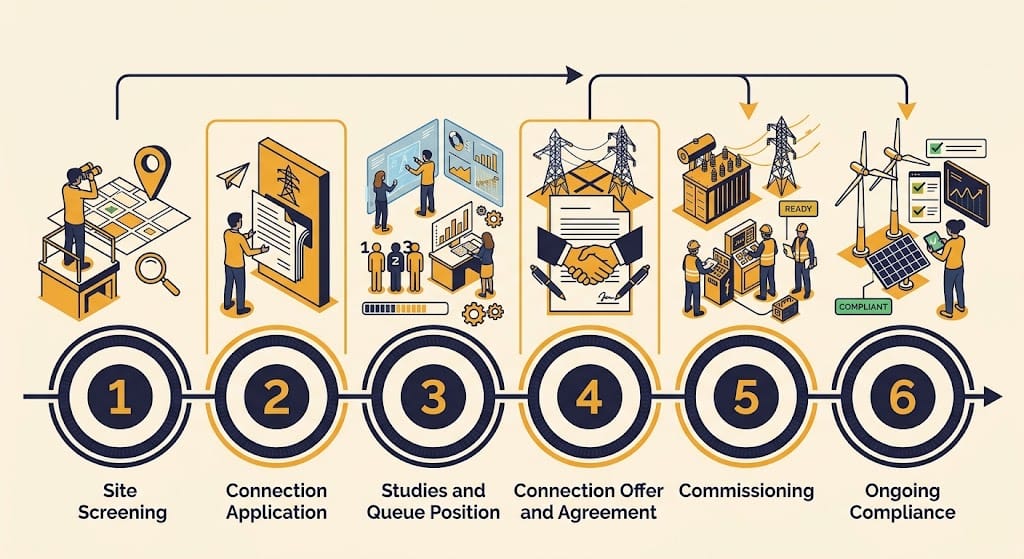
Treat the connection journey as a set of stages, not one checklist. Each stage builds on the last, and the 2025 Connections Reform changed how several of them work.
Stage 1: Site Screening and Capacity Assessment
First, check the site’s real limits before you lock in battery duration or PCS (power conversion system) rating. Review available capacity at the likely connection point. Then confirm whether the project falls within the applicable G98 current limit and notification conditions, or whether it will need a full G99 application instead. Next, assess local network constraint, since some regions are heavily congested for new BESS capacity, and a few areas have effectively closed for certain technologies.
Also map planning consent requirements and any land or grid-easement issues early. A connections queue position can take months to secure, so running planning and land work in parallel avoids a stacked delay later in the schedule.
Stage 2: Connection Application
Next, submit the applicable connection application. For distribution-connected projects, this usually means an EREC G99 application to the local DNO, identifying the proposed site, export capacity, inverter specifications, and intended operating modes. For larger or transmission-connected projects, this instead means an application to NESO. That application now sits inside the reformed Connections Reform pipeline, rather than the old first-come, first-served queue.
Stage 3: Studies and Queue Position
The network operator then sets the study scope for the project. Distribution-connected projects may need protection-coordination, voltage-rise, and export-limit studies. Larger or transmission-connected projects may also require load-flow, short-circuit, and dynamic-performance studies against the applicable Grid Code requirements.
Since 10 June 2025, eligible transmission-connected and some larger embedded projects are also assessed under NESO’s reformed connections framework, commonly known as TMO4+ (Target Model Option 4 Plus). Under this framework, a project earns a Gate 2 connection date and queue position by meeting defined readiness criteria and passing a strategic-alignment check. That replaces the old rule of holding a position by application date alone. Projects with existing agreements go through a one-off reassessment called Gate 2 to Whole Queue (G2TWQ). For small and medium embedded generators, NESO issues a Gate 1 offer to the DNO first, and the DNO takes it from there. The precise process depends on the project’s connection route, capacity, application status, and the relevant network operator. So confirm current requirements directly with NESO or the DNO, rather than assuming every project follows an identical path.
Stage 4: Connection Offer and Agreement
For distribution-connected projects, this stage produces the DNO’s response to a G98 or G99 application. Depending on the project and DNO process, that response may take the form of an acceptance, technical offer, connection offer, or approval subject to specific documentation. Either way, it sets out technical conditions and any required network reinforcement. For transmission-connected or larger embedded projects, this stage instead produces a Bilateral Connection Agreement. That agreement binds the project to the Connection and Use of System Code (CUSC) and the applicable Grid Code requirements. Offer timing now depends on the project’s phase and queue position under Connections Reform. So confirm current expectations directly with NESO or the relevant DNO, rather than relying on older published timelines.
Stage 5: Design, Construction and Commissioning
Commissioning confirms the installed plant matches the approved design. So, first, expect to provide as-built drawings and protection settings. Then witness testing and G99 or Grid Code compliance testing follow, covering protection, anti-islanding, and, where applicable, dynamic-performance verification. Commissioning evidence and updated models may also be required before the DNO or NESO issues final approval to energise.
Stage 6: Ongoing Compliance
Compliance does not stop once operation begins. Instead, changes to inverter firmware, protection settings, control-system configuration, or export limits may trigger a reassessment. So, treat compliance documentation as an ongoing operational task, not a one-off commissioning step, since it protects the connection agreement over the plant’s full operating life.
Realistic timelines vary widely by project size and location. A straightforward G98 or small G99 connection may progress in a matter of months. But a transmission-connected or large embedded project now depends heavily on its position in the reformed connections pipeline. NESO’s own December 2025 results show the queue moving in phases through 2026 and beyond. Build schedule contingency around queue position and study timelines, since both remain genuinely difficult to forecast precisely during this transition period.
Grid Code Requirements for a UK BESS Grid Connection
Grid Code requirements sit at the technical centre of any transmission-connected or large distribution-connected UK BESS grid connection. The Grid Code and associated connection-code provisions include requirements specifically relevant to Electricity Storage Modules. These interact with the applicable Power Generating Module classification, connection voltage, capacity, and operating mode.
First, the Grid Code sorts Power Generating Modules, including storage, into Types A to D. The thresholds are the same across Great Britain, and they set the technical requirements each module must meet. Then, depending on the module type and connection arrangement, a project may need to become a CUSC party. Or it may instead qualify for a licence-exempt arrangement handled mainly through the Distribution Code. Which pathway applies depends on connection voltage, project size, and sometimes regional variation. So confirm the applicable module type and compliance route directly with NESO or the relevant network operator early in development.
| Performance area | Why it matters for battery storage |
| Active-power control | The BESS must charge, discharge, and respond to dispatch instructions accurately. |
| Reactive-power capability | The plant may need to inject or absorb reactive power to support voltage. |
| Frequency response | Storage can respond fast, but the response must still match the relevant Grid Code obligations. |
| Fault ride-through | The plant may need to stay connected through defined voltage disturbances. |
| Protection | Settings must clear internal faults while avoiding unnecessary tripping for external events. |
| Dynamic performance | Validated models help confirm the plant behaves as designed under real system conditions. |
Background reading: NESO’s Guidance Notes for Electricity Storage EU Code Users.
Does Every BESS Need a Bilateral Connection Agreement?
No, not every project does. Whether a BESS needs a Bilateral Connection Agreement and CUSC party status instead depends on its connection voltage, capacity, and sometimes its specific region. The England/Wales-versus-Scotland threshold difference shows why. Smaller distribution-connected projects instead work through the relevant DNO under G98 or G99. Developers should confirm the applicable pathway during early site screening rather than rely on a single capacity threshold as a proxy.
G98, G99, and G100 for Distribution-Connected Batteries
For distribution-connected battery systems, Engineering Recommendations G98 and G99 are the core technical references, with G100 applying separately wherever export limitation is used. G98 covers connect-and-notify installations that meet specific current and equipment conditions, generally up to 16A per phase, roughly 3.68kW on a single-phase supply. Installations outside those conditions generally need a full G99 application, but the DNO should confirm the correct route for the proposed configuration rather than relying on capacity alone.
G100 applies where an export limitation scheme is used to restrict the power a site sends back to the distribution network. It is not specific to DC-coupled battery storage. A DC-coupled BESS may need to meet G98 or G99 requirements too, depending on the generating-unit and inverter configuration. And an export-limited connection normally needs a validated control scheme, metering arrangement, and fail-safe behaviour. The DNO needs to be able to rely on that behaviour if control, communications, or measurement fails. None of these Engineering Recommendations replace the DNO’s own connection agreement or local network conditions. Larger C&I or grid-scale battery projects should confirm export limits, protection requirements, and network reinforcement needs directly with the DNO. See our full BESS grid codes comparison for the country-by-country comparison, including how UK grid codes fit alongside other major markets.
Reference: ENA’s official G98/G99 forms and guidance.
Which UK BESS Connection Pathway Applies?
A quick self-check before diving into the detail below.
| Question | Likely implication |
| Is the system within the G98 current limit and notification conditions? | G98 connect-and-notify may apply |
| Is the system above those G98 limits or conditions? | A G99 assessment is likely |
| Does the project use an export limitation scheme? | G100-related requirements may apply, alongside G98 or G99 |
| Is the project transmission-connected or a large embedded project? | NESO, the Transmission Owner, CUSC, Grid Code, and BCA requirements may arise |
| Is the project in the reformed connections queue? | Gate 1 or Gate 2 status and readiness evidence may affect timing |
Technical Challenges Unique to a UK BESS Grid Connection
A few UK-specific conditions make grid approval harder here than a generic global playbook suggests. These conditions shape both design choices and realistic project timelines.
Connections Reform and Queue Position
As Stage 3 covers, readiness now matters as much as application date. NESO’s own reporting shows the pre-reform queue exceeded 700 GW, while the reformed pipeline instead prioritises a smaller, more deliverable set of projects. In practice, that means a project’s land rights, planning progress, and evidence pack can matter more to its timing than how early it applied.
See: NESO’s Connections Reform results.
Grid-forming capability: NESO has published dedicated technical guidance for grid-forming plant, including Electricity Storage Modules. In some locations, connection studies may consider whether grid-forming controls can support network stability. Grid-forming capability is not a substitute for a connection assessment, however. Its value depends on the network need, the plant’s control design, and the operating characteristics the project accepts. So treat it as one design input among several, not a fix on its own.
See: NESO’s Grid Forming Guidance Note.
Regional Network Constraint
Network capacity for new BESS varies sharply by region. Some parts of Great Britain, including areas of Scotland, face significant constraint for new storage and generation capacity. So, in practice, a site’s regional location can matter as much as its technical design for realistic connection timing.
Curtailment and Commercial Risk
A connection offer may include a formal non-firm connection, active network management, or another constraint mechanism in congested areas. These are not all the same thing. Distribution export limitations, transmission constraint costs, and scheduled or dynamic curtailment can each apply differently depending on the connection. Because of this, test your revenue model against the specific curtailment terms in your own connection offer, not a generic assumption. Do this before you finalise the business case. A conservative revenue case, built around the connection offer’s real terms, protects the project from an optimistic forecast that never eventuates.
Common Risks in a UK BESS Grid Connection
Most delays in a UK BESS grid connection trace back to a small set of repeat mistakes. So here is how to catch them early.
| Risk | Consequence | Mitigation |
| Assuming a single GB-wide MW threshold applies | Wrong compliance pathway assumed early | Confirm the applicable threshold with the specific network operator |
| Treating queue position as fixed by application date | Schedule built on outdated queue assumptions | Track readiness and Gate 2 status directly through NESO |
| Selecting a site before checking regional constraint | Unexpected non-firm terms or long delays | Screen regional network capacity early in site selection |
| Incomplete or unvalidated dynamic models | Delayed studies and commissioning rework | Require validated models from the PCS vendor and integrator |
| Treating Grid Code compliance as an afterthought | Design changes late in development | Confirm the applicable Power Generating Module Type early |
| Uncontrolled post-commissioning changes | Non-compliance or reassessment obligations | Set up formal change-control for firmware and protection settings |
Planning a BESS project in the UK? Start with a connection-readiness assessment. Cover site capacity, regional constraint, the applicable Grid Code or G98/G99 pathway, and Connections Reform queue status, before you finalise equipment specifications.
Frequently Asked Questions About a UK BESS Grid Connection
Common questions developers ask before signing a connection agreement, answered directly.
Do I need G98 or G99 for a battery storage system?
It depends on the maximum design current per phase and the connection arrangement, not just battery nameplate capacity. Systems that meet the G98 current limit and notification conditions, generally up to 16A per phase (roughly 3.68kW single-phase), can usually connect-and-notify. Systems outside those conditions generally need a full G99 application instead. The assessment timescale varies by DNO and project complexity, so treat any indicative period as a planning estimate, not a guaranteed service window.
What is NESO’s Connections Reform and how does it affect BESS projects?
Connections Reform, approved by Ofgem on 15 April 2025 and live from 10 June 2025, replaced the old first-come, first-served queue with the readiness-based TMO4+ model. Eligible projects earn a Gate 2 connection date by meeting readiness criteria and passing a strategic-alignment check, rather than by application date alone. Projects with existing agreements go through a one-off reassessment called Gate 2 to Whole Queue. The precise process still varies by connection route and network operator.
Does every large BESS project need a Bilateral Connection Agreement?
Not automatically. As the regional-threshold note above explains, it depends on connection voltage, capacity, and sometimes region. Confirm the applicable pathway with the relevant network operator during early screening, rather than assuming a fixed MW cut-off.
What is G100 and when does it apply?
G100 applies where an export limitation scheme is used to restrict how much power a site sends back to the distribution network. It is not specific to DC-coupled battery storage; a DC-coupled BESS may still need G98 or G99 separately, depending on its configuration. Confirm the applicable route with the DNO.
Does Northern Ireland follow the same rules as Great Britain?
No. Northern Ireland operates under a separate regulatory system, as part of the Single Electricity Market with Ireland, with its own versions of the equivalent engineering recommendations. This guide focuses on Great Britain.
How long does a UK BESS grid connection take?
It varies widely. A straightforward G98 or small G99 connection can take months. A transmission-connected or large embedded project now depends heavily on its position in the reformed connections pipeline, which is still moving through its phased rollout.
What is system constraint and how does it affect BESS projects?
Network constraint describes limited capacity at a given location to accept new generation or storage. In constrained areas, a connection offer may come with curtailment terms or a non-firm connection, which developers should factor into their revenue modelling.
Can a battery connect without full export capability in the UK?
Yes, in some cases. A non-export or export-limited design under G100 can simplify the connection pathway, especially for smaller distribution-connected projects. However, the project generally still needs DNO approval. It also needs a validated control scheme, metering arrangement, and fail-safe behaviour the DNO can rely on if control, communications, or measurement fails.
Glossary of Terms for This UK BESS Grid Connection Guide
Because this guide leans technical, here are the acronyms used throughout, defined in plain terms.
Organisations, Codes, and Agreements
BESS — Battery Energy Storage System — the battery, inverter, and control equipment that stores and dispatches electricity.
NESO — National Energy System Operator — Great Britain’s independent electricity system operator, responsible for coordinating the reformed transmission connections process.
Ofgem — The independent regulator for Great Britain’s gas and electricity markets, which approves code changes such as the Connections Reform modifications.
DNO — Distribution Network Operator — the regional company that owns and operates the local electricity distribution network.
iDNO — Independent Distribution Network Operator — a licensed operator of a distribution network not owned by the regional DNO, often serving a specific site or development.
TO — Transmission Owner — the company that builds and maintains the transmission network in its region, such as National Grid Electricity Transmission or SP Transmission.
CUSC — Connection and Use of System Code — the industry code governing transmission connection and use-of-system arrangements in Great Britain.
BCA — Bilateral Connection Agreement — the formal agreement binding a transmission-connected or large embedded project to CUSC and Grid Code requirements.
PGM — Power Generating Module — the Grid Code classification (Types A to D) based on connection voltage and capacity, which sets a project’s technical requirements.
ESM — Electricity Storage Module — the Grid Code and connection-code term for a battery storage installation, which interacts with the applicable PGM classification.
Connection Types and Process Terms
G98 — The Engineering Recommendation for connect-and-notify generation and storage installations that meet specific current and equipment conditions.
G99 — The Engineering Recommendation requiring DNO approval before connection, for installations that fall outside G98 conditions.
G100 — The Engineering Recommendation covering export and import limitation schemes, applicable wherever a project limits what it sends to or draws from the network.
TMO4+ — Target Model Option 4 Plus — the readiness-based connections queue model introduced under the 2025 Connections Reform.
Gate 1 — An indicative connection offer stage, typically issued to the DNO for small and medium embedded generators under the reformed process.
Gate 2 — The stage at which a project earns a confirmed connection date, point of connection, and queue position, after meeting readiness and strategic-alignment criteria.
Important: This guide is general information, so treat it that way, not as legal, engineering, or connection advice. Grid-compliance requirements vary by network operator, project design, location, and the applicable rules at the time of assessment. The UK’s connections framework is also under active reform. Confirm requirements with the relevant DNO, NESO, Ofgem where applicable, and qualified electrical, grid-connection, and legal advisers.
Further Reading on UK BESS Grid Connection
More Sunlith Energy guides on battery storage connection, interconnection, and compliance.
- BESS interconnection process (BESS Interconnection Process: From Application to Commercial Operation)
- UK and international BESS grid-code requirements (BESS Grid Codes and Compliance)
- Australia BESS grid connection process (Australia BESS Grid Connection: AEMO, TNSP and DNSP Requirements)
- PCS fault ride-through and LVRT/HVRT capability (Fault Ride-Through Features: The PCS Hardware and Control Functions Behind LVRT/HVRT Compliance)
- Voltage ride-through curves behind Grid Code compliance (LVRT and HVRT: Voltage Ride-Through for BESS and Solar)
Source
Grid Code and Connections Reform detail in this guide is grounded in NESO’s Connections Reform overview.