

Balcony Solar System: Rules, Limits, and Where It’s Legal
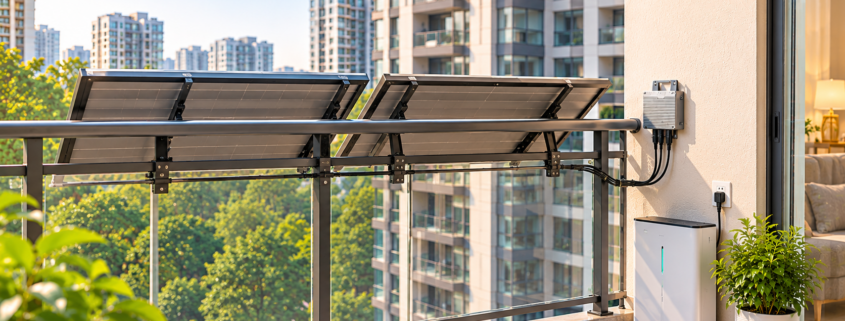
A balcony solar system gives apartment residents a small way to generate electricity without a full rooftop array. It typically combines panels, a microinverter, and a connection to the household circuit.
But permitted equipment and rules vary by location. This guide explains why the idea spread, where it is legal, what it needs, and its limits.
Quick Answer: A balcony solar system is a one- or two-panel kit with a microinverter that plugs into a household circuit. It is popular because it is affordable and renter-friendly. Germany and Great Britain both cap inverters at 800 VA. Shade, building rules, and local law limit results.
What Is a Balcony Solar System?
A balcony solar system turns sunlight into home power without a full rooftop setup. Panels attach to a railing, wall, or patio.
A typical kit has four parts:
- One or two solar panels
- A microinverter that matches the grid
- A pre-assembled cable with a plug
- A mounting frame for a railing, wall, or ground stand
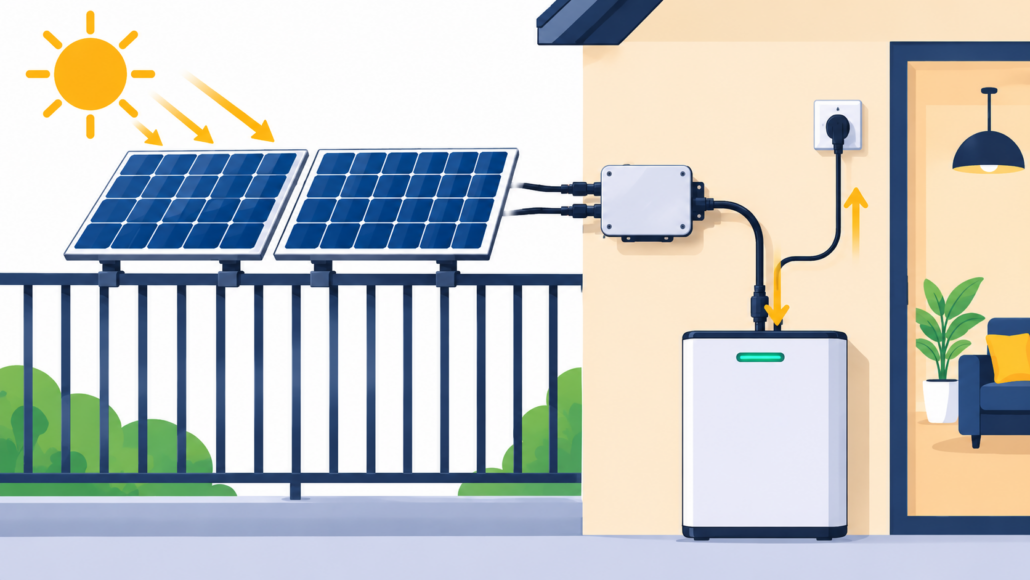
A small inverter converts the power for home use. The power flows into your home circuit first.
Your appliances use it, and then the grid covers any gap. In Germany these kits are called Balkonkraftwerke, or balcony power plants.
The inverter must also shut down if the grid fails. This safety feature protects utility workers, too.
Panel Capacity, Inverter Output, and Energy
A kit has two key ratings. Panel capacity (Wp) is the peak power of the panels.
Inverter output is the most AC power the device can deliver. Rules may state it in watts or volt-amperes, so check the unit in your local rules.
Annual energy production is a third measure. It is counted in kilowatt-hours (kWh), and it depends on sun, tilt, and shade.
Germany, for example, permits an inverter limit of 800 VA. Its dedicated standard allows 960 Wp of panels with a household plug.
A special energy plug allows 2,000 Wp. That means an “800 W system” can mean different things, so check which rating a seller means.
Why Is Balcony Solar Becoming Popular?
The balcony solar system took off because it solves four problems at once.
Low Cost and Fast Payback
First, a kit costs far less than a rooftop system. Also, you often skip installer labor and some permit fees.
But payback depends on your power price and your daytime use. High electricity prices shorten it, which is why the idea thrived in Europe.
Balcony Solar System Access for Renters
Renters rarely control the roof. A balcony kit gives them a way to generate power anyway.
Germany went further in 2024. Its reform made plug-in solar a privileged measure, which makes it hard for landlords and owner associations to block.
Simpler Rules in Some Places
Some places offer simple rules for approved plug-in kits. Whether electrical work is needed depends on several things.
These include the kit, the connection method, the wiring, and local rules. Germany, for example, needs only one free online entry.
Energy Prices and Policy Momentum
High power prices and climate goals also pushed governments to act. In April 2026, the European Commission urged member states to ease permits for small solar and storage.
Then the idea spread by example. Each new country that legalized it made the next debate easier.
Where Is the Balcony Solar System Legal and Popular?
The balcony solar system is legal in a growing list of countries, but the rules differ.
The examples below are not a complete list of countries where balcony solar is allowed. They show how differently places regulate the same basic idea.
Germany: The Global Leader
Germany is the most mature market. A 2024 reform raised the inverter limit from 600 W to 800 W and cut registration to one online entry.
In December 2025, the first dedicated product standard for these kits took effect.
The United Kingdom
Plug-in solar became legal in Great Britain on August 27, 2026. Compliant kits must be complete sets that follow the official interim product specification.
Kits are capped at 800 VA, and connection rules allow one device per household. You must also tell your network operator when you connect and disconnect.
The specification bars timber balconies and some cladding types. It also says kits are not meant for use with a battery, and Northern Ireland has separate rules.
The United States
Utah passed the first law in 2025. As of early November 2026, a legislative tracker reports ten states with signed laws. New York’s bill awaits its governor.
Most state laws cap systems near 1,200 W, and Colorado allows up to 1,920 W. Some laws start in 2027, so check your state legislature for status and dates.
Several laws also require a safety listing from an approved test lab. Colorado’s HB26-1007 and Vermont’s S.202 both do.
One consumer guide reports that no complete kit had been found to meet the required standards. Legal does not always mean you can buy a kit.
Rules summarized as of November 2026; confirm current requirements locally. Use this table as a starting point.
| Jurisdiction | Inverter Limit | Panel Limit | Registration or Notice | Status |
| Germany | 800 VA | 960 Wp with a household plug; 2,000 Wp with a special energy plug | One entry in the federal register within one month | In force; product standard published December 2025 |
| Great Britain | 800 VA (3.5 A maximum) | Up to 2,000 W of panels; professional assessment advised above 960 W | Notify the network operator of connection and disconnection; one device per household | In force since August 27, 2026 |
| United States | Varies by state; 1,200 W in most, 1,920 W in Colorado | Varies by state | Varies by state and utility | Signed laws reported in ten states; some take effect in 2027 |
How to Check Balcony Solar System Rules in Your Country
Balcony solar rules are still developing, so there is no single worldwide answer. Before you buy, check if your country or utility allows plug-in solar.
Also check which kits it permits and if you must register. Then ask whether a qualified electrician must connect or approve the system.
Most places fall into one of four categories:
| Category | What It Means | What to Do |
| Explicitly permitted | The place has a rule or utility process for plug-in solar | Follow the stated equipment, connection, and registration rules |
| Permitted under general rules | There is no dedicated plug-in law, but small grid-connected solar may be allowed | Ask the utility or a qualified electrician before connecting |
| Not clearly addressed | The rules do not mention plug-in kits | Do not connect until the utility or regulator confirms the position |
| Restricted or prohibited | The place or utility does not allow the connection | Do not install a plug-in kit without official approval |
Three examples show the range:
- Explicitly permitted (Austria): the regulator E-Control says kits up to 800 W need no grid operator approval. The operator must be told at least two weeks before start-up.
- Not clearly addressed (France): Enedis says every self-consumption installation must be declared. A May 2026 government answer says the revised wiring standard bars plugging a generator into a standard socket.
- Restricted (Hungary): a building-requirements decree in force since January 1, 2025 bars panels on balconies, according to a law-firm briefing.
Ask your regulator or local utility first. Their advice beats any general article, including this one.
Balcony Solar System Requirements: What to Check in Your Country
A balcony solar system must meet technical, legal, and site requirements, and these vary by country. Answer these questions for your location.
Technical Requirements for a Balcony Solar System
- Is a plug-in connection to a household socket permitted?
- Must the kit be certified as a complete product?
- Must the inverter meet local grid-protection and anti-islanding rules?
- Does a dedicated circuit, RCD, or GFCI protection apply?
- Are batteries, second systems, or higher-capacity kits treated differently?
For example, Germany’s standard, DIN VDE V 0126-95, sets the plug rules and the 800 VA inverter limit. The inverter must also stop feeding power when the grid drops.
Legal and Administrative Requirements
- Must a qualified electrician inspect or connect the system?
- Must you register with the grid operator?
- Is exported electricity credited, limited, or not paid for?
- Is landlord, condominium, heritage, or building approval needed?
Germany, for example, wants you to register the system within one month of start-up. In Great Britain, buy only kits that meet the interim specification, and tell your network operator.
In the US, confirm your state law and utility rules. These differ widely.
Site Requirements
You need sun, a safe mount, and a suitable outlet. Check direction, tilt, and shade together with a yield tool before you pick a spot.
Also check railing strength and wind exposure. Then confirm the outlet sits on a properly protected circuit.
Balcony Solar System Limitations
Because a balcony solar system is small, its limits matter as much as its benefits.
Limited Power Output
Where an 800 W inverter limit applies, the system is meant to offset part of household demand. It does not replace the grid connection, and it mostly offsets always-on loads such as fridges and routers.
But real output is usually lower than the label. Season, tilt, and shade all cut it, too.
Shading and Orientation Losses
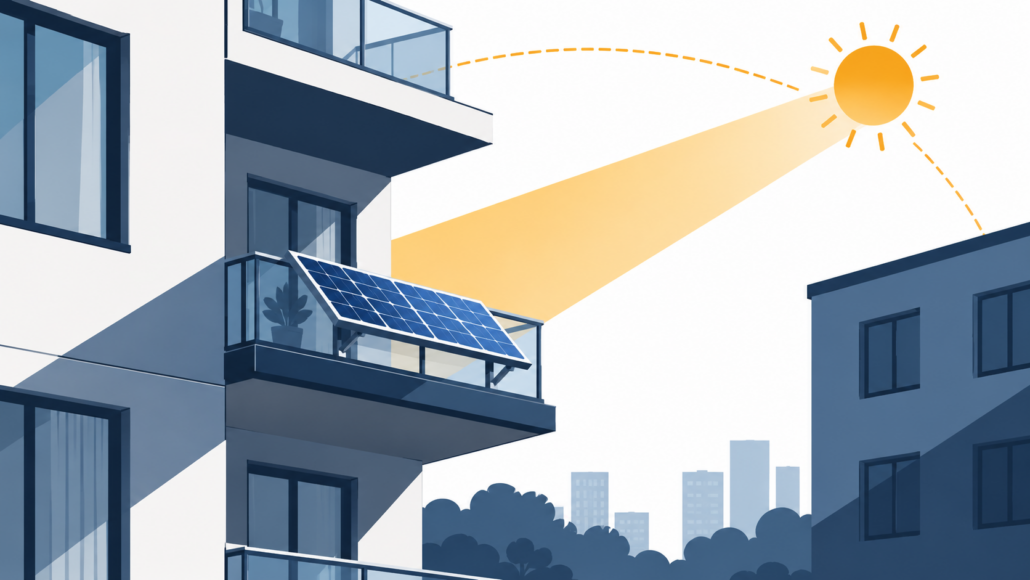
A balcony is often a poor solar site because vertical railing mounts catch less sun than tilted roof panels. Nearby buildings also add shade.
One MDPI study found that vertical self-shading between floors limits balcony panels in dense housing. Another MDPI study, however, found that east- or west-facing vertical panels can match household demand better than south-facing ones.
Self-Consumption and Export Limits
Most value comes from using the power as it is made. But under many plug-in rules, surplus power earns little or nothing.
Adding a Battery Can Change the Compliance Requirements
Simple rules often cover panels and inverters only. A battery can change which standards and approvals apply.
In Germany, the plug-in standard does not cover devices with storage, so they must meet extra requirements. In Great Britain, the specification says kits are not meant for use with a battery.
US state laws differ, so check how your state treats storage.
Building, Rental, and Safety Limits
Landlords, owner groups, and heritage rules can still shape where panels go. Also, counterfeit or uncertified kits create shock and fire risk.
In the US, dedicated plug-in standards are still developing. Since requirements shift, always confirm what your utility and state accept.
How to Estimate Balcony Solar System Output Before Buying
Rated power alone cannot predict what a balcony solar system will produce. Check these five factors first:
- The balcony’s compass direction and the panel tilt
- Shade from floors above, neighboring buildings, and railings
- The planned panel capacity
- Estimated annual generation from a balcony-specific calculator
- How much of that energy your household will use
Germany’s Federal Environment Agency points buyers to a simulator from HTW Berlin. Then use it to test your direction, tilt, and shading.
Still, treat any single published example as one case, not a typical yield. Each balcony is different.
Balcony Solar System Buying Checklist
Use this checklist to test whether a specific balcony solar system fits your home.
- Is this exact kit permitted under my local rules?
- Does its documentation name the product and grid-connection standards it meets?
- Is my planned plug and socket arrangement allowed?
- Is the mount suitable for my railing and wind exposure?
- Do I need landlord or building-association approval?
- What registration or network notice is required?
- What happens to the electricity I do not use?
- Does adding storage change the requirements?
Is a Balcony Solar System Worth It?
Payback depends on three things. These are installed cost, electricity production, and how much of that power your household uses. Start with the total installation cost, then estimate annual savings.
What Counts as System Cost
The advertised kit price may not include every cost of your installation. Check each category below, but not every project needs every item.
| Cost Category | What to Check |
| Core equipment | Whether panels, inverter, and connection cable are included |
| Mounting | Whether the supplied brackets fit your balcony |
| Electrical work | Whether the connection needs assessment or changes |
| Administration | Whether any registration or approval has a cost |
| Optional extras | Monitoring, storage, or alternative mounting |
Payback With Self-Consumption
This simple math assumes no payment for exported power and ignores ongoing costs. Use these formulas:
Annual savings = Generated kWh × Self-consumption share × Electricity price
Payback (years) = System cost ÷ Annual savings
Where generated kWh is annual output, self-consumption share is the part your home uses as it is made, and electricity price is what you pay per kWh.
Suppose a kit generates 600 kWh per year, and your home uses 70% of it as it is made. That leaves 420 kWh that replaces grid power.
At $0.30 per kWh, savings are $126 per year, with no payment for exports. A $600 installation then pays back in about 4.8 years.
These are hypothetical assumptions, not a price or output forecast. Maintenance, replacement costs, and price changes would also shift the result.
Balcony Solar System With Battery Storage
Many buyers ask whether a balcony solar system should include a battery.
A battery lets you use midday solar at night. But it adds cost and can change the compliance requirements.
A grid-linked kit with a battery is not always backup power. Check that the full system clearly supports backup use.
If you add storage, treat it as a separate project. Then look for LFP cells, certified gear, and a qualified electrician.
Final Thoughts on the Balcony Solar System
The balcony solar system works because it is simple, affordable, and open to people without a roof. Since Germany proved the model, the UK and many US states are now following it.
It will not replace a full rooftop system. But for renters and apartment owners, it is a practical first step into solar.
Frequently Asked Questions About the Balcony Solar System
These answers cover the questions we hear most about the balcony solar system.
Is a balcony solar system legal everywhere?
No, because rules vary by country and, in the US, by state. Check your local law and utility rules.
How much power can a balcony solar system produce?
Germany and Great Britain cap inverter output at 800 VA. But most US state laws cap it near 1,200 W, and daily energy depends on sun, tilt, and shade.
Can renters install plug-in solar?
Often yes, since Germany gives tenants a legal right to request one. But building rules still apply, so check your lease first.
Do I need an electrician for plug-in solar?
Not always. Some places allow approved kits without an electrician. But it depends on the kit, the wiring, and local rules.
Does a balcony solar system work during a power outage?
No. A standard grid-connected kit is not backup power, and its inverter stops feeding power when the grid fails. Do not assume a battery adds outage protection.
Does plug-in solar work in winter?
Yes, but output drops sharply because low sun and short days cut winter yield.
Further Reading
These SunLith guides also cover solar basics and storage costs that sit beside the balcony solar system topic.