

Flow-Based Market Coupling & Grid Congestion: How TSO Bottlenecks Shape BESS Dispatch in Central Europe
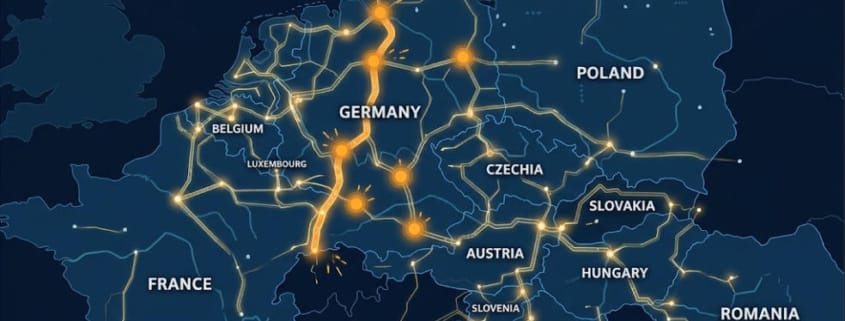
Central Europe’s power market no longer clears prices on simple, static border limits. Since June 2022, thirteen countries in the Core region have used flow-based market coupling to set day-ahead prices. This method models the physical grid, not just contract borders.
It has made transmission bottlenecks visible in a new way. Redispatch is the fix TSOs use when the market can’t physically deliver.
That fix has become one of the fastest-growing costs in European electricity bills. BESS developers need to understand how flow-based market coupling exposes congestion, and where storage can relieve it.
That understanding is now central to the investment case in Germany, Austria, and their Core-region neighbors.
| Quick Answer Flow-based market coupling is the day-ahead pricing method used across Central Europe’s Core region since June 2022. It replaces flat cross-border limits with a physics-based model of grid constraints. When those constraints near their limits, TSOs must redispatch power. Localized BESS can relieve that congestion directly. |
Key Takeaways
- Flow-based market coupling models real grid limits, called critical network elements, instead of flat cross-border caps. That is why congestion inside bidding zones, not just at borders, now drives market outcomes.
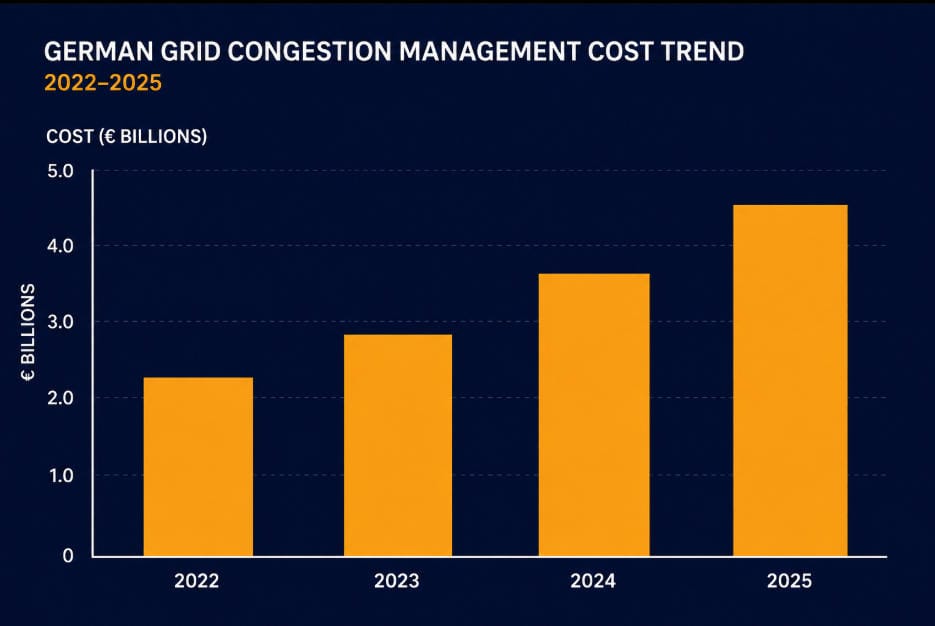
- Germany’s total grid congestion management costs have climbed sharply. They rose from about €187 million a decade ago to roughly €2.95 billion in 2024, and about €3.07 billion in 2025, per Bundesnetzagentur/SMARD data.
- Wind-heavy northern Germany and load-heavy southern Germany sit on opposite ends of a constrained corridor. The 2018 Germany-Austria bidding zone split was a direct response to the loop flows this mismatch caused across Poland, Czechia, and Slovakia.
- TSOs are now deploying transmission-connected battery storage as “storage-as-transmission-assets.” These projects are moving from pilot to rollout on the German grid, targeting the corridors with the highest redispatch volumes.
- Academic modeling shows preventive congestion management alone rarely clears as a standalone BESS business case. Revenue stacking with balancing and wholesale markets is what makes the economics work.
What Flow-Based Market Coupling Actually Does
Before 2015, most European day-ahead markets cleared against net transfer capacity, or NTC. This method set one fixed MW limit per border. It ignored what was happening elsewhere on the grid.
NTC is simple to run, but it gets the physics wrong. Electricity does not follow contract paths. It flows along the path of least resistance across a meshed AC network.
Flow-based market coupling replaces that fiction with a real physical model. It centers on critical network elements, or CNECs — the specific lines and transformers whose loading actually limits trade.
For each CNEC, TSOs calculate power transfer distribution factors against every bidding zone. Together, these form a “flow-based domain.”
The market-clearing algorithm treats this domain as its real constraint set. That replaces a string of separate bilateral limits.
The Core Capacity Calculation Region covers Germany, France, the Benelux countries, Austria, Poland, Czechia, Slovakia, Hungary, Slovenia, Croatia, and Romania.
This region went live with day-ahead flow-based market coupling on 8 June 2022. It built on a Central Western Europe pilot that had run since May 2015.
For BESS operators, the practical effect is simple. Market prices in the Core region now reflect grid physics far more closely than they did a decade ago.
But the model still can’t fully replace physical intervention. When a network element overloads after the market has cleared, someone still has to act. That gap is where redispatch, and storage, comes in.
Why TSOs Still Hit Bottlenecks Under Flow-Based Market Coupling
Germany’s grid shows the structural problem clearly. Wind generation is concentrated in the north. Turbines run offshore in the Baltic and North Seas, and onshore across the northern plains.
The largest industrial and urban load centers sit in the south and west. Conventional generation there, including nuclear, has been retired fastest.
Moving that northern power south needs corridor capacity. In many hours, that capacity simply doesn’t exist yet.
Until 2018, Germany, Austria, and Luxembourg formed one bidding zone. The market cleared huge volumes of scheduled trade between German wind and Austrian demand.
It never priced the physical constraint of actually delivering that power. Electricity that couldn’t take the direct path flowed instead through neighboring grids.
It moved through Poland, Czechia, Slovakia, and Hungary as unplanned “loop flow.” Those TSOs then had to intervene to protect their own networks.
After years of complaints to the EU’s Agency for the Cooperation of Energy Regulators, the joint zone split on 1 October 2018.
That split introduced an explicit bidding zone border and congestion management at the Germany-Austria interconnection.
Post-split research on cross-border flows found real gains. The split reduced unplanned flows across the Germany-Austria, Czech, and Slovak borders.
But Poland saw unplanned flows increase over the same period. Central Europe’s grid is interconnected enough that a fix at one border can shift pressure elsewhere.
The underlying mismatch between renewable generation and demand geography hasn’t gone away. Flow-based market coupling just makes its cost visible, instead of absorbing it silently.
The Cost of Congestion: Redispatch Spending Under Flow-Based Market Coupling
Redispatch happens after the market clears. Day-ahead and intraday trading produce a dispatch pattern that fits the flow-based domain.
But real-time conditions change: forecasts update, outages happen, grid topology shifts. A specific network element can still push toward its physical limit.
TSOs then pay generators to cut output in the oversupplied area. They pay others to raise output where the power is needed. In effect, they re-solve part of the dispatch problem after the market has already closed.
Germany’s Bundesnetzagentur tracks this spending under “Netzengpassmanagement,” or grid congestion management, and publishes the full-year figures through its SMARD platform. The total includes conventional redispatch, renewable curtailment compensation, and reserve power plant activation.
| Year | Total congestion management cost | Notes |
| ≈2014 | ≈ €187 million (est.) | Baseline implied by the roughly 15-fold increase to 2024 |
| 2022 | ≈ €4.2 billion | Energy-crisis year; sharp rise in gas-fired redispatch costs (figure not independently re-verified against a Bundesnetzagentur primary release — confirm before publish) |
| 2023 | ≈ €3.3 billion | Bundesnetzagentur/SMARD; near-record renewable curtailment |
| 2024 | €2.95 billion | Bundesnetzagentur/SMARD; 9.4 TWh curtailed (3.5% of renewable output); €554m curtailment compensation |
| 2025 | €3.07 billion | Bundesnetzagentur/SMARD; conventional redispatch €1.18bn; curtailment compensation fell 22% to €433m |
Two patterns stand out. First, the mix of costs is shifting. In 2025, conventional redispatch and reserve power plant activation — not curtailment compensation — made up the largest cost blocks.
Second, these costs track gas prices closely. TSOs often ramp gas-fired plants in southern Germany to fill the gap left by curtailed northern wind. When gas is expensive, redispatch gets expensive too.
Both patterns point the same way: relieving congestion with storage, rather than fossil generation, cuts both cost and emissions.
From Curative to Preventive: How BESS Relieves Bottlenecks Under Flow-Based Market Coupling
Conventional redispatch is a curative measure. It responds to congestion that has already appeared, close to real time.
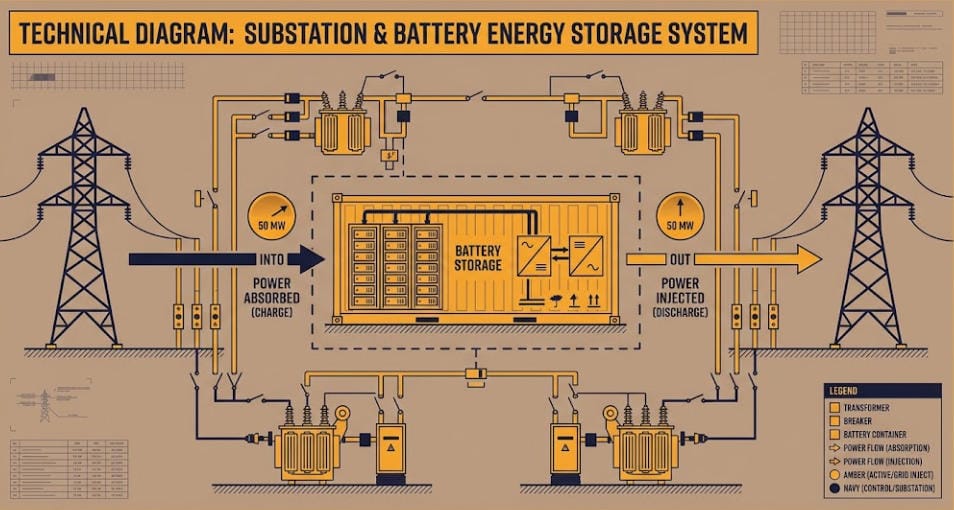
Transmission-connected battery storage adds a second option: preventive congestion management. Here, a battery sits directly on a constrained corridor.
It charges and discharges to keep power flows within limits. That happens before an intervention becomes necessary.
German TSOs have started deploying utility-scale battery storage for exactly this purpose. The concept is often called the “Grid Booster,” or storage-as-transmission-asset (SATA).
Functionally, these systems act like a virtual transmission line. A new overhead line can take years to permit and build.
A battery at a key substation works faster. It absorbs excess generation on the constrained side of a corridor.
It then injects that power back on the other side, raising the effective use of the existing transmission asset.
One 250 MW project on the southern German grid went live in 2025. A second 250 MW system, on a different corridor, has been approved for service by 2028.
Beyond congestion relief, these installations are typically specified to also provide synthetic inertia, dynamic voltage control, and contingency reserves. That stacks several transmission-support functions onto one asset.
Academic modeling is more cautious about the limits. One widely cited techno-economic analysis of grid-operator-owned BESS for the German transmission system reached a clear conclusion.
Using a battery exclusively for preventive congestion management does not, on its own, clear economically out to 2030. The capital and operating costs don’t pay back against congestion-relief value alone.
The same research found something else. Combining dynamic line rating with distributed static series compensators was, in some scenarios, more cost-effective than batteries used alone for relieving wind-driven congestion.
For developers, the practical lesson is clear. Congestion relief works best as one revenue stream among several, not the sole reason for a project.
Where Storage Delivers Most Value: Locational Economics of Congestion Relief
Flow-based market coupling prices the zone, not the node. Germany’s day-ahead market still clears at a single national price, even though the underlying grid is congested internally.
That single-price design means a battery’s locational value for congestion relief never shows up in the wholesale price signal. It only shows up in what a TSO is willing to pay.
That payment comes through a SATA contract, an innovation tender, or a flexibility procurement mechanism, tied to a specific corridor.
Siting decisions hinge on proximity to the critical network elements that recur most often in TSO congestion forecasts and Network Development Plan corridors.
That typically means the north-south transmission backbone through Lower Saxony, Thuringia, and Baden-Württemberg. It also includes interconnection points along the Germany-Austria and Germany-Poland borders.
ENTSO-E’s own market design guidance for utility-scale storage frames this as a broader question. Transmission congestion is one of several distinct system needs storage can address.
The others include renewable curtailment risk, balancing reserve requirements, and voltage stability.
But each need requires its own market signal to attract the right asset to the right location. Where that locational signal is weak or absent, storage tends to cluster wherever wholesale arbitrage is largest. That is not necessarily where the grid needs it most.
Regulatory Tailwinds: The EU Electricity Market Design Reform
The EU’s Electricity Market Design reform was published in the Official Journal on 26 June 2024. It gives Member States a formal way to close that locational gap.
TSOs and DSOs must now submit a harmonized methodology for flexibility needs assessments to ACER.
Member States whose renewable flexibility investment falls short of that assessed need can then run Non-Fossil Flexibility Support Schemes, or NFFSS. These are support payments for new storage and demand-response capacity.
They can explicitly include locational criteria. The scheme must still keep the asset exposed to normal price and market risk.
This reform matters directly for flow-based market coupling regions. A national single-price zone like Germany’s doesn’t reward a battery’s corridor-specific value on its own — a dedicated support scheme can.
For BESS developers, this creates a legitimate, EU-sanctioned route for a congestion-driven siting premium. Developers no longer need to rely solely on a bilateral SATA contract with a single TSO.
A separate 2024 study for the European Commission’s Joint Research Centre covered redispatch and congestion management. It set the analytical groundwork both the flexibility needs assessments and NFFSS design now draw on.
Grid Reinforcement vs. Redispatch vs. Battery Storage-as-Transmission-Asset
In flow-based market coupling regions, these three tools work together rather than compete. Each solves a different part of the congestion problem.
| Factor | Grid reinforcement | Conventional redispatch | BESS (storage-as-transmission-asset) |
| Typical lead time | 10–15 years (permitting, construction) | Immediate, recurring operational cost | 2–4 years (siting, procurement, grid connection) |
| Cost driver | Steel, land, permitting, right-of-way | Spread between curtailed and ramped-up generation, gas-price sensitive | CAPEX plus O&M, offset by revenue stacking |
| Reversibility | Permanent, fixed capacity | Fully reversible, but recurring every constrained hour | Redeployable; can relocate as corridor needs shift |
| Primary role | Long-term structural capacity increase | Short-term correction after market clearing | Preventive and curative; bridges the gap until reinforcement is built |
| Consumer cost exposure | Financed via grid fees over decades | Passed through annually via grid fees | Can reduce both reinforcement need and annual redispatch spend |
Designing a Congestion-Relief BESS for Flow-Based Market Coupling Regions
Projects aimed at TSO congestion relief carry a different technical profile than a standalone frequency-response or wholesale-arbitrage asset. They need to perform reliably across several duty cycles at once.
- High cycling tolerance: Preventive and curative dispatch often means frequent partial cycles, not one clean cycle per day. That favors LFP chemistry’s cycle-life margin over higher energy-density alternatives.
- Fast, bidirectional response: Curative interventions close to real time need sub-second to few-second response. That is a similar profile to FCR products, even though the revenue mechanism differs.
- Siting discipline: Value concentrates at specific substations and corridor pinch points identified in TSO Network Development Plans. Proximity to the recurring critical network element matters more than proximity to load or generation alone.
- Revenue stack design: Congestion relief alone rarely clears a standalone business case. Contracts should let the asset also join balancing markets like aFRR and mFRR, or wholesale arbitrage, when congestion relief isn’t required.
These are largely the same asset traits that already govern the balancing-reserve cluster on this site — see the existing coverage of aFRR and mFRR, the MARI platform, and FCR response requirements. A well-specified BESS is often designed to serve congestion relief and frequency products from the same hardware. Dispatch priority is then set by contract, not by design.
Frequently Asked Questions
What’s the difference between flow-based market coupling and net transfer capacity?
Net transfer capacity (NTC) sets one fixed MW limit per border, independent of conditions elsewhere on the grid. Flow-based market coupling instead models the loading of specific critical network elements across the whole region.
It lets the market clear against that physical constraint set. This generally allows more cross-zonal trade, while representing congestion more accurately.
Why did Germany’s redispatch costs rise so sharply?
The core driver is a geographic mismatch. Most new wind capacity sits in the north, while demand and retiring conventional generation are concentrated in the south.
Transmission build-out hasn’t kept pace. Rising gas prices compound the effect, since TSOs often ramp southern gas plants to replace curtailed northern wind during congestion events.
Can a BESS actually replace the need for grid reinforcement?
Not entirely. Storage-as-transmission-assets can defer or reduce the scale of reinforcement and cut annual redispatch spend on a specific corridor. But transmission planning studies generally treat storage as a complement to reinforcement, not a permanent substitute for new transmission capacity.
Is preventive congestion management alone a viable BESS business case?
Independent modeling of the German transmission system found that using a BESS exclusively for preventive congestion management does not clear economically on its own out to 2030.
Projects that also join balancing markets or wholesale arbitrage alongside congestion relief have a materially stronger case.
How does the EU’s 2024 Electricity Market Design reform affect storage investment for congestion relief?
It requires TSOs and DSOs to formally assess flexibility needs and report them to national regulators. It also lets Member States run Non-Fossil Flexibility Support Schemes with explicit locational criteria, when private investment falls short of that assessed need.
That gives regulators a more direct policy channel for siting storage where congestion is worst.
Further Reading
Frequency Restoration Reserve (FRR): aFRR and mFRR Explained
Frequency Containment Reserve (FCR) Explained
The MARI Platform: Cross-Border mFRR Balancing
Fast Frequency Response (FFR): How BESS Stabilizes Grid Frequency