

The MARI Platform: How mFRR Balancing Energy Trades Across Europe
The MARI platform is the piece of European market infrastructure that turns national mFRR reserves into one shared, cross-border pool. For a BESS asset manager, understanding how it clears bids is not optional background reading. It is the difference between a bid that earns revenue and one that never activates.
This guide goes beyond the platform basics covered in our Frequency Restoration Reserve overview, focusing on how the mechanics translate into bidding strategy for BESS asset managers.
| Quick Answer The MARI platform matches mFRR balancing energy bids across TSOs every 15 minutes. It builds a shared merit order list and clears at a marginal price per direction, but only if enough cross-border capacity exists. For asset managers, that capacity constraint often decides whether a bid clears. |
What Is the MARI Platform?
MARI stands for Manually Activated Reserves Initiative. It launched in October 2022, connecting five TSOs at first, under Article 20 of the EU’s Electricity Balancing Guideline.
The MARI platform exists to solve one problem. National mFRR markets used to clear in isolation. A shortage in one country and a surplus next door could not offset each other. MARI lets that offsetting happen automatically.
From National Markets to a Common Merit Order List
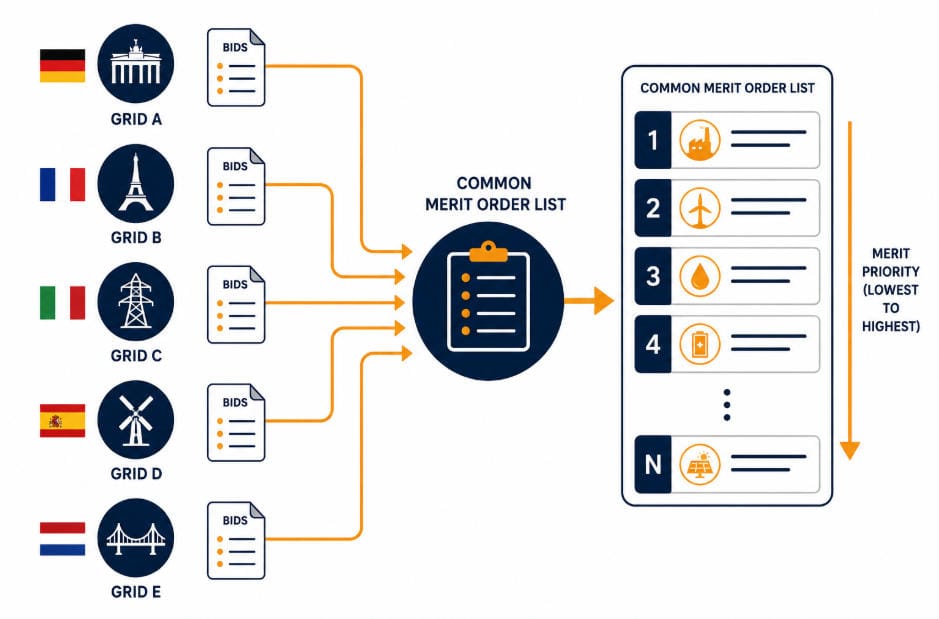
Every participating TSO submits its standard mFRR bids into a shared Common Merit Order List, or CMOL. The MARI platform rebuilds this list every 15 minutes, a period it calls a Market Time Unit.
An Activation Optimization Function then selects bids from the CMOL. Its first goal is maximizing total economic surplus. Only after that, it also tries to minimize how many cross-border exchanges the platform needs to meet demand.
How Bids Clear on the MARI Platform
Clearing on the MARI platform is not simply “lowest price wins.” Two separate conditions both have to hold.
First, the bid has to fall inside the accepted portion of the merit order. This applies for its direction and Market Time Unit specifically. Second, enough Cross Zonal Capacity has to exist on the transmission path between the bidder’s zone and the demand.
That second condition is easy to overlook. A BESS asset can offer the cheapest bid on the entire MARI platform. It can still miss clearing, simply because the interconnector between its zone and the TSO with the shortfall sits congested.
Direct vs. Scheduled Activation on the MARI Platform
The MARI platform runs two activation modes side by side. Direct activation is continuous. A pool of bids sits ready. The platform matches a TSO’s balancing need against that pool instantly, whenever it arises.
Scheduled activation, in contrast, works more like the older national mFRR process. It just runs coordinated across the shared platform now, instead of staying confined to one country. Both modes draw from the same underlying CMOL.
Marginal Pricing and Indivisible Bids
Every bid that clears on the MARI platform in a given direction earns the same marginal price. The most expensive accepted bid sets that price, not what each bidder originally offered. This pay-as-cleared structure rewards accurate cost estimation over aggressive underbidding.
Bids can also carry an indivisible tag. An indivisible bid clears entirely or not at all. For a BESS operator, a smaller, divisible bid size can sometimes clear more reliably than one large indivisible block, even at the same price.
MARI Platform Bidding Strategies for Asset Managers
Understanding the mechanics is the starting point. Turning that understanding into a bidding strategy is where the real economics live.
Balancing Markets Are Getting More Complex to Bid Into, Not Less
European balancing markets, including mFRR, are moving toward gate closures set closer to real-time delivery. Bid and price resolutions are shrinking too. That combination opens the market to more participants. It also makes correctly positioning a bid harder than it used to be.
An asset manager bidding on the MARI platform faces this trend directly. A bidding process built around slow, infrequent adjustments falls behind. Reviewing and adjusting bid levels closer to each Market Time Unit keeps pace with how the market has evolved, more than setting a static schedule days ahead ever could.
Treat Bidding and Dispatch as One Decision, Not Two
A common mistake: design a bid in isolation, then react to whatever activates. Research on value-stacking in adjacent European reserve markets, covering FCR alongside imbalance participation, points to a better approach instead. Shape the bid itself around the asset’s later dispatch flexibility, not after the fact. The same logic carries over to mFRR bidding on the MARI platform.
This matters most when a BESS stacks mFRR revenue from the MARI platform with other services. Think FCR and FRR, the products this platform sits alongside. A bid that looks optimal for mFRR in isolation can quietly eat into the state-of-charge headroom another service needs later the same day.
Consider the Cost of Capacity Withholding
Larger BESS portfolios face a different question entirely. Should the operator bid a smaller volume than what’s physically available? Doing so can influence the clearing price instead of simply accepting it. Broader research on storage bidder market power has derived formal bounds on this behavior, validated in simulations calibrated to the ISO New England market. It shows when capacity withholding still pays off, and when it turns self-defeating.
For most independent asset managers, this is more caution than strategy. A BESS large enough to move the clearing price also draws more regulatory scrutiny. Still, the underlying principle explains something real: very large storage fleets sometimes bid less aggressively than their full capacity would suggest, even outside the specific market that research examined.
Do Not Ignore Congestion Risk in Bid Placement
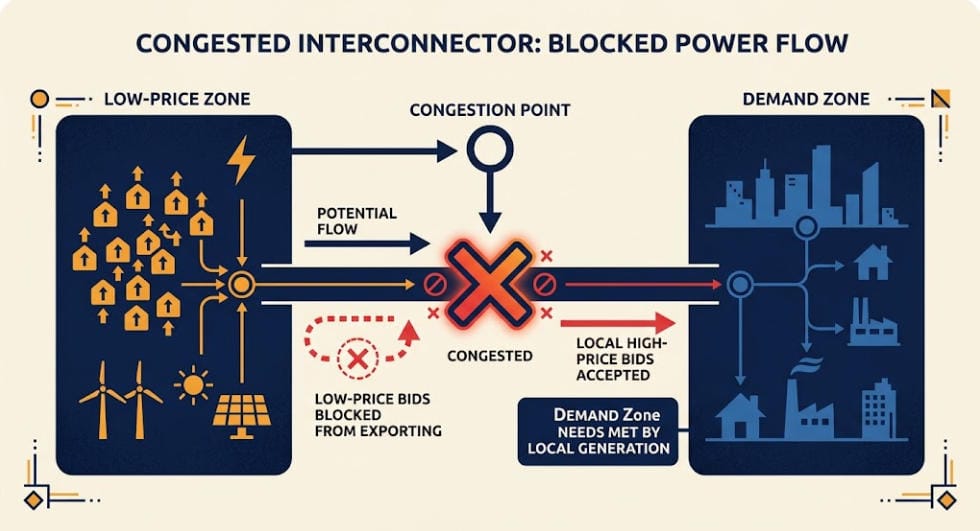
Cross Zonal Capacity gates every clearing decision on the MARI platform. Because of this, a BESS asset manager should treat interconnector congestion forecasts as seriously as price forecasts. A bid priced to win on the merit order alone can still miss clearing when the path to demand runs constrained.
Diversifying bid exposure across delivery windows helps too. Concentrating volume only in the most profitable hours raises the odds that one congestion event wipes out a day’s expected mFRR revenue.
MARI Platform vs. PICASSO
| Platform | Reserve | Activation | Pricing |
| MARI | mFRR | Manual, TSO instruction | Marginal, pay-as-cleared |
| PICASSO | aFRR | Automatic, centralized | Marginal, pay-as-cleared |
The MARI platform and PICASSO share the same underlying logic: a shared merit order and cross-border clearing. Each applies that logic to a different reserve product, with different activation timing.
FAQ
What does MARI stand for?
MARI stands for Manually Activated Reserves Initiative. It is the European platform that clears mFRR balancing energy bids across participating TSOs.
How often does the MARI platform clear bids?
The MARI platform rebuilds its Common Merit Order List and clears bids every 15 minutes. The platform defines this period as a Market Time Unit.
Why would a competitively priced bid fail to clear on the MARI platform?
Price alone is not enough. If not enough Cross Zonal Capacity exists between the bidder’s zone and the TSO with the balancing need, the bid cannot clear, no matter how competitive its price is.
Can a BESS asset manager bid into both MARI and PICASSO?
Yes. MARI handles mFRR and PICASSO handles aFRR separately. A BESS can participate in both, but sizing and state-of-charge planning need to account for both duty cycles at once.
Further Reading
Frequency Restoration Reserve (FRR)
Frequency Containment Reserve (FCR)








Trackbacks & Pingbacks
[…] the balancing-reserve cluster on this site — see the existing coverage of aFRR and mFRR, the MARI platform, and FCR response requirements. A well-specified BESS is often designed to serve congestion relief […]
[…] the full MARI platform guide for how the Common Merit Order List clears bids across borders, plus bidding strategies for BESS […]
Leave a Reply
Want to join the discussion?Feel free to contribute!