
Frequency Containment Reserve (FCR) for BESS: Sizing, Revenue & Degradation
Grid frequency must stay close to its normal value at all times. This holds true whether the source is a coal plant, a wind farm, or a battery. Frequency Containment Reserve (FCR) is the automatic response that holds this balance across all of them.
So when power supply and demand drift apart, FCR assets react within seconds. Battery energy storage systems have become top Frequency Containment Reserve providers. They respond faster than almost any other technology on the grid.
| Quick Answer Frequency Containment Reserve (FCR) is the fastest layer of grid balancing. It restores the power balance within 30 seconds of a frequency drop or spike. Batteries sense frequency locally and respond in milliseconds. Operators earn a steady payment for staying ready, whether the reserve activates or not. |
What Is Frequency Containment Reserve (FCR)?
FCR is the first line of defense against grid frequency swings. European rules define Frequency Containment Reserve as the active power reserve that contains frequency right after an imbalance hits.
FCR is also called primary reserve. In Germany, people call it Primärregelleistung.
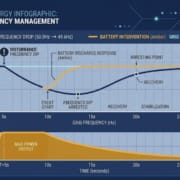
But it does not push frequency all the way back to 50 Hz. It only stops the drift. It buys time. Then, slower reserves step in and finish the job.
Primary, Secondary, and Tertiary Control
Grid operators stack three response types on top of each other. First, Frequency Containment Reserve acts, and it acts fastest of the three.
Next comes Frequency Restoration Reserve (FRR). It responds between 30 seconds and 12.5 minutes after an event. Finally, manual reserves close out the recovery over the following minutes.
Frequency Containment Reserve 30-Second Response Window
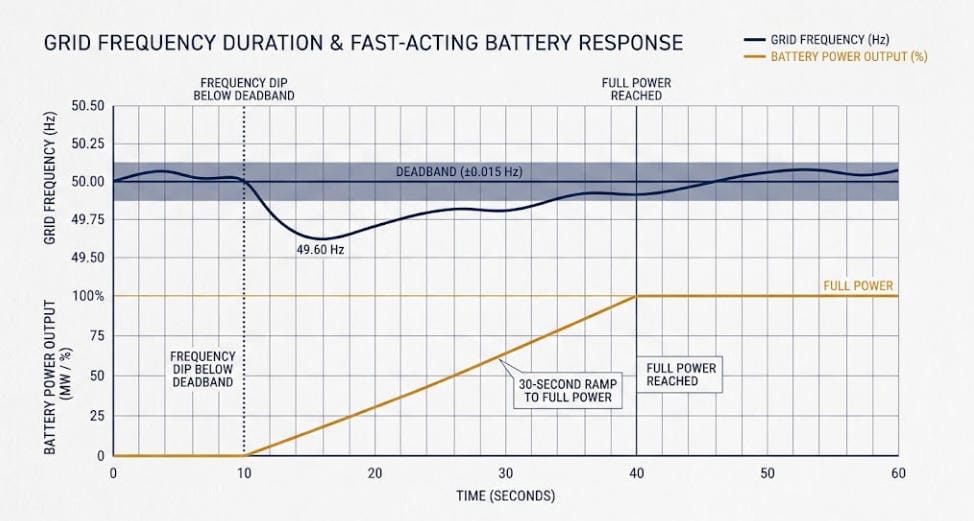
Frequency Containment Reserve assets must adjust their output based on the size of the frequency deviation. In Continental Europe, full activation kicks in once the deviation hits 200 mHz.
At that point, the asset has 30 seconds to deliver its full contracted capacity. So once activated, it must hold that output for 15 to 30 minutes, depending on the region.
Suppliers measure frequency locally, right at the point of generation or use. Because of this, the response runs on its own. No signal from the grid operator is needed first.
The Deadband
A small deadband sits around normal frequency. In the Continental Europe FCR market, this band runs from 49.99 Hz to 50.01 Hz.
Inside the deadband, no response is required. Outside it, however, providers must deliver the volume they promised.
FCR-N vs. FCR-D: The Nordic Split
Nordic countries split Frequency Containment Reserve into two separate products. FCR-N covers normal, everyday swings within about ±0.1 Hz.
FCR-D, on the other hand, covers bigger disturbances that fall outside that range. This split allows finer control across two very different event types.
So, FCR-N assets cycle often, but only shallowly. FCR-D assets sit idle most of the time. Then they respond hard during rare, larger events.
Battery duty cycles differ sharply between the two products. Because of this, the gap matters for sizing and for degradation planning.
Why Batteries Excel at Frequency Containment Reserve
Batteries hold a clear edge over generators for FCR duty. A power electronics-based asset can shift from zero to full output in milliseconds.
A generator, in contrast, needs several seconds just to change its governor setpoint. That gap matters, since FCR is a symmetric product.
Providers must move power in both directions, up and down, from the same asset. A battery handles this cleanly. It still needs a dedicated state-of-charge controller to stay ready on both sides at once.
So, FCR has become one of the strongest early revenue streams for grid-scale batteries. It often beats secondary and tertiary reserve markets on a per-megawatt basis. That is part of why so many storage developers target it first.
Market Structure and Revenue
Frequency Containment Reserve is sold as a capacity product, not an energy product. Providers get paid a set price per megawatt for the tender period.
That payment applies whether the reserve activates once, many times, or not at all. The common European group, for example, runs daily auctions for the next delivery day.
Since a 2024 reform, blocks can be sold in 30-minute chunks instead of longer windows. This shorter block length gives battery operators more scheduling freedom. So operators can now combine FCR with other revenue streams across the same day.
Prequalification Requirements
A battery cannot bid into FCR without passing prequalification tests first. The grid operator checks response speed, accuracy, and sustained delivery through a formal test sequence.
A passed test typically qualifies a unit for up to five years before retesting. The full process, however, commonly takes three to six months, from application to approval.
So, Sunlith recommends starting this process well ahead of commercial operation, because delays here push back revenue directly.
Battery Wear Under Frequency Containment Reserve Duty Cycles
FCR asks a battery to cycle constantly. The bursts are small and frequent. They track real-time frequency noise.
This pattern differs sharply from the large, planned cycles used in energy trading. Researchers describe this cycling as path-dependent: wear depends on the exact charge and discharge order, not just total energy moved.
Newer wear models built for BESS now account for FCR duty directly. They also cover peak shaving and solar profiles in the same framework.
These models weigh heat, current rate, discharge depth, and charge level together. So they no longer look at each stress factor alone.
Keeping Charge Level Balanced
An FCR asset must stay ready to respond in both directions at all times. A battery pinned near full charge, for instance, cannot absorb more energy.
A battery pinned near empty cannot deliver more power either. Either state risks a penalty from the grid operator.
So a dedicated recharge controller keeps the battery centered in its usable range. This controller balances two costs against each other. Aggressive recentering adds extra cycles of its own, so the trade-off needs care.
FCR vs. aFRR vs. mFRR
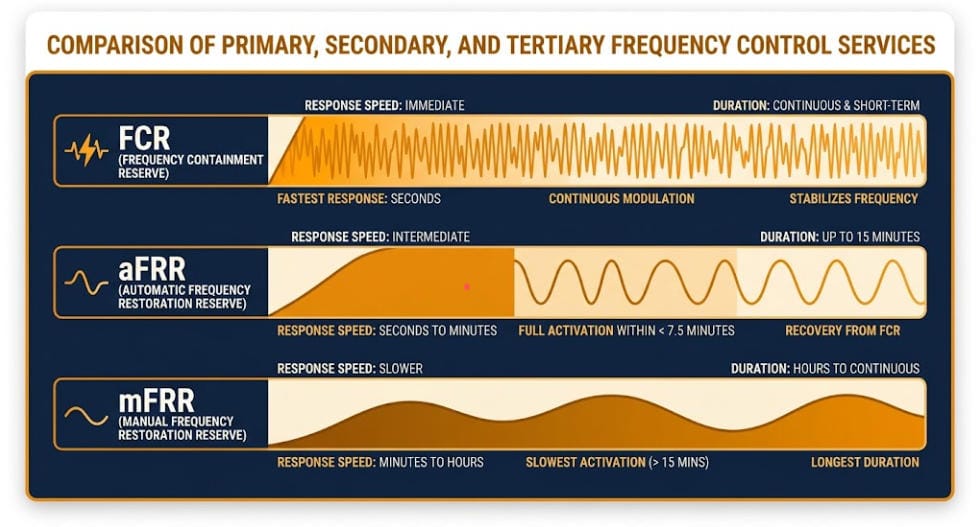
| Reserve | Response Time | Duration | Payment Type |
| FCR | Within 30 seconds | 15–30 minutes | Capacity only |
| aFRR | Seconds to minutes | Up to 15 minutes | Capacity and activation |
| mFRR | Up to 15 minutes | Longer sustained periods | Capacity and activation |
Frequency Containment Reserve asks the least of an asset in energy content. But it asks the most in speed and cycling frequency. This mix is why lithium iron phosphate batteries fit the service so well.
Sizing a Battery for Frequency Containment Reserve (FCR)
Sizing starts with headroom, not raw capacity. The system needs enough usable energy for a full-power event across the required duration.
It also needs margin for charge-level recovery between events. Power electronics matter just as much as cell chemistry here. A weak inverter design can bottleneck an otherwise well-sized battery.
The inverter and battery management system must both support fast, frequent switching. Because of this, they need extra thermal design margin, so they can do it without adding excess heat.
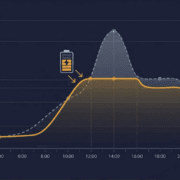
Also, pairing Frequency Containment Reserve with a second revenue stream, like energy trading, often helps. It can offset the wear from constant small cycling and improve project economics overall.
Frequency Containment Reserve (FCR) Outside Europe
Frequency response services exist well beyond the European FCR framework, even where the acronym differs. In the United States, regional grid operators like PJM and CAISO run their own fast-frequency-regulation markets with comparable speed requirements.
Australia’s FCAS framework and the UK’s Dynamic Containment product both serve the same core purpose. They ask batteries to hold grid frequency steady within seconds. Contract terms and payment structures still vary by market.
A developer targeting FCR revenue in one region should still study the local prequalification rules closely. Response-time thresholds, penalty structures, and settlement periods differ enough between markets. A design built for one grid code rarely transfers directly to another.
FAQ
What is the difference between FCR and frequency response?
FCR is one specific type of frequency response, defined under European grid codes. Other regions use different names and slightly different rules for similar fast-acting services.
How much can a BESS earn from FCR?
Revenue depends on the local capacity price and the size of the contracted block. FCR pays as a capacity product, so income tends to be steadier than pure trading revenue.
Does this service wear batteries faster than energy trading?
FCR causes many small, shallow cycles instead of fewer deep ones. The real impact depends on charge-level management and heat control, not on cycle count alone.
What size BESS is needed for FCR?
Sizing depends on the contracted capacity, the required delivery duration, and the margin needed for charge-level recovery between events.
Further Reading
Energy Arbitrage for Battery Storage






Trackbacks & Pingbacks
[…] cluster on this site — see the existing coverage of aFRR and mFRR, the MARI platform, and FCR response requirements. A well-specified BESS is often designed to serve congestion relief and […]
[…] (FCR) acts first, within 30 seconds. It only stops a deviation from growing worse — see our full Frequency Containment Reserve (FCR) guide for how that first layer works. FRR follows, and actually restores the […]
Leave a Reply
Want to join the discussion?Feel free to contribute!