
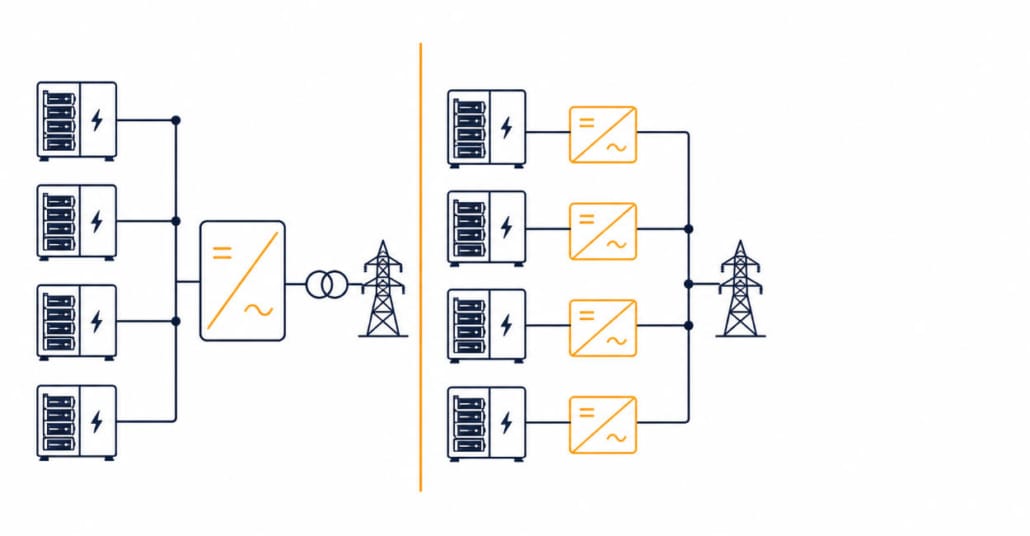
String vs. Centralized BESS: PCS Topology Compared
Every BESS project faces the same early choice: string vs centralized BESS design for the PCS. This one choice sets fault behavior, efficiency, and long-term cost.
Both designs store energy in the same LFP racks. So what changes? Just how the PCS wires up. Still, that single choice shapes the whole project.
| Quick Answer In a string vs centralized BESS comparison, string BESS gives each battery cluster its own PCS. A fault stays isolated. Each cluster also runs closer to peak efficiency.Centralized BESS uses one large PCS for the whole array. It costs less per kW. But it risks taking the entire block offline if that one unit fails.Utility-scale, cost-driven projects often pick centralized PCS. C&I and uptime-critical sites often pick string PCS instead. |
What Is PCS Topology in a BESS?
The PCS is the bidirectional inverter in a BESS. It turns battery DC power into grid AC power. Then it also flips AC back to DC during charging.
PCS topology just means two things. First, how many PCS units a project uses. Second, how each one wires into the battery racks. Two topologies lead the market: centralized and string.
A modular hybrid approach also exists. It borrows a bit from both sides of the string vs centralized BESS divide.
What Is Centralized BESS?
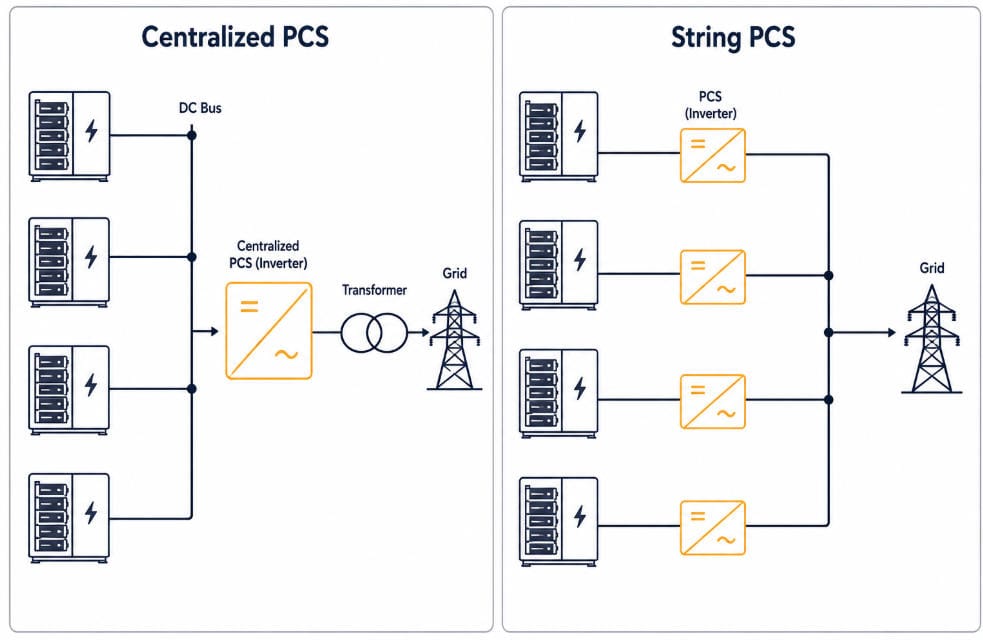
Centralized BESS is a battery storage design that routes every battery cluster through one large, shared PCS. So one or a few big inverters handle the whole array’s power conversion.
Think of it as a single hub. All the DC power flows to one point before it turns into grid-ready AC power. That hub is efficient to build, but it is also a single point of failure.
What Is String BESS?
String BESS is a battery storage design that gives each battery cluster its own dedicated PCS. So there is no shared hub. Every cluster converts its own power independently.
Picture a set of parallel lanes instead of one funnel. Each lane runs on its own, so one blocked lane never stops traffic in the others. That is the core idea behind a string vs centralized BESS layout.
How Centralized PCS Architecture Works
A centralized design uses one or a few large inverters for the whole array. Every cluster feeds a shared DC bus. Then that bus feeds a single converter.
Picture a typical utility-scale block. It might pair four 2.5 MW inverters with a 10 MW, 40 MWh array. Each inverter connects to one medium-voltage transformer.
Modern central PCS units handle 1 MW to 10 MW per inverter. Peak conversion efficiency is high — commonly in the high-90s percent range. But weighted-average efficiency at real-world load is what actually matters for revenue, and it always runs lower than the peak number.
Centralized PCS Advantages
- Lower cost per kW once a project reaches utility scale
- Fewer transformers, combiner boxes, and cable runs
- Simpler control setup, since fewer units need coordination
Centralized PCS Trade-offs
- A single fault can take the whole battery block offline until repair
- Efficiency drops at partial load, and most systems run below full output most of the time
- A larger footprint per unit complicates transport and crane access
How String PCS Architecture Works
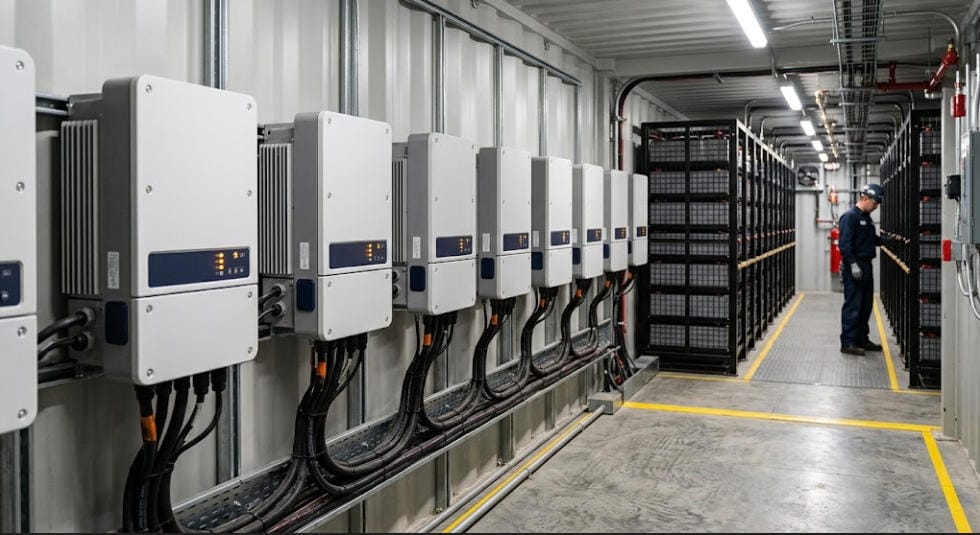
String architecture gives each battery cluster its own dedicated PCS. Each cluster’s DC output goes straight to its own converter. So it never touches a shared bus.
Compact C&I string units run far smaller than their utility-scale counterparts. Utility-scale string units run larger — and they keep growing.
In 2025, a 400 kW+ string PCS module reached the utility-scale market, built for large containerized deployments, according to ESS News. That single data point shows how far string PCS has moved past its old C&I-only reputation.
Since each string works on its own, one unit can shut down for maintenance. Meanwhile, the rest of the array keeps running without a hiccup.
String PCS Advantages
- Fault isolation — a failed unit only affects its own cluster
- Better partial-load performance across clusters with uneven aging or temperature
- Easier phased expansion, since a project can add capacity string by string
String PCS Trade-offs
- More total units to install, wire, and monitor
- Slightly higher balance-of-plant cost in most designs
- More interconnection points, which adds commissioning time
Centralized BESS: Features and Functions
In the string vs centralized BESS split, a centralized PCS handles the same core job as any inverter.
See our BESS PCS Functions and Features guide for the full list. But a centralized design delivers those functions from one shared unit, not many.
- DC-to-AC and AC-to-DC conversion for the entire array, from a single converter
- One grid-forming or grid-following control loop governs the whole block
- Protection functions — over-voltage, over-current, short-circuit — apply at one point, covering every cluster behind it
- Reactive power and power factor control dispatched from a single, larger unit
- One data and monitoring point, which simplifies SCADA integration
This concentration is exactly what makes centralized PCS cost-efficient. It is also exactly what makes a single fault so costly.
String BESS: Features and Functions
On the string side of the string vs centralized BESS split, the PCS performs the same core functions.
See our BESS PCS Functions and Features guide for the full list. The difference is that every cluster gets its own copy of them.
- DC-to-AC and AC-to-DC conversion happens per cluster, not once for the whole array
- Each unit runs its own grid-forming or grid-following control loop, independent of the others
- Protection functions trip at the cluster level, so a fault never reaches healthy strings
- Reactive power dispatch is finer-grained — each string can be commanded separately
- Monitoring is far more granular, since every cluster reports its own data
That granularity is the trade for a higher unit count. More data, more control points, and more independence — at the cost of more hardware to manage.
How Functions Differ Between String and Centralized BESS
Both topologies run the same core PCS functions. The string vs centralized BESS split is about where those functions live, and how finely they’re applied.
| Function | Centralized PCS | String PCS |
|---|---|---|
| Control loop | One loop for the whole array | One independent loop per cluster |
| Protection scope | Trips can affect the whole block | Trips stay isolated to one cluster |
| Reactive power dispatch | Coarse — set at the array level | Fine — set per cluster |
| Monitoring granularity | Array-level data | Cluster-level data |
| SCADA complexity | Simpler — fewer points to poll | More complex — more points to poll |
String vs Centralized BESS: Key Differences
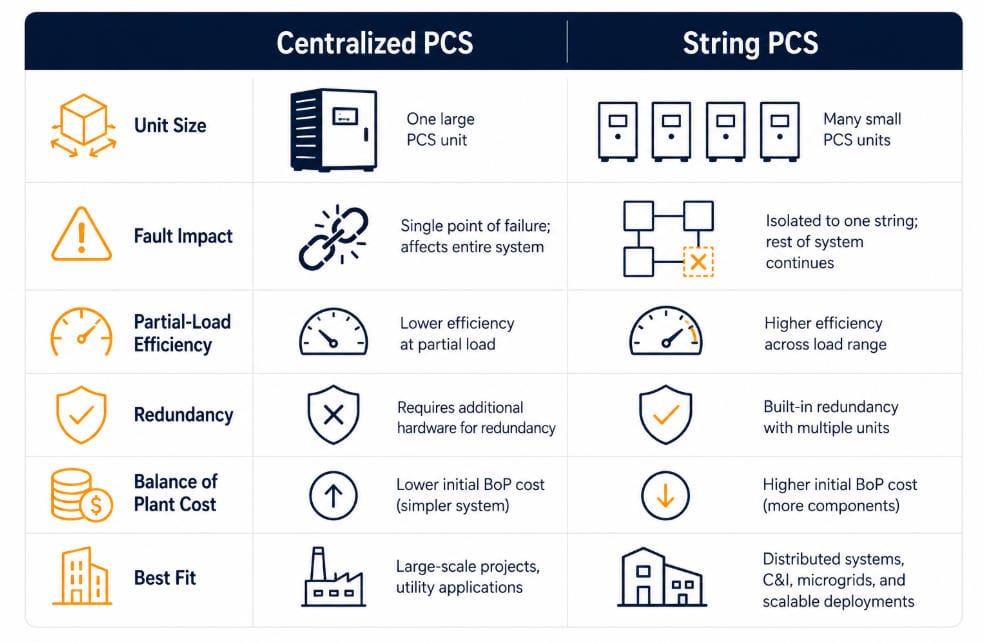
The table below lines up the string vs centralized BESS choice against the factors that matter most for planning.
| Factor | Centralized PCS | String PCS |
|---|---|---|
| Typical unit size | 1–10 MW per inverter | Well under 1 MW per unit |
| Fault impact | Can affect the entire block | Isolated to one cluster |
| Partial-load efficiency | Lower at reduced output | Higher across varying loads |
| Redundancy | Needs spare or N+1 units | Built in through unit count |
| Balance-of-plant cost | Lower per kW at scale | Higher per kW, more units |
| Best fit | Large, uniform utility-scale sites | C&I and uptime-critical sites |
Redundancy and Fault Isolation in String vs Centralized BESS
In a centralized design, one PCS fault removes the whole block from service. Then the other clusters sit idle, since they all share the same converter.
A string design isolates that same fault to one cluster. So the rest of the array keeps charging or discharging without a break.
This isn’t just a vendor talking point. Sandia National Laboratories’ Energy Storage Handbook, Chapter 13 describes the same trade-off in modular, multi-converter PCS designs. If one converter or storage unit must be taken offline, the rest of the system keeps operating. It runs at reduced capacity, but it doesn’t stop entirely.
This gap matters most for revenue-critical work. Once a system goes offline, frequency-response contracts, backup deals, and peak-shaving windows all carry a real cost.
Efficiency and Partial-Load Performance
Peak efficiency between the two topologies is often close. Neither has a dramatic edge at full output.
But the real gap shows up at partial load. Most BESS assets spend most of their life below full output, not at it.
String units track their own cluster’s charge and temperature. So each one runs nearer its own peak efficiency point.
Distributed control also helps on sites with uneven cluster aging. A 2025 study on two-string BESS balancing, published on arXiv, tested independent, balanced control of separate battery strings. Versus a coupled baseline, it improved inverter efficiency by about 1.5 percentage points and derating efficiency by about 2 points.
Cost and O&M Considerations
Centralized PCS lowers upfront cost per kW. Fewer, larger units mean fewer transformers, less cabling, and fewer combiner and interconnection points — all balance-of-plant items that add up fast in a string design.
String PCS raises the unit count. Then that adds wiring, monitoring points, and commissioning time.
Still, field maintenance is often simpler per event. A technician can swap one unit without derating the rest of the array.
Yet neither cost profile holds everywhere. Site labor rates, transformer lead times, and financing terms all shift the real-world number in a string vs centralized BESS budget.
Which Architecture Fits Your String vs Centralized BESS Decision?
The right choice depends on scale and uptime needs, not on price alone. First, weigh how much a fault would actually cost you.
| Project Type | Typical Choice | Why |
|---|---|---|
| Utility-scale, uniform site | Centralized | Lower cost per kW; simpler design outweighs the redundancy gap |
| C&I or frequency-response asset | String | Fault isolation and better partial-load performance protect revenue |
| Mixed shading or phased buildout | String | Independent cluster control captures a documented efficiency gain |
| Cost-constrained, fault-tolerant site | Centralized + N+1 spare | Keeps the low-cost benefit while covering the single-point-of-failure risk |
Best PCS Choice by Project Type
The table above covers the general split. But real projects fall into more specific categories. Here’s how the string vs centralized BESS call plays out in practice.
- Utility-scale solar-plus-storage (50+ MWh): Go centralized. Site conditions are usually uniform. So the cost savings outweigh the fault-isolation gap. Add N+1 spares if the offtake contract penalizes downtime.
- C&I behind-the-meter (500 kWh–5 MWh): Go string. These sites often run at partial load most of the day. So a single fault taking out the whole system is a bigger business risk at this scale.
- Frequency response and ancillary services: Go string. Revenue depends on being online and dispatchable. Losing the whole asset to one fault can mean a contract penalty, not just lost output.
- Microgrids and islanded sites: Go string. Grid-forming duties often split across multiple units for redundancy. So an islanded site can keep forming voltage even if one string trips.
- Data center backup power: Go string, or a hybrid layout. Uptime requirements are strict. Cluster-level fault isolation matches the redundancy philosophy data centers already use elsewhere.
- Phased or multi-year buildouts: Go string. Capacity can be added string by string as budget grows. That avoids resizing a large central inverter up front.
- Cost-constrained utility projects with firm redundancy needs: Go centralized, but budget for N+1 spare units. This keeps the lower cost-per-kW while covering the single-point-of-failure risk.
String vs Centralized BESS: Key Takeaways
| Key Takeaway |
| 1. Centralized PCS uses fewer, larger inverters and costs less per kW at utility scale. |
| 2. String PCS gives each cluster its own inverter, isolating faults and improving partial-load efficiency. |
| 3. Peak efficiency is similar between the two — the real gap shows up at partial load and during faults. |
| 4. String designs suit C&I, uptime-critical, and uneven sites; centralized designs suit large, uniform utility-scale projects. |
| 5. An N+1 centralized design can add redundancy without a full switch to string architecture. |
Frequently Asked Questions About String vs Centralized BESS
What is the main difference in a string vs centralized BESS comparison?
Centralized BESS routes every battery cluster through one large PCS. String BESS gives each cluster its own smaller PCS instead. So faults and performance stay isolated per cluster.
Is string PCS more efficient than centralized PCS?
At full load, the two are close. But at partial load, where most systems run most of the time, string PCS usually wins. Since each unit tracks its own cluster’s condition.
Which topology costs less?
Centralized PCS usually costs less per kW upfront. This comes mainly from fewer transformers and simpler cabling. Still, string PCS can offset that gap over time through easier fault isolation.
Can a BESS use both string and centralized PCS?
Yes. Some projects use a modular hybrid layout instead. This groups several clusters per mid-sized PCS. It splits the difference between cost and fault isolation.
Does PCS topology affect fire and safety compliance?
Topology does not change NFPA 855 compliance directly. But faster fault isolation in a string design can support the hazard mitigation analysis a project needs for permitting.
Summing up the string vs centralized BESS choice
Once you know your uptime needs, the string vs centralized BESS decision gets simpler. Start with fault cost, then let scale and budget settle the rest.
Further Reading
For a broader look at how the PCS fits alongside the BMS and EMS, see BESS PCS Functions and Features.
For the full range of PCS specifications, including efficiency and grid-forming vs. grid-following control, see Understanding BESS Specifications.
For fire and life-safety requirements that intersect with PCS layout, see the NFPA 855 Guide.
For how project scale shapes the rest of the electrical design, see C&I vs. Utility-Scale Solar and BESS.
For how millisecond-scale power demand affects PCS sizing, the AI Data Center Energy Storage





Trackbacks & Pingbacks
[…] String vs. Centralized BESS […]
Leave a Reply
Want to join the discussion?Feel free to contribute!