
Frequency Restoration Reserve (FRR): aFRR, mFRR, and How BESS Fit In
Grid frequency does not stay balanced on its own once primary reserve acts. Frequency Restoration Reserve (FRR) is the next layer that finishes the job, restoring frequency rather than just holding a line.
FRR is the collective term for two related services, aFRR and mFRR. Together, they bring frequency all the way back to its target value. They do more than just stop the drift.
| Quick Answer Frequency Restoration Reserve (FRR) restores grid frequency after primary reserve contains a deviation. It covers two products: aFRR activates automatically within about 5 minutes. mFRR activates manually within about 12.5 minutes. Both pay a capacity fee for standing ready, plus an energy fee when dispatched. |
What Is Frequency Restoration Reserve (FRR)?
FRR sits second in the grid balancing stack, right after primary reserve. Primary reserve only halts a frequency drift. Frequency Restoration Reserve pushes frequency the rest of the way back to 50 Hz.
FRR splits into two distinct products. Automatic FRR, or aFRR, is also called secondary reserve. Manual FRR, or mFRR, is also called tertiary reserve.
Each product differs mainly in what triggers it, not in its overall goal. Both aim to restore frequency and free up primary reserve for the next event.
FRR vs. FCR: Where It Sits in the Reserve Stack
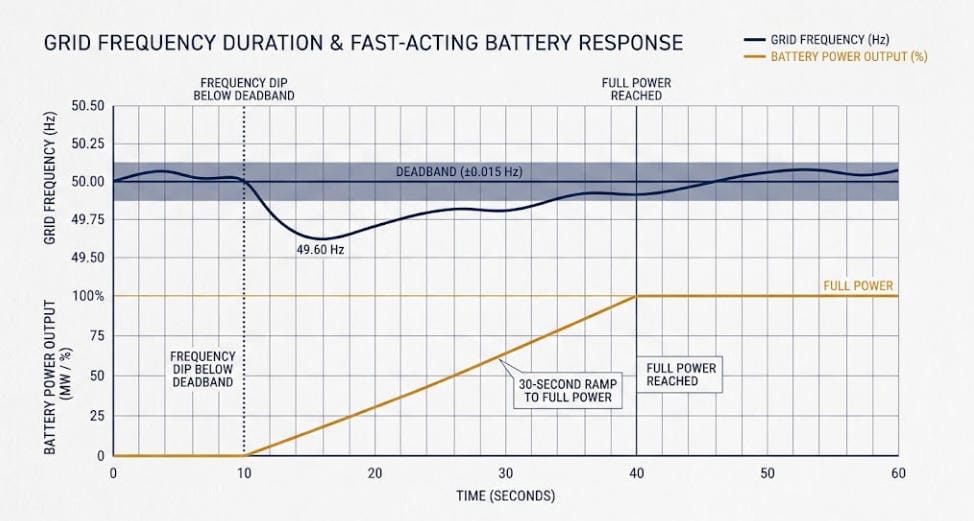
Frequency Containment Reserve (FCR) acts first, within 30 seconds. It only stops a deviation from growing worse — see our full Frequency Containment Reserve (FCR) guide for how that first layer works. FRR follows, and actually restores the frequency.
Think of FCR as an emergency brake. Frequency Restoration Reserve is the driver correcting course afterward, over the following minutes. Neither product works well without the other.
aFRR: Automatic Frequency Restoration Reserve
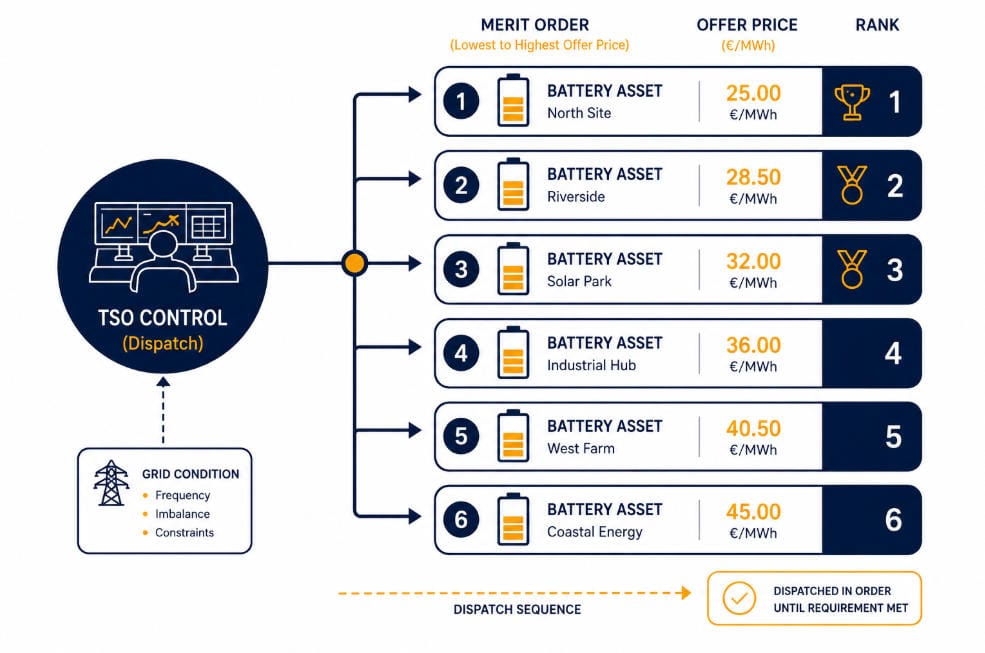
A centralized TSO controller dispatches aFRR. Local frequency measurement does not trigger it. This is a key difference from FCR, which reacts locally at each individual asset.
Because dispatch is centralized, the TSO can rank available assets by cost. Operators call this ranking a merit order. It also lets the TSO account for grid congestion when choosing which assets to call on.
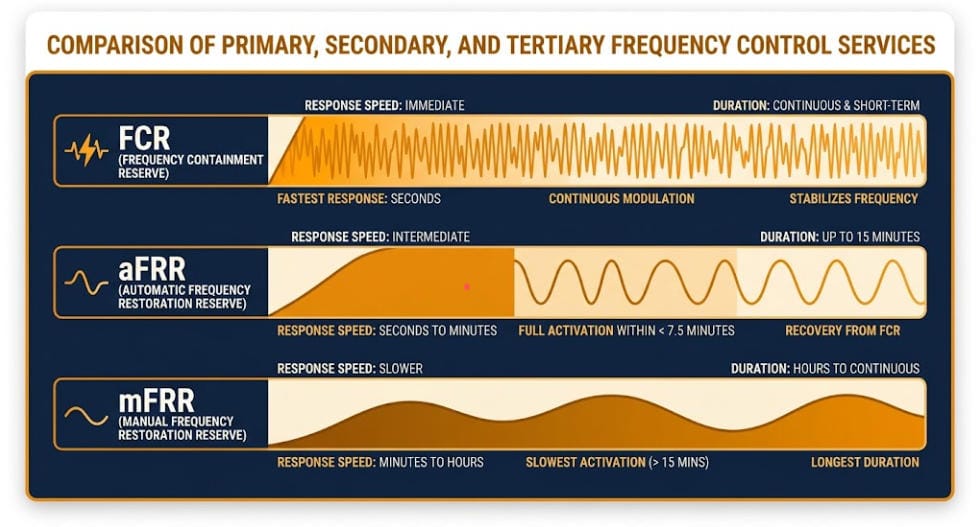
Under the harmonized European framework, aFRR assets must reach full output within about 5 minutes of an activation signal. That five-minute window is the deadline for full power, not the start of the response — the asset begins adjusting output within seconds of each signal, then ramps to full power over the five minutes that follow.
Signals typically arrive every few seconds. Instead of a single discrete instruction, setpoints are continuously adjusted in real time.
The PICASSO Platform
European TSOs coordinate aFRR through PICASSO, a shared cross-border platform. It lets balancing energy flow across country borders. This spares each grid from staying siloed inside a single control area.
More than two dozen TSOs now participate in the platform. As a result, a BESS in one country can, in effect, help balance a neighboring grid during a shortfall.
mFRR: Manual Frequency Restoration Reserve
mFRR, in contrast, requires an explicit instruction from the TSO. A human operator or an automated dispatch system tells the asset when to activate. The asset does not react entirely on its own.
Under the same harmonized framework, mFRR assets must reach full output within about 12.5 minutes. After activation, a bid must sustain that output for a minimum of 5 minutes.
mFRR steps in when aFRR alone cannot cover an imbalance. A large, sudden loss of generation, for example, can exhaust the available aFRR capacity fast.
The MARI Platform
Just as PICASSO handles aFRR, the MARI platform coordinates mFRR trading across European TSOs. It works toward the same cross-border balancing goal.
National mFRR auctions still exist alongside this shared platform in many markets today. Full integration is still an ongoing process across the continent.
Read the full MARI platform guide for how the Common Merit Order List clears bids across borders, plus bidding strategies for BESS asset managers.
Market Structure for Frequency Restoration Reserve
TSOs do not sell FRR as a single product. Both aFRR and mFRR split into separate capacity and energy markets, each with its own rules.
The capacity market pays for standing ready, whether or not the TSO calls on the asset. This market typically settles pay-as-bid. So each accepted bid earns exactly what it offered, not a shared clearing price.
The energy market, on the other hand, pays only for power actually delivered during an activation. This market typically settles pay-as-cleared. Every accepted bid then earns the same clearing price, regardless of what it originally bid.
Auction timing also differs by product. aFRR capacity auctions often close in the morning before delivery. mFRR auctions typically close slightly later the same day.
Why BESS Fit Well Into aFRR
A BESS can shift output in either direction almost instantly. This suits the merit-order, centrally dispatched nature of aFRR well.
One European TSO, for example, runs a two-phase aFRR structure: assets first reserve capacity ahead of each operational period. The TSO then dispatches them just-in-time within it, with a response time around 30 seconds after each call.
Operators can submit bids in that structure up to 25 minutes before each delivery window. They split into separate upward and downward regulation. A BESS’s ability to bid cleanly on both sides, from the same hardware, gives it a real edge. Most thermal assets cannot match that flexibility.
Because of this, BESS operators participating in Frequency Restoration Reserve markets often stack aFRR with other revenue streams. This spreads risk across several products instead of relying on just one.
Sizing a BESS for FRR Duty
An FRR asset needs enough usable capacity to sustain a full activation for the required duration. A simple instantaneous power rating is not enough on its own.
This matters more for mFRR, since its minimum delivery duration runs longer than a quick FCR burst. That means energy content, not just power rating, drives the sizing math.
State-of-charge management still applies here too, though less aggressively than under constant FCR cycling. Because activations are less frequent, the BESS has more time to recover between events.
But designers still need to plan for that recovery window, not simply assume it. A poorly sized recovery buffer can leave a BESS unable to respond to the next Frequency Restoration Reserve call.
Frequency Restoration Reserve in Practice: FCR vs. aFRR vs. mFRR
| Reserve | Trigger | Full Activation Time | Minimum Duration |
| FCR | Automatic, local | 30 seconds | 15–30 minutes |
| aFRR | Automatic, centralized | About 5 minutes | Varies by market |
| mFRR | Manual, TSO instruction | About 12.5 minutes | 5 minutes |
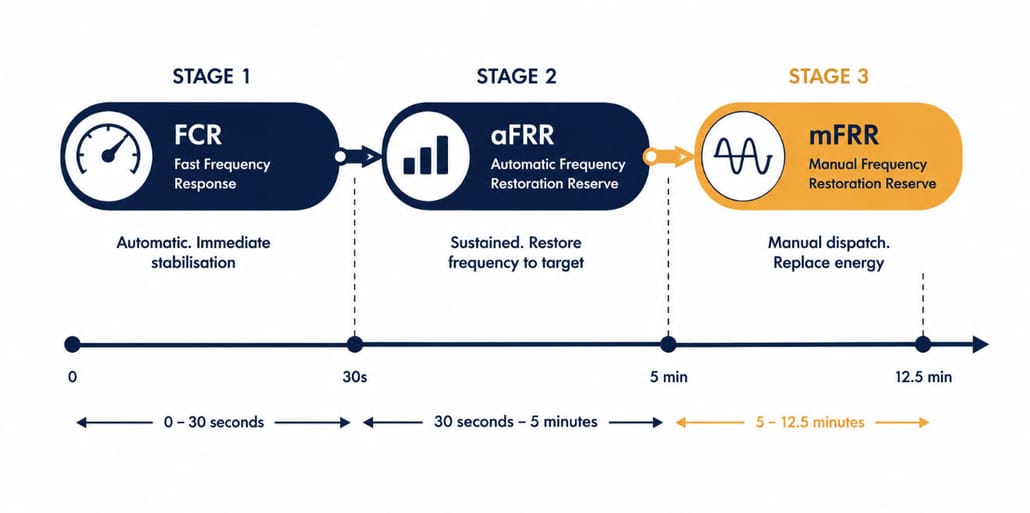
So the three products form a relay. FCR buys the first 30 seconds. Frequency Restoration Reserve then takes over in two stages. aFRR covers the next several minutes, and mFRR closes out anything that remains.
FAQ
What is the difference between aFRR and mFRR?
aFRR activates automatically through a centralized TSO signal. mFRR requires a manual instruction from the operator. aFRR also responds faster, typically within 5 minutes versus about 12.5 minutes for mFRR.
Is FRR the same as FCR?
No. FCR only contains an initial frequency deviation, within 30 seconds. Frequency Restoration Reserve, covering aFRR and mFRR, then restores frequency back to its nominal value over the following minutes.
Can the same BESS provide both FCR and FRR?
Some BESS do stack services. But sizing and controls must account for both duty cycles at once, since FCR and Frequency Restoration Reserve stress a system differently. A BESS designed only for FCR’s rapid, shallow cycling does not automatically suit FRR’s longer, sustained activations.
How is FRR paid?
Both aFRR and mFRR pay through separate capacity and energy markets. Capacity payments typically settle pay-as-bid. Energy payments typically settle pay-as-cleared.