


BESS Augmentation: The Complete Guide to Restoring Capacity Lost to Degradation
BESS augmentation is the process of adding new battery capacity to an existing energy storage system. It restores or increases capacity lost to degradation. Every BESS loses usable capacity over time. Cycling wears down the cells. Calendar aging adds to it too, even when the system sits idle. So, eventually, the project can no longer deliver the energy or power it promised. BESS augmentation exists to close that gap. It does this by restoring nameplate capacity, or by pushing past it.
| Quick Answer BESS augmentation adds new battery capacity to an existing system, later in its life, to restore or increase capacity lost to degradation. It differs from oversizing, which installs extra capacity upfront. Owners execute augmentation one of two ways: AC block addition, which adds a new self-contained power block, or DC shuffling, which reallocates and adds capacity behind the existing inverters. |
What Is BESS Augmentation?
BESS augmentation and BESS oversizing solve the same problem. However, they act at different points in a project’s life. Oversizing installs extra capacity on day one. This happens before any degradation occurs. BESS augmentation, on the other hand, adds capacity later. It happens once real-world fade has been measured. Our BESS oversizing guide covers that upfront strategy in full. It also covers the trade-off between the two paths. This guide, instead, focuses on the mid-life path. It covers what triggers augmentation, how it works, and how to plan for it.
BESS Augmentation vs. Oversizing: The Short Version
Neither strategy is strictly better. Oversizing locks in capital and tax credits early. But it carries idle capacity for years. BESS augmentation, in contrast, defers that capital. It depends on good execution years later. By then, battery prices, chemistry options, and site conditions may all have changed.
| Factor | BESS Augmentation (Mid-Life) | BESS Oversizing (Upfront) |
| Capex timing | Deferred to year 5-10 | Higher Day-1 cost |
| Section 48E ITC eligibility | Can face reduced eligibility on added capacity | Full credit on entire capacity at commissioning |
| Execution risk | Depends on future prices, chemistry, site conditions | Locked in at commissioning |
| Physical planning | Needs reserved space and headroom | Full footprint installed upfront |
| Best fit | Falling-price markets, budget-constrained projects | ITC-sensitive, stable-forecast projects |
Why Projects Need BESS Augmentation
Lithium-ion cells fade with every charge and discharge cycle. Specifically, the protective layer on the anode cracks and reforms with each cycle. This consumes active lithium. High charge rates and cold temperatures also speed up the damage. Meanwhile, calendar time adds a slower fade on top of cycling.
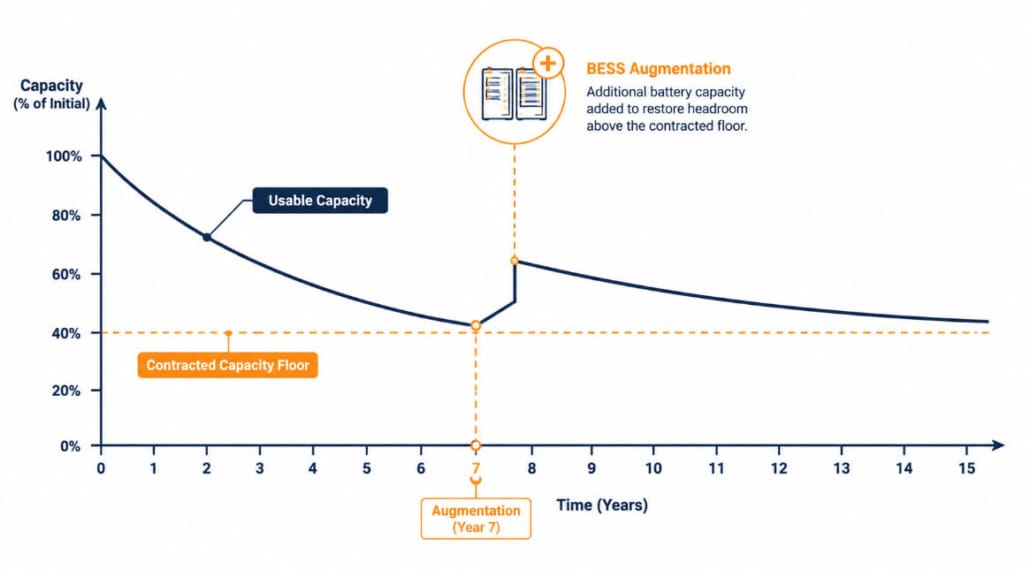
For some grid-scale LFP projects, usable-capacity fade may average around 2–3% per year, but actual degradation varies substantially with operating conditions, climate, duty cycle, and cell design. As a result, after five to seven years, many projects fall short of their contracted energy or power. That, in turn, threatens revenue directly.
Capacity Guarantees and Tolling Agreements
Most utility-scale BESS projects operate under a tolling agreement or a capacity sale agreement. These contracts are priced against a guaranteed deliverable capacity. This is not simply nameplate capacity at commissioning. So, if degradation erodes that capacity below the contracted floor, trouble follows. The owner then faces liquidated damages or lost revenue. BESS augmentation, therefore, is how owners keep that promise as the asset ages.
These agreements often run 10 to 20 years. So, the augmentation plan is not an afterthought. Instead, it gets built into the financial model at financial close. It sits alongside the degradation curve and the warranty terms.
The Two Paths to BESS Augmentation: AC and DC
There are two ways to physically carry out BESS augmentation. One works on the AC side. The other works on the DC side.
AC Block Addition
First, AC block addition installs a new, self-contained power block next to the existing system. It comes with its own inverters, and often its own transformer too. Because it does not share a DC bus with the old batteries, it avoids voltage and state-of-charge mismatches. It also works with any battery chemistry. As a result, it opens the door to pairing a newer chemistry with an aging LFP fleet.
DC Shuffling
Second, DC shuffling reorganizes existing battery modules behind the inverters already on site. It does not add capacity by itself; additional capacity requires installing new battery modules or racks. It reuses the existing power conversion equipment. This, in turn, keeps costs down. However, busbar ratings, breaker capacity, and voltage matching all place a ceiling on how much it can add.
When new and aged modules share the same DC string, however, the design becomes more complex. For the BMS and string-level considerations, see our guide to Mixed-Age String Design After BESS Augmentation.
For a detailed technical comparison of these two approaches, see our guide to AC block addition vs. DC shuffling guide walks through the full technical comparison. It includes a worked example for sizing the restore buffer. It also covers the busbar and short-circuit limits that cap DC shuffling.
What Triggers a BESS Augmentation Decision?
BESS augmentation planning typically starts at a trigger point. That point is when a site’s measured state of health nears the level needed for its contracted output. Operators track this through periodic capacity tests. In addition, battery management system state-of-health estimates support the tracking. So, neither relies on guesswork.
Typical Timing: Year Five to Year Ten
For most grid-scale LFP projects, that point arrives between year five and year ten. Cycling intensity and climate both affect the timing. For instance, hot climates and aggressive cycling schedules push the timeline sooner. On the other hand, shallow cycling, or oversizing at commissioning, pushes it further out.
Planning early matters a great deal. A reactive BESS augmentation project, ordered only after a shortfall occurs, has far less room to negotiate. Because of that, procurement timelines, chemistry options, and price all suffer.
Battery Chemistry and BESS Augmentation Planning
Battery chemistry affects how easily new capacity can be added. LFP has a relatively flat voltage curve, which can make voltage matching less restrictive than with chemistries such as NMC. However, old and new LFP modules still require careful matching of SOC, SOH, resistance, voltage limits, and BMS behavior before they are combined. This is one reason DC shuffling is more common on LFP systems.
AC block addition, however, removes chemistry matching from the equation entirely. The new block runs its own inverters. So, an operator can add a different chemistry, such as sodium-ion, next to an existing LFP fleet. No voltage curves need to line up.
Tax Credits, Costs, and Procurement for BESS Augmentation
The tax picture for BESS augmentation is less favorable than for oversizing. Under Section 48E, the tax credit applies most cleanly to capacity installed at commissioning. The tax treatment of capacity added through mid-life augmentation can differ from capacity installed at initial commissioning. Project owners should confirm current Section 48E eligibility and applicable requirements with qualified tax advisors before making the augmentation decision. It can also add compliance work. This is a core trade-off against upfront oversizing. So, model it carefully before committing to a mid-life augmentation strategy.
Procurement timelines also differ sharply between the two paths. DC shuffling makes no new grid connection. So, it can often skip a fresh interconnection study. AC block addition, in contrast, usually cannot skip that step, since it adds new grid-connected hardware. That difference alone can add months to the schedule.
Cost varies too. DC shuffling generally costs less per megawatt-hour added. This is because it reuses the existing PCS, transformer, and switchgear. AC block addition costs more. However, it buys a clean equipment boundary. It also adds the option to upgrade power conversion technology at the same time.
A Practical BESS Augmentation Planning Checklist
1. Confirm the site’s actual state-of-health trend against the contracted capacity floor.
2. Model the restore buffer in AC terms, then convert it to a DC installation size, accounting for round-trip losses.
3. Choose between AC block addition and DC shuffling based on busbar/breaker headroom, chemistry needs, and permitting timeline.
4. Reserve physical space for future modules if a DC shuffling path is likely.
5. Model the Section 48E tax credit and financing impact of adding capacity mid-life.
6. Build procurement and, if needed, interconnection lead time into the schedule early.
Key Takeaways on BESS Augmentation
1. BESS augmentation restores or increases capacity lost to degradation, later in a project’s life.
2. Most grid-scale LFP projects need to plan for it between year five and year ten.
3. Tolling agreements and capacity sale agreements make augmentation a contractual necessity, not an option.
4. AC block addition and DC shuffling are the two execution paths, with different cost, timeline, and chemistry trade-offs.
5. Augmented capacity can face reduced Section 48E tax credit eligibility compared to capacity installed at commissioning.
Frequently Asked Questions About BESS Augmentation
When Should a Project Plan for BESS Augmentation?
In short, BESS augmentation planning should begin early. It should start as soon as a site’s degradation curve first threatens a future contract obligation. It should not wait until after a shortfall occurs.
What’s the Difference Between BESS Augmentation and BESS Oversizing?
Oversizing installs extra capacity upfront, before degradation happens. BESS augmentation, by contrast, adds capacity later, once real-world fade has been measured. Oversizing generally captures a fuller tax credit. It also carries lower operational complexity. Augmentation, however, defers capital and can benefit from falling battery prices.
Does Augmented Capacity Qualify for the Section 48E Tax Credit?
Capacity installed at commissioning generally qualifies most cleanly for the Section 48E credit. Capacity added later through augmentation, however, can face reduced eligibility or added compliance work. So, this should be modeled carefully before choosing a mid-life strategy.
How Long Does a BESS Augmentation Project Take?
Timelines vary by path. DC shuffling projects typically avoid a new interconnection study. So, they can often move in weeks to a few months. AC block addition projects, on the other hand, usually require new grid-connected hardware. As a result, they more commonly take several months, due to interconnection and permitting steps.
What’s the Difference Between AC Block Addition and DC Shuffling?
AC block addition installs a new, independent power block with its own inverters. It works with any battery chemistry. DC shuffling, in contrast, reallocates and adds capacity behind the existing inverters. It costs less, but it is limited by busbar, breaker, and voltage-matching constraints.
Further Reading
- BESS Oversizing: Pros, Cons & the Right-Sizing Strategy
- AC Block Addition vs. DC Shuffling
- Mixed-Age String Design: Managing a BESS String After Augmentation Adds New Cells
- Understanding BESS Specifications
- Battery State of Health (SoH) Estimation Guide
- What Is a Tolling Agreement in BESS? — BESS.courses
- Augmentation: What Is It and Why Is It Important to BESS? — Modo Energy