
How to Choose Solar Panels and Batteries to Run a 100kWh Load 24/7: Full Guide with Examples
| ⚡ Key Takeaways • A 100kW load run continuously (24/7) consumes 2,400 kWh per day. That daily energy figure is what drives solar and battery sizing. • Solar array size must be calculated for your worst realistic Peak Sun Hour (PSH) day, not your annual average — winter and cloudy-day sizing can be 2–2.5x larger than summer sizing. • Battery capacity depends on days of autonomy, Depth of Discharge (DoD), and round-trip efficiency — budget 3,000–10,000 kWh depending on backup duration. • The PCS/inverter is frequently undersized in DIY calculations — it must handle both the continuous 100kW draw and any surge/peak load, plus simultaneous charge and discharge in hybrid topologies. • LFP (LiFePO4) cells are the standard choice for stationary systems at this scale, rated for 3,000–5,000+ cycles at 80% DoD. |
Planning solar panels and batteries to run a 100kW load around the clock? Sizing this correctly isn’t as simple as multiplying watts by hours, though.
Weather conditions, seasonal sunlight availability, cloudy-day derating, inverter sizing, and battery efficiency losses all factor in. Because of that, this guide walks through the full sizing process step by step, building toward a properly sized battery energy storage system (BESS) with formulas, worked examples, and a free interactive calculator.
📌 What You’ll Learn About Sizing for a 100kW Load
- How to calculate required solar panel capacity for a continuous load
- Why yearly weather data and Peak Sun Hours are critical to correct sizing
- How to handle cloudy days and winter months without under-building
- Battery sizing for different backup durations, DoD, and round-trip efficiency
- How to size the PCS/inverter — the step most sizing guides skip
- Battery chemistry, cycle life, and thermal management considerations at 100kW scale
- Rough cost and payback framing so you can budget before requesting quotes
- Example formulas and real-world worked values
🔧 Step 1: Understand Your 100kW Load
Let’s start with a 100kW load running 24 hours a day, every day.
- 100 kW × 24 hours = 2,400 kWh per day
- That 2,400 kWh/day figure is your daily energy demand — it’s what solar and battery capacity are sized against.
If your load isn’t perfectly flat — for example, it dips to 60kW overnight and spikes to 130kW during a production shift — use the peak figure for PCS/inverter sizing. Use the daily kWh total instead (from a load profile or utility bill) for solar and battery sizing.
Averaging a variable load into a flat 100kW figure will, in short, undersize your inverter for the actual peak.
🌍 Step 2: Analyze Your Location’s Solar Irradiance for a 100kW Load
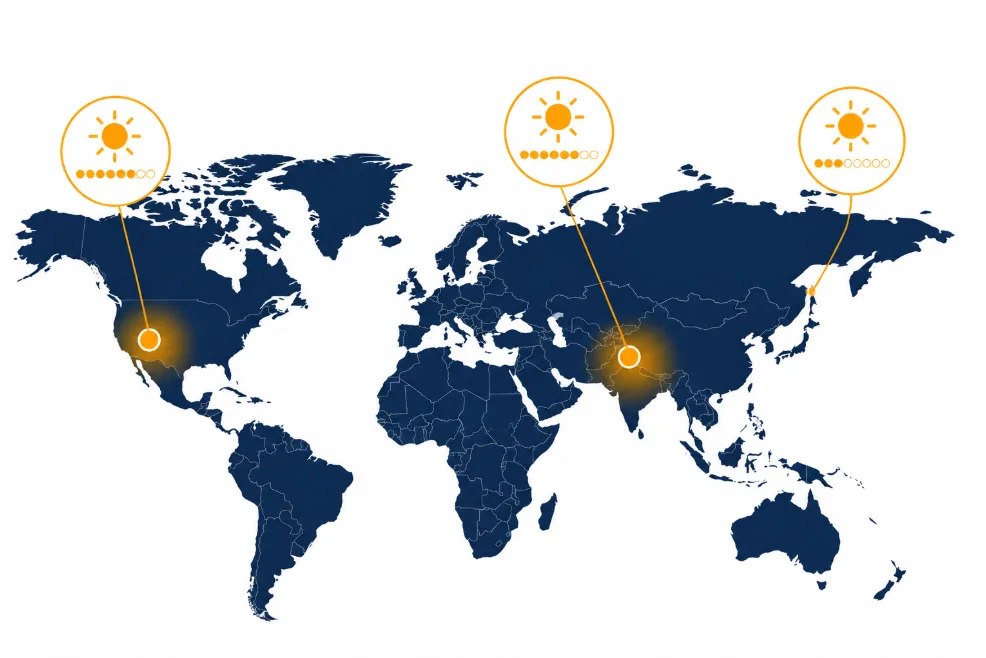
Your geographic location heavily influences how much sunlight you receive. Specifically, this is measured in Peak Sun Hours (PSH), the equivalent number of hours per day at 1,000 W/m² irradiance.
| Location | Peak Sun Hours (avg) |
|---|---|
| Phoenix, USA | 6.5 PSH |
| New Delhi, India | 5.5 PSH |
| London, UK | 2.8 PSH |
👉 You can pull PSH data for your exact site from PVWatts (operated by the National Laboratory of the Rockies, formerly NREL), the NASA POWER Data Access Viewer, or commercial tools like Solcast. For a full breakdown of PSH by region and how it interacts with panel tilt, see our dedicated guides:
Peak Sun Hours by Location Guide
Solar Panel Tilt Angle by Location: 2026 Guide
🧮 Step 3: Calculate Required Solar Panel Capacity for a 100kW Load
Formula:
Required Solar Capacity (kW) = Daily Load (kWh) ÷ (PSH × Derating Factor)
- Daily Load = 2,400 kWh
- Derating factor (system losses — wiring, temperature, soiling, inverter efficiency) = ~0.8
| Season | PSH | Required Solar Capacity |
|---|---|---|
| Summer | 6.5 | 2,400 ÷ (6.5 × 0.8) ≈ 462 kW |
| Winter | 4.0 | 2,400 ÷ (4.0 × 0.8) ≈ 750 kW |
| Cloudy Days | 2.5 | 2,400 ÷ (2.5 × 0.8) ≈ 1,200 kW |
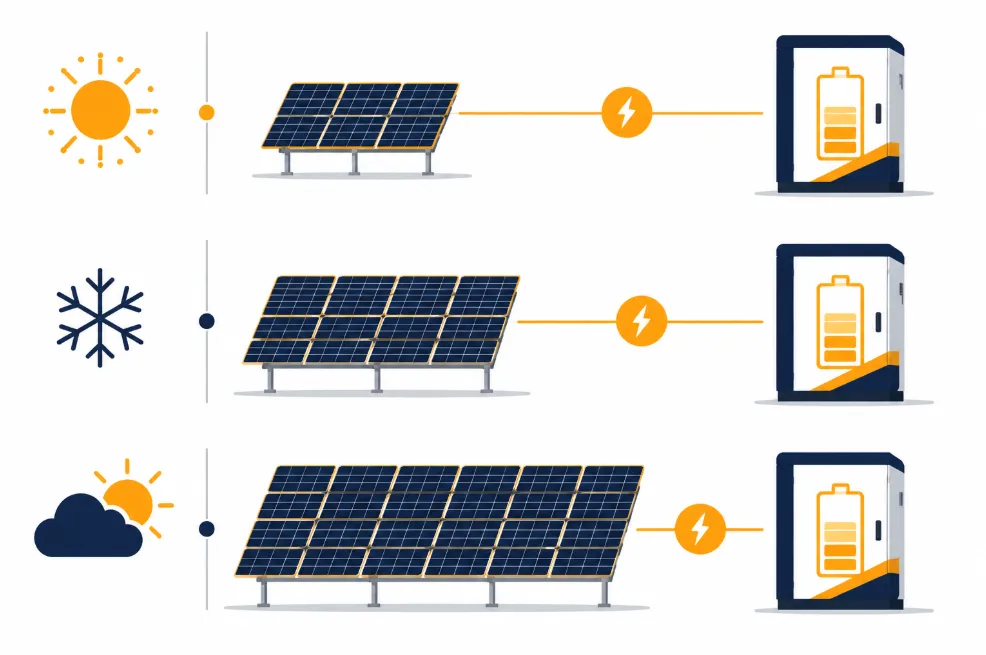
Sizing for the worst realistic case (cloudy-day PSH) rather than the annual average is, in fact, the single most common mistake in DIY sizing. In other words, it’s the difference between a system that works on a sunny July afternoon and one that keeps your load running in December.
For a full breakdown of panel-count math once you have your target kW figure, see How Many Solar Panels Do I Need?.
🌥️ Why Consider Cloudy Days When Sizing a 100kW Load?
Even in a region with high annual irradiance, you’ll still, in fact, face stretches of poor sun exposure. For mission-critical applications, therefore, your system must:
- Be oversized for worst-case scenarios, not average-case.
- Include battery backup sized for 1–3 days of autonomy.
- Use hybrid systems (generators or grid backup) where continuous uptime is non-negotiable.
❄️ Considerations for Winter Months
Winter brings three compounding effects:
- Lower sun angles, which reduce effective irradiance on fixed-tilt arrays
- Shorter daylight hours, which shrinks your PSH window
- Snow cover in northern regions, which can fully block production for days
As a result, effective PSH drops and your dependence on stored energy or supplemental power increases. That’s exactly why the winter row in the Step 3 table above requires roughly 1.6x more solar capacity than the summer row.
⚡ Step 4: Size the Battery Energy Storage System for a 100kW Load
Ultimately, your BESS needs to store enough energy to power the load during non-sunny hours or outright weather/grid failures.
Formula:
Battery Capacity (kWh) = (Daily Load × Days of Autonomy) ÷ (DoD × Efficiency)
- Daily Load = 2,400 kWh
- Depth of Discharge (DoD) = 0.8
- Round-trip Efficiency = 0.9
| Backup Duration | Required Battery Capacity |
|---|---|
| 1 Day | 2,400 ÷ (0.8 × 0.9) ≈ 3,333 kWh |
| 2 Days | 4,800 ÷ (0.8 × 0.9) ≈ 6,667 kWh |
| 3 Days | 7,200 ÷ (0.8 × 0.9) ≈ 10,000 kWh |
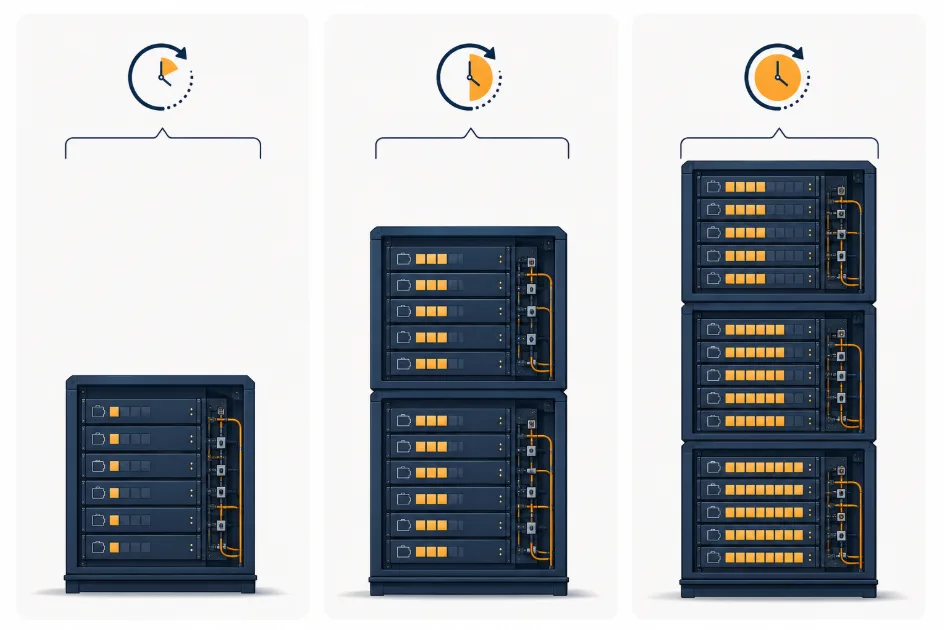
Note that these figures are usable energy requirements — rated (nameplate) capacity will need to be slightly higher once you account for BMS reserve margins and end-of-life capacity fade. For the difference between rated and usable capacity units, see Ah vs Wh Battery Capacity Explained, and for the general framework behind these backup calculations, see our Energy Storage Calculation Guide.
🔌 Step 5: Size the PCS / Inverter for Your 100kW Load (Often the Missing Step)
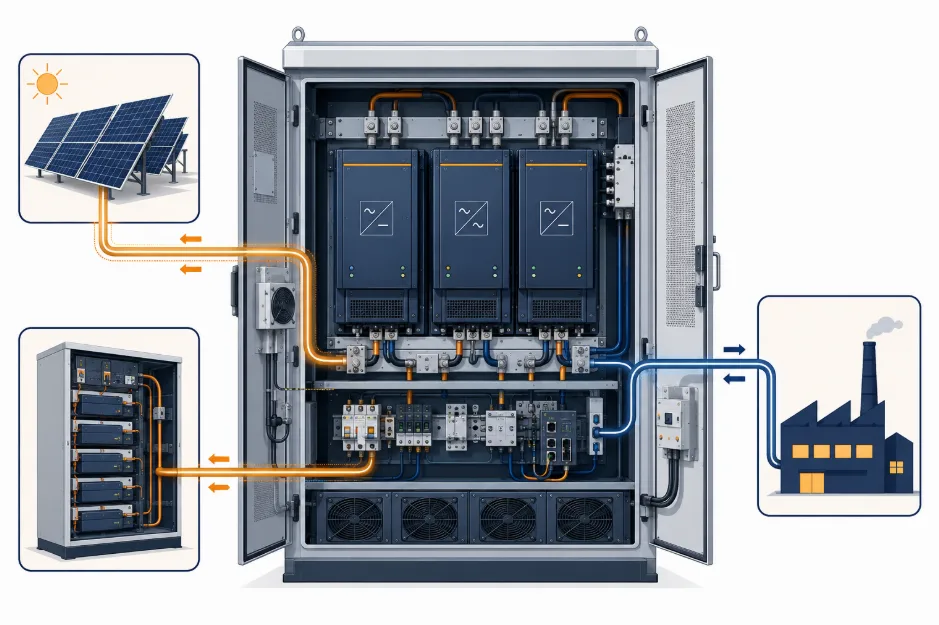
Solar array and battery capacity get most of the attention in sizing guides. However, the Power Conversion System (PCS) — the bidirectional inverter that moves power between panels, batteries, and load — is just as critical. In fact, it’s the component most DIY calculations undersize.
Specifically, your PCS needs enough continuous rating to handle the load, plus headroom for surge and simultaneous charge/discharge:
- Continuous rating: must cover your 100kW continuous draw, not the average of a variable load profile.
- Peak/surge rating: motor starts, compressor inrush, and HVAC cycling can spike 20–50% above continuous draw for a few seconds — undersized PCS units trip or clip during these events.
- Simultaneous charge + discharge: in a hybrid solar + battery + load topology, the PCS may need to charge the battery from solar while discharging to load at the same time — size for the combined throughput, not just the larger of the two.
As a starting point, a reasonable figure for a 100kW continuous load is a 125–150kW PCS, though the correct number depends on your actual peak load profile and topology. For the functional breakdown of what a PCS does and how to evaluate one, see:
Bidirectional Inverter vs PCS: Understanding the Differences, Functions & Usage
🔋 Battery Chemistry & Cycle Life for a Continuous-Duty 100kW Load
A 100kW load running 24/7 puts a battery through far more charge/discharge cycles per year than a typical backup-only installation. As a result, chemistry and cycle-life ratings matter more here than in a system that only discharges occasionally.
- LFP (LiFePO4) is the standard choice for stationary systems at this scale: Tier-1 EV-grade LFP cells are typically rated 3,000–3,500 cycles at 0.5C / 80% DoD, with 120Ah-class prismatic cells often rated 3,500–6,000 cycles.
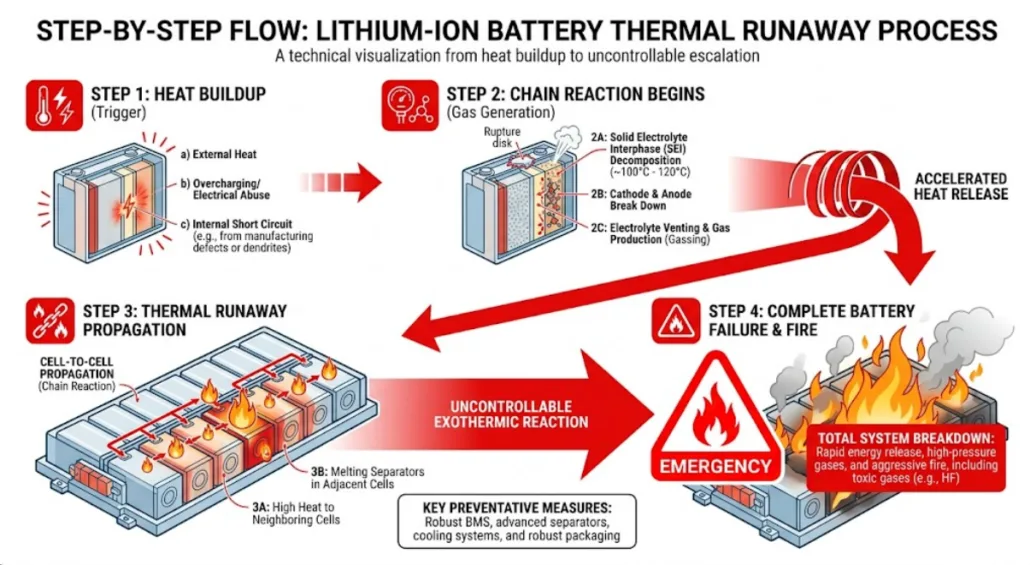
- NMC offers higher energy density but lower cycle life and reduced thermal stability — generally a weaker fit for continuous-duty stationary storage than for space-constrained mobile applications.
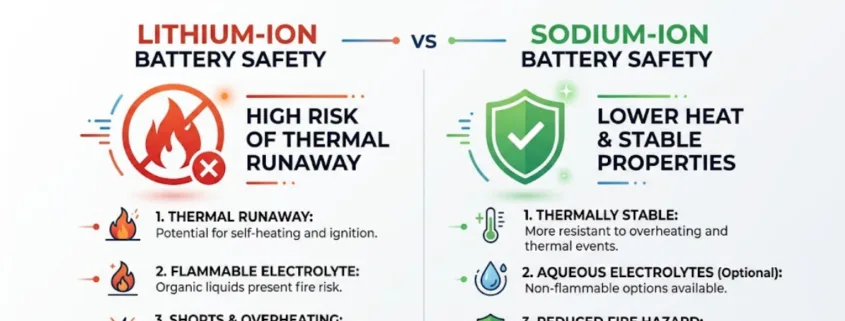
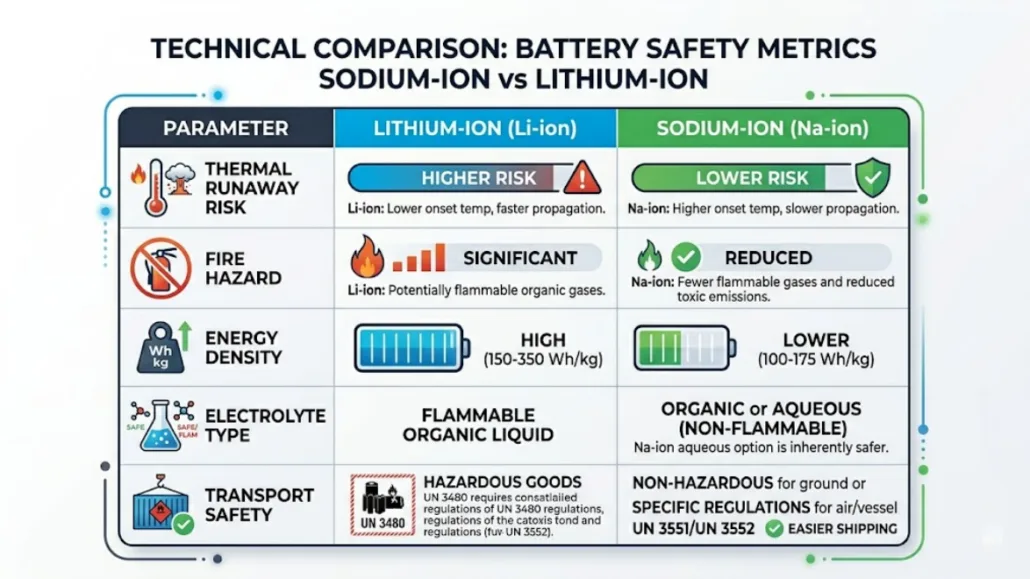
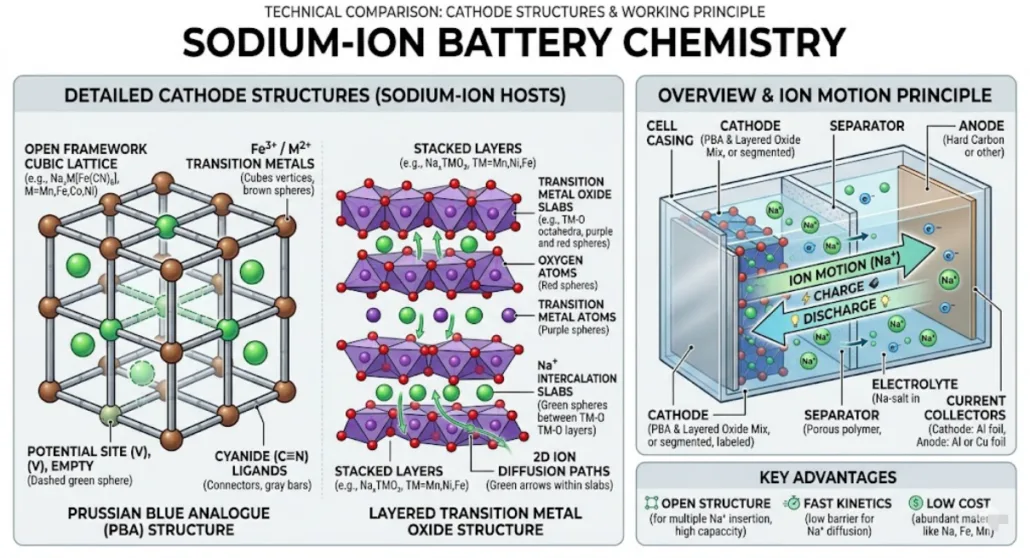
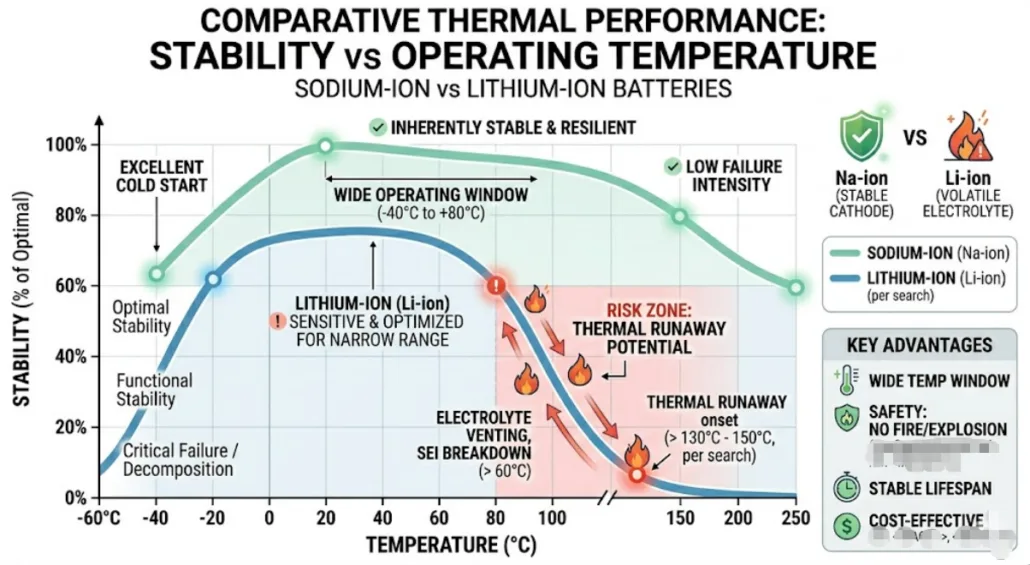
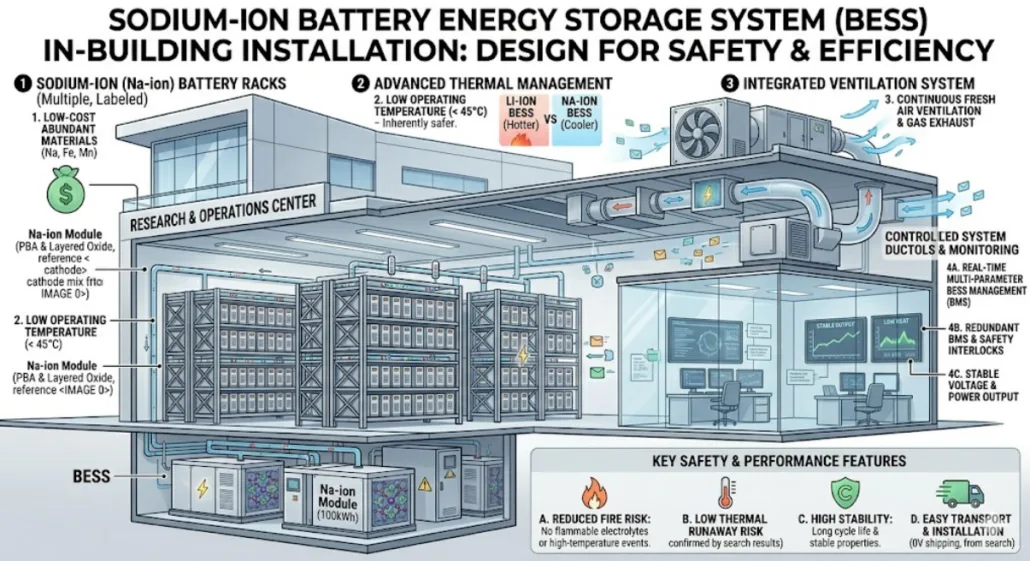
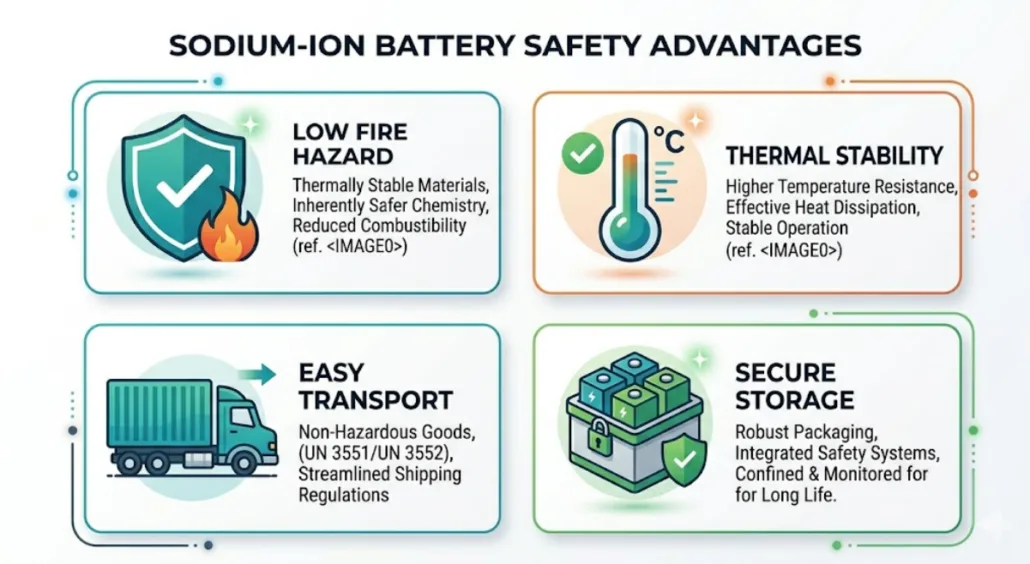
- Sodium-ion is an emerging alternative worth watching for cost-sensitive, cycle-heavy applications, though it currently trails LFP on energy density.
At 1–2 cycles per day, a 3,500-cycle-rated cell reaches end-of-life capacity (~80% of nameplate) in roughly 5–10 years. Therefore, factor this into both your battery oversizing margin and your long-term budget. For deeper comparisons:
NMC Battery vs LFP Safety: The Complete BESS Risk Breakdown
Beyond Price: How to Evaluate Cells Value by LiFePO4 Datasheet Metrics
Top 5 Battery Technologies Used in BESS: Choosing the Right Storage Solution
Is Sodium-Ion Safer? The Ultimate 2026 Guide to Battery Safety
🌡️ Thermal Management: Do You Need Liquid Cooling at This Scale?
A 3,000–10,000 kWh battery bank running near-continuous cycling generates meaningfully more heat than an occasional-backup system of the same size. Consequently, thermal management becomes a real design decision rather than an afterthought.
- Air-cooled systems are simpler and cheaper, and remain viable for lower cycle-rate, moderate-climate installations.
- Liquid-cooled systems hold tighter cell-to-cell temperature gradients, which matters directly for the cycle-life numbers above — sustained high temperatures accelerate capacity fade regardless of chemistry.
- For continuous 0.5C–1C duty cycles in hot climates, liquid cooling is generally the safer long-term choice despite the higher upfront cost.
→ Full comparison: Liquid vs Air Cooling System Use in BESS: Choosing the Right Thermal Management
✅ Tips for Choosing Solar Panels
- Use Tier-1 panels with high efficiency (≥21%)
- Consider bifacial panels if space allows
- Use anti-reflective coating for dust-heavy areas
- Install with adjustable tilt for seasonal optimization
TOPCon cells are, in fact, increasingly the default choice for higher-efficiency Tier-1 modules. For more detail, see our TOPCon Solar Cells guide on how they compare to standard PERC panels.
✅ Tips for Choosing Battery Cells for BESS
Use temperature-controlled (or liquid-cooled) enclosures for extreme climates
Choose Lithium Iron Phosphate (LFP) for safety and long cycle life at continuous-duty scale
Look for modular scalability so you can expand storage as load grows
Integrate with a proven BMS and EMS — don’t treat this as an afterthought
🔄 Hybrid Solutions for a Reliable 100kW Load
When powering a 100kW continuous load, therefore, it’s worth considering a hybrid setup:
Go fully off-grid: Solar + Wind + Battery — for redundancy in variable-weather regions
Add diesel backup: Solar + Battery + Diesel — for industrial backup where uptime is non-negotiable
Stay grid-connected: Solar + Grid + Battery — for grid-tied systems using the battery mainly for peak shaving and outage ride-through
💰 Estimating Total System Cost & Payback for a 100kW Load
Before requesting formal quotes, it helps to budget at a rough order of magnitude. Specifically, total installed cost scales with three line items: the solar array (per-watt installed cost), the battery bank (per-kWh installed cost), and the PCS/BOS/engineering package. Typically, the battery bank is the single largest line item at this scale given the 3,000–10,000 kWh range from Step 4.
- Get exact per-watt and per-kWh figures from vendor quotes — these vary significantly by region, scale, and financing structure, so we intentionally don’t publish a single blended $/kWh figure here.
- Payback period depends heavily on your alternative: offsetting diesel genset fuel and grid demand charges typically pays back faster than pure grid-tied offset in low-electricity-cost regions.
- Model your specific numbers rather than relying on rule-of-thumb payback claims.
→ For the full ROI framework and worked example: How to Calculate the ROI of Your Commercial Solar Installation
→ Scaling this same methodology to utility scale: How to Build a 100MW / 250MWh BESS with Solar Power for Grid Connection
📊 Real 100kW Load Use Case Example
Scenario:
- Location: Northern India
- PSH (winter): 4 hours
- Load: 100kW × 24 = 2,400 kWh/day
- Solar Size = 2,400 ÷ (4.0 × 0.8) = 750 kW
- Battery for 2 days = 2,400 × 2 ÷ (0.8 × 0.9) ≈ 6,667 kWh
- PCS sizing (per Step 5): 125–150 kW continuous, sized for the facility’s actual peak/surge profile
While static estimates give you a solid baseline, real-world engineering requires calculating system sizing interactively based on your specific geographical peak sun hours and target safety thresholds.
🧮 Interactive Solar & BESS Capacity Calculator
Use our professional sizing engine below to customize your numbers. Specifically, this tool automatically computes the balance between direct daytime consumption and the excess energy required to charge the battery bank for night or emergency runs.
☀️ Solar & BESS Capacity Calculator
🛠️ Sizing Definitions Explained
- Daily Total Consumption (kWh): the total energy your system expends every day.
- Required Solar Array Capacity (kWp): the nameplate rating of your panel configuration under Standard Test Conditions (STC), sized high enough to fill your BESS during operating hours.
- Required Battery Storage (BESS, kWh): the gross storage capacity needed to survive weather downturns without exceeding safe Depth of Discharge (DoD).
- PCS / Inverter Rating (kW): the continuous and surge power-handling capacity of the conversion system linking panels, batteries, and load — see Step 5 above.
📖 Recommended Sizing Resources for a 100kW Load
To fine-tune your inputs for the calculator above, explore our comprehensive technical guides:
How Many Solar Panels Do I Need? – structural panel-quantity math breakdowns.
Peak Sun Hours by Location Guide – find your exact regional PSH value.
Solar Panel Tilt Angle by Location – optimize panel orientation to capture max sunlight.
Energy Storage Calculation Guide – deep-dive on BESS backup planning parameters.
BESS PCS: Functions, Features, and Why the Power Conversion System Is the Heart of Every Energy Storage Project – size and evaluate your PCS.
100MW / 250MWh BESS & Solar Grid Connection Guide – scaling solar sizing up to utility-grade networks.
🧠 FAQs
Q: Can I go without batteries for a 100kW Load?
Only if your load is flexible or you remain connected to the grid as a backstop. Otherwise, a continuous 100kW load with no grid connection and no battery has zero ride-through the moment the sun sets or a cloud rolls in.
Q: Should I oversize the battery or the solar array?
Both, in proportion to your climate. Specifically, cloudy regions need more solar oversizing to fill the same battery bank in fewer usable hours, while regions with frequent multi-day outages need more battery autonomy regardless of solar oversizing.
Q: What’s better — LFP or NMC batteries?
LFP is generally the safer, longer-cycle-life choice for stationary storage at this scale, while NMC’s higher energy density suits space-constrained mobile applications more than fixed installations.
Q: How big a PCS/inverter do I actually need for a 100kW Load?
Size for your actual peak draw plus surge headroom, rather than the 100kW continuous average. As a starting range, 125–150kW is reasonable, though you should pull your real load profile before finalizing (see Step 5).
Q: Do I need liquid cooling for a battery bank this size?
Not always — it depends on cycling frequency and climate. Continuous 0.5C–1C duty in hot climates benefits meaningfully from liquid cooling’s tighter thermal gradients, while lower cycle-rate systems in moderate climates can often stay air-cooled.
Q: How long will the battery bank last before it needs replacing?
Tier-1 LFP cells at 0.5C/80% DoD are typically rated 3,000–6,000 cycles. At roughly one full cycle per day, that’s a working life in the 8–14-year range before capacity fades to around 80% of nameplate, so budget your replacement schedule accordingly.
Q: Is grid-tied or off-grid better for a 100kW continuous load?
Grid-tied lets you undersize solar and battery relative to a true off-grid design, since the grid covers shortfalls. Off-grid or hybrid designs, on the other hand, are necessary wherever grid reliability can’t be trusted for a continuous critical load.
📌 Conclusion
Designing a solar + battery system for a 100kW load isn’t just about matching numbers. Rather, it’s about planning for the worst realistic day of the year, not the best.
In short, location-specific solar data, battery autonomy, PCS sizing, cell chemistry, thermal management, and cost all need to be part of your sizing strategy from the start, rather than bolted on after the array is already ordered.
📚 Further Reading
What is BESS? Understanding Battery Energy Storage Systems
kWh vs kW Explained (Simple Guide to Power vs Energy)
kWp vs kWh: What’s the Difference in Solar Energy?
Ah vs Wh Battery Capacity Explained
Bidirectional Inverter vs PCS: Understanding the Differences, Functions & Usage
Liquid vs Air Cooling System Use in BESS: Choosing the Right Thermal Management
NMC Battery vs LFP Safety: The Complete BESS Risk Breakdown
Top 5 Battery Technologies Used in BESS
How to Calculate the ROI of Your Commercial Solar Installation
How to Build a 100MW / 250MWh BESS with Solar Power for Grid Connection